I’ve long been fond of the poetry of Kenneth Patchen — but even though an old edition of his Collected Poems has followed me about over the years, it was only today that I appreciated this poem of his. He wrote it sometime in the 1930s, but reading it this morning I felt he was speaking my thoughts as I look back from the ending of our year 2024.
Patchen’s poetic sensibility was essentially an exercise in Keats’ Negative Capability. Patchen admired human love and wrote reverently about nature and joy, but he was also disappointed and in opposition to a world manipulated by selfish and thoughtless power. He wrote some poems so sweet you might select them for a child’s bedroom wall, and others bitter in the taste of his analysis — but his life wasn’t a trajectory between those poles. Some of Patchen’s most politically radical and downbeat poems were written in his youth and some of the most hopeful pieces of bonhomie came from late in his life. And this was so despite never achieving crowning literary success, and after suffering chronic and painful health setbacks. He seems to have liked today’s poem, as it stuck with him. Looking briefly at its history tonight I see he had sent it out to be set for a choral musical performance in the 1940s,* and he printed a broadside of a slightly revised version in 1967, shortly before his death. So whatever specifics he was thinking of when he first set it down, the man himself thought it more universal. Here’s a link to the version of “At the New Year” I found on my bookshelf.
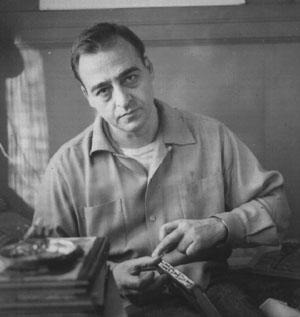
Kenneth Patchen. He wrote of his times and is timeless.
.
Today I read it as if it was expressing my own thoughts this year, about this year — not some year in the 30s, 40s, or 60s. Most any decade has wars, but the cruelty of current wars and new refugees cuts freshly. And then, my country’s last national election was heartbreaking for me. I have long held faith with Lincoln’s democratic analysis of how long how many can be fooled, but at my old age I don’t know if I will be there awaiting the arc of the universe when it bends toward justice. As Patchen moves into the second half of his poem he writes of the brave talk and the mean talk, he takes in this world as full of the good and the lovely, but also a measure of the sham and hatred. When he says as the New Year’s bells are to be rung that there are other bells that he, that I, that you and I too perhaps, would ring — well I got a little misty singing those words this afternoon.**
I had to proceed rapidly to create a realized singable version of Patchen’s poem before New Year’s Eve, and so I quickly set up a broadly repeating musical cycle for the accompaniment: VI, V, i changes in musician’s shorthand, but the VI and V sometimes go minor in the quick and dirty rush to make the cycle. Since the passage of years is cyclical and won’t wait, perhaps this accidentally makes for a fitting setting. I was lucky to get accommodation this afternoon so I could open a microphone, and I ripped through the vocal you can hear below while that musical cycle did its thing.
The audio player is below for my performance of Kenneth Patchen’s “At the New Year.” What, has the ball dropped, the bells have rung, and there’s no player gadget on your screen? No need to stop time, just use this highlighted link. That’ll open a new tab with its own audio player.
.
*I make a quick search to see if I could find this once-planned 1940s choral setting, but came up empty,
**The bells motif at the end of Patchen’s poem recalls Henry Wadsworth Longfellow’s holiday poem “I Heard the Bells on Christmas Day”that I wrote about and performed a few years back. Long after Longfellow, and some years after the death of Patchen, Leonard Cohen did his own New Year’s “Anthem” with bells that contains one of that poet’s more remembered passages: “Ring the bells that still can ring,/forget your perfect offering,/there is a crack in everything/that’s how the light gets in.” Cohen’s poem echoes Patchen’s sentiments, and Cohen’s poem and song may have been in conversation with those earlier poets’ work.
However similar if amorphous shapes, everyone’s ghosts are private spirits, and I have a new musical piece with words by Emily Dickinson testifying to that — but let me slide over to a couple of personal things first, as if I was a regular blogger externalizing their internal story.
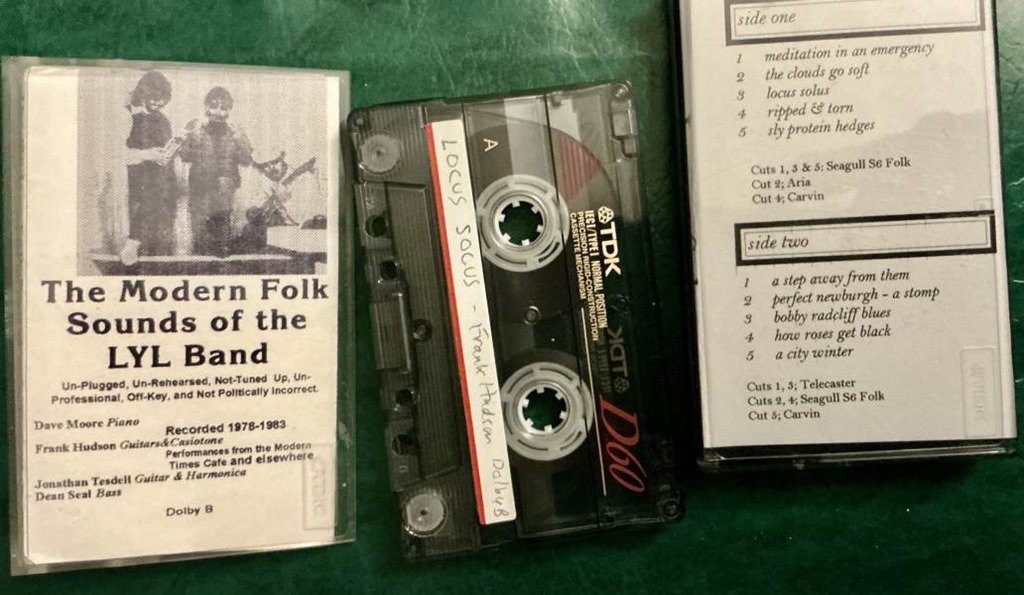
I’ve had a couple of weeks when I’ve needed to come back to the Parlando Project stuff from other things. I had a colonoscopy with unremarkable results. Huzzah. That’s some prime blogger internal dialog! But before that, I searched around my crowded little bedroom/office to find old cassette tapes. The oldest are from The Sixties when I had one of those small battery powered monaural cassette recorders with a slide-out chrome handle, a single speaker on the top, and a chorded plastic microphone with a start-stop slider button on its side. Others were from the 1970’s-2000 era when I recorded musical things, first on the stereo tape decks of the late 20th century home hi-fi era until I was able to afford one of the legendary Portastudio models designed for musicians, using the same humble cassette tapes, but able to record 4 distinct tracks. My task: to make digital copies that I can store in no appreciable physical space and are independent of an obsolete format.* More than 30 years of this stuff, much of it of only private interest, though you may hear some of it eventually.
Some of the cassette tapes.
.
The ubiquitousness of inexpensive video is fairly recent, but assuming no catastrophic events, many born in the past 15-20 years will likely have color video with sound of their childhoods and young adulthood that could follow them the rest of their lives.** Is that a good thing, something they welcome? I don’t know. Before this some folks had diaries and journals, or kept letters, so some level of self-documentation is not entirely novel. Still, for me, a person whose Project lives in music and sound, whose favored form of literature began in sound before writing was invented — retaining an element of the sound of the words, and their sequence, and echoes — my particular audio time-capsules have a special tang. And fears.
Most of the tapes are not just me, in a few I’m just the man holding the microphone, though I’m there as the shadow that chose to start the recorder. They hold our imperfections: things before we knew, before we learned — and then too the persistent faux pas that we still commit: there, and committed to a recording. Given that most can record now anytime with the tap of screen, how many will simply erase to save future embarrassment?
So back to Emily Dickinson and this poem about ourselves and what we think we fear — which may not be what we actually fear, or should fear. “One need not be a chamber — to be haunted” is a poem about that self we either can’t lose or can’t consider. In five stanzas Dickinson lays out some conventional gothic scenery (some of which she herself will erect in other poems) haunted houses, undead ghosts, church graveyards, and finally an assassin laying in wait for us.*** Dickinson points out that the self may be making or amplifying those fears, and perhaps that self, making scary movies in our imaginations, may be doing it to displace us from seeing the real fear source, our mind’s-self. “Ourself — behind Ourself — Concealed — Should startle — most” Dickinson’s poem concludes. You can read the text of Dickinson’s poem at this link. And yes, you might note I sang “alley” by mistake instead of “abbey” messing up Dickinson’s graveyard implication.
So, is that our choice? To ignore ourselves, out of fear of what we’ll find, or to disappear into a copious kingdom of solitary solipsistic self, many of us with the digital equivalent of Krapp’s Last Tape clanking and dangling from them like Marley’s ghost? Socrates decried the unexamined life. Memoir can be an honorable genre. Despite my taking the time this month with the old tapes, I think of this Scylla and Charybdis, and in the end there’s ultimately no keeping of this life and self, though sometimes there is sharing.
Today’s musical ensemble is a Rock-band of some kind: drums, bass, piano, 12-string acoustic guitar, and two electric guitars, one of which is run through enough effects to mask its guitaristic nature. No need to rewind, you can hear it with the audio player below. No player? No need to untangle that with a pencil in the reel-hole — this highlighted link will open a new tab with its own audio player.
.
*Many years ago, I was on a committee working on the technical design for a radio network’s archives (most of which were still on audio tape then) which involved long-term storage and public accessibility elements. The online “New Media” folks had their ideas about what formats to use for listeners to stream over the Internet, the audio engineers had concerns about what would give the longest life and best fidelity, and the computer IT folks had thoughts about what media would have the capacity to hold something that might climb into the then hard to imagine “terabytes” of digital storage. The three groups weren’t always in agreement, and a grizzled consultant from some outside large, already in existence, archive was brought in to meet with us. Should we use digital tape, hard drives, optical disks? What file-system format on which? What audio file format should be used on that media? Is some of this going to die from “bit rot” on the media in how many years? We had lots of questions and wanted the wizard to arbitrate our concerns. He listened for a while as we cross-talked.
Then he answered. “It doesn’t make much difference what you choose. You’re going to have to convert to other media, file-systems, and audio formats in the future, and every few years going forward. Plan for that.”
**Many of my mid-century generation have photos from their youth. I had a “baby book” that lasts into my grade-school years in black and white. A few families had movie cameras (though no one I knew did) but many of those shot silent film. The cost of film and developing that film constrained the amount of pictures and home movies made. Lots of birthday parties, weddings, holidays. Parts of life yes, but selected shorts.
***I was working on this in the wake of the news of a planned, lay-in-wait killing of an insurance company CEO, which will be followed in the American drama by the killing of a teacher and a teenage student in a school reported by a 2nd grader who called 911. The first was caught on ubiquitous digital video, and the emergency call of the second perhaps made on one of those smaller than a fat postal-letter things we call phones even when we aren’t making phone calls. More than social embarrassment may haunt our digital archives as we live going forward.
I also note that final stanza of this poem’s “revolver” is another example to go with “My life has stood — a loaded gun” of Dickinson poetry citing a firearm being held as the high card in some kind of deadly personal dispute.
Sometimes we don’t know there are heroes in our world, for adventurers don’t always move and report themselves in the most well-seen spaces. I think of Mina Loy as I write that. Early in the 20th century this London-born young woman began an odyssey that carried her from the St. John’s Wood art school, to the Munich Künstlerinnenverein, to Paris and the left-bank Montparnasse, to the Florence of Mabel Dodge Luhan’s circle, and then into the center of the Italian Futurist movement.
And she was just getting started filling up her passport leaves. Up to this point she seemed mostly working in visual art, having started as a girl as an admirer of the Pre-Raphaelites and William Morris, but by her early 20s she was writing fierce Modernist poetry. She’d met Gertrude Stein while in Italy, and like the Pre-Raphaelites, the Futurists wrote as well as painting. After leaving Italy she moved to the extraordinarily vital 19-teens Modernist scene in New York City. If one was to survey those in the Western World’s avant-garde in their artistic hot spots in 1919, Mina Loy would likely be as prominent as any woman creator — but that’s one point in time, and far-flung doesn’t mean widely-known or lastingly famous.* She was there at a lot of “theres,” a person on the scene when Modernism was being shaped, and then largely forgotten.
Loy had a complex love-life during this time, casting into alliances with several men. Involved for a time in a triangle with two Futurists principals, about which she wrote a series of poems that became her best-known/yet still under-known work, “Songs to Johannes.” A version of it was first published in the landmark NYC based Modernist magazine Others** in 1917, and subsequent editions of the poetic sequence were included in a couple of later book-bound collections of Loy’s work.
So, what’s the catch, why isn’t Loy as known as William Carlos Williams, T. S. Eliot, Carl Sandburg, Wallace Stevens, Ezra Pound, et al? Can we chalk it down to “The Patriarchy?” Yes, that’s a factor, but until recently Loy also didn’t have the footprint of Marianne Moore or Gertrude Stein — Modernist poets to whom she was compared to in her heyday.
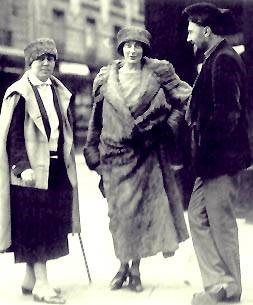
The Freewheelin’ Mina Loy standing next to Ezra Pound in Paris. The woman on the far left is Jane Heap who edited The Little Review in which Pound wrote of Loy’s Others published poems “In the verse of Marianne Moore I detect traces of emotion; in that of Mina Loy I detect no emotion whatsoever.”
.
Part of it may be a smallish corpus of work. Part of it may be due to her leaving active literary circles about 100 years ago, even though she lived until 1966. Key critic Pound thought her work however skilled was cold and without emotion.*** But more importantly, there’s this factor: her work, in particular “Songs to Johannes,” scared people. Not just the un-hip general public (which never widely considered her, unlike Stein), but other Modernists. Harriet Monroe of the influential Poetry magazine thought Loy’s work unpublishable. The “Johannes” poem sequencesubject matter and her treatment of it was problematic.
Men for ages have been prone to “kiss and tell.” Propriety might lead them to disguise the names of the paramours, even if insiders would know. Yet women arising from the prone to write about their experience might be on shakier ground. Edna St. Vincent Millay and Sara Teasdale were able to do this in the 1920s with popularity and prizes, but their poems of female desire were written within conventional romantic poetic tonality. Loy? Not so much. “Songs to Johannes” can be frankly carnal. If Modernism was to speak otherwise and often of direct treatment of the thing, of charged moments, of images depicted in all their dimensions, this wasn’t something that automatically extended to women talking about sexual relations within the fine art of poetry. Boys will be boys when they do it — and the boys become prim fuddy-duddies when a woman adventurer writes from her perspective.
So all this. Decades passed with Loy largely forgotten.
Feminism and now the 21st century has re-opened the case of Mina Loy, and now she’s considered a rising subject for academic study and consideration. What’s my consideration? I’ve always figured if someone writes a literary poem and calls it “Song…” that the poem is challenging the Parlando Project to realize that element. I chose two short poems from the sequence to fit things to my schedule and preferences; and for instrumentation, I used an acoustic guitar challenged by some keyboard ghosts. You can hear my performance of the segments of “Songs to Johannes” numbered IX and X with the audio player gadget below. What, has the audio player ghosted you? No, it’s just that some ways of viewing this post will suppress showing it. This highlighted link will open a new tab with its own audio player.
.
*I’d suppose H.D. would be in the running in such a mooted 1919 survey too.
Curiously, Mina Loy’s Wikipedia article mentions that the delightful and highly popular classic Hollywood actress Myrna Loy may have gotten her stage name from our poet/artist Loy. Wikipedia footnotes that claim with two books I haven’t read. Mina Loy did act on the NYC stage at least once, in a Provincetown Playhouse play where she co-starred with William Carlos Williams.
**As its name implies, Others saw as its purpose to publish outsider Modernist work, and in its short life it was troubled as many such publications are by shaky revenue and artistic factionalism. Long-time readers might remember that three traditionalist poets contemporary with Loy pranked Others by concocting the Spectra hoax and wheedling the magazine into a special issue dedicated to the made-up Spectra movement poets who wrote parodies that they thought might pass as real Modernist poems. One of their pseudonymic poets, Anne Knish, may have been an inside dig at Loy.
***Pound’s critical blurb where he’s pairing Loy with Marianne Moore seems a strange judgement to me, though the quote I’ve seen says he meant it as at least a mixed complement. Work like Loy’s “Songs to Johannes” seems quite charged with feelings. Reading the whole thing in one sitting — even given its Modernist fragmentation of narrative and proto-Surrealist metaphoric freedom — can exhaust one, buffeted from the range of conflicting states of emotion being depicted. You can read one version of the entire “Songs to Johannes” sequence here.
And in the woman-poet’s “you can’t win” department: in the post-Eliot world of High-Modernism some of Loy’s female contemporaries like Teasdale and Millay were down-rated for writing extensively about love, desire, and romance as subjects to be examined in their poetry, rather than the big-boy themes of culture and philosophy.
Today is the anniversary of Emily Dickinson’s birthday. Let’s open a small present.
Her poem cataloged by its first line “A face devoid of love or grace” transmits clearly on first reading. I hear it as describing a widespread human feeling: the disgust one might feel looking at a confidently self-satisfied face. So, a simple poem?
Simpler than some of Dickinson’s work, even though we should always consider that she can cloak unique thoughts in cottage-core embroidered-sampler language. The thing I think described is a bit of an odd emotion though. Why can we feel such disgust at sensing resolve and rest on the face of someone we dislike? Is it just our hate transferring to some visage a hate we’re sure we find behind the surfaces? Not if our judgements of the person behind the visage are valid — if what drives us to fury are the actions we know the expression covers.
That’s an F Major 7, mixed in with all those minor chords. That’s been a favorite chord of mine for more than 40 years.
.
This week’s news includes the overthrow of a dictator, an event that brings obligatory photos of newly mutilated portraits of the disposed tyrant, and videos of the toppling of statues — enthusiasts performing the pre-requisite of “Ozymandias.” While in my country, many see the calm, regularized-in-demeanor news-slug faces of our upcoming national administration while reading alongside them their announced motives and plans which horrify — the “sneer of cold command.” There’s a disconnect there that many feel. “He looks so righteous, while your face is so changed” as yet another writer put it. So, the self-absorbed bureaucrats of disorder and disregard look unconcerned behind their hard successful faces.
In Dickinson’s verse I note a choice: she could have described the unconcerned face that stands for someone that disgusts her in a variety of ways. The one she chose, stone-like, brings along with it that idea of heroic statuary. And there’s an unexpected double-twist from her pencil at the end: that face and its metaphoric linkage with stone. Stone is rhymed* with “thrown.” It’s like stone, and like the stone that the angered would want to throw, rock against rock. And then too, something I didn’t notice until I was singing this, a possible intended pun: thrown/throne.
Am I dissecting a bog-simple nobody-frog of this short poem here? Could be. But even if this is a short birthday gift, it’s the thought that counts.
You can hear my musical performance of Dickinson’s “A face devoid of love or grace” with the audio player below. It’ll only take 90 seconds of your time, about as much time as it takes to sing “Happy Birthday.” No audio player to be seen? It hasn’t been blown-out and removed with frosting-feet, it’s just that some ways of viewing these posts won’t display it. This highlighted link will open a new tab with its own audio player.
.
*Speaking of rhyme: I love the off-rhyme of “ease” and “acquaintances” in this poem.
So here it is, our 800th officially released audio piece from the Parlando Project. Perhaps it’s not representative: it’s not by a dead poet, and unlike almost everything else we do it may not have been written for the page without thought of it being sung. “The Fade” was written and sung by the leading alternate voice of the Project and all-around inspiration Dave Moore. Dave and I go back to when we were leaving our teenage years. I met him then when he read two pieces in a church: one was his own poem, a cheeky number that mixed eros and agape, and the other was a reading (as if it was page poetry) of Bob Dylan’s “With God on Our Side.” A decade later we started doing music together as the LYL Band, and some of what we were doing has become melded into what became the Parlando Project.
So, as I think again — is there any way to have a representative Parlando Project piece? Maybe not, and if so, by design. Variety and seeking something unexpected are founding goals.
Dave’s writing here, and our common efforts in making it the song you can hear below, strikes me as something too little done. Rock, whether it’s Rock’n’Roll, punk-rock, Alt-Rock, Indie-Rock, has tended to speak from a youthful perspective. Even the Classic-Rock acts that are still treading the boards at Dave’s or my age hew to topics that would interest those younger than they are. “The Fade” is far from those common tropes: it’s about the diminishment of aging and particularly about the fogging and loss of memory.
Early this morning I watched an old documentary, a British South Bank Show done in the mid-1980s about the Velvet Underground, a band that was more than a decade defunct at that point, but all the principals (several dead now) were alive then, only entering into middle-age in the 80s, and of a mind to answer questions about the band’s influential work. The topic most covered as they spoke about their former joint project was what made the songs the original lineup put out of lasting importance when the idea of 20-year-old Rock songs having currency seemed novel.
Chief songwriter Lou Reed had it that he wrote about the things he saw around him rather than using the regular subjects of pop songs. True enough, but he chose subjects decidedly less ordinary in song in the times when he wrote them. He specifically wrote about things that frightened people enough that they left them out of the songs they wished to listen to: drug dependency, gay and gender issues, less-vanilla sexuality, and mental variations. And then several others, including the band’s PhD, Sterling Morrison, took pains to note that Reed presented those stories without editorial comment or stance, without sentimentality.
I’ll note now, that later in his career, past the times of that now 40-year-old documentary, Reed wrote one of the few Rock albums about aging and its disabilities: Magic and Loss. It still stands pretty much alone. It’s also unlikely that even the adventurous readers and listeners that this Project has have heard it.
Dave and I recorded “The Fade” this past spring. When I talked to Dave this morning we exchanged info on folks we know, folks our age or even a bit younger, who are moving into assisted living or who are suffering from dementia. I don’t know, there are probably a few songs about how sad Alzheimer’s and the like are, probably some songs that try to mitigate it with a chorus that mixes in the memories the sufferer no longer maintains. Dave’s song isn’t like those songs — if they exist — and I’m glad I helped make his song exist, and that I get to share it with you today.
This is the sheet Dave handed me with brief scribbled chord notes on the day we recorded this. As you listen to the performance you may see that he did a masterful job of revising his typed words. I think the song gained power from the verses he left out.
.
You can hear that recording of “The Fade” with the audio player below. I think Dave gets a bit of the VU-ara John Cale sound with the keyboards in it. I’m using feedback in it too, but not quite as the Velvet’s did. What? No player visible? No, you didn’t forget it along with where your keys are or what you came into the room for, it’s just not shown in some ways of reading this blog. You can use this highlighted link as an alternative.
As December begins, I’m going to be taking some time to celebrate and elaborate the roots and concepts of this long-running Parlando Project as we reach our 800th-released audio piece milestone.
For those who are new here, let me restate again what we do: we take various words, mostly literary poetry that was never intended by its authors to be performed, and combine them with music in differing styles. Sometimes the page-words are sung, sometimes they’re spoken or chanted. Sometimes the music will patently match the text, sometimes not. The latter class are some of my favorite pieces: Emily Dickinson as blues singer or psychedelic ranger, Robert Frost with EDM, Longfellow at a beatnik coffee-house, Li Bai with western orchestral instruments, Jean Toomer or John Keats as performed by an indie-folk combo. I expect long-term listeners to scratch their heads at times, though I also fear that some will sample a piece that they don’t much care for and leave off from future listening here.
No one idea or artist inspired this all, but today’s piece is about the farthest back I can recall anything that might have inspired the Parlando Project. I think this happened when I was around age 10.
I grew up in a mid-century Iowa town of 700 folks, and it wasn’t a particularly musical place. There was a small high-school marching band, a handful of children probably had piano lessons of some kind, if only in hopes there’d be someone to play piano in the three Protestant churches in town. The two best musicians in my childhood cohort played trumpet and accordion. The former was surprised to admire Louis Armstrong despite having personally absorbed dismissive racial stereotypes, the other might aspire to Myron Floren level of showpieces on the stomach-Steinway. The same little town might have over-achieved in literature though. It was named by its 19th century town-platter “Stratford,” and its streets were named for British poets and Longfellow — main street being Shakespeare Avenue. If you grew up on a street that was merely numbered, or an avenue named for some animal or geographic feature, such things never had a chance of shaping your worldview. I grew up thinking of Milton or Shakespeare as being a local possibility.
My father sang, mostly in church. My mother thought he had a good voice (“better than Perry Como” she once said) and I recall it having a very nice timbre when I was a child, but there was no piano or other instrument in the house, and he didn’t sing a cappella that I recall. We didn’t have a TV until I was 7 or 8 (and even then it was a chancy fringe-reception, rabbit-eared, used set that would send its display to snow or tumbling whenever it felt like it). There was some kind of radio, for which I’d hurry home from school to listen to the Lone Ranger on, though I can’t recall what the radio looked like. And at least some of the time there was a phonograph. I recall it was one of those that looked a bit like a portable typewriter with a luggage-finished case that could be clasped-closed. It may have been one of my parent’s from their college years. It sat in a little side room off the kitchen at home that we called “the breakfast nook.” And with it was a small cache of records. And here it gets odd — specifically odd — but applicable to the Parlando Project.
I clearly recall four 78-rpm disks, an unexpected set for a Fifties, small, rural-town-in-Iowa record collection. Two were commercial spoken word recordings, the sort of thing that was a viable genre then.** Record one: Robert Frost reading his poetry. My recollection that the featured poem was his “Two Tramps in Mud Time,” but so far I’ve found no Frost recording of that poem to refresh my memory or share here.*** The second was Vachel Lindsay reading from his “The Congo,” which has an insistent, chanting, rhythmic flow. The fact that I can remember them would be clearly meaningful, but to be honest I have to say that I didn’t like either of them. I’m not sure what I expected from poetry that came from poets more recent than those whose names were on my streets, but Lindsay seemed overwrought to me, and even at a young age I might have been put off by the whole white-guy-doing-primitive-African vibe of his poem. And Frost? I’ve often written here that I didn’t care for him until I started to explore things musically that became this Project in the 21st century. Only then did I discover that he was a supple lyric poet — and furthermore, a much more subtle observer of humanity than I had appreciated in my youth.
The fact that I didn’t really dig these two poets didn’t keep me from playing the records. Experiencing them felt exotic then, and I liked that even if I didn’t admire what was engendering that feeling.
The third record didn’t match suit. It was a recording from the 1940s of a song called “Open the Door Richard.” I didn’t know then, but this was an unusual “Novelty Record” piece, charting in versions by as many as five different musicians within one year, 1947. All those musicians were Black, and before it was one of their recordings it apparently was a Black Vaudeville comic number that the musicians spruced up with swinging jive-cat musical settings and choruses. The musical versions all differ in detail while sharing the chorus. Some of them are largely drunk-act comedy,**** while others are more at down-on-one’s luck frustration and focus on the riffing, musical, chorus-hook. From listens today I suspect the recording I listened to back them could have been the Count Basie Orchestra version or (best guess) this one by the Three Flames. I liked that record, though I thought it a little odd, and I probably didn’t fully understand it. If these first three records have a link, that’s it, isn’t it? I enjoyed the strangeness, the difference.
Tortured Poets Department, but my childhood: disks containing a psalm of comfort, a song of misapprehension,. and two early 20th century Modernist American poets.
.
The final record was the one I listened to the most. It was not a commercial 78, but a recording, perhaps from a record-yourself booth (or offers like that) which provided the earliest Elvis Presley recordings. It was my father reading “Psalm 23,” the famous psalm of David. The voice was someone in my life, no exotic stranger, but I was totally mesmerized. If no one is more mundane than one’s own parents, this everyday, ordinary person had their voice on a record! And the text, in familiar English translation, is one of the most comforting pieces of poetry in the canon. When I’ve revisited the Psalms periodically as an adult I’m sometimes shocked at violent and authoritarian themes I find weaving in and out of Psalms’ religious rapture — but if “Psalm 23” implies frightful things, it does so to say that they pale in comparison to a connection with a godhead.
Parents sometimes comfort their children, do so by saying “it will be all right, we’re here to protect and care for you.” My parents weren’t much like that in expression however, though by action in life they were being that with much effort. This object, this record, did that, using someone else’s words translated from a Bronze-Age king, poet, and musician.
I think I asked about the “Open the Door Richard” record and the “Psalm 23” record. I can’t recall what my dad said about the Psalm recording, though I wish I did. I have a vague memory that he said the “Open the Door Richard” song was something of an in-joke between his brothers. I didn’t get, or can’t remember the full story, but one of my father’s brothers went by the name Richard (one that became a successful Protestant minister). Another brother was named David, though he never talked to Leonard Cohen about secret chords or sling trajectories.
So there you go, in summary: I had formative exposure to poetry on recordings. One case with my own father’s voice offering comfort; and another, an Afro-American tale of misapprehension. It would be years before I had any idea to do likewise, and decades before I could do something from this early experience regularly in ways that you could hear.
Longish post, but here’s a short musical piece called “Records in Childhood” using a sonnet I wrote this year casting some of that remembering my early experience with recorded words. You can hear it with the audio player below. No player? This highlighted link will open a new page with its own audio player
.
*There may have been other records, though it was not any kind of large stack. The fact of memory that these four are the ones I recall testifies to their impact.
**Besides poetry recitations, sermons, and even some secular speeches were released on disk — and spoken-word comedy records were often big general-interest sellers. In a previous post I talked about how vividly I experienced Hal Holbrook’s one-man stage show of Mark Twain Tonight on an LP record in a library in Iowa.
It’s possible that my home’s Frost recording was a separated part of a set. 78 RPM records were sometime sold in a bookbinder of page-sleeves holding multiple disks, which is the reason we still call a longer form vinyl LP, CD, or issued-together set of digital files “an album”


 Frank Hudson