For National Poetry Month this year we’ve been looking a poems that were selected in 1922 and 1923 for a pair of gendered poetry anthologies: The Girls Book of Verse and The Boys Book of Verse. Today’s poem is another reasonably well-known selection, John Masefield’s “Sea Fever.”
I’ll not have much to write about the poem itself, it speaks so straightforwardly. I will say that I always thought of it as a poem by an older poet, and an archaic one at that in that it speaks of ocean-going sailing ships. Turns out, I read this poem with misapprehensions. Reading briefly about the poem, I found it was published by a poet only in their mid-twenties, and though the long-lived Masefield’s life overlapped mine — he was still England’s Poet Laureate during my schooldays in the United States — he indeed worked on windjammers.
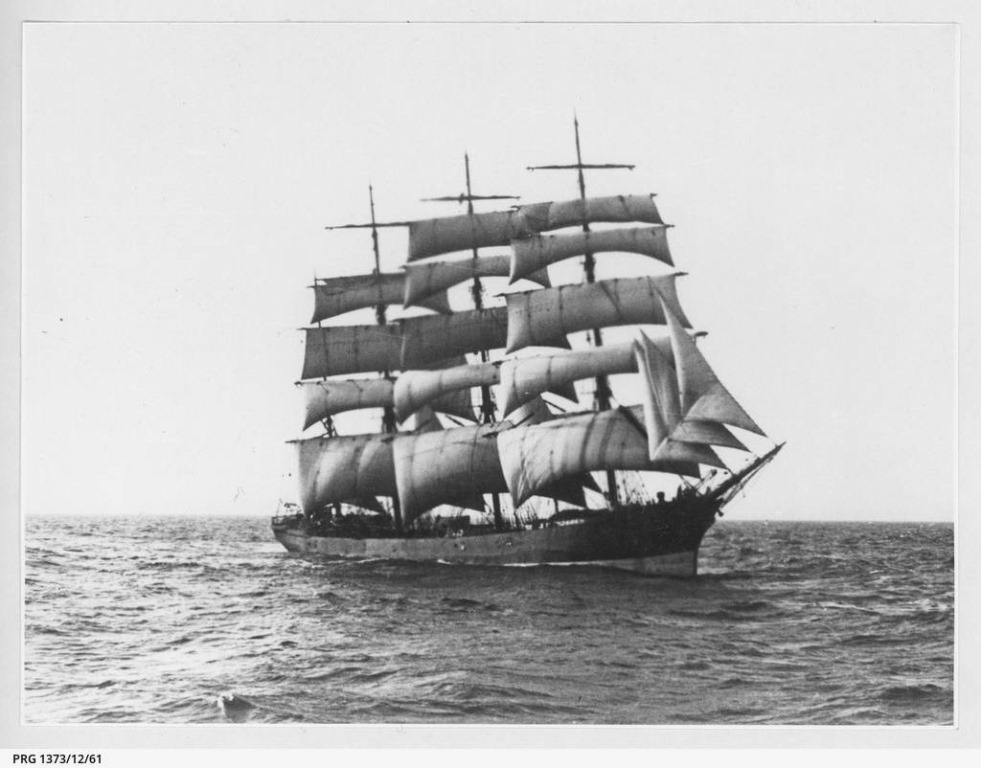
The young Masefield sailed on the cargo ship Gilcruix at the end the 1800s, and yet the ship looks like it could have been from the beginning the 1800s.
.
These two 1920’s poetry anthologies clearly wanted to encourage reading for the children that would grow to become the fabled Greatest Generation of the Great Depression, WWII, and the Cold War. Ironically, Wikipedia says Masefield was unhappy in school and shipped out to a life at sea “to break his addiction to reading, of which his aunt thought little.”
Masefield worked at sea and in America* for the next decade. The seagoing did not cure his reading addiction,** he continued to read on shipboard and eventually began to write himself.
While “Sea Fever” is more in the mode of poetic memoir than our poem last time by Emily Dickinson — it’s a nice bit of parallelism that Dickinson imagined books as a replacement for sailing far away, and Masefield imagined he could sail far away as a replacement for books!
As with our other poems from this pair of gendered anthologies this month, I’m going to ask you to guess if this was in the boys or the girls poetry anthology — answer below.
Here at the Parlando Project we take words, usually literary poetry written by various poets, and set them to original music in different styles. Not for the first time, this is a poem that already has a fairly well-known “art song” setting: one by John Ireland. Ireland made a lovely song, and not an overly elaborate one melodically for that sort of thing — but it’s beyond the limits of my vocal talent. So, the setting I created and performed with just my cruder voice and acoustic guitar is what you can hear below. I don’t know if you will be able to hear the canvas slap or the wind through the rigging in this version, but I was trying for that and a hearty song feeling in this one. There’s a graphical audio player to hear it below, but if that player is not visible, this highlighted link is your backup. It will open a new tab with its own audio player. Was this song of manly company on the high seas in the girls or boys book? It was in the girl’s volume.
.
*In between voyages, Masefield worked in a factory in Yonkers New York, something I did in my early 20s too. I may not have shared his nautical adventures, nor will I ever become the poet laureate of anyplace, but that tiny little happenstance made me feel kinship with Masefield 70 years apart.
**More of what is likely only coincidence: when Lou Reed’s protagonist in his song “Heroin” escapes into his drug addiction he likens it to a wish that he’d “Sailed the darkened seas on a great big clipper ship sailing from this land here to that.” If Reed had started his other song of that era “I must go down to Lexington 125, to the call of the running tide” we’d have an actual connection to go on.
 Frank Hudson