Did T. S. Eliot for Halloween* suffocate our audience with too much of the musty air of the classroom? I hoped those loud synth fanfares would set such terrors to run. Maybe not. Well, I’m ready to tempt you back with a bit of love and seduction, a song set away from graveyards and into castles. Our Halloween series continues, and this time with 100% wooden music I played on an acoustic guitar.
So, ladies in nightclothes flaunting impossibly flowing but still in good array hair, running through the forest under a moon over the branches kind of stuff? Maybe. First some literary history. Don’t worry, I won’t take long with that, and there’s a good creature-feature song at the end.
We started our Halloween series with Frost and Eliot, poets that many will know even if poetry isn’t an interest. Today’s piece uses words from a well-known name that when applied to a poet isn’t well-known: Belfast writer Joseph Campbell is that name. Yes, every cursèd time I mention his name here I’m required to say “No, not the Power of Myth guy.” Poet Campbell was a contemporary of Yeats. And like Yeats he visited London when F. S. Flint, T. E. Hulme, and the “What’s with the initials guys?” Yank-transplant Ezra Pound were taking up their make-it-new idea to be called Imagism. Several years before Pound and Flint published their famous essay on the tenants of Imagism, Campbell published some of the earliest Imagist poems.
Campbell’s relationship with Yeats is complex. They both were heavily into valorizing Irish culture. Campbell was even more so into Ireland throwing off its exploitative English colonial status. Both seemed to have an interest in the faerie and spirit realms, though Yeats had an interest in practicing wizardry, while Campbell, AFAIK, didn’t. Both had interest in music, but Yeats was specifically resistant to having his poems sung conventionally, while what of Campbell’s work survives (underrecognized) is as a lyricist** for songs better-known than he is.
As a song, today’s piece, “Reynardine,” became oft-performed in the British 20th century folk revival. When those performers would present it, they would introduce it as an old song — which is true in part. Its melody is largely based on an old air. The name of its main character, and something in the general trope of “I’m in love with a mysterious bad boy” did have old ballad antecedents. But those revivalist performers would usually want their audiences to know that the main character, the haunting love interest the singer knows but society doesn’t, is a shape-shifter, a were-fox.
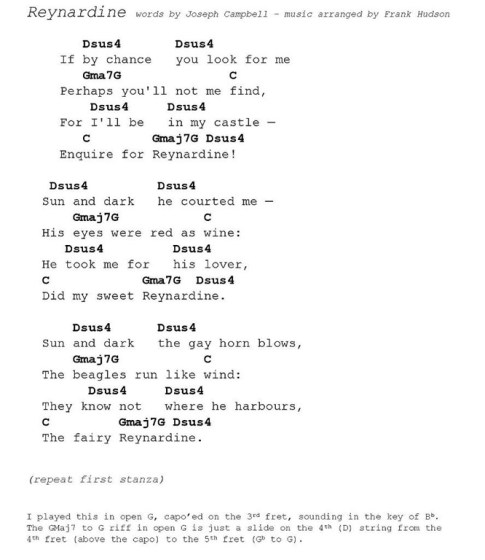
Campbell’s words as printed in “The Mountainy Singer” are better, more direct, than the lyrics usually used for performing this song. I made one change: Campbell has “took me for his leman” in his, and I translated this to “lover” for clarity.
.
As I discussed briefly when I first presented this one a couple of years ago: that doesn’t seem to be so in the extant pre-20th century versions of this song. In 1909, our “Reynardine,” now a were-fox eluding the patriarchy and foxhound driving hunters, was published in two books: as a collected Irish folk song from Belfast, and as a page poem in Campbell’s poetry collection The Mountainy Singer. This idea of the song’s dark hero emerged that recently, and I have every reason to believe it was the little remembered Joseph Campbell who cast him that way.
I did my best with my performance of this one, thinking I was emulating those folk revivalists whose work I greatly admire. The one special thing I did was use Campbell’s set of words as printed in his poetry collection. With one small alteration, I think they work well to sing to modern audiences, and his version has the compression and specific mystery that can make Imagist poems and short lyrical songs compelling when contrasted with lengthy poems and discursive sung ballads. Audio player to hear the performance below. No player? This highlighted link will open a tab with a player.
.
*Unlike the other pieces I’ll present in this series, my settings of Eliot are not listener favorites. I watch the stats here while not spending much time trying to maximize them. Eliot draws some interest outside the U.S., and very, very little from here in the States.
I also want to say that I want to celebrate Halloween this year (more about why later in this series) and I want to do it as Emily Dickinson once wrote she did in approaching some topics in her poetry “I sing, as the Boy does by the Burying Ground — because I am afraid.” But writing as Eliot did of his unreal city of corpses that can’t be hidden, and casting it as a song of fantasy, vision, or delusion, can be offensive in a time where real corpses are piling up not from natural death, but from human intention.
If I offend you, you likely aren’t reading this far. I assure you I offend myself in doing so. “You! hypocrite lecteur! — mon semblable, — mon frère!” “You! Hypocrite reader! — my fellow, — my brother!” quoted Eliot, quoting Baudelaire, quote I.
**Even as the composer part of most of the Parlando Project, I want to say that a pet peeve of mine is folks crediting a song solely to the music composer. I hear this all the time with contemporary songs, particularly when the melodist has sung the piece: Brian Wilson, Carole King, Elton John, and so on. Besides his unacknowledged work in recasting “Reynardine,” Campbell is the lyricist for “The Garten Mother’s Lullaby” and “My Lagan Love.”
 Frank Hudson