Touch lightly Nature’s sweet Guitar

This week while attending the online reading of all 1789 Emily Dickinson poems as part of the yearly Tell It Slant Festival, I have been noticing how many Dickinson poems use music as a metaphor. I know she played the piano herself, but I know little about what her personal musical aesthetic was, or if there were other musical instruments played in her home. Piano could be then, as it still was in my mid-century lifetime, a home entertainment device — provided that the family could afford the space and the cost.

For whatever reason though, Dickinson chose to use guitar in this poem, and seeing my “home” instrument in it attracted me.

In Emily’s 19th century, guitar also played such a home entertainment role. I have a somewhat worn-out, very small bodied six-string that I sometimes play, and in today’s guitar marketplace such guitars are often called “parlor guitars.” The historic usage that name honors was that with less cost in space than a keyboard instrument, a home player could entertain themselves or their housemates with a guitar. These small guitars easily suited smaller-bodied women* and many of the players in the home were women.
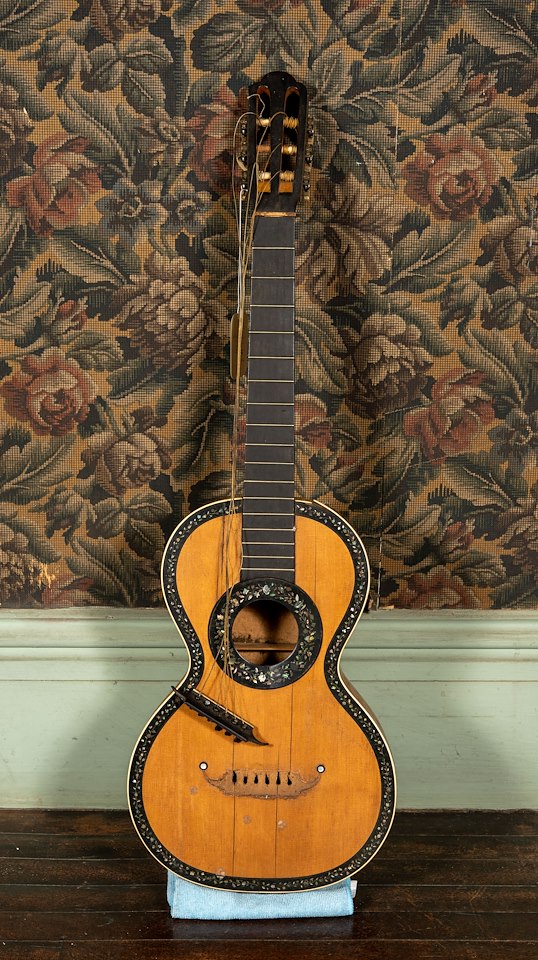
A parlor guitar from the Emily Dickinson Museum’s collection**

.

When it came to realize my music for this poem, I didn’t play my parlor guitar — I played an electric model — but as I continued to go over the words in the process of creating the audio piece I’m not sure that Dickinson had an actual guitar in mind either.

Touch lightly Nature’s sweet Guitar
Unless thou know’st the Tune
Or every Bird will point at thee
Because a Bard too soon —

The opening line, used in place of a title as we do with Dickinson’s untitled poems, has somewhat conventional words for playing a guitar: “touch” “lightly” and “sweet.” Indeed, a parlor guitar like mine responds sweetly to a lighter touch and isn’t designed for driving picking such as used in some later American guitar styles. But Dickinson is a master at choosing the unusual word, the one you or I might never come up with. Her opening line calls it “Nature’s…guitar.”

Given that she moves over to bird’s opinions by the poem’s third line, I think this guitar may be figurative. Its wood and strings might be tree branches, and the Bard too soon, a too early storm. Still, the final line might be speaking of prerequisites for musicianship or songcraft, seeming to warn that a player should be cautious until they know their “song well before I start singing” as another songwriter once stipulated.***

I left a middle section open for an additional top line when Dave and I recorded the basic tracks last week. Afterward I wasn’t sure what should go there, but I decided to score one of my simple orchestral instrument parts for this featuring a violin. You can hear the result with the audio player below. No player seen? Touch lightly this highlighted link and it will open a new tab with its own audio player.

.

*They weren’t made especially small, the petite size was normal for guitars in that time. The current standard size acoustic guitar in our era, often called a “dreadnaught” (because it was seen on arrival between the World Wars as big and formidable as a battleship) is much larger in dimensions: deeper, longer, and wider, and often with a longer-scaled neck.

Men played these small guitars too. In an earlier post I showed a picture of what purports to be Mark Twain’s own guitar, which is also that then standard parlor size, though Twain said he played it for the roughs in his California sojourn.

**The Museum has only recently been able to digitally document the artifacts in its collection. Perhaps due to the difficulties in provenance because the houses of Emily Dickinson and her brother and important friend and sister-in-law Susan Gilbert Dickinson did not pass immediately into museum curation, there is no online information as to who may have owned it, or even if it was played in Emily’s presence. I’m somewhat knowledgeable, though not a professional appraiser, and think this guitar could be a 19th century instrument. The collection’s picture of the back of the guitar shows a blacksmith-quality repair at the headstock joint. A common guitar injury, then as now, is for the neck to fracture at that place. My somewhat-informed-amateur’s opinion is that the headstock may be later than the rest of the guitar and was grafted onto it.

***A stipulation I disregarded, as the first song I learned to play was the Dylan song containing that line, “A Hard Rain’s A-Gonna Fall.”   I did not touch it lightly.

The Terror of the Blank Page

I think today’s audio piece is something many writers will relate to, but since it’s one I wrote I’ll be brief later down the page in writing about my encounter with it. The top part of this post will be a process post about music and working “live in the studio” with Dave Moore again after a long break. Feel free to skip to the bottom if this process stuff isn’t your thing.

For many years I’ve taken time every September 18th to remember guitarist and composer Jimi Hendrix. This September 18th I planned to get together with Dave Moore to do what we’ve done off-and-on for more than 40 years: attempt to make music together as The LYL Band.*   For almost all that time we’ve done this in a peculiar way.

I have a space with various guitars, basses, drum pattern software, and a couple of keyboards. Dave comes there after I’ve setup the recording equipment. I start playing something harmonically simple (often a one-chord groove) and Dave walks up to a keyboard. I start with some words (usually something from another writer) as we play off the top of our heads while the recording software rolls.

After that, Dave hands me a sheet of paper with something he wrote or wants to play. Sometimes there are chords handwritten on the sheet, sometimes not. I ask for a key center. He starts off and I try to follow and figure out a part on the spot. We finish playing to that set of words. I hand Dave a chord sheet with chords written out, something I’ve composed or want to play. I start out and Dave tries to come up with a part on keyboards.

We almost never do second takes. We rarely present the songs to each other by playing the sections through to demonstrate before recording. This alternation of I, then Dave, leading a piece continues for a couple of hours with a short break in the middle to rest our hands and voices.

A great many musicians cannot do this, wouldn’t do this, are perhaps afraid to do this. It is not an exact way to accomplish the art of music. Many skilled folk, Blues, and Jazz musicians can do this if they choose to.**  Dave and I are not at that skill level. What comes out can be inarticulate, chaotic, of no use whatsoever. We give it permission to utterly fail.

Are we just lazy or eccentric. Well, maybe the latter, but the aim is to catch moments when something happens spontaneously that has a quality of that type of creation. You know the expression “Building an airplane while it is flying?” That’s the feeling when something coheres as we feel our way into the piece. I believe the best of the pieces that come out of this process may transfer some of that feeling to a listener later on.

When I work on the Parlando Project pieces I work as a composer, usually playing or directing most of the parts myself. It’s a thoughtful process, painstaking to a degree though I try to create more pieces rather than a few most perfect and maximally impressive pieces. There’s lots of do-overs, retakes, instruments attempted and rejected. What Dave and I do when we play together uses a very different part of the brain. I love the change, each type of music-making refreshes the other.

Epimetheus Unbound Cover picture

Part of collating the useable material from a session is creating a cover image. I had no idea who Epimetheus was until I encountered this Greek titan in a Longfellow poem that you may hear more about later this fall.

.

Today’s new audio piece

Back to today’s new audio piece. It’s the first thing Dave stepped up to the keyboards to play with me this past Monday. “The Terror of the Blank Page”  is a poem I wrote more than a decade ago during what the US liked to call “The War on Terror.” I think the germ of the idea may have come from finding out that Saddam Hussein had fashioned himself as a novelist and had several books published attributed to him as an author. The finished piece isn’t really about that, it’s about how we punish ourselves if we are writers for fearing and avoiding starting new work. What if it’s not the best idea? What if it’s bad, embarrassing, revealing of our faults as artists? In the end, I think my poem and this performance makes fun of that fear as it names some imagined incarnations.

The process I talked about above, the one that Dave and I use to make music quickly is a way to get out the door before the fear arrives to arrest us. To hear our live in the studio performance of “The Terror of the Blank Page”  you can use the audio player gadget below. No gadget? This highlighted link is there for those whose way of viewing this doesn’t show the gadget — it will open a new tab with its own audio player.

.

*Various other musicians have played with Dave and I from time to time in The LYL Band. Given our peripatetic musical path, it takes a special kind of musician to enjoy playing with us. One could easily say that a model for The LYL Band is The Fugs, an intently impolite band created around a core of two poets and assorted others. Don’t go listening to The Fugs recordings around your parents, your children, your school board censors, or anyone who can’t help but mention when your singing or guitar is out of tune.

**Two accomplished musicians who have used something like this approach are Miles Davis and Bob Dylan. Dylan’s classic mid-60’s ensemble recording sessions would start off pieces live in the studio which (just maybe) a music director of a sort had prepared the musicians somewhat for. He’d try a few takes, and if it didn’t work, he just went on to something else or some other combination of musicians. A record like Highway 61 Revisited  is corralling the best attempts to make chaos cohere. Miles Davis hired exceptional musicians with extraordinary ears and knowledge of the Jazz repertoire. Even though Davis was comfortable with charts and pieces with set forms and sections, he had periods when he worked with a roomful of musicians given little direction. He made a series of records from In a Silent Way  on that were mostly assembled after these live sessions by editing and collaging the best parts of this spontaneous playing.

That approach by Davis is similar to what I do with some pieces that Dave and I originate together in spontaneous live playing. I’ll add parts and remove or edit parts to create a resulting hybrid recording that contains live and composed playing.

Like trains of cars on tracks of plush

Later this month I’m hoping to attend remote online sessions of the Tell It Slant Poetry Festival run by the Emily Dickinson Museum in Amherst, perhaps as many as I did last year. Something they do that I enjoyed was listening to all the sessions where a range of readers read all of Dickinson’s 1789 poems.

Now was I sitting in rapt, solitary devotion for every hour of that multi-day marathon? No, though I was paying some attention throughout. I restrung some guitars, reduced the clutter in my office and studio space, put away laundry, and tended to the dishes. If I gardened or cooked, I could pretend I was work-a-day Emily herself.

What makes the marathon meaningful, even if one does it only in part? The multiple voices for one thing. A group of several people read the poems in rotation each session, so there was no careful preparation from foreknowledge of which poems exactly each reader would read. A prepared reading might be powerful — having trained actors or voice artists read the whole corpus would bring something to it. This is not that, yet worthwhile.

I’ve heard a lot of folks read poetry over the years. Several of the readers struck me as better than most, even given that they might be reading the poems that came up in rotation for their turn essentially cold.*  Of course, every so often one of the readers in their turn would get one of ED’s greatest hits, and all of us: the reader, the other readers, and the attendant listeners would perk up. If one pays attention to this, that happenstance, it “dazzles gradually.”

But then too the ordinary readers, the times when someone stumbled on a word, the lesser-known poems, the small ones that might be no more than a quatrain or two — they two are part of the fullness of Emily Dickinson. She may have been a genius, but she produced these hundreds of poems among a more-or-less ordinary life, infusing them with worthwhile attention. With this many poems it’s unlikely anyone (certainly not I) can really hold all of Emily Dickinson’s work in memory. And so it is, in such a complete reading, that some poems will spark with my attention as if they were just written and never before read or heard. With the smaller poems especially, it may be not much more than a glimpse we share in real-time with Dickinson’s ability to see and think differently. Yet, those small visions add up over the hours, grander from their numbers of unique takes.

Which are the poems she drafted while baking, head full of the hymnal meter, hands dusted with flour? Which while in the garden? Which while caring for her sick mother?

Virtual attendance is planned for many of the Tell It Slant sessions that run from September 25th through October 1st. You can sign up for them at no cost at this link. No one’s taking attendance — see or not see any of the sessions as they fit into your life or level of interest. Given the uncertainties in my life, I’m not sure how many I will be able to fit in.

One game I played during the readings — where I eventually jumped into the chat window with exclamations — was whenever the poem cycle came upon a bee. Dickinson closely observes many plants and animals, but she seems to have had a particular affinity for the bee. Is it a symbol of the Puritan work ethic? A chunkier, easier to observe bug? A symbol of fertility? A flying rose with sweetness and a sting? A coworker the knowledgeable horticulturalist knows is essential to pollination?

like trains of cars on tracks of plush illustration

Billy Strayhorn and Duke Ellington aside, sometimes the muse takes the bee train,

.

Here’s one of her short bee poems, particularly extravagant in its imagination. And here’s a link to what I believe to be the authoritative text.**  That opening image alone should astound. Bees as a railroad train, with the plush flowers as directive as train-tracks —yet soft, not iron.***  “A jar” in the second line is ambiguous. A jar as in a container for the pollen it collects? Possibly, but I’m suspecting more at ajar’s meaning as apart or out of harmony. Bees as locomotives and their train of cars makes them outsized from reality’s proportions. They may move the petals on close examination, their industry is harder and heavier than the plants.

In the second stanza, the metaphor shifts. Now the bee is a knight, the flower a fortress or castle they assault. The bee-knight seems a strangely chivalrous marauder, if inconstant and ready to move off to the next bloom.

As an Imagist poem, this then can be apprehended as simply a picture, an observation of a charged moment of attention. How strange to see the tiny bee as a train or even a knight — but yes, it must travel in appointed commerce on its compelled track, and yes, like a wandering knight-errant it must move on.

But this bee could be a muse too, couldn’t it? It knows its schedule, even if we don’t. It arrives, shakes us like a passing train, assails our walls, then bids a courtly adieu and passes on to another artist, writer, musician.

You can hear my musical performance of this short Emily Dickinson poem “Like trains of cars on tracks of plush”  below with the audio player gadget you should see there. No player? This highlighted link is another way to hear it, as it will open a new tab with its own audio player.

.

*I once worked for a radio network. Watching the on-air folks, I was reminded that the ability to cold read text is a skill. It sounds easy to do — when it’s done right.

**There’s a twice as long version out there which I think is derived from the 19th century Mabel Loomis Todd and Thomas W. Higginson posthumous collections. These were straightened up for easier public assimilation and were given, by the editors, their ideas of meaningful titles. Did they append two fragments thinking them connected? My apologies for not researching this issue further.

***As striking as Dickinson’s image is here, railroads were as essential to 19th century American commerce as bees are. Towns grew and shrunk based on their routes. Another plausible reason for the train image: one of Dickinson’s father’s commercial achievements for Amherst was assuring that it’d get a railroad line.

Another Child (“To Any Reader”)

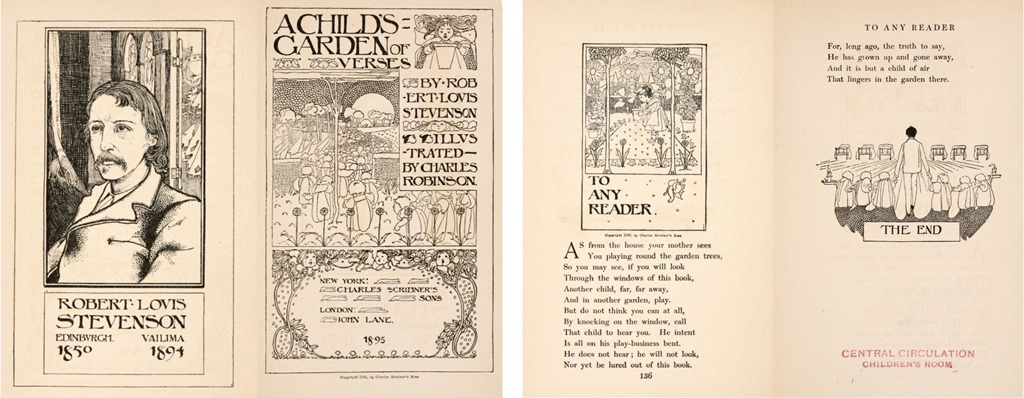
When I used a Robert Louis Stevenson poem last July I wasn’t expecting to follow it up with another. When introducing his “Bed in Summer”  then I mentioned that writing poetry for children, as Stevenson was doing in his A Childs Garden of Verses,  seemed to reduce some of the fustian of a lot of Victorian verse.

So, when I happened upon this other example from that collection I was even more struck by the sensibility of this one. Though I had no reason to believe Stevenson was intending visionary poetry, today’s piece could almost fit inside of Blake’s Songs of Innocence  — though it was written a half-a-century after Blake’s death.

another child layout

Here’s one illustrated edition of the book and the original text with Stevenson’s title “To Any Reader”

.

What was the author’s intent? I first read it as Stevenson making a pitch that even if the poems in his book might someday seem quaint and old-fashioned, they could still relate to like-experiences of some future another child. Was this canny foresight on Stevenson’s part? Stevenson was only 35 when he published this book, so his own childhood memories should not have been all that outdated as he wrote the material. On the other hand, his childhood nurse (to whom the book is dedicated) raised him on John Bunyan, stories from the Bible, and tales of 17th century Scottish Covenanters. That may have made him aware from a young age that tales from past times could be transmitted to young minds.

I do recall encountering A Child’s Garden of Verses  as a young child in the mid-20th century, though I can’t say for sure where. Did someone read it to me in my pre-literate days? Was it a book from my parents’ library, perhaps a keepsake from their childhoods? Did I run into it while exhausting my tiny Iowa town’s small library children’s section?

I would not have minded if it was old-fashioned, for I was from a young age fascinated with the past. It could have seemed juvenile unless I came upon it very early in my reading years, but most editions were illustrated, and illustrations excited the ekphrastic in this young reader. Yet my recall on this is not that specific, I just remember that I had seen it. I have more recall of reading Stevenson’s Treasure Island  and enjoying that.

Oddly, when I finally looked this week, this is not the lead-off, introductory poem in the book. Instead, it’s the final poem — not the place to make the case to continue reading “To Any Reader”  who just happened onto the book. Instead, in this place, it’s a ghostly envoi, a reminder to the child (or to the adult reading to them) that they, their childhoods, will obsolete themselves.

As I did with Claude McKay a couple of pieces ago, I decided to adapt Stevenson’s words slightly for singing. Some changes were to make it less awkward to separate things into a series of sung verses. A couple of changes just fit better to my non-agile tongue. Most significantly, I devised a repeating coda to drive home a final summary to the listener. One subtle thing I did was a covert attempt to speak to my own child’s specific journey to young adulthood.

Another Child song with chords 1080

Here’s my version. Since I want to emphasize that other child of air, I also retitled the poem.

.

An uncomplicated folk-song style setting seemed appropriate. The chords today are simple for the guitarist, though the alt-tuning I used changes the sound of this simple chord progression slightly. You can hear my performance with the graphical audio player below. If you can’t see any player, I also provide this highlighted link which will open a new tab window with its own audio player.

From “The Windy City"

This Monday, Labor Day in the U. S., is a legal holiday which arose from the idea of a day to celebrate workers. Some see this holiday as being in conflict with May 1st, International Workers Day, but I myself have no beef with having two days to celebrate work and those that do it.

Poets and poetry are not, as a rule, oversaturated with attention to labor. Creative work such as writing is, in itself, labor — but the wages are so scant for poetry that it’s hard to see it as allied with such. Currently television and movie writers are on strike, but poets have little in the way of wages and rights to negotiate. If the weekend and the 8-hour workday were obtained through labor struggle, it’s hard to imagine poets picketing for a full honorarium for the 12-line sonnet, or chapbooks for sale on every bookstore shelf that stocks James Patterson books.

What I find less forgivable is that poets don’t write about labor as much as I think is due. Poetry’s Greatest Hits will tell us about mystery, death, love, war, dreams, desire, loneliness, family, friendships, every facet of our non-commercial relationship with nature, all the panoply of pain and joy. What poetry won’t speak of much is the third or so of our lives spent making or getting a paycheck.*  And I don’t think the situation for the subject of labor is getting better. Farm work, even if romanticized into shepherd tropes or the like, supplies many of the poems in the canon that speak of work. As the percentage of Americans engaged in, or even living among others engaged in that line of work decreases, we see fewer of those poems.

Around Labor Day or May Day, I often find myself dipping into the work of Carl Sandburg. Despite his less than illustrious education, not of the Ivy League but more a Row-Crop League college with hobo semesters, and attendance in The Front Page era of journalism, rather than sessions abroad and drawing room soirees. Sandburg was by intent a thoroughgoing Modernist artist, making it new as much as any of the early 20th century Americans, but his Modernist solutions and prosody get little respect currently. Maybe they’re right, though I find Sandburg can be effective for my purposes. Judge those things as you might, he does pay attention to labor and laborers as colleagues. He can portray all kinds of struggle in doing so, but also endurance, achievement, and harbored joy.

Before I get on to the piece I found in Sandburg to celebrate Labor Day, let me suggest a rough analog of the Bechtel Test.  Let me call it the Sandburg Test. To be clear, it’s not my suggestion that every poem has to be about work, about the things we do for our daily bread. But, if we are viewing an anthology or substantial poetry collection from a poet, to pass the Sandburg Test it has to have poems that deal with work in some substantial way. How does the speaker or characters in the poem relate to work? What are they doing that work for? What is it in presenting them that portrays something about life? What are the mysteries, sensations, and systems of that work?

What Sandburg poem did I choose? I picked a selection from the 6th part of a longer, multipart poem, “The Windy City.”   This one is sort of an extended revisiting of Sandburg’s Greatest Hit “Chicago,”  sometimes remembered as a boosterish paean to the great Midwestern American city, which it’s not — “Chicago”  is a poem about a city and a workforce in struggle. “The Windy City”  on the other hand is more mystic, and the section I chose is essentially a labor hymn. Physicists tell us that the things we see about us, solid things apparently, are in fact full of moving atoms and vibrating particles, their close motion making solidity. Sandburg’s windy city is such. The labor we celebrate on Monday, and do most every other Monday, is the gusty current that makes our world.

Carl Sandburg looks out on midcentury Chicago

Looks solid enough, but it’s made of something as transitory as work. Carl Sandburg looks out on mid-century Chicago.

.

My music for today’s piece is in my punk orchestral mode: simple musical structures making use of orchestra instruments and a few interlopers. You can hear it along with Sandburg’s words with a player gadget below. No gadget? Here’s a highlighted link, that’ll open even on Labor Day to present you with an alternative audio player. Want to read more of from the poem from which I selected today’s passage? Here’s a link to that.

Thank you for reading and listening. Thank you for the work you do when you’re not doing that. Yes, you may be paid for that, well or not, but our lives and communities are made out of that work. How can that not be mystical?

.

*My diagnosis of this avoidance is that poets may still feel an expectation that they should either be full-time poets earning a living from their poems, or if not that, rich enough to not need a “day job.” Their day jobs then are not poetic, and so don’t appear in their poems. Poets with academic jobs are a considerable middle case however. I suspect administrative policies and faculty politics still don’t seem poetic. Perhaps office-based work in bureaucracies is harder to press into non-humorous verse than the village smithy or a steel-drivin’ man?