William Butler Yeats’ “Politics”

Are we through with Irish poets? No. Is there going to be less politics this time. Well, sort of.  This Project’s goals were not to provide political commentary – the Internet has plenty of that in all varieties – but I’m beginning to have some appreciation for what a hero of mine Carl Sandburg said when asked about his radical politics while already at risk because of his is-this-really-poetry free verse, he answered that politics must find its way into his poetry, in that it was part of him, surrounding him and his times.

So, here’s a poem by Irish poet William Butler Yeats about being weary of politics – yet, he couldn’t avoid it, it was part of him and part of his times too. This poem’s weariness elicits a short catalog of international political issues that he thought of while exclaiming he’s not wishing to think of them. It’s also an old man’s poem, written near the end of Yeats’ life, when he was in his seventies. I’m older than Yeats was when he wrote this, but I too can see what old men do with the weapons of political power so discordant from the Spring that still exists and says we are not here to be the last ones living, but to be as the first ones. Here’s a link to the text of Yeats’ poem, “Politics,”  and it’s an interesting link for more than just a reference to the text.

Let me delay you just a bit from listening to the song I made from Yeats’ verse to speak a little about its making. My household this year has become a haven for a small group of young people going through living as if they’re the first ones. Mostly, I try to stay out of their way, but their hustle and bustle in this house complicates the process of creating these pieces you read and listen to here. In these days, I remind myself of the musicians and composers’ prayer: “May music find a way.”

Unable to use one of my good acoustic guitars in my studio space, which I would normally record with a sensitive microphone, I decided to realize the song I had made using a guitar I keep in my home office. It’s an Ovation Applause, a battered old thing, designed as an experiment in making a cheap instrument out of materials thought unmusical.*  The body is plastic with plywood, and the neck doesn’t seem to be made from wood (other than the fretboard facing).**   Before I bought it used decades ago, my Ovation suffered from a fall or other accident as a lower edge has shattered and there’s a spiderweb of fine cracks extending from the site of that blow. For the past few years this guitar has been stuck in a rack out in the open in my home office because there’s little or nothing in it that could be damaged by the dry winter air there.

Many serious acoustic guitar players make something of a fetish around the woods and construction details of their instruments. It’s not just rosewood, it’s Brazilian rosewood. Sapele isn’t really mahogany, and don’t let them tell you otherwise. Spruce, sure, but from what forest region? Did they use old-school hide glue to assemble it and nitro lacquer to finish it?

This guitar is in opposition to all that: certainly the familiar of a heretic.

So, how’s it sound? Let’s give the witchfinder their due – not to put to fine a point on it, it sounds like crap. If you want richness of sound, this is poverty. There might be some value in its current role: a tool to compose on. That mystery neck has stayed stable all these years, it’s still easy to fret. And its sparce sound would keep one from being to enamored of a something that sounds pretty without having anything beyond its timbre to recommend it – but I’m not sure I’d go that far: it was even more inexpensive being used and damaged, I have it, it’s a hardy thing, and its small size makes it easier to play sitting in an office chair.
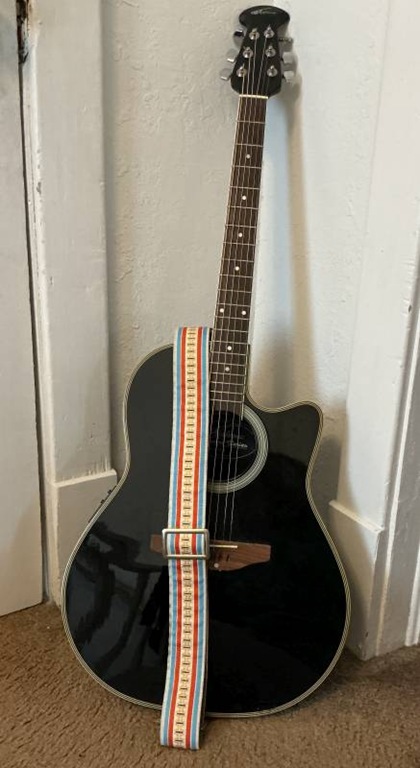
Ovation

It’s looks legitimate & peaceful sitting there, but what might it summon with its tinny horn?

.

And one night this month, I had an inconvenient time to record a realization of a fine poem by the famous Irish poet Yeats. Yeats got a Nobel literature prize. Yeats became a Senator when his country achieved independence. Yeats is so honored in Ireland, a poem of his is on their passports. Yet, I played my song version of Yeats on an old battered guitar, its cheapness designed in.

And you know, I appreciate a good sounding acoustic guitar. Those folks in thrall to the details aren’t imagining things. But then my singing voice isn’t a finely crafted instrument either, and I’m asserting I can express something of the essence of Yeats’ poem anyway. You can hear it with the audio player below. No player? Has that old wizard Yeats summoned the devil to fly from the shuttered Ovation Connecticut factory with Hartford’s Mark Twain and Wallace Stevens riding with his hoard to take that audio player from you? No, it’s likely just a matter of some ways of reading this blog choosing to not show the player gadget.  This highlighted link will open a new tab with its own audio player.


.


*The Ovation brand still exists, a shadow of itself, having been haunted through a series of owners. The plastic bowl-shaped back – though often paired with much better sounding other components than my low-end example – is still controversial. In its glory days, Ovation was well-known for pioneering under-saddle acoustic guitar pickups. They were so preeminent there, that in the last quarter of the 20th century if you were to see a popular guitarist in concert in any sort of larger venue playing acoustic guitar, you’d be more than likely to see them playing an Ovation guitar that looks remarkably like my more lowly example.

Eventually other manufacturers caught up with their own acoustic guitar pickup systems, eclipsing Ovation’s USP. Come the 21st century, the New Hartford Connecticut Ovation headquarters and factory, home to these innovations, was closed.

**At least some early Applause models used aluminum necks. I can’t say for sure what’s under the black paint of mine, but it sure isn’t wood.

I had a guinea golden

It’s known that Emily Dickinson played piano, but my scattershot scholarship doesn’t inform me if she played any other instrument, or exactly what kind of music she played or appreciated. Many of her poems use hymn or ballad meter, and I was still a young person when I first was told that you can sing many a Dickinson poem to the tune of “Amazing Grace,” “The Yellow Rose of Texas,”  or “The Theme to Gilligan’s Island.”

That factoid tells us that her metrical musical inspiration is hard to pin down, for in her 19th century a great deal of music followed that form. By our time, ballad meter is heard as presenting a certain kind of old-timey folk-music vibe — in Dickinson’s 19th century a wide variety of more or less contemporary music used it.*  Did she ever sing her poems, or perhaps noodle a tune on piano while composing poetry? I know of no accounts. Still, when I ran into this early Dickinson poem, written by her as a twenty-something before the bulk of her poems followed during her highly productive thirties, I couldn’t help but think of it as being made to be sung.

“I had a guinea golden”  is a poem about loss of friends or lovers, and it’s not hard to think it a characteristic work of someone in their twenties. Dickinson grew up in a dynamic time, in a small college town. Her school-and-college-age friends would, as they likely would today, be due to scatter to occupational and romantic opportunities during that decade of life, and the biographic data on Emily Dickinson would give us a goodly number of separations from meaningful people in her life during this time. From memory, I can think of only one who was separated by death in this part of Dickinson’s life (Benjamin Franklin Newton) — and I mention that because it may be impossible to be certain about how seriously Dickinson took this poem’s lament at losses.

My suspicion is that “I had a guinea golden”  is layered. That it catalogs more than one loss (the guinea coin, the singing robin, the bright star) and takes time to note that each of these losses are not generally the loss of wealth, bird song, or a starry firmament seems to say to me that these losses are less serious than they feel. In letters to those Dickinson longed to hear from, she often takes a stance that she feels betrayed or onerously deprived of contact from her separated friends. In the informality of friendly correspondence that reads as playful there, and so it could well be here in this poem too. As we reach the poem’s — now song’s — conclusion, I suspect this lawyer’s daughter (unlike our country’s mad king) well knows that unforgiveable treason is not actually indictable just because someone has traveled away from Amherst. But even if playful, the piece does speak to how these losses feel, and in performance I chose not to wink at the pain of the symbolic losses portrayed.

Guinea_1775

Back in 1775 this mad king was taxing and tariffing Americans out of spite, and sending government troops to “protect” American cities that wanted no part of his chaotic misrule. This was the gold guinea coin that might have paid those troops.

.

Well frankly, I was glad to be able to use the limited instrument of my voice once again to record anything. Since late June I have had some kind of flu or respiratory bug that had me greatly fatigued, coughing, and so brain-fogged I could read only superficially. I’m not sure that intentional irony has yet come back fully online, so I performed “I had a guinea golden”  as a serious lament. I’ll let Dickinson’s words and the listener provide the layered context. You can hear my performance with the audio player gadget you should see below. No player visible? “Treason!” “Exile!” “Avicide!” No, it’s just that some ways of viewing this blog suppress the player, and so I offer this highlighted link that will open a new tab with its own audio player.

.

*Poets too, including ones we know Dickinson read, used the format for literary ballads not necessarily meant to be sung.

Railroad Avenue, Langston Hughes’ Locus Solus

Returning to the poems published in the 1926 issue of Fire!!  magazine which proclaimed it was “Devoted to Younger Negro Artists,” we get this simple seeming, yet mysterious poem by one of Fire’s  most famous contributors and organizers: the then 25-year-old Langston Hughes.

“Railroad Avenue”  looks like a simple free-verse street-scene vignette. Here’s a link to the text of the poem if you’d like to follow along.  Yet the more I looked to understand it, the deeper the mystery of it became.

Here are a few things that seem quite clear: it’s evening. There’s a street, likely named by the poem’s title. A few things are seen or heard: lights in two businesses, a boxcar, a record player, a player piano, a boy and a girl, laughter. Largely unremarkable things, so there’s some specific character given to them.

The record player is a Victrola, a short-lived brand from the early 20th century — for example, the ones with the big conical horn as in the original RCA Victor logo. The businesses are a pool hall and a restaurant serving fish. The boy is at leisure, comfortable. The girl has a dark face that is powdered.*  In what may be internal monologue the poem’s narrator gives us the winning number in the day’s policy game.**

So, are we clearly visualizing the place being described? At first I thought I could. I figured without evidence that this was a crowded urban nightlife street, the two other people only examples of many, the sounds and things part of what could have been a larger catalog. Is that reading possible? Two things mentioned that are likely heard not seen: the player piano (reasonably loud) and the Victrola, which would not be. Victrolas were not electric record players. The records turned via clockwork, the sound was produced acoustically from the grooves in the records. So, it’s not blaring out a window over robust street sounds. If the statement on the winning daily number 942 is audible rather than the interior thoughts of our narrator, it too would likely be at a conversational level (given no indication that the speaker/thinker won).

And then there’s that boxcar. Mentioned twice, Hughes really wants us to see that there’s this boxcar there, yet says nothing about it other than also saying twice that it’s forgotten.  What’s that mean? A boxcar is a freight train car. This is not an urban light rail or passenger train line being invoked. Who forgets a boxcar? Is it just one piece of rolling stock left off somewhere as a spare or scrap? While the poem doesn’t say this, I began seeing it as part of a train on a grade-level street crossing, with the boxcar’s location blocking the road, a location so that it has to be mentioned, can’t be ignored. Did Hughes see this clearly in his mind and forgot to make it plain in his poem, or am I imagining things?

This vision invoked in me of a small town to small city location where the freight train line runs on grade-level, not on bridges over the roads or in tunnels under them, let me begin to see this as a much sleepier street. This isn’t the busy streetlight and neon Harlem of Hughes’ Harlem Renaissance. The dusk is “dark,” the street quiet enough to hear things distinctly as the evening begins. As the poem reaches a crescendo portion, it’s laughter we hear. It’s “sudden,” indicating that it startles the relative quiet and is not muffled by it. Hughes metaphorically amplifies that laughter with repetition — stating that this laughter with its transport from the ordinary and unenergetic street is able to shake the shop lights and move billiard balls.

This is a poem published by a 25-year-old, but I get a sense this may well be a memory of an even more youthful time with daylight ending, with sounds and a scattered glow from remembered lit windows. Dusk is a marking time for many young people, between the era when it says “time to go home” spanning to the age of “time to first go out and explore your nighttime world of romance and adult recreation.” I wondered, would the poem have more context if I knew where the poem’s titular Railroad Avenue is? America has lots of Railroad Avenues and streets, so the name alone tells us little, other than this isn’t a boxcar dropped off miles from a rail line.

Broadway AKA Langston Hughes St and Railroad Ave in Joplin MO

A Google Streetview showing the intersection of a main Joplin MO street now renamed for Langston Hughes with Railroad Ave. Google’s camera vehicles didn’t drive & record down the gravel path that is Railroad Avenue right beside the train tracks.

.

I spent half a day trying to figure out where such a street might be in the places the young Hughes was known to have lived. I’ll summarize the candidates as briefly as I can. He was born in Joplin Missouri, and there’s a very good Railroad Avenue there, with everything you might want for this less-populated scene — though the Afro-American population at the time Hughes’ family lived there was low. But Hughes and his parents left Joplin when Hughes was around 1-2 years old, and there’s nothing I could find saying anyone went back. And was Joplin even big enough and ethnic enough for a numbers game? Hughes spent his grade-school years in Lawrence Kansas being raised by his grandmother. Yes, there were some Black neighborhoods,*** but no likely Railroad Avenue. He spent time at Howard University in Washington D. C. There’s a Railroad Avenue in that city, but it’s far from Howard, and seems to be (and likely was) a non-descript industrial area. Afro-American Howard students might spend evenings on U street circa 1920, but like Harlem in that era, it’d be lit and busy, and no likely boxcars there.  Hughes attended Lincoln University in Pennsylvania, and once more I thought I might have a chance. Not as urban circa 1920 — but then no Railroad Avenue, not even a railroad line for more than 15 miles that I could find. And even if he’s a famous figure from the Harlem Renaissance, Hughes’ Harlem is as unlikely for a sleepy dark dusk with a grade-level railroad line as Washington D. C.

Is Railroad Avenue just something Hughes made up? Is it someone else’s story, something he absorbed from a friend, or his mother or grandmother? Did he go back and visit his birthplace Joplin before 1926 and observe a relaxed scene somewhere on that gravel-surface Railroad Avenue? I’ll probably never know.

But what’s up with that boxcar? Why is it so important, and so specifically forgotten? As a short, Modernist free verse poem, we can think: “So much depends/upon/the boxcar/serenaded by a/Victrola/beside a purple/powdered girl.” One theory: the boxcar is a plausible hobo-ride escape out of the town, but our narrator either doesn’t want to leave, or doesn’t know if the train-car is soon going his way. Within a year Hughes published another poem “Homesick Blues”  written more in Southern Black dialect about someone looking to hobo back south.****  Another theory? If, as I imagined without direct evidence, the train has stopped and the boxcar is blocking the road, it’s a symbol of systematic blockage of the people in the scene. Whoever owns/controls the boxcar doesn’t even need to care about this (it’s “forgotten”) — and meanwhile the laughter of the folks in the scene mitigates their lives as they deal with this unfair, indifferent, hindrance.

I’ll conclude by admitting I composed the music and performed Langston Hughes’ “Railroad Avenue”  without knowing exactly what the poem was about. I did have my supposed internal vision while doing so: it’s a small non-urban place, like some in Hughes’ youth. A boy or young man is watching the grownups, thinking without even thinking much, about where he might go, what he might do as he grows up. He knows somehow this, and he, will go away — but this evening he’s there. That personal, practical, vision of mine is, as Hughes has it, “Neither truth nor lie.”

You can hear my performance with the player below, or lacking that, with this highlighted link.

.

*This line is the only one that specifically calls out the racial caste situation in the poem. Powders to lighten the skin tone of darker skinned Afro-Americans were a common cosmetic in Hughes’ time.

**Number or Policy lottery games were present in cities by the time of this poem. The illegal gambling game was usually a daily low-cost bet, winners determined by some coincidental trio of numbers that could be found published daily in newspapers. While associated with Afro-Americans, it was played by other ethnicities too. I don’t know much about its plausible presence in smaller cities and towns before 1926, though Wikipedia says such games go back to Civil War times.

***During the mid-19th century violence of the “Bloody Kansas” struggle to decide if Kansas would be admitted to the union as a slave or free state the pro-slavery forces sacked and destroyed Lawrence more than once. John Brown became a leader of guerilla anti-slavery forces in Kansas, and Hughes’ grandmother, who largely raised him, had a first husband who was killed with Brown at Harper’s Ferry.

****Example that Hughes was comfortable writing either as a collective noun or in the voices of personas.

Surely You Could Do Better Than This

And now for something completely diff…Oh, Monty Python references may be lost on a good portion of the modern audience—and then today November 22nd is one of those dates that some folks remember, and some don’t. Someone older than Dave, George Bernard Shaw, once said “We learn from history that we learn nothing from history.” Kurt Vonnegut said “History is merely a list of surprises. It can only prepare us to be surprised yet again.” And Ambrose Bierce who for all we know is still wandering around a Mexican border wall with a Sawzall and a book of poems by Du Fu, defined history as “An account false, of events mostly unimportant, which are brought about by rulers mostly knaves, and soldiers mostly fools.”

So how much should we care for all that? Well, as I often say here, my opinion is less important than yours. Today’s audio piece, written and sung by Dave Moore, says something like that too.

Note that in each case today I’m giving the opinions of humorists, the class of thinkers and writers who expect that whatever you attempt you’re going to fail at it a little or a lot. Maybe that’s the lesson of history: that every advance for humankind has been across a field of failure.

Pieter_Bruegel_the_Elder_(1568)_The_Blind_Leading_the_Blind 1080

This gives me a chance to include another Bruegel painting. And it’s a good thing it’s a painting, because sightless people cannot be offended by seeing it.


Use the player below to hear Dave backed by the LYL Band sing his song to those that will dance upon our graves. For those who’ve come here expecting poetry: as my son predicts, it’s likely we’ll be back soon with more of that dead poets society stuff.


It Is Not Always May

I cannot start any presentation of a Longfellow poem here without noting his extraordinary fall from esteem and fame. Once, through a combination of the historical moment in the growth of the United States, his talents, and a desire to write earnestly meaningful poems, Longfellow seemed our national poet. Did it seem, when that was so, that this would be for all time—or at least for an age longer than a decade or two short of a century?

Any reading across this project’s nearly three years will show that I find worth in the less-well-known, the overlooked. But nothing that is honestly popular can be unworthy of examination—after all, even manifold problems and failures of art in that which drew a large audience tell us something about that audience, our fellow human beings. Which case now, overlooked or popular, is Longfellow?

Choice Thoughts from Longfellow

Imagine a current poet whose rep could generate a board game where one wins quotes from their poems (image from Maine Historical Society collection)


If Whitman, Dickinson and Frost—or their unseen ghosts in our zeitgeist—still motivate our inner singing muses, can we understand that trio—our current national poets—as reactions to Longfellow, making him still a prime-mover of some interest?

So, let’s listen to “It Is Not Always May”  today. Rhymed metrical English language lyric is not easy to do, and harder to do if you want it to sound easy, and this one is pretty good. Yes there’s a bit of “poetic diction” here, words and word-order that we’d never say in actual speech, and I suspect that would be true even in 1842 when this poem was published, but it doesn’t greatly harm the poem.

The imagery is largely conventional, though as a seasonal poem we may expect some of these ready-mades to be checked off: birds, bird-song, budding trees, the young, the frolic. Can one do a winter poem without snow and stasis, an autumn poem without colored falling leaves, and so on? Yes, this is possible, and originality can be a great strength—but there’s a certain resonance with the choir of poets to sing those ancient notes in one’s own song. Conventional and outdated it may be, but I rather liked the clouds as sailing vessels in a river-fed harbor awaiting a west wind to up-anchor from New England for the “Old World.” And the poem’s refrain: “There are no birds in last year’s nest,” which Longfellow identifies as a Spanish proverb, has its vividness too.

Oh in my soul, I think the Imagists were right, that too many poems use conventional images as mere counters, pro-forma symbols, not real vivid objects we can consider as existing outside the poetic line. But I could just see Longfellow and the sea-side clouds as an actual charged moment.

And how about this poem’s sentiment? Well many acceptable modern poems have opinions, outlooks, sentiments, and so the charge against Longfellow isn’t really that, rather it’s sentimentality, the idea that he has no original outlook, no fresh take. What would his readers in the days of his fame have thought? A feature, not a bug? Longfellow was the premier “Fireside Poet,” suitable for reading to the family, suitable for school-books and children’s illustrated early readers. Did they view this poem as a basic truth to be reminded of, or did they view this as sufficient in itself? I assume some thought each.

Yes, I want more than that from poetry. Reassurance and singular conventional answers aren’t even what children want and need exclusively. But this poem is balanced in a way that I can admire. It’s a carpe diem poem without a smarmy pickup line, a song of the life-death cycle that plays the undertones, a poem that asks subtly for youth to be irresponsible, or responsible to their youth not earned wisdom (“to some good angel leave the rest”).

Do we need a new Longfellow today? I’m not sure. I would be pleased if more people appreciated poetry more widely, and as I’ve argued elsewhere here, that “not great poetry” does no harm, and might even do some good for more unusual or challenging poetry. I think I forgot to say clearly enough in my recent series on “Are Song Lyrics Poetry” that to a large degree we’ve asked song-lyrics to fill this role of poetry in my lifetime. But I do believe we needed a Longfellow at least once to establish the ground on which our foundational modern poets erected their structures.

So, it’s fitting that I chose to sing this May poem of Longfellow’s, even given the limitations of my singing voice. Once more I was drawn to using the less and more than realistic Mellotron flute and cello sounds to signify a pastoral scene. Even with my limitations, “It Is Not Always May”  sings well and easily, and I urge you to hear it with the player below. The poem’s text is available here if you’d like to read along.


The Young Intellectual

I spend an invisible part of the iceberg in this project looking around for material that I think might work combined with music. One thing invariably happens when you look broadly at something: you find connections that you didn’t expect you’d find.

Here’s something I’ve noticed this fall: around 1875 or so, in a small, little-thought-of area of the U.S., a bunch of people were born who went on to leave a mark on our nation’s culture, even if only one of them retains any fame now in the 21st Century (and even that exception is undervalued in my estimation).

Geographically the area I speak of is the region where the Mississippi and Rock rivers meet in the Midwest, which had transitioned from what had been an important point for the Native-American tribes at the beginning of the 19th century and before, to an area that supported settler towns which grew up around river-based commerce and industry. “Transitioned” of course is a passive word for a slow-motion invasion and conquest by the European Immigrant-Americans, which included the short Black Hawk war of 1832 that left a great many Native-American names, but fewer Native-Americans, in the area. Eventually states were created here bearing those native names: Iowa and Illinois.

Who’s in the cohort from this area and time?

My relative*, Susan Glaspell, born in Davenport Iowa in 1876. Glaspell and her husband (George Cram Cooke, also born in Davenport, 1873) eventually midwifed the birth of Modernist American drama in Provincetown Massachusetts and New York City.

Carl Sandburg was born 1878 in Galesburg Illinois. Sandburg was a big noise in the first half of the 20th Century, and I maintain he is now the forgotten Modernist, and a man who strived to weave several important American threads.

Arthur Davison Ficke (born 1883 in Davenport) a now lesser-known, but fascinating figure that I’ve yet to grapple with. Like Ezra Pound, he was drawn to Japanese art, and like his post WWI hot-crush, Edna St. Vincent Millay, he attempted to utilize older forms such as the sonnet in an increasingly Modernist age. As part of this friction, he and his friends Witter Bynner and Marjorie Allen Seiffert (born 1885 in Moline across the river from Davenport) concocted the Spectrist movement, parodying the -ics and-ists schools that were forming in Modernism. Oddly, the parodist seems to have been captured by his game, and Ficke later reconsidered Modernist poetic tactics.

Muriel Strode born 1875 in rural Bernadotte Township Illinois. I haven’t quite gotten a grip on her yet (though she was sometimes styled as “The Female Walt Whitman”), but she wrote a number of books early in the 20th Century combining a sort-of-Kahlil-Gibran-like popular non-denominational spirituality with Nietzschean self-improvement. She’s the most little-known here by far. So little is known about her that one can’t really use biography to help sort out what she’s getting at.

There was even a younger generation that called Davenport it’s hometown. Floyd Dell (born 1887) the editor of The Masses  which in the early 20th century linked Modernism with left-wing politics until the red scare of 1917 closed it down, and Bix Beiderbecke (born 1903), the live-fast-die-young jazz composer and cornetist.

Folks from where the Mississippi meets the Rock river
They’d make one hell of a roundtable. From the upper left: Susan Glaspell, Carl Sandburg, Arthur Davison Ficke, Floyd Dell, Muriel Strode, and Bix Beiderbecke.


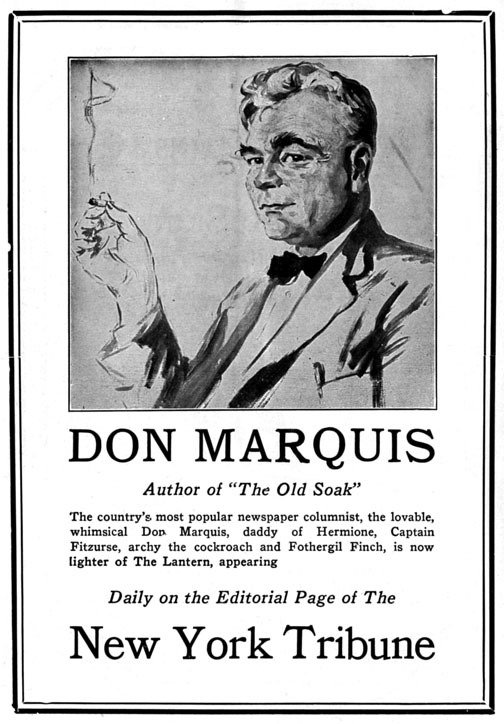
But since we last time touched on Dorothy Parker, let’s present a piece I slightly modified from a poem by Don Marquis, born 1878 in the tiny settlement of Walnut Illinois, but educated in Galesburg. Don Marquis is usually filed (like Parker) as a humorist, but like Parker he worked in various genres including collaboration with the Krazy Kat cartoonist George Herriman. Unlike some of the others here, it appears that Don Marquis’ most consistent connection to Modernism was to satirize it. Today’s audio piece, which I call “The Young Intellectual**”  pricked the romantic presumptions the young Modern of his time might suffer from. I updated part of one verse (the original next to last line was “I’ll start a Pale Brown Magazine”) when I performed it, an update I choose just so we can more easily feel offended or amused by his humor now. The player to hear the LYL Band performing this is below.


*My Great-grandfather lived on the Iowa side of these river-towns and worked in war-industry factories there. My father’s mother and her sister also grew up in the Davenport area. Alas, many of them died before I was old enough to ask questions, and one thing I regret about my youth is that I didn’t query those that were around.

**I’m not sure I qualify as an intellectual, but I’m sure I’m not young—so, Marquis can’t be talking about me now, can he. Like Ficke, Marquis also parodied Modernist verse, rather broadly from the examples I’ve read in his Hermione and Her Little Group of Thinkers  from 1916. Marquis’ greatest success was a series of later newspaper columns that became a series of books about “archy and mehitabel” ostensibly created and typed by a cockroach hopping on the typewriter keys in Marquis’ office. Archy, the cockroach/author, is also something of a free-verse poet, and Archy’s poems are a much subtler expression.

Don Marquis in the Tribune

Marq Daddy? He looks like an urban swell here, but the country he comes from they call the Midwest