It Is a Small Plant

September 17th is the birthday of the American Modernist poet and physician William Carlos Williams, and today’s piece uses the words from one of his poems “It Is a Small Plant,”  the best known selection from a sequence of poems Williams called “The Flowers of August.”

William_Carlos_Williams_passport_photograph_1921

Just because you have have a passport doesn’t mean you have to move overseas.


Unlike some other American Modernists—including two poets he met and befriended while a student at the University of Pennsylvania, H.D. and Ezra Pound—Williams spent most of his formative writing years in the United States, much of it in his native state of New Jersey where he practiced as a pediatrician. Like his fellow stay-at-home Modernist Carl Sandburg, Williams wrote poems the followed the new Imagist rules, at least at the start, finding them useful in breaking away from the old poetic styles.

One of those Imagist rules, the first one in fact, was “direct treatment of the ‘thing.” That doesn’t mean that you just directly state the message from your heart. Rather, it means that you honor and hone the image(s) that represent your meaning as palpable thing, not as mere poetic decoration for your words. “It Is a Small Plant” demonstrates that by spending nearly the entire poem presenting a description of a flowering plant.

In the series “The Flowers of August,”  each of Williams’ other poems are titled with the name of a particular meadow or pasture flower, but not this one. So, I suspect this is meaningful. The description of the flower here sounds a bit to me like the common bluebell, but it’s possible that he diverged from botany in service of one of the poem’s images, or that the omission of the flower name in the title for this poem made a point for him.

The other, more important, mystery is who the “her” that is inspecting the flower with the poet is, the her who regards the subject flower as “a little plant without leaves.” At first. I wondered if it was perhaps a young girl looking at the flowers, but I now believe that it’s the “her” featured at the poem’s close: summer. If that’s so, that is the reason the flower has no name, as the human name doesn’t exist for nature and for nature’s incarnation as summer. And in the course of the poem, summer then too cannot care about the anthropomorphic desires presented in Williams’ presentation of the image of the flower.

Violet

Unlike William Blake, William Carlos Williams didn’t see Heaven in a wildflower,
but he did see nature observing himself observing the flower.

I’m not a quick understander of poetry. In working on this piece, I read Williams’ poem, enjoying some lines in themselves. The ostensible subject seemed to fit with the season and coincidentally with some other pieces I’m working on—but I wasn’t sure what it meant. In the course of fitting it with music, recording the vocal, and then tweaking and mixing the music, I lived with this poem for a good part of the last couple of days, reading or hearing the words over and over.

If I had been too concerned with its meaning, I might have stuck with my initial supposition, that it was child apprehending the flower. I was pre-disposed to that on first reading, having briefly re-meeting Margot Kreil earlier this week, a poet who wrote an excellent poem called “Weeds”  which featured just such an image. But I was more concerned with getting the drums right, playing the bass, setting up delay divisions for the guitar lines, and marshalling my limited keyboard skills for the soft keyboard parts, and then making that all fit together.

Through you don’t have to go through those composition and production steps, this points out again one of the things that music can do to change the context for words when it’s combined with them. While music can emphasize some mood or presentation of the words, in the same way that suspense music makes a film clip of a character walking down an unremarkable hallway scary, it can also offer its art as a distraction from worrying about meaning too soon with a poem.

To hear my performance of William Carlos Williams’ “It Is a Small Plant,”  use the player below.


Heat

Just after the start of the 20th Century two teenagers met at the University of Pennsylvania. One was 16 years old, a smart and cocky boy without much in the way of money, who had somehow managed admission to the University at such a young age.  The other was 15 and the only daughter of an astronomer and professor at the college. So devoted was the girl’s father to his astronomy, that it’s told that his wife needed to come by during the colder months with a kettle of hot water to unfreeze his eyelashes from the eyepiece of his telescope. This professor was the enlightened sort of early 20th century father who believed in women’s intellectual equality. He dreamed that his daughter would become another Marie Curie.

However, the two teenagers soon fell in with each other, and science was not in their bond. Poetry and the arts were. A year or so later, a new freshman arrived at the University to study medicine. That freshman was William Carlos Williams, and he would complete his studies and become a pediatrician and family doctor who practiced for decades in Patterson New Jersey while writing purely modern poetry. The boy and the girl fell in love, and were secretly engaged, knowing that the boy’s lack of money and established career would prevent the girl’s father from giving permission of them to marry.

Real Genius Jordon or HD
The 1985 movie “Real Genius” is a documentary of this meeting between two teenagers in college.


The girl grew up and was sent to Bryn Mawr, a woman’s college that was known for having a tough “men’s curriculum,” following her father’s hope that she would become a scientist. There she met Marianne Moore, who also became a noted modernist American poet, but at Bryn Mawr she failed in her studies. The American oracle Barbie would later proclaim: “Math is hard!” and a career in science was out.

But wait. What of that cocky boy? Oh no, he’s gone to England! And double oh no, he now engaged to another woman there. After all this, we can now begin our story again.

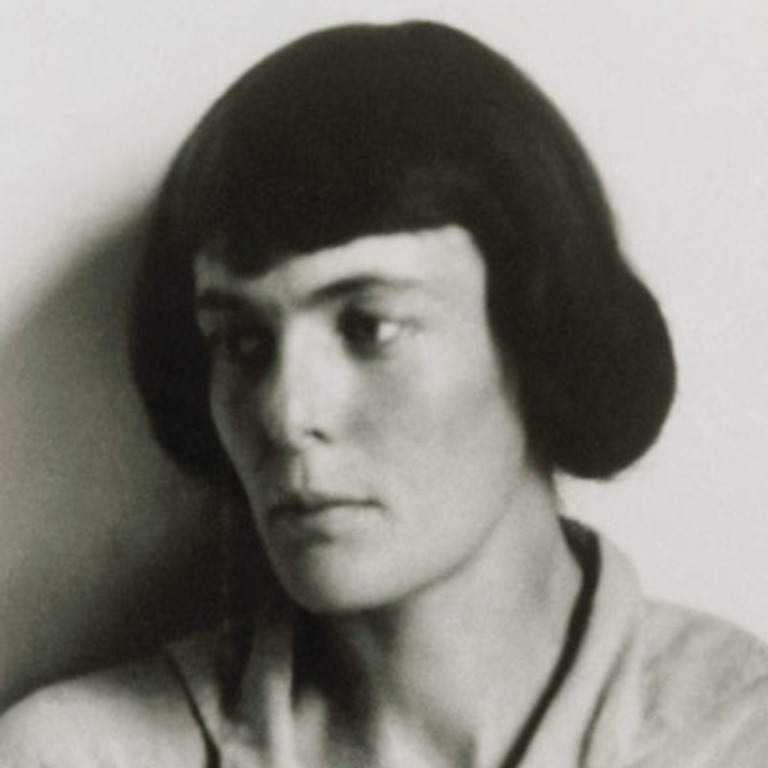
This now young woman who had already met and befriended William Carlos Williams and Marianne Moore, went to England to meet back up with the young man she had fallen in love with as a teenager. The young man was Ezra Pound, and the young woman was Hilda Doolittle—but she wouldn’t be much longer.

Young Ezra Pound2HD

Sorry, “Real Genius” its really about how Tears for Fears was uncool, but now is kinda cool.
And here are the real and young Ezra and Hilda.


Pound was in England trying to stir up a poetic revolution, something that would forge past the reformation of William Morris and the Pre-Raphaelites and give poetry a fully modern cast. Hilda showed Ezra some of her new poems, and Ezra did three things that he would do repeatedly for other poets in the next couple of decades.

He immediately recognized that Hilda was writing the kind of fresh, spare, honest poetry that he thought necessary to break the grip of the past. He would see to it being published.

After admiring it, it took his pencil to it, and slashed out parts of the already concise poems. I can hear some of you drawing a breath on that, considering the sexual politics, ready to cry “Asshat!”—but that’s Pound, even with poets of genius: cut it, pare it down, make it new, not one extra word. A few years later he’d do the same thing to T.S. Eliot, and the surviving variorum manuscripts show why Eliot called Pound “The Better Maker” of The Wasteland.”   Pound’s editing pencil seemed to teach like the sensei’s stick, and once shown, poets like Hilda Doolittle and Eliot understood how to do the same thing themselves.

And then he took that editing pencil and signed Hilda’s poems “H.D. Imagisite.”

That last move was another part of Pound’s talents. He was probably more successful in launching other poet’s careers than he was his own. He had a shrewd promoter’s eye. “Imagiste” or “Imagist” was the name Pound would give to the modernist poetic movement that would during the years of WWI as radically reshape English poetry as the war would reshape the maps of the world, and here he was saying, rightly, that H.D.’s poems would be the ne plus ultra of that movement. As a name, H.D. was as pared down as the new poetry would be. If he’d lived long enough to see video screens with 1024 lines, he could have said calling them HD for “High Definition” was a tribute to his call for seeing things truly. And H.D. masked Hilda’s gender, still important in a world where women were widely thought to be incapable of great art. The former Hilda Doolittle didn’t object. She’d never liked the family name (“Do-Little” she thought it scanned) and besides, her sexual identity and friendship affinities were at least HD.

Let me admit that this post is unfair to H.D., the writer of the words of today’s piece. We’ve gone past my customary length limits and we’ve only barely touched on H.D.’s talents and extraordinary life. I’ll need to revisit her work soon and give H.D. her due.

What can I say about today’s piece “Heat?”  Well it’s an appropriate July poem, and the titular heat, in true Imagist fashion is both a closely observed thing: actual summer heat, and an image that, without simile or extra framing, is imbued with complexity. Last episode we had Pound/Li Bai, two men, showing desire and longing in the “River Merchant’s Wife”  with only a few actual named emotions or feelings. H.D., the better Imagist, shows female desire with not a single named emotion. The poem’s final phrase:

that presses up and blunts

the points of pears

and rounds the grapes.

is sensuous beyond words—it’s only 13 words to be beyond after all—and with four p and s sounds it holds four kisses.

To hear my performance of H.D.’s “Heat,”  use the player below. And thanks again for the likes and the social media shares!