Welcome back to our regular fare after a spate of summer diversions. And what is it that you’d expect to see here? We take various words, mostly literary poetry, and combine them with original music in differing styles. I’ve done this Project for over nine years, and within the archives here you can wander through nearly 850 of these combinations. Since poetry can be described as words that want to burst into song, such combinations might seem an obvious task – sometimes they are – but I enjoy looking for unusual connections, conversations between tendrils and mycelium deeper in the soil, not just the majestic and visible branches everyone sees.
One frequent supplier of words to be recast in sound here is the seminal American 19th century poet Emily Dickinson. Dickinson’s mind is Shakespearean in its scope, and while her modes of expression vary to meet those needs, much of her poetry sits in a rich intersection between short epigramic verse that superficially seems like it could be stitched as some crewel homily, and unconventional, rebellious, independence of thought.
For example, this lesser-known Dickinson poem: “The spider holds a Silver Ball.” I’ll link the full text of it here. The opening four lines are praise to a spider’s industriousness, with the arachnid – unusually for this poet – standing in here for the highly common Dickinson totem, the bee. Dickinson, the avid gardener with a science-focused education, knows well the necessity of pollinating and honey-keeping bees. In this rarer appearance in her work, the spider is no such creature, for their work is occult or predatory. She praises its web-work none-the-less, that work’s imperial provisioning for prey goes unmentioned. This praise continues in the next stanza. The web is anchored or arises from “Nought” she says. The spider makes its spider silk from a secreted process, its attachment points may be a dimly lit corner unespied, its constructions do not exist until the spider’s efforts create them. But “Nought to Nought” is an omen too for all this effort as the final stanza will tell. Note too, Dickinson genders the spider: “His.” Spiders of either sex spin webs, but this action is male.
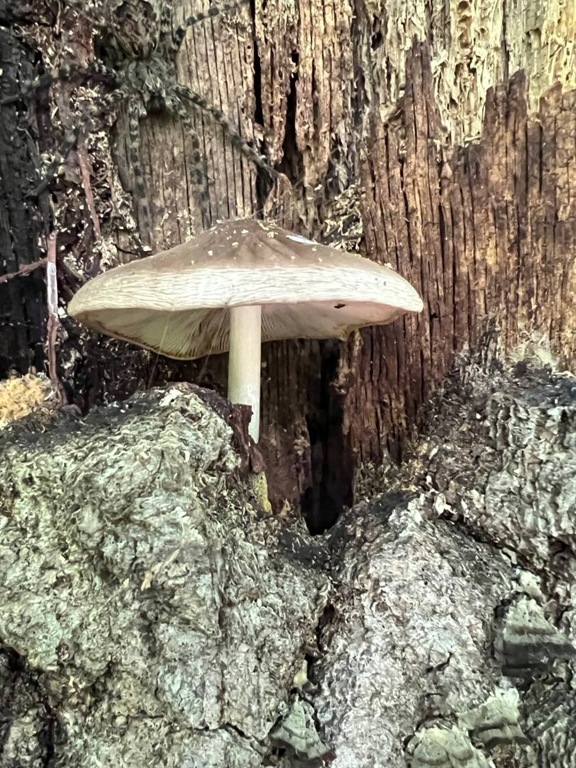
A mélange of moss and mushroom. Can you spot the spider’s unperceived hands in the picture? (click to enlarge)
.
I’ll make a leap here: Dickinson, the prolific weaver of 1,789 poems, identifies with this spider. One accounting has this as poem 513, so there are hundreds of poems behind her as she makes this one, and more than a thousand yet to go. The bees in Dickinson’s poems are usually cast as joyfully playing, the spider here is more obsessive. Even the dourest Puritan in her era would know the worth of the bee’s work: flowers, food, unspoiled sweetness. In the final stanza, the spider’s work is destroyed by what Dickinson genders as woman’s work, by housework – as endless as this spider’s spinning. Another leap: I wondered if Dickinson might have composed this poem while busy with housework, secretly engaged in the (gendered by her) masculine work of inessential gossamer creation – no matter if “Nought to Nought” is that work’s fate.
As I read this poem I thought of another poet working in this mode, the William Blake of Songs of Innocence and Experience, who wrote of “The Fly” and likened his own intellectual and creative drive to the bothersome insect.
I combined Dickinson’s words with music that partakes of the sound of the 1960s psychedelic genre.* The joy of that kind of expression is the freedom granted to instruments to take novel roles and reconstituted timbres. To a loping 6/8 time, the bass is allowed to rise to sing, the electric piano has been having an episode, the guitars wander onto new paths, an organ breathes, the drums fibrillate. Over this I sing wildly, unconcerned to be overheard. You can hear this performance with the audio player gadget below. What, has that audio player seemingly come to nought? Some ways of viewing this post will suppress the gadget, so I offer this highlighted link which will spin a new tab that has its own audio player so you can listen.
.
*I don’t find this a strained pairing at all. The 19th century American New Thought and Transcendentalist strain was still alive in the Beat and later counter-culture outlooks that arose a century later. Dickinson’s recasting of language and syntax in many of her poems is like to the sonic experiments of psychedelic music, which I’m attracted to for their adventuresomeness rather than their drugs. What is novel about my application of this to Dickinson is that this element of her poetry is under-observed, while it’s more common to view William Blake as “A ‘head’ before his time.”





 Frank Hudson