Old Soldier

Today’s piece was created from a poem written by the Irish poet Padraic Colum. Colum was born in the 19th century, then traveled through the world of 20th Century Modernism, and lived on long enough to overlap my lifetime. Looking at the outlines of his life I am pleased to report that Colum connects a favorite of this Project, the undercelebrated Irish poet Joseph Campbell* and the American mythological theorist of the “Heroes’ Journey” also named Joseph Campbell. With the American Campbell, Colum connected because he was a folklorist as well as a poet, and he wrote several young adult and children’s collections of folk tales and retold myths which I’ve not yet read. With the former Campbell, besides being Irish literary revival contemporaries, he collected folk-songs.** Like that Irish Campbell, Colum’s best-known work today is arguably a folk song.

Long-time readers here may recall that the poet Campbell is likely responsible for the song “Reynardine”   being sung in a version featuring a supernatural, shape-shifting lover. At around the same time, and for the same publisher of Irish folk songs, Colum collected/wrote the lyrics to the song “She Moved Through the Fair.”   Why the slash notation on the authorship? There’s some controversy if Colum closely adapted a traditional set of lyrics, or largely wrote original lyrics to an existing tune. Colum claimed he wrote the lyrics, making use of only a few floating lines that are folk song ready-mades. The challenge to Colum’s authorship strikes me as highly suspect: it’s based on another collector writing in 1970 that he came across an old man who told him he’d learned it as a traditional song before Colum’s version was published in 1909.

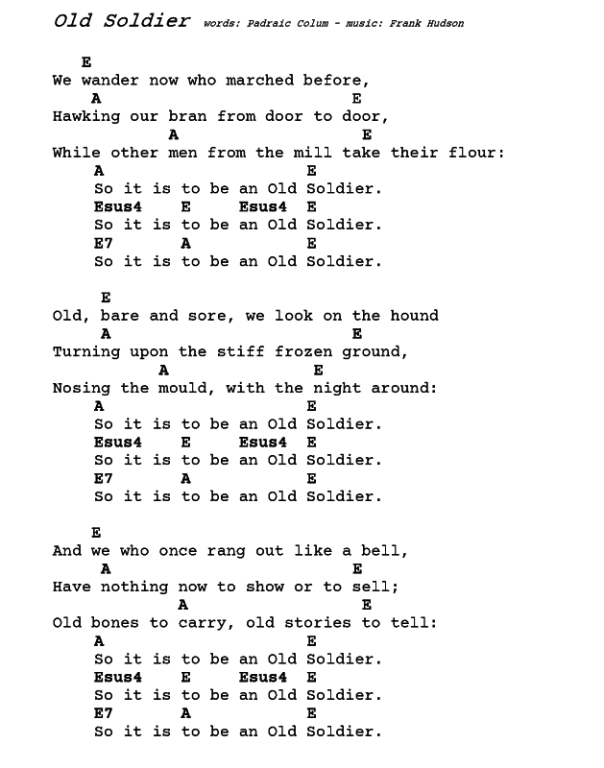
Old Soldier

I suspect there’s someone out there who can do a better job singing this song I created from Colum’s poem.

.

“She Moved Through the Fair”  was included as a poem in Colum’s first poetry collection “The Wild Earth”***  which also includes today’s poem. I note that “Old Soldier”  has some similarities with the lyrical methods of SMTtF:  both use spare details and leave out a great deal. Some of what is implied in the two lyrics may have become more obscure to modern listeners. SMTtF  very early on speaks of the singer’s “lack of kind” which uses a now archaic meaning of “kind,” meaning family. “Old Soldier”  opens with the titular old soldier going door to door. Since “hawking” (a hawker is a street-seller) is used as a verb in the second line I thought at first he was peddling, but from what I can find, no one sold flour that way. I think he’s begging for bran, which was then the discarded part of the milling of flour. That waste part after the wheat was milled or boulted, was thrown out or used as animal feed, though apparently the poor sometimes made use of it for human consumption.**** In the second stanza we meet the old soldier’s only companion, a dog, and the bran the soldier has garnered may have gathered mold.

I don’t know if “Old Soldier”  has been set to music before this, but it seems every bit as singable as “She Moved Through the Fair,”  and as soon as I read it, I wanted to sing it. I decided to use an arrangement soaked in South Asian musical influences, perhaps due to the wonderous extended version of the SMTtF tune played by Davy Graham. That link above includes one of Graham’s recordings of it, as well as Anne Briggs wonderous acapella version. Oh, hell, here’s that link again, click it indeed if you haven’t heard the song Colum made. Last week I recorded the basic tracks singing and playing a tune I created for Colum’s poem using my guitar in an alternate tuning driving a sitar virtual instrument though a MIDI pickup. To this first pass, I added harmonium, tanpura, tabla drums, acoustic guitar, and a final vocal.

Every one of those overdubbed passes felt good as I played them (save for my vocals, I’m never happy with my vocals) but the result was a whole bunch of tracks that would require careful mixing so that the instruments blended well. I set about doing that, working until midnight when I figured I might have a piece to present and saved a complete mix down. Awaking the next morning, I listened again, and the result wasn’t just flawed, it was a mess. A useful question for one mixing a piece of music with various instruments in an ensemble like this is “What track is the focus of the piece?” My putative mix had no good answer for that. The voicings of the chords on the sitar and the guitar didn’t mesh well. The harmonium and the tanpura were fighting over the same part of the sonic spectrum despite my efforts to give them their own sonic space. The tablas didn’t mesh with the acoustic guitar’s rhythm.

The wise solution would be to just re-track the piece. Maybe I should have more particularly considered that Davy Graham had made his impressive version of a Colum poem/song with only a solo acoustic guitar. But I would not have another opportunity to record with a sensitive open mic until this week, too late for Veteran’s Day. So last night I went to work stripping back the crud of my failed mix, leaving mostly the acoustic guitar and the vocal, with the tanpura and then the harmonium coming in for later parts of the song in turn. It’s not an ideal recording, but it’s my hope it lets one consider “Old Soldier”  as song today.

The more palatable version can be heard with the audio player below. The song itself is simple, and the remixed arrangement that builds a bit as the song continues serves it better. You don’t see any audio player gadget? No, I didn’t remove that, it’s a side-effect of some ways of viewing this blog. I have a plan B for that too: this highlighted link that will open a new tab with its own audio player.

.

*Joseph Campbell, who also wrote under the name Seosamh MacCathmhaoil, was acquainted with the original London Imagist circle, and wrote what I think is some excellent short verse in the form. His life and literary career were brought low by siding with the losing side in the Irish Civil War.

**Given that I’ve been doing this project for a decade, the folklorest/singer/collector and poet is a combination near to my heart. Besides Colum and Campbell, two American poets from the same era, Carl Sandburg and Edwin Ford Piper did both things, and I’ve tried to briefly make the case that Sandburg should be more often cited as instrumental in connecting folk song with progressive politics and literary poetry in the United States, which eventually leads to the case of a Nobel laureate in Bob Dylan. Around the same time as all these others, elements of the “Harlem Renaissance” in Afro-American literature were open to melding folk song with high literature too (Fenton Johnson, Langston Hughes, Jean Toomer, Waring Cuney, Zora Neale Hurston).

I’m going to jump far afield before leaving this footnote: I’m writing this on the 50th anniversary of the release of the Patti Smith Group’s glorious debut LP Horses. The Patti Smith Group started because Smith, a poet personally immersed in colloquial music, a paramour of Fugs-adjacent musician/actor/playwright Sam Shepard, joined up with a guitarist/rock critic/crucial anthologist of garage bands Lenny Kaye, wanting to make unexpected poetry combined with electric guitar.

***Just when Colum’s The Wild Earth was published is unclear to me. My copy has a 1927 American printing of a 1922 edition. Wikipedia says “She Moved Through the Fair”  was in a 1916 edition of the book, and then in their entry for Padraic Colum gives a 1907 date for the book.

****What, that’s the healthy part! Whole wheat! At the time the milled pure white flower was prized from making lighter baked goods and for a longer shelf life. The city I live in was growing rapidly at the time of this poem by finely milling the “Best” and the “Gold Medal” flour that had absolutely no bran or wheat germ at all.

At the New Year

I’ve long been fond of the poetry of Kenneth Patchen — but even though an old edition of his Collected Poems has followed me about over the years, it was only today that I appreciated this poem of his. He wrote it sometime in the 1930s, but reading it this morning I felt he was speaking my thoughts as I look back from the ending of our year 2024.

Patchen’s poetic sensibility was essentially an exercise in Keats’ Negative Capability. Patchen admired human love and wrote reverently about nature and joy, but he was also disappointed and in opposition to a world manipulated by selfish and thoughtless power. He wrote some poems so sweet you might select them for a child’s bedroom wall, and others bitter in the taste of his analysis — but his life wasn’t a trajectory between those poles. Some of Patchen’s most politically radical and downbeat poems were written in his youth and some of the most hopeful pieces of bonhomie came from late in his life. And this was so despite never achieving crowning literary success, and after suffering chronic and painful health setbacks. He seems to have liked today’s poem, as it stuck with him. Looking briefly at its history tonight I see he had sent it out to be set for a choral musical performance in the 1940s,* and he printed a broadside of a slightly revised version in 1967, shortly before his death. So whatever specifics he was thinking of when he first set it down, the man himself thought it more universal. Here’s a link to the version of “At the New Year”   I found on my bookshelf.

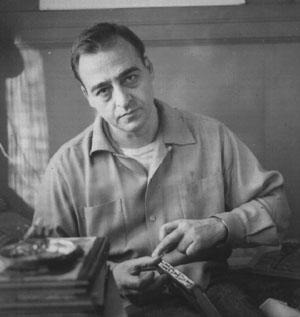
Patchen photo

Kenneth Patchen. He wrote of his times and is timeless.

.

Today I read it as if it was expressing my own thoughts this year, about this  year — not some year in the 30s, 40s, or 60s. Most any decade has wars, but the cruelty of current wars and new refugees cuts freshly. And then, my country’s last national election was heartbreaking for me. I have long held faith with Lincoln’s democratic analysis of how long how many can be fooled, but at my old age I don’t know if I will be there awaiting the arc of the universe when it bends toward justice. As Patchen moves into the second half of his poem he writes of the brave talk and the mean talk, he takes in this world as full of the good and the lovely, but also a measure of the sham and hatred. When he says as the New Year’s bells are to be rung that there are other bells that he, that I, that you and I too perhaps, would ring — well I got a little misty singing those words this afternoon.**

I had to proceed rapidly to create a realized singable version of Patchen’s poem before New Year’s Eve, and so I quickly set up a broadly repeating musical cycle for the accompaniment: VI, V, i changes in musician’s shorthand, but the VI and V sometimes go minor in the quick and dirty rush to make the cycle. Since the passage of years is cyclical and won’t wait, perhaps this accidentally makes for a fitting setting. I was lucky to get accommodation this afternoon so I could open a microphone, and I ripped through the vocal you can hear below while that musical cycle did its thing.

The audio player is below for my performance of Kenneth Patchen’s “At the New Year.”   What, has the ball dropped, the bells have rung, and there’s no player gadget on your screen? No need to stop time, just use this highlighted link.  That’ll open a new tab with its own audio player.

.

*I make a quick search to see if I could find this once-planned 1940s choral setting, but came up empty,

**The bells motif at the end of Patchen’s poem recalls Henry Wadsworth Longfellow’s holiday poem “I Heard the Bells on Christmas Day”  that I wrote about and performed a few years back. Long after Longfellow, and some years after the death of Patchen, Leonard Cohen did his own New Year’s “Anthem”  with bells that contains one of that poet’s more remembered passages: “Ring the bells that still can ring,/forget your perfect offering,/there is a crack in everything/that’s how the light gets in.” Cohen’s poem echoes Patchen’s sentiments, and Cohen’s poem and song may have been in conversation with those earlier poets’ work.

Let Me Call It Remembrance Day

A post today for a holiday with complications. In the UK, Canada, and the former Commonwealth, today is Remembrance Sunday and tomorrow is Remembrance Day. In my United States tomorrow is Veteran’s Day. Remembrance Sunday/Day is a bigger deal. Here in the U.S., it’s one of two holidays set aside to honor the armed forces,*  and the Spring Memorial Day gets more observance. America moves it around as a Monday workday holiday, so it now rarely occurs on November 11th, the day it was originally meant to commemorate, Armistice Day, the day that WWI ended. In the American observance, the day and the moment being observed are no longer there as they happen to be this year.

But then, all the events of WWI have now passed out of the living’s remembrance, and WWII is entering the time of that leaving — while in England the wound and loss are still felt by a generation that themselves only recall the generations that personally experienced it.**

Historically, poets suffer, fight, and die in wars. Presently in the U.S. this may be less true than was traditionally so, our soldiering ranks now coming from a different cohort than those with MFA and workshop attendance. That too is complicated, and I’ll choose to honor your time today by not going into all of that. Yet I’ll maintain that the experiences of service to country, of organized protection and organized death, of comradeship and loneliness — these words of history aren’t so far away if we only open ourselves to listen to them.

Here are five poems for this complicated holiday that this Project has presented over the years. In honor of the UK preservation of the original reason for the holiday, four of them will be British to one American.

Gone, Gone Again (Blenheim Oranges)

British poet Edward Thomas is too little considered in the United States, but in the run-up to WWI this overworked and underpaid freelance writer started to expend his writing efforts to the least commercial of literary forms, poetry of individual honesty — urged in that endeavor by his expatriate American friend, Robert Frost. Frost left England for America as the war began and he asked his friend to follow him and emigrate to the United States.

Thomas didn’t accept his offer. In Britain Thomas is remembered as a War Poet, as one of the casualties of The Great War, but his poetry doesn’t speak of his trenchside times in the conflict — instead it sings with lovely precision and concision of the British countryside as he is making his decision to take the road well-traveled to enlist to the front. “Gone, Gone Again”  is one of his masterful poetic verse-essays on this time of decision, as he observes an England depopulated of its workmen. Why did he go to the front? He explained it mostly as being unable to shake his patriotic connection to the very soil and experience of Britain that his poetry sings of, but I said today’s post would be about complications. Thomas was also a troubled soul, looking for meaning in his life not captured by certainty, and some have speculated that a soldier’s pay was a better economic offer for his family than his Grub Street freelancing. He packs every bit of that into this short poem.

.

Shadwell Stair

Wilfred Owen is another Brit who took up poetry in the context of serving in The Great War. He’s known for his scathing anti-war poems, which to Britain’s credit doesn’t keep him from being honored nationally as a War Poet. But here’s a lonely poem written on the banks of the river Thames, likely during the time he was back from the front being treated for what was then called “shell-shock.” Folks today can experience the poem in a context pointed out later, that the Shadwell Stair location was a gay cruising spot at that time. Historically, there’s a blindness in some eyes to see that not just that poets and artists serve, but that they aren’t all straight.

.

On the Troop Ship to Gallipoli

Rupert Brooke was a rising young poet before WWI started, and even at his young age, great things were predicted for him. Unlike Owen, his war poetry is conventionally heroic, conventionally patriotic. Unlike Thomas, he was under no economic pressure when he enlisted. Would that tone have continued, could he have written glorious battlefield odes, or would the war have turned him into a skeptical Modernist? In an irony that only the Fates could have woven, he was detailed to be part of the disastrous attempt to land at Gallipoli. While on the troop ship steaming there, he fell sick from what I’ve read was an infected insect bite, and died before reaching the deadly front.

I took a fragment Brooke composed on that fatal voyage, and audaciously decided to take a Modernist blue pencil to trim and rephrase it the way an Imagist might. That was a complicated act, one that I’m not sure I can justify, other than to say that I wanted Brooke’s moment on that troopship to stand out more vividly, riding roughshod over his verse to honor that.

.

The Cenotaph

I don’t believe there are any women on WWI War Poet plaques in Britain, but of course they were asked to and worked with the war effort, and were there to tend, mend, and mourn the casualties during and afterward. Here’s a complicated poem of mourning, written as the original Cenotaph*** was erected in London. Its author Charlotte Mew is another British poet little-known in America. From what I’ve read she was seen as eccentric by other artists of her time, and her poetry doesn’t fit easily into any movement or style. Every Remembrance observance in Britain to this day has a ceremony at the London Cenotaph where the current government pays solemn homage to the soldiers’ sacrifice. If I read Mew right, she’s the ghost-at-the-feast here, and has some particular wailing to do.

.

.

Grass

Lastly, for Remembrance Day, here’s the American — and non-more American than the child of immigrants Carl Sandburg. I would post his poem “Grass” every Memorial Day, every Veteran’s Day — and yes, even every Remembrance Day. Yet, this is a poem that sings about forgetting. Is forgetting wars, forgetting soldier’s service and sacrifice, a callous thing? Is forgetting the follies and cruelties of war dangerous ignorance? Is it better to forget wars than to suffer them forever in endless horror? Is forgetting just the way things are eventually, an erasing sigh that fades into new present days — as what humans do that humans can never fully comprehend?

Look, I said it was complicated.

.

*In the US, there’s fine print sometimes invoked to separate the two: Memorial Day for those who died in service, and Veteran’s Day to honor all that served. The UK Remembrance Day is more like American Memorial Day focused on wartime losses and sacrifice.

**Proportionate to population, the US casualties in WWI were much lower. And England’s cities suffered under bombs during WWII. I was going to write too about the World Wars and their effect on the British Empire and colonialism, and America sliding in as a replacement, but that subject is too big for any footnote.

***So great were the WWI deaths that logistics couldn’t see to repatriating all the bodies of British war dead back home, and unidentified dead and missing in action mysteries clouded the situation too. Regional cenotaph memorials, including a great one in the national capitol, would serve as a consolidated gravesite to lay flowers and visit in remembrance.

The Drunken Singer

Even though the Parlando Project is about presenting other people’s words,* I sometimes remind myself that I still write poetry and lyrics. Every so often I’ll think of a song, sometimes one I wrote years ago, maybe one that never got a presentable recorded version, and I’ll wonder if I could record it like a regular Parlando Project piece.

“The Drunken Singer”  is one of those songs. It’s well over a decade old, predating the Parlando Project altogether. A couple of coincidental things made it come to mind. At another place online that I participate in, there was a recent thread on another older song, one by the extraordinary singer-songwriter Richard Thompson called “God Loves a Drunk.”   I love Richard Thompson’s work, but his fans sometimes feel called to warn potential listeners that he can be very dark. Like the British Isles folk music that influenced him, he can produce songs of death and misadventure — but he’ll also go another step further and produce songs of even greater bleakness. “God Loves a Drunk”  is one of those.

Early in this Project I told the story of my misapprehension of a folk song of alcoholic abandon “Rye Whiskey.”   I had wondered how my teetotaler great-grandfather could have been fond of it. In the process of working with this Project I discovered it was an oft-performed set-piece for the popular “Cowboy Singer” Tex Ritter, who played the song for laughter by imitating a drunken fool while he sang it. Thompson’s drunk song has no plausible laughter, though it does point out something ironic: that inside their degradation, the alcoholic touches on elemental things about the limits of the human condition.

Thompson’s song, and his performance of it, are skilled and intricate as are the many details he uses in it. None-the-less, it reminded me of this song of mine. “The Drunken Singer”  uses only three sketchily presented incidents, a less-is-more approach that I often favor when writing lyrics or other poetry.**

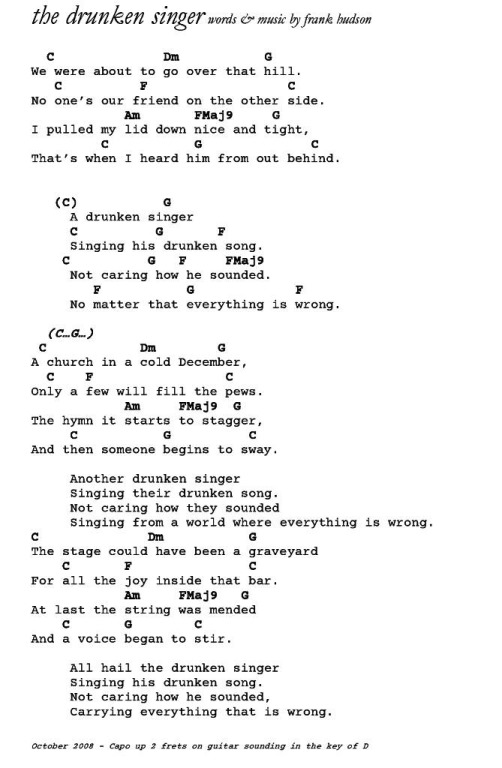
The Drunken Singer

A part of the inspiration for writing this song: despite my being in the cold-water army, my voice often produces sounds that too are not proper or correct.

.

The second reason “The Drunken Singer”  came to mind was that I found myself working this month on a handful of possible songs I could set from poems that referenced singers, and you just heard one of them last post: “The Late Singer”  by William Carlos Williams.

So, these are my reasons for inserting this, my own song, into the Project today. You can hear my new recording of “The Drunken Singer”  with the player gadget you should see below. If there’s no gadget (some ways of viewing this blog suppress it) you can use this highlighted link that will open its own tab with an audio player.

.

*New here? The Parlando Project takes those words, usually literary poetry intended for the page, and combines them with music we compose and perform. Because I almost always use poetry in the public domain, I often use poems from the most recent period that has clearly moved into that status: the early 20th century, the era when Modernism emerged. But I don’t keep to the early Modernists only, as an examination of the more than 700 audio pieces available here since we started eight years ago will demonstrate.

**As to the “Are song lyrics poetry?” question, my summary answer is “They are a kind  of poetry.” Do lyricists and literary poets focus on, or stress different things, or work with different expectations? Yes — but the range of what is canonically literary poetry shows those things vary widely within literary poetry too.

This Project knows there’s a tension there between page poetry and songs. I just think it’s fun to work within that tension, to push: to pull, to refer and to connect.

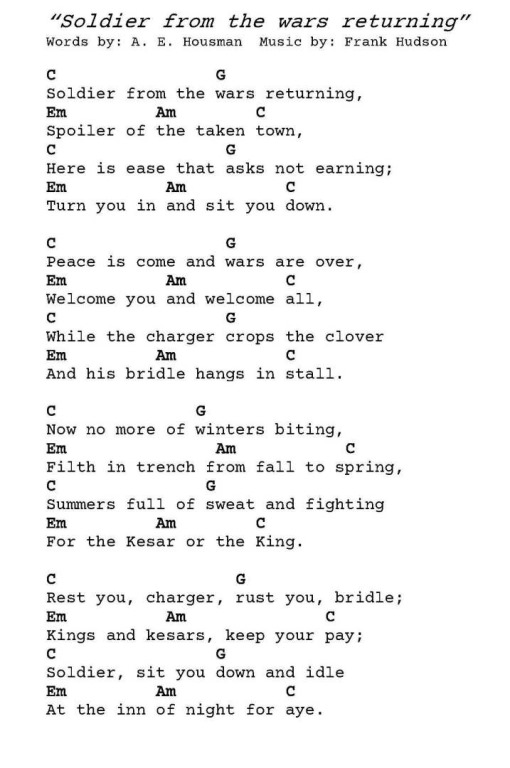
Soldier from the wars returning

I’m going to present a pair of poems which are more related to Armistice Day, the former name for the holiday now called Veteran’s Day in the U. S. Here’s the first one.

Earlier this month I was confessing to Lesley Wheeler that I haven’t read much of English poet A. E. Housman, a poet who I believe retains more readership in the UK than here in the States. Well, no matter how little I know of him, his poetry has qualities that attracts musical composers like myself.

Soldier from the wars

Here’s a chord sheet for today’s song. I recorded this with a capo on the 2nd fret, sounding in the key of D

.

This poem, which may not have had a title as I saw it with just the first line in quotes, is clearly a poem for Armistice Day and its veterans, first published a few years after the end of WWI. I don’t find it a complicated poem, but that doesn’t hurt it when one seeks to be comprehensible in an immediate performance such as I gave it. It’s hope, contemporary with Housman and his listeners when he wrote his words, that “wars are over,” now has sort of cruel quaintness, but it was an earnest statement then. Here’s a link to Housman’s words, and then below this is an audio player gadget to hear my performance of the song I made from them.

No audio player? Clicking on this highlighted link will open a new tab with its own audio player in that case.

.

All Souls’ Night, the conclusion of our Halloween Series

You may wonder if our Halloween Series has continued past Halloween — but in pedantic fact,* the calendar date referred to in this poem’s title is November 2nd. Halloween has no particular religious element for most these days in the US, but originally it was All-Saints’ Day Eve (saints=hallowed people), the day before that observation.

That Halloween was for spooky, eerie, and likely non-Christian things was kind of a “get that all out of your system before the day for all saints comes around” proposition. So, if All-Saints’ day is on November 1st, what is this next-up All Souls’ Day? It’s a day for all the dead souls who aren’t  saints — that is to say, for most of us. The ubiquitousness of the total of all those who’ve ever lived, minus those few that were saints, is a likely cause for this holiday to fall into obscurity. It’s the Participation Medal of the holy calendar.

Similarly, the author of today’s text, Hortense Flexner, is not a famous poet, though she spent her entire life working in the field of literature and education. For some reason, probably the effectiveness of the poem and its continued relevance, this single poem out of her life has survived her to be passed around the Internet and in publications as a Halloween poem.**  She subtitled it “1917” on publication, no doubt in reference to the suffering and casualties of WWI — but it’s since needed no dated subtitle. I’m risking little to suggest few read it now as a historical document of situations more than a century old.

All Souls Night

Once more I present a chord sheet so that other singers can spread the singing of this.

.

Today, to anyone her words reach in times of fresh suffering and a glass separation between those comfortable and those afflicted with new death, “All Souls’ Night”  requires no further instructions from me. I’ll just say there’s an audio player gadget to hear it below, and if you don’t see that, I supply this highlighted link that will open a new window with an audio player in it.

.

*I have family members who were Protestant ministers. I’ve had friends who had at least passing familiarity with the Catholic religious calendar — but I’m evidence in that I knew Halloween in its devout practices of costumes and candy, and vaguely its religious connection to All-Saint’s Day, but nothing at all about All Souls Day.

**Although this poem is the last in my Halloween Series this year to get a blog post, a previous post here presenting “All Souls’ Night”  has gotten steady visits throughout the past few weeks.

Complexities of Memorial: Kevin FitzPatrick’s “Survivor” & Carl Sandburg’s “Grass”

A great many countries have holidays honoring their nation’s soldiers, often with an emphasis on memorializing the dead of past wars. The United States has two such holidays, a Veteran’s Day on the date of the WWI Armistice and the one that arrives this weekend, Memorial Day.

Long time readers here will know I’ve presented a lot of soldier’s poems in this Project, and poems otherwise about wars. This is fitting, war as a poetic subject matter goes back to Homer and further.

Many soldiers’ poems are at least ambiguous about the worth of war, some are outright harrowing. But that’s poets. Outside of poetry, many in the US have developed a particular carefulness in speaking of our wars, a hesitancy to speak honestly about those ambiguities mixed with a deadened obligatory reverence for veterans — a reverence with no other required obligation or attention. Yet we have these two holidays.

Well, do we have such an obligation to remember the horrors of war and the hard-won realities the warriors helped enforce? Asked this way the answer is suggested: yes, we do. For this year’s Memorial Day, I’m going to present two poems that suggest something else in addition.

The first one is by poet Kevin FitzPatrick, who I’ve been memorializing since his death in late 2021. Kevin was not a vet, but he helped with the arrangements that led to his father Bernard FitzPatrick’s memoir, A Hike Into the Sun,  about his WWII experience as a prisoner of war in the Bataan Death March. Let me briefly summarize that, for those for whom this is ancient or foreign history: In the early days after Japan declared war on the US, the Philippines came under attack. The fighting was fierce, with Americans and Filipinos resisting without anything like sufficient logistical support to hold out very long.

After they surrendered the near 70 mile march began, with brutal mistreatment and wanton execution of captives adding to the suffering of the weakened and injured soldiers. Forced labor for the duration of the war followed for those who survived the early days. Death counts vary, ranging from 5600 to over 10,000, continental American soldiers and their Filipino comrades. WWII had many accounts of human depravity. This was one of them.

Kevin’s father survived the march, survived the years as a POW doing forced labor, and then wrote his book about it in the 1990s. That’s only background, this isn’t what today’s poem is about. “Survivor”  is about his son Kevin visiting his dad in the 21st century while the infirm father in his late 80s was in a care home. How much can someone like myself know about Bernard FitzPatrick’s experience?

It just happens that one of the Parlando Project’s mottos is “Other Peoples’ Stories.” That motto also admits, understands that I (and you) can only partially understand others’ experiences, even if poems and performances might inform us somewhat.

I’m not going to spoil the ending of the poem, you’ll need to listen to my performance in order to hear it. Without spoilers I can say that when I first heard Kevin’s poem, when he read it in draft form, his tale of a chair transfer reminded me of my time working in nursing homes and like Ray was performing those kinds of tasks, but the ending took it another place I didn’t expect the poem to go. You can hear my performance with the audio player below. If you don’t see that player (some ways of reading this blog hide it), this highlighted link will open a new tab to play it.

.

Knowing how Filipinos and US troops suffered in the hands of the Japanese, what does the ending say? There’s no secret right answer, this isn’t a pop quiz. Instead of defining a clear answer, let me supply another poem in a performance I shared here many years ago before some of you followed this Project. I think of it as a great Memorial Day poem because for it to achieve its greatness you need to think about it, think about what it implies in the compressed story it tells. The poem is Carl Sandburg’s “Grass.”   Coincidentally, Sandburg was a veteran of the Spanish-American war, the conflict that made the Philippines an American Commonwealth up until independence just after the ending of WWII around 50 years later. Sandburg as a soldier wore Civil War era heavy woolen uniforms while stationed in tropical Puerto Rico, and his commander was a Civil War officer. That’s how close his time was to the bloody American Civil war whose battles are mentioned. “Grass”  was written when the bloody battles of WWI, also mentioned, were contemporary events.

Kevin FtizPatrick and Carl Sandburg

Kevin FitzPatrick and Carl Sandburg. A couple of poets imply some things you’re not likely to hear elsewhere this Memorial Day

.

Sandburg’s poem in its short duration reminds of the costs of war — but what does his ending mean? Does it mean it will be best all-tolled when we have the option to forget their sacrifice? Does it simply observe that time passes, and we will forget, eventually? Is he saying that more wars, more bloody battles, obscure the dead of past wars? Chances are you won’t hear any of those statements in any Memorial Day commentary or post — but you will hear about Memorial Day discount savings, and rote uncomplicated praise for service.

Here’s the audio player for The LYL Band performing Carl Sandburg’s poem “Grass”   live several years back. And here’s the backup link for it.

.

More of Kevin FitzPatrick’s poetry is available at this link. His father Bernard’s book is linked here.

Instructions for Angels

What I’ll write about today’s piece might be needlessly complex. I’ll try not to take too much of your time so you can get to the simple performance of the poem below and you can decide.

The usual job of a critical essay on a poem or other work of art is to explain how something works and doesn’t work, usually making use of, or in the context of, criteria for artistic value. Within these efforts, the spread of essays praising or condemning a poet, poem, or poems is maintained. There’s no contradiction here. How can there be good art if we don’t have bad art? Judgments, pointing out good and bad, are equally creative, just as when we are writing and revising ourselves.

Is this a critical essay? I’m not sure it is. Instead, I think of these pieces of prose as short notes about my experiences with the texts, nearly always literary poems, as I combine them with music and perform them. And in the case of today’s audio piece using Kenneth Patchen’s “Instructions for Angels”  my experience so contradicts what criteria I believe I have that it calls into question that I have them or really believe in them.

What do I think are the things I look for in a successful poem? First, I think poetry is musical speech. “Instructions for Angels”  is free verse, something formalists take as problematic. I doubt I’m a formalist. I admit the effects of rhyme and meter, but my musical sense admits also that the amount of symmetry and regularity can and should vary. There’s some underlying da DUM da DUM iambic back-beat feel here in Patchen’s poem, that King James version 17th century English thing that can itself now feel overused or overfamiliar. But familiarity is not always bad, no more than regularity in structure. “Instructions for Angels”  does clearly use one musical feature: the refrain. Perhaps this is what drew me to it when skimming through a book-length selected poems looking for what would be good to set with music. I’m not alone in choosing this poem. I’ve found several other musical settings online.

instructions for angels

Today’s piece is easy enough to play on guitar, so guitarists have at it.

.

I do think we too often confuse imagery with poetry’s essence, praising coded word-play rather than word-music. But imagery is a more abstract version of word music isn’t it? That this-is-like-that, or things arrayed in an as-above-so-below manner is an intellectual harmony. The intervals and combinations are pleasing as audible music is. “Instructions for Angels”  is plainsong in this regard. Yes, I suppose angels and God have a certain majesty, but as a recent coronation reminds us, tired pomp can bore quickly. The rest of the poem is full of threadbare, generalized counters isn’t it? “pretty girl,” “red mouth,” “baby,” “beautiful,” “rain,” “snow,” “flowers,” “trees,” “winds,” and “fields.” If one looks for fresh and arresting imagery this poem doesn’t seem to have it. If I was revising this poem or it was being workshopped, it would be easy to imagine changing a few of those general terms to more specific ones. I can see someone asking “But Ken, what flower exactly do you like? Give us the name so we can see it.”

How about a poem’s message? Shouldn’t that count for something? Yes, I think it should, yet over the ages critics can worry that worthy messages are too common, too cheap — or that art for art’s sake has judged any meaning as secondary. Writing in the 1930s Patchen was often reacting to a Modernism that was too inhuman, too concerned with form, and too unconcerned with the fates of its readers. I sense the present pendulum has once more swung and we are now again asking poems to tell us worthy things, and for the poets to be worthy people. I should be happy, yet I’m not always happy with poems on the right side of the issues. I wouldn’t like it if that was all the poetry I read and sing. Am I just cursed with contrariness? Should I note here that Patchen’s pacifism continued throughout WWII? That was a contrary position and not helpful to his poetic career at the time.

If a poem’s message is important, shouldn’t it be as clear as prose about saying it? How obscure can or should poetry be? Again, poems and critics differ on this, but there’s a consensus that a poem shouldn’t be harder to understand than it has to be.

That “has to be” is a broad thing however. Proponents of exciting and fresh images and language will say beauty and skill allows indirection, ambiguity is true to life, a little, even a lot, of mystery can compel, and that irony combats blandness and tiresome cliché. The greatest benefit of workshopping poems, or at least second readers, is for a poet to find out they are sometimes unintentionally obscure.

One could say that “Instructions for Angels”  is clear. But on first and later readings, even into my performance, there was one small thing that was less than clear and more at odd. We don’t have to wait long for it: the first sentence says “Take the usual events/For your tall.” “The usual events” is clear, it’s a statement of purpose for the everyday and common that Patchen will praise as the poem continues. But “tall?” It looks like a typo.* I could make more immediate sense if it was “tale,” “tail,” “toll” or “tell.” Is Patchen saying “Angels pass this info up (way up,  like to heaven) the chain?” A phrase soon to come, “Blue weather,” is fine, and there is some nice ambiguity there: blues or blue skies? Patchen returns and expands that image with “The weather in the highest soul” indicating he intends that ambiguity.

So where does that leave me, all this applying of what I think and have been taught to understand might constitute a “good poem?” In my present, poems have two states: ones that interest me, often because I can see performing them; and then, the ones I skip over. It may not be the fault of the poet or their poem that I skip them — that poem just doesn’t exist with me in my moment. I’m not totally without criteria, some things I can predict, but this poem is an example of a poem that met me emotionally in my moment, the place where some poems live while others are undressed tombstones. Is Patchen’s poem technically perfect? Unlikely, but there’s a ruined recording take were I just started crying a bit as I tried to sing.

I don’t believe every poem needs to do that. Pleasure in the words, images, and music of some other poems will make them live for me. Amazement at virtuosities can compel at times. If every poem in the world was like “Instructions for Angels,”  I’d be a rebel angel, and crawl into a John Ashbery volume and never come out. As it is, I’d instruct the angels to not poop on my head and to pass it up the line that I’m grateful for Kenneth Patchen.

You can hear my performance of “Instructions for Angels”  with the graphical player below. No player? This highlighted link will open a new tab with one.

.

*I have a scanned pdf of the published collection presumably OK’d by Patchen, but the typo theory remains possible. Patchen was recorded reading some of his poems, sometimes with music. That would answer this doubt, but as far as search goes I haven’t found him reading this  poem.

Winter Stars

Yesterday was some kind of day to celebrate Wales, and I asked the teenager in the house what they did to celebrate since they have an interest in languages and had recently been studying Welsh language online.

“You mean for St. David’s Day?” They replied. I was surprised they knew — but then they’re often surprising. “What are you supposed to do?”

“I dunno. Maybe make a point to use W as a vowel?”

What did I do? I worked, using some increasingly rare time recently, on a new piece here that you may see later this month with words by Welsh poet Edward Thomas. But that’s not today. Today is my catching up with a piece that has been in the works for a couple of weeks at least, remaining unfinished as other concerns remand me to only hot takes and short contributions on Twitter.

Late February

Those I follow in the British Isles are sharing pictures of buds and first wildflowers. Not here.

.

Is Sara Teasdale’s “Winter Stars”  late then? In my upper Midwest, absolutely not. Monday it snowed, my bicycle which I’ve ridden all winter, is behind a shed door whose jam is frozen completely shut by an icy enchantment after melt/refreeze — and 15 degrees F. this morning certainly won’t let it go. Yet, there’s one other time displacement to account for in this poem, for this is another of Teasdale’s poems about WWI. Particularly in Great Britain, when “War Poets” are mentioned, male citizen-soldiers are typically meant, and few now recall that American poet Teasdale wrote poems about the war. One of those poems is likely her best-known poem (or at least poem title, since Ray Bradbury borrowed it) “There Will Come Soft Rains.”   So lovely and complete is that dystopian vision within itself that I suspect it never occurs to readers today that she was writing it in the context of WWI.

“Winter Stars”  has the same strengths of not seeming to be stuck in time or current events. Indeed, folks have written about the poem and thought the blood flowing and wars mentioned within its lines are metaphoric tropes. Alas, as I considered this poem during this past February, the anniversary of the still ongoing invasion of Ukraine provided a corresponding all-too-actual simile. Here’s a link to the full text of Teasdale’s poem.

Teasdale’s night stars are then, like the sure-to-come soft rains of her other poem, a meditation on what endures when suffering, violence, and human vanity can change everything else. I was particularly taken with the next to last quatrain in Teasdale’s poem, remembering as I read it her guarded and constrained by illness childhood looking out a bedroom window at the immortal stars and the mighty Orion, the hunter, who could change and master things.

In the poem, it turns out that Orion doesn’t change things, rather that desire to change things is the constant. Teasdale would leave her sick-room childhood in St. Louis, find some brief success in New York. That older Teasdale is the writer of this lyric. Armies can march, hunting changeable borders to be drawn in blood. Teasdale seems to somehow fatalistically know that Orion and winter never leave, they only blink, they’re always there, the hunter and the prey.

The player gadget to hear my performance of Sara Teasdale’s “Winter Stars”  is below for many of you. No player to be found? This highlighted link will open a new tab window with a player so you can hear it too.

.

All Souls’ Night

Today’s words are from a poet who’s been forgotten, but this one poem seems to have outlived all her other work largely because it’s a fine short ghost poem with a definite shiver from an ambiguous ending. The poem was called “All Souls’ Night, 1917,”  and it was first published in 1920 in the author Hortense Flexner’s first collection Clouds and Cobblestones.  That book’s acknowledgements indicate “All Souls’ Night”  was never accepted by any of the many publications Flexner had published in toward the beginning of her career, and a selected poems published shortly after Flexner’s death in 1972 does not include it. So it was never her most famous or noteworthy poem while she lived.

Why did I hear of it, why is it out there on the Internet in 2022 to be read? Because of its eerie qualities “All Souls’ Night”  has made a number of contemporary lists of Halloween poems.*  To read or hear it once is likely to impress you of its value as such, and you can read it here with this link, or listen to my brief musical performance below. Our discussion has spoilers, so read or listen first. My performance is only 2 minutes.

clouds and cobblestones cover

I’ve looked at clouds and cobblestones from both sides now, and still somehow…

.

Now that you’ve experienced “All Souls’ Night,”  let’s suppose you’re interested in at least a few questions that the poem might bring to mind after you read its 12-lines with their unambiguous chill. Yes, there’s a window here — just as there was in Sara Teasdale’s nursery last time — but either side of this window’s glass has questions.

Outside the window, there’s a date 1917 ending the original title. The poem internally mentions nothing about World War I which was ongoing that year and would still be a universal memory when the poem was published. Several other poems Flexner wrote and published around this time deal with the war, and one short play of hers, Voices,  that was produced on Broadway in 1916, is about the despairs of war.**

Given that WWI is no longer in most any living soul’s memory, I’ve chosen to drop the 1917 in today’s title, as have some of the re-publishers of fantasy or Halloween poems that are featuring it. Outside this poem’s window we only know there are “hosts of lovers, young in death.” Maybe it’s me, but when I first read the poem, I thought the many lovers would be pairs, many of the lovers throughout time who are now dead and stayed in their passionate youth, and the poem does not directly disabuse that notion. But in the 1917 WWI context, one presumes the dead were soldiers, freshly dead. Whatever Flexner’s intent, I think the former has, potentially, greater impact today, even with our current European war. Can we simultaneously allow how Flexner might have intended her ending to be read, and allow how you or I as a modern audience can see the two groups or characters in this poem?

In the poem’s ending, the poem’s speaker, in a warm room next to a fireplace on the other side of the window asks that their warming fire should be allowed to die down, to eliminate the warmth and light on their side of the glass. It’s implied the poem’s speaker is there with others, a party perhaps, as the fire has been set for cheer in the poem’s opening line. With the onrushing crowd of ghosts outside, the insiders are now told at the end: hush, dim the light, turn the room cold so that the ghosts are unaware of them. This is an ambiguous statement if you think about it.

It can be read three ways I think. One, this is simply self-preservation, the ghosts might be vengeful toward the living. In the WWI context the dead might blame them for starting or not stopping the war. Or the folks inside may be smug, and the ghost lovers are their opposite. The insiders may be saying those outside lovers are the not-the-elect living, and that they would steal the warmth, which the insider speaker concludes they will not be able to use, being they are creatures who didn’t stay living and warm. Or lastly the poem’s statement may be one of pity: we shouldn’t be happy, we shouldn’t flaunt our warmth and light to those dead who now can have none of those things.

If, in the WWI context, Flexner has the ghost lovers to be likely the partners of the not dead inside, then the last reading is the most likely. But the reality of any  of those readings is that the cheer, the warmth, and the joy inside the glass must cease. At least for the night, the light and temperature must equalize to death-like on either side of the window. That is the poems genius: it’s chilling on both sides.

At the time of the performance, I went more with the middle reading in my internal approach. I was tempted by that contrast, even if my reading isn’t correct, perhaps because I see so much in our current culture where the other is cast as undeserving. Their desires are a distorted, improper grabbing for joys, things they haven’t earned as members of “the elect.”

This touches on religious beliefs, so one more factor: the poem references All Souls’ Day, a Christian religious holiday. I’m not sure if Flexner wishes to put a religious overlay on her poem, other than an occasion for ghosts. The Flexner family were 19th century German Jewish immigrants to America, and beside Hortense, there are several notable members. The foremost Flexner was her uncle, Abraham Flexner who I see credited with (among other things) the founding of the Institute for Advanced Study at Princeton, the eventual American home of Albert Einstein. Abraham was raised Orthodox, but became an agnostic. I have no info on what religious customs Hortense Flexner may have been knowledgeable about.***  All Souls Day as a traditional Roman Catholic holiday was devoted to praying for those dead not in heaven, in purgatory, and was separate from All Saints Day, which was reserved for the saints who got right into heaven. Protestant Christianity dispensed with those twin holiday distinctions and more or less considered it one holiday.

OK, here’s the part about my short musical performance of “All Souls’ Night.”  I got out the virtual orchestral instruments again and started writing orchestral string parts to go with acoustic guitar. To help with the ghostly air there are two non-acoustic instrument tracks that are mixed at an almost subliminal level: a somewhat overdriven electric piano and a suitably unreal synth patch. You can hear it with the graphic player were it’s seen, or with this backup highlighted link.  I still have other pieces planned for our Halloween series this year, so check back or click Follow to experience them.

.

*Poets.org, a long-time online poetry repository, has “All Soul’s Night, 1917”  as it’s only Hortense Flexner poem, and references it under themes where a search might find it, but I may never know what the Ur-source is for this poem’s revival.

**Don’t think big time. There were more theaters then, and the Broadway theater where it was produced was The Princess, which sat only 299, and we don’t know how long the run was. I have watched a low budget amateur performance of Voices. It’s an earnest to a fault two-hander with a young French WWI-experiencing girl and another mysterious character who turns out to be Jeanne D’Arc.

***I went down a happy rabbit hole reading about the Flexners. Hortense was a feminist and a suffrage activist, college educated and eventually a literature professor at two of the “Seven Sisters” women’s Ivy League schools. She’s also some kind of relative to Kenneth Flexner Fearing, a lefty poet who became a pulp-noir novelist around mid-century.