The modern kings will throttle you to greet the piping voice of artificial birds

Here’s a new Claude McKay poem song setting, “To a Poet,”  completed as part of my concentration on his poetry this February. Somewhat of a “deep cut” in McKay’s poetry, but as sometimes happens when reading a bunch of poems, there was one set of lines that stood out as I read this pioneering Jamaican-American poet’s work. I’ll get to those lines, but first a detour about the music.

Which is something I don’t write much here. The Parlando Project started as a musical idea, though I always thought I’d want to say something about the experience of encountering the poems on the way to making the music, and so this blog. While true engagement with the blog posts here is hard to judge – something made harder by occasional bouts of what appear to be bots skimming (and reskimming) posts here since last autumn – there’s been a satisfying and unrelenting increase in visits to this blog over 10 years. Blogs may no longer be the new-hot, but the visits keep coming. Thank you, readers, and I wish that my personality and situation would allow me to be more attentive to your comments.*  I treasure anyone that spends a little time here.

But the musical pieces, the cause of this all? They get no more listens than they did only a few years into this Project when monthly readership and listening numbers were roughly equal – while presently listeners are maybe 10% of the numbers of readers. I’m realistic about the limitations of my musical expression. I’m about as far from a poptomist composer as could be imagined, and I’ve long feared that not sticking to one style of music creates what used to be called by radio programmers “button pushers” – those who hear one or two songs they strongly dislike and decide to go elsewhere. I understand, people react to music sensually, emotionally, and so a bad experience with music creates a stronger distaste than a duff blog post or the choice of a poem some don’t care for – but my music making reflects my listening, it’s eclectic. I’m committed to musical adventurousness and variety, and so by intent or missteps the music may not always be something you’d choose. I don’t believe I’d enjoy this Project if it was anything else.

But one musical constraint has always been with me: my singing voice and its take it or leave it limitations. Spoken word poetry, even with integrated music, is one thing, and I’ll do that, but some words tell me they expect to be sung, and almost always, that means the singer is me. I’m grateful for the times my long-time LYL bandmate Dave Moore has given me and my listeners a break, and there have been scattered other “guest vocalists” over the decade. Today’s song is different. I wanted to do something (however simplified, as I think simplified music retains powers) more like Art Song, the composed music that features trained singers who express strong melodic contours through skilled techniques, rather than off-the-cuff, I’ll-give-it-a-go, folk-singing.

Go ahead, scroll down and listen to today’s piece setting to music the words of Claude McKay. I’ll wait. And here’s the text of McKay’s poem that was performed with my music.
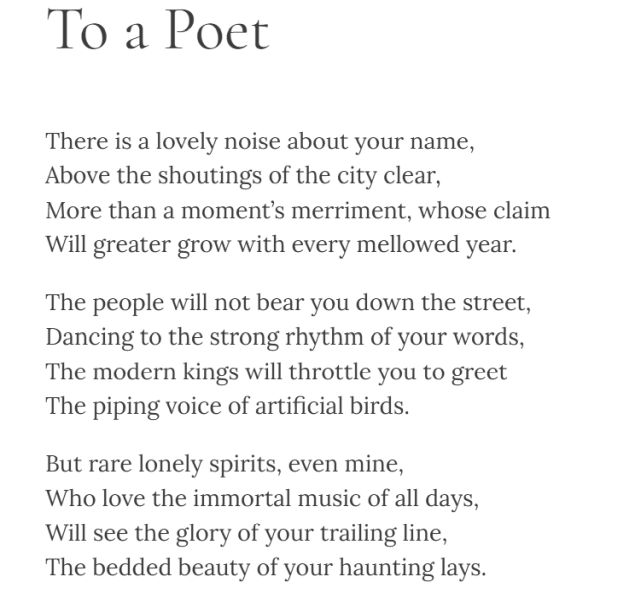
To a Poet 600


.


OK, you’re back. Who’s the guest vocalist? The stage name is Felicia. Felicia is a virtual instrument. Readers here may recall what that is, but I think it’s important to reiterate: a VI is often a set of atomized recorded samples of a real “acoustic” instrument, a whole range of notes with articulations expressing a range of colors. Let’s not confuse two-letter-acronyms, VI is not AI as expressed by services like Suno which take an overall text description of the nature of a song and create in one fell swoop the finished melodic lines of the singer (and all their arrangement and accompaniment) by apparently recombining conventional musical materials. If I take a VI of, for example an organ, and invoke it on my computer it won’t play a toccata, early Phillip Glass, or “Rock Lobster,” or anything like those pieces, no matter how I write a run-on requesting sentence about it. It instead needs me to play my MIDI guitar or little plastic keyboard, or inscribe notes on a MIDI piano roll notation. I could (as a very limited keyboardist) invoke arpeggiators or chord and pattern generators to extend what I play or write – but it still feels like composition to me. In contrast, AI like Suno feels like I’m a royal patron asking my musicians for some conventional musical noise to underscore my cultural pretenses, caring only that it be inoffensive.

Another difference: even a despot likely paid their court musicians something. AI? Not so much. The company that sells the Felicia voice VI (Dreamtronics) claims it pays the human singers that it samples to make its products.

Still, I expect this revelation, or its implementation in this piece, will repel some listeners. The spirals inside the ear have their own Uncanny Valley, and I too feel that fearful symmetry. It sounds like a human putting artifice onto itself or an artifice taunting the qualities of human. I put up with it because I had a goal, and my voice could never sing with the VI’s technique, particularly over a longer piece. I played the vocal line on my little plastic keyboard, and typed each syllable as text that the notes would sing. Early vocal VIs were very picky about needing explicit phonetic text, but this one knows much more about the baroque tangles of English pronunciation, yet I still had to tweak some syllables. The program has a range of controls for expression variations – learning how to use them will improve results – but it presents default expressive choices that keep the monotonous spiel of old-school robot speech away.**

Felicia made it much easier to get something that wasn’t fakey bad or unintelligible as older vocal VIs I’ve tried, even as I still felt the need to do work to improve problematic passages. It took me several hours to create the vocal line realization you hear in today’s piece. A trained human singer at the mic could have done it in an hour, even including leeway for retakes and “try it this ways.”

One thing I noticed: even when I had polished up the intelligibility of the VI sung text, the meaning of the words seemed abstracted to me as a listener. Oddly, this is the same thing I sometimes hear as a listener with Art Song, where the composer’s elaborate melodies or the singer’s concentration on demonstrating virtuoso technique make the words vehicles for expressing music more than shared experience. Human vocalists singing Art Song, in their own way, produce their own unsettling Uncanny Valley.

Which may bring up the question, why not just use a real singer? Yes, that would be better. I, who am socially awkward, not able to schedule a time to do my creative work, and heading-up a non-revenue Project can say that would be an ideal, but unlikely, option. Furthermore, in the process of composition I wouldn’t be able to test my musical choices as a limited singer, so there’d likely never be a score for such a singer to follow.***

Will I use a vocal VI again here? Likely, though I don’t think I’ll use it most of the time, or even often. My voice is my voice, and I feel I should use it. Still, I was very happy that I could realize this musical piece. Through the technology of VIs I was also able to play the atomic recombinations of an oboe, a viola da gamba, and a hurdy-gurdy as part of the accompaniment.

OK, so back to Claude McKay’s poem. Like his “When I Have Passed Away”  from earlier this month, McKay’s poem here speaks of posthumous poetic legacy. In the context of this month while using a computer VI to sing his words, I was much taken with the pair of lines in his poem: “The modern kings will throttle you to greet/The piping voice of artificial birds.” Maybe 100-years-ago, a prophetic McKay knew how I’d come to try to make a song of his poem using a voice of artifice under the rule of a disordered king and assorted technological barons.

You’ve already heard that song haven’t you? What, you didn’t obey the words and stop partway for the music? You’re a rebel! An outlaw! A traitor! You have one – no, two – more chances to hear my musical setting of “To a Poet:” with the audio player you should see below, or with this highlighted link that will open a new tab with its own audio player.


*Besides mundane life-chores, these increasing problems are partly from aging, and partly secondary to the folks I share my home and life with. It’s hard for me to devote regular and predictable time to this Project, and when opportunity time comes, my nature is to work on finding new words and creating the musical pieces. For some reason (aging? self-doubt?) it’s increasingly hard for me to make the social small-talk that should be trivial and expected.

**I doubt this variation of expression is heavy duty AI either. For a long time VIs have used a pseudo-random cycle of expression variations as an option in their programs. I didn’t get a sense the VI generally knew from the denotative sense of a word or placement in a sentence or musical phrase to give it a particular kind of invocation.

***A product like this, it seems to me, would be ideal for a composer who doesn’t sing well and who would like to rough out scores before an actual performance, as it might give a better quick approximation than just playing the vocal line’s notes on a piano for instance, just as orchestral composers are increasingly roughing out arrangements on other virtual instruments.

Artificial Intelligence in Music: the last wall of the castle

Just a note to readers coming here for the experience of literary poetry combined with the original music stuff we do – I’m still doing some “summer vacation” writing that breaks from that form this month. This post does deal with music – if from another angle – and I expect to fully return to our traditional presentations this Fall.

So, I’m at my frequent breakfast place on a fine August morning that has not yet reached the AQI-alert level of smoke. In an unplanned coincidence, Glenn walks in. We’d talked last week about, of all things, Herb Alpert, and his early 1960’s instrumental hits, particularly “A Taste of Honey”  which was a chart topper in our youth.*

Glenn has some Herb Alpert and the Tijuana Brass CDs, but like many he’s as likely to have a CD player as he is to have a way to play 78 rpm shellac records. He’s been trying to get their music onto his new Mac Mini, but his old USB Apple Super Drive won’t recognize a music disk.**  Somehow (likely my current preoccupation with finally writing about it) we got to talking about AI. I mentioned that I’ve been struggling to use my collection of Virtual Instruments (VIs) to realize recordings with brass instruments that capture the full level of articulation the real thing can produce.

We talked a little bit about the various ways these instruments can be controlled: little plastic keyboards, various guitar pickup schemes, even wind controllers. Glenn has a bit of engineering background – this had (I hoped) some mutual interest.

I have little or no guilt in using VIs here for the Parlando Project. Not only is a VI grand piano highly affordable, it takes up no space, requires no fancy mic’ing, and produces a pleasing sound. Given my musical eclecticism, I think of how much more cluttered my studio space would be if I continued to collect odd instruments that I would experiment with to add unusual colors to pieces. And though I can’t actually play a real cello or violin, I can use a MIDI guitar controller to add those sounds. I’m grateful for those options for realizing my music.

Then I told Glenn about the Mellotron – a pioneering virtual instrument before such a thing had a name and acronym. Rather than hard drive files containing databases of digital recordings of actual instruments playing a range of notes in different articulations like one of my computer VIs, this primitive mid-20th century machine used strips of analog tape recordings of an instrument playing a single note for each tape strip. When professional musicians (among them: The Beatles, the Moody Blues, King Crimson, The Zombies) started to use the Mellotron, some objected: could the Mellotron put real musicians out of work? When the Beatles and their producer George Martin wanted a high trumpet part on “Penny Lane,”  a real musician was contracted for and played that difficult and memorable part. But flip the “Penny Lane” 45 RPM record over and on “Strawberry Fields Forever”  Paul McCartney pressed a Mellotron’s keys to produce an eerie flute sound. Listening closely, it wasn’t quite like a real musician blowing into a real flute. It was maybe 80% there – but if it sounded a little fake to a discerning ear, one might think it was still an interesting sound, whatever its level of verisimilitude. But imagine you’re a flutist in 1967 – the Beatles could certainly afford to pay for your services. Though bands moved on to use more complex synthesizers and other devices, real instruments still retained a level of preference when their fully-authentic sound was called for.

Could I pay or otherwise record real musicians instead of using my computer VIs? It’s hard for me to imagine a cello or violin player that would accept my chaotic and self-imposed quick-turnaround schedule, naïve/inconsistent musicianship, my shifting moods, and my no-revenue-project budget.

In my defense, this human being may well be playing the instruments,  just as I play guitar: this note, here, this loud, this long. Other times I’m scoring the music the VIs play, writing or modifying the MIDI event data rather than on a music-staff leger.

Still, there are some gray (or even darker) areas. For me, that started with using arpeggiators: ways to tell a computer you want it to take a chord and play the notes within it in a rhythmic series. I can tell it what note-length to use, something about the order of the notes, but the precision is then all the computer’s – and arpeggiators will have presets to suggest, and I might agree to one. Numerically quantifying the level of plausibility of my own work is problematic, but VI technology is such that even with my limited musical-instrument-operator skills, I may approach 90% there – but my musicianship, with its intents, and also it’s limits, is still involved. I can’t help but think my brass VIs sound badly because they are so far from the families of instruments I have played in “the real world.”

But a greater temptation arrives: more sophisticated computer “players” that take a chord sequence and duration I supply – from composition or by my playing something – and augment them by playing those cadences musically in a style it supplies and I consent to. These “players” have multiple adjustments, I can (and often do) modify what they supply as defaults, but this further development bothers me. Am I still the composer? In a human-musician world the answer would be clear by well-established tradition: yes, they’d say, I’m still the composer. Professional musicians, working before computer algorithms, have long supplied “feels,” timbres, expression, and entire decorative lines. They might even revoice the chords or play extended harmonies. They will do all that (or more, or better) than my computer does for me. So why do I feel bad when I ask my computer to do this? Well, there’s the impersonality to it. I’ve worked with others who’ve made important musical contributions to work I’ve originated, and that doesn’t feel the same. While I think I would be problematic to impose this on human musicians for the rewards I can offer, there’s more to it than not offering them that opportunity. I can’t help but think I’m cheating, that these realizations are fraudulent.

Yet guilt hasn’t stopped me from using these computer functions, and you’ve heard some of the parts they’ve played sometimes in Parlando Project recordings. The term artificial intelligence is elastic, it’s become a marketing buzz-word, but these enhanced arpeggiators and play-with-this-feel-or-articulation variations could fairly be called AI – even when the same musical piece has my vocals of I-hope-for subjective-quality or my it’s-supposed-to-sound-like-that guitar playing.

That said, over breakfast, I tell Glenn about how far AI music generation has come in the past few months. Just by entering a prompt or making a menu selection, often made up of generalized summary words for genre or playing style, one can create an entire song including vocals and all the musical accompaniment. Earlier in this decade the results would’ve been overly simple or subject to embarrassing defects. Now, the results easily pass the “Turing Test” for casual listeners. If the Mellotron flute is 80% there, and my best VI violin might be 90% there, these entirely machine-generated songs are about 95% there in verisimilitude. Sure, human musicians, real composers, even avid music listeners, are forever aiming for that extra 5% of skill, originality, and listener appeal; but when I listen to these productions which can be produced endlessly in minutes of hands-off computation time, the “tells” are the thoroughly AI songs meh obsequiousness to genre musical tropes and the slight artificiality of the machine-made vocalists. And that’s a problem. Centuries of musical theorists from the days of music theory treatises written with a quill, and onward to the accretion of hardened commercial songwriting craft, have supplied all the steps in ink-stained longhand to create a coherent musical structure with predictable effects. The computer coders only have to apply a light dressing of adaptation to transfer this consensus for robotic mass-duplication. The singers would still have remained a challenge – except by a fateful choice: popular music has increasingly prized machine-aided polishing of human voices to remove the inexactness they are prone too. Ironically, what could have been the last rampart to be surmounted by AI was dismantled by meticulous vocal production and ubiquitous auto-tune before the tech-bro Visigoths arrived.

I said to Glenn over breakfast in the café “Here we are talking about a popular song released 60 years ago, one we both still remember. ‘A Taste of Honey’  didn’t have any vocals, and now AI could easily produce an entire album of other instrumental songs to surround it – and even listening carefully, I’m not sure we could tell AI from human-written and realized musical pieces.”

This is not a theoretical exercise. Streaming platforms and playlists care even less than casual music listeners about AI content standing in for human work. In some genres, the algorithm that supplies your next song playing may already be a robot suggesting robots playing robot-composed imitations of human music. The only thing holding off an overwhelming onslaught of AI slop is that we, the audience, are still invested in the erotic worship of flesh-and-blood young performers and some residual romantic veneration of the human artist. Those things may be illusionary, but even if so, those things may be our defense. Do I have any other hope to offer? Yes, there’s something else, that comes next post.

This is the author of the play “A Taste of Honey” for which
the tune was composed. Her play frankly portrays a whole range of working-class situations in ‘50’s Britain. A teenager when she wrote her play, she was 21-years-old when this cheeky interviewer interrogated her. What admireable self-confidence!

.

*As vividly as I remembered the song, I knew nothing about its origin – and while I could distinctly recall the musical sound of Alpert’s recording in my head (trumpet, trombone, and that beating drum) I also heard in my mind vocals and a crooner singing. I tried to find the version with the sung lyrics I was remembering. I likely had heard the (somewhat unlikely) version of “A Taste of Honey”  done on the Beatles’ earliest LP, but I don’t think it was that one I was hearing in head.

**If you still own that ancient Apple artifact, the external Super Drive CD/DVD drive, you should know that it won’t work unless connected directly to one of your Mac’s USB ports. Even deluxe powered USB hubs or docks won’t work–  the drive will seem completely dead when connected through them.