In 1970’s age of the Singer-Songwriter, Poet and folksinger U. Utah Phillips had an anachronistic career. In performance he might sing for only a portion of his time on stage, mixing in story-telling, verse, jokes, and his brand of political advocacy that reflected his even-then old-fashioned connections to Catholic Worker activism and the Industrial Workers of the World.* He would sing his own songs sometimes – and while he apparently didn’t write an awful lot of songs, a couple of them I know are extraordinary. Today’s musical piece, performed for American Labor Day, is one of those.
Here a video of my performance of U. Utah Phillips’ song
.
On the dusty surface of it, “On the Goodnight Loving Trail” is a cowboy song, one of the real ones that recognize that cowboy is a job title after all, not a romantic name for a gunfighter or wandering charismatic cinematic horseman. That type of cowboy song existed of course – Phillips didn’t have to invent it – but his take on the genre is sui generis. Consider the historical appropriation in the song title and the chorus’ refrain from a historical cattle drive route going from Texas to Wyoming. That trail was named for two cattle-driving ramrods: Charles Goodnight and Oliver Loving. A mere accident of family names, but Phillip’s choice to use them imbues the song from the start with elegiac affection.
Calling the aged cowboy whose cattle drive job fell to being the camp cook “The old woman” is also taken from fact. Is this gendered part of the song’s refrain an inevitable accident, or a choice by Phillips? That the song reinforces the old cook’s abrogation of manhood in a verse’s line about “wearing an apron instead of a name” says that the author wanted to underline that – it’s a choice. If this song isn’t Brokeback Mountain or the sibling of Paul Westerberg’s and the Replacements’ “Androgynous,” I’ll take the leap and say it’s maybe a second-cousin. Is it possible that Westerberg knew Phillips’ song? That’s impossible to say – the underground aquifer of the folk process is dark and damp.
U. Utah Phillips: an IWW member in the days of James Taylor and Carole King
.
I chose to present “On the Goodnight Trail” todaybecause it’s Labor Day weekend here in the U.S. This song about work ends with the ground-truth that the lot of many of us is to use up most of our life in our labors. Years ago, thinking of two specifically American holidays, I wrote this short statement caught commuting itself towards a poem:
The temple of summer is guarded by two pillars:
Memorial Day for those who gave up their lives in war,
and Labor Day for those who gave up their lives in peace.
I’ll flatter myself and say U. Utah Phillips would have liked that one if he had heard it. I did my best to sing his song. Seven years ago I did a musical performance which included these three lines about The Temple of Summer, and if you haven’t had enough Parlando Project music after the video above, here’s an audio player below to play that performance as we ride up to the gates of autumn this weekend.
The responses invoked by so-called Artificial Intelligence are a complex mix. Expressed feelings recently would include any of the following in any combination: disgust, fear, ridicule, outrage at theft of Intellectual Property, and charges of tech-bro over-valuing. Let me say at the outset that I have caught myself feeling all those feels too.
I’ve planned for some time to write a post about AI here, and this summer period when I feel free to take short holidays from our usual music/literary focus would be a good time for it. Then this morning I read this post by a blogger/teacher/musician Ethan Hein,* and I’ve been driven to start this long-delayed, provisional, and likely incomplete post on the subject.
What Hein wrote isn’t extraordinarily provocative. “I understand the impulse to decorate your newsletter with AI slop images but when I see that, it makes me assume that you don’t know what you’re talking about.”
If I’m not a proponent of AI, why would that motivate me?
Well, for one, I could be found guilty of the failing he uses as a marker of knowledge. And if my energy holds out, there’s more than that to say.
THE MATTER OF IMAGE
As the Parlando Project moves into its 10th year, how I work and present things has been a learning experience for me. Some years back I noted that images in blog posts increase new visitors to this blog. Now, the Parlando Project is a poetry/varied music thing, and a great many of the casual visitors don’t become regular readers or listeners – but some might.
Given that I’m an abysmal visual artist, I began using this way of finding images: public domain pictures or (I hoped) benign reuse of images found on the Internet. This is a more complex subject than I’ll go into today, and I know enough to know that as a courtesy or strict matter of rights, I’ve likely sinned in regards to crediting images. The Parlando Project isn’t even a non-profit organization at this point – my plan from the start was deliberately to be a non-revenue thing. I want to spread knowledge and outlooks and to promote other people’s art. I certainly don’t want to remove value from others’ art.
The original attempts at figurative AI illustrations that I saw were ludicrous. I knew there was this thing called DALL-E, and its warped and poorly detailed images others shared seemed to have come straight from the Island of Misfit Toys. But in 2022, I was made aware of a new option. I’m a long-time user of the Adobe Audition audio editing program, and Adobe had a new product offered for beta-testing called Firefly. Firefly claimed to produce better AI illustrations, and it also claimed this Unique Selling Proposition that, AFAIK, has remained unique: they said it was trained only on art whose creators had been compensated for.**
The very first image I used from Firefly actually pleased me. I did modify it, but it worked for illustrating the musical setting of the poem I was presenting, Hey, I could use something like this, I thought.
This acceptance of the tool was reinforced by my decision to present videos some times. While a blog post needed only a single illustration, having something germane to put up against the linear flow of a video asked for multiple images to fit different points in the song.***
I think this was the final Parlando Project use of AI-generated images to illustrate this very short Emily Dickinson poem’s “lyric video.”
.
Over about two years, I continued to use Firefly. My experience was mixed. No matter how much care and detail I tried to put into the prompts I often couldn’t get anything like what I wanted. I’d resort to 20 or 30 tries to get one I could charitably use. Afterwards, I’d sometimes wince at what I accepted and included with Parlando work, but I have a policy here of leaving work up “warts and all.” But I did write “mixed.” Just like that initial image that I used of a purported dancing William Carlos Williams, some of the ones I got from Firefly pleased me, and I hope pleased audiences. Maybe someone now sees a poem in a different light, or checked out some music they otherwise wouldn’t have heard.
A combination of things turned me away from AI-generated illustrations. The amount of time to go through all those bad results to pick the sometimes barely acceptable one bugged me. I could use that time to read or research more on poets and poetry, or to make somewhat better recordings! And partway through my use I started to read the charges of extraordinary energy use by datacenters generating AI.**** While I didn’t make some hard and fast decision, my Firefly use just tailed off. Now in the past year, the outrage against AI has grown, particularly from artists in various fields. If my personal energy holds out and I continue to write on this, I’ll get into more detail on those concerns and theorizing around AI, but those concerns are genuine feelings about genuine threats.*****
.
Which leads me to my personal concern, one I had reading Hein’s honest and informal opinion. I’m nearly willing to join the pitchfork and lit torch brigade marching on the AI castle, and I share their concerns. But for around two years I was up in my energy-dense lightning-powered lab twiddling the dials to generate this – well, yes it is, isn’t it – monster. Look, villagers, I didn’t intend to drown the little flower-picking girl – I was just trying to juice up my low-budget poetry/music blog. I actually had moments of pleasure when the monster grunted semi-intelligibly!
I made a short reply to Hein this morning, he clarified that his statement was more of a vibe thing. I understand – I make those suppositions too. This post is, in so many words, asking for mercy for using AI image generation. If posts on AI here continue, what I’ll write will get more complicated yet, but that’s enough for today.
.
*Hein has a wonderful way of writing about the theory and practice of musical composition. I’m grateful for the things I, an untrained and largely naïve composer, have learned from what he’s written. His particular specialty is examining (with practical examples) the disconnect between the venerable Western/European musical tradition and the way music is realized here in modern America. Currently he seems to be pivoting to podcasting his information, but links to his work are here.
**Presumably, Firefly’s source material was Adobe’s stock art library.
***I sometimes ask myself why I don’t just do a single still image and leave it at that in my videos. After all, there are many YouTube videos that do only that for music-centric content. Despite my love for spare, concise poetry, I speculate I’m just a maximalist with the arts that I’m not knowledgeable about.
****My first thought reading those energy estimates was: what is the methodology to determine how much energy draw was due to AI? I’m an old IT guy. If one has full access to all the systems, and wished to log the amount of CPU and access time for each sub-process running on them that they knew pertained to AI, then one could make a reasonable estimate from that mass of information as a proportion of the total energy drain of the entire facility. I couldn’t imagine anyone writing about the astronomical AI heat and energy drain had such access. They might have some sense of the total for a particular facility, but I’m unaware of any facility that only does AI processing. Facility A may use a whole lot of cooling and electricity, but how much is for transcoding cat videos, searches for what actor played who in that movie, and order processing for Labubu orders? Did someone use estimates from proposals? It would be easy to imagine that any engineer asked to create energy and heat needs for establishing AI at a site would be encouraged to spec high.
That said, total energy costs for our modern computerized world does seem to be increasing, and AI does seem, at this time, to be remarkably energy-demanding.
*****What did I do instead? I think I’ve had less weird or imaginative blog illustrations recently – that’s a loss, if a survivable one – and per Hein, the cheesiness of some of them might not have helped. For videos I’m subscribing to a product that offers a portion of a leading stock image library. My report: there are plenty of times when I hate a not-quite-right stock image as much as any AI fresh-off-the-slab monstrosity. And I worry that those stock image libraries may soon enough include AI-generated images.
If you are reading this post and think, “But he didn’t say this! That’s the key point.” I may yet get to that.
I’m not one to closely follow religious matters, though many poets over the ages have — the history and the weight of all that combined belief and its inconsistent practice is considerable. I did have an interval as a youthful churchman of the Protestant kind, attracted by the community bonds and social activism of the Martin Luther King era,* but it was recent reading of those fresh drafts of history that we call the news that brought the selection of a new Catholic Pope to my attention. For a moment my country was caught up in ancient offices as a break from the depravity of our domestic head of state.
So, first the death of the serving Pope, then the mourning, then the secret conclave in its smoke-emitting room, then the new Pope and the follow-up consideration of his background and concerns — extended this time by his North American origins. My BlueSky feed of wits supplied me with humorous predictions based on Bob/now Leo’s Chicago origins, but the pedant in me snorted most heartily when I read this news service summary of Leo’s biography explaining that he was a member of the Augustinian Order, monks with a call to service and piety. The wire-service, no doubt constrained by the spread-so-thin-the-bread-tears nature of modern journalism, informed its readers that the Augustinians were founded in the 13th century by Saint Augustine.
I have no idea what the titrated level of history buffery is within my treasured readership, but they were off by near a millennium — St. Augustine being a 4th century North African early church father! The medieval founders of this order of monks were looking back to late Western Roman empire times for a guiding light.
The Parlando results of my guffaws? I thought of a song that abides with me that I found on one of the first three record albums I bought as 1967 turned into 1968: “I Dreamed I Saw St. Augustine” from Bob Dylan’s slightly undervalued LP John Wesley Harding.** Dylan was on the face of it no more accurate than our news-service scribe. His apparition of St. Augustine is a troubled man, as many spiritual people are, and he briefly charges us with his preaching in the song, but Dylan’s Augustine is also specifically a martyr who was put to death, presumably by the authorities. Unlike many saints, Augustine of Hippo was not a martyr. While Augustine’s town was under siege by Vandals (the original ones, doing business as that tribal name not as members of DOGE)*** he died an old man from natural causes.
Dylan’s song is brief, brevity being an unusual virtue Dylan exercised in all but one song on John Wesley Harding. And yet he was bringing history into the three verses, no choruses, no bridge song structure of his song. Within his seeming historical inaccuracy was his choice of a borrowed tune. “I Dreamed I Saw St. Augustine” uses the melody and the structure of a 1930s song setting by Earl Robinson of a 1920s poem by Alfred Hayes**** about a man put out to death in 1915: “I Dreamed I Saw Joe Hill Last Night.” I believe Dylan clearly meant to link the two men, in the way that dreams can combine things we never see in waking hours.
This song, and Dylan’s performance of it, has always touched me — and so having the coincidence of Augustinians being in the news, and the hopes that the new Pope may preach to our current overly-gifted Kings and Queens, I went to record myself singing this song of a remarkable comparing. Since it’s a copyrighted work, I present that performance today as a YouTube video. The few-hundred views one of my videos might gather would not make even a widows mite, but it’s my understanding that any revenue gathered from those annoying YouTube ads can be claimed by the rights holders. For my video I mingle artists representations of Augustine and Hill. If you can’t tell, the photos are Joe Hill and a news photo of a memorial march for him in 1915. Our 4th century Augustine was camera-shy, and has to be represented by artists’ paintings.
.
*My youth included a couple years working at a hospital still being actively managed by an order of nuns in those days.
**In search of more footnotable connections: was it coincidence that the then considered inscrutable cover of the LP has two Bengali Baals, singers in the tradition of the first songwriter to win the Nobel Prize, Rabindranath Tagore. Surely the Bob Dylan of 1967 didn’t know he’d eventually be the second. Another connection: Joe Hill was a songwriter who sang for union organizing meetings and “He who sings, prays twice” is a saying attributed to Saint Augustine.
***Augustine’s writings include thoughts on The City of God that may survive the fall of empires. Shortly after Augustine’s death, the Vandals sacked his city. Stories have it that these Vandals were impressed by Augustine’s learning, and spared the library he had established there. The current ones aren’t up to that level of civilization.
****Hayes had a long writing career. Wikipedia tells me he was an uncredited screenwriter for the famous Italian film The Bicycle Thief. It also claims he wrote a script for The Twilight Zone, but IMDB doesn’t confirm that.
I’m trying to decide between work on finishing a new Parlando piece combining literary poetry and original music, and seeing what I can do for a February Black History Month observance here. The first is mostly done, the latter is but ideas at this late date.
What to do? In my typical direct approach, I did something else today. This weekend I watched Timothée Chalamet appear on Saturday Night Live as the musical act on the long-lived sketch comedy television show. Chalamet is fresh off an acclaimed performance as the young Bob Dylan in the film A Complete Unknown.
I mostly liked that movie. Biopics are always dodgy things to do, as most people’s biographies when told straightforwardly do not have enough dramatic concision to make a compelling two-hour film. Which means they all have fibs in them, and they will perforce leave things and people out. It’s become an apparently unavoidable cliché to remark on this element by quoting a line from another film, The Man Who Shot Liberty Valance: ” When the legend becomes fact, print the legend.”* This misses the point of John Ford’s great film. When that line is uttered near the very end of that movie, Ford has shown us a compelling tale of a man, played by Jimmy Stewart, who had many great things about him, a man who at the end of the film had risen to become an honored Senator, a plausible Vice President even — but Ford also told us of another man, played by John Wayne, who may have been less interesting as a biography, but whose acts are critical to the movie, and who gave up more than legendary fame when making his choices. Ford isn’t praising that “print the legend” eventuality. Ford’s film prints “the fact.” He thinks that’s more interesting.
A Complete Unknown tries within conventional running time to tell a complex story: of a young man who’s forming himself — not so much finding himself — as he wants to be unfindable. Instead of doing a “great man” tale, it wants us to see the other folks around him, lovers attracted to and understandably frustrated by Dylan; and a pair of men: one a businessman, the other a saint of citizenship (Albert Grossman and Pete Seeger). In between these, Johnny Cash plays an imp of the perverse. That complex tale is told at a brisk pace. I was able to forgive that. Yes, there are characters undervalued, incidents re-arranged in the timeline — but in the movie’s defense I’d say it couldn’t be otherwise, there were just so many talented and interesting people in that time and place.
And then we got to the final incident, the film’s climax. Here time is suddenly allowed to expand and we are given more detail about something that lasted maybe 48 hours in real time. Some of that detail is accurate, much of it is not. Most of the inaccuracies are aimed not to expand the complexities of the relationships and times, but to simplify them and underline a simplistic point. Finally, the movie has introduced all these characters, and this is the place where the earlier parts of the film are exposition, and you can get them to fully spark and rub with their differing viewpoints. Instead, that doesn’t happen, you get instead a rock’n’roll pantomime, with caricatures shouting and everything but a pie-in-the face fight.**
This is not the fault of the performers though. The cast does a fine job, and before his actual work could be seen, Chalamet’s ability to pull off his performance as Dylan was generally doubted in online forums of musicians and music fans. He did fine, and as the movie publicity has informed us, he “did his own stunts” by learning to play guitar and harmonica and to sing live, and this led to this past weekend’s choice for him to appear as a musical act.***
Again, Chalamet exceeded expectations. His opening Dylan song, “Outlaw Blues,” (done as a rap-chant with Jack White/Black Keys-like elements in the ensemble) was fresh and effective, including that Minnesota call-out to being “9 below zero at 3 o’clock in the afternoon.” Even more surprising was Chalamet immediately going down-tempo with a real rarity that would have stumped all but the deepest of the deep-cut Dylan fans: “Three Angels.” It’s a brief song from a now little regarded Dylan album New Morning. It seemed a throw-away even in that less-celebrated collection, an off-hand narration of an urban winter scene post-Christmas. From my Parlando focus, it attracts me though. It’s got some elements of one of poet Frank O’Hara’s “walking around poems,” that paying attention to what we are not usually paying attention to mixed with a casual surrealism. Everyone in the song seems a non-sequitur somehow, and why does the truck have no wheels, why is the cop skipping? Three fellas are “crawling back to work” under the same number of angels playing silent fanfares in snow, and we may not know if those three are wise men or not, as nobody stops to ask why they are going to work. Here a link to his set of performances.
So, I admire Chalamet’s taste in Dylan songs there. Perhaps if he lives to my age he’ll also be good enough looking to play me in my biopic. But watching his performance my ego remembered that decades ago I did a cover of “Three Angels” myself, one done early in my ability to overdub parts creating a one-man-band on a recording. Today I found the recording and made this short video to present it.
I think I did this recording on a “portastudio” cassette, or on my first computer-based recording system.
**If you really want to know the complexities, I recommend the book which the movie bought the rights to: Elijah Wald’s Dylan Goes Electric. I thought I knew all the details of the film’s famous climactic Newport Folk Festival scene, but I learned stuff from Wald’s reporting and extensive context on the “folk scare” American folk revival. Sure, 99.5% of the folks who watched the movie will not benefit from getting this book, but the .5% who would, need to read it.
***In the post WWII era, there were a lot of poets who in their dreams wanted to also be musical performers. Easy to see why too: poetry was a small cultural sideline, but for much of this era it was possible to become highly popular and well-paid as a “rock star.” It’s less acknowledged, but the same could be said of some actors — despite the fame, adoration, and income levels achievable in commercially successful acting being roughly equal to popular musicians. In 2025, I believe this is less often true — more and more professional musicians these days have meager incomes. But there may still be some desire to play Orpheus in real life among a sub-set of actors.
What do I think? I think poetry and music are kin, and if my thought-dreams could be seen they’d probably put my head in a guillotine. And despite the fame level of Bob Dylan, Chalamet is helping Dylan’s art by illuminating it. Good on him.
There’s new Parlando stuff coming. Indeed, there would already have been a new piece with words by Emily Dickinson this week if it wasn’t for a couple of issues.
Issue #1 was with a new, upgraded Macintosh computer system which handles most of the complicated recording stuff I do for this Project. After working beautifully the night before, the next day it was nearly unusable. I first noticed the mouse wasn’t working well — or a times, at all. I use wired mice, as I’d have no patience with Bluetooth gremlins — but still and all, maybe that mouse had gone bad? I swapped in an old one (I’m a packrat of old computer stuff, so I had a spare handy). Mouse back to working. But then the keyboard was nearly unusable, being extremely balky at registering keypresses. It was so bad that logging in again after rebooting the Mac was a challenge.* Keyboard dying too? Tried a different keyboard. Same deal. I even tried booting the Mac into MacOS safe mode, which for some reason caused a kernal panic with a crash dump rather than completing a boot into that version of the operating system that’s a fall-back stripped to just the basic stuff. Was my new system demonstrating an internal hardware issue? Besides the nearly unusable keyboard, the whole system was slow, even though the system monitor showed plenty of resources available.
I wondered how much time would be wasted getting warranty service or restoring my complicated music creation environment. And then I noticed that my Time Machine backup drive was no longer mounted — or recognized as a drive in Disk Utility either. Would a warranty replacement Mac be able to transfer my stuff back from that backup? The last Time Machine backup was logged early that morning, then nothing as it had no drive to back up to. Additional worries: that drive might have checked out for good.
There’s a large overlap in musicians with folks involved with computer technology, but since that Venn diagram convergence is much slighter for poetry, I’ll cut to the solution.** At some point I power-cycled the powered USB hub that holds most all the USB stuff that my kind of music production needs: two software protection dongles, two MIDI interfaces, a little plastic piano keyboard, an audio interface, that Time Machine hard drive, and a charger cable for my MIDI guitar. Mind you, the mouse and keyboard were plugged directly into a USB port on the Mac itself, not into this hub. And —
Everything returned to working normally. How a USB hub plugged into a different USB port from the one used for the mouse and keyboard could all but disable them, as well as causing the other issues, is beyond my knowledge level.
Large, powered USB hubs are not a common in-stock item in local stores, but just in case the issue with mine might return, I ordered a spare. It would be at a will-call desk the next morning. I’d pick it up along with my weekly major grocery run.
Issue #2. A member of the household awoke in clear emotional distress and was unable to talk about it. I thought it best to stay home. I told them I loved them and would be here if they needed me. I spent much of the day worried and concerned, but puttering around in case there were any needs that would emerge. By the middle of the afternoon they were better and talking (though not about the issue that had struck them earlier). They asked for their favorite take-out quesadillas.
I made a quick trip and grabbed the spare hub and that requested late lunch. Issues. Problems. Things don’t always work, sometimes they shut down and don’t tell you why. My late wife worked as a mental health therapist before her mortal illness. I worked decades in hospitals, then another couple of decades in IT. Some people think poetry is difficult, that it taunts you with its obscurity. Maybe so, but life does that too. Spares are difficult for us human beings. We wear and wear-out the ones we have for the most part, learning to use what we have at hand.
I would return to my studio space this morning to continue Parlando Project work. I’d read the night before that the songwriter Melanie had died, I learned of her death in a modern way that somewhat famous strangers have their fortunes told now: by folks speaking their name in past-tense on social media. As I was awaking, with my aim to record at dawn, I read a post by one of those I follow mentioning that they had a favorite Melanie song: “What Have They Done to My Song, Ma.” Myself? My favorite Melanie is likely her cover of the Rolling Stones “Ruby Tuesday,” or maybe even her big hit fronting a gospel group, “Candles in the Rain.” But “What Have They Done to My Song, Ma” is a fine song, maybe better than you remember it, if you remember it.
I sat at the mics alone, and I decided to sing that song before recording a new Parlando Project piece. In the moment I found it to be about folks attempting to fix you, or make you fit with them and their expectations or needs. That’s not always bad. That’s not always good — which is what this song feels.
This is a video as it’s my understanding that if any appreciable streaming occurs (unlikely with my fame and impeccable musicianship) that the rights owners would be paid by YouTube. Back soon with that Emily Dickinson song-setting.
.
*Yes, I worked in IT. Yes, I’m capable of asking myself “Have you tried rebooting?”
**Early in the days of home computers, SF author Jerry Pournelle had a monthly column in Byte magazine which aimed to cover the emerging field of personal computing, but more often than not, it instead dealt with some problem with a computer system in his household. In the early days of BBSes and dialup online services, there’d be lot of chatter about how this guy who got paid to write about stuff in a glossy magazine didn’t know some detail that was sure to have caused his problem right away. Best as I can figure, something inside the hub itself was “stuck” and no amount of unplugging the USB cable from the Mac, or plugging the devices in an out from the hub, helped until the hub’s own power supply was cycled.
This is going to be a sort of catch-all post following up on a variety of things. And speaking of catch-all, it’s Willie Mays’ birthday today,* and at the end there’s a recording of an early LYL Band performance of a Dave Moore song celebrating the great center-fielder.
I want to start off by saying that I plan to write something regarding the welcome and thoughtful response about translation Teresa Pelka left here a couple of weeks ago. Hope to have that here soon.
Next, I want to thank those of you who stuck with the experiment/new thing during April Poetry Month where I did daily posts which included some of my favorite pieces from the early years of the Parlando Project with short new accounts of how I view them in 2022. Many of my regular readers/listeners hadn’t heard some of those early pieces. On the other hand, I worried too that that much posting, that many audio pieces, could overwhelm some people.
I’m up to around April 25th in catching up with the blogs I usually follow. I’m too often a week or two behind, but I missed all of your own posts in my being “away” for National Poetry Month on my adventure.
Besides the “classic pieces from the early years” posts I did two other different things this April. The most easily noticed one was the lyric videos. I had noted that my teenager does a fair amount of searching for topics inside of YouTube itself, and sometimes follows algorithm suggestions for other videos, and since a large part of the readership of blog posts here comes from general search engines, I wanted to see if the YouTube audience might bring some new eyes and ears to this.
Did that work? Hard to say. YouTube analytics say that I didn’t get to a thousand views in the month, but I doubt they count the views of the embedded videos in the blog posts.** The most popular video as far as YouTube counts was Yeats’ “He Wishes for the Cloths of Heaven” at just 33 views, but the effort may have a long tail, as some older videos of mine have slowly picked up views over the years. Having 30 videos of various kinds of poetry and music on YouTube at least gives something of a representation of what the Parlando Project does for those who happen upon it.
I thought I could knock off the lyric videos quickly. “It’s just a lyric video” I’d tell myself, but I kept getting interested in the limited toolset of the software I was using*** and wondering how this or that could be used. And I started wanting to include more and more relevant pictures behind the lyrics after the first couple of them, which led to rapid but extensive searches for pictures. One thing I feel bad about: I don’t have my wife’s photos (the better digital photographer in the family), or even my own, handy for quick search and retrieval, so I ended up under time pressure sometimes using other people’s work without giving the photographer their due credit. Photographers in my audience: my apologies to your art, and if I ever do successive lyric videos expect to see credits.
The less noticeable thing I tried — and that less-noticeable result was particularly disappointing — was that I became Twitter-active during April. I tweeted multiple times many days, and tried promoting the pieces with tweets embedding the blog post link and/or the video. Neither link drove any traffic to speak of. With YouTube the views on Twitter may have been invisible, but the WordPress blog post analytics tell me if someone read a post via a tweet link, and I don’t think I got into double digits for the whole month. The tweets themselves didn’t take as much time as the videos of course, but that wasn’t all. During the month I also monitored #NationalPoetryMonth hashtag tweets — reading many, liking those that gave me something I appreciated, replying to some that I thought I had something to say about, and at least skim-glancing the rest. That this was humanly possible to do says something about how skimpy the Twitter National Poetry Month traffic was by Internet standards. Yes, hundreds of #NationalPoetryMonth tweets a day, but I also monitored three “Day” events during April: Arbor Day, Anzac Day, and International Jazz Day. If Arbor Day swamps the number of tweets over National Poetry Month traffic that tells you something (Anzac Day was even heavier, I couldn’t even skim there were so many).
I think Twitter works if you already have a large circle of acquaintances and want to keep them at least minimally engaged, but I can’t say that it works well to grow that circle. I wasn’t the only one sincerely trying to promote poetry on Twitter in April, and it’s possible I wasn’t the best at it, but from watching not just myself but the others using the #NationalPoetryMonth hashtag, I’d say Twitter was non-rewarding in promoting poetry via #NationalPoetryMonth.
I probably worked full time every day of April on these things, part for the adventure (which I received) and part to grow the audience for poetry and this Project (results mixed, some may be yet to come).
Well, I promised Willie Mays, and you shall get him in the person of Dave Moore’s exuberant piece from the middle 1980s recorded with Radio Shack microphones and battery powered mixer, a cassette tape recorder, and drums via me pounding on a four-pad Mattel Synsonics Drums electronic drum toy from the era. How did I play the drums and the guitar on this? I would pound out the beat and record it onto a second tape recorder first, and then press play while the rest of the band joined in with their parts. Dave’s on keys, and the bass player is Dean Seal.
Something this very short clip doesn’t show you. There were 2 men on base. You see Mays throwing the ball after the catch from that deep a center field and it was fast and on target to the 2nd baseman. The opposition batter who hit that didn’t even get a sac fly RBI out of it!
.
I “remastered” this this morning from a stereo digital file I took from the cassette 20 years ago, but there’s only so much help I can give it. I like the way Dave tells the story though, and maybe you will too. Player gadget below where it can be seen, and this backup highlighted link for others.
.
*Experience has taught me that baseball-related posts here get a very low interest. I understand somewhat — my interest in the game has dropped since my youth too. Still, Willie Mays was a baseball hero of my youth, and he was a very good centerfielder who could hit, run, and go and catch the ball in the strangely elongated center field of the New York Giant’s Polo Grounds stadium. Shaped like a very deep U, the deepest part of center field was nearly 500 feet from home plate, and the gaps a “mere” 450 feet or so. “Two-thirds of the earth is covered with water. The rest is covered by Willie Mays in center field.” Oh, and a super-tangential link to the name-alike baseball player to poet Ray Dandridge we featured last month: Ray Dandridge the baseball player played for the NY Giants high minor league team in Minneapolis for several years. One of the young Afro-American players he took under his wing: Willie Mays.
**It doesn’t appear the count includes views of the embedded videos you saw inside the blog posts here, and if you’re like me that’s how you view the videos in web posts, because viewing them on YouTube itself means you have to sit through at least the start of an ad or two in many cases.
***I started using Windows Movie Maker, which is slow, a bit buggy, and has been unsupported for several years now. I moved over to Apple’s iMovie on the Mac, the latest version of supported software from a huge company that is supposed to be very aligned with art and artist’s needs. I found it indistinguishable from iMovie versions of several years back, incredibly simplistic and simpleminded in how it treats text and typography, and yet because it was running on a nearly decade newer computer than my Windows desktop, faster and more responsive — and I found I needed that doing a video a day along with everything else. One other thing it became fast at during April: complete and utter lock ups of the Mac that would be followed seconds to a couple of minutes later by an unbidden computer reboot. This would happen when editing/creating pieces, particularly when I was trying to work rapidly, and other times when rendering the video. This was very frustrating, and I can’t understand how a company with Apple’s resources would produce application software running on its own operating system on its own hardware that could produce a crash of the entire system and an unbidden reboot like I was some 1990’s computer. Bizarre. If you ever find yourself in this kind of iMovie situation, the old “dumping prefs” thing seemed to help, and I went to a planned reboot before every render by the last half of the month.
You might think we’d need do nothing but what we usually do — after all, we’re always celebrating poetry here. We have over 600 pieces you can find in our archives, performances that combine words (mostly poetry) with original music we compose and record ourselves. But here was my problem as April arrived: time to compose new pieces is inconsistently available.
So, I’m going to lean on that collection of pieces we’ve done and make this also a celebration of what the Parlando Project has done over this past 6 years. My plan is to regularly repost pieces from the first half of our history this April. For many of you who joined this Project already in progress these may well be pieces you haven’t heard, but an additional goal is to introduce new listeners to these audio performances.
Why do that? Readership of this blog, originally intended as brief “show notes” for the audio pieces, has grown tremendously over the past year, but the audience for the musical presentations has increased only by a small amount over the same time. I’m hoping to capture more ears for those performances and the poets whose work we interpret, sometimes in surprising ways.
To gather more ears I’m going to be making new low-budget YouTube videos for these classic pieces, mostly just “lyric videos” that display the poet’s words we are presenting. Most new people find us via search engines, and my wild guess is that putting things in front of YouTube searchers may bring more listeners and readers.
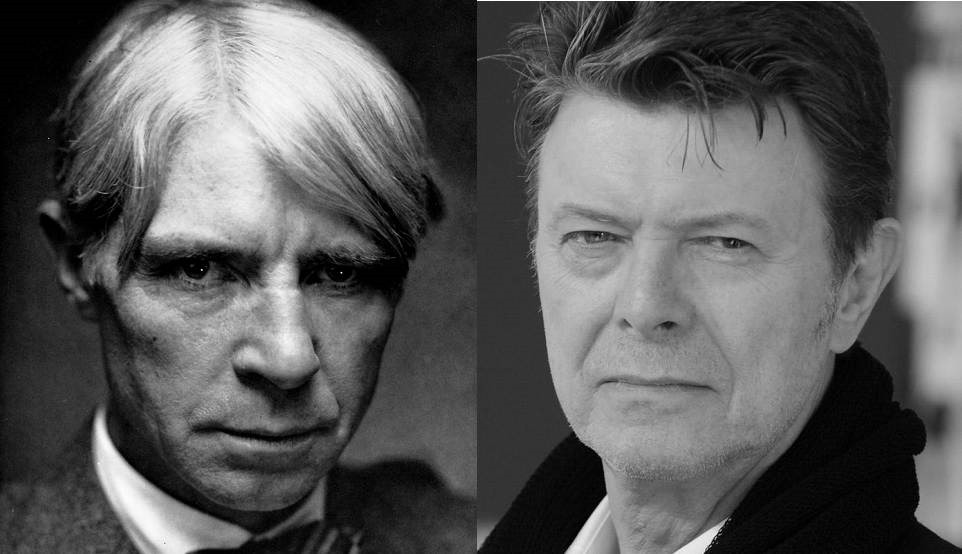
To begin this series? Why not use the first piece from this project’s official public launch in 2016: Carl Sandburg’s “Stars Songs Faces.” Speaking of strange, The LYL Band performed this on January 11th 2016, the day after David Bowie died. Carl Sandburg didn’t have the opportunity to prepare a eulogy for Bowie, since that American poet died in 1967, but back in 1920 he wrote this short evocative poem that we used for the words in this performance. Spookily, Sandburg’s poem presented this way makes it seem like he did write a eulogy for Bowie. And to eerily evoke that short time when both Sandburg and Bowie were extant, the music makes use of one of The Sixties most distinctive sounds: the wobbly Mellotron that could sound like a string section whose batteries were running down.
“What will I be believing, and who will connect me with love?” The young Swedish-American and the star with songs and faces.


 Frank Hudson