In my roundup of World War One War Poets earlier this week for the upcoming centenary of Armistice Day, I only mentioned Edward Thomas in passing. He shares the military service and the battle-related death of the others, but his writing about the war is different. Though he was working on notes that could lead to poems during his short front-line service, I’m unaware of any Thomas poems that tell of his experiences of battle. Many of his poems instead deal, intentionally, or inherently in their time’s context, with the change in norms that the war brought.
A poem like his much loved “Adlestrop,” if read in the context of the war’s coming outbreak, speaks even more intensely of the peace and unnoticed wonder that pauses in the muddle of an unscheduled train delay.
“Adlestrop” doesn’t mention the war though, and it’s based on one of Thomas’ journal entries from before the war. On the other hand, a poem like his “Gone, Gone Again” speaks intentionally and masterfully about the changes in his beloved countryside “before the war began turning young men to dung.” His highly condensed “In Memoriam, Easter 1915” is another that intends to mark the war’s changes.
Edward Thomas, a British nature poet that events bent into a War Poet
If you look at a continuum* from his “In Memoriam” through today’s “The Owl” to “Gone, Gone Again” you can see a journey from a short and moving, though impersonal, elegy/pastoral through “The Owl’s” introduction of a linkage of his own corporal experience to those on the front, and concluding with the even more personal and aching conflation of his own state with his country’s situation in “Gone Gone Again.” For this reason, I’m going to put the audio player gadgets for all three in the post today, so that you can follow Edward Thomas’ journey as he decided as a middle-aged family man to enlist—volunteering for the front-lines, and his eventual death.
Here’s “In Memoriam (Easter 1915)” as Thomas begins to weigh the costs of war.
And this is today’s new addition, “The Owl.” It’s not important to the poem, but the pendant in me wanted to know what species of owl Thomas heard. England helpfully has fewer species of owl than North America, so it must have been a male tawny owl, as the other candidate, the barn owl, has a screechy call that couldn’t have been cast as melancholy.
And finally, here’s “Gone, Gone Again.”
*I don’t actually know what order that Thomas wrote them, or even if “The Owl” was written before the war, as some particulars of the journey he describes echo the book he wrote about a bicycle tour he took from the suburbs of London to the border of Wales in 1913. But for performance reasons, seeing the three poems as a narrative seemed defensible to me, or at least no more anachronistic as having the artificial tang of Mellotron strings and flutes to stand in again for England in the music.
We’re entering a month in which Veterans Day will be celebrated with additional ceremony, because the 11th will be the 100th anniversary of the ending of the first world war. Earlier in the blog I remarked that World War 1 was the last war which was substantially narrated to us by poets.
That’s so for a complex set of reasons. Modernism, arising before the outbreak of the war, sought to revive a fresh poetry shorn of worn-out imagery and obligatory practices. The war brought both the old poetry and the new Modernist ideas into a great deadly laboratory to test their efficacy. The comfort of the old poetic music survived this test, but it was gravely wounded. The new practices were not exactly proved either, such was the horror and absurdity of the war. Indeed, the post war Modernism that came out the other end of the war’s meat grinder was oddly often much more obscure and seeking after esoteric tactics.
To a large degree, the post-WWI era marks an off-ramp for poetry. 20th century poetry emphasized the language of aesthetics and philosophy that might employ music to sweeten its sound, rather than the music of words that might employ philosophy as one of its harmonies. Eventually, by our current century, it turned again, and it is now largely about memoir and the establishment and explanation of personal identity.
World War 1 broke poetry, and in it’s wake, the Modernists ascendant decided the shards better reflected reality than some dusty Grecian Urn.
Any of these schemes can work (and not work) artistically, but there is a sort of hierarchy of needs and audience here. The old poetry was more universal, the post WWI High-Modernism the most exclusionary, and our current poetry can result in a multitude of voices crying “I’m here!” to the exclusion of “I see you!”
If one sets aside modern literary poetry, the old poetry still survives. One place you might find it is in the library that some carry about in their heads: memorized poetry. How rare is that today? I cannot say, but I can recall late in the last century, observing Garrison Keillor offering some prize (an autographed book? a T-shirt? I can’t recall the exact prize) to anyone in an admiring crowd who could recite a poem of more than 8 lines. I recall no one taking him up on that offer. Poetry started with those libraries in our heads, and we have the Iliad, the Odyssey and other ancient poetic epics because of prodigious memorization before writing. It isn’t just the noise from our glowing palm screens, or giant TVs that numbed this out of us, it started with the silent racket of all those printed books that call us to read them. Memorization seems a mooted point.
Can you pick out the veteran in this picture?
But returning to that portable library in our heads, and returning da capo to where we started. Somewhere near the middle of the 20th Century, a U.S. Navy pilot was captured and imprisoned by the forces of the country they were bombing. Their captors were none-too-restrained in their treatment of their prisoners, torture and physical abuse was part of that; but in-between that and the constant lack of control that all prisoners face, the prison was made up of small solitary cells with deliberate and extraordinary limits on communication between the prisoners. The design was to break their will, not just their bodies.
The captured pilot was John McCain, who survived this and later went on to a long political career, but one thing that he said helped him persevere in his prison was another captured pilot teaching him a poem by Robert W. Service, essentially loaning out a book from the library of one prisoner’s head to the other. And the method of doing this was painstaking: a pseudo-Morse-code of taps on the wall of the cell that the prisoners devised.
Robert W. Service poems would fit well into taps, as his marching poetic feet can make one tap involuntarily—and the rhymes and narratives give a good structure to assist memorization too. Of course, this was a war prison, it wasn’t a graduate class in Modernist poetry, and if any of the prisoners might have known T. S. Eliot’s “The Wasteland” they might have skipped it if they couldn’t add the famous published edition’s footnotes in tap codes.
Other than Service’s poetic aids to memorization that let his poetry be present in these solitary cells without possessions, another reason that it should be a poem of his that helped these prisoners endure is that some of Service’s best-known poems are about fatalistic endurance leavened by dark humor. Service’s poetry wasn’t just available without paper, it shared an outlook that helped sustain the prisoners.
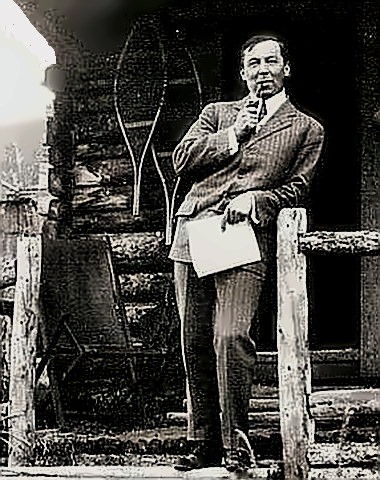
Canadian poet Robert W. Service, not essaying a look that Leonard Cohen would own up to.
So that’s one veteran’s story from a war, decades after WWI. Here’s another.
While McCain was imprisoned, another Navy veteran went into a studio in New York City and recorded an LP of Robert W. Service poems set to music.* While Service’s pre-war “Canadian Kipling” poetic style hadn’t changed, the outlook of the poems used in this record included Service’s rage at the horror and lies of WWI. Robert W. Service didn’t become a Modernist poet, but he showed in these poems the same WWI impact that broke other pre-war poetic outlooks.
The veteran in this case was “Country Joe” McDonald, and even if these Service poems talked distinctly of WWI and the British, French and Canadian experience of it, McDonald no doubt intended it to reflect on the then ongoing war in Vietnam. Of course, there were poems written after the WWI era about war, and McDonald had already tossed off one of the most famous Vietnam war songs himself: “I Feel Like I’m Fixin’ To Die Rag.**” And yet, here he was, drawn to these poems about World War I to express something decades later.
For our audio piece today, here’s a Robert W. Service poem, “The Lone Trail,” more from the endurance side of the poet, performed by Dave Moore with the LYL Band. Here’s the player to listen to it:
*The record War, War, War largely draws on Service’s Rhymes of a Red-Cross Man which was published in 1916. McDonald’s record is a true solo record, just acoustic 12-string guitar, vocals, a bit of harmonica, and some foot-stomping; a straightforward, earnest, and harrowing collection. Parlando Project voice Dave Moore owned that LP, part of the reason he performed today’s Robert W. Service piece.
**McDonald later tells the story of hearing that not only did the North Vietnamese appropriate his song for propaganda broadcasts meant for the U.S. troops, but they even piped it into that POW camp in Hanoi. In the story McDonald heard, the soldiers, and even the prisoners, would laugh. His analysis: the French-educated Vietnamese “Never understood…an American sense of humor.”
November 11th was first celebrated as Armistice Day, the day that World War I ended 99 years ago. As wars—even World Wars—continued after that war, the day has been pressed into other service. In the United States it’s Veteran’s Day, a day to think of and thank those that served in the armed forces. In the UK and Commonwealth Countries I hear it’s celebrated as Remembrance Day, making it more akin to the US Memorial Day.
Because I like modern poetry, and the most recent poetry I can use freely here is from before 1924, and because we are marking the centennial of World War 1, I’ve performed a lot of things from the the WWI era here, including poems about that war. Since many of you are new to this blog (traffic has grown considerably since this summer) I’m going to take this day to point out a few poems about the experience of soldiering, many of which are written by the veterans themselves.
“On the Troop Ship to Gallipoli” has turned out to be one of the most popular pieces here. It’s my adaptation of a fragment written by Rupert Brooke. Brooke was a believer in the British cause in WWI, and this piece comes out of words he wrote shortly before his death of an illness he contracted while on the ship taking him to the front in Turkey. It’s a testament to people willing to put their life on the line for an idea.
“The Trenches St. Eloi” is nearly a dispatch from the front in poetic form. It was written by T. E. Hulme, one of the founders of Imagism and modernist British poetry, though his own poetry is less known than it should be. St. Eloi was a major front in the trench warfare that stagnated for much of WWI. Eventually elaborate tunnels were dug at St. Eloi by Welsh coal miners in hopes of gaining an underground advantage. Hulme was wounded there serving in the British Army, came back to England to heal, and then returned to the war where he was later killed in action.
“South Folk in Cold Country” was published in this form during the time of WWI, but it’s a translation (by Ezra Pound) of a work by classical Chinese poet, Li Bai. In it, the lot of the soldier sounds eerily similar to that Hulme was experiencing a thousand years later. Li Bai is the same poet that Pound used as the source for the more commonly anthologized poem “The River Merchant’s Wife.” Anthologies, and perhaps readers, seem to prefer love poems to poems about war.
“Christ and the Soldier” is by Siegfried Sassoon, who was a decorated hero of Britain’s army in WWI. However, he was at least as courageous in publically taking a stance against the war while still in service. A compromise was reached that he would be treated as a casualty of “shell-shock” at a asylum in Scotland rather than charged with treason or some other serious crime. Sassoon published poetry about the war during the fighting, but this one was held back and was not published until later.
As a break from the gravity of these men’s experience, let’s remember that the experience of soldiering, even in wartime, is not without absurdity. After WWII, several artists had a hit with a spoken word record written and originally performed by T. Texas Tyler called “The Deck of Cards.” And it’s been occasionally revived, slightly revised, for later wars—which is only right, as the original concept of the disreputable deck of cards that symbolizes what is holy goes back to at least the 18th century. The song’s performer usually follows Tyler’s model and says at the end of the piece that they know it’s a true story because “I was that soldier.” Well, Tyler wasn’t from Texas and I’m not even sure he served in the second great war, but its enduring popularity says that the story of a disrespected common man who shows the brass that he’s just as pious and knows a thing or two is just so satisfying. English songwriter Robyn Hitchcock performed a parody of Tyler’s song from a more Dadaist angle a few years back, and this is my version inspired by Hitchcock’s. I’m not a soldier, but the story is true: B. B. King did ride a bicycle out of the Mississippi Delta to Memphis.
Finally, a complete change of mood, and perhaps more in the Remembrance Day or Memorial Day spirit, but here’s Spanish American War veteran Carl Sandburg’s elusive elegy to the peace all wars fail to, “Grass.”


 Frank Hudson