I wanted to get another musical piece up this week as I was somewhat dissatisfied with my performance in my last one here for Armistice Day/Veterans Day. I looked a pieces I had near ready, and selected this one, by Anglo-Welsh poet Edward Thomas. Thomas is lesser-known in the United States, but is more recognized in Britain where he often gets grouped as a “War Poet.” The main reason for that: he volunteered and was killed in WWI, and some of his poetry speaks about his thoughts as he considered volunteering for overseas front-line service.
Sitting in America, which hasn’t regarded Thomas enough, I’d like to expand him a bit from behind that label. First off, like Wilfred Owen (another British poet filed under war poets, and another WWI casualty) Thomas was something of a beginning poet,* but like Owen his poetic voice is so strong it doesn’t need to apologize for being early days. As powerful as Owen’s poems about trench warfare are, I’m just as impressed by his home-front poem “Shadwell Stair.”And Thomas, this other “war poet,” seems not to have finished any poetry about his short front-lines experience before his death in that service. As we celebrate Veterans Day it would be good to remember that each person who served is not just their service.
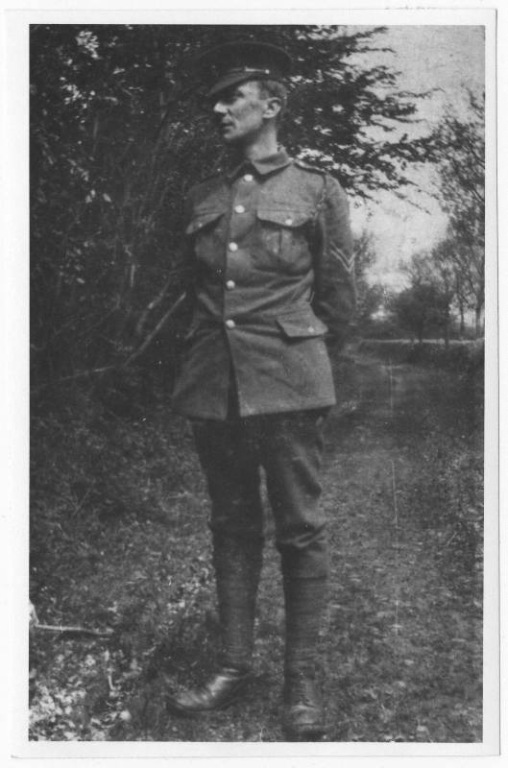
Edward Thomas in his uniform. He was married and past the age of most soldiers, but still volunteered.
.
So, here’s a poem that I think has nothing to do with the war directly – perhaps not indirectly either. “Like the Touch of Rain” seems to me to be a love (or rather a loss of love) poem, though the nature of the relationship is not spelled out.** It uses as its central symbol rainfall, and I suspect it’s speaking of erotic love because of the sensuous opening where the rain, however wild, is caressing the poem’s speaker and he sings and laughs here. The poem ends by telling us he’s now closed in, out of the rain, not by his choice but by some her’s “Go Now.” It’s a turn-about from the typical “Who’ll Stop the Rain” or “Shelter from the Storm” depiction of rain vs. shelter. Here’s a link to the text of the poem that I’ve now turned into a short song.
“Like a Touch of Rain” is not the most complex or virtuosic poem, but it also doesn’t detract from its depiction with any overreaching or stilted poetic diction. There’s a power in that. Reading Thomas’ contemporaries’ poetry in search of material for this Project I’ve read a great deal of published poetry that doesn’t escape those faults. My wife gave me a copy of Thomas’ collected poems a few years back – it’s not a thick volume, and I believe that most of the poems in it were first published in this collection posthumously through efforts of Thomas’ friends.***
After overreaching with my Padraic Colum poem setting earlier this week, and having to settle for an incomplete recording, it may behoove me to leave today’s piece as just voice and acoustic guitar accompaniment – and as rough-hewn as my voice is on this performance, I think it’s better too.
You can hear my performance of Edward Thomas’ “Like a Touch of Rain” with the audio player below. What, has the door to any such player gadget been shut? Well, this highlighted link will open a new tab with its own audio player.
**I have not read a full biography of Thomas, but before the war he seems to have had a complicated set of affections as well as bouts of depression and drug use. Those two things might cause one to suspect a ne’er-do-well life, but through-out that he wrote voluminous freelance reviews and essays to pay the bills for a young family.
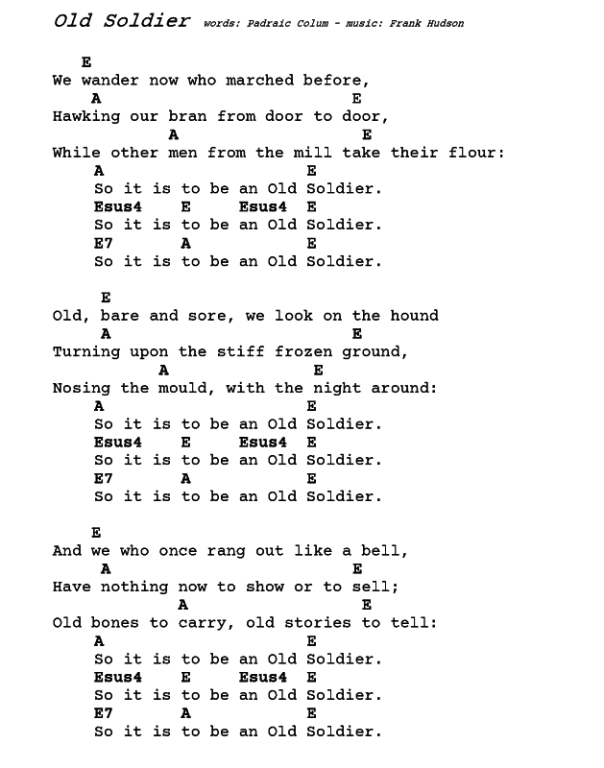
Today’s piece was created from a poem written by the Irish poet Padraic Colum. Colum was born in the 19th century, then traveled through the world of 20th Century Modernism, and lived on long enough to overlap my lifetime. Looking at the outlines of his life I am pleased to report that Colum connects a favorite of this Project, the undercelebrated Irish poet Joseph Campbell* and the American mythological theorist of the “Heroes’ Journey” also named Joseph Campbell. With the American Campbell, Colum connected because he was a folklorist as well as a poet, and he wrote several young adult and children’s collections of folk tales and retold myths which I’ve not yet read. With the former Campbell, besides being Irish literary revival contemporaries, he collected folk-songs.** Like that Irish Campbell, Colum’s best-known work today is arguably a folk song.
Long-time readers here may recall that the poet Campbell is likely responsible for the song “Reynardine” being sung in a version featuring a supernatural, shape-shifting lover. At around the same time, and for the same publisher of Irish folk songs, Colum collected/wrote the lyrics to the song “She Moved Through the Fair.” Why the slash notation on the authorship? There’s some controversy if Colum closely adapted a traditional set of lyrics, or largely wrote original lyrics to an existing tune. Colum claimed he wrote the lyrics, making use of only a few floating lines that are folk song ready-mades. The challenge to Colum’s authorship strikes me as highly suspect: it’s based on another collector writing in 1970 that he came across an old man who told him he’d learned it as a traditional song before Colum’s version was published in 1909.
I suspect there’s someone out there who can do a better job singing this song I created from Colum’s poem.
.
“She Moved Through the Fair” was included as a poem in Colum’s first poetry collection “The Wild Earth”*** which also includes today’s poem. I note that “Old Soldier” has some similarities with the lyrical methods of SMTtF: both use spare details and leave out a great deal. Some of what is implied in the two lyrics may have become more obscure to modern listeners. SMTtF very early on speaks of the singer’s “lack of kind” which uses a now archaic meaning of “kind,” meaning family. “Old Soldier” opens with the titular old soldier going door to door. Since “hawking” (a hawker is a street-seller) is used as a verb in the second line I thought at first he was peddling, but from what I can find, no one sold flour that way. I think he’s begging for bran, which was then the discarded part of the milling of flour. That waste part after the wheat was milled or boulted, was thrown out or used as animal feed, though apparently the poor sometimes made use of it for human consumption.**** In the second stanza we meet the old soldier’s only companion, a dog, and the bran the soldier has garnered may have gathered mold.
I don’t know if “Old Soldier” has been set to music before this, but it seems every bit as singable as “She Moved Through the Fair,” and as soon as I read it, I wanted to sing it. I decided to use an arrangement soaked in South Asian musical influences, perhaps due to the wonderous extended version of the SMTtF tune played by Davy Graham. That link above includes one of Graham’s recordings of it, as well as Anne Briggs wonderous acapella version. Oh, hell, here’s that link again, click it indeed if you haven’t heard the song Colum made. Last week I recorded the basic tracks singing and playing a tune I created for Colum’s poem using my guitar in an alternate tuning driving a sitar virtual instrument though a MIDI pickup. To this first pass, I added harmonium, tanpura, tabla drums, acoustic guitar, and a final vocal.
Every one of those overdubbed passes felt good as I played them (save for my vocals, I’m never happy with my vocals) but the result was a whole bunch of tracks that would require careful mixing so that the instruments blended well. I set about doing that, working until midnight when I figured I might have a piece to present and saved a complete mix down. Awaking the next morning, I listened again, and the result wasn’t just flawed, it was a mess. A useful question for one mixing a piece of music with various instruments in an ensemble like this is “What track is the focus of the piece?” My putative mix had no good answer for that. The voicings of the chords on the sitar and the guitar didn’t mesh well. The harmonium and the tanpura were fighting over the same part of the sonic spectrum despite my efforts to give them their own sonic space. The tablas didn’t mesh with the acoustic guitar’s rhythm.
The wise solution would be to just re-track the piece. Maybe I should have more particularly considered that Davy Graham had made his impressive version of a Colum poem/song with only a solo acoustic guitar. But I would not have another opportunity to record with a sensitive open mic until this week, too late for Veteran’s Day. So last night I went to work stripping back the crud of my failed mix, leaving mostly the acoustic guitar and the vocal, with the tanpura and then the harmonium coming in for later parts of the song in turn. It’s not an ideal recording, but it’s my hope it lets one consider “Old Soldier” as song today.
The more palatable version can be heard with the audio player below. The song itself is simple, and the remixed arrangement that builds a bit as the song continues serves it better. You don’t see any audio player gadget? No, I didn’t remove that, it’s a side-effect of some ways of viewing this blog. I have a plan B for that too: this highlighted link that will open a new tab with its own audio player.
.
*Joseph Campbell, who also wrote under the name Seosamh MacCathmhaoil, was acquainted with the original London Imagist circle, and wrote what I think is some excellent short verse in the form. His life and literary career were brought low by siding with the losing side in the Irish Civil War.
**Given that I’ve been doing this project for a decade, the folklorest/singer/collector and poet is a combination near to my heart. Besides Colum and Campbell, two American poets from the same era, Carl Sandburg and Edwin Ford Piper did both things, and I’ve tried to briefly make the case that Sandburg should be more often cited as instrumental in connecting folk song with progressive politics and literary poetry in the United States, which eventually leads to the case of a Nobel laureate in Bob Dylan. Around the same time as all these others, elements of the “Harlem Renaissance” in Afro-American literature were open to melding folk song with high literature too (Fenton Johnson, Langston Hughes, Jean Toomer, Waring Cuney, Zora Neale Hurston).
I’m going to jump far afield before leaving this footnote: I’m writing this on the 50th anniversary of the release of the Patti Smith Group’s glorious debut LP Horses. The Patti Smith Group started because Smith, a poet personally immersed in colloquial music, a paramour of Fugs-adjacent musician/actor/playwright Sam Shepard, joined up with a guitarist/rock critic/crucial anthologist of garage bands Lenny Kaye, wanting to make unexpected poetry combined with electric guitar.
***Just when Colum’s The Wild Earth was published is unclear to me. My copy has a 1927 American printing of a 1922 edition. Wikipedia says “She Moved Through the Fair” was in a 1916 edition of the book, and then in their entry for Padraic Colum gives a 1907 date for the book.
****What, that’s the healthy part! Whole wheat! At the time the milled pure white flower was prized from making lighter baked goods and for a longer shelf life. The city I live in was growing rapidly at the time of this poem by finely milling the “Best” and the “Gold Medal” flour that had absolutely no bran or wheat germ at all.
I spent Thursday recovering from a brace of winter vaccinations. I was tired and achy enough that I even missed attending my treasured monthly Midstream Poetry reading, but besides whatever mojo the shots might give me from winter respiratory crud, it made me grateful upon waking up Friday with my usual level of old-guy energy. I took a crisp 34 degree F. bike ride for a veggie sandwich and tea at a local bakery, and then spent a good deal of the day finishing some live LYL Band recordings from last September. Only then did I recall that I should do something for Veteran’s Day — or Armistice Day as it used to be called here in the United States. Armistice Day is still the name in much of the rest of the world that experienced WWI, and perhaps because I’ve been thinking a bit more about British poets this week, I quickly settled on two poems by British authors.
The post just before this one, Housman’s “Soldier from the wars returning” was the first poem I wanted to do, and it’s a straightforward poem of simple gratitude for a veteran’s service. The second one is a little stranger, and I made it stranger yet. Can we be sure Robert Louis Stevenson wished his poem “The Dumb Soldier” to be read as a whimsical piece about a child’s toy? He published it in A Child’s Garden of Verses after all.
There were no sensitivity readers for children’s books then,* but the nature of the poem’s story is not benign. It starts right out with the poem’s speaker burying a soldier, which from the text alone we don’t know yet is a toy. When we read “leaden eyes” we might get the hint that it’s a cast metal toy soldier — but if we were to hear this poem as I performed it, without context, sung by an adult, even that detail might not tell us clearly what is going on.
I leaned into that strangeness. I trimmed a couple of stanzas for better performance length and chose to truncate the final one, leaving off the reveal that this is a toy soldier that will return to the child’s shelf. This left this a more ambiguous buried soldier then unable to tell us anything about what they’ve seen.
Here’s the chord sheet for my version of Stevenson’s poem. To read his original text, here’s a link.
.
Although written decades before the first Armistice Day in 1918, this mode of the silent war dead is clearly apt for that holiday as celebrated outside the U.S.**
It was late Friday night before I was ready to perform these two poems as songs. I had music written, and for practicalities sake, I was able to quickly use my studio space to record the pair of songs with just acoustic guitar for accompaniment. Neither of these are perfected or sophisticated performances, they are more or less what you’d hear if I was to present them off the cuff. You can hear my version of “The Dumb Soldier” with an audio player below, unless you don’t see any such player. Some ways of reading this blog won’t display that, so I give you this highlighted link that will open a new tab with an audio player in those cases.
.
*”Dumb” used as a term for someone who cannot speak is now a highly impolite term. Given the sacrifice and suffering of war, that term’s objectionableness might be a lesser concern.
**Since the U.S. had an existing holiday, Memorial Day, for remembering those who died in military service, the U. S. Armistice Day became Veteran’s Day to celebrate all who served, particularly the living. Housman’s poem, couched though it may be in the particulars of WWI, speaks to that element of the holiday. As a mid-century child, I can recall Armistice Day was still used occasionally in my youth for November 11th since veterans and others who had experienced that war were numerous.
I’m going to present a pair of poems which are more related to Armistice Day, the former name for the holiday now called Veteran’s Day in the U. S. Here’s the first one.
Earlier this month I was confessing to Lesley Wheeler that I haven’t read much of English poet A. E. Housman, a poet who I believe retains more readership in the UK than here in the States. Well, no matter how little I know of him, his poetry has qualities that attracts musical composers like myself.
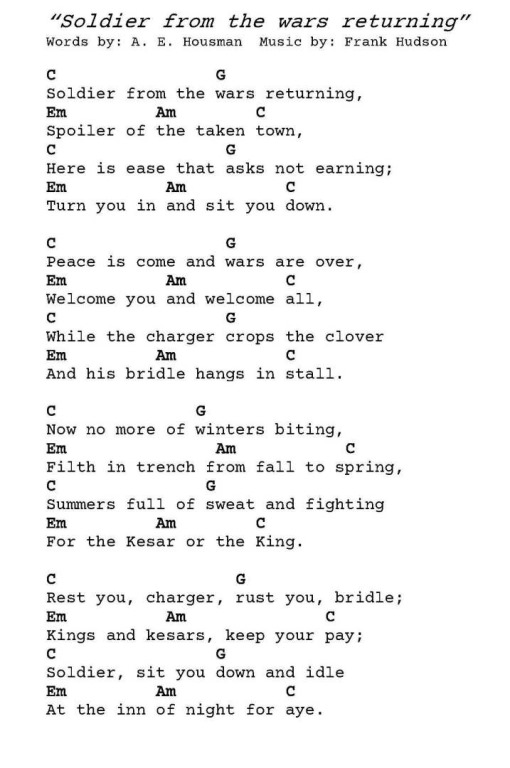
Here’s a chord sheet for today’s song. I recorded this with a capo on the 2nd fret, sounding in the key of D
.
This poem, which may not have had a title as I saw it with just the first line in quotes, is clearly a poem for Armistice Day and its veterans, first published a few years after the end of WWI. I don’t find it a complicated poem, but that doesn’t hurt it when one seeks to be comprehensible in an immediate performance such as I gave it. It’s hope, contemporary with Housman and his listeners when he wrote his words, that “wars are over,” now has sort of cruel quaintness, but it was an earnest statement then. Here’s a link to Housman’s words, and then below this is an audio player gadget to hear my performance of the song I made from them.
No audio player? Clicking on this highlighted link will open a new tab with its own audio player in that case.
Even before I was interested much in literature, I developed a love for history. Today’s Veteran’s Day post will only briefly touch on literature, and instead offer a slice of history. Older readers may think they know all this, or know it better than what I’ll write today. Some younger readers won’t care, but perhaps a few will learn something they didn’t read or hear elsewhere. As with any short piece, I’m going to need to leave out many things. While this post was not written intending to be a puzzle, I noticed that one thing was left out of this Veteran’s Day post. By that I don’t mean some opinion or judgement, or even some biographic item — I mean a particular significant historical Veteran’s Day fact that I expect few will notice is missing. When I reveal it late in the post, I’m also thinking you’ll take that elision as something to consider.
So, a bit over 50 years ago there was a war going on, the Vietnam War. The way it was presented then: our great geo-political rival had invaded another country and we were morally obligated to resist that aggression. This doesn’t seem to have been the case, at least not in any way that could be simplified as such. Another summary would be that Vietnam had invaded Vietnam, as it had been doing since the days of WWII, seeking to become an independent country. In the course of things, they succeeded, and now are one of those more or less unremarkable governments around the world that may be good or bad to their citizens in some mixture that we don’t generally concern ourselves with.
This obligation eventually led to a considerable number of American troops fighting in South-East Asia, but luckily the post WWII Baby Boom had raised a bumper crop of what were considered prime fighting age 20-year-olds. I was one of them. Even though this was a war, there were only so many troops that could be used. The amounts that could be used were filled to a significant degree by draftees, young people conscripted (other words: forced, obligated, duty-bound) to serve in the military, and since there was a war going on, some percentage of those draftees would be asked to kill other people or to be killed themselves.
To a surprising extent, this was not remarkable then. I can imagine how many living adults now find that odd, what with present controversies about wearing cloth masks and getting vaccinations — as not only were these conscripted men plausibly in for the kill/killed experience, they were also vaccinated forthwith and forced to wear entire uniforms. And yes, in certain training situations they were instructed in how to put on masks.
I can say that as a teenager in that crop of draft-age men then, I thought about this, and remarked on it. Others in my cohort did too. But there were whole days when one didn’t think about it, and instead thought about sex, fun, school deadlines, the price of a pizza, the general meaning of life and what that meant for you personally, and so on and so on. Still, it was an issue considered by the young.
But no, in general the adult country was fine with this, and even to observable empirical level it was not the biggest deal for a lot of my immediate cohort. You see, I was in college, a small one in a not very big town in Iowa, and because only a certain number of troops were needed, college students were given “deferments.” They didn’t need to serve while in school, and if this was a political post one could get into why that might be so. I’ll also add that dropping out of school, or failing out, or being short of tuition funds, or just deciding to take a gap year — those things would make the draft imminent for a college student — but for college 20-year-old men it wasn’t a next Thursday kind of worry, though it could be a next year one.
Now I and a few of my friends did think this was a bad thing, the war, the draft — oh, and a lot of other stuff: racism, what recreational drugs were legal, female students having “hours” where they had to be back in dorms by a certain time each night. The “we should do something about this” group was probably around 5% of the student body at my college in 1968.
Then in the spring of 1970 something happened that surprised me. The President made public (as if it was a new decision rather than a more substantial incursion that couldn’t be kept secret) that US troops were going to invade countries next to Vietnam. To those who had been paying less attention, this seemed a sign that this was maybe going to be around a lot longer, like past graduation, with more draftees needed. Opposition to the war on college campuses had been growing for about a year, and this gave it another bump, and on an obscure Ohio campus, Kent State, this boiled over (as it occasionally had elsewhere) into disorder and vandalism which wasn’t enough to cancel classes, but was enough for the National Guard to be sent in.
Something happened, likely a confused Guard squad, and the Guard opened fire, A bunch of students got shot, some were just walking between classes — because again, whatever disorder this was, classes were in session — four died.
Of course, I was appalled, but did that surprise me? Not greatly. Even in my youthful life there had been the drumbeat of the civil rights movement martyrs and assassinations of Presidents and Presidential candidates. In my crowd the fatal Chicago police shooting of Fred Hampton was considered duplicated multiple times against the Black Panthers. And in 1969 there had been a shooting death in the People’s Park confrontations.
Here’s what surprised me more. Not only around the country, but in my little Iowa college, much larger numbers of students thought something had to be done right now about this. One by one colleges and universities suspended normal operations and any number of alternative actions were taken that spring. This was called a strike. Here’s something little remarked on about male students choosing to do this for what was then an unknown duration in 1970: it could’ve led to them becoming subject to the draft.
There are no pictures available of my 1970 memories, so the guy on the left will have to stand in. The statue on the right is a clue to this post’s subsidiary riddle. The Nov. 11th born veteran Vonnegut tried to speak between generations.
.
Ad hoc organization coalesced at my school and as I recall the one concrete action to “really do something” was to try to garner support for a federal bill that would restrict funding or expansion or authorization or some other matter regarding the war in SE Asia. The bill had been co-sponsored, or co-authored, or supported by one of Iowa’s Senators, Harold Hughes.*
Let me stop for a moment and get to a reason I’m writing this on a Veteran’s Day. Sometime, maybe a generation after these events, it became a commonplace that Vietnam war opponents, or college students, or hippies, or leftists, or some Sixties group hated soldiers in general. “In general” is a dodgy term, but I think it’s meaningful in this matter. I spent time with all those supposed soldier-hating groups, in both Iowa and New York (two fairly unlike places), and I never heard anything like that, not once. And it would have seemed so odd to me personally, that if I had heard it, I think I would have remembered it. And it wasn’t reticence or propriety that would have masked those feelings. Expressions against police were so common that I couldn’t count them then, much less now. And fairly soon, as early as 1971, I was running into ex-Vietnam era soldiers who could be put in those loosely defined groups above themselves.**
Back to working with this newly motivated group of Iowa college students who naively thought they had to do something right now about this expanding war. We were going to go door-to-door asking for folks to write letters in support of this bill. Now who takes point walking on a patrol, or even boring days painting what doesn’t move, or for that matter being under a napalm attack — this isn’t on that order (well, maybe the middle one is a little), but for some reason, I have memories of the few days I did this before leaving for New York. I believe now what we were doing was essentially meaningless, if the best we could come up with at the time.
In our door-knocking in town we might run into what was later called “The Greatest Generation.” Most said little to our spiel, but a couple of them, men, wanted to set us straight as to what we didn’t understand. Well, even then I suspected there were things I didn’t know, and now I can drop the suspected and replace it with certainty. The one I remember most vividly responded with a statement that I didn’t know what it was like to watch your buddies die.
I try to replay him saying that through the fog of the years. Although there was anger in it, I think it was a sincere personal statement. I often think since of what did that statement, however incongruous, mean? Did he mean that I should watch my buddies die? That that would be enlightening, educational? I don’t think so, no more than it was his considered opinion that such an experience had been worthwhile or ennobling for him. What he meant, putting my most empathetic interpretation on it, was that a certain sacrifice and commitment added something to one’s opinion on national matters.
More broadly though, his generational experience was why there was not a great deal of concern then, other than a slowly growing one among those of draft age, for the idea that young men could be conscripted to possibly kill or be killed. The Greatest Generation had faced the same sacrifice, and so this was normalized, not even Great yet, unexceptional. In the case of WWII good wasn’t a question, necessary was the question.
In those times, some in my generation eagerly latched onto WWII veteran Kurt Vonnegut’s books (and Joseph Heller’s Catch 22 as well) to portray everything else around the necessary part of WWII. They were our cross-generational allies in seeing and saying that war needed extraordinary necessity. Vonnegut even wanted to connect us 20-year-olds with his Dresden POW book Slaughterhouse Five, subtitling it “The Children’s Crusade” which had been a nickname for the 1968 US Presidential campaigning by folks often too young to vote for anti-Vietnam-war candidates, and which he then applied to the 18-20 year old range of his WWII cohort.
OK, what Veteran’s Day historical event did this old man leave out of the above story, dealing as it did with differences and connections between men serving in the Vietnam War era and those who wanted to end that war, and between 20-year-olds and the WWII generation then in middle age? I completed an entire first draft and didn’t notice it myself. And I’m not alone. American Veteran’s Day stories in 1970 and up until now almost always leave it out. It’s the Korean War. As with WWII, few living veterans of that war are left now, but it occurs to me that the fervent man at the door in 1970 could easily have been a Korean War vet. And in historical analysis, that war had as much or more to do with the missteps of the Vietnam War as WWII.
The musical piece today is another song from birthday-boy Kurt Vonnegut’s novel “Cat’s Cradle” in which his trickster guru character Bokonon muses ontologically. You don’t have to look up the word to appreciate this little song. Player gadget below to hear it, and if you don’t see that, you can click this highlighted hyperlink.
.
*I knew all those details then, even if I don’t remember them now. Harold Hughes is a little-remembered figure these days. Capsule description of Hughes: imagine if Johnny Cash had been a governor and then a U. S. senator. As to the general student feeling, I think it was close to how some people felt in the post-George Floyd murder reaction. The watchword was “We’ve got to do something.”
**Some of you may find this striking, The precipitating event of the college strikes of 1970 after all was men in military uniforms shooting and killing students, In this era, various acts were taken against what was considered part of the recruitment and processing of soldiers: draft boards, recruitment offices, ROTC buildings, that sort of place. I can’t know everything, but I never heard any of this characterized as “let’s go get those soldiers” and was more at “let stop more from being conscripted as soldiers.” Given human nature someone somewhere in 1970 may have said or thought that, but speaking of my experience: war-fighting soldiers were what we young men at that point increasingly feared being forced to become. Opinions differ on the nobility of those thoughts then and now, but we might have thought of cops differently if we knew that folks like us, and potentially us ourselves, might be forced to put on a police uniform.
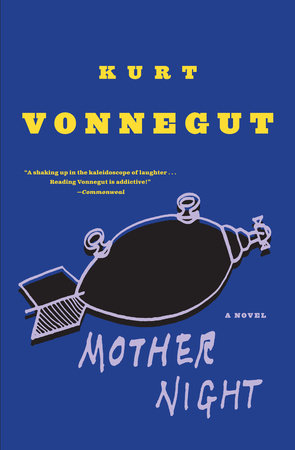
Celebrating Kurt Vonnegut during this week that will mark the 99th anniversary of his birth allows two things to cross and connect, for he was born in 1922 on what would have been called Armistice Day then and will be called Veteran’s Day tomorrow in the US. Two decades later as a 20-year-old, he enlisted in the Army, served in WWII, and was rather famously a prisoner of war incarcerated in the German city of Dresden when it was subject to a massive firebombing raid from his own side.
As one might imagine that experience impressed itself mightily on Vonnegut, who as a writer eventually dealt with the matter in his best-known novel Slaughterhouse Five. But that was not his first novel to deal with WWII. That would be 1962’s Mother Night.
The short plot summary for Mother Night is that it concerns the story of an American who was in Nazi Germany during the war, and who tells us that all-the-while working with American undercover efforts he made fulsome fascist propaganda broadcasts. This situation gives us all kinds of resonances: with important American Modernist Ezra Pound for example,* with America’s own fascists, and with anyone who has ever found themselves working (for whatever reason) with a cause that they themselves feel they are not in alignment with.
The novel’s protagonist wrote “The Great Machine” in the novel as a poem explaining how he and his beloved German wife had done what they felt was necessary to survive, and once again the novelist while in character allowed Vonnegut license to write poetry.
Abstracted from the novel, and as a stand-alone poem, it mentions nothing of the fascist double-life theme of Mother Night however. Heard in this way, as the LYL Band performed it during the week of Vonnegut’s death in 2007, “The Great Machine” speaks instead to refugees trying to escape violent situations by whatever means they can muster. In such events it’s not uncommon for the “you really must understand” class of commentators to mention that the refugees should not be fleeing but should stay and try to counter the violence in their own countries. I don’t know if it’s absolutely required, but such commentators almost never seem to have been in similar situations themselves. In the saddest reportage in Vonnegut’s poem, it says that most people do not, in fact, flee in these situations, but ignorantly or fatalistically accept becoming victims of The Great Machine that is History.
After our first two installments of our Vonnegut series it’s gotten darker here, but you can hear The LYL Band’s performance of this poem found in a novel with the player gadget below, or by clicking this highlighted hyperlink.
.
*Living during the war in Italy, Pound (who had been attracted to outsider political ideas, not just fresh approaches to literature) made propaganda broadcasts for the Italian Fascists. Pound, as with several other Axis broadcasters from Allied countries, was arrested at the war’s end and faced charges of treason, with a possible death sentence. American literary figures helped lobby to have Pound instead declared insane, reducing his culpability. British humorist P. G. Woodhouse was in Germany during the war and made Axis broadcasts, which his literary admirers and defenders characterized as not propagandistic.
It’s easy for us at this remove to forget how close at hand these issues were when Vonnegut was working on his novel. WWII was as close as September 11 2001 and the wars that followed are to us now in 2021. Oddly though, American fascism, which had been a considerable issue during the ‘30s and ‘40s and is again now, was considered something of a comic non-entity in the 1962 world of his novel.
Remembrance of warfare is a complex thing. There are forces for forgetfulness and memorial fighting inside us regarding war, and the entropic forces of time passing put a thumb on the scale as years pass. This Wednesday was once Armistice Day, the day when, for a mere two decades or so, countries celebrated solely the end of “The War to End All Wars.” In America this date eventually became Veterans Day, a holiday to celebrate all those who served in the military, particularly during wars—whereas we already had a spring holiday, Memorial Day, established in the years after our Civil War, to decorate graves of the fallen and to remember their deaths.*
In Great Britain and other countries in the Commonwealth, November 11th continued as the Remembrance Day, and the deaths of WWII or other subsequent conflicts were incorporated, and the holiday remained unchanged, save for the erosions of time. It remains a solemn day. The Sunday nearest the 11th has royal celebrations in London centered around a memorial there, The Cenotaph,** and it’s still customary on the 11th hour of the 11th day of the 11th month to pause for a couple of minutes of silence to remember those who died seeking to reach that Armistice Day. This results in an odd divide: Armistice Day was generally a festive, celebratory holiday in 20th century America with joyful parades celebrating surviving veterans.
But that is just the surface of the complexity of the remembrance of war, where the questions of the wisdom or justification for a particular war are adjacent to the undeniable sacrifice of the war’s dead. Those questions are left to the war’s survivors who, from some level of power or acquiescence, made those judgements. In America, so fraught are those two strands of thinking about wars, that we have come to strictly segregate these two issues, out of fear or concerns that to speak of the evils of wars is to speak evil of our dead countrymen, or that to speak of the folly of some wars would denigrate the last full sacrifice.
This painting by William Nicholson shows the temporary London cenotaph that was put up for the first Remembrance Day in 1919. Note the flowers strewn at it’s base, and a woman adding to them in this portrayal by Nicholson and echoed in Mew’s poem.
.
Today’s piece, “The Cenotaph,” was written by a British poet, Charlotte Mew in time for the first anniversary of the Armistice, the first Remembrance Day, in 1919. Here’s a link to the full text if you’d like to follow along. It begins with nods to conventional rhetoric about the sorrow of those who lost loved ones, it voices sentimental tropes of the dead in “splendid sleep” and the grave as a bed. I was not sure how to perform those lines. Mew’s poem is complex, not just in syntax and some long lines and sentences that can trip up the breath. If one was to read it with only casual attention, more than three-fourths of it can seem a conventional Victorian poem of mourning—but read or listen to it all the way through! It ends with a statement of anger so shocking that it should make you reconsider how you read the opening body of the poem. No spoilers here—it’s best to experience this by reading the poem or listening to my performance via the player gadget below.
In my performance I tried to subtly undercut some of those early phrases, but I’m not sure if I (or anyone) can successfully portray the totality of Mew’s poem. Musically I got to write a fanfare, something I hadn’t done before now, and then there’s a quieter, contrasting motif played at the end on a bassoon and two English horns.
.
*In some ways the American Civil War experience was similar to the British WWI experience, as the levels of mass casualties Americans suffered in the mid 19th century conflict previewed the shocking casualties the British and Commonwealth soldiers suffered in WWI. America entered WWI late and suffered proportionally fewer deaths from the combat.
**The London Cenotaph in Whitehall, central to Remembrance Day activities in England, particularly since the advent of mass media, is not the only one. Many other cities erected their own versions. Cenotaph means “empty tomb” and the imposing markers were meant to be local sites for decorating and mourning the war dead that were largely buried near foreign battlefields as the logistical challenges of so many dead prevented them from being repatriated. Mew is not in fact describing the particular London Cenotaph in her poem, for when she wrote her poem it didn’t even exist yet, though it was planned and a temporary structure was in place by the first Remembrance Day in 1919. So like Keats’ “Grecian Urn” it’s not a cenotaph, but the concept of a great war memorial in the center of the marketplace that she grapples with.
Modernist American poetry has two parents, Emily Dickinson and Walt Whitman, but it’s been awhile since we’ve presented any Whitman here. Dickinson is a subversive Modernist, ironically skewing the expected tropes. Whitman on the other hand is the provocateur, the poet who is proud to say right out front everything he wishes to change.
As Whitman prepared his 1860 edition of his evolving Leaves of Grass, he was about to cross a Rubicon of a sort. He had decided that erotic material needed to be added to his great collection. Since he wished to be all-inclusive and unabashed, starting with himself, that material would vary, but it would include expressions of male homosexual longing and relationships.
Walt Whitman as caricatured in 1860 in Harper’s Weekly
Once again, my knowledge of the historical context here is not extensive, but some brief reading this weekend indicates that to the mid-19th century American audience, the homosexual elements of what Whitman was to publish was little or no more disturbing than the erotic element generally. For a man who was already wishing to revolutionize English poetry with his free-verse and universalist message including what would surely be considered shockingly fleshy writing about desire, longing, and connection was certain to complicate his goals for a wide audience. His leading ally within American High Culture, the Transcendentalist Ralph Waldo Emerson, counselled him to not include, or to greatly tone down that material.
Whitman didn’t take that council. The 1860 edition of Leaves of Grass included a section, Calamus, that was full of love and desire between men. Emerson was right, that would complicate Whitman’s task of revolutionizing American poetry.
When Transcendentalist Thomas Wentworth Higginson* asked Emily Dickinson if she had read Whitman shortly thereafter, Dickinson replied: “You speak of Mr. Whitman. I never read his book but was told that he was disgraceful.” If one is of a speculative mind, one can imagine Emily Dickinson getting a plain brown wrapper delivery of Leaves of Grass that she would never acknowledge.
This Monday is Veteran’s Day/Remembrance Day, and as he prepared the Calamus poems Whitman was not a veteran or a survivor with war memories, as the American Civil War that would add another tremendous shaping force on his poetry was still more than a year off. Still he would write this moving comparison that I present today.
Today’s poem as it appeared in the 1860 edition of “Leaves of Grass.”
“When I Peruse the Conquer’d Fame” is a comparison of two things: fame and envy. Perhaps the fame part will strike you first, along with the implications of worth and value. The fame in the title most often comes to prominent men: victorious generals, Presidents who bask in their election and men who put their names on large buildings. The U.S. Presidents that Whitman would have had in mind then were bumbling ineffectual men, totally incapable of coming to grips with the immense and deadly crisis they were careening toward, but famous none the less.** What generals would he have in mind? Napoleon or his adversaries perhaps, men who could shuffle the borders and crowned heads back and forth in tides.
And for comparison, Whitman sets out “the brotherhood of lovers.” Does he mean men who love men? As this is part of the homoerotic Calamus poems section I think we need to accept that is significantly so. He goes on to praise the lovers who are steadfast in their love as aging and fate and even the numbing of time is arrayed against them.
This task of enduring love is not something unique to same-sex lovers, and I suspect that Whitman, the universalist, recognizes that too. But in his particular, he’s saying that unfaltering love which would not then be socially acknowledged is all the more extraordinary, though unknown compared to the war-heroes and political potentates.
Did Whitman, and I suppose myself in my choice to present this poem at this time, just dis veterans? That objection would assume that the two groups are mutually exclusive, at odds. That isn’t so. And if Whitman was here to answer he’d point out he spoke of Generals, Presidents, and rich men, not the soldiers he later comforted and whose wounds he dressed in the upcoming war.
And of course, in the U. S. today it’s Veterans Day, set aside for those who after their service may well have continued as or became those ardent lovers whatever their sexual orientation. We honor them for their service in the one regard, Whitman asks that we consider the second as well.
What of the other comparison, the one you may not have noticed, the one concerning envy? Whitman has chosen not to weigh his comparison between the two sets of roles only by their levels of objective fame, but specifically in the example of his own state of envy. He says he doesn’t envy those powerful and rich men—but of the “long and long” lovers, there he says he is bitterly envious.
Let me suppose Whitman was sincerely speaking here (he has almost no other mode in his poetry than sincerity). But there is an element in Leaves of Grass where the poet speaking—“Walt Whitman” as the character in his great collection of poems—is meant to be an example, as his verse is an example, of an imperfect thing striving to find a different, better path to something new and not fully known. Whitman, like the best of Modernist art, like various America, like many veterans, ardent as a lover is running faithfully and with a heart open toward an affectionate and unknown future.
Once more I marshal the ranks of my marcato orchestral instruments for “When I Peruse the Conquer’d Fame” into another “punk orchestral” piece. Harmonically, I’m working a three-chord trick here, just as if the composer/conductor’s podium was stocked with Ramones. Other than the use of a rock’n’roll drum set, the other unusual textures are mixed subtly into the low-end where there’s a contrabassoon line and Fender electric piano bass (ala Ray Manzarek). You can hear it with the player below.
*It’s possible that a canny Dickinson might have been telling Higginson what Higginson would want to hear, since Higginson, though au fait with political and social radicalism, was also of the opinion that Whitman was disgusting.
**Coincidentally, the U. S. President when the Calamus poems including edition of Leaves of Grass was published was James Buchanan, who may have been gay himself. Though Donald Trump has already selected Andrew Jackson as his favorite President, Buchanan may also prove to be indispensable to his legacy in that Buchanan has long been the consensus choice among historians as the worst-ever President of the United States.
As we celebrate the 100th anniversary of the armistice ending World War One, let’s bring in a writer not primarily known as a “war poet,” Thomas Hardy. Hardy is one of those bridge-poets between the era of the romantic and sometimes sentimental Victorian poets and the Modernists. Though I’m told Hardy never felt at ease in London artistic circles (he was country-born, son of a stone-mason and largely educated through apprenticeships as an architect) his poetry was admired by some of the Modernists. Why might that be? While his language can sometimes seem antique to modern ears, it was his language, the language of a rural 19th century working class Englishman. And while he will write about sentimental subjects, he’ll balance that with a cold eye.
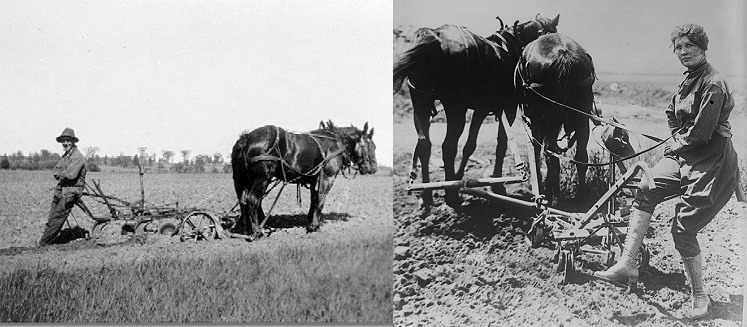
The horse-drawn harrowing time of the Breaking of Nations. But what’s that woman doing behind the horse?
Hardy grew up in a rural, farming district, as I did, and it may have been natural for him to relate the violence of the Great War to that setting. And I love how he does it here with three spare quatrains: the boustrophedon horse-drawn disk or rake plow that is literally breaking the earth*, in contrast with the prophetic “Breaking of Nations” warning from Jeremiah used for the title. Then there’s smoke rising, not a razed town after an army has swept through it, “only” the burning of invasive weeds. And finally, a mysterious third stanza with a mysterious word: wight.
It’s an old word, one of those that came to English with the German Saxons centuries ago. Chaucer knew it, used it in The Canterbury Tales, and as best as I can tell it meant a sort of unimposing person or creature. Sometime later, perhaps after Hardy learned the usage of the word and after this poem was written in 1915**, it’s taken on a supernatural connotation. It’s fairly easy to trace that back to J. R. R. Tolkien’s use of the word in The Fellowship of the Ring written decades after Hardy’s poem. Tolkien was a scholar of the ancestor languages of modern English. Did he know of other usages of the word, or did he simply take a very old word and choose to use it for an undead-spirit slain in battle?
So, in this last stanza, what does Hardy mean by his whispering maid and “her wight.” A flirting young couple? Are they whispering merely to shield their romantic bantering from others? Or is it something weirder? Is this a young woman whose man is off to battle, or even one of the battle-dead? Or, as part of Hardy’s theme are they both immortal ever-returning spirits, whispering because you only barely sense them in our time-bound world?
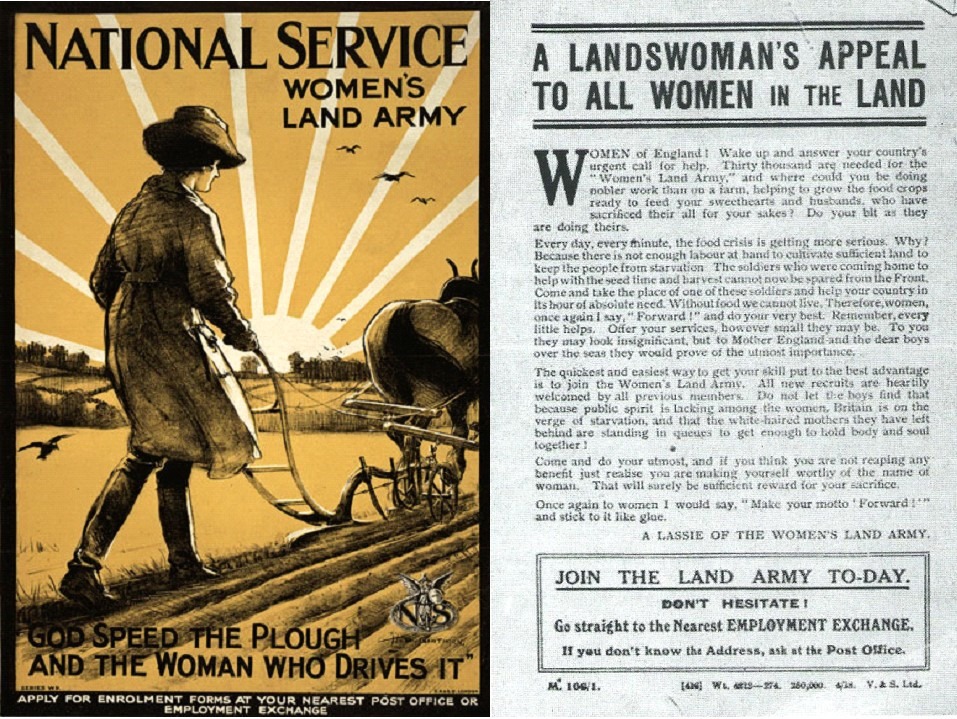
I don’t have the detailed historical knowledge to know how depopulated the farming areas of England were by the need for soldiers during WWI. From Edward Thomas’ poem from last month, “Gone, Gone Again” I get the idea that the absence of farming men was noticeable. And it was at least enough of an issue that England formalized an effort to recruit and train women as replacement farm labor.
Not just whispering to her boyfriend. “There’s not enough labour at hand to cultivate sufficient land to keep people from starvation.” Recruitment ads for the Women’s Land Army in England during World War I.
Well, I just like it that this is blurred. Do the final two lines give us any clues? Why does Hardy say that “War’s annals will cloud into night?” In early drafts, Hardy wrote “fade,” and “cloud” seems a more peculiar choice. In the context of the 2nd stanza weed-burning, I’m thinking he’s saying they will disappear in a cloud of smoke. Also in context of the 2nd stanza, this would make such war records in some future as valueless as weeds, but smoke/cloud again reiterates that there’s something unsubstantial about the couple.
“In the Time of the Breaking of Nations” demonstrates a lot of what I like about short lyric poetry. T. S. Eliot could write a Modernist masterpiece like “The Wasteland” extending to the farthest lengths of lyric expression, 15,000 words—but a poem like this can touch a lot in its 63 words.
It may not be apparent due to the instrumentation used, but I might have been subconsciously inspired by Bob Dylan’s repeating chord progression used for his masterful three-short-stanza song “All Along the Watchtower,” which is very much in the same mode as Hardy’s poem.
Here is my performance of Hardy’s poem. Use the player below.
*Note too, Hardy’s pun on “harrowing.” For another discussion of boustrophedon plowing and time, see this earlier post. Near the end of his life, while visiting a farming museum, my father wanted me and his grandson to know that he’d walked behind a horse-drawn plow.
It’s 1956. World War One had ended less than 40 years ago, instead of 100. Robert Frost is the most celebrated living American poet, and he has traveled back to England to receive honors from both Oxford and Cambridge universities, a symbolic laurel helping to mark the 20th Century acceptance of American poetry into the pantheon of our polyglot language.
Two elderly women follow an invitation to an upstairs to-do in London, where the American poet has just landed. Eleanor Farjeon is one of the pair, then 75 years old, and here’s how she described what happened:
We approached a white-haired man who was talking to T.S. Eliot. ‘It’s Helen and Eleanor, Robert.’ He turned towards us quickly, unmistakably Robert. Were we as unmistakably ourselves? Eliot smiled at us and withdrew a little…. Robert muttered, ‘Well, well, well.’ Soon he and Helen were talking of their grandchildren.
Who are these ladies that broke off the tête-à-tête between the two Modernist poetic titans?
One was the widow of Edward Thomas, the man who Robert Frost called “the only brother I ever had.” The other was the woman who had introduced Edward Thomas to Frost in 1913, Eleanor Farjeon. The poet Edward Thomas is not well known outside of Britain, Farjeon even less so, but none-the-less she had a long and varied literary career as a poet, playwright, children’s book author, and songwriter in a life that spanned from the Pre-Raphaelites to Carnaby Street.
Eleanor Farjeon early and late in her life
Back just before and after the outbreak of WWI, the Frost Family, the Thomas Family, and Eleanor Farjeon were a sort of an extended pod of friendship and affiliations. The Thomas marriage had strains, and Farjeon was in love with Edward Thomas. Thomas’ spouse, Helen, surprisingly cast Eleanor Farjeon not as a rival but as a balm to Edward. And so, between her own writing, and typing manuscripts to help D. H. Lawrence (also hanging around this circle*) Farjeon, like Robert Frost, took to accompanying Edward Thomas on his indefatigable walks around the countryside.
Eleanor Farjeon was still a literary stem cell at the time. She later said “In my youth I dreamed of being a ‘real’ poet, but half way through my life that dream died, and whatever figments of it remained went into writing songs** and verses for children.”
When Edward Thomas decided to enlist and volunteer for the front lines in the war, the pod all shared correspondence with Thomas, a correspondence that continued right up to the very week of Thomas’ battle-death. And after that, they all shared the task of putting his literary affairs in order and promoting the poetry of the man who had only started writing it during that short pre-war period.
Robert Frost and Eleanor Farjeon both wrote elegies for Edward Thomas. It may surprise you, but I’m choosing to use Farjeon’s memorial sonnet here to cap off our Armistice Day series on Edward Thomas, instead of Frost’s poem. Farjeon might have thought of herself as not a “real” poet, but it’s us, the audience, that decides. Her poem may seem to be made of genteel English stuff: gardens, Easter eggs, love tokens, so that it has the patina of an antique valentine—but that’s just the surface. How about those relentless repetitions? You can hear James Joyce or Gertrude Stein tuning up in the distance if you listen for those. Did she mean the punning subtext of the repeated “Eve” with the repeated apples? If this were a Joyce poem we’d assume yes, so why not here? And that surface? It’s a paper scrim she means to tear, to rip—and yet when she does it in the last line, there’s no sound, only an invisible gap, an understated “apology”.
Here is what Eleanor Farjeon said, shortly before her own death, writing again about Edward Thomas and Robert Frost when recounting her last, 1956 meeting with Frost in the company of Thomas’ widow: “We do not lose our friends when they die, we only lose sight of them.”
Here’s my performance of Farjeon’s “Easter Monday (In Memoriam E. T.)” that you can hear using the player below or with this highlighted hyperlink.
*Sounds a bit unconventional for an Edwardian village in 1913 doesn’t it—but any bets on who did the housework?
**And it’s in this guise that Farjeon is likely to be best known in the U. S. Back in 1972, three denizens of that Sixties London: Cat Stevens (later Yusef Islam), Rick Wakeman (later caped-keyboardist of Prog Rock fame) and Paul Samwell-Smith (producer and former bass-player with the Yardbirds) created an arrangement of Farjeon’s hymn “Morning Has Broken” for a best-selling LP and eventual #6 hit single on the Billboard U.S. charts.





 Frank Hudson