Isabel

I enjoy the part of this Project that gives me cause to examine the lesser-known and forgotten poets and poems. Even the most famous literary poetry principally exists in quiet books, but give me a book now largely unread and my interest is perked.

Today’s poem is by Richard Hovey, one of the co-authors of a remarkable yet forgotten three-book series that began with Songs from Vagabondia  published in 1894. Who was Hovey?

He was the son of a Civil War general* who privately published his first book of poems in 1880 when he was a teenager. He attended Dartmouth College, graduated with honors in 1885, and was highly active in literary activities there, coming to write what remains the official school song. After college he seems to have considered various paths. He studied for a while in New York’s General Theological Seminary, taught briefly at Barnard College and Columbia University. In 1887 he met his Vagabondia  co-author Bliss Carman, and true to their eventual series title, they spent some time tramping around New England. Hovey wrote that he decided to dedicate himself to writing on New Year’s Day of 1889 while viewing a solar eclipse, which seems somewhat magical for an epiphany, but yes, there was an eclipse on that date. In 1891 he began publishing a planned lengthy series of verse plays based on King Arthur’s court, and he seemed to have traveled to Europe around this time where he met writer Maurice Maeterlinck and took on the job of translating Maeterlinck’s work into English. Hovey was also enamored with the French Symbolist poets and did English translations of their work.

Let me set the literary stage for this young poet as he began his career: Verlaine, Rimbaud, and Mallarmé were still alive. So was Walt Whitman. So was Mark Twain. The first and just-posthumous volume of Emily Dickinson’s poetry was still in process. Ezra Pound was a toddler in Idaho. While Hovey was a college student, Oscar Wilde toured America giving lectures on Aestheticism.** Hovey and Carman, with their on-the-road poems of beauty and poetry, of wit over dour seriousness, seemed to have resonated.

Richard Hovey with his mother

Richard Hovey around the time of the Vagabondia books. The woman here is his mother Harriet, not his “older-woman” wife Henrietta. A cousin who knew the young Hovey wrote that he “was so strikingly good-looking that I have seen people turn in the street to look after him.”

.

I learned one other possibly salient fact about the time Hovey and Carman were putting together the first Vagabondia  book. In 1893 there was a sudden economic depression in the United States. Vagabonds were not always free-thinking college boys yet to establish their literary careers. Was there a sub-rosa political/economic point at the start of this series? There’s little I’ve found in the Vagabondia  books that tip me to Hovey’s political stance, if he had formulated one.

I chose Hovey’s poem “Isabel”  from Songs from Vagabondia  partly because it was short and naturally suggested being set to music on first read. Given that I was also trying to get a grasp on Hovey’s life, I wondered who this Isabel might be. I didn’t find out. There’s no Arthurian Isabel, and I haven’t found any prominent Isabel characters in the works of Hovey’s literary heroes. I believe it was a somewhat common name in this era.***

Despite Vagabondia’s  praise for male comradeship, I’m not (as yet) catching any homoerotic overtones there. Where eros does appear, it seems directed at women. The only romantic relationship I know for Hovey was a married woman who he had a child with and later married after her divorce. If you want to wonder at Hovey’s sexuality from afar, clouded in a sexually repressed time and with the small amount of information, I can only offer this tidbit: his lover and eventual wife was said to be “old enough to be his mother.”

Indeed, after all this search for biographic info, today’s poem might seem a tad insignificant. As a short love poem “Isabel”  reminds me of Robert Herrick more than any of Hovey’s contemporaries, and she might be only a device to let Hovey write that sort of poem. In straightlaced society I suppose the poem’s breast-pillow line could have seemed 1894-era hot stuff, but I’m immune to that level of “I’m so naughty” eroticism — likely why Swinburne (also still alive in Hovey’s time) always seems laughable to me.

But Aestheticism holds that a poem doesn’t have to have great wisdom or weight as long as it’s beautiful, so I spent more than my usual amount of time with this 6-line poem’s music to justify asking for your attention to it. “Isabel”  uses some of my favorite odd chords and flavors, and you can hear it with the audio player below. No player?  This highlighted link will open a new tab with its own audio player.

.

*Father Charles Hovey was the President of what is now Illinois State University in its early days, and organized the 33rd Illinois Regiment (known as “the Teacher’s Regiment”) at the outbreak of the American Civil War, serving the Union as a Brigadier General.

**The fact of Oscar Wilde’s tour I first learned about from an episode of the TV Western Have Gun Will Travel Those who knew him remember a young Hovey who seems to have taken Wilde for a model, dressing like him with colorful topcoats, long hair in a center-parted style, and dyed carnation corsages.

***I wondered about writers with that name Hovey could have read. The only hit in that search was the marvelous early 19th century folk poet, folk singer, and tavern keeper Isabel Pagan. Pagan’s poem “Ca’ the Ewes to the Knowes”  was popularly set to music by Robert Burns, a poet who Bliss Carman extolled earlier in this series. I did read that Hovey either knew or took classes with Francis Child, of the famous Child Ballads collection. That the Vagabondia  series calls itself “Songs” is evidence that folk song, at least of the literary variety, is one its elements.

The most famous poetic Isabel remains Ogdon Nash’s from 25 years later.
Down the Songo — Summer: Still Rowing, Still Dreaming

Does the summer feel like it’s gone by like a dream, one of those dreams where the ungainly night-plot finds its own winding path? I started this summer with a May Day suggestion to remember to write of our workday labors, and then too, I presented back then a cover song marking my teenager’s last childhood summer. And now it’s Labor Day weekend, and I’m going to present a poem that is the antithesis of paid labor, another poem from the 1894 Songs of Vagabondia  book by Bliss Carman and Richard Hovey. We’ve already heard from Carman this month, now let’s sample some Hovey.

Richard Hovey is another of those pre-Modernist era poets who wrote in the final years of the 19th century. Because his work falls before the Modernist revolution and the ascension of American poets to a preeminent place in English language literature there’s lesser interest in it, but with a figure like him I think of a bright young man living in an age that felt stirrings of desire to form its own poetic styles.

His Songs of Vagabondia  struck a carefree chord in its time. Tennyson, Longfellow, or Robert Browning would have presented a very serious life that should be attended to. The Vagabondia poems, with intent, fail the Sandburg Test I’ve proposed to assay poetry collections. If my beginning-of-Summer cover song asked the listener to indulge in “That Summer Feeling,”  these poems concur. There’s no Winter and barely an Autumn there. No work or studies either. Instead, we have flirtations and libations, the comradeship of likeminded friends, and here the open road and heart are spent without anything much in one’s purse or paycheck.

For this Hovey poem from Songs From Vagabondia  I chose to create a denser piece of music, a presumptuous rock band ensemble with two drumsets, electric bass, piano, two electric guitars, along with string synth and wind instrument parts. For a Labor Day holiday song about an aimless trip down a Maine river, I spent quite a few hours working to form this into shape. I’m not sure I produced the perfect arrangement after all that, but I enjoyed the process.

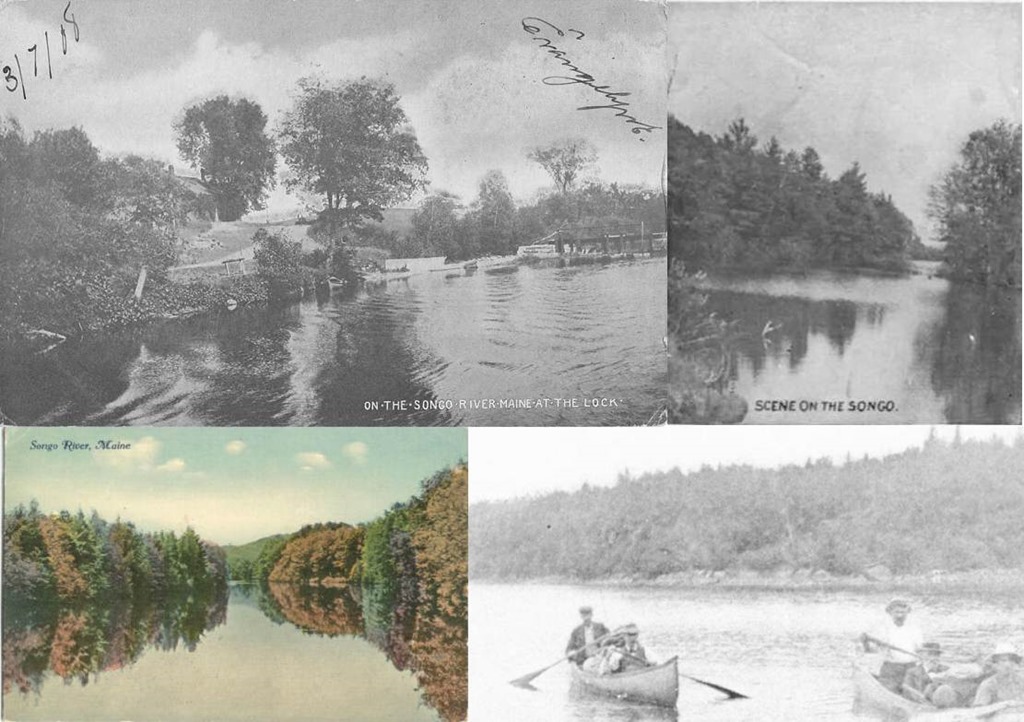
Songo River 4 pictures

These Songo river photos look like they could have been taken within a decade or so of Hovey’s poem. Looks bucolic in these, but others show passenger steamboats (one named for Maine’s poet Longfellow) plied the river too.

.

The Songo in Hovey’s poem is a short river in Maine, but the Songo connects a large lake and some other bodies of water — and though I don’t think the poem mentions it, it had then (and still has!) a hand operated set of locks and a swing-away draw bridge constructed in 1830.*  Hovey’s poem makes this river sound rural and solitary, but having never been to Maine, much less the Maine of the late 19th century, I can’t say how busy it actually would be. The poem’s voice says someone is using oars for propulsion, so even if this is an aimless pleasure trip, there’s work involved just as there was in my recording the song I made of the poem. At the end of the poem there appears to be someone else in the boat, as the poem’s voice cries out “Kiss me” unexpectedly. Who is the other there? Could this be a Hendrixian excused kiss of the sky-blue-water-sky? Maybe, but a lover would be the likely (if unprepared for) guess. The unprepared suddenness of this ask seems dream-plot strange to me.

In my performance I turned the poem’s remarks about the experience being dreamlike into something of a refrain to further emphasize that element for someone who might hear this once as I perform it. I also removed one short stanza from the poem’s original text in the interest of shorter performance length. You can hear the full band performance of “Down the Songo”  with the graphical audio player you should see below. No player?  This highlighted link is an alternative that will open a new tab with its own audio player.

.

*This short modern video shows the continued remarkable operation of the manual lock and drawbridge. Yes, these are hand-cranked mechanisms!  So, Sandburg Test met with this post, there are necessary folks working a job on this river, even if unmentioned in Hovey’s poem.

The Mote: a 19th century SciFi prose poem

So, what else did our two young late-19th century North Americans Bliss Carman and Richard Hovey put in their 1894 Songs from Vagabondia  book? How about this one: a SF prose poem adrift in wine and the universe?

I’ve already mentioned that Hovey’s poetry is easy to link to the French language poets* that were a strong influence on English language Modernism that was just over the horizon in 1894, but perhaps pioneering Canadian poet Carman had obtained a copy of Rimbaud’s Illuminations  when it was issued just a few years before the pair’s Vagabondia book. The form of the prose poem was still fairly novel, but this experiment in that form adds another, fantastic, element too.

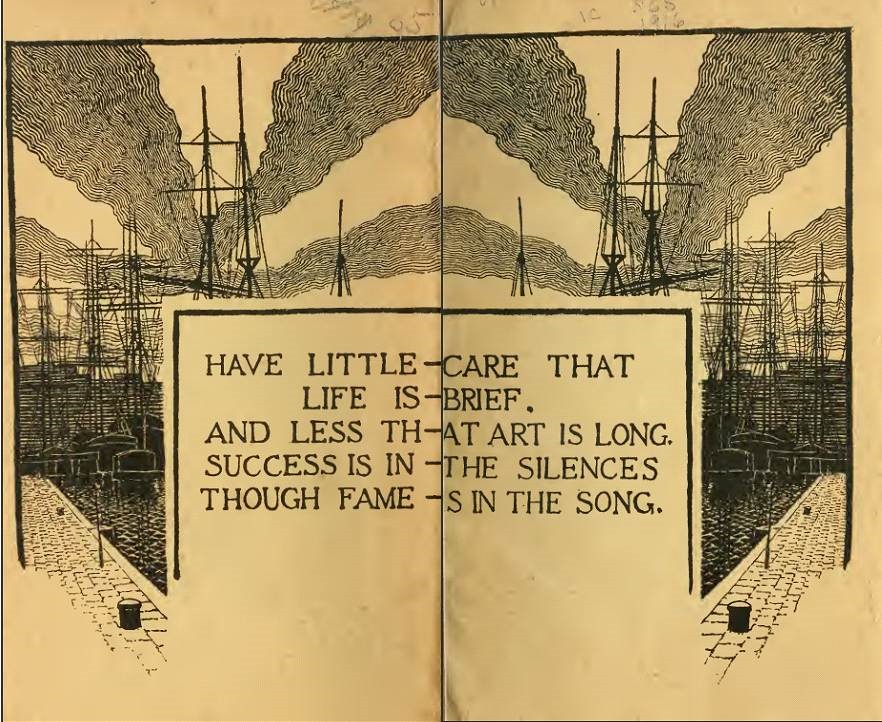
Vagabondia Front Piece

The front piece in Carman & Hovey’s “Songs from Vagabondia.” Here’s a link to the text of “The Mote” included in it.

.

The first time I read “The Mote”  I thought it the story of a short slightly tipsy conversation between two young men in a bar. For young men with loosened tongues to talk of the universe, its unfathomable scope and mysterious connections, is a comic commonplace after all.

As the mote flies into the wine cup of one of the young tavern drinkers and the conversation starts, it’s easy to overlook the way Carman set the scene: the pair entering the tavern are of “august bearing, seraph tall.” Are Rudy Gobert and Karl Anthony-Towns having a post-game libation? “Seraph” isn’t the most common form of an esoteric word, “seraphim,” but it’s a name for the highest order of angels.

If one reads it again, taking that seraph literally rather than figuratively, then the mote which is called “Earth” isn’t a parable, but the plaything of two indolent angels! This ambiguity seems cleverly designed-in by Carman.

You can hear me perform Bliss Carman’s “The Mote”  with the audio player below. The guitar part was played with my Squier Jazzmaster, an affordable rendition of a once unsuccessful Fender electric guitar design. One of the knocks against the Jazzmaster was that it had too much open string-length between the tailpiece and the bridge, a fault that could generate extraneous noises when one uses the vibrato bar. Some modern players see this and figure: “Feature, not a bug!” So, in that manner, some of what I recorded here has me intentionally playing the outside noises that a Jazzmaster can make.

If you don’t see the audio player gadget, I provide this highlighted link that will open a new tab with its own audio player.

.

*Here’s an odd thing: the 19th century French poets that were stretching the subject matter, outlook, and prosody in advance of their contemporaries in England took influences from American poets like Whitman and Poe. Carman and Hovey wouldn’t have needed to go across the ocean to France to read those Americans — but still, there’s a field of echoes going on in this pre-Modernist era. There’s another cosmic joke here too: Brits may have needed to hear some American-originated poetic ideas spoken in French before they could recognize their value!

The Two Bobbies: compare & contrast Robert Burns and Robert Browning. Make your answer in the form of a song.

When we last left off pioneering Canadian poet Bliss Carman he was audaciously publishing a collection of 100 lyrics by Sappho.  If you read that post you find that such a substantial book of Sappho required Carman to largely imagine what the ancient Greek poet wrote, since much of what survives of her poetry are fragments, often but a line or two.

One could shelve that effort next to Ouija board transcriptions, among literary frauds, or within the loose bounds of historical fiction. Still, the “Sappho” poems he published have their attractions. And there’s a greater reason to look at Carman’s work: he was writing these things in the generation between 1890 to 1915 before English language poetic Modernism fully emerged with new models and freedoms for poetry. Some younger poets then suspected that Victorian 19th century poetry was overdue to be superseded. In England, William Morris and the Pre-Raphaelites had done what segments of young poets, musicians, and artists sometimes choose to do: they rejected their current and parent’s generation and looked to older models of their arts for different forms of expression.

Imitating the ancient Greeks in English was one such idea. Carman went further by treating his recreations as translations, but he may have gotten away with it when English translations of Sappho were still a bit thin on the ground. Other early Modernist poets writing in English like H. D. and Edgar Lee Masters produced original works that echoed the tone and methods of Greek lyric poetry.

Those Sappho lyrics weren’t Carman’s breakthrough however. That happened in 1894 when he and American poet Richard Hovey* published Songs of Vagabondia, the first of a series of co-written poetry collections that sought to break the Victorian mold. For a mid-20th century person like me, I sensed a rhyme in the appeal of these books as I read through them. Is it too easy for me to see them as the late 19th century equivalents to On The Road  and beatnik bohemia?

How so? Though the Vagabondia  poems have variety in subject and tone, they extol carpe diem, wine, women, and song, along with non-itinerary wandering. Sensuality and beauty are self-rewarding. Respectability, career, and money are for others.

Two Bobbies

This song is fun to sing, so let me share the fun with a simple chord-sheet to encourage you to try it.

.

Carman’s “The Two Bobbies”  speaks to this literary and cultural moment. He jauntily compares the English Victorian worthy Robert Browning with the 18th century Scottish poet Robert Burns. Silent on its now age-beiged page, Carman’s poem was just begging to be made into a song, so this week I came up with a simple setting for acoustic guitar and my voice of subjective quality. You can hear me hold forth with it using the audio player gadget below. No audio player?  This link is a backup that will open a new tab with its own audio player.

.

*And what of Vagabondia’s  co-author Richard Hovey? I have plans to present some of his work here soon. Rather than looking to the ancient Greeks or to 18th century British poets, Hovey was steeped in another motherload of Modernist-influential poetry: certain French poets of the second-half of the 19th century.