The people before in the place the scrapbook was left, Part Five

One of the things about writing this series surrounding a scrapbook connected with a 1930-‘50s Afro-American Jazz combo is to observe the risk of writing here as an old white guy in the 21st century about a bunch of young Black Chicago musicians and what I might suppose about their lives. The Cats and the Fiddle in the scrapbook took their shot in the world of art and entertainment, but they’re not famous guys. They lived their lives, as I’ve lived mine, as you likely will live yours, with few persisting details or indelible marks. Perhaps I’m overly fixated with looking for those marks.

In today’s piece I’m going to look at the house where that scrapbook was found. It still exists: 3132 Park Ave South in Minneapolis. I’ve looked to see what I could find out about that inanimate place and the people who passed through it. I hoped any details might help me figure out who collated and left that scrapbook. I found what preceded the scrapbook’s discovery sustained my interest.

Back in the first part of the series I recounted that I lived there briefly in 1976 while helping a friend whose words, voice, and keyboard playing has appeared here over the years, Dave Moore. Dave and his then wife had purchased the somewhat rundown house at an attractive price for their planned little family and their small business. I helped a bit with their work in fixing it up and getting the business going.

The house had character, and this young couple, my friends, hoped to honor part of it by making it look a little more like it did in the house’s youthful years at the beginning of the century, looking for clues in old style books and in the “bones” of the house. Similarly, today’s post is going to start as far back as I can find information.

As Minneapolis started to grow as an upper-Midwest business hub, Park Avenue was a broad, tree-lined boulevard that ran north-south through the middle of the city from the southern neighborhoods to the rail depot and centers of government, business, and milling which were fast being established in Minneapolis’ downtown. Park Avenue became a prime site for the commerce titans to build their mansions. In the mid-70s you could still sort of squint and image that era: the trees were still there, elder elm branches arched much of the way over the wide street, and a handful of the mansions still remained.*

3132 was not one of the mansions. In 1902 it was built by an A. E. Rydlum (or Rydlun) who was a builder, and it was complete and offered for sale in the Spring of 1903 by Thorpe Brothers, who were an active real estate sales firm in this era of rapid growth and building of new housing in Minneapolis. Here’s how Thorpe listed it:

For Sale-Modern house, ten rooms, hardwood finish throughout; full basement, nickel open plumbing, hot water heating plant, sideboard, china closet, mantels, bookcase. Location 3132 Park Av; easy terms; will be sold soon.”

The next notice of the house I found was a birth announcement later that year. A Mr. and Mrs A. J. MacDougall were listed as living there in that announcement. Next year, 1903, they place an ad seeking “a nurse girl, 12 to 15 years old” for service at 3132. In 1904 they place another, similar, ad: “A nurse girl from 14 to 16 years old for 3-year-old boy.”

When I was working on the house, an attic servant’s quarters and separate stairway were part of the house. There was still a bell in the pantry off the kitchen that had a ringer button on the floor of the dining room. How many servants eventually lived there? How long did a 12 or 14 year old childcare worker likely stay an employee? The McDougall child had a theater birthday party at the downtown Orpheum Theater in 1908. The original Minneapolis Orpheum was a 1500 seat, ornate vaudeville house that had been built in 1904.

3132 Park Ave South Streetview

A recent Streetview picture of 3132 Park Ave S, servants quarters behind the three dormered windows at top.

.

I pictured a somewhat prosperous young family, that kind that the house seemed to be built for in this location. So, I thought Mr. MacDougall, the first owner of a fine large house with its attic servant’s quarters, was perhaps a middle-manager, a businessman, or the like. Then earlier this year I began to look at the city directories that are available from the Minnesota Historical Society. It might be helpful to my generation to say that these Directories were like the phone books of their time, a combination Yellow and White Pages of a city’s residents, businesses, and organizations — but younger readers will find that obsolete image useless. So let me reset: they were large books issued yearly, or near so, listing alphabetically by name the head of each household in a city, followed sometimes by the name of their spouse, sometimes by the name of their company or employer, and almost always by a general classification of their job.

No one is just their job, but as a shortcut to figuring out, however roughly, where someone and their family was in the class structure, city directories are a data source for everyday people in the past. Here’s what a series of annual Minneapolis city directories say about our MacDougall (whose first name was Allan or Allen — the first spelling used in earlier entries, and then the other):

1903 not in the directory. Likely the directory’s data predates his moving into 3132 Park
1904 he’s listed as “miller” living at our 3132 Park Ave. house
1905 his occupation is “lab,” short for laborer, living at 3132
1906 the “lab” adds that he works at “Washburn C” — Washburn Crosby was a large milling firm in Minneapolis that is now the corporation General Mills
1907 laborer again, no mention of what company, still living at 3132 Park
1908 job now changed to “foreman,” continues living at 3132 Park
1909 looks like he, still a foreman, (and likely his family, though none of these listings mentions his wife) now live at 3436 Columbus Ave, about three blocks away

This scant info tells me little and makes me wonder. Does a miller or an ordinary laborer afford this large new house — much less, live-in help, and theater birthday parties for his kid? Does the later classification as foreman tell us he wasn’t just a line worker? Was there a blip in the market that caused Thorpe to sell under normal market prices, or would they possibly rent an unsold house? Mortgage terms were shorter then, but moving a young family from a fine house in a great location after only 5 years could mean it turned out to be only aspirationally affordable to MacDougall.

The next residents appear in 1910 from the records I’ve found. A Mr. and Mrs. Peter W. Campbell — leaving a gap, 1909 is unaccounted for. The 1910 city directory lists him living at 3132 Park, and his daughter Elizabeth is married at the home that year. The newspaper account lists 25 guests at the wedding. The house I later knew had a big dining room and parlor joinable by opening a large set of pocket doors. I imagined that many guests, the bride and groom, the officiant. It’d be a cozy affair, but they’d probably all fit.

Peter Campbell is confirmed to be living at 3132 Park in the 1910 directory, but there’s no Peter Campbell in the 1911 Minneapolis directory at all, and he’s a boarder elsewhere in the city in 1912. These listings don’t list his job. This short-term occupancy for someone that doesn’t seem clearly homeowner class testifies against his ownership.

In 1910, during the same summer as the Campbell wedding, 3132 Park is listed for sale again: “”Elegant 8 room all modern home, fine lot, reduced price $6,250.” The house isn’t yet a decade old. It’s a fine upper middle class home in a desirable location in a growing city, and in this time servants-wanted ads were placed, and then placed again, curious residents arrive and leave. If this was a Stephen King novel, I could see the haunted story potential, but I don’t really know the story, just these little points.

I can’t say when the house sold but by 1913 we have yet another servants wanted ad, “girl for general housework.” This ad is likely announcing the family that would be the home’s longest occupants, The McLeods: husband John, wife Elizabeth. I note there have been three Scottish names in the house’s history: MacDougall, Campbell, McLeod. John McLeod was certainly Scottish, born on the Island of Lewis, a very northwestern part of the Outer Hebrides. McLeod was said to have built several grain elevators in North Dakota, but his job now in Minneapolis’ downtown was as an “independent grain trader.”**  The McLeod’s were a middle-aged couple when they lived there, and Mrs. McLeod was an active clubwoman, holding regular meetings for the Columbian Club and her Presbyterian church at 3132. In 1921 the Columbian Club agenda was a talk on “Greece, the Reign of Pericles, the Glory of Phidias.”   Rather than thinking of cursed winds crying “Heathcliff” around 3132 Park, the next 21 years record the kind of stable middle-class life the house’s builders might have expected.

In 1934 Mrs. McLeod dies. Then five years later, in April 1939. this headline appears in the local paper “Trader Collapses at Grain Exchange.” John McLeod was 77, still apparently working as a grain trader. He died the next day in an oxygen tent at the Swedish Hospital in South Minneapolis.

This more-or-less ends the upper middle-class phase of the fine house on 3132 Park. In May 1941 it’s listed for sale as a “very livable home” and “interior in excellent condition….must be sold to close an estate.” I think of all the hardwood trim, doors, built-ins — much of which Dave and I were chemically stripping of layers of paint in 1976. It was likely still pristine then, and still echoing with talk of Phidias and perhaps John McLeod’s mumbles about the Non-Partisan League’s pressures on his trading margins.

Two years past McLeod’s death to settle an estate? You got me on that, but there are indications that the Great Depression isn’t the best time to be selling a big house. The house is listed again in August and September of ’41, this time in the for rental ads. Rent? $50.

Yet in 1942 someone else is having social club meetings at 3132 Park: a Mrs. Jewell Bliss is holding a meeting there for the Juline Burr Tent, DUV to be followed by a social hour and cards. DUV is probably Daughters of Union Veterans and Mrs. Juline Gales Burr (who died in 1906) was a Minneapolis resident and the first state president of the Minnesota Grand Army of the Republic (another Union Civil War veterans organization). Also that year a luncheon for “past president of D. of H.” hosted by Jewell again. D of H is likely “Degree of Honor” a Catholic female fraternal benefit society.

Yet the house on 3132 remains in a murky state in 1942 as I look for mentions. I’ve found records for Jewell Bliss, who was married to a Norland (who went by Noel) Eldred Bliss. Since city directories are alphabetical by head of household (often husband) I looked for Noel Bliss. Throughout the entire US WWII years he lived on Penn Ave North, not Park Ave, and Jewell is listed as his wife, same address in 1942, ’44, and ’45 in the city directory. Noel’s occupation is listed as “beverages” and his business address seems to be 2501 Marshall in Minneapolis.***  Bliss was in the news in 1936 for being a liquor dealer indicted for perjury in Minneapolis. He pled not guilty — but alas, I have no more information on this case.

Noel Bliss perjury charge

Noel Bliss: liquor dealer three years after the end of Prohibition, but facing charges.

.

But the situation at 3132 Park remains unclear. Jewell is holding meetings there, though she apparently doesn’t live there. In post-WWII years larger houses on Park Ave were used for offices of various organizations. Was 3132 Park being used at least temporarily in this way, or was Jewell an organizer using someone else’s home or apartment? Again, I think of the home’s two large main rooms, a good place to hold your social gathering.

1943, a short newspaper story about one of our house’s residents links to some fascinating details. A 14-year-old boy named Bruce Dybvig who lives at 3132 Park Ave stumbles on the shores of one of Minneapolis’ urban chain of lakes. He breaks his foot falling into Lake Nakomis where his injury inhibits his ability to swim. OK. I’m not trying to stress a 3132 Park Ave curse theme — and look, the newspaper story I found says a boy lifeguard, only 16 himself in these wartime years of military mobilization, pulls Dybvig out of the lake. Bruce is treated and released from a hospital, and surviving he soon goes on to become another teenage Jazz musician with a story comparable to our Cats and the Fiddle main thread this February.

A year after his accident, Dybvig takes up alto sax, and by 1946 he’s organizing Minneapolis high school students into a 16-piece Jazz orchestra to play the “books” of the hippest white Jazz big bands of that year: Stan Kenton and Woody Herman. What happens to Bruce and those kids? If I haven’t exhausted you with this thread about a house, you may be the kind to enjoy the Jazz-in-Minnesota side-trip to be found at this link.

Bruce Dybvig and his teenage Jazz band

Boy saved from drowning, the teenager then starts playing modern Big Band Jazz. Bruce Dybvig at the left of each picture. What’s with the Carnegie Hall sign behind him? I’ll tell you again, you might want to read that above link.

.

By 1953 the Park Avenue house is on the market listed again as “Lge. Inc. home, full basmt, gas heat, partly furnished, in excel repair, Ideal for rest home.” Two elderly men with different last names died in 1950 with 3132 Park as their address. This indicated to me that sometime in the early Fifties it may have become a “rest home,” a midcentury type nursing home/elder care facility.

In 1956 another for sale listing: “3132 Park Av S. See this lg, well kept home, 8 BRs, 2 1/2 baths, completely furnished for income, has gas HW heat, nice yard & gar.” It appears that sometime in the mid-50s the house’s rooms were subdivided or areas in attic and possibly the basement became living areas. In the mid ‘70s Dave was told the place had been a Black-owned rooming house.

In 1963 a teenager, Roosevelt Gains, likely a son living with his mother, a hotel maid, at 3132 Park, gets convicted of robbery.

In 1973 I found one more appearance of a 3132 Park resident in the newspapers, Bill Wilson, a house painter doing a little frozen lake winter fishing. In Minnesota this sometimes involves big trucks and semi-elaborate shacks pulled out on sledge runners, but Wilson is equipped with just regional hardiness and a hand-auger. Dave Moore, and then I, will be arriving soon to the Park Avenue house. The scrapbook that’s the idée fixe of this series will be uncovered there. Did 3132 Park Ave have a curse, or is the nature of the place simply the nature of the struggles and reprieves of life? I will be returning to the Black History focus of this series next, but leaving today’s stories of inconclusive fates and historical lacunae of largely white residents who lived at 3132 Park Ave, I’ll summarize. I don’t know even the names of everyone who lived in that house: those teenage servants advertised for (likely newly arrived European immigrants), other old people who may have lived in a midcentury rest home, the transient renters. I’ll leave you tonight as I go to sleep, saying these clippings of life collected here, outside the scrapbook that started things off, are exhibits of working class people in my South Minneapolis — Black, white, Asian, Latin and Native American — saying that our histories have commonalities of dreams (and yes, blunted dreams) passing under all our shades of eyelids, closed in our place across time.

Bill Wilson is ready to go ice fishing

Bill Wilson, one of the last tenants at 3132 Park Ave S. in its rooming house days.

.

If you want a short poem performed with original music after these decades, here’s the young Langston Hughes preparing to close his dark lids amidst his neighborhood in the last decade called the Twenties. Backup link in case you can’t see the audio player the rest of you will see below.

.

*Rather shortly after I arrived, nearly all of the remaining mansions were torn down, as they had no clear commercial or residential usage by then. We’ll discuss South Minneapolis in the later 20th century later in this series, but in 1976 as it is now, this Park Ave area is a series of varied working class to under and unemployed ethnic mix neighborhoods. Over in the other twin city in the 1960s and ‘70s, St. Paul’s similar Summit Ave, was preserving their grand pre-WWI houses which became once again homes to upper middle-class owners.

A surviving Park Avenue mansion is now the Swedish Institute. It was built by a Swedish immigrant businessman in 1908. It’s five blocks from where 3132 went up a few years earlier.

As to the tree canopy, most of the old trees were elms, and Dutch Elm disease wiped most of them out after I arrived. The city’s urban foresters have tried to replant, but it’s trees, and old trees take time.

**Noting McLeod’s North Dakota and Minneapolis connections, I think of the history of the successful organization of the Non-Partisan League in the Dakotas. Farmers there rankled at the low prices they got for their crops, and high markup profits by traders and middlemen who owned the grain elevators, the railroads, and the grain processing mills. Those latter folks often worked out of Minneapolis, but the eventual NPL elected governing majorities in state government, built their own elevators, and pressed with more leverage and bargaining power to improve the farmer’s lot.

***As late as 2022 Bliss’ old business address was the location of Betty Danger’s Country Club, a hip and eccentric restaurant. The owner listed it for sale that year, citing the reason for the sale in this report: her mental health. However many levels this is removed from 3132 Park, it’s another reason for Stephen King to contact me about that gothic novel.

A Birthday, Vampires, and The Greatest Original Music Band Minneapolis Ever Forgot.

If Halloween is about shadows, ghosts, the dead and un-dead etc etc, it comes in the month I celebrate the birthday of my friend, the living Dave Moore, an occasional alternate voice here at the Parlando Project. Dave’s a poet, songwriter, cartoonist, and my longtime musical partner in the LYL Band. Back in the 1970s his lyrics were frequently used by “The Greatest Original Music Band Minneapolis Ever Forgot,” Fine Art.

I wrote about Dave and Fine Art a few years back. TL:DNR summary: Fine Art were a Rock band that emerged in 1978, issuing a self-produced, self-titled, vinyl LP, and then performing often in what few Twin Cities locations that were open to the handful of original music bands.* “Punk” was still the sticky label used for young bands that performed non-conformist new material then, but it was not a homogeneous scene of Ramones and Sex Pistols cadre three-chord-shouting-in-leather-jackets-and-frayed-cotton.**  Television, Patti Smith, Pere Ubu, Talking Heads — all these were formative bands in the Seventies, present at the beginning. Yet, oddly enough, labels like New Wave, and Post-Punk were generated to try to describe those that didn’t follow the stance of regimented simplicity for concentrated force and/or skill-set necessity. Fine Art were one of those from that non-traditional tradition.

As the famous Minneapolis First Ave club moved to presenting young original music bands, Fine Art played there regularly in the early Eighties, both in the small side-room the 7th Street Entry and in the big main room. When someone reprints a poster of that fabled club’s scheduled acts from that era to highlight Husker Du, The Replacements, Soul Asylum, or even Prince, you’ll often see the Fine Art band name playing the week before or after.

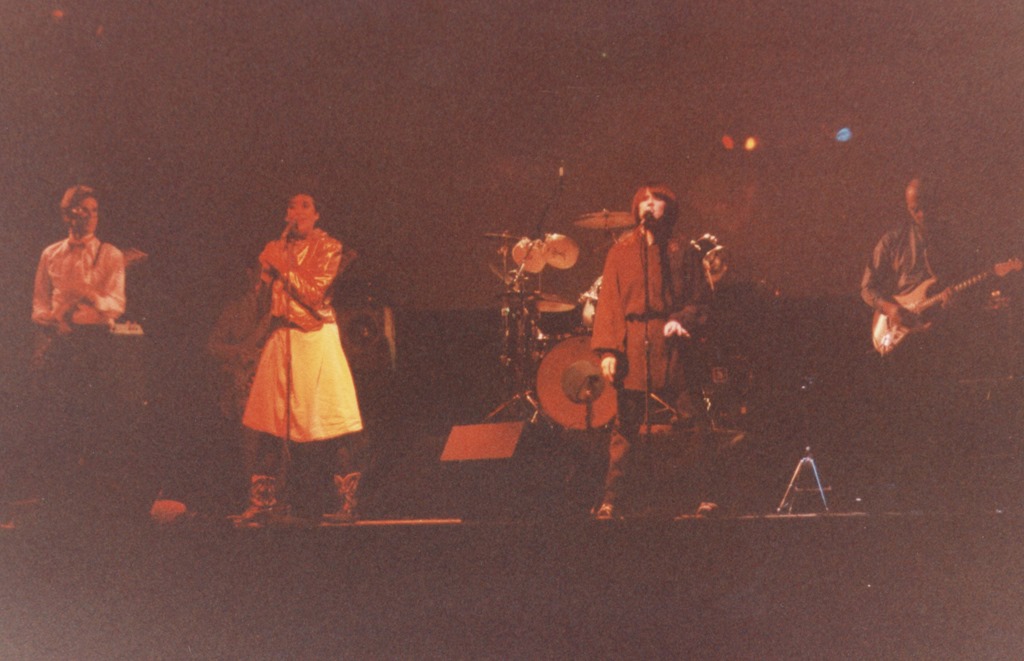
When this era is covered in overview, even by locals who want to concentrate on “the scene” not just the national acts that emerged, Fine Art barely makes the footnotes. That’s not exceptional, history-is-written-by-the-winners and all that. But here’s the thing: Fine Art’s material was all original (they never performed a cover), and it was very very good. The band two guitarists were excellent: Ken Carlson’s driving chordal center on rhythm guitar and Colin Mansfield the genius lead guitarist who could do song hooks or Free Jazz, sometimes in the same song. The two women lead singers format was unusual then as now, and the original pair Kay (Carol) Maxwell and Terry Paul, and later Kay and Jennifer Holt were effective. But it’s the songs, those constructions that were passing sounds on a club stage and remain only on the barely surviving and out-of-print records that shock me to revisit. They’re still  unconventional — and as such, they still sound fresh 40 years later. Dave’s lyrics are part of that, even if he wasn’t the only lyricist in the band.

Vampires. Coffins. Fear of being suffocated. A song with a Dave Moore lyric from Fine Art’s LP issued at the start of the band’s existence in 1978.

.

Fine Art didn’t survive past the Eighties, but the LYL Band still gets together. You still can hear songs Dave wrote and ones he contributes to here sometimes. I do my best trying to be musically adventurous to support Dave’s words.

In one’s youth you are told you should think of the future.

Generally, you don’t.

In one’s old age you are said to think too much of the past. I generally don’t. A smaller future is the treasure I consider, the treasure I want to spend. Playing with and knowing Dave is part of the treasure.

.

*I think this surprises some younger indie musicians or fans today. In the Twin Cities in the Seventies, if you wanted to play in public in a band you were expected to perform songs people knew, which meant cover songs. If you wanted to buck that trend, there were in 1978 maybe 2-3 places that would let you try it. When you hear of The Replacements doing one of their live piss-take cover song tangents, there’s likely just a bit of residual anger at that constraint behind it.

**In retrospect, many assume an amoeba, fish, surfacing amphibian, stooped monkey, biped man with club picture of how indie evolved from punk. But the earliest CBGBs bands were a very mixed lot. The Ramones stood out  because of their fast, faster, and fastest strumming rock minimalism in that scene. And Ur-source band The Velvet Underground mixed simple and complex, pop ambition and alienation noise with abandon. New Wave and Post-Punk existed from the beginning — or before the beginning. Fine Art may have produced fewer hard core adjacent songs as the band evolved, but they were always composing fresh, heterodox musical concepts.

The Stare’s Nest at My Window revisited

For Heidi

It’s been a rough series of days in the Twin Cities. Other than no great new loss of life (only fear of it) there’s not been much accomplished in my home or in my city.

I have a few new pieces in various stages of completion, and ordinarily I’d be working on additional ones for this project. This spring the pandemic quarantine measures have been bothersome, but so far Dave and my family have been coping and doing the best they can. Given the number of people sickened and killed by Covid-19, bothered and coping might as well count as “the best we can do.”

Then comes a public act of callous manslaughter. Worse for not being unprecedented. Worse for being tied to the sickness of racial oppression. We have a vaccine and a natural immunity for that: It’s empathy and love. Yet, many refuse to be vaccinated, or don’t have the vaccine available to them.

The phrase “the best we can do” has fallen into disrepute. Perhaps you’ve come upon this piece after reading or hearing someone else remarking on why this phrase is dispensed with, or should be dispensable.

For the last two nights the quarantine from the virus has been trumped by the fires and murmuring crowds. Crowds with the wisdom of crowds, which is to say, not much. Crowds work like a jangling overstimulated nervous system, tingling with pleasure and pain receptors, with a prejudice for why not.

My family, my friends, my artistic compatriots, my neighborhood are at the epicenter of this. Long time readers may know that alternate voice here Dave Moore was associated with a 20th century literary magazine that called itself “The Lake Street Review.”  Minneapolis’ Lake Street is (insert here the English verb that needs to be invented that stands for the balance of hope/fear/despair in our present moment poised in is/was/will be) a multi-ethnic, multiclass (if mostly working class) strip of enterprises where you can get diapers, groceries, your prescription filled, that part to keep your old car running, foods from fast to global, places where bands used to play before Covid-19, bookstores, libraries, arts labs, paper and toner for your printer, intoxicating beverages, hardware stores, your laundromat-load destination, where you go when your car needs gas and air for the leaky tire. It’s were the Latin Americans and African and Asian immigrants have their shops. Lake Street is an early 20th century construction. Apartments still over the retail ground-floors in older buildings, houses and apartments right next door behind the stores, closer than modern codes allow. Great portions of this are now gutted, looted; still smoldering from last night or cold ashes from the night before that.

I’m sure what we live  is a hugely interesting phenomenon for commentators, political philosophers, or folks just looking for a “news hook” to write or say something. Some will be civic sports-bar-tone arguments for who needs to be shot on sight for the sight of their targets, others will be earnest explainers about how rioting is the only effective language of the dispossessed, and that the wreckage of the places that a large percentage of those from the middle on down to the homeless frequent and depend on isn’t the disaster for them that it looks like to those less-evolved in their political consciousness.

As I’ve said already, I myself fear I’d dishonor this with my broken prose and dim eyes. And what old men think about this is less important than what those younger who may read this think, resolve, and do.

The Stare Nest at my Window text

Yeats poem written while sequestered in Ireland with his wife during a civil war. “Stare” is a old name for the starling, considered a nuisance bird.


Beneath the beach, more paving stones.

Friends of my family since both our children were born spent the hours around midnight wondering if the unchecked flames from a torched gas station would spread to the homes next door. My neighborhood post office (the same one where Lake Street Review  submissions used to come in) went up in big black smoke as it was deliberately broken into and set aflame. I’m not sure if anyone looted stamps.

My wife asked around midnight if we should flee.

“Where would we go?” I asked.

“Away from the flames.” She said.

All this is happening in a mix of memorializing assemblies at the site of the callous killing, protest marches with pointed aims, and then the looting and vandalism. I’ll offer one piece of observation that you may have not seen in the reports and thumb-sucking think-pieces: the memorializing, the protestors, and the vandals are an integrated lot. Skin tone and hair, those markers for ethnicities we use in our great cultural mythology of race, is My Rainbow Race in these events from the pious, to the protest, to the break and burn brigades. Watching cell-cam videos and media long-shots has impressed on me that the palette of the sufferers and perpetuators of these actions are not one shade. Racists are going to need to ignore these visuals as they form their illness’ distortions. The guy smashing the library window, setting fire to the auto parts store, or acting like a drunk frat boy he would never righteously be as he shoves the burning dumpster nearer to the building might well be white in these nights.*  And the “Nothing-ever-changes” cadre of gloomy-Gus activists** are likely too tired and weary to notice that the white, Asian, and Latin American participation has increased markedly in this time’s repetition of events sad, demanding, and chaotic.

I used gendered pronouns in moving to the vandal side of things, as that part does tend to become a sausage-fest. My wife is going off to join others this afternoon to sweep up broken glass. Not to get into gender stereotypes here, but how much do you want to bet that the gender mixture there will be distinctive too?

Tonight, I do not know what will happen. The memorializers will continue to do so, for George Floyd is still dead. The protestors will continue to protest, for it’s still wrong. And the vandals, not even interested in the materialist desire of the looter *** for a case of beer, a flat-screen TV, a book of Yeats collected poems or LeRoi Jones’ liner notes will continue to maintain that the best refutation of a failed “the best we can do” is: “the worst we can do.” The tao is too strange for me to know. Blessed be if they are right.

This is all the squishy thinking and writing I’ll be capable for a while. Tonight, I will probably not sleep, or fall asleep in imponderables. Will my wife be able to sleep the night before our anniversary? Will someone’s laddish fire, set with self-congratulating righteousness, find its equivalent of four Birmingham Sunday-school girls? When will America’s Valkyrie gunfire (I say with dread: remarkably rare so far) begin to sing? Will progressive change crest and recede? How happy is Donald Trump, our king of misrule, as his empire expands while progressives proclaim nothing ever changes as proof of their progressive acuity. Tell me, I want to believe, I need comfort: are you sure too it can’t get worse?

I now return you to our usual cultural activities. The most popular piece I’ve posted this year is by a cultural nationalist poet from another nation: Ireland’s William Butler Yeats. When I posted it at the end of January I wondered if I’d done well by it, but I now think I did, and listeners seem to agree. I’m also now sure my reading of this text is shared-heart-true. If you have time, and are interested in the exact background as Yeats wrote this, read the original post linked here.

This is a week where I have been in my own little run-down tower, seeing out my  window as Yeats showed me. Brothers and sisters, read the last stanza of Yeats poem in tears—even though they don’t put out fires directly.

Rather than a link to the text you’ll see it above in its entirety because I urge you to do that. If you’d like to hear my performance and music for this, the player gadget is below.


*Having tasted but not absorbed the fibrous materials of current cultural appropriation tropes, do any white anarchist allies as they smash the state at the library window, or get all dewy being a revolutionary fire-starter in a multi-ethnic neighborhood wonder if they are being authentically respectful of non-white culture from their skin privilege?

**I have long wondered at the futility of the salesman (as an agitator is, to a large degree) who paints their product as ineffective in use and their allies and audience as always deficient. I’m an old man. I understand being sick and tired. I’ll buy the “I can’t believe we’re still fighting these same old battles” T-shirt. But don’t tell me it itches, it’s guaranteed to fall apart, and isn’t available in my size.

***A few years back someone, who I cannot remember in order to credit, said that rioting with looting combines the two least attractive tendencies in American culture: shopping and violence.

3D Blues

Man Ray was sort of Man Ray’s real name. His family immigrated to the U. S. in the 19th Century and like many families they changed their name along with their country, and so Radnitzky became Ray. His birth first-name was Emmanuel, which would be conventionally shortened to Manny, and with just a bit more compression you arrive at Man.

I think I’ve mentioned in passing that in my 20s I developed an interest in Dada and Surrealism. I’d never pass myself off as a scholar of these subjects, it was more a matter of feeling that some of their ideas resonated with ones I had already been using. As evidence of my lack of scholarship, I’ll mention that I had always assumed Man Ray was French. Well, no. He grew up and began his career in Brooklyn and moved to Paris in his early 30s, before he could speak any French, That must have increased the Dada potential of the move!

Man Ray always felt free to range about in media and approaches. He was creating Dada assemblages and “ready-mades” by 1920 and Andre Breton called him one of the “pre-Surrealists” who had been creating art in harmony with that movement before it was officially a movement. Man Ray pioneered the idea that photography could be non-representational, made short experimental films, but also shot portrait photographs. And, luckily for this Project, he also wrote poetry. Ray once said that his artistic credo was seeking pleasure and liberty. “I simply try to be as free as possible, in my manner of working and in my choice of subject. No one can dictate to me or guide me.”

His short poem “Three Dimensions”  was published in Alfred Kreymborg’s NYC-based Modernist magazine Others  in 1915. As I understand Ray’s poem he’s looking at houses at night, not a city but outer borough or suburban scene. They’re lit up, representing the lives within. I suspect he’s punning when he says the luminous houses, walled off and oh so separate, should not be viewed “as masses.” They seem weightless, but in their separations the are as well not “The Masses.” The dark spaces between the houses, the hedges and walls, are then compared to shawl-covered heads as would’ve been worn by old women in his day. Ray concludes, still recognizing the separateness of the houses and the lives within, but perhaps with a hint of their potential. Mystery and curiosity are separated when we know that if they were to be combined they would combust!

So, what can I do with Man Ray’s poem?

Glover Ray and Ray

Glover, Ray and Ray. Tony Glover on blues harp, Dave Ray on 12-string guitar, and a Man Ray self portrait


Dave Ray* was a singer and guitar player. In the early ‘60s he was part of Koerner Ray and Glover. I guess you could call Koerner Ray and Glover a group, though they themselves didn’t.** Dave Ray was 20 years old when KR&G released their first LP***, half-a-decade younger than when Robert Johnson first recorded a side, and much, much younger than Leadbelly was by the time John and Alan Lomax recorded him. Ray kept up playing his whole life until it ended while he was still too young in 2002.

KR&G formed in Minneapolis and were part of the early days of the West Bank and other folk music scenes here. I can’t say for sure (I’m a late arrival), but Dave Ray was probably one of the reasons that the Twin Cities area has a higher percentage of 12-string guitar players than anywhere else.**** Shortly after I moved to the Twin Cities in the ‘70s I bought a cheap 12-string at a record store on Hennepin Ave. It seemed mandatory, like learning the snow-emergency parking rules.

Cortez 12 string 1080

Why yes I can prove I’m a Twin Cities guitarist: here’s my 12-string.


Today I made a Dada assemblage. I’ve recast Man Ray’s “Three Dimensions”  as “3D Blues”  and I played it on that still surviving 12-string—not as well as Dave Ray could have done it, but then it wouldn’t exist if I hadn’t done it. The old 12-string has a soundhole pickup which I played through a little combo amp. KR&G started all acoustic, but Dave Ray often played plugged in later in his career. I rearranged some lines and phrases in Man Ray’s poem to fit it into a blues form. You can read Man Ray’s original here. You can hear my revision with the player gadget below.


*As far as I know, Man and Dave aren’t related. Dave Ray’s youngest brother, the equally well-named Max Ray, played the saxophone with the Wallets and still plays around town. If I was to Kevin-Bacon-game Man Ray and Dave Ray, Max Ray and the Wallets would be my move.

**Koerner Ray and Glover never broke up because they never joined up, performing solo or in various combinations from the first to the last. Dave Ray claimed they should have been truthfully billed as “Koerner and/or Ray and/or Glover.” Koerner made a record with Willie Murphy back in the 60s. Tony Glover wrote an important early instructional book on how to play blues harmonica as well as writing about the new Rock music that emerged later in the 60s.

***That first LP was called Blues, Rags and Hollers  and just like it says on the cover, they played a wider-range of material than what was labeled “Blues” as time went on.

****Both Koerner and Ray played 12-string guitar, in the tradition of Leadbelly and Blind Willie McTell. As time passed, the blues 12-string tradition became forgotten in many places, and I’d encounter people online who thought acoustic-guitar blues must be played on small-bodied 6-strings or resonator guitars.

Willie Murphy (Is Always Playing on the West Bank)

A couple of weeks back a local music legend Willie Murphy died. I’m going to ask indulgence from this blog’s overseas audience, because unless you were around Minnesota in the last 50 years or so, you’ll likely have no idea who Murphy was—no, it’s even more location specific than that—I believe you need to have memories pinned within a few blocks of the intersection of Cedar and Riverside avenues, in a Minneapolis neighborhood near the Mississippi river known as The West Bank.

Many years ago the West Bank was a Scandinavian immigrant enclave, and it is now the home to Minnesota’s largest Somali community. But my story today is in-between, in the second half of the 20th century, when it was home to a thriving bohemian culture, immigrants of a slightly different sort.

Shortly after I moved to Minnesota, I got work at a hospital there, and when I had enough money saved up, I took classes at the University of Minnesota which spans the two banks of the river. I came late to the West Bank scene, but I absorbed the stories of those nonconformist young immigrants who were homesteading something that was called “the counter-culture.” The counter-culture was Willie Murphy’s job, as much as musician: putting together bands, recording other musicians, inaugurating live music venues, working and networking the scene.*

Willie and the Bees photo by Dave Ray

Willie and the Bees getting down somewhere in the past


But he was a musician too. Sang, played bass, guitar, and piano. Interpreted a lot of great R&B and wrote some good songs himself.

He was never the businessman. He engendered some of the things that entrepreneurs like to claim they do, but he never got the cash rewards. It’s a complicated story and I don’t know all the details—but I do know that he was an artist making art on his own terms right up until his last months of his 75th year. In one trope of musician’s slang, musicians “make the gig” or “make the scene.” Murphy lived that literally: he made a lot of gigs, helped make a scene.

Willie Murphy Angel Headed Hipster

Angel headed hipster. Murphy in his later years, still keepin’ on.


Mine’s a complicated story too. I eventually fell in love at the same time with two people who lived on the West Bank. There was music most nights and every weekend at a couple of coffee houses, a short-lived jazz club, a music school, and several bars, all of them within four or five blocks. And for my literary side, besides the University, there was Savran’s bookstore, which was well stocked with small press publications and poetry in several languages. In one’s Twenties many are imprinted on the culture encountered then, but the West Bank in the ‘70s seems an especially strong tattoo—and nostalgia fades in reverse.

Most change happens slowly enough that you never see it happening. One day you look over your shoulder and you see everything behind you isn’t there anymore.

Or you pick up a paper and see that Willie Murphy has died.

Most change happens slowly enough that you never see it happening. One day you look over your shoulder and you see everything behind you isn’t there anymore.

Or you pick up a paper and see that Willie Murphy has died.

I felt I needed to write about this, regardless of how well I could do it. The song I wrote “Willie Murphy (Is Always Playing on the West Bank)”  has in-jokes and puns that only West Bank habitués will understand. In the first verse I twisted a line from Ginsberg’s “Howl”  that also supplied the name of Murphy’s last band. Punned-in the name of some West Bank bars in the second verse, gave a shout-out to Koerner Ray and Glover in the bridge, and got in a sideways nod to the West Bank’s Mixed Blood Theater before I finished.

A week ago, I sprung it on the LYL Band and we gave it a go, with Dave Moore supplying his piano part off-the-cuff. You can hear it with the player below.


*Murphy recorded an LP with “Spider” John Koerner back in the 60s, and produced Bonnie Raitt’s first LP in the early 70s. Willie and the Bees was an integrated R&B band that mixed funky jazz and danceable grooves for a decade or so from the mid-70s into the early ‘80s.

The Story of Dave Moore and Love Songs

Don’t worry, we’re only taking a break from our regularly scheduled mix of various words (mostly poetry) with original music to tell the history of the Parlando Project’s alternate voice Dave Moore. So far in our story, he’s gone from poet to pioneering Twin Cities indie band lyricist to full-fledged songwriter to singer-songwriter-keyboardist for a two-person band of poets with instruments in about two years. If you’ve been following along, I’m the other poet.

How did this turn out?

Returning to 1980 after the release of the Lose Your Lunch Band’s Driving the Porcelain Bus  recording, the two-man-poet-band thing seemed to be a problem. Around this time a handful of Twin Cities indie rock bands had eked out a local circuit of venues that would book them. This was all very tentative, and only sufficient to give bands the initial toe-hold on a career, and it wasn’t really open to something as sparse and loose as we were. Could we possibly have tried to push that square peg, a “hardly rock band,” into that circuit?

Perhaps. We started looking to fill out the band, with the drummer being the biggest problem. I had started to dabble with electric bass, and Dave’s Farfisa combo organ had left-hand gray keys which could be dedicated to keyboard bass duties in the Ray Manzarek mode. The first third was Jonathan Tesdell, a guitarist who had a set of congas, and who was drafted out of a commune down the street. Jonathan practiced and played with us for a few gigs on electric guitar, but I can’t recall us ever even trying the congas as a replacement for a more rockist drum set live. But after a few months, Jonathan left town, traveling light. I once heard that his Gibson Firebird electric guitar that he sold before packing for travel was bought by The Replacements’ Bob Stinson.

Next up was a very talented guy who I believe was working then in the live comedy and theater scene,* Dean Seal. Dave somehow recruited him**, and Dean played drums and bass. Of course, not at the same time, a limitation we overlooked because he was willing to play with us. Dean could write great songs as idiosyncratic as Dave’s, and he had a good singing voice (later recordings with Mr. Elk and Mr. Seal demonstrate his cabaret-ready performance chops***). Dean later went on to a long and unique career, leading the Minnesota Fringe Festival for several years, and in this century becoming a UCC minister who combined his theater and comedy experience with religion.****

A fully operational LYL Band

Performing “Magnetized,” the rarely seen, full LYL Band live in the ‘80s. L to R: unknown drummer (see below) Dean Seal, Dave Moore, and Frank Hudson


Alas, Dave and I had sort of lost the fire to play out around the time Dean joined up. I’m not even sure if Dean could have been the singing drummer (harder than it looks) and songwriting voice that could have given Dave a rock-club ready band. With us, Dean played mostly electric bass, and he took a liking to a cheap Japanese copy of a Gibson EB0 bass that I had found in a second-hand store. We traded basses, mine for his similarly low-quality Made In Japan bad-translation-of-a-Fender bass. That instrument sits next to me as I type this, and I still play it often on pieces you hear here. Somewhere in the later ‘80s the LYL Band went, as press-releases still say these days, “on hiatus.”

Why? When I asked Dave today he said he hadn’t thought of that, but as we chewed it over I think it was the matter of both of us, in committed relationships and needing to pay the rent and bills at the lower edges of the economy, gradually converting the concept of the public band to a private joy.

But as that was, almost imperceptibly to us, happening, Dave’s songwriting took one more turn. The goth and gothic Fine Art lyrics and the agitprop and Dada characters of the early LYL songs were joined by unconventional and sincere love songs.

It’s more than 30 years ago, but I can still remember the first time I heard Dave sing this song, as I have heard Dave sing many songs before or since, stone cold fresh. We didn’t often discuss songs before playing them. Unless specifically working out a live set, we didn’t work out arrangements, run through the changes or discuss accompaniment. We just let it happen for fun or failure.

So, there we are in the 1980s. Dave’s standing at the Montgomery Wards electric piano, I’m no doubt sitting with my Cortez 12-string acoustic guitar with a DeArmond soundhole pickup. I’ve programmed a simple three-drum beat on a Mattel Synsonics electronic drums toy. I hit record on the cassette recorder. Dave hammers out some chords and I figure out the key and some kind of pattern as quick as I can. He begins to sing—and I suddenly realize this is, surprisingly, a love song, a damn fine love song, though still uniquely Dave. What do I think next? Well, that I had better not screw this up. Playing lead/melody lines on a 12-string has a catch: the two highest string courses are tuned in unison, but move to the G string and lower, and they jump up to courses tuned an octave apart. Listening to this now, I can still feel how I kept that in mind as I played. If music be the food of love, don’t lose your lunch.

I have some later, better-recorded versions of “(I Think I’ve Lost My) Total Recall.”  The lyrics Dave wrote as a younger 30-something were good then, but when I perform or listen to this song now, thoughts of memory loss mixing with love are real as well as art representing the impact of love. As songs occasionally do, it’s gone from heartfelt to heartbreaking—but this is the moment I first heard it, and so, excuse the archival audio quality and listen.


As a bonus, although also low-fi, here’s what a putative ‘80s LYL Band as a fully realized rock band would sound like. We’d planned this gig at a Native American center with Dean Seal playing drums or bass on alternate numbers. We’d setup and sound-checked ourselves, and then left our instruments sitting on stands at the end of the building’s gym. As we left for the rest of the event before we played, four guys, unknown to us, went over to our instruments, and began to play them. They were pretty good as I recall, sort of blues-rock. We figured there was no reason to stop the better, volunteer musicians. They played a short set, maybe two or three songs or so. Later that night, the drummer asked if he could sit in for our set on Dean’s drums. Trusting in chance, that’s what happened. The song “Magnetized”  is a Dave Moore lyric, another love song, but I think I wrote the music and sang it here. Once more it’s a cassette recording, taken from the vocal PA that night. You can hear me slightly off-mic trying to let the band know when I’m going to the bridge and walking over to let the rhythm section know that it’s time to end the tune.


*Someone should write a book on that circa ‘80s Twin Cities comedy scene, and yet oddly enough no one has. Louie Anderson, Liz Winstead, Joel Hodgson, Kevin Kling, Jeff Cesario—and I could go on—were all starting out in the Twin Cities in this era.

**Dave remembers he was working as a record store clerk for a time at the Wax Museum on Lake Street, and his manager there, knew Dean, and probably introduced them. Dave doesn’t recall knowing anything about Dean’s theater and comedy work then, only that he played bass.

***One story is that when Mr. Elk and Mr. Seal recorded an album at Prince’s Paisley Park they did it so quickly that it was the least expensive recording ever made there. Here’s some of their work.

****Here’s an article that touches on Dean’s 21st century take on Christianity.

The Story of Dave Moore and Fine Art

This month, I’m going to start a series here featuring the words and music of Dave Moore. This is different—and not—because long-time listeners will have heard Dave’s voice and words here from the beginning, but this time I’m going to expose a little more of Dave’s range of work. If you’ve come here expecting our usual eclectic mix of poetry from various eras with music, don’t worry, we’re not abandoning that (and there’s lots here, just look at the archives on the right), I’m just taking some time to present something different, and “something different” has been my aim since the start.

I’m going to try to put Dave’s stuff in context, at least the way I’ve seen it. I’ve known Dave for 50 years. He was writing poetry before I met him, and he’ll write things for the page to this day, but he became a songwriter and he has had a long-running one-panel comic for decades too. I’ll start by talking about the songs.

A little over 40 years ago Dave’s words were used for the lyrics of a third of the songs on one of the pioneering Twin Cities punk/new-wave/indie records: 1978’s Fine Art’s Fine Art.  Dave didn’t perform with the band, and as far as I know, he didn’t have any direct input on the music the band created for the songs. Fine Art existed from just before their only LP was recorded until around 1983.

That you haven’t heard of Fine Art is likely derived from several reasons. The biggest one is that they, unlike some later Twin Cities’ Indie bands, never made it nationally, but I remain puzzled as to how they have disappeared from the memories, books, and posts of those who have sought to cover the local Minnesota-based heroes that made and made up the late 1970s scene that produced The Replacements, Husker Du, and Soul Asylum, and even to some degree Prince, a scene that was then the platform under an even later generation of Twin Cities connected indies like Babes in Toyland, The Hold Steady, or the Jayhawks. Like other cities who experienced the eruption of indie bands in the late 70s and early 80s, the Twin Cities has its own selection of “They were so good and original, how come they never made it as national acts?” bands. The Suicide Commandos, The Suburbs*, and The Wallets were unforgettable to most who saw them locally, but their national/international profiles never really existed, and are now, like our weather will be soon, below zero. Fine Art, who have a good case to being seminal to the scene, who staked their own distinctive sound within it, are forgotten even locally, and that pains and puzzles me.

So, if you make it through this post, you’ll know more about the band Fine Art than anything you’ll be able to find in a book or on the web. In talking about why they didn’t make it into history, I’m going to try to sneak in why you should care about what they did.

OK, what were the problems and obstacles that explain why you haven’t heard of Fine Art, even though they helped break the ground for a significant Indie rock scene?

Their name, Fine Art, can be understood unironically. Their leader**, Colin Mansfield was a highly experimental guitarist, and his compositional ideas were not punk pure nor entirely pop accessible. A sizeable portion of the Twin Cities scene followed the early 80’s movement to make hardcore music which was intense not only in its volume and velocity, but in the kind of loose authenticity that later was called grunge.***   “Art rock” was another of the labels hung on “Progressive Rock,” and that was the enemy to this segment. Fine Art, particularly in it’s early days, could be just as much (or even more) a focused frenzy as, for example, Husker Du,**** but that band had a non-sequitur, non-significant name, and Fine Art’s name on a concert handbill may have suggested the wrong thing to some of the market.

They were song-oriented. Despite the continuing connoisseur appreciation for Grant Hart, Paul Westerberg, and Bob Mould as songwriters, the early TC live indie music scene then was not conducive to them. PAs, live board ops, and venues tended to make all the bands vocals unintelligible. On record, the songs come through, but Fine Art issued too few recordings: essentially one self-titled LP of an early version of the band before they were fully formed, and one EP, Scan,  that better represents the middle of the band’s life. I’m unaware of any other Minnesota band with the breadth and quality of material from this early ‘80s era which left so little recorded legacy—but then that proves my point I guess, how would I know if such other bands existed?

Fine Arrt 1980 Liz-Terri-Carol-Colin with period dancer

The Fine Art lineup in 1980 fronted by Terri Paul and Kay Maxwell, Colin Mansfield on the far right. Also visible is Liz, their bass player that year which gave the band a 50/50 male/female split.

Live shows. The power of Fine Art in a live show could be substantial, perhaps most intensely on a small stage in a small room, but despite having exceptional singers/front-women over the band’s lifetime, they didn’t always come over on the First Avenue mainstage, the largest venue to present indie acts by the early ‘80s. Their contemporary local heroes The Suburbs (who like Fine Art never limited themselves to hardcore punk-rock moves) would in this era have one of the most dynamic high-energy live shows I’ve ever seen. Last night I watched Sammy Hagar on TV relating what he thought the wisest words legendary concert promoter Bill Graham had imparted to him: “It isn’t the audience’s job to win you over, you have to win them over.” Sammy Hagar, then as now, wouldn’t be a cool re-teller of an always controversial promotor’s bromide, but Fine Art in all it’s incarnations, had a cool stage demeanor, putting out the best music they could devise without a smarmy sales pitch, but also never explicitly pulling the audience into their vision. This stance works more often after you’ve become famous, or (paradoxically) after you’ve become famous for not catering to audiences in an overt way, but it’s the more difficult shot to make, and Fine Art didn’t make its shot.

I was going to write even more dancing-architecture about Fine Art on stage when I discovered that there is available a good quality film of them just past the midlife of the band, performing at the famous 7th Street Entry small room in Minneapolis. This was a good lineup for the band musically, and the performance is about as open and inviting as any I recall seeing. The short film misses some of my favorite numbers, any 45 minute film would, and in particular it includes none of the songs that best showed singer Kay Maxwell’s more exploratory vocal work. But, apropos of my point above, this is about as open and warm as they got, even in a small club. Guitarist Colin Mansfield even smiles. On stage. While the camera is on him.*****

Fine Art in 1981 perform a set in First Ave’s small 7th Street Entry room. As per usual, I think Dave Moore may have written about a third of the lyrics in the songs here.

They didn’t tour. I can’t say for sure why they didn’t. Any bootstrap band has to commit to a “get in the van” leap even for an Indie tour. This means no income other than chancy part-of-the-door proceeds and increased costs even if only for gas and repairs. Hometown relationships will be sacrificed. And the logistics for a six-person band with two women are a much greater challenge than for say a three person trio male-bonding road trip. Realistically, if they had toured, would out-of-state audiences have reacted differently than Twin Cities ones? In some markets I think it’s possible, but far from assured.

Front women. Throughout almost the entire run of the band’s life it used dual female lead singers. This was unusual in this era, locally and nationally, but more so in Minnesota indie circles before the mid-‘80s. Gender mix at indie shows in this era from my memory showed a higher male attendance, and the tastemakers were almost entirely male. Early versions of the band paired Kay Maxwell with Terri Paul until Terri Paul left to marry Suburbs’ principal Chan Poling. Maxwell then was joined at the front of the stage by violinist/vocalist Jennifer Holt, who in turn left to form Tete Noires, another needs-to-be-remembered-more Twin Cities band that prefigured the Riot Grrl idea of the later ‘80s. In theory, you could expect CIS sex-appeal to be a marketplace-trumps-art plus, but remember Fine Art wasn’t a band that wanted to explicitly ingratiate itself with audiences, and the band’s songs almost never featured conventional or playful boy-girl romance or sexual come-ons. In fact, most Fine Art songs throughout the life of the band took a distinctly cool look at relationships and their frictions with individual autonomy, something that pop and rock music didn’t allow female singers to do much in the 70s.****** In this skeptical and examining regard, they were doing in the small Minnesota scene what some post-punk bands in England and the US coasts were doing, but it’s likely that Fine Art was developing this attitude independently. My guess is, that to the extent the young men of the Brent Kavanaugh generation heard the lyrics at a gig, or absorbed the stance portrayed by the singers on stage in a non-literary way, Fine Art wasn’t going to be their new favorite band. Would it be better if they listened? I certainly think so.

Fine Art on stage at the First Ave Mainroom early 1980s

Fine Art circa 1982 on the First Avenue mainstage:  Ken Carlson, Jennifer Holt, Kay Maxwell, and Colin Mansfield

Today as I think through these things I wonder what would have happened if I was rich and possessed a time machine, could I use cubic money and hindsight to change things? Could I have tried to break them as a recording act without local scene cred? No assurance in that. Try to move them to New York and ace out Blondie, but end up as The Shirts instead? Move to Athens Georgia and try to be the B52s, but end up as Pylon? I suspect the best fantasy bet would have been to move them to England, an even more imaginary gambit, but it was a scene more capable of breaking unusual bands because the extensive network of critics and music press there competed relentlessly to find unusual bands to champion.

OK, we’ve left Dave Moore for awhile here, so let’s circle back. Fine Art had women frontmen who handled the vocals. That means that Dave’s lyrics first were sung by women. A song like “Nailed,”  performed by Fine Art on their LP and regularly in concert afterward, is ostensibly a vampire blues that might have been the text from an issue of Tales From the Crypt,  takes on a different cast sung when sung by two women in harmony. Lines like “I gave you my body, and you took it too. Always thought you’d give it back—shows how much I knew” change in that context.

Here’s Dave Moore’s lyric “Nailed”  performed not by Fine Art, but by the LYL Band. Colin Mansfield wrote the music here, and we only approximated it. I’m doing the lead vocal, though Dave peeks through on backing vocals. If you watched the Fine Art/7th Street Entry video you may be able to put together a mental construct of what the “real thing” sounded like on a good night. Let me assure you, it was even better than what you are imagining.

——————————————

Because what’s more punk-rock than footnotes

——————————————

*The Suburbs are perhaps the most similar Twin Cities band to Fine Art in style. Their principal Chan Poling brought a broad outside musical background into his band as did Fine Art’s Colin Mansfield. And at their best, each band’s rhythm section was solid, and their approach to songwriting eclectic and unafraid of oddness. The Suburbs had the more dynamic live show though, even on a large stage, and the conventional all-male lineup presented a show that could be enjoyed without further thought by the plastic beverage cup waving male club goer. My impression was that the Suburbs were soon a very consistent live draw for any venue hosting them, and Fine Art never was that. Of course, all that talent and appeal didn’t mean that even The Suburbs made it past local hero standing.

A survivor band version of The Suburbs still exists, and Poling (who performs with them) has gone on to a successful career in music that continues to today.

**I don’t know exactly how the band was organized, but Colin Mansfield, along with his then wife Kay Maxwell and outstanding rhythm guitarist, the late Ken Carlson were the three members who participated in every version of the band, and though music and lyrics were contributed not only by Dave Moore but as well by the rest of the band, I always got the impression that Colin was the organizer and collator of that process. I’ve lost the thread with Colin over the years, but he transitioned to in the box electronic music later on, and unlike the Fine Art material, that later work is available.

***As a marker for this aesthetic, I’ll note that Soul Asylum first performed under the band name Loud Fast Rules. The Replacements, whose IP holders should see about the availability from Blackglama of the phrase “What becomes a legend most,” were able to gain attention as the ultimate in anti-showbiz casualness, where a sloppy show meant that they really meant it.

****Colin Mansfield from Fine Art produced Husker Du’s first demos and their initial single, which sounds less like later Husker Du and more like Fine Art. After Husker Du broke up, Colin and Du bassist Greg Norton formed a short-lived trio Grey Area.

*****In my experience Colin Mansfield was a pleasant, understated and helpful man, as well as quite a musician. I once suggested, from my position on being less than any of those things, that it might help if he looked more animated and moved by the music on stage, and he asked back if there wouldn’t be some visual value in all that sound coming out a still and undemonstrative musician. We both were probably right, but he was right from a position of greater talent and achievement.

******Here for example are some of the other songs from that LP issued at the band’s beginnings in 1978, and remember all vocally performed by women: “Don’t Tell Me That,” “Too Much Pride,” “I’ve Got to Protect Myself,” Rapist,”  and “Speak My Language.”  Ken Carlson wrote the first three, Andy Schirmer wrote the third, and only the last was written by one of the vocalists, Terri Paul. It’s an odd dynamic isn’t it? Songs of self-assertion, anger, skepticism toward love relationships as a system, sometimes inward turning pain, written largely by men to be sung from the viewpoint and voice of two women. I don’t know if this was planned, my suspicion is that was something of an accidental combination which the band allowed to happen and then grew to embrace. I never asked. I don’t even know if any of the band men thought of themselves as feminist, and it wouldn’t shock me if any of the women in the band would have stories where the men failed to show feminist understanding. Human beings, they’re like that.