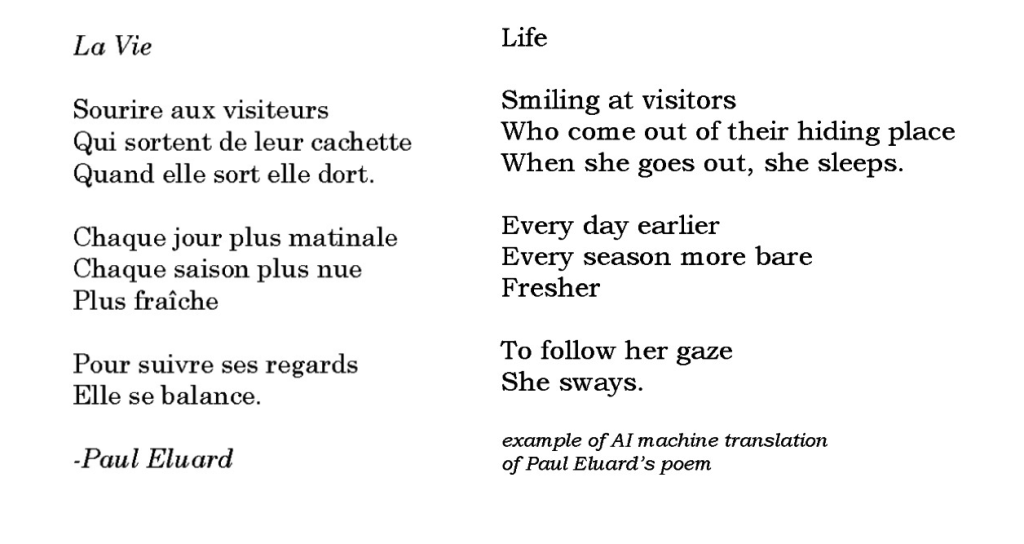
This poem by the French Surrealist poet Paul Éluard wandered into my view earlier this month, and it seems like it, and my work translating it into English, slots right in between my late wife’s poem I performed last time and this Saturday’s planned #NoKings protests planned around America.
I’ve mentioned earlier this year that in my youth I became interested in the French Modernists because I had gotten the impression that they were a key force in English-language Modernism. Later, from my work for the Parlando Project, I came to learn that this is only partially so. I wasn’t far into the Project when I realized that there was in London before WWI (at that time still the center of English-language literature) a “reverse British Invasion” going on as crucial as the 1960’s British Invasion that helped revitalized rock’n’roll music. Americans: Pound, Eliot, H.D., Frost, and even the important British Imagist theorist T. E. Hulme who had spent some expanded-sky time in Canada, were all there shaping up a make-it-new freshness. Now it’s also true that Eliot and Pound were fond of some French poets,* but as I later traced those French poets with the greater resources I could obtain this century, I found that some of those French writers were taken with Whitman and Poe.
Still, the French Symbolists, and the more internationally-sourced but eventually Paris-centered Dada and Surrealist poets were important. Having only High School French it was hard for me to absorb a great deal of French Modernist poetry, but what I was able to find in translation, or painstakingly translate myself in the 1970s was an important influence on me.
It was soon enough that I came upon Paul Éluard then, who as far as the French were concerned, was a big deal, often rated as the greatest Surrealist poet. Well, ratings are silly – ought to remain so – but his poetry had striking imagery and was often concerned with some combination of erotic love and anti-fascist politics. In the 1970s, the first attracted me primarily, while the latter seemed a noble history lesson.
Ha ha! History, it seems, has jumped out of the past, and the anti-fascist Éluard is due for a revival – and so I welcomed seeing his poem “Bonne Justice” appear on BlueSky in its original French. I could make out enough of it (my French is even more scant than it was in my 20s) to want to do a translation and possible performance.
I don’t know why his handwritten manuscript uses a circular format. Éluard may be trying to convey the eternal in natural law. Cynics might read “circling the drain.” Young moderns seeing this would need to start with the translation task of reading cursive.
.
Translation moved quickly. Vocabulary issues are easily handled by computer these days, and online sources help to drill down on a word’s flavors.** Éluard’s language here is not fancy, there are no obscure or archaic words, and he seems to me to be speaking to a general audience, not artistic theorists or avant-garde cadres. I proceeded as I normally do when translating from a literal gloss: first finding the images and what word choices will most clearly illuminate them, while giving care in preserving the “music of thought” in how the poem introduces the images and sets them off in the context of each other – though then I will take a hand at using a modern English word order and sentence structure that has some new music of sound in its new language. I rarely try to make rhyming translations. This poem’s word-music retains Éluard’s original repetitions, which I think are sufficient.
A chord sheet presented so that others can sing this fresh song created in English from Éluard’s poem.
.
So, my “Beautiful Justice” keeps all of Éluard’s parallels, though I made one set of considered changes, both for the benefit of myself as the performer of the result, and from my reading of Éluard’s intent. This poem seems to be speaking of qualities and situations of mankind as a whole, but he uses “hommes” (men) for this, and in another case a masculine noun for brothers (“frères”) which I rendered as “family.” I decided these gendered words were outdated conventions that would benefit from translation. Yes, I was thinking too of my late wife’s poem, “In Another Language,” performed here last time, who in those same 1970’s was dreaming a genderless language.
It’s just a single acoustic guitar and my rough-hewn voice for this performance. If one wanted to remember this poem, now song, when marching on October 18th, it could be portable that way, though I don’t think my own performance is a stirring march – it’s more a reminiscent prayer. Prayer is focused speech. Song adds intensity of breath and music to speech. Marching and standing together, as simple as that is, adds action from our bodies (even this old man’s body). There may be more going forward that we will be called to do – who can tell with accuracy – but I think it’s not a bad start to be praying in song for those laws old/yet new, those always perfecting laws that protect us, the laws that aren’t capricious decrees to persecute and sever us.
You can hear my song in English made from Paul Éluard’s French poem with the graphical audio player below. No player? This law says you’re permitted to click on the highlighted link and it will open a new tab that will have its own audio player.
.
*Core Imagist F. S. Flint, working-class-born, but a native Londoner, worked hard to promote modern French poetry in this pre-WWI era for one.
**Though an online French dictionary I use for that had a service outage while I was working, and I began to dismay that I’d given away to charity my large old French-English dictionary volume.
I must apologize for how rapidly these new pieces for National Poetry Month are being released. That must tax some of my valued reader’s and listener’s time. I planned — and still plan — heightened activity here during Poetry Month, but I expect it won’t be near-daily posts.
In announcing this April’s observance, I said that following #NPM2025’s theme of “The Shared World” that I’d like to include some poetry that wasn’t originally written in English. I’ve done a fair number of translations here, despite not being much of a linguist. I’m also not a creative writing teacher, but I highly recommend for poets to follow my example in this and to do their own poetry translations. When I first started doing French to English translations in my 20s I had only my high school French to guide me, and I relied heavily on French to English dictionaries. This was a laborious process, but approachable with short poems. Nowadays, online dictionaries and even reasonably fluent automatic translation features are available on computers or the Internet. Just plugging in a poem’s text into Google Translate isn’t translation, or a translation that will help your poetic skills. The machine translators are pretty good these days for denotative texts, news accounts, manuals, advertisements, directions — that sort of thing. But poetry asks for at least two other things beyond that: a heightened sense of which exact word brings something to the poem, and those word choices are also part of how the sound and flow of the poem is presented in its new language. As a teaching exercise, sitting for a few hours beside the spirit of another poet and their poem of another language, helps one find skills in making those choices when one writes their own poems.
As a non-native speaker, it’s entirely possible you will make mistakes (even embarrassing ones) or come upon mysteries where even experts will not know what the poet intended in the original language. No matter. That’s scholars’ work — honorable work — but as a poet that’s not necessary for your translations.*
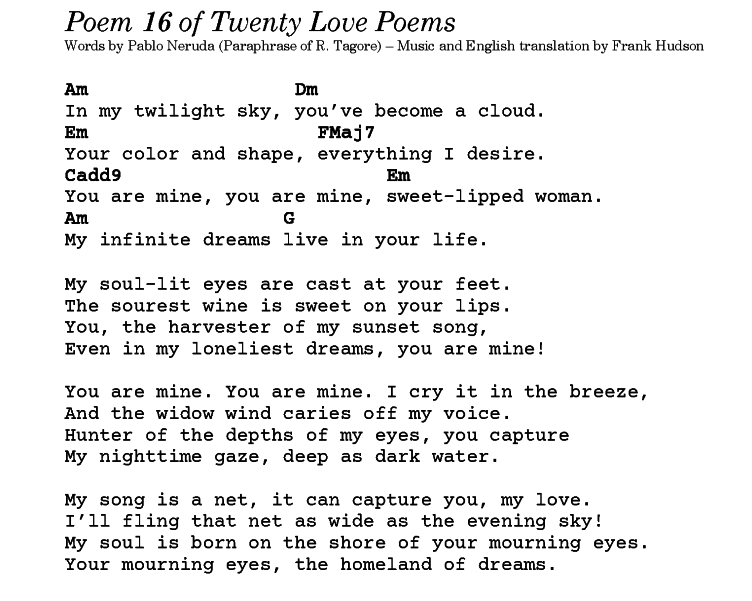
The imagery and the refraining way it’s presented made me think this a good candidate to sing. Looking at a couple of machine translations, I started work on making a poem in singable modern English out of it. This poem is not entirely straightforward to me, but it seemed to be about separation, though I cannot be sure it’s not about a subjective, obsessive, or jealous sense of separation, a “I want you so much, all the time, and all to myself” kind of feeling. As I started to work on the images — the shared-world-vision that the poet’s voice wants to invoke — and those word choices and sequences necessary for word-music, I was overcome with a connection likely unintended by Neruda.
I include a chord sheet because I was inspired by folk revival publications Sing Out! and Broadside back in the day. You might sing it yourself as a prayer and plea for the two Garcias.
.
The poem’s speaker talks about being captured, even imprisoned, constrained as he speaks of his beloved. I thought of a pair of recent news stories of men taken abruptly from their families, one hauled off to a brutal prison in El Salvador, the other pried from the embrace of his wife and children.** The charges, the evidence? They are, what, maybe gang members. How do we know that? “Oh, we just know” says our government. OK, what are their crimes? “No matter, we just have to say so — or maybe we don’t have to say, we can just do.”
It’s possible we have nonsensical laws, though I’d hope our consideration is better than that. But there seems no way this can be just.
I stopped trying to make a better translation. I’d normally want to take more care — after all, this is a work of a young poet who later won the Nobel Prize. I just wanted to put together the sense of this way I could hear the poem’s speaker speaking across our Shared World, because I wanted to sing it to salve my own heart.
The poem, as I now shape it in English, is speaking as a man who loved America, loved his wife, loved his family. All this can be taken away. In one case some executive branch functionary in court, being asked of one of these men, is said to admitted his deportation and subsequent imprisonment there was “an error.” With such slipshod execution, this might be expected. What is to be done? “Nothing can be done. He’s in another country now. Out of our hands.”
This is a project about poetry and music. There’s nothing those two things can do but sing. I did say I would share civic poems this month. Why? To sing a poem, or to listen or read it closely, you must feel it somehow. What you do afterward, I don’t know.
*When sharing such translations publicly, I often take the example of another poet I came to read through this blogging adventure, Robert Okaji. Okaji, like myself, sometimes takes literal, non-poetic, glosses of classic Chinese poems and renders something vital in modern English out of them. He uses the traditional note of “After a poem by…” which indemnifies either of us from lack of fully understanding the Tang dynasty and ancient Chinese.
As it so happens, Neruda in “Poem 16” writes at the top of this poem that he’s paraphrasing another poet and songwriter, Rabindranath Tagore. Tagore’s poetry and song lyrics are sometimes psalms to his country or godhead, written in the language of love poetry.
Is today’s piece the Parlando Project’s surrender to the Internet’s pervasive cat fancies? No, this is a very serious piece of cultural distribution — and it’s Halloween fans, that grave and gothic lot, that we’re serving with content this month.
I do fresh translations into English as part of this Project semi-regularly. Translations bring benefits, important ones that would fulfill that serious…cultural claim. Since poetry exists in nearly every society* no matter the language spoken, translation allows us to casually absorb more outlooks as readers. And as proud as English speakers can be about the home-team’s innings in verse, a great many poets have taken tactics, forms, and inspiration from writers that wrote in other languages. Adding to the corpus of translations then, is a service to readers and poets.
A couple of the poets I’ve translated here have almost nothing available online in English, a few more, little. Rilke, who wrote today’s piece in German is not such a case. He’s a favorite poet of many English-speaking readers, and has had many well-known translations. But even so, adding another Rilke translation is like adding another human perception of a piece of his writing. All translation comes with a viewpoint and a path taken by the translator to the point of translation. My viewpoint is not particularly learned. I’m not an expert in German literature, and I don’t speak German beyond a few phrases. While I happen to like my approach to writing or performing poetry (most poets get little love for their verse other than self-love, so we’d better have that regard to do the work) that’s about all I bring in qualifications to translating.
My translation approach is primarily image-centered. I want to try to absorb what the poet is seeing, and feeling and transfer that portrayal of sensation into contemporary English. I usually don’t try to convey the parallel sensation of the poems word-music in its original language, but I will give some weight to a sequence of the images as they convey the poem’s argument, the thing I call “the music of thought.” I do like there to be some English word-music in the end result, but as with my original poetry in English the images shouldn’t suffer much just to make some formal lock-step.
Which brings me to the other benefit of translating, the reason I recommend translation to every poet, to every creative-writing class: translating forces you to consider choices made by the original poet intimately, and to make subsequent English-language choices that are not dictated at origin by your desire to tell your life-story or outlook. This separation allows you to practice, in separation, the craft of poetry.**
I took on Rilke’s “Black Cat” because it seems like an apt Halloween poem — after all, it does start out with the cat being described as an apparition of mysterious supernatural powers.*** As I dug into the poem there was one mystery I didn’t solve: how much is Rilke joking with us? Is this cat a dark vision, a domestic cosmic black hole with a gravity that absorbs light? A real Rilke scholar might have a learned opinion on this, but I am not that person. The Rilke poems I know, and famous Letters to a Young Poet essays seem utterly serious — I’d say almost to a fault as weighed by my own tastes. There’s a certain kind of Rilke fan, like a certain kind of Robert Bly fan, that makes me wary of the seriousness with which they take their precepts and scriptures.
The Internet was designed so that scientists, the military, and government could exchange ideas. And cat pictures like this one I found there. Well, the cat pictures came later, but I’m sure it was in the design. Now, who’s my dark little existential vision of non-being that meets my gaze…
.
But as I translate Rilke I occasionally find images that seem to fall into slapstick. Did Rilke intend this, or is that my own path, my outlook, reflecting off the surfaces of poems? Seriousness is indispensable to slapstick after all. My favorite part of this poem is when the frustrated viewer of the black cat resorts to enraged stomping about. Last time we had a poem about the pathos of black & grey ghosts seeming to manifest in a dark house. Is this dark cat a solemn symbol of ever-so-serious human-condition dread — or an excuse to burlesque the frustration of life we cannot fully control, things we cannot perceive clearly, yet are stuck trying to figure out anyway?
This is what I came up with for today’s performance
.
It may not be what we’d wish, but as Rilke gets to his last line, I smile. We try to see in the darkness, we might try to command capricious cats, but in the end we’ll all be extinct as prehistoric insects captured in amber crystals — but at least by translating Rilke (or other poets) we can see our gaze in their gaze.
To hear my spoken word performance of my fresh translation of Rilke’s “Black Cat” you can use the audio player below. What, has a black cat crossed your screen and obscured any such audio player gadget? This highlighted link will open a new tab with its own audio player.
.
*Do historians and anthropologists know of any documented society that didn’t have a form of poetry? I’m neither — but I don’t know of one. If so, this seems a strange fact in the face of poetry’s peripheral place in modern American culture. Is poetry just an archaic skill, like how to make a stone knife or knowing which fungi are safe or sacred to eat?
**Current online language translators (Google’s seems particularly good) are generally adequate at giving you an English-language gloss to start with. For key words conveying images in a poem, online foreign language dictionaries can drill down into further insight. The translator’s job isn’t just turning some decoder ring though: the job is to find effective English language poetry to hold the poem you’re translating.
***Admitting my lack of portfolio to do so, there’s a third reason to do my own translations: I want to avoid — even for my “absolutely-no-profit” Project — taking other writer’s work that isn’t free for reuse. Rilke’s work is in the public domain in the U.S. — but this isn’t true of most English translations of it.
We’re going to travel to one of the best short poems that late 19th century American poet Richard Hovey ever wrote, a strange poem about approaching death, a place far or near, with no trusty mileposts. As I like to do, we’re going in a round-about way. Let’s start with a blue lake.
I can remember what a wonder it was. My father and his youngest brother loved to fish on lakes, and in search of ever more pure sport-fishing beyond the sky-blue waters of northern Minnesota, they took to traveling up further into Ontario Canada. I was maybe 10 or 11, still at an age when I was open to whatever my parents led me toward. We stayed at a family-owned fishing lodge at the end of a gravel road outside of Reddit. A few small, well-kept cabins, a couple of outhouses, and a lake-dock — which was all the two brothers needed, as the day was mostly spent out fishing.
As I said, I was accepting of this. I gamely came along, earnestly operating a rod and reel, waiting, sensing for any piscatorial tugs on the line, listening to the two men occasionally talking about what fishing tactics were most promising. My youngest uncle, maybe 18 or 19, had been about my age when their father died, and my father now served as his younger brother’s father-figure. I was unaware then that more than lures and casting targets was in their talk.
I was never bored. I had a vast imagination when young, and could sit quietly daydreaming stories and ideas in my head for hours. I suspect a good poet would have been more observing of the boundless nature around me; and while I watched and listened to my dad and uncle some, they were too commonplace for me to treasure.
Instead, here is what I recall being fascinated by: I was in another country, Canada, subject to its laws, and a Queen, a governmental oddity that seemed a little out of time to me. A gallon wasn’t even the same gallon there, nor a dollar exactly a dollar! The lodge owning family and everyone we met in Canada spoke English of course, but since my imaginative and book-minded mind lived in words, I was amazed that all the groceries we picked up in Kenora on our way up had bilingual labels including French.
I was as if I had found the Rosetta stone all by myself. As a native Iowan, I already had a passing place-name experience with French from my state’s then 160 year past life as a French possession, but here in Canada a box of Wheaties or a carton of milk could be held inside other words. So, later in high school and in my truncated college studies, I selected French as my foreign language.
I was terrible at it as a school subject. I did OK (not outstanding) in basic vocabulary. I was passable in recalling the tenses and such. I accepted the arbitrary gendering of nouns. But my mouth stumbled entirely in the speaking of French, so obtusely bad at speaking it that I strongly suspect it is something in my neurological wiring. That I persisted with French as I entered college was at least in part because I was learning that French poetry had been so interactive with English language poetry, particularly in the formation of Modernism.*
After my formal education ended, I continued translating French poetry, not by any right of fluency, as I’ve confessed above, but because I wanted to bask in the secret sauce that helped form Modernism.
Richard Hovey seems to have been greatly enamored of what was modern French poetry to him. His published work includes translations of Verlaine, Maeterlinck, and Mallarmé. While going through his published work this summer I came upon this sonnet “Au Seuil,” in French, dated as having been written in 1898. When I translated it, I found this graceful consideration of dying and some possible judgement and afterlife which I present to you in English today. As an old person, dying no longer requires any heroic situation, acute illness, or grandiose gothic stance to make such consideration apt for me. It’s a matter of petty logistics now.**
The poem as published posthumously in a collection by the Vagabondia co-author titled “To the End of the Trail.”
My translation, presented here as a chord sheet for the musical performance you can hear below. In performance I refrained the final line of the sonnet as shown here.
.
Was today’s poem written by an old man, or a young man staring down a deadly disease? No, Hovey was 34 years old, likely in vigorous health. Still, in less than two years he’d be dead, dying during a routine operation for something as unromantic as a varicocele. One can only wonder how he would have coped with the upcoming English poetic Modernism that would be sparked in part by French writers he admired.
Though subject to my language limitations, today’s poem to song turned out to be a relatively straightforward and faithful translation — with one exception. My usual poetry translation tactic is to primarily find the images in the poem and work at carrying them over vividly to English. I strive to have a non-creaky, natural syntax and word choice in the target language, and to make from that a poem in modern English word-music rather than trying to mimic the prosody of the poem’s native language. What was that one exception? In the poem’s 13th line, “ Qui nous benira de ses grands yeux bleus,” there’s an image I think.*** It could be that Hovey intends a witty little aside about a Nordic male god-in-heaven sitting on a throne of judgement, the cliché being then his point. As I worked on this line I wanted the possibility, however unexpected and wishful, of something universally marvelous. I dropped the andromorphic gendered pronoun as more than unnecessary, and then perhaps unconsciously recalling the poetry of the first-nations name for my current home-state of Minnesota, made the apprehending eyes more than humanly large.****
You can hear my musical performance of what is now an English language poem with the audio player gadget below. No player seen? This highlighted link is the alternative, and it’ll open a new tab with its own audio player.
*Oddly it wasn’t Spanish poetry. In England we can assign this to not forgiving the Armada and all that — but large portions of the United States had been Spanish possessions after all. And while Canada’s French is spoken regionally, Spanish is the predominate language across our equally large southern border and in the American commonwealth of Puerto Rico.
**For example: when I replaced two bicycles stolen early this summer, ones I’d ridden for 20 and 40 years, I wondered at the return-on-investment of spending like-amounts in current market prices to replace them. My favorite old-person’s joke is that when someone offers me a lifetime guarantee, I ask if there’s a better offer.
***Literal: “Who will bless us with his big blue eyes.”
****Lakota compound word for the place of sky-reflecting-waters. And there I have returned to that boat with my father and his youngest brother, as Hovey wrote in a different language: “we know this hidden way/as one knows the ghost of a dead friend.”
I regularly read and take part in a daily poetry thread on X/Twitter. Its host, Joseph Fasano, posts a theme word and an example poem reflecting a topic most mornings, and other poetry readers respond with poems that relate to that. Early this week the theme was “Longing.”
One of the responding poems was this one:
The X/Twitter poster here happens to be a relative of mine, though I’m not sure which one
.
This is an English translation of a poem by the ancient Greek poet Sappho rendered by famed Canadian poet and translator Anne Carson. If we didn’t know it was a translation, if we thought of it as a poem by a modern poet, here’s one thing we might notice on the photographed page: those short lines, those white spaces, those fenced-off blanks kept apart by square brackets. Looking at the text this way, the poem on the page has a striking effect. Its incompleteness — its, well, longing — is amplified in those spaces.
In Carson’s presentation that’s an inescapable part of Sappho’s work. We have only fragments of Sappho after all, only a handful of her poems are even comprehensively within sight of being complete. Some Sappho fragments are but single words, and many, a phrase or a few lines. And we know so little of the poems’ context. What details recorded about Sappho’s life date at best from centuries after she is thought to have lived, and are inconsistent. That she was a woman in a male dominated world, and lived in an outlying area away from the centers of classical Greek culture that we most know from later surviving works adds to the mystery. That the Greeks of the Athenian Golden Age, or the later Hellenistic Greeks, misread is some way the larger corpus of Sappho still available to them as they supplied us with Sappho quotes, commentary, and biography is plausible.
As readers of modern poetry, we likely assume when reading a Sappho poem that it’s a more-or-less authentic voice of someone describing a moment in her own life. I can’t say that as being a sure thing (any more than it is for, say, Shakespeare’s sonnets). But maybe that makes little difference, especially in the absence of well-attested facts — the words have the effect they have on us, based on our own lives, our own culture, our own time.
Carson’s translations are well-regarded, but she’s not the first to translate Sappho into English — she’s not even the first Canadian to do so. The first attempts there I know of, likely the first in fact as it’s by such an early Canadian poet, were by Bliss Carman.* In 1904 Carman published Sappho: 100 Lyrics. Unlike Carson, who is a scholar, I don’t know if Carman was all that knowledgeable in ancient Greek, and from what I can find he’s less open in sharing translator’s notes on his methods. The preface to his book, written by a friend, says only he more-or-less imagined the poems as complete and wrote then from that imagination.
From a scholars’ standpoint this is an outrageous act. On the other hand, there’s a current in poetry of writers finding something in assumed characters, some for anonymity, some for fraudulent reasons, some to burlesque writing styles they wish to make fun of. Carman’s life was not straightforward. There were a lot of bumps and setbacks in his career — all as one might imagine at a time where the idea of a Canadian literary poet was yet to be established. So, to take a vacation from all that to the isle of Lesbos and imagine Sappho strumming her lyre within his earshot? Maybe understandable.
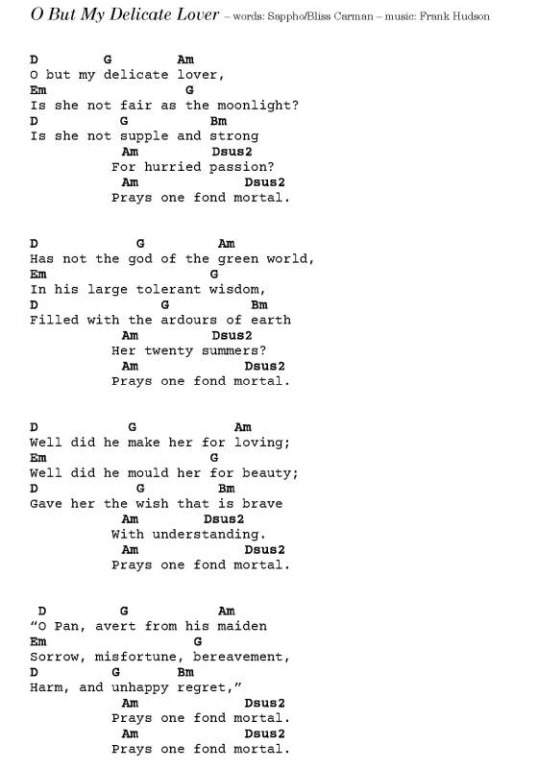
Another green world. Here a chord sheet for today’s musical performance.
.
Published in the era just before the outbreak of English-language Modernism, Carman’s version of Sappho found some readers. Ezra Pound apparently read them, and in his loose Chinese translations and elsewhere he seems to have adopted a no-hurt, no foul practice of translation as a personal recasting of the original work. Carman’s Sappho is sensual without overelaborate decoration or any “I’m so naughty” stance. I can imagine some of those Not-Yet-Modernists who kept a well-thumbed copy of Swinburne in their back pockets circa 1900 appreciating these poems. If the tropes in these love poems are often common ones, he’s portraying Sappho who would have predated those tropes becoming commonplace, and he’s asking us to believe our moments are repetitions with a long heritage.
Many modern readers of Sappho have adapted Sappho as a pioneering Lesbian poet. In the many centuries between Sappho’s 600 B.C. E. and the present there have been a variety of renderings of Sappho’s sexuality. The text, fragmentary as it is, often shows attraction and praise for women and female gods. If we assume Sappho herself is the voice in her poems (and why not, we know so little, and nothing for sure, and Occam’s razor) this would follow. In this poem of Carman’s Sappho, the lover and object of longing is certainly female. Bliss Carman was an apparently hetero male, but his poem’s assigned author is a woman. Parsing….
Those that object to drag-time story hour at the library will have a hard time with all that. If for only that alone, I’m going to give voice to this poem from Carman’s collection of imagined Sappho translations. You can hear my musical performance of “O But My Delicate Lover,” with the audio player below. Has the important fragment that includes an audio player disappeared for you? This highlighted link will open a real, not imaginary, tab with its own audio player.
.
*Carman’s 1904 work may also be the first American translation of Sappho, as it predates the top hit in a web search that shows Mary Barnard’s 1958 volume as the first from the U.S.A. Coincidently, Ezra Pound is attributed as someone who encouraged Barnard to do her book of Sappho translations.
Carman studied in the U.S. and was distantly related to Ralph Waldo Emerson. His ancestors emigrated to Canada as Tories escaping after the U.S. Revolutionary War.
Today’s piece is a fairly well-known poem by the Spanish poet. Given that I’ve played guitar nearly for 50 years and been interested in poetry for more than that, I keep thinking I must have run into it before this year. If that’s so, why don’t I recall considering it?
My answer is going to sound more judgmental than I mean it: bad translations. No, maybe I shouldn’t use “bad” here. I don’t suspect any moral failing or lack of effort by translators of this poem. And given that I’m not all that knowledgeable about the work of Lorca and have only the most limited grasp of his native language, I should have no standing to rate other published translations of “La Guitarra.” What I do know is that native speakers find his poetry passionate and vivid, and the English versions seem to my ears and heart (those being the entry points for poetry) stilted and muffled.
I’m not going to link any of the English translations I found of “The Guitar.” None I’ve seen seem fully effective to me, though I cannot say that they might be effective for others. I’m not going to link or line-by-line dis the translations I’ve seen. I will say that the first one I saw at one of the leading poets and poetry organization’s site was representative. I didn’t find it musically compelling, and it was a jumble of abstracted images that had little sock, little immediate feeling evoked. I assume the translator had the advantages I must clearly concede I don’t have. Why might their work not succeed, at least to this reader?
Two theories. Other translators may have been too literal in carrying over Lorca’s original sentence structure, which might be natural and unaffected in his Spanish. This is poetry, so one can make a case that how it’s said is essential — but when languages order words differently, following the original sentence structure and word order too exactly damages the natural vividness of a person speaking. Secondly, Lorca to my slight knowledge connects to Surrealist expression, a style of poetry I loved as a young man and still like to connect with today. Surrealism likes the wild and incongruous image; and from its ancestor Dada, it’s often willing to take an image in a random, raw and undercooked state. This creates a problem for me when I translate Surrealist and Dada work.
You see, I view my task as a translator to primarily find the images in the work and to then portray those images in clear modern English, and secondarily give the poem a word-music in the new language that gives pleasing movement and return to the poem. What if the original intent was to mystify the reader, to present an image that was intentionally confounding? I risk, while puzzling out the text in a language I don’t know well, to over-simplify or over-determine an image. I fear embarrassment of doing that, but I think it’s the better risk because vivid images that the reader/listener grasps and gasps are compelling to me.
As to the word-music, my version of “The Guitar” rephrased Lorca somewhat, aiming to make him sound like an English speaker. While doing that I tried to make the poem musical in English. The poem was already using repetition for poetic effect in Spanish, and I added just a touch more.
As you might imagine, this poem about the expression of a musical instrument has been set to music before my attempt you can hear today. While not a Lorca expert I know that he connected too with Spanish Deep Song and the evocation in that tradition of “Duende,” a difficult to translate term that some Afro-American musicians have seen as analogous to the Blues. I played a nylon string guitar for my setting, the type of guitar associated with Spain, and the simple chord progression I used would not be foreign to that tradition. But both from my skill level and inclination what I played for this song was simple and sparsely ornamented. Though the harmony wasn’t Blues, I approached playing this as if it was American Blues. Another Blues element I introduced that wasn’t in Lorca’s poem: my version has a gendered call and response. The guitar is a her, the singer (there’s no singer in Lorca’s poem) is a he.
A three-part post today — let’s see how short I can keep it, though we’re going to go far. Read on and we’ll leap from an important artistic movement whose poetry is forgotten, to the case of the odd filtering out of a woman artist from that movement, to some notes about translation and musical composition — and in the end to a remarkable trick, an April Fools’ joke of a sort I played on myself unconsciously.
Canons
It’s weird sometimes trying to figure out whose work gets remembered. It’s too much to ask for there to be some fair-minded, objective, and well-informed process of experts weighing the canon as our caissons go rolling along. Instead, quality and salience is supposed to just emerge. Emerge from what? Taken, via circular reasoning, from that memory. This sort of works, though how we know how well it’s working is hard to explain, as it may not consider those we aren’t as a culture considering. Canons have always changed — it’s ahistorical to say they haven’t, and when did we agree that history stops?
Dada poets are under-considered — or if they are, it’s as a conceptual statement more than a considered poetry. Visual arts will always include a Dada piece when discussing Modernism, literary arts are much less certain to. Dada’s evolution into Surrealism makes it almost easier to leave out Dada poetry. Dada poetry can be seen as the rough demonstration, the provocation that initiates a disruption.
My idea of presenting a Dada piece today comes out of an idea as question I had: “What can I do for April Fools’ Day?” Dada can be seen as an April Fools’ Joke. How so? Let me invent a manifesto of Dada that no Dadaist is likely to earnestly write as it violates the concept of Dada:
Much of what we’ve been given as meaningful can be seen in the human predicament as useless, maybe even harmful. Yet, we’re constantly being fooled with the trappings of power and precedent. Arbitrary examples of meaning, truth, and rules, dressed in the right costumes, framed in the expected way, keep us susceptible. So let us show how the trick is played and laugh at its absurdity.
Art Movement — and also the structure of an April Fools’ Joke.
Therefore, Dada presented poetry — a literary form we believe must be meaningful because it’s beautiful — that was random, perverse, taking the forms and frames of meaning while eschewing that meaning. Surrealism later posited meaning — or perhaps more exactly, the experience of art including poetry — as being above and beyond logical, conventional rationalizations, but the way was cleared by Dada’s withering can(n)on-fire that made merciless sport of the idea of hierarchical poetic meaning.
Still, we’re more comfortable with the idea of looking at the urinal/fountain or bicycle handlebars above a bike seat and seeing a worthwhile experience than we are looking at a series of chaotic words uttered incongruously as poetry. The first is a gentle poke in the ribs, it can easily elicit a pleasurable “See that?” The second worries us more, how should we take this? And the connection of denotative meaning (even an elusive one) that we rely on to carry us through an assemblage of words, is it indispensable? Is reader/listener boredom a legitimate artistic response, or one we’ll long endure?
The questions in some Dada poetry are valuable. The answers, not always so.
Emmy Hennings, forgotten because she was a Dadaist and because she wasn’t a Dadaist
Earlier this week I set myself a task to look at some Dada poetry to see what I could present here. I came upon a handful of poems by a name I believed I’d never seen: Emmy Hennings. I’ve retrospectively rechecked a couple of books I’ve read on Dada/Surrealism and I found my memory faulty. Hennings’ name was mentioned, but the context of those mentions didn’t make her seem anything like a key player. She was the partner and wife of Hugo Ball, a big macher in Dada, and consigned as a peripheral helper/muse/hanger-on. She did perform (from the very first Cabaret Voltaire performance!) but she was often characterized as a “music hall performer,” the kind of conventional entertainment that wasn’t what Dada was about. The supposition was put forward by the avant-garde that she was an interloper tempting Ball and the Cabaret away from real Dada into some kind of bourgeois, conventional performance career.
On further examination, there’s a case that she’s been underestimated.
Just kids. 1913, three years before the Cabaret Voltaire, but Emmy looks to me here like this could have been taken in 1975.
.
Looking over her poetry in a handful of human translations and quickie machine translations from her native German, I was immediately drawn in. It showed that essential Dada tactic as stated many years later by American Dada composer Frank Zappa: “Anything Anytime Anyplace For No Reason At All.” It also contained German Expressionist poverty-stricken darkness — and yes too, an element of erotic romanticism, though in the context that element was being set in place against the rest, implying criticism of it. Downrating her including music hall and folk song in her Cabaret Voltaire performances would seem to leave-out the case for Hennings consciously creating a Dada collage. If you put disparate things together as part of Zappa’s AAAFNRAA, those elements will talk to each other when viewed as one thing.
Here’s a secret factor most artists remain loath to admit: the random, or even the most carefully constructed miss-matches, can generate meaningful perception in the human mind. Yet Hennings didn’t write unalloyed gibberish, though outlandish collisions were allowed. She sometimes writes in a manner I recognize from later Surrealism — although from a woman’s mind and experience, a vantage point the Surrealists were loath to admit into their boy’s clubhouse.
Reading more about Hennings, I could see a rich collage of biographic and aesthetic components to her art.* I tried to sum that up to my wife by describing my emerging conception of Hennings as “A WWI sort-of Nick Cave: dark outlook, opiate addiction but hard working, catholic mysticism encrusted, mixed with elements of power-observing romantic eroticism.”
I already had a rough performance mix of the musical composition used for today’s piece before any of these Dada and April Fools’ ideas. I composed it using four new “virtual instruments”** that were newly available to me: a viola da gamba, a hardanger fiddle, a singing voice, and something that called itself a dulcimer.
I love bowed strings, and the somewhat rare and archaic viola da gamba is one that has long interested me, an interest that was sustained by once having a co-worker who played the instrument. The VI is a bit harsher sounding than hers (she used period correct gut strings and a softer bowing attack) but I used it to play the low-end lines in today’s piece.
The hardanger fiddle is a Norwegian folk-variation that uses sympathetic drone strings to add persistent, powerful overtones to the those actually fingered on the fretboard. A musical hero of mine, guitarist Steve Tibbetts once recorded an entire album featuring the instrument. My honest summary: I love drone, I love Tibbetts, my wife would testify I must love Norwegian-Americans, but I found it hard to take the sound of the hardanger for the length of an album — my reaction is similar to how some people experience bagpipe music. I also like sour tunings and harmony, but still that was my reaction. Dada being my goal, I went against sweetness however, and there’s a brief hardanger section in the middle of the piece.
By far the predominant sound in today’s music is from the VI that calls itself a dulcimer. I play the American mountain dulcimer a little bit. It’s a gentle diatonic scale instrument associated with American British Isles immigrants who settled in rural Appalachia, usually played by women as a quiet solo accompaniment for singing. This VI’s sound is nothing like anything I’ve played on mountain dulcimer. A demonstrator for the company that sells the VI says it sounds more like a lute. I’d expand that to say any of the oud variations or maybe even a mandolin family instrument. I treated its sound with a lot of reverb, so it’s more Coleridge’s opium dream Abyssinian maid dulcimer than some rustic American in a lone cabin.
The last thing I added to what was an otherwise vocal-less piece at this point: a high, keening VI voice. The human singing voice is something that VIs don’t yet allow easy access to. Perhaps eventually the ability for an easily available VI to sing all the components in human sung language will emerge, but for now what they do quickest is singing vowel-rich syllables. This VI went beyond the usual Oohs and Aahs with what sounded like nonsense words in no certain language. I hadn’t made the connection yet, but nonsense words are another part of Dada.***
So, on completion of the realized composition I surprised myself — I had what I then saw as a Dada piece without starting out with any such intent. That led me to seek out Dada poetry, and then to find and translate Emmy Hennings’ poetry to meld with my music.
“Singing at Dusk” is one of the few Hennings poems that has English translations I could find, but I made my own fresh translation. I followed a priority that guides my translations: determine what the images are in the original language and construct a contemporary English language way to convey those images. Since that is my primary goal, I will take liberties with the original’s sentence structure and wording. At times (and this happens here in this translation) I’ll even change the matter of the image in search of vividness. This latter choice is a historical fault, and I feel conflicted about it, but as I continue to translate, I catch other more renowned translators, resorting to it. Because I wanted a compelling sound to match up with the rather insistent music it was to mesh with, I also (uncharacteristically for my translations) decided to impose a rhyme scheme along with some other sound elements for this translation, which further caused me to depart from Hennings’ original. That kind of mutation to serve a form or rhyme scheme is another thing I catch other translators doing. Due to these choices, the result is partway between an earnest attempt a poetic translation and an “after a poem by” variation.
This version is a looser translation aimed for the needs of today’s performance
.
If it’s Dada, how much of this matters? It could, maybe should, be nonsense syllables, a random whatever. However, I didn’t find Hennings’ poem in the original German to be nonsense. Dedicated to her husband, Hugo Ball, it strikes me in German — and perhaps even more so in my looser translation — as a critical look at romance and marriage/partnership from a woman’s standpoint. Another element I bring out in my translation is the immigrant/exile experience. The originating Dadaists were from various countries, holed up in Switzerland, with a World War raging around them. They were writing work in German and French and a smattering of other languages, when those languages were being spoken in opposing trenches. National rootlessness was endemic in Dadaism, both as a choice and a fate.
Here’s the promised final observation: those keening nonsense words I generated from a VI played on my little plastic keyboard resolve at the end to something that I suddenly realized sounded very much like a woman singing “Jawohl.” What! They were just vocalese syllables, abstract sounds when I chose them — and they remained so for the dozens of times I’d listened to those passages, played even before I chose a German language poet to translate. Was that a trick of the ear? Here it was, the night-time, I was going to bed after a long day working on this piece. I was listening to this singing at dusk, and inside my earbuds I hear this voice loudly singing the German word for the certain and absolute “Yes.”
Will you have my experience with this musical piece? I can’t say, but you can hear it with the audio player below. No player? This highlighted link will open a new tab with its own audio player.
.
*Like some other Dadaists, she was a hyphenate: she wrote poetry, prose, sang, danced, made and performed with puppets, painted.
**A virtual instrument (VI) is a playable instrument made up of multiple samples (most often taken from a microphone in a recording studio placed on the “real thing”) of the various notes, ranges, and articulations of an actual instrument. One plays the VI by using a controller (a keyboard or perhaps a guitar with a MIDI pickup) that controls the notes played, or by scoring the music and selecting how that score should be played. This is a much more atomized use of sampling than the other kind of sampling that uses recorded snippets (often several bars long) of already recorded music afterward triggered to create musical beds and motifs in modern hip hop/rap music. The latter is another use of collage: thank Dada again.
Obviously, the tactile experience and idiosyncratic techniques of the real instrument cannot be brought over, but the results are increasingly convincing, at least to casual listeners. For composers without grant patronage or large exploitable friend networks, it’s a godsend. Even when the exact sound of a musician and acoustic instrument in the room isn’t produced, a musical something can be.
***The most famous Dada poem in any form known to modern English speakers is the Talking Heads song “I Zimbra.” When he presented it during his American Utopia theater piece, composer David Byrne explained that he adapted the vaguely foreign-sounding lyrics from a Dada nonsense-word poem by Hugo Ball, the partner of today’s poet Hennings.
Despite my inveterate bicycling and my wife’s love of nature walks, I’ve never been much of a hiker, and I’m very much not so in my old age. None-the-less I was charmed this winter when I saw this short poem because it appealed to my mental wandering. Walk with me: it’s not all that long a hike to a short audio piece.
When I saw today’s poem, I immediately noted that its translator from Goethe’s original German was the American poet Henry Wadsworth Longfellow. Let me reassure the poetry hardcore who might be reading this post that Longfellow was far from my interests when I started this project. While 19th century worthies Whitman and Dickinson remain staples of American poetry, Longfellow was to me only a schoolchild’s memory — and at that, not even a literary anthology schoolbook memory. My Midcentury-Modern anthologies of poetry in English didn’t concern themselves much with him, so I recalled only the Longfellow of illustrated poems for children that predated Dr. Seuss’ ascendency, Midnight rides, patriots at the bridge, culturally appropriated native Americans epics in stalwart meters. Longfellow’s Wikipedia page, reflecting critical consensus, still makes the case to downgrade him — and that’s hard to do, to downgrade someone who is now largely overlooked. The judgement handed down can be summarized: you don’t know him, and it’s probably best to keep it that way.
How did Longfellow come to me then? Part way into this Project I visited Massachusetts, planning to see the historic sites in Boston. While in Boston I decided to add a visit to the Washington/Longfellow house in Cambridge. This was a toss-in, yet it was while I was there that I heard about Longfellow’s life and I started to pay a bit more attention to the range of poetry he wrote.
While on that tour, our group was walked through Longfellow’s study where he wrote. I noticed right away that he had something that 21st century Americans would recognize immediately as a modern adaptation for intellectual work: a standing desk. If you must be deskbound, current theories hold, it’s best for your body to spend some of it on your feet during its mental wanderings.
The other thing that stood out was a statue on the desk. It’s not a small little desktop trinket that some of us keep on our own desks,* but something you could easily see across the room from behind the tour ropes. “Who’s the statue on the desk of?” I asked our guide.
“Goethe.” They replied.
If Longfellow has some incontrovertible objective value remaining, it’s that he established the idea of a preeminent American national poet. Those children’s books were thinly veiled citizenship lessons, direct appeals to America’s nationhood after all. So, what’s up with this German poet?
Longfellow, born of a generation where many living adults knew the American Revolution firsthand, was tasking himself with finding what could be an American poetry. What materials did he gather for this?
It’s likely he knew British literature of his time well, but he was officially a professor of Modern European Languages, and while still a young man he taught himself French, Spanish, Italian, Portuguese and German. He read literature in those languages, translated works from them into English. Whitman and Dickinson largely looked inward (within national and mental borders) for their remarkable American poetry, Longfellow was (as far as influences) a proper internationalist.
He could have decorated his desk with former householder: George Washington I suppose, or that other Washington who was a pioneering American literary figure, Washington Irving. Nope. The man he wanted staring at him when he stood and wrote was this formidable German poet and polymath.
Longfellow’s desk, and Goethe is right up in his grill when he wrote there.
.
Johann Wolfgang von Goethe was not a model for a faint-hearted writer, but perhaps one of the things from Goethe’s overstuffed portfolio might have interested Longfellow: Volkspoesie, “Folk poetry.” The idea here was that shared history, mythic tales, and interests of ordinary people experiencing their landscape was a nation-forming cultural foundation. Here’s a connection Longfellow might have felt: France, England, Spain, and Portugal had been nations for centuries by Goethe and Longfellow’s time: but Germany was not yet a nation in the modern sense, and Longfellow’s United States was only freshly one.**
“Wanderers Nightsong” is not a grand, nation-building poem however. It’s a tiny little lyric, really only concerned with an internationally-known experience of being outside under one’s own power, perhaps by choice recreationally, perhaps in some outside-directed travel or need to escape, but anyway alone enough in one’s landscape that all things are silent. You can hear your own breath, feel your own accumulation of footsteps, and the landscape says: rest with us.
This means that Longfellow has a delicate task. The thoughts contained in Goethe’s German are not unique — indeed, they wish to speak of a shared experience. Nor are there striking images or clever language effects in the poem. No strange worlds or visions are portrayed. The song-sense here, even on the silent page, is the poem’s substance. Like Hank Williams’ American country song standard “I’m so Lonesome I Could Cry,” the point here is not that the singer has seen something you haven’t seen, the point is that he sees what you’ve seen, felt what you’ve felt, and you, even reading silently, can sing it with them. Therefore, Longfellow chose to keep Goethe’s German rhyme scheme in his translation to English so that it continues to sing on the page in its new language.
Schubert fans will tell you, I’m a follower not a lieder.
.
Longfellow’s choice here is the right one, and I’ve honored it while slightly modifying his syntax and usage. You can read Longfellow’s original text and Goethe’s German at this link. Coincidentally, the poem’s original germ was written on a wall, a fact shared by “Smells Like Teen Spirit”and this poem presented here a few years back. My performance is not complicated — it’s folk-song like — though the chord structure uses some less-common chord extensions. I do use one of my standbys, the simple sustain-pedal piano notes which testify to my absolute non-mastery of that instrument while wanting to make use of its sonorities. Like some other poems I’ve presented here, an accomplished composer has set this before me. You can hear my simple version with English lyrics using the audio player gadget you should see below. No gadget? This highlighted link is an alternative way that will open a new tab with its own audio player.
.
*I used to keep a sentimental ceramic rabbit that was a gift from my late wife on my writing desk. More recently, a Lego figure of Shakespeare my child assembled and gave to me.
**Yes, nationalism, and in particular German or American nationalism, has its downsides — but the case that it’s foundational to establishing a civic bond can be mooted without denying it’s plausible faults. I should also note for students: my knowledge of German literature is scant, despite my mother having been bilingual in her childhood, and her grandparents speaking German in their home and church. This is a blog written by a “layman” explorer of poetry and music, my scholarship is spotty, though my interests are broad.
It wasn’t a conscious plan, but I’ve been pretty tough on love within recent presentations here. Today’s piece from Russian poet Anna Akhmatova continues that, but it wasn’t something I just started to work on either. My efforts on this 1912 love poem “Liubov” began when I did a fresh English translation of it last June. Perhaps because of its striking winter imagery, I decided not to publish it until later in the year. I stuck with this decision even though I’d also completed writing the music eventually used for the performance you can hear below.
It was only this week when I decided it was winter enough to complete my work on this, and oh does Akhmatova’s “Love” fit in with the Australian poet Kenneth Slessor’s “Wild Grapes” and Margaret Widdemer’s “The Dark Cavalier.” Her poem wastes no time making its sinister case for distrusting love: it opens with a cold-blooded snake shape-shifting itself into a frosty heart, persistent, and pretending to be as harmless as a dove. It ends with the poet warning others that desire “Knows how to cry so sweetly/with prayers of an aching violin” and its final statement that the hint of interest shown by any man’s smile now sends fears, warning, to the poem’s speaker.
It’s such an arresting statement that it sounds like the judgement of a woman’s hard-won experience. One never knows with poets and their conjured personas, but this is a poem of a young woman, written when Akhmatova was in her early 20s, and the poet herself later rejected her early work off-hand as “naïve poems by a frivolous girl.”* Yet, even by that age she was already participating in avant-garde circles within an adventurous life of shifting romantic alliances.**
Portrait of the young Akhmatova reclining on a couch by Modigliani
Later photo of Akhmatova on a couch. “Is that a smiling winter snake-heart-dove at my frosty window? I’m in no mood to get up to answer.”
.
In my translation (which relied on English literal glosses as I don’t speak Russian) I followed my usual practice: to try to determine what images the poet is presenting, and then to vividly portray them in a way in contemporary English language word-music, even if that’s not closely tied to the original “tune” of the poem’s native language. I thought the solutions I came up with for this poem worked well, and I hoped my instrumental music would add to that. I had recorded the basic tracks of energetically strummed acoustic guitar and my vocal first, and then found it somewhat difficult this month to work out a keyboard part to flesh out some additional melodic interest. I tried to follow myself with the added keyboard arpeggiation, but the eccentricities of the rhythm was challenging. My final judgement was the tension of my attempts might be a feature not a bug, and perhaps you’ll find it so too. You can hear the musical performance of my translation of Anna Akhmatova’s poem “Love” with the audio player below. If you see no player, this alternate method is offered: you can use this highlighted link which will open a new tab with its own audio player.
*Akmatova’s life was complicated by more than love affairs, as she lived through two world wars, a revolution, and shifting and threatening political currents in the USSR. It’s not impossible for older writers to see their work as a progression and to discount the fondness readers have for their previous work, but living through such history suggests that shifting cultural expectations could have made expressing such doubts an external expectation.
**From choice, chance, and restriction, she lived her life within the bounds of the old USSR. However, before this poem was published, she’d traveled to Paris where she met artists and writers there. If Gertrude Stein had her Picasso portrait to display in her famous French apartment, Akhmatova had a portrait by Modigliani which she carried with her and displayed in her living spaces throughout her life.
Does any poet know if their work is any good? Some perhaps have that conviction, but at least during substantial moments I think the majority of poets have doubts. This drives some poets to ever tinker with and improve their writing, and causes others to abandon the idea of poetic writing as a useless pretention. Some even numb themselves to the question — yet anything that numbs doubts can overshoot and numb creativity too.
Do bus drivers and child-care workers have these doubts about their work? Do politicians or generals? Is a poet’s lack of confidence in their work generally less than other artists? Let me only take the last question. I do think more poets have more doubt, because their audience is usually small, and that audiences’ response is so muted. Actors, musicians, or other performers can expect immediate audience response, it’s in the nature of their work that it exists only in front of others. Poets, even successful ones, read publicly much less often than they write. The attempts at bringing performance to poetry, with slam and other spoken word variations are seen by many literary poets as corrupting the complex and more contemplative aspects of their art. Novelists, screenwriters, the authors of non-fiction and memoir, can lucidly dream of paydays that would be fantastical for poets, and it’s not unusual for poets to step aside from their poetry to those other writing fields seeking something they can touch and deposit on account from their work. Visual artists are as abstracted from their audiences while doing their work as poets, but we have no auctions of living artists poetry that bring bidders to the alexandrine numbers.
So, in such solitude, such silence, or even within the quiet, diffuse reverence of award-winning poets, there is most often doubt. What would it be like if poetry was on most everyone’s mind, if living poets were giants in our culture?
Since I started this project I’ve sometimes thought of Longfellow, an American poet who reached that level of achievement. The American culture of Longfellow’s era wasn’t more educated or entitled to access to high culture that we are today. Yet, I grew up in a town, and live in a city now, which from that time created streets and spots, and named them for him like we would for Presidents or Generals. My father and his father would know, would memorize his work. We do not need to travel back to Classical Greece or the Confucian Odes to imagine that level of poetry in our culture.
And yet. Longfellow has disappeared, and as far as those that do care about poetry this is regarded as neither mistake nor injustice. This isn’t due to scandal. AFAIK, Longfellow lived a praiseworthy life. He must have said or written some things we could condemn, but on the big issue of his age, slavery, he was on the side of the angels. He was a nationalist, but an internationalist too. He may have appropriated First Nations names and legends with insufficient grounding, but he did it to ennoble not dehumanize them. No, the main reason we have dumped Longfellow off the bookshelves of our culture is that he doesn’t excite or move us in the least. His poetry seems like old civic statuary covered in pigeon dung, not worth noticing, and not worth any effort to replace.
American poetry is a different country now, and Longfellow is exiled from it.
Inside poetry, in its provinces, and within old classics where we might still retain interest, there’s current discussion about Emily Wilson and her fresh translation of Homer’s Iliad. Wilson has been clear in discussing her practice of translation. She assumes or assays that there must be something there in the archaic Greek. Her task, she writes, isn’t to make a work that sounds like the original text, or to bring us its most exacting word-for-word translation, but to make a new poem that works like the original must have worked for it to have had the impact it had — a version which we can by extension expect to be something like the authors best intentions. We believe this is what Homer deserves, regardless of if our tactics vary from or agree with Wilson’s.
We do this for Dante. We do this for Du Fu. We even do this to some degree with Shakespeare’s plays. We don’t do it with Longfellow. Why not?
We may think there’s nothing much there. We may think that Longfellow’s English is close enough to our modern English that to do so would be presumptuous or dishonest to the work. This last objection is a funny combination with the first. If there’s nothing worthwhile there, who cares what we do with it?
For a recent live in the studio LYL Band recording I decided to “translate” — or more exactly, extract and arrange for greater direct effect to the modern ear, a portion of a lesser-known Longfellow poem, one he titled “Epimetheus, or the Poet’s Afterthought.” Epimetheus, for those not up on your Greek mythology is Prometheus’s contrasting brother. If Prometheus is a hero, however tragic his fate, Epimetheus is the “Oops! I did that?” guy, a total fool. Prometheus is the I’ll give humans fire and suffer the eagle eating my liver forever hero. Epimetheus is the ”What’s in that cool box, Pandora. Let me have a look” disaster.
In my version I left Epimetheus out of it. Pandora too. Longfellow’s poem is a Friday-the-13th thirteen stanzas long and would require more melody and virtuosity than I can muster to capture a modern listener’s attention. I cut it to three stanzas, modified a couple of pieces of archaic word-order, killed one perfect rhyme for a near one. I did this because I think there’s a core in the piece that might speak to me or you without delay or overly baroque elaboration — and that’s the intent I found in Longfellow’s subtitle. If you write, particularly if you write poetry, you likely know the feeling: that joy and initial appreciation of the inspiration that carries you into the first draft, only to be followed by the problems of realizing the best poem that escapes us. And the completed poem? It travels out to a place where there are only wanderers like us.
Here’s my much shorter adaptation of Longfellow. The full poem as originally published is linked here.
.
You can find that performance of my revised version of Longfellow with the audio player many will see below. Don’t see any audio player? This highlighted link will open a new browser tab that will have such a player.