The spider holds a Silver Ball

Welcome back to our regular fare after a spate of summer diversions. And what is it that you’d expect to see here? We take various words, mostly literary poetry, and combine them with original music in differing styles. I’ve done this Project for over nine years, and within the archives here you can wander through nearly 850 of these combinations. Since poetry can be described as words that want to burst into song, such combinations might seem an obvious task – sometimes they are – but I enjoy looking for unusual connections, conversations between tendrils and mycelium deeper in the soil, not just the majestic and visible branches everyone sees.

One frequent supplier of words to be recast in sound here is the seminal American 19th century poet Emily Dickinson. Dickinson’s mind is Shakespearean in its scope, and while her modes of expression vary to meet those needs, much of her poetry sits in a rich intersection between short epigramic verse that superficially seems like it could be stitched as some crewel homily, and unconventional, rebellious, independence of thought.

For example, this lesser-known Dickinson poem: “The spider holds a Silver Ball.”   I’ll link the full text of it here. The opening four lines are praise to a spider’s industriousness, with the arachnid – unusually for this poet – standing in here for the highly common Dickinson totem, the bee. Dickinson, the avid gardener with a science-focused education, knows well the necessity of pollinating and honey-keeping bees. In this rarer appearance in her work, the spider is no such creature, for their work is occult or predatory. She praises its web-work none-the-less, that work’s imperial provisioning for prey goes unmentioned. This praise continues in the next stanza. The web is anchored or arises from “Nought” she says. The spider makes its spider silk from a secreted process, its attachment points may be a dimly lit corner unespied, its constructions do not exist until the spider’s efforts create them. But “Nought to Nought” is an omen too for all this effort as the final stanza will tell. Note too, Dickinson genders the spider: “His.” Spiders of either sex spin webs, but this action is male.
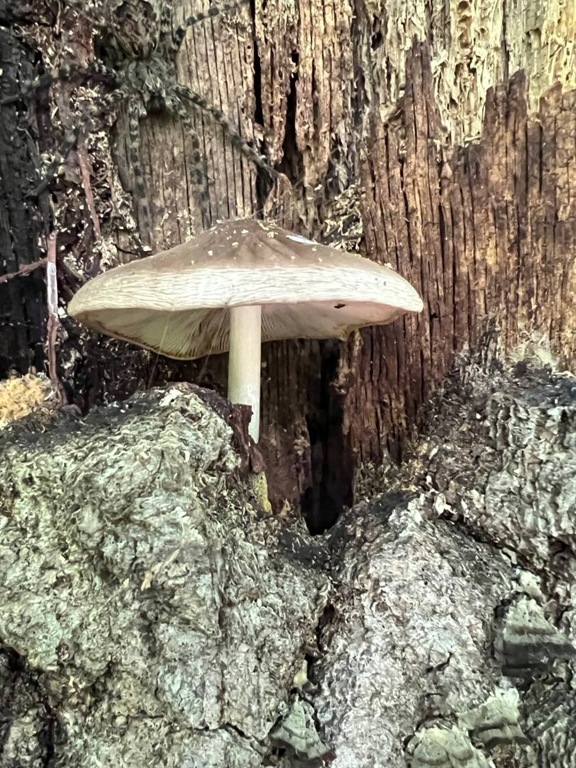
spider and mushroom by Heidi Randen 1080

A mélange of moss and mushroom. Can you spot the spider’s unperceived hands in the picture? (click to enlarge)

.

I’ll make a leap here: Dickinson, the prolific weaver of 1,789 poems, identifies with this spider. One accounting has this as poem 513, so there are hundreds of poems behind her as she makes this one, and more than a thousand yet to go. The bees in Dickinson’s poems are usually cast as joyfully playing, the spider here is more obsessive. Even the dourest Puritan in her era would know the worth of the bee’s work: flowers, food, unspoiled sweetness. In the final stanza, the spider’s work is destroyed by what Dickinson genders as woman’s work, by housework – as endless as this spider’s spinning. Another leap: I wondered if Dickinson might have composed this poem while busy with housework, secretly engaged in the (gendered by her) masculine work of inessential gossamer creation – no matter if “Nought to Nought” is that work’s fate.

As I read this poem I thought of another poet working in this mode, the William Blake of Songs of Innocence and Experience,  who wrote of “The Fly”  and likened his own intellectual and creative drive to the bothersome insect.

I combined Dickinson’s words with music that partakes of the sound of the 1960s psychedelic genre.*  The joy of that kind of expression is the freedom granted to instruments to take novel roles and reconstituted timbres. To a loping 6/8 time, the bass is allowed to rise to sing, the electric piano has been having an episode, the guitars wander onto new paths, an organ breathes, the drums fibrillate. Over this I sing wildly, unconcerned to be overheard. You can hear this performance with the audio player gadget below. What, has that audio player seemingly come to nought? Some ways of viewing this post will suppress the gadget, so I offer this highlighted link which will spin a new tab that has its own audio player so you can listen.

.

*I don’t find this a strained pairing at all. The 19th century American New Thought and Transcendentalist strain was still alive in the Beat and later counter-culture outlooks that arose a century later. Dickinson’s recasting of language and syntax in many of her poems is like to the sonic experiments of psychedelic music, which I’m attracted to for their adventuresomeness rather than their drugs. What is novel about my application of this to Dickinson is that this element of her poetry is under-observed, while it’s more common to view William Blake as “A ‘head’ before his time.”

Stars: Robert Frost and The Book Of Nature

Robert Frost. Long-time readers/listeners here will know I love to sing Frost’s early poems as part of this Project. We’ll get back to Frost, but another thing long-timers here know: for me, roundabout is the best mental journey — and there will be a piece of music at the end as we rest from our walk.

Ok, let’s stroll.

It’s a famous midcentury half-hour black & white TV episode. So famous that you don’t have to have seen it to know the recognition scene near the end of its story that has become a modern myth that SF and Fantasy fans like to point out their stories aspire to. Given that, I’m going to assume no one will need a spoiler alert for this 1962 Twilight Zone episode called “To Serve Man.”

The format’s so brief, the story must be told rapidly. We’re told that a race of other-planetary beings have landed on Earth. With retrospectable irony, their leader is described as “Christopher Columbus from another galaxy.” They go about setting things here in benign order with advanced technology. They leave behind a book in their language that seems to be a guide to the extraterrestrials’ efforts. Partway in, Earth’s code-breakers have deciphered the book’s title: To Serve Man.  And they seem to be doing just that: ending hunger, gently enforcing world peace, taking selected humans on spaceship rides to their home planet.

Many of you are now speaking — telepathically or aloud — to a device’s screen what is urgently delivered to the story’s human hero once the humans can decrypt more of the book than just the title: “It’s a cookbook!”

I’ve written here often about something I call The Book of Nature. Though not an exclusive American idea, I connect it with the 19th century American “New Thought” movement called Transcendentalism. The Transcendentalists believed that a true scripture of the universe’s higher power was transcribed in nature. By contemplating nature big to small one could discern the highest truths. Our contemporaries who are “spiritual but not (sectarian) religious” may hold to this as a core belief, but it’s likely that every denomination of religious belief can incorporate this too — after all, if The Creator made this, their authorship means there is plausibly something there to be read.

Now we can get back to Robert Frost. Frost no doubt knew Transcendentalist thought, but unlike his fellow great American poet, Emily Dickinson, Frost didn’t hold with its doctrines.*  Yes, Frost wrote seemingly “En plein air” about nature often. His early poems, some of the ones I like best, are suffused with the landscape and particulars of New England nature. Did he see a supreme being’s handwriting there?

If so, Frost would be critical of The SB’s penmanship.

stars

Chord sheet so that you can sing this one yourself.

.

If we look at this example, “Stars”  from Frost’s first book of poems, A Boy’s Will,  what do we “read” from nature’s book? The stars come out at night. What is their nature?** “Countless(ly),” we can’t even get the basic stats correct. Oh wait, Frost can see a primary Roman goddess in there: Minerva, the goddess of wisdom and strategy. No, he reconsiders: it’s a statue of Minerva he sees in the stars, a human-made simulacrum — and her marble eyes are the form of sight organs without any such function. So should we look lower down at our earthly landscape?***  Snow covers it profoundly, drifting “as tall as trees” and so obscuring even the ground-level facts. Wind is blowing — the choreographer of this landscape — yet, this dance doesn’t tell a story, it obscures it, though here at last Frost reads a message. That wind, that obscuring snow, is “our fate.” In the most mysterious part of the poem, the second stanza, we cannot see where we’ve walked or where to guide our steps. The gothic part of my nature reads Frost’s “place of rest invisible at dawn” as death. I read the image in this stanza that in such deep and overblown snow, one cannot even see the walk fate will not reveal to a farmhouse graveyard.

Nature acts “with neither love nor hate.” Robert Frost has decrypted The Book of Nature — and all the pages are blank.

Here’s that song at the end of our mental walk where I set Frost’s poem to music with acoustic guitar. You can hear it with the audio player gadget below, or with this backup highlighted link if that gadget is not shown.

.

*Frost’s friend and fellow poet Edward Thomas was an exquisite nature poet of his British Isles countryside. In regards The Book of Nature, he’s between Frost and Dickinson for he has a horticulturalist’s specific eye like Dickinson — and his consistent naming of natural details and seeing them as readable symbols indicates he finds them plausibly capable of guidance.

** Astrologers, Biblical Magi, and classical constellation dots-connectors of course are reading that sky in clear text.

***In a changeup meant to fool this writer and singer, my specific winter this year has been oddly empty of any expected Northland winter symbolism. We’ve had next to no snow, only a week or so of bitter sub-zero cold, and I look out today on a sunny brown yard over which squirrels are carelessly playing tag and tree as we rise to our predicted afternoon high of (in Minnesota! In January!) of 55 degrees F.

I’ve been riding my summer bicycle with its summer tires most every day this “winter,” where that bike normally stays hung up high in the back of my shed. Spring in Minnesota is famously snowy, my winter bike with studded knobby tires cannot be put out of the way. Perhaps as long as I leave it by the door we may continue to have a mild winter.