So, what’s in that scrapbook? There were a bunch of clippings from magazines or newspapers, sometimes pictures from them, sometimes articles, often about people in the entertainment business. A couple of letters. Ephemera from places, like business cards, tickets, a cocktail napkin. A few things related to Hollywood movies. A theater program. A restaurant menu. And photos, some posed “publicity shots” for musical combos or performers, some amateur snapshots. Even more than 40 years ago when I received the scrapbook, the pages these things were attached to were starting to fragment, and stuff that was likely attached to the dried-out paper was now loose inside the book, making it hard to leaf through. Alas, there were almost no captions or notations anywhere by the scrapbook’s maker. From clothing, cars, and dates on the clippings it was from the 1940s and 50s.
I think I tried when I received it in the 1980s to determine if it had a story, but I couldn’t really figure it out. Because a majority of faces in the scrapbook were Black, I thought it was safe to assume it was kept by someone who was also Black. On thinner grounds, I made another likelihood assumption: that it was made and kept by a woman. Somehow, it seemed feminine to me, and I could imagine someone fan-crazy about music collating this book. But there was a lot of miscellany to it too. One plurality thread seemed to be in the entertainers’ pictures and clips: a band that called itself The Cats and the Fiddle.
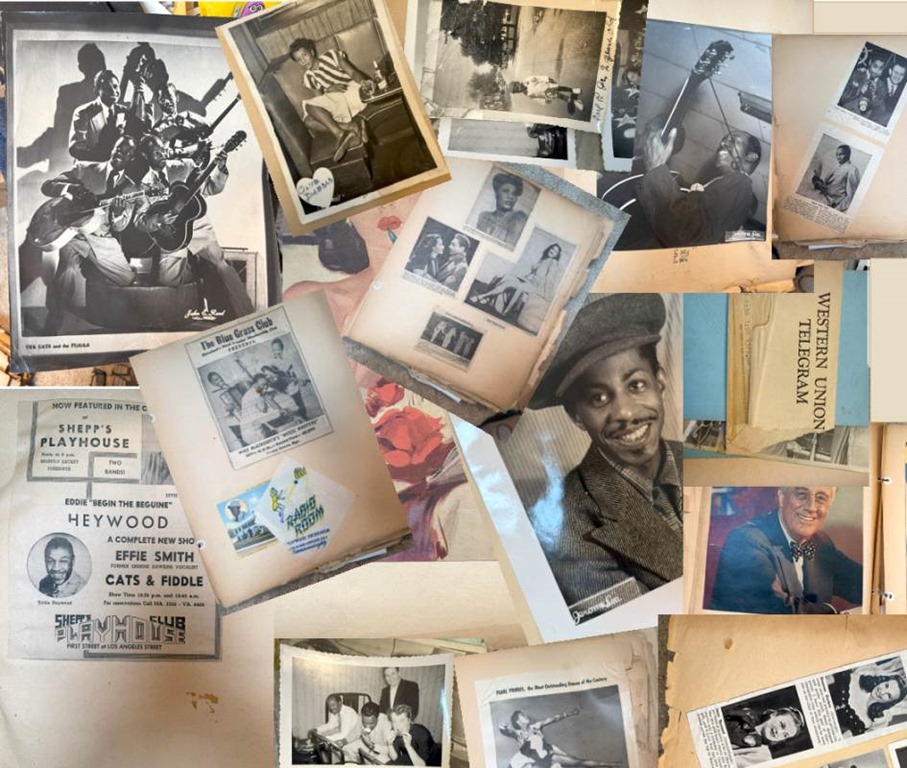
Stuff from the crumbling scrapbook that I’ll be examining this month.
.
I’d never heard of them, and back in the pre-Internet age it wasn’t easy to find out about them. In the pictures they were an all-Black group in sharp suits. The “fiddle” was the bass fiddle — a standup bass player* was in all the pictures of the band. The rest of the small combo were playing a range of fretted stringed instruments. I could see one of the guitars had just four strings, and I knew that was a tenor guitar, an instrument that otherwise looked like the acoustic guitar I was playing with Dave in our punk folk band then. I knew that it was developed to allow 4-string tenor banjo players to transition over to the guitar as the banjo faded out as a Jazz instrument. Another would hold a regular archtop hollow-body guitar. And there as an odd instrument I could make out in some pictures: smaller than a conventional guitar, with more than 6 strings. The Cats and the Fiddle looked pre-rock’n’roll, but it didn’t look particularly like the Chicago Blues bands I knew of then, nor was it a typical modern Jazz combo that I listened to. No keyboards, no drummer.
I somehow located an LP record, a reissue collection of some of their recordings. They played hot tempo, small combo, hard swinging Jazz backing accompanying their own tightly-grouped vocal blends. This was a genre I knew only a little about. It had largely faded out as popular music by the time I was aware of music, but I had encountered something like it in acts that were reviving 40s-era genres, nationally: The Pointer Sisters, Bette Midler, Dan Hicks and His Hot Licks, and locally a band called Rio Nido. As a guitarist The Cats and the Fiddle were easy for me to take a liking to. Though a vocal group, the energetic short solo breaks on the guitars still sounded fresh to me, a fellow stringed instrument plucker. I’m not sure if I stole any licks, but I would have liked to have.
What is this group doing in cold Minnesota? A movie clip shows they can take to the snow!
.
There was something else about the songs: many of them were lyrically about what might have been called the Jazz life: referencing the music itself, but also things connected with it: drinking, partying, hepcat slang, and those “Jazz cigarettes.” There were a handful of lovelorn ballads, but the approach more often was near-hypermania good times. No drummer, but the combo’s rhythm was solid, and that accompaniment was not mixed down low way behind the vocals.
Proof that Jimi Hendrix and Stevie Ray Vaughn didn’t invent the behind-the-back guitar strum
.
There were liner notes on the LP sleeve. Yes, they were a ‘40s group. I can’t recall if the notes mentioned where the musicians were from or what region the band worked out of, but I know I was looking for a tie to Minnesota where the scrapbook ended up, and didn’t find any. One thing the reissued LP did reveal: one of the members was Tiny Grimes. I’m not a hard-core Jazz historian, but I knew of Grimes — a contemporary, though longer-lived, of electric guitar pioneer Charlie Christian. Guitarist Grimes, like Christian, was present at the creation as Swing music morphed into Be-Bop.
I put that scrapbook away, and when I moved to my present home, it stayed on an upper shelf in my study where I work on the pieces you read here. Did I decide I had hit a dead end with the scrapbook, or was I just busy with my life then as sometime gigging member of a band? Probably a little of both. I’d sometimes look up at it, look at it looking down at me, and I’d think: I should get back to it sometime, see what more I can determine.
And this is the month I did that. More to come, as I examine the scrapbook again for Black History Month 2025.
.
*Well, not always an upright bass player, as you can see in the second video clip.
 Frank Hudson