Ode to a 1953 Automobile Ad

I’ve mentioned this Fall that I’m on a project to clean out the accumulations of my long life. There are various battlefronts in this effort, but last month I worked on emptying my stuff from a small storeroom in my house, which was filled with boxes, some of which hadn’t been unpacked since I moved 40 years ago. One box was completely stuffed full of spiral bound notebooks.

I had once saved the notebooks I used in my high school years and then throughout my twenties. This meant a slowly growing cache of them had traveled from a tiny hometown in Iowa, to a dorm in a small college in that state, and then to the locations I lived at in New York for six years, and onward the four places I’ve lived in Minnesota.

I had a typewriter, which I used for some more formal things and finalized school assignments, and then in the ‘80s I got a personal computer,* but for 20 years or so, my creative work began and was recorded with handwriting in these college-ruled notebooks. Early, when there were only a handful of them, I mentally cataloged them by the color of their covers. Even after all these years I recall a couple of the earliest ones as “The Orange Book” and “The Green Book.” Like Emily Dickinson I didn’t always save working drafts, written on whatever was handy, but when I felt I had finished a poem I’d make a good copy in my most legible hand inside one of the notebooks to be saved.

I’ve written briefly at least once about starting to write poems as a teenager, and I won’t go on much more about that today, but I was surprised at the urge – it was not planned. I felt compelled to do this for reasons I couldn’t tell you then, or now. Living in my tiny town I had no idea how many people were writing poems, but I presumed it a small number, as the literature anthologies I had in school made me think the number at any one time was a select few. This misapprehension led to a grandiose feeling that I was writing poetry! – this grand art-form of literary geniuses.

Clearly there was a lot I didn’t know, but in my case this helped me, giving me a sense of accomplishment. Did writing poetry give me an unearned, unrealistic, sense of self-worth? Yes, I think it did – but we all need a minimum deposit in that bank, and that was the source I had. And after all I was a teenager, and few of that age have any substantial achievements.

In that process of pulling aside these old notebooks I came upon “The Green Book” that I recalled when there were only a couple of these, and I set it aside to look through first. In it I saw my good copy of a poem I remember quite well from my early work, one I had thought was one of my better ones then. Looking at it as an old man who’s read much more, written much more, lived much more, I think enough of it to present it here in performance today.

I didn’t have many poetic models to draw on, but this one certainly came from reading John Keats “Ode on a Grecian Urn”  in my high-school literature class. I’ve performed Keats’ poem here, and I think I was already impressed at the ambiguity in the poem’s famous ending back then. My “Ode to a 1953 Automobile Ad”  was on the surface a free-verse parody, burlesquing Keats classical art object – but I was at least partly conscious of wanting to make some solemn points too, though I don’t recall thinking out all the themes the poem includes, so my best recollection is composing the poem without knowing all I was including in the text under my pen.

I think there was a  1953 automobile ad in my memory, though I haven’t found the one described in the poem.** Sometime in my early teenage years, a man in my little town – no doubt doing the same “death cleaning” I am doing in 2025 – gave me several dozen 10-15-year-old Popular Mechanics/Popular Science/Mechanix Illustrated magazines. I devoured them, first because I adored the hyperbolic writing of the self-styled dean of journalistic automobile test drivers Tom MaCahill who wrote for Mechanix Illustrated – but this was a strange genre of magazine. Part reviews of new models of cars and novel ideas in consumer goods, part pre-Whole Earth Catalog handyman tips and project plans, and part more general writing about science and technology including predictions for the future.

1953 Studebaker 800

The soft golden car in front of a Greek colonnade, or a peaceful ride in a Paris that 8 years earlier would have been in the midst of a World War.

.

I enjoyed the time-travel aspect of reading these magazines, visiting as an abstract thinking teenager the world of early childhood. The too fantastic flying car future has since become a meme – but the junior historian in me would think: the Korean Conflict was being fought as some of these old pages went to press (little mentioned in these mags, little remembered now too), the new age of atomic war fear was beginning, and in the sixties as I wrote this poem, Vietnam was echoing the Korea situation. So, as the poem was being written, there was then too the feeling of a glorious and blest domestic United States – yet with a “conflict” acting as a far-off minotaur ready to take sacrificial children.

So, I wrote this in the 1960s linking those times in the 1950s, and sublimation of killing young men is the topic. Inexperienced as I was, I tip my hat to the images the young person that would become me put in there: the camera and/or coffin dark box capturing the bright sunlight of the ad, the rust-holes in the teenaged car as the wound in the son. The use of Whitmanesque (or Sandburg or Ginsberg in their Whitman mode) extra-long lines is not something I do much now, but as I performed them this week, they seemed to work well enough.

This old poem is now published with a musical performance in the lead up to the holiday that was once known as Armistice Day – the very day that World War I ended at a moment when it was just “The Great War” and didn’t need a number, and didn’t expect to gain one – but now our wars don’t get the roman numerals, though fantasy film franchises and Super Bowls do. We didn’t get flying cars. We got armed drones.

You can hear me performing my “Ode to a 1953 Automobile Ad”  with the audio player gadget below. Has the audio player gone with Studebakers and saving old magazines?  This highlighted link is supplied as an alternative which will open a new tab with its own audio player.

.

*My penmanship was erratic and not consistently easy to read, so a typewriter was essential for things of any length destined for others. But I didn’t do creative writing on a typewriter – something about the mechanical nature seemed an authorship firewall: the machine made the letters, keys and levers away from the writer, and one couldn’t easily cross-out and add little marginal changes as one wrote.

One of the things found in the storeroom with the notebooks was a postcard about requirements for receiving a rebate on what would be officially my first personal computer: A Timex-Sinclair bought in 1982 – but that tiny $85 plastic wedge wasn’t able to take over from a pen or typewriter since it had a small membrane keypad that was only useful to learn to write computer programs with. In 1984 I got a Commodore 64 which could do limited word-processing, but I couldn’t afford the software that did that. In 1987 I got an Amiga 500 which came with a copy of Word Perfect – the then leading word-processing software product – and I began a slow and inconstant transition to using computers to do initial drafts over a decade or so.

**The 1953 year of the car in the ad makes me sure it was a Studebaker ad, for a remarkably beautiful new 2-door coupe was introduced for that model year. When I look for examples of the ad campaign, I see many of the Studebakers are depicted in yellow, but never in a family tableau described in the poem in the ones I could find. And there’s the chrome bird hood ornament. Was I thinking of the Packard swan? Looking at pictures of the 1953 Studebaker I see there’s a 3-bladed chrome insignia on the peak of the hood – meant to be a propeller, or bird, or abstract shape? I appeal to Brancusi on the bird.
Racial Relations and gender play in the 1940s-‘50s scrapbook, Part Ten

Early this morning, I was reading a blog of a modern avant garde poet who has lots of philosophic theories about prosody, and there this quote of Walter Benjamin’s is brought up: “To write history is to give dates their physiognomy.”  Well, yes, I thought, that’s what I’ve been doing in this Black History Month series. This scrapbook, its photographs, ephemera, ads, and clippings from newspapers — all a picture of the history of an American Black man: Lawrence Kasuth “Hank” Hazlett, a musician and singer who lived from 1911 to 1990. That scrapbook that had come into my hands portrays his nation-touring time in the 1940s and a residence in South Minneapolis in the 1950s. When it comes to civil rights or diversity, we tend to see change, or the preceding things that needed to change, from a later vantage point. The scrapbook documents such a preceding time, and the sort of things that musician Frank Zappa liked to call “mutations” — the tiny breaking of norms. But, isn’t it just a scrapbook?

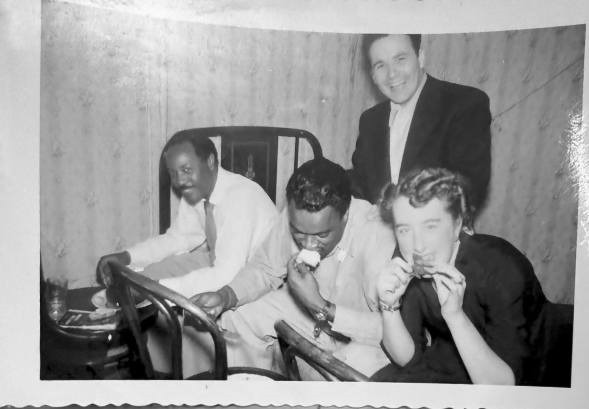
There are pieces in the scrapbook that may give us a glimpse into what its maker noted and selected to save. In the last post, we saw a picture of Hazlett playing on stage with a white bass player with the hippest of truncated neckwear — but overall, the performance photos show black musicians with him, playing (as far as I can see) to black audiences. Yet, here’s a photo from the scrapbook that stood out from that segregated norm:

Bedsitting photo

.

In this photograph two black men (the one on the left appears to be Hazlett) are sitting on a cheap enameled-bedstead bed eating. Sitting on the same bed is a white woman and behind those three, a white man in a dark suit is standing. Black and white, men and the woman are smiling. It looks like an inexpensive hotel room, and maybe they’re all on tour.

Jeannie and her Boyfriends promo

On the back of the postcard they wrote: To Edith and Hank. So nice meeting you, it’s a pleasure to be an entertainer along with you. Jeannie Bill and Don

.

The scrapbook also collects this promotional picture postcard for an act called Jennie and her Boyfriends, who issued a single 45 RPM do-wop style record in 1959. Jeannie in the promo picture has a completely different hairstyle and hair-color, but it’s plausible this is her and one of the members of her trio in the bed-sitting photo.

Also in the last post in the series, we showed some clippings in the scrapbook of Black entertainers working to defeat limiting stereotypes, but one thing that struck me was that the scrapbook also contains clippings showing white entertainment figures. Ephemera in the book, like that MGM W2 form from ’44 and Los Angeles addresses for Hazlett make me think that he might have had at least tenuous connections with some of them during the 1940s. Here’s a page from the scrapbook showing a clipping featuring Lana Turner, which may have been included because its caption says Turner likes Duke Ellington records.**

Lana Turner likes Eillington records

Lana Turner isn’t into vinyl, she’s spinning shellac.

.

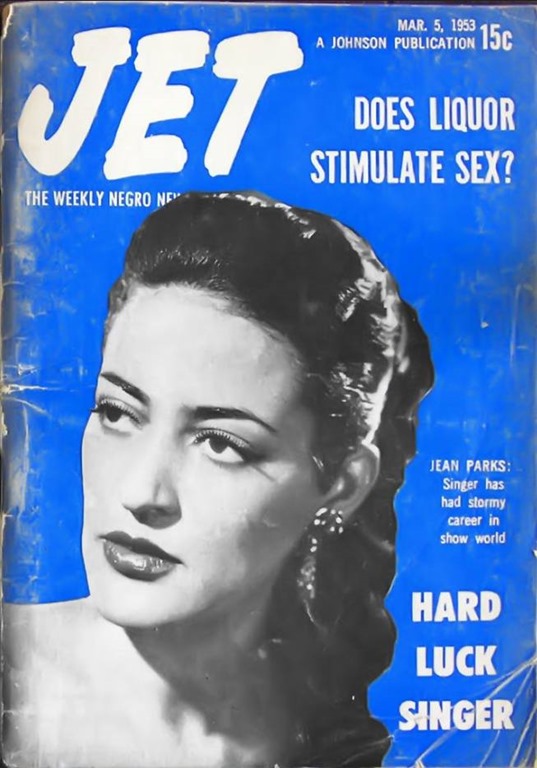
These are old clippings, sometimes from lower-res reproduction, and occasionally I’m misled by the ambiguities of race in the photographs. Take this one of Jean Parks found on this page with both white and Black entertainment figures. I figured she was white.

Jean Parks et al

Find the second Afro-American woman on this page.

.

Those who’ve followed this blog will know that I was immediately saying to myself “Who’s Jean Parks?” The story outlined from asking that is as rich or richer than the story of Bruce Dybvig from earlier in this series. WWII military service put a crimp on the supply of male musicians — so just as with other occupations, there soon arose a number of female bands — Rosie the Riveter, only with saxophones. Popular pre-war bands often enough had female singers, and there were a smattering of woman pianists (and small-group guitarists) — but women playing horns, reeds, drums in big bands— important featured instruments in those ensembles — I can’t think of one. Then came the war and mobilization. All of a sudden there were groups entirely made up of Black or white lady musos sprung full borne from the brow as it were.

One of those was Eddie Durham’s All-Star Girl Orchestra.   OK, now we’re studying history, so we have to do dates. It’s Victory over Japan Day, the war is over. In NYC a sailor grabs a nurse in a crowd without her consent, starts kissing her in front of a cameraman, and everything thinks this is splendid because the immense horrors of world war are over — and the, you know, sissy stuff  of regular old living is to return. The All-Star Girl Orchestra are in the middle of an engagement on the opposite coast, in Oakland California. The link above says that manager Durham sees that the men are going to return — and just then, dissolves the act. Well, sort of. Some remainder is rebranded around singer Jean Parks. As it turns out, the post-WWII years will be tough for all big bands — and all-around, the all-girl band thing doesn’t survive the peace.

And here’s what happens when Parks meets the world of The Fifties. Just look at the bad-girl triple-double implied and indicted in this paragraph: Black, caught with a 6-foot-tall platinum blond “friend”/roommate, sex-work — and drugs? We got’em all: reefer, opium, cocaine. Other than a Communist Party membership card signed Mr. and Mrs. and documents linking her to a plot to cancel Howdy Doody, this is complete “All-Star” material.***

Parks arrestHard luck singer Jean Parks Jet cover

Seeing that other headline on the Jet cover, and suddenly I’m a teenager in the back row of the classroom muttering to a classmate “I must be drinking the wrong kind of booze.”

.

Two other pictures in the scrapbook seem to tell some kind of story about connections between the races, likely in Minneapolis in the ‘50s. There’s this snapshot, pasted on the same page as the similarly posed picture I speculated last time might be of a child of the Hazletts. I have no idea who Maxine is, or who’s Chuck. But as with the other pictures and accounts in today’s post, I’d reckon that mixed race connections like this had elements of risk beyond just social disapprobation. White school integration riots, Emmett Till, the beating and burning of the Freedom Riders buses, all were contemporary with the scrapbook.

Maxine Chucks wife

.

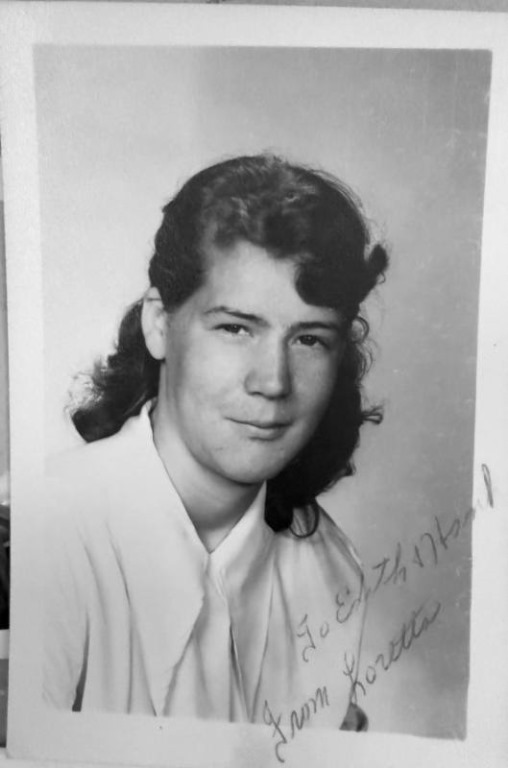
Then there’s this picture, inscribed to Hank’s wife Edith and so presumably from the early 1950s. So many of us have awkward school-picture-day photos, but I found this one more arresting than awkward. This is hard to detail, so I’m going to be more awkward than the picture, where after all Loretta is smiling and seems comfortable with themselves: Loretta looks quite masculine. Unattributed, it could easily be a 20-year-later photo of a mullet-head male guitar player in someone’s high school rock band. Burn-out the long-point blouse collar and retouch the long tresses in the back and it would be a 1950s boy who wants to grow up to play in Elvis’ band.

Get Back Loretta

Loretta.

.

There’s no other context other than the inscription and being in the scrapbook. Looking at Loretta’s photo this month I immediately thought of “Get Back,”  the Beatles lyric. Some of you may be singing the applicable verse in your head now that I’ve said that. My second thought: I’d love to know Loretta’s story, but there’s next to no chance I ever will.

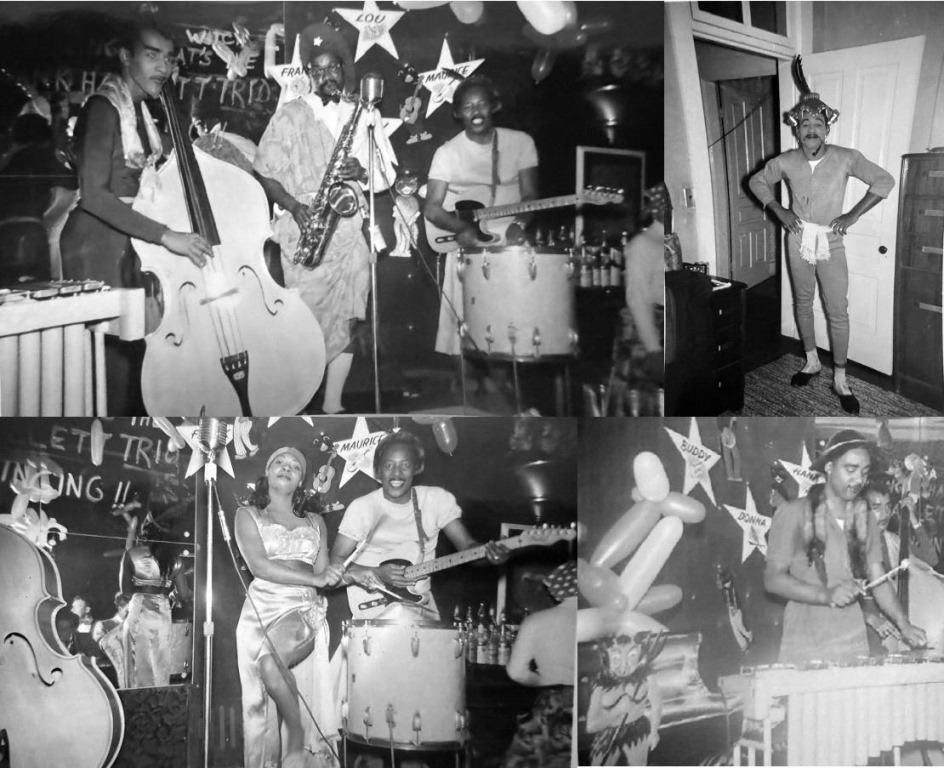
And now a transition that may or may not be apt. There are several pictures of Hank Hazlett, and Hazlett with his Trio, dressed in drag. I can’t place the club stage shown in most of the pictures. The Telecaster he’s playing says this is likely during the Fifties when he’s largely working out of Minneapolis, and it may be a Minneapolis club. Everyone looks like they’re having a good time, and dressing in drag is a multivalent act that can be meant to convey different things.

Drag performance Hank Hazlett Trio

..

Everyone seems to be having a good time. Of course, right now we know it’s supposed to mean danger to children, and therefore we must let rich folks get richer so they can stop those goings on, because…religion. That’s a very serious opinion, mandate and all — you ought to pay attention to it instead of looking at this approaching 20,000 word series on — what? — a scrapbook about a Black musician who few have even heard of. And the scrapbook is mostly pictures,  where’s the meaning in them? Of course, then there are these other Walter Benjamin quotes: “Those who do not learn how to decipher photographs will be the illiterate of the future” and “We collect books in the belief that we are preserving them, when in fact it is the books that preserve their collector.” Benjamin’s life, which we know more about than Hank, or Edith Hazlett’s, or Loretta’s life, could be called in to rebut those quotes. In a corporeal sense, he had little future, books didn’t extend his human, breathing, skin-coated living. But Benjamin did have his quotes, groups of words that might work like poems to let us see something new, and there are even some who will read philosophy at length.

There’s a new musical performance today, taken from a piece of folded and unfolded paper that was pasted into the Hazlett scrapbook. Did Edith carry it? Did Hank? On it, in faded pencil, are written 6 quotes, 6 maxims that someone wanted to carry in order to carry on. They are from a mixed-bag of writers, numbered 1-6 on the page, and in which order I read them in this performance: M. B. Whitman, H.D. Thoreau, Lloyd C. Douglas, Helen Keller, Herbert Kaufman, and Ambrose Bierce.

You can hear that performance with the audio player below. What? No player to be seen? Well, there’s injustice, carelessness, and cruelty we don’t see, and that’s a bigger deal than a couple of minutes of me dressing up in weird Jazz-band drag and reading some inspirational quotes — but you could use this highlighted link which will open a new tab with its own audio player.

.

*Marv Goldberg mentions that the Cats and the Fiddle might have had some involvement with the 1945 MGM Judy Garland film The Clock,  which would have been several years and lineups past the original Cat’s quartet burst of Hollywood film appearances in 1938 — those all even before they had made their first appearance on recordings. A 1945-released film would have overlapped the time that Hazlett was in the Cats, could explain the 1944 W2. Mysteriously, I distinctly recall seeing a clipped advertisement for that movie when I first looked into the scrapbook years ago, thinking I should check the film out — but for some reason it isn’t in the scrapbook now.

**Frank O’Hara poetry fans will note Turner is fully upright and operational in this photo.

***Like The Clock ad, I also distinctly remember seeing an article about someone in entertainment arrested for prostitution when I first looked through the scrapbook years ago. It too is missing now. The scrapbook was part of at least one move, and when I look at it now, I have to take care, as it’s falling apart. I now suspect that might have been more on the Parks case. The All-Star Girl Orchestra could have shared bills with the Cats in Hazlett’s time — they played the same theater circuit during WWII.

The Hank Hazlett Trio and South Minneapolis Part Eight

Last time an Afro-American 35-year-old singer and skilled guitarist named Hank Hazlett had left The Cats and the Fiddle, a swing Jazz quartet made up of Chicagoans, when that group’s founding and featured singer returned after serving in the armed forces during WWII. Hazlett had been standing in for that man, and though he never recorded with the Cats* he got experience touring the best Black-oriented entertainment venues of the 1940s and interacting with other acts that the Cats shared bills with.

Hazlett must have decided he was comfortable fronting a band. In the scrapbook that is the centerpiece of this series, we can find two posed large-format glossy promo photos taken at a professional studio in Chicago of his next act: The Hank Hazlett Trio.

Hank Hazlett Trio Promos in Black and White

Interesting pairing visually. One with all black suits against a white background, the other all white against a black background. Could be simple use of contrast, but the poet in me sees metaphor.

.

That photo studio location indicates they were formed in Chicago. The trio was touring in 1947, as the scrapbook contains a letter from a San Antonio radio station thanking the group for an appearance there. I’ve also found this ad for a 1949 Trio appearance in Denver.

HHT at Rossonian 1949

The Cats and the Fiddle had played Denver more than 10 years earlier in an early gig before Hazlett joined up. By now this venue says it’s in “The Heart of Denver’s Harlem.”

.

Unlike the scrapbook material from Hazlett’s Cats in the Fiddle stint, there are no clipped-out ads for appearances by the Hank Hazlett Trio pasted into the scrapbook. We don’t know who sang in the Trio, and I can’t be certain what kind of music they played either. The rapid, chopped chord-change swing Jazz of the Cats was morphing into what was renamed as Rhythm and Blues, a term invented by music journalist soon to be Atlantic records principal Jerry Wexler to replace the previous music business term “race records.” R&B could include former Jazz band vocalists who now fronted small combos, vocal harmony groups like the Cats or their more successful and smoother contemporaries the Mills Brothers and the Ink Spots, and the newly plugged-in Black rural and southern singers who had moved north to play a gruffer, harder-edged electric Blues. Basically R&B was rock’n’roll, just not named that yet, and with a much smaller white musician contribution when the term was coined.

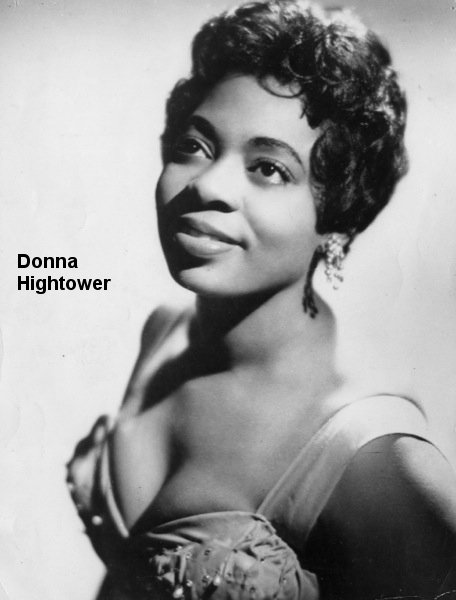
The first reports I can find of the Trio performing has them backing a Missouri-born by way of Chicago female R&B singer Donna Hightower which are collected on Marv Goldberg’s website.**

The Cats had played as a band for female singers, including backing Lena Horne with Hazlett on guitar.

August 1952 Minneapolis Spokesman (another Black newspaper) wrote this:

The musicians who are playing at the Key Club are Hank Hazlett, leader and Spanish guitar; Maurice Turner, bass fiddle; Buddy Davis, piano and vibraphone; Donna Hightower, Decca recording artist and vocalist. The musicians are all from Chicago and staying at the home of Mr. and Mrs. William E. Gray, 420 E. 37th St.”

That “staying-with” address is in the heart of Black South Minneapolis and would be two short blocks from a Portland Ave address we’ll meet just down the page. Goldberg has them playing at the Key Club in a long-term engagement until New Years Eve. Here’s what the St. Paul Recorder (the other Twin Cities Black newspaper) has to say (with Goldberg’s interjected corrections):

The Hank Hazlett Trio, composed of Buddy Davis, pianist and Maurice Turner, base [sic] drummer, along with the capable leader of the combo Hank Hazlett is now playing at the Key Club, 1229 Washington Ave So., every night and Sunday afternoon matinees.

The popular trio featuring Dinah [sorry Donna] Hightower, vocalist, got its start in Chicago in 1947 and has played successful engagements in many outstanding nightclubs.

Miss Hightower with her ultra modern version of popular music, seems to have a way with the patrons. The entertainers will be here through the holiday season.”

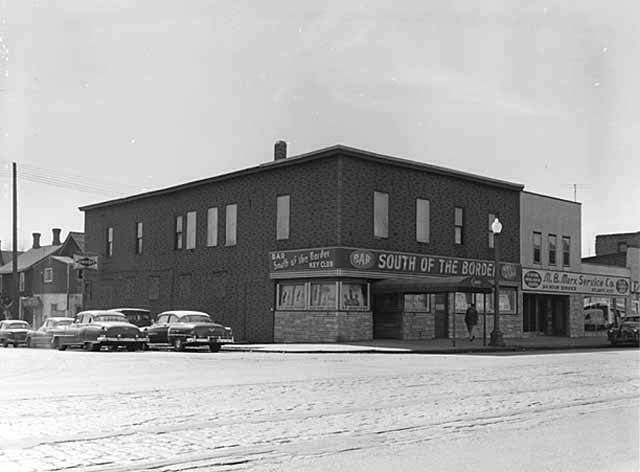
Don’t look for it now, this location was demolished for the I35 freeway.

.

If you want more details about The Key Club aka South of the Border, the Twin Cities Music Highlights website has much to read. Many national Jazz and R&B luminaries played at this establishment in the Seven Corners portion of Minneapolis’ West Bank neighborhood. Lots of seedy goings-on too, as this era of the Minneapolis Jazz and music scene often finds stripper acts, guns, and likely mob connections intermingling with the musicians.

This YouTube video dub of an acetate (demo or proof record) is the only audio artifact of the Hank Hazlett Trio I’ve found. Donna Hightower sings backing vocals. The guitar and likely the lead vocal is Hank.

.

Around the time of this extended engagement, it seems that Hazlett moved to the Twin Cities, setting up residency at 3648 Portland Ave in South Minneapolis, six blocks from where the scrapbook was found. Why there?

From what I can gather, Minneapolis has a strange and complex racial history, so please excuse these meager paragraphs that try to summarize the highlights of my incomplete understanding that follows. Minneapolis has long had some Black residents, and when it gathered more in the first waves of the Great Migration after WWI, there was white backlash. One instrument of that backlash were special clauses put into property deeds excluding transfer of those deeds to non-white or Jewish buyers. In theory government courts would need to be called in to enforce these racial covenants, but in practice these were often a silent exclusionary agreements, though they were sometimes enforced in breach by mobs of sullen whites who would surround an incursive Black occupied home with threats and vandalism against this blatant integration. This private customary segregation was later reinforced around mid-century by “red-lining,” a practice by home-loan issuers (including federal government loans) to exclude writing mortgages in Black areas. All of this, pretty rotten stuff — but perfectly “normal” and widespread in the United States, not just Minneapolis.***

In Minneapolis there were two sections of the city that became “Black:” one, on the north side of town (shared with a Jewish population that were often excluded by the same covenants and a higher than usual American level of local antisemitism), and the other, a vertical north-south strip in South Minneapolis. 3132 Park Ave was just on the borderline of these redline established sections. Even when I came to South Minneapolis in the ‘70s, you could see by the skin tones of the residents where those invisible lines sort of remained, to a fine resolution that could be almost block by block.****

Our 1953 musician Hank Hazlett lived in a house in the Black South Minneapolis area for several years, his only Minneapolis residence I can establish. I don’t know if he owned it, but the scrapbook maker was proud of it. There are a couple of photos clearly identifiable as his house, one with a new-looking or late-model 1953 Cadillac parked in front. I don’t know what his income was. The city directories continue to list him as musician, and at least in the mid-50s his local gigs were common. Even this late in the 20th century, when radio, television and recordings allowed music to be captured and transmitted on devices, live music was still a vital part of the experience of music. Perhaps for Hank the choice of Minneapolis went like this: I could tour from any city as my home base. The music scene in Minneapolis may be smaller than Chicago or LA, but on the other hand there are fewer Black bands competing for the club slots — and since it’s not a town to launch one’s new act to musical stardom, my middle-aged self may be able to settle down without having to directly compete with the most ambitious young acts.

Portland Ave with Cadillac

One of the pictures of 3648 Portland Ave in the scrapbook. I’m assuming the car is Hazlett’s. The scrapbook has 1955 telegrams directing Hazlett and his trio to go from a gig at Williston ND to Sheboygan WI and that Scotts Bluff in Nebraska is cancelled. If they drove, that’d be a good car for this.

.

The city directory records tell us that he had a wife, Edith. It could be that the marriage predates 1953, and there’s certainly lots of 1940s material in the scrapbook if she collected any of it then. There’s a possibility they have a child. The scrapbook is oh so scant on this. There are three photos of young children on its pages. The oldest by background clues may be as early as the 1940s, and it shows a young toddler standing in a quiet road that is not   Portland Ave, and in pen on the bottom it says “Earl P. Jr. 2 years old.” Lawrence/Hank Hazlett isn’t Earl, and “Jr.” traditionally means a father’s name given to an offspring. And then there’s a pair of what looks to me like two snapshots of one child. One shot of this kid shows a smiling sub-1-year-old in their onesie. To the right of that photo is pasted another one of a young Black couple sitting in front of moon and stars backdrop. That man doesn’t look like Hank Hazlett to me, but not only are the two photos near each other, I can sort of see the baby looking like the child of that couple. It’s possible that the man in the moon and stars photo is a much younger version of the performer Hazzlett, who I have only older-age pictures of. And finally there’s a somewhat serious looking, slightly older child in a push stroller-scooter. The back of that last photo has a date: 1952.

Two baby pictures that may be the same child

This is the second set of baby pictures that I think may be the same child. The one in the middle is dated 1952. Do you think the moon & stars picture that’s pasted on the same page as the left-hand baby is a younger Hank? There’s another picture below of a woman that may be an older Edith Hazlett.

.

There’s also a handwritten, child-like letter which I transcribe as:

Dear Daddy,

How are you? Fine I hope.

And all the others. We had a vary nice Christmas. Well today is the last day in the year and a new year is coming. Yvonne Dickie Gwen and myself are getting along fine in music. I love my fountain pen. We all like our fountains very much, our pens write fine.

Thanks for the money, Daddy. We were very glad to hear your voice. I have been over to whites ever since last Friday. White has a lot of Christmas cards. They are very pretty. Yvonne and Dickie White has a beautiful Christmas tree. I am glad you liked my present, and I know that picture is a good picture. White Chick and Marshall like there souvenirs very much. Well goodbye and good luck. With a lot of love

Felicia”

This could be an “on tour” letter to a traveling father from home — New Year’s Eve is always a prime gig opportunity. Or it could mean that the child doesn’t live with her father. Someone chose to put this letter in the scrapbook, and I believe the scrapbook was made by Hank, his wife Edith, or the two of them in collaboration. Knowing more would change the meaning of the letter.

Let me be clear: a musician’s life, particularly a touring musician, detracts from marital stability. Incomes change rapidly. Travel and late-night hours bring separation. Alcoholism and drug problems are endemic. Egos swell and are crushed and those changes can abrade a relationship.

The Minneapolis city directory tells us one more thing about Hank Hazlett’s home life. In 1958 the city directory records that Marian M. is now the wife at 3648 Portland. Marian is also listed as working for the Minneapolis Public Library. Hank is now 47, and the city directory doesn’t say “musician” next to his name — instead it says “banquet formn Dyckmann Hotel.” Same in ’59. In 1960 and ’61 Hank is shown at the 3648 Portland address, but he’s a musician and working at the Flame in Duluth, 150 miles north. In 1962 and ‘63 the musicians place of work is listed as the Manor House in St. Paul and the Downtowner Motel in ’63. Marian remains until the most recent city directory available listed as his wife.

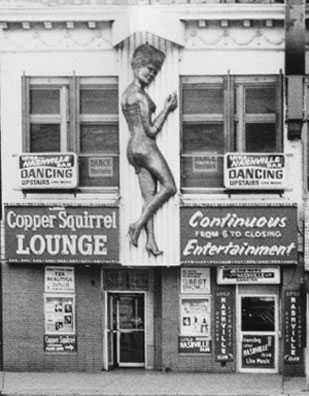
The last Hank Hazlett Trio gig I have found a record of was at a strip club/lounge on Hennepin Ave called “The Copper Squirrel” in September of 1963.

Site of the last known Hank Hazlett Trio gig.

.

I’ll admit, like someone looking at amorphous clouds in the sky I can picture these scenes: Marian isn’t necessarily up with the musician’s lifestyle. If Edith is the maker of the scrapbook or a collaborator in making of this document largely about her ex-husband’s life and music career she may have taken it with her. Out of spite or from fond memories of their days together? Maybe Marian didn’t want that scrapbook mostly about Hank’s earlier life around anyway? Who can say? Maybe it’s something else. There are no pictures in the scrapbook I can say for sure are post-1958. If Hank was the one making the scrapbook, maybe he had tired of documenting things.

Two women possibly Edith Hazlett

Here are two picture which look like they could be the same woman found in different parts of the scrapbook. The man is Hank Hazlett, and I suspect that the woman would be Edith Hazlett prior to 1958. Edith may have been the person who made the scrapbook of her husband’s career, and may have been the one who put it in a crawlspace to be found in the mid-1970s.

Here’s a quartet of scrapbook photos of the Hank Hazlett Trio performing.

4 shots of the Hank Hazlett Trio

Hank with an Epiphone archtop in most of these photos, but a “blackguard” early ‘50s Telecaster in one. In the upper right there’s a woman holding down the pianist’s spot in the trio, and the white bass player there is crossing time and space with that tie he’s wearing to protest Donald Trump’s haberdashery sense and opinions about Black History Month.

In our next post we’ll track back a bit and talk about how the scrapbook includes the home-front World War II experience and what else it shows about American mid-century race relations and Afro-American cultural pride.

.

*The WWII years caused considerable interruption in recording activity. Shellac, the hardened resin that 78 RPM records were made from came from a residue produced by overseas insects located across a warfront Pacific Ocean, and there were strikes by musicians labor organizations as they tried to extract concessions from entertainment companies during this time too.

**I’ve mentioned Marv Golberg’s site multiple times in this series. It’s full of marvelous details about Jazz and R&B artists of this era. Thanks, thanks, thanks, Marv.

***Just after the end of WWII the practice of racial covenants was taken to court, and in an early post-war civil rights victory, they were struck down nationally, but redlining was not addressed, and “it goes without saying” agreements to hew to segregation continued. Yet at the same time in the late 1940s, a young Minneapolis mayor Hubert Humphrey saw to enactment of an early law against racial discrimination in hiring, giving promise that more job opportunities would open up for Black residents.

****By these 1970s properties in these parts of South Minneapolis were affordable, assuming you could swing the finances, because it was still considered a “bad part of town.” This led to some kinds of mostly young white people to move in: gay folks, and Boomer “hippies” and political radicals. Some of that generation are still alive, and still live there, and there’s a new influx: immigrants from Africa and Latin America.

The Galton Case

This is Parlando Project alternate reader Dave Moore’s birthday month, and so I thought it’d be a good time to interrupt the autumn poetry with his presentation of a short passage from detective novelist Ross MacDonald’s The Galton Case  first published in 1959.

Dave did this live performance that I recorded a few years back, and when I asked him earlier this fall about it, he wasn’t sure exactly what went into its choice. It may have been that some of the formative influences on the Parlando Project date to the era depicted in this scene in the novel, the “Beatnik*” phase where a certain kind of post WWII bohemia reached general public attention.

I’d characterize most of that general attention then as somewhere between comic amusement and pearl-clutching concern. The “beatnik” as a comic character became a stock item, and it’s easy to see the derivation from earlier foolish artist characters like Don Marquis’ Fothergil Finch.**  The world doesn’t understand their pure art, but in the comic context, the world is entirely right.  And then the concern-faction folks were writing that standards were surely slipping as free verse, free jazz, free-style prose myths, and free love were celebrated in the demimonde.

The Beatniks moive poster

Explosive ivory towers! The Beatnik id of the Fifties.


Fiction writers, even writers of detective fiction, have the choice of walking fine-borderlines on such things. Characters and voices can hit the comic notes, show the raggedness of the coloring outside the lines and the amputations when sharp lines cut, while allowing their readers the ability to vicariously experience those parts of town they would never visit. Attracted to the Beat but find it out of reach? Repelled by it? Find it phony? It’s possible to write a novel and hold the interest of readers who have one or more of those opinions of “Beatniks.”

This passage from Ross MacDonald is a good example. I’ve not read the book, I don’t know how it comes out, and what additional framing and information we might have if we did. Listening to the section Dave reads I wonder: does the narrator dislike the modern jazz playing behind the poet, or just dislike its incarnation that night? Is the poet reading to music a beatnik fool speaking useless nonsense, or a fool speaking the truth because they no longer care not to? What level of imposture is everyone portraying, and how can we know or find out?

We don’t know. We’ll turn pages so the detective can find out.

It occurs to me that detective fiction is allied on some essential level with literary criticism. Sherlock Holmes foretold the New Criticism; Edgar Allen Poe, one of the Fugitives before their time.

If last time Emily Dickinson was getting meta with autumn and poets who wrote about autumn, today we have Dave reading in front of the LYL Band this short, mysterious passage from The Galton Case  which describes—someone reading before a band.

Happy birthday Dave! The player is below…


*Beatnik was created by newspaper columnist Herb Caen who combined the term “Beat” used by some writers in the scene with the Russian suffix used for the tiny artificial earth satellite Sputnik launched in 1957. Many members of the “beat generation” didn’t like the term, which after all was a diminutive. People breaking molds don’t generally like labels anyway.

The successor term “Hippie” was similarly made by adding a diminutive suffix to an existing term “hip” that was used within the subculture. Both Hippie and Beatnik had connotations of a vague aspiration to bohemianism, particularly by those who might be too young to really understand.

**”The Poet of Revolt” as he self-branded. Furthermore in Marquis’ Hermoine and Her Little Group of Serious Thinkers  from 1916, we can find other characters like Voke Easeley the Modernist composer who “Doesn’t know a thing about music. He tried for years to learn and couldn’t. The only way he knows when you strike a chord on the piano is because he doesn’t like chords near as well as he does discords.”