Next week I’m going to be attending a number of events online that are part of the Emily Dickinson Museum’s annual “Tell It Slant” festival.* While I’m not sure how this will change my production schedule for new pieces here, I’m hoping to present a series of Emily Dickinson musical settings before September ends.
The first of these pieces is Dickinson’s “The Day undressed Herself” — and what a charming poem it is. As my reading of Dickinson has expanded, I’ve become aware that some Dickinson poems are so compressed and abstract that extracting a clear meaning is very difficult, but despite this poem’s use of an un-introduced conceit throughout, it’s clearly a poem depicting a sunset. If something of a riddle, the subject is one most readers will “get” easily.
But poetry isn’t just plot and foreground. I don’t mean to replace the direct evidence of hearing the words sung in my performance, but the sounds here are so lovely, and the poet here is clearly choosing words for sound, starting right off with the fabric swish of the poem’s first line and continuing in the 1st verse with the now antique word “Dimities” (which are undergarments.) And Dickinson’s metaphoric details aren’t just sounds, they set this sunset, this emblem world and its cosmic time, in an intimate female universe.
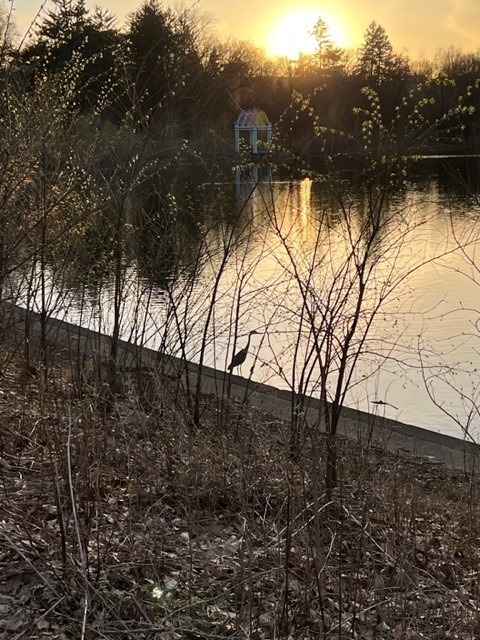
The window next to me as I write this faces west too, but it’s only an urban alley. Here’s a sunset a few blocks east, the heron doesn’t seem to know they’re in a city.
.
It starts with a woman undressing, where in art a long tradition of erotic gaze comes with that choice. If that’s so here, it’s a deep and unstated undercurrent. Is she just readying for bed, for dreams perhaps? Or something else? By accounts, Dickinson wrote often at night. I don’t know if she wrote after a change into her bedclothes or not, but this possibility: the sunset’s heralding of an opening to the looser dress of imagination may be in Dickinson’s mind.
The 2nd stanza expands from Earth’s sunset, to let us know, as scientifically educated Dickinson did, that the Sun is but a single star — and if I read her right, that stars are being born daily in the universe.
Another trope that comes with the sunset: day’s end meaning life’s end. The poem’s 3rd verse indicates this is considered and taken as a side issue of this sunset — sunset’s ars longa isn’t so concerned with that — and as it happened, Dickinson’s night-scribed poetry became more than a lifetime-lived. In some mythologies, the sky gods are male —in this one, our western, setting sun is a “Lady of the Occident,” female.
The final stanza starts with a line: “Her Candle so expire” which if considered more fully isn’t just sunset extinguishing the last light before bed. My ear may be over-pun-sensitive, but I hear the rhyming word “fire” in “expire,” and once more the cosmologist is saying in that line that stars themselves have lifetimes.
Someone has been sailing on frigate-books in the closing two lines. I’m surprised at her knowledge of the truck in a sailing ship’s rigging, a ball where the halyard’s pass. It’s an unusual word, no-doubt chosen to consonante with Bosporus, the water separating Europe and Asia next to Constantinople/Istanbul. The dome in the final line is then the Hagia Sophia (“holy wisdom”) church in that city. And the final words, “Window Pane.” What’s this definitive, capitalized pane of glass? Dickinson’s bedroom faced west, her little writing table at a western window.

Here’s a rough chord-sheet of today’s musical Dickinson.
.
I wanted to do something featuring a lush sounding steel-string acoustic guitar for this one. With luck I was able to just squeeze in the final take you can hear below as my studio space time so expire. You can hear that performance with the audio player gadget below. No player seen? This highlighted link is an alternative that will open a new tab with its own audio player.
.
*This Festival features a multi-day round-robin reading of all of Dickinson’s 1789 poems, and each time I go through that experience I’m reminded that it is as impossible to comprehend all of Dickinson’s poetry as to remember all the stars in the night sky. Each time through, “new poems” seem to have been inserted — which are in reality ones I had heard in previous years but wasn’t ready to feel until now. Just sitting through a small portion of the readers’ reading — an hour or even a half-hour — can change your appreciation of what Dickinson offers. Busy people might want to choose only one of the reading sessions that has a convenient time for them, and maybe do some hand mending, cooking, or housework as the variety of readers speak the poems in turn. Let the poems that you are ready to feel come to you in your household, as their author composed them in hers.
There are also a variety of programs discussing other aspects on this year’s schedule. It’s all free to attend, but you should sign up at this link.
 Frank Hudson