And the most popular piece here last season was…

Musician jokes have a cruel streak, though most musicians love them.


“How can you tell if there’s a drummer knocking at your door?”

“Because his knocking speeds up and slows down, and he doesn’t know when to come in”


“Did you hear about the banjo player who played in tune?”

“Neither did I.”


“How do you get an electric guitarist to turn down?”

“Put sheet music in front of him.”


Here’s my favorite. A doctor, a lawyer, and a musician each win 100 million dollars in the lottery. The doctor is all smiles and says, “Oh, this is great! I don’t have to worry any more about arcane billing codes and insurance bureaucracy. I can just treat my patients!”

And the lawyer claps his hands on hearing, and says, “I’m going to just take all my cases pro bono and never again have to represent someone just because they can hire me.”

The musician though is downcast, he says, “Well, I guess I can keep gigging until the money runs out.”

The most popular piece for the Parlando Project this past Winter was Fenton Johnson’s “The Banjo Player.”  Johnson’s poem is essentially another musician joke, but one elaborated with some telling details observed from Johnson’s early 20th Century life.

The banjo is an African-American instrument, something often forgotten in my time until a few folklorists made efforts to set things straight. Fenton Johnson, born in 1888, just one year after Papa Charlie Jackson, knew that world before the guitar picker became the bluesman.

PapaCharlieJackson_GetAlong

Hype-man ad copy circa 1924 for the first ever to record self-accompanied blues .


Yes, he’s poking a little fun at his banjo player, but Johnson’s real case is for his value. It was a cold 20 and icy this March morning, and Johnson says the banjo player’s music is welcome “as the violets in March.”

And the section where I do a bit of a sticks and harmonica breakdown is the heart of the poem: children, who won’t even be able to pay the banjo player dimes like the adults in the saloon, love him like Santa Claus.

Here’s an irony darker than the joke of the banjo player who doesn’t know what a troubadour is. Fenton Johnson, Chicago’s pioneering Afro-American modernist poet had a life a bit like those three in the lottery joke. There was no 100 million, but he was born into an Afro-American family that had somehow accumulated some wealth. He was able to attend college. He dressed well, drove his electric motor car around the city. Like our joke’s doctor and lawyer, he wanted to use his good fortune and talents for good, to raise the status of Black Americans, the present task then for the early 20th Century “Talented Tenth.” And so, he established literary magazines, hoping to start a Chicago variation of the Harlem Renaissance, to promote the arts. But he was also like the musician in the lottery joke. Slowly, as literary magazines often do, those enterprises drained his efforts and his finances. He spent the last half of his life living on diminished means, his pioneering verse forgotten by all but a handful in Chicago.

There’s probably a good novel, play, or movie in Fenton Johnson’s story, but here at the Parlando Project we ask only that you listen for a few minutes to the compressed expression of poetry and some music, best as I can make it. The player is below.


Well that’s it for our look back that most liked and listened to pieces this past Winter. I’ll return soon with some new audio pieces.
Tired

I’m going to close out our investigation into the little-known early 20th Century Chicago Modernist poet Fenton Johnson with one of his most emotionally moving poems. James Weldon Johnson first included “Tired”  in his “Book of American Negro Poetry”  in 1922, and it has been anthologized several times since. “Tired”  remains the poem of Fenton Johnson’s that one finds most often shared on the Internet today.

You can see why. Only a few beats in, that powerful line is spoken: “I am tired of building up somebody else’s civilization.” It may take no more than that line alone to have some tag Fenton Johnson as the first radical Afro-American poet.

I cannot categorically disagree there. I know little about Johnson’s political views, and though the two short-lived magazines he founded before 1920 are said to have included political philosophy, I know nothing of the particular stances he took or supported. At least at the time (the first two decades of the 20th Century) “Tired”  along with a few other of Johnson’s poems caused some Black cultural critics to remark that Johnson was too pessimistic, too given over to despair. You might find that strange, but in that moment, there was a feeling that educational and cultural uplift could soon raise the Afro-Americans along with the time’s large and wide immigrant demographics into a new, more accepting America. We know now that didn’t happen, that indeed 20th Century racism and poverty had some mighty blows to land on America and American Blacks with KKK branded racism, Great Depression poverty, and world-wide Fascism—but at the time, that uplift was what many Afro-American elites were pulling for.

However, just by going on what Fenton Johnson poetry I have available to me, I’m not entirely sure Johnson was, at this time, a political radical or a thorough pessimist.

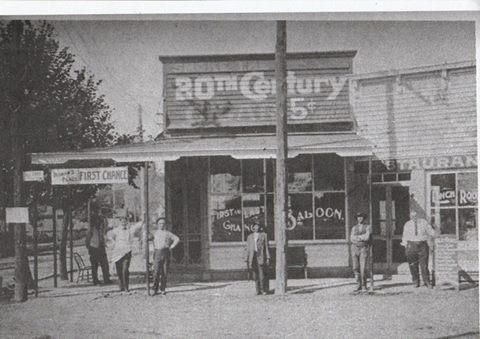
Last Chance Saloon

Somebody give me my gin.” Mike is out back serving warm gin to ladies.

After all, the speaker in “Tired”  is not Johnson himself, no more than the banjo player in our last post’s poem is Johnson, the middle-class raised, college educated man. Even the Last Chance Saloon, where the banjo player played for tips, returns in “Tired”.  Johnson didn’t live in a shanty, he wasn’t married to a laundress.

True, this is a character that Johnson wants us to hear, an important voice that maybe even the Black “Talented Tenth” wasn’t listening to then, much less White America. And though it’s free verse, this is a poem, not an incisive political analysis or program. It’s a dramatic speech with rhythm, repetition, and a rise in despair from gin-houses to the stars.

It’s not hard for me to see in “Tired”  the ancestor of August Wilson’s great play cycle, or the range of characters and voices in Walter Mosely’s detective fiction.

Musically I stepped at least as many decades into the future here, concluding this audio piece with a short burst of the kind of free jazz that allied itself with the Black Arts movement in the later part of the 20th Century. I’ll allow that this music is an acquired taste, but at its core is an ethic of allowing individual voices and modes of expression even in a group context. Free Jazz is not always as raucous as what I played for this, but it does not forbid it either. That’s consistent with what I try to do (within my limits as a musician) with the Parlando Project. When I say we combine words with various music, I mean it.

That does mean that you may not like all the writers’ words I present, or all the kinds of music I write and play to combine with those words, but it means that I’m also not going to stick with one thing and repeat it until we are both tired of it.

I’ve ordered these last four posts here on Fenton Johnson purposely, so to present the man more in full, and because, to be honest, I didn’t feel I could earn any license to speak these words without doing something more than just putting them in my mouth. To listen to Johnson’s “Tired”  as I performed it, you can use the player below where it appears, or this highlighted hyperlink.