The Sunset stopped on Cottages

Here’s a poem by Emily Dickinson that I made into a little song. There’s an audio player below to hear it.*  I intended the music I made for this piece to be jaunty – not only because I worry that too many of the Parlando Project pieces are slow to mid-tempo, but because it fits the language of Dickinson’s poem. Just 8 lines, but its “what’s in the box” description includes: a sunset, a morning, cottages, and a USB C charging cable.

No – error – sorry. No charging cable. I looked at the catalog listing:

Emily Dickinson no longer includes a charger or charging cable as part of our environmental commitment, which we maintain as we continue to offer the finest in Cottage-Core products for the home poetry enthusiast. Folks who listen to ‘The Sunset Stops on Cottages’  often listen to I’ll Tell You How the Sun Rose’   and may also be interested in a delightfully antique Emily Dickinson tulle tippet nightgown or one of the delightful Tyrian purple moth-scented candles from our Susan Gilbert Dickinson collection.

OK. I’m funning with you. After living with the poem for awhile as I set it to music and recorded my performance of the result, I instead believe this poem is an example of the genre my wife calls “Cozy Gothic.” How come? I think the poem’s cottages are graves.

Here’s how I understand Dickinson’s poem. There’s a pretty sunset, an eternally repeated and universal, broad-sky-set thing. The sunset must appear where ED’s poem sees it, but after its moment it’ll be “Gone Westerly,” for today. Gone westerly is likely a similar idiom to “gone south,” a euphemism for death. The sun has not fled out of dereliction of duty –“treason” – but because a day, like a human life has its limits. The poem’s second stanza reminds us of the circadian day too: that morning and a sunrise was, and will be, there – but that’s no matter to the dwellers in the cottage/grave “swellings in the ground” who can’t see the “supercilious Sun.”

Sunset stopped on Cottages

Here a chords sheet, and what’d be more Cottage-Core than playing this Cozy Gothic song in your own cottage? That G chord form I played is just the B & E strings fretted at the effective 3rd fret along with the open D and G strings.

.

I asked my wife again this morning about “Cozy Gothic” as I prepared to write this. I reminded her that the young Emily Dickinson did not grow up in the grand house that’s now the Emily Dickinson Museum, but in another place where the Dickinson family lived in her youth after her grandfather got the family finances mired in debts until her generation extracted them from that and were able to move back to the grander house we associate with her poetry. The grand Dickinson manse was across the road from a crop field, and had room for gardens of fruit, food, and flowers; and it was beside a main road for travelers in and out of town. The place that her family had to relocate to was smaller, and across the street was a graveyard. Mix those two homes ED knew in her lifetime, and you have some pretty good poetic loam. I asked my wife, a known PK,** “Did you ever live next to a graveyard?”

Yes, when we lived in a parsonage. The town was taken aback when I sunbathed in the graveyard. I didn’t know what the big deal was about that – it just seemed like a nice, peaceful, place.”

That’s my wife. Nature nymph and likely a better writer than I am – and for all the mixture that made up her childhood, she got to live the spirit of this Dickinson poem directly – Cozy Gothic.

Here’s that audio player gadget. What, has any such audio player “Gone Westerly?” You can take hope in the resurrection, but it’s likely because some ways of viewing this blog suppress displaying the audio player gadget, just like they mute the angels that would write better, more concise blog posts. I make do by providing this highlighted link that will open a new tab with its own audio player though. Playing the bass track for this one – without making a point to think of it, but still thinking of it – I was thinking of the great British bassist, Danny Thompson, who died this autumn. Thompson’s playing could be quite free and capable of quick, large, leaps in register, but while doing that he could follow complicated or chaotic other players ad lib and help make musical sense out of them. I loved his playing, and of course mine is more a tribute than the work of a peer in skills or dedication to the instrument.

.

*I find it puzzling as this Project enters its 10th year that the number of people who take the time to listen to the (almost always) short musical pieces here remains essentially flat from 3 years in the Project on forward, while the number of readers of the blog posts continues to grow. Less than 10% of readers click the audio player or link, assuming that the stats I get are accurate.

I have guesses. My rough-hewn voice will never make me America’s sweetheart. My naïve compositional skills may fall between the sawhorses of pop ready-mades and art-song sophistication. The variety of my musical approaches may put a stop to continued listening, as I’m near certain to attempt a style someone doesn’t like (and so my failure or limited success in evoking those styles could be beside the point).

**”PK” = “Preacher’s Kid.” Not just my wife, then Dave Moore, my long-time musical partner sometimes heard here, is a PK too. I’m sort of one, though my father left the Protestant ministry, except for fill-in roles, in my childhood – but that history and those fill-in pulpit appearances likely helped shape me.

The sequela of being a PK vary. Some become rebel angels, some follow into the “family business,” some suffer from having had childhood expectations of goodness and polity, others take the close-hand connections with music, ethics, or philosophy and use that in some other field. For myself, I think the main thing I took from it (and my father deciding not to take to it) is the concept of “a calling.”
The Day Undressed Herself

Next week I’m going to be attending a number of events online that are part of the Emily Dickinson Museum’s annual “Tell It Slant” festival.*  While I’m not sure how this will change my production schedule for new pieces here, I’m hoping to present a series of Emily Dickinson musical settings before September ends.

The first of these pieces is Dickinson’s “The Day undressed Herself” — and what a charming poem it is. As my reading of Dickinson has expanded, I’ve become aware that some Dickinson poems are so compressed and abstract that extracting a clear meaning is very difficult, but despite this poem’s use of an un-introduced conceit throughout, it’s clearly a poem depicting a sunset. If something of a riddle, the subject is one most readers will “get” easily.

But poetry isn’t just plot and foreground. I don’t mean to replace the direct evidence of hearing the words sung in my performance, but the sounds here are so lovely, and the poet here is clearly choosing words for sound, starting right off with the fabric swish of the poem’s first line and continuing in the 1st verse with the now antique word “Dimities” (which are undergarments.) And Dickinson’s metaphoric details aren’t just sounds, they set this sunset, this emblem world and its cosmic time, in an intimate female universe.

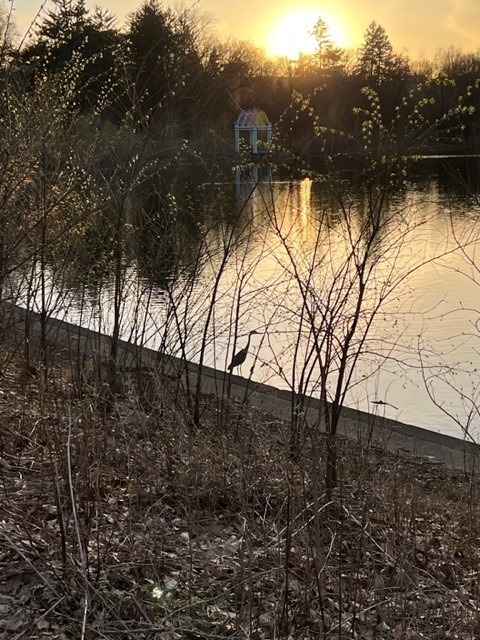
Heron at sunset

The window next to me as I write this faces west too, but it’s only an urban alley. Here’s a sunset a few blocks east, the heron doesn’t seem to know they’re in a city.

.

It starts with a woman undressing, where in art a long tradition of erotic gaze comes with that choice. If that’s so here, it’s a deep and unstated undercurrent. Is she just readying for bed, for dreams perhaps? Or something else? By accounts, Dickinson wrote often at night. I don’t know if she wrote after a change into her bedclothes or not, but this possibility: the sunset’s heralding of an opening to the looser dress of imagination may be in Dickinson’s mind.

The 2nd stanza expands from Earth’s sunset, to let us know, as scientifically educated Dickinson did, that the Sun is but a single star — and if I read her right, that stars are being born daily in the universe.

Another trope that comes with the sunset: day’s end meaning life’s end. The poem’s 3rd verse indicates this is considered and taken as a side issue of this sunset — sunset’s ars longa isn’t so concerned with that — and as it happened, Dickinson’s night-scribed poetry became more than a lifetime-lived. In some mythologies, the sky gods are male —in this one, our western, setting sun is a “Lady of the Occident,” female.

The final stanza starts with a line: “Her Candle so expire” which if considered more fully isn’t just sunset extinguishing the last light before bed. My ear may be over-pun-sensitive, but I hear the rhyming word “fire” in “expire,” and once more the cosmologist is saying in that line that stars themselves have lifetimes.

Someone has been sailing on frigate-books in the closing two lines. I’m surprised at her knowledge of the truck in a sailing ship’s rigging, a ball where the halyard’s pass. It’s an unusual word, no-doubt chosen to consonante with Bosporus, the water separating Europe and Asia next to Constantinople/Istanbul. The dome in the final line is then the Hagia Sophia (“holy wisdom”) church in that city. And the final words, “Window Pane.” What’s this definitive, capitalized pane of glass? Dickinson’s bedroom faced west, her little writing table at a western window.

The Day Undressed Herself

Here’s a rough chord-sheet of today’s musical Dickinson.

.

I wanted to do something featuring a lush sounding steel-string acoustic guitar for this one. With luck I was able to just squeeze in the final take you can hear below as my studio space time so expire. You can hear that performance with the audio player gadget below. No player seen? This highlighted link is an alternative that will open a new tab with its own audio player.

.

*This Festival features a multi-day round-robin reading of all of Dickinson’s 1789 poems, and each time I go through that experience I’m reminded that it is as impossible to comprehend all of Dickinson’s poetry as to remember all the stars in the night sky. Each time through, “new poems” seem to have been inserted — which are in reality ones I had heard in previous years but wasn’t ready to feel until now. Just sitting through a small portion of the readers’ reading — an hour or even a half-hour — can change your appreciation of what Dickinson offers. Busy people might want to choose only one of the reading sessions that has a convenient time for them, and maybe do some hand mending, cooking, or housework as the variety of readers speak the poems in turn. Let the poems that you are ready to feel come to you in your household, as their author composed them in hers.

There are also a variety of programs discussing other aspects on this year’s schedule. It’s all free to attend, but you should sign up at this link.

I’ll Tell You How the Sun Rose

After our short trip to Chinese translation, let’s return again to Emily Dickinson, who is observing another morning.

This LYL Band performance of “I’ll Tell You How the Sun Rose”  is a bit imperfect. Alternative Parlando Project reader Dave Moore takes the lead here, but he and I are singing instead of our usual recitative, and we’re caught at the top of our singing range as well. Dave even bobbles a word in the line “The hills untied their bonnets.” So, yes, this leads to some imperfection—but this lyric is so perfect that perhaps it can carry us along anyway.

I suggest you listen to this piece now and then read my discussion of what I see in it afterward. Dickinson, like a good melody, doesn’t require understanding before enjoyment. The player to hear it is at the bottom of this post.

“I’ll Tell You How the Sun Rose”  begins with a homespun 19th century village dawn, and the singer starts right off almost bragging that they can tell us how the sun comes up. As proof, Dickinson unleashes a string of lovely, singing metaphors for sunrise, looking down from the dawn only once to let us see the squirrels running about as if with the news of the day. She concludes this section with finest simplicity: “That must have been the sun!”

Isn’t that a strange way to sum up dawn? It comes up and it’s already past tense, like Meng Haoran’s morning in the last post, and Dickinson comments on this common splendor as if she’s a surprised alien from another planet who has never seen the sun. Her boast that she can tell us “how the sun rose”—something she and all of us should already know, set in nothing more special than a prosaic town—becomes instead a small, whispered, apprehended wonder.

In the second section, Dickinson shifts gears so smoothly that no matter how many times you read or hear this poem you will never notice. There is a little engagement of the gears as she says of sunset “I know not,” unlike our first gear’s “I’ll tell you;” but we’re soon on to a rural scene with the sun rays like children climbing up and then down a stairway over a hedge or fence row (a stile).  At that point, there’s a bustle in your hedgerow as the dusk becomes a grey robed “dominie,” a strange and archaic word perhaps even in Dickinson’s 19th century, and a sure stumper for any modern English speaker.

A dominie is a Latin word meaning the leader of a congregation, a minister, a pastor—and ‘pastor” is derived from the word for shepherd—and that’s just what our grey dusk becomes as it leads the children of the dawn, now dusk, away like a flock, closing the bars, closing the gate, so that they cannot return.

Some readers are so charmed by Dickinson’s first section that they feel it is pedantic to think that this sunset section is describing a passage to death, “The undiscovered country from whose bourn, no traveler returns,” so no wonder that Dickinson moved from “I’ll tell you” to “I know not.”

That dominie seems so removed from the pleasant village of the first section, so foreign. Another subtle word choice contrasts the two sections. There’s only 88 words in this piece, and five of them are colors. “Rose” puns for dawn pink in the first line and then dawn is “amethyst,” a word for both purple and a semi-precious stone. The sunray children are “yellow”, and our strange dominie is dusky “gray.” The stile sunset stairway that the sunray children are climbing is “purple.” So out of our five colors, one of them is roughly the same color. In the first section, it’s semi-precious and wondrous, but in the second it’s just purple—a ruling, royal color perhaps—but those sunset ray children’s steps are ruled over not ruling, not shining like the amethyst steeples of the dawn.

stile sunset

Putting on the stile


Did you listen to the performance of “I’ll Tell You How the Sun Rose”  before reading all this? I feel a bit here as if I’m acting  like that dominie myself, leading you past the plain and beautiful dawn, over the stile, and closing the gate to simply hearing the sound and the manner of expression of Dickinson. Too often we make too much of the meaning of poetry, and particular the deeper meaning of poems. Just as Meng Haoran’s poem from last time can be understood well enough to be enjoyed by children, this poem too can be enjoyed as compressed observation. Perhaps it’s because I am an old man, one who has tried to write and make music for many years, that I care to see what is underneath the sun rays, to look over the stile, and to find what is inside Emily Dickinson’s expression.

To hear the LYL Band perform “I’ll Tell You How the Sun Rose,”  use the player below.