I completed the off-the-cuff recording of my musical performance of this Robinson Jeffers poem a few days ago, but it’s taken me awhile to figure out what I wanted to say about my encounter with it, and secondarily how you, my valued readers and listeners, might receive it. In “Be Angry at the Sun” Jeffers is ostensibly writing a poem, but it seems he wants to give a political speech about political speech. TL:DNR, he’s not a fan. Here’s a link to the full text of Jeffers’ poem, but since he’s writing about speech, I thought it might best be heard.
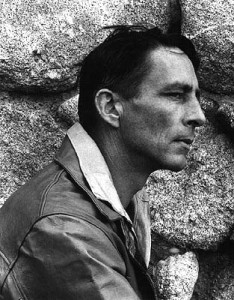
I sometimes make rock music, but like my spouse, Jeffers knew how to build with stone, constructing his own castle-like home from local seaside rocks.
.
Politics and poetry mix and don’t. Politicians will quote poems. A few poets (or diverted poets) have run for, even obtained public office. Personal political engagement by poets is likely no more rare than political engagement by nurses, baristas, bookkeepers, or shopkeepers. In my foray into social media* during the past year or so, I’ve often found an expectation that any posting poet or writer should declare their stance and allegiances.
Let me admit a reluctance to do so. My reaction is internal and perhaps odd: it feels like those calls to the pulpit at a Protestant Christian tent revival or Billy Graham’s mid-20th century adaptation of them to the TV age. It’s not oversimplified to be summarized thusly: make a simple public declaration in your acceptance of Jesus as your savior, and by that simple act, your soul’s continuous existence and the worthiness of your life has been assured. There are usually sub-clauses to that declaration: you will be expected to perform acts consistent with it. How consistent must those acts be with the declaration? Empirically, it varies considerably, which to my outlook makes the insistence and importance of the declaration problematic.
Now, some who read this may be Protestant Christians. You are welcome here. Your outlook, your understanding, your lives, may find nothing troubling about that act. I believe I understand your beliefs there fairly well. Long time readers here will know that myself and two other voices you’ve heard here are “PKs” (Preacher’s Kids). We literally grew up with variations of Protestant Christianity.
I also grew up with politics. I proudly wore my Stevenson campaign button as a grade-schooler. I participated at low-levels with campaigns for office and issues quixotic and successful for decades. I’ve been to political conventions. So, to you the readership here that are politically engaged: I have some understanding of your actions there.
So why this particular Robinson Jeffers poem, and why do I find it problematic yet worthy of considering today? Long-time readers may recall one of the poetic maxims I’ve expressed here: poems aren’t just about a message, an idea the poem wishes to express — they are more about how it feels to experience that idea, the sensations of the moment.
I was attracted to the Jeffers poem because I recognized that moment, that feeling. Perhaps you do to. I’ve been living in it this week: politicians and jurists seeming to speak as political operatives have increased my disgust. And this is not because (as Jeffers, the poet I’m voicing today, might believe) that politics is essentially dirty, though Jeffers and I will agree it’s humanly imperfect. Jeffers wrote this poem in the run-up to WWII. Unsaid within the poem, he’s specifically knocking Franklin Roosevelt,** a great and consequential American President, but he’s another of those Modernists who seems to have had, if not full-fledged admiration for fascism, at least a belief that it was no worse than other existing political schemes. There’s a lesson here: those who believe that politics is exploitative, dirty, always disreputable, will be drawn to or tolerate the belief that it’s best handled by leaders who revel in that themselves — the dirty men who will handle the dirty job, while we can stay clean sweet-smelling artists. Stone, not ivory tower in Jeffers case, but the same idea.
So, as you listen to my performance of Jeffers poem about politics and political speech, know my aim is to say that if you feel pain and disgust at what you’re hearing and seeing, I feel it too. Best as I can tell, I don’t share Jeffers prescription and proscription for politics, but in the world of today’s poem and my expression of it, I’m saying if you despair: you’re likely just one person, one citizen, someone without extraordinary powers. Your choices, your actions alone didn’t cause our country and our world to be in this state. How do we turn our nation away from letting the dirty men to do dirty jobs from being left unfettered? I’m a composer and writer, I can’t say I know more than a nurse, barista, bookkeeper, or shopkeeper.
Audio player gadget below for most of you. Is your sub-caucus not seeing any player? This highlighted link will open a new tab with it’s own audio player.
.
*I’ve given in and now post on short-post-format social media after eschewing it for a decade or more. It’s been good and bad. Like poetry, it lets me practice reigning in my long-windedness; and I can engage in it when distractions abound. Alas, it becomes its own distraction when I do have longer blocks of time or energy. In theory, like poetry, it could be complex while being concise. In practice, it’s mostly superficial —something one can relax with when needed —but that “just give me a momentary diversion while I scroll through my timeline” expectation stunts it.
**To those who might want to remind me of FDR’s faults and bad acts. I have long had a strong interest in history. I know of them.


 Frank Hudson