Wild Peaches, an Eden with undercurrents

There’s an undercurrent of grief beneath life. I don’t say this as a sentimentalist, it’s just there. This doesn’t preclude joy – it may in fact demand it.

I awoke at dawn today, August drizzle falling. I connected briefly with a livestream of the candlelight anniversary memorial service in Hiroshima,* and then shared a few tears with my living wife. Tears from each of us mixed on my face, shed for my late wife now dead for 24 years this morning. After she left for work, I took to my daily joy and hopped on a bike and rode to breakfast under gray skies without remaining rain.

I usually read the news with breakfast, a long habit – and I still do, though there’s little joy and much sense of loss in it these days. I took an old pocket music player with me (which no longer works except for the radio)** so that I could listen on air to the children of a recently assassinated state legislator memorialize her and her husband killed alongside her. They played their parent’s favorite songs mixed with sharing stories of hearing those songs in the back seat of a minivan while all sang along in flagrant voices. See what I mean: grief demands joy.

Perhaps you don’t. I express myself awkwardly, some will wonder what I’m on about. Let me look at it from the perspective of absent connection: the man who has gained some wealth by bamboozling someone or by force of power, often has the briefest of joys. The one who seeks joy in the suppression of others, has a meagre joy constructed out of a comparison to other’s pain inflicted. Grief for them might be a weakness, a sure sign of submission. I, a nobody in this world of power, can laugh at myself writing this and tell myself I should stop trying to be mistaken for Kahlil Gibran.

Today’s musical piece came about when someone shared a poem by Elinor Wylie called “Wild Peaches.”  Wylie, a contemporary of Edna St. Vincent Millay, gained an audience during the last decade to be called The Twenties. She was born into a successful family steeped in political rectitude, but her love life became a national scandal. She eloped with the son of an admiral at age 20, but soon left him for a married, older lawyer by the name of Wylie.***  The abandoned husband committed suicide after she left him, and the lawyer Wylie and Elinor fled to England and lived undercover under an assumed name. Eventually the couple married and were able to return to the U.S. in time to have that relationship too fall apart.

Hanging out with the East Coast Modernists, the now Elinor Wylie launched her poetry career. The scandals likely helped and hurt that career, but Millay and some other women poets were writing with complexity in melodic verse about eros (and what surrounds it) – and for a while they found readers hoping to understand “the New Woman” of the 1920s. As it turned out their careers were helped and hurt by many of them writing rhyming verse in metrical forms. Even before Modernism, rhyming verse was already becoming associated with less serious poetry, and women writing about eros were judged less substantial than men writing about the supposed important things. The oncoming middle of the 20th century was to be very concerned with important things – many deadly through new bombs or other means.

“Wild Peaches”  was published as a series of four sonnets, and I’ll link the full text here. My performance is only of the first one, which I think can stand alone and is representative. Rewardingly musical, the first impression one might have is of a poem that’s kin to the famous Yeats’ poem “The Lake Isle of Innisfree.”  Instead of an Irish bee-loud glade and house of wattles made, the poem’s voice is describing an Eden, a locus solus, a blessed arcadia, in the south-eastern coast of the U.S.**** But wait, there’s an undercurrent.

This is the poem of a woman who had twice eloped – the second time was subject to an international “womanhunt” – and neither partner stuck. The voice of the poem knows full well flee and exile may the entry and exit point of such an Eden. I love the ironic turn the sonnet takes even within its octet when it goes all Frank O’Hara – though written before that poet or Disney’s Davey Crocket had come into existence – with the man taking to wearing a coonskin cap and the fleeing couture-debutante clad in homespun. The exultation of “We’ll swim in milk and honey till we drown” is delicious, moving from Exodus past the parted sea to drowning.

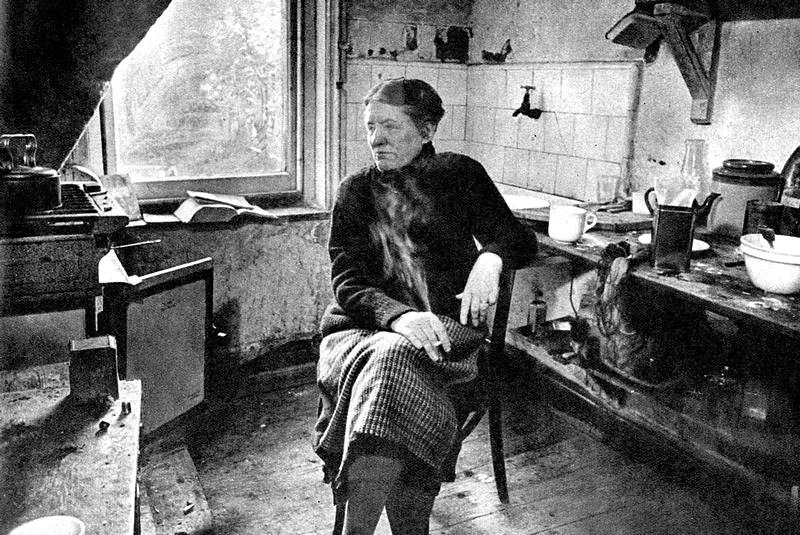
Wylie in elaborate dress

Elinor Wylie, not wearing homespun fabric


The sextet seems to offer more Eden – but wait, the best season is Autumn, the season of The Fall, and we are left with the abrupt movement from wild fruity abundance to a subsistence bringing death, and a hunter whose shot will not miss.

Oh mercy, I’m going to go all Gibran again: death will surely win one battle, though love can win many battles. That’s what I’ve found – and though she died young, Elinor Wylie later seems to have found her most successful marriage the third time around.

After our last piece where I accompanied my speaking ghost with lots of electric guitar, today’s piece is full of bowed strings: cello, violin, and viola da gamba. In secret I’ll tell you I played most of the string parts for my Carolina Eve in Exile with my MIDI guitar. I’ve taken to calling pieces such as this “Punk Orchestral,” in that I’m not getting overly fancy with the rank and order of calling these instruments up. You can hear my song made from the first sonnet in Elinor Wylie’s “Wild Peaches”  with the audio player below. No player? You’ve not been driven out of the garden, it’s just that some ways of viewing this blog will suppress it, and so I’ll supply this highlighted link that will open a new tab with its own audio player.

.

*For several years after my late wife’s death, I didn’t notice that it happened on Hiroshima Day, but I’ve found that linking a single death with the death of thousands underlines my point about humanity’s shared undercurrent of grief and loss.

**I could have Internet-streamed the children’s memorial radio program of course, but I decided to use the old device because it reminded me of the era I shared with my late wife.

***The imp of the perverse in me can’t help but think of the lawyer’s family name with the animated coyote and his well-funded Amazon Prime account who is none-the-less doomed. We find that funny.

****We can locate this poem’s Eden from its fruits. The wild peaches indicate it’s southeastern as that non-native fruit is only cultivated below the Mason-Dixon line. Wild peaches are the remains of abandoned orchards or animal-carried/buried/excreted seed-pit refugees of cultivated fruit. The poem’s other fruit, scuppernong, is a wild white grape native to the Carolinas.

The Unquiet Grave

August brings me this triple obligation: it’s the anniversary of the public launch of the Parlando Project, of my late wife’s death, and of the atomic bombings — three things varying in nearness, scope, and heart-weight. Two of them plainly have to do with grief — and poetry’s connection to matters of death and survival is there to be examined too.

Today’s musical piece isn’t exactly literary poetry, as its survival can largely be laid to singing, not printing and the murmuring eye.*  “The Unquiet Grave”  is one of those works from that prolific author Anonymous. Their publisher? The memories of people who wanted something to sing. The version of “The Unquiet Grave”  that you can hear below was collected by Cecil Sharpe in Great Britain from the singing of a “Mrs. Lucy White at Hambridge, Somerset, 6 August 1904.” This is a portentous coincidence: I just went to the book where I saw that version to gather the note on its collection, and that date of the year is the very day my late wife died; the year of collection, the same that the house my late wife and I bought and I still live in was first occupied; and the place it was sung “Somerset,” says August in its sound.

The Unquiet Grave

With all the words flowing through the Internet, you still might want to pause and listen when the ghost begins to speak.

.

The story in the ballad is compressed, but it opens with a lover’s mourning. The next event, the dead partner becoming present and speaking is not just supernatural, it’s also an empirical report of what many of those in grief experience.

Just last week I was listening to Fresh Air’s Terry Gross interviewing podcaster/comic Marc Maron.  As they talked, ostensibly about Maron’s career, the two bonded over their own recent partner’s deaths — Maron’s a couple of years ago, Gross’ earlier this year. They each shared that their dead spouse’s presence and voice had vividly returned to them, and each averred that this experience was not horror-show scary — rather it was, while remaining strange, comforting. I can remember one of my own experiences around a year after my wife’s death. I was becoming involved with my present wife around this time, and I felt it awkward that here was the presence of my dead wife returning. I don’t know if I spoke to my dead wife’s presence out loud, but then in such a spirit world our conversations likely needed no sound or syntax, only the sense, and that sense was a common realization between us that it was  awkward, but that this new complexity was fine. More than speaking — do ghosts laugh? Do we laugh in their presence? I think we both might have that night.

I’ve always felt that “The Unquiet Grave”  has a practical, darkly humorous, intent. If ghosts have additional knowledge, extra-existential wisdom, what the ghost in the song shares is that one can cherish the dead, even hear them speak, but that they are changed forever — and the living can, should, change too. When the ghost says that you wouldn’t want to kiss the corpse’s lips, the gothic joke on deadly “mourning breath” almost writes itself.

The words in Lucy White’s version, which I remained faithful to, somewhat fumble the lyric’s closing statement. What the final exchange the lovers share means to say is “When the autumn leaves fall from the trees/and (then) spring up green again.” I just sang what was on the page, but that fumble is, I now think, also exemplary of grief, it’s misdirection. Grief’s disruption, like a slight-of-hand magician: something is here (like what you meant to say), and then it’s, poof, gone.

Today’s musical performance of “The Unquiet Grave”  is a tribute to Fairport Convention, the pioneering British folk-rock group — a choice of mine inspired by recently listening to Andrew Hickey’s 500songs.com history on how that group formed its own Cecil Sharpe revival-with-Stratocasters after their own encounter with death and grief. You can hear my performance with the audio player below. Has any such player failed to materialize? If so — mourn but organize — and click this highlighted link which will open a new tab with its own audio player.

.

*It’s hard to date the ur-versions of folk songs, though many were printed in the 18th and 19th centuries, first by commercial broadsheet publishers and then by collectors and song-catchers like Cecil Sharpe and Francis James Child. Child collected “The Unquiet Grave”  in America in the late 19th century and numbered it 78 in his ballad collection. It’s always seemed to me that “The Unquiet Grave”  (also known in versions as “Cold Blows the Wind”)  is an extended variation of one of the oldest fragments of English language poetry “Westron Wynde,” which has been dated to the Middle Ages, plausibly to quite early in that era.

Four Performances-Part Three: Punk Folk. Folk. Folk!

It took me an extra beat or two to continue this series, because I soon see myself as inappropriately going on too long about myself — this recounting influences and small events, even if personally meaningful, starts to seem out of proportion. I don’t know if there’s another way to write memoir than to engage in that “objects closer to the mirror” distortion, but I can’t help but think it’d be more appropriate if there was some greater payoff in achievement. The simple fact of the matter is that these are not stories of a performer’s early days before finding a notable level of success with audiences — more its opposite.

I’m grateful for the hundreds that might read one of these posts, for the thousands of times someone has listened to one or another of the audio pieces over the years. I try and honor your attention by being respectful of your time. I’m not so much afraid of embarrassing myself as I’m afraid of wasting your time.

A number of bands that came out of Minnesota in the Eighties did gather national attention — the scene punched above its weight — but as in most artistic or commercial activities, even a successful scene had many more failures-to-thrive than notable acts.*  This band of poets, Dave and I, wasn’t going to be one of the notables. Today’s performance was an inflection point for that.

We’d recorded our official album, which was released on cassette tape for lack of capital funds to get LPs pressed.** The local alt-weekly, The Twin Cities Reader,  reviewed it, and its cover linked us, the LYL Band, with a new record from The Time.

LYL Reviewed in Twin Cities Reader

The Time article promised on the front page teaser was a longer feature in the same issue. Great, but too forgotten too often local rock band Fine Art and their guitarist Colin Mansfield gets mentioned here too.

.

As reviews go, Paul Fishman Maccabee’s “So engagingly out-of-tune and cheerily offensive: it could well become a cult item” wasn’t exactly Robert Sheldon’s “Bob Dylan is one of the most distinctive stylists to play in a Manhattan cabaret in months,” but it allowed us a modicum of creditability. We were trying to evolve from a pair of acoustic folkies to an electric rock band (the recording was largely played on electric instruments), but we were doing that in a meandering way. A neighborhood guy, Jonathan Tesdell played electric guitar — and, we were assured, conga drums. I hoped he might become our analog to the Fugs Ken Weaver as he joined up with us.

At the time of that Reader  review we got an offer to play at the University of Minnesota. We took them up on it. We were practicing regularly now, trying to solidify our repertoire. This could be, if not our break, our foot in the door.

A small blip in our ascension dropped before the show date: the University called and asked what kind of music we should be billed as. I think Dave gave them a capsule description of our weirdness — and Dave’s an articulate guy — whatever he said it included the genre label “Punk Folk.”

That week as I walked across the never-named-that John Berryman bridge to the U, I noticed the posters along that span and on into the campus. They said “local PUNK FUNK.” Typo? Mishearing? I don’t know, but if Punk Folk wasn’t yet a common genre category in the early Eighties, Punk Funk was a term Rick James was using at this time for his work, and in the less-commercial indie scene the term was used to describe acts like James Chance’s NYC No-Wave skinny-tie-white-guy James Brown extrapolation. We were a trio expanding from acoustic instruments to electric ones without a bass player or a drummer.

Okay.

LYL Band concert poster Univerity of Minnesota Willey Hall

Photo in the poster by Renee Robbins. L to R: Dave Moore holding my tiny CasioTone that was my first synthesizer (it was also a calculator). Jonathan Tesdell, the new guy in the group and 25th Century Quaker, and Frank Hudson trying to look like he had Jazz chops, which he didn’t. Yes, our backup singers “The Cookies” did serve cookies and cider to the audience. The Replacements confounded audiences at key times in their career, but they never tried that.

.

The day of the concert came. We loaded Dave’s newly purchased used Farfisa combo organ and my homemade speaker cabinet for it, Jonathan’s Firebird electric guitar and Roland amp, my sound-hole pickup 12-string acoustic and heavily modified Japanese Sixties’ electric guitar along with my Fender Princeton amp into our rattle-trap old cars. On arriving, we found the concert location was a broad stage, the width of the room in front, with audience seats for a few hundred.*** The venue had supplied a full-sized Yamaha grand piano for Dave to play. I recall it had a paper band across the keyboard, which I joked was like the “sanitized for your protection” bands on a hotel toilet.

The audience arrived, accumulating to not a full-house. My memory isn’t clear on this, perhaps just a third or a quarter of the seats. Even so, that could mean at a minimum there were 80 people there, and unlike the shows at Modern Times, most weren’t folks we knew from the neighborhood. I don’t know what Dave or Jonathan felt, but I was hoping to put on a good show, to put forward our intent: some satire and civic points, some music with the not-necessarily-perfect, but perfectly-necessary energy of the still underground indie music movement that was also called around then “College Rock.” How well would we go over with this barely-Rock, with this audience, at this college?

I was on the stage performing when my nerve started to fail. That came during the song that the audience showed the most response too: four-songs-in we played a number that I think we informally called “Booker T”  or “Memphis Thing”,  an instrumental based on a nice riff I’d come up with as something of a concession to new-member Jonathan, the non-poet who wasn’t much of a lyrics guy. I could sense the audience perking up with that piece’s groove, hopes out there in the seats that things were going to lock in for more of a Rock show. Did some of the audience come for the poster’s Punk Funk? Did they at least expect something more like the other young Twin Cities rock bands that would play the Longhorn, 7th Street Entry or Duffy’s? Whatever, I knew “No, it’s not going to lock in. We’re going to do more folk songs about social issues and weird observations from two poets.” Not being able to change that, however true the set list was to our concept, dismayed me — yet I needed to carry on, while confidence was draining away.

I recall those feelings hanging on after the concert. Rather than having stubborn pride in presenting our band and its shambling, eclectic, cabaret setlist, I felt I’d let the band down. If Dave, the better performer felt any of this, he didn’t show it, and Jonathan , as ever, was by nature a quiet, pacific guy. I remember sitting in the car after loading back out immersed in a sort of punk folk funk, and on the radio — of all things — came Jimi Hendrix’s “Voodoo Chile/Slight Return.” I, the guitar-playing poet. heard him in my mood not as the obligatory guitar-great Hendrix, but as the lyricist Hendrix, the kid who’d scrawled spaceship doodles and poetry in his school-lined notebooks.

I stand up next to a mountain
And I chop it down with the edge of my hand
I pick up all the pieces and make an island
Might even raise a little sand

That’s what artists do. We are at essence pretentious, that thing we fear, that prideful sin we are sometimes called on. And the charge, that indictment, is sometimes true: we fail, or sometimes certain audiences fail, sometimes we lack conviction, sometimes we are convicted, a just verdict. Still, we think we can raise mountains, raise up islands from our imagination. Sometimes that imagination lets others climb on those mountains, take shelter on those islands — other times we fall through our dreams. When nothing is beneath our feet, are we falling or flying? Hendrix continued, singing:

I didn’t mean to take up all your sweet time
I’ll give it right back one of these days

When I took up your time today with the continuing shaggy dog story of my band of poets, I asked if it was worthwhile telling this story about a band that didn’t make much of an impact. Here’s a plausible reason: despite that outcome, I’d do it again — maybe harder next time— and the music-making with fellow poet Dave Moore continued, continues. I know some of my readers are younger and are making music or other art within a career that doesn’t yet know it’s apogee. Have courage: you’re falling or flying.

Here are two pieces from a lo-fi tape of that U of M concert in 1981: Dave’s adaptation of a poem by Kevin FitzPatrick “Bugs in the System”  and my own Surrealist summer meditation “China Mouth.”   You can hear them with the graphical audio players below, but if you don’t see those players, the highlighted titles are links that when clicked on will open a new tab with an audio player.

Here’s Dave Moore singing a tale from the front-lines  of minimum-wage, Bugs In the System (keys to the drop safe):”   This was the second song in the 1981 concert.

And here I am singing the third song in the concert’s set list, “China Mouth”,  a song of Summer discontent. The “Memphis Thing”   groove-oriented instrumental I write about above was the next song we played.

.

*An off-the-top-of-my-head Eighties Twin Cities list: Prince, The Time, Hüsker Dü, The Replacements, Soul Asylum, Babes in Toyland, Alexander O’Neal, The Jayhawks, Flyte Tyme (Jimmy Jam/Terry Lewis, largely as important producers). And like most scenes, the above acts are a quick list of those someone elsewhere might have heard of, when there’s a list at least as long of good acts that remained at local hero status. Given the LYL Band’s penchant for satire, I could also have mentioned that the Eighties saw the Twin Cities grow a substantial comedy scene, one participant in that became our bass player for a while.

**I believe it was the first cassette-only release in the Twin Cities scene. I duplicated the cassettes myself, and Dave made the packaging for them. I got the idea from ROIR in New York City who in 1981 put out its first cassette-only release (James Chance and the Contortions). Their release and ours followed the introduction of the Sony Walkman, a small battery-powered portable cassette with headphones that was a cultural artifact of the era. I wrote a press release for our recording that exclaimed “Teach your Sony Walkman to crawl!”

***Looking online today I see there are two possible Wiley Hall rooms, one that seats just under 700 and another 362.

I had a guinea golden

It’s known that Emily Dickinson played piano, but my scattershot scholarship doesn’t inform me if she played any other instrument, or exactly what kind of music she played or appreciated. Many of her poems use hymn or ballad meter, and I was still a young person when I first was told that you can sing many a Dickinson poem to the tune of “Amazing Grace,” “The Yellow Rose of Texas,”  or “The Theme to Gilligan’s Island.”

That factoid tells us that her metrical musical inspiration is hard to pin down, for in her 19th century a great deal of music followed that form. By our time, ballad meter is heard as presenting a certain kind of old-timey folk-music vibe — in Dickinson’s 19th century a wide variety of more or less contemporary music used it.*  Did she ever sing her poems, or perhaps noodle a tune on piano while composing poetry? I know of no accounts. Still, when I ran into this early Dickinson poem, written by her as a twenty-something before the bulk of her poems followed during her highly productive thirties, I couldn’t help but think of it as being made to be sung.

“I had a guinea golden”  is a poem about loss of friends or lovers, and it’s not hard to think it a characteristic work of someone in their twenties. Dickinson grew up in a dynamic time, in a small college town. Her school-and-college-age friends would, as they likely would today, be due to scatter to occupational and romantic opportunities during that decade of life, and the biographic data on Emily Dickinson would give us a goodly number of separations from meaningful people in her life during this time. From memory, I can think of only one who was separated by death in this part of Dickinson’s life (Benjamin Franklin Newton) — and I mention that because it may be impossible to be certain about how seriously Dickinson took this poem’s lament at losses.

My suspicion is that “I had a guinea golden”  is layered. That it catalogs more than one loss (the guinea coin, the singing robin, the bright star) and takes time to note that each of these losses are not generally the loss of wealth, bird song, or a starry firmament seems to say to me that these losses are less serious than they feel. In letters to those Dickinson longed to hear from, she often takes a stance that she feels betrayed or onerously deprived of contact from her separated friends. In the informality of friendly correspondence that reads as playful there, and so it could well be here in this poem too. As we reach the poem’s — now song’s — conclusion, I suspect this lawyer’s daughter (unlike our country’s mad king) well knows that unforgiveable treason is not actually indictable just because someone has traveled away from Amherst. But even if playful, the piece does speak to how these losses feel, and in performance I chose not to wink at the pain of the symbolic losses portrayed.

Guinea_1775

Back in 1775 this mad king was taxing and tariffing Americans out of spite, and sending government troops to “protect” American cities that wanted no part of his chaotic misrule. This was the gold guinea coin that might have paid those troops.

.

Well frankly, I was glad to be able to use the limited instrument of my voice once again to record anything. Since late June I have had some kind of flu or respiratory bug that had me greatly fatigued, coughing, and so brain-fogged I could read only superficially. I’m not sure that intentional irony has yet come back fully online, so I performed “I had a guinea golden”  as a serious lament. I’ll let Dickinson’s words and the listener provide the layered context. You can hear my performance with the audio player gadget you should see below. No player visible? “Treason!” “Exile!” “Avicide!” No, it’s just that some ways of viewing this blog suppress the player, and so I offer this highlighted link that will open a new tab with its own audio player.

.

*Poets too, including ones we know Dickinson read, used the format for literary ballads not necessarily meant to be sung.

Meru

Poet William Butler Yeats had interests and a life that spanned times and poetic styles. His earliest poems whole-heartedly exhibit 19th century romanticism and prosody, but like the English Pre-Raphaelites he sought to vividly revive elements of the deeper past while doing so. His interests beyond poetry ranged as well. Last time I performed Yeats, I mentioned he had deep interests in esoteric magic, and yet the same man had a firm grounding in civic poetry while supporting an Irish cultural revival and independence from England. A poet with an already established style, he crossed paths with the American and British Modernists early in their revolution, and his later poetry shows that rather than getting his back up about their changes, he adapted some of their make-it-new approaches. Yeats employed influential American Modernist critic Ezra Pound during Modernism’s rise, and while he dipped his toes into fascist movements,* unlike Pound he seems to have drawn back from that.

Today’s piece, “Meru,”  is a late poem in Yeats’ career. I find it balancing the worldly and spiritual, and on no more authority than my own necessary to come to grips to perform it, I see it as commenting on the rise of rapacious authoritarians contemporary with its composition in the 1930s.**   Here’s a link to the poem as Yeats published it.

“Meru”  is a sonnet, a rather regular one structurally. Though the word we use for this lyric poetry form literally means “little song,” many sonnets are hard for me to perform with music. Their length is good, and lyric poetry in this context means that they focus on a compressed scope of time and experience — but the form rarely uses refrains, a powerful, almost indispensable, tactic for song attractiveness. Seeking a good musical structure, I divided Yeats one-stanza poem into four verses, with refrains after verses two and four.

Meru

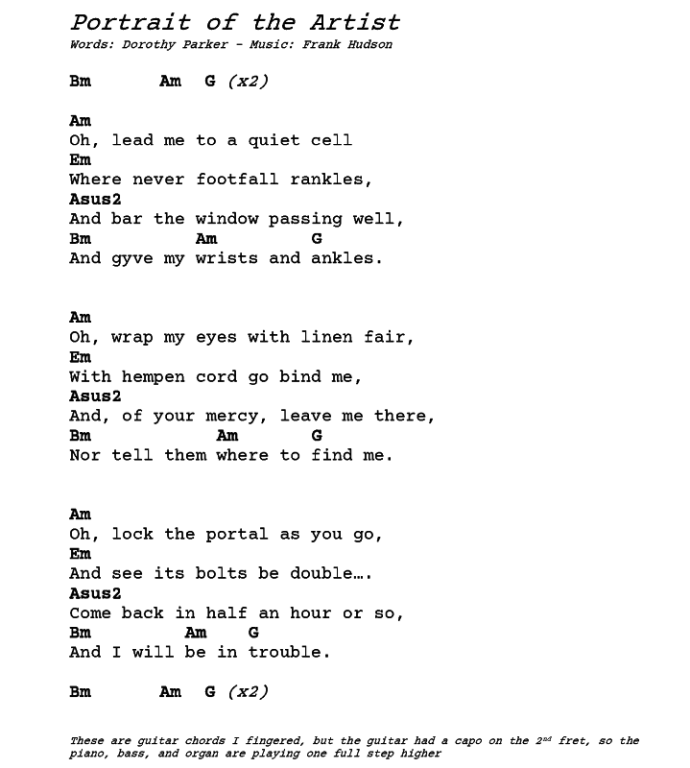
The song form I reformed Yeats’ sonnet into. Note the chords shown are what I fretted on guitar, but I used a capo on fret 3, so the piano, bass, and the song song sound in Eb.

.

What do I think, as I chose to perform this, the poem conveys?

I like Yeats opening here, with its circular word-choice of “hooped,” for describing civilization’s shared beliefs. I’m unaware that this is any kind of established British Isles idiom, and the choice of this scene-setting word seems to invoke something like a key-ring or perhaps a wooden barrel or cask — and in the last image, that’s a construction that can fall apart. The opening statement continues to say civilization’s order is only an illusion, but the first three lines end by reminding us that such creations of the human mind are none-the-less great movers of reality and life. I’ll come back to that at the end today.

The second, four-line, group is remarkable in its ferocity, and I think it’s a description of mankind’s often perverse desire to gather more power, more wealth, and perhaps something they vaingloriously ascribe as rough justice while doing so. The ending line of this section serves as my first refrain: “The desolation of reality” that results from this.

Third segment, as I read it, brings in a distinct element of Yeats’ occult beliefs, starting by reminding us that the “desolation of reality” is a repeating motif of history and the fall of empires. But what’s with the two mountains introduced? Everest is Earth’s highest mountain, but it’s remoteness and location in Tibet links it with a late 19th century form of occultism: Theosophy. Theosophy is too large a subject to go into here,*** but its founder posited that certain Ascended Masters located in Tibet held onto ancient secret wisdom becoming super-human in the process. Mount Meru is more obscure to most readers I suspect: it’s a symbolic mountain, and like other symbols such as Mount Ararat, the Garden of Eden, or the entrance to the underworld, it is not an actual fixed map point, but is often referred to as being in some part of the Himalayan region. Some read the poem’s plural hermits as two hermits, one-per-mountain, and Theosophy holds to two current Ascended Masters.

I suspect these Theosophical details were in Yeats’ mind as he wrote his poem, but I don’t know if he ever wrote about the genesis of this sonnet. And luckily for most readers (and listeners today) you don’t need to know any of that. After a description of desolation of nations, I think the image of two or more hermits, ascetics living naked in snow and ice shelters in famously remote places stands as an image of the other-worldly mystic surviving with nothing but belief and the knowledge that the world’s disasters are part of some reoccurring process driven by human greed for power and wealth. Is this removed survival our fall-back in today’s world of raging authoritarians, blinded in their ravening?

And once more, I suspect the aged Yeats was thinking of his own age, of the rising of fascist authoritarians then, not just specifics of Theosophy — as a poet, one uses the images in one’s cupboard. This aged singer certainly thinks of those men and the desolation they cause as I sing Yeats poem this month. The poem ends — and I refrain on this — with a twist on the old saw: “it’s always darkest before the dawn.” Chillingly, naked in the snow, Yeats has as his dawn consolations that all tyrants (and alas, all mankind’s) glory and monuments are gone.****

Is this fate? Is this prophecy? Is this inevitable? I’m no Ascended Master — if you are, you tell me. I’m just a composer drafted by words and asked to sing them. But I promised I’d come back to the “manifold illusion” of peace, of some sustainable rule without unleashed tyranny. “Man’s life is thought” the poem said. A diverted American poet turned President once spoke of a conception, a particular manifold illusion, imagined on: “Liberty, and dedicated to the proposition that all men are created equal.” If enough believe, the mage’s trick works. I’d rather it be a kind trick.

You can hear my musical performance of Yeats’ “Meru”  with the audio player gadget below. Has the audio player become subject to the desolation of reality? No, just some ways of reading this blog suppress it. This highlighted link will conjure up a new tab with it’s own audio player so you can hear it.

.

*I’m not a Yeats scholar, and there are surely many who know more about the man and these political matters. While disappointing, I was not surprised to see he found some connections in fascistic groups, as trappings of cultural nationalism and nostalgia for some mythic past were widespread then, just as they remain in the fascistic nationalists now crowding under the aged wings of my country’s self-fancied mad king.

**Because of the later date of publication, this poem may not be in the Public Domain in the US, and this entirely non-commercial project almost always uses work in that class out of respect for author’s rights. I’m making an exception here out of a renewed commitment to civic poetry in the current world.

***Here’s more info on Theosophy if you want to wade in deeper. Having had some interest in esoteric beliefs as a young person, I carried some knowledge of it as I encountered this poem. As the Wiki article points out, Theosophy continues to influence various “New Age” ideas, but I’m not a believer.

****Some readers of the poem hold the “His” in the last line to be a godhead. I’m not sure why that would be. Could it be the then traditional capitol letter at the beginning of the poetic line leads to that reading? Or is it some element of Theosophical mythology? There’s another, non-cap, “his” in the poem, and I read that pronoun, along with its partner, to refer to elements of mankind.

I Pity the Poor Immigrant

It occurred to me: should I try to sing a version of Bob Dylan’s “I Pity the Poor Immigrant?”  Afterall, I, without a plan, seem to be performing songs from Dylan’s 1967 LP John Wesley Harding  recently, and that song is one of the more noted ones from the album. And immigrants, and immigration, are currently a preoccupation of my country’s inept and callous administration.

Dylan might have been writing of his own family’s immigrant history in this song — being second-generation from his grandparents emigration from the Russian Empire and Turkey. Furthermore, he grew up in the iron-ore mining area of Minnesota, a place full of folks with wide-ranging immigrant backgrounds. Given Dylan’s, and folk-song’s in general concern for the underdog, one might expect this to be a song of empathy for these close-in immigrants.

Yet when Dylan sang his song in 1967, still a young man,* there’s a duality in its presentation. The immigrants within it are portrayed then as poor not only in wealth, but also in spirit. For all of Dylan’s genius, the voice that sings this song largely speaks about how the immigrants, who’d be the elders of his town and family, are stunted in their outlook. Dylan may be a genius, but this could be the disappointed vision of a young person who sees the faults and failures there. That’s what many young people, even those who aren’t geniuses, do, and it’s an important task.

His singing on this 1967 version is calm, not accusatory — at moments even sounding concerned as he decries the immigrants fallen state. If the harmonicas play the skeleton keys to the song’s interior, the passionate timbre of his playing on that instrument in the song may well be saying he feels sorrowful about the situation. The performance doesn’t lay any blame on poverty, exploitation, or the hard road of feeling the need to leave one’s homeland to find succor with strangers. Dylan, whatever he’s expressing here, likely knows these factors. Perhaps he assumes we do too.

I think Dylan’s aim was to confound the expected here — to write a great song instead of a good one, some mere piece of civic songcraft.

I’m not a young man, and I would have to go back to relatives I never knew, and who therefore can’t be blamed for imperfect mentorship or spiritual poverty. And I know from my life, and in my time, what immigrants contribute to my country. Some of course are noticeable success stories, but I think too of the many who do the hardest and least-rewarded work of the nation. I’m hesitant to pick a bone with the quality of their spiritual insight while they are trudging through unglamourous work — but even more so in 2025 when they also get slammed by disreputable politicians as criminals, scofflaws, swindlers, and parasites. I’m sure there are some immigrants who are those things, but I’m also quite sure that those slathering on those broad charges include in themselves a good measure of those failings — and are so eagerly pointing at immigrants to divert focus on that.

So, this is how I came to create this new performance of Dylan’s song, one for our time and situation. I changed only a few words, but by phrasing and refocusing my aim from Dylan’s original performance, I tried to illuminate those opposing scapegoating forces to the immigrant’s lot.** I may not even have made a (downgraded) good song of it, but I got some things off my chest I felt I had to say.

I can’t identify all the sources for the pictures used here. Alas, my stock photo library was bereft of any suitable pictures.

.

.

*When he wrote this, Dylan had only young children, ones not yet able to judge him and his generation’s failings. Has an older Dylan, now a grandfather, revisited this song? AFAIK, no. Expert Dylanologists may have more info, but Wikipedia says it was last performed during the latter legs of the Rolling Thunder tour many decades ago, and then as a bizarre rollicking up-tempo jaunt.

As I said recently when a reader/listener pointed out that I may have completely misread Blake’s “Holy Thursday,” my theories about what was behind Dylan’s creation of this song are in no way meant to be definitive. They are just what I hear in it, and feel free to think my new recasting of the song is a sacrilege. I’ll plead that one part of Dylan’s genius is that he sees fit to approach his own work in highly different ways, and I’m just doing what I learned from the master. You should feel something to sing a song, and this is what I felt. Feel different? Sing the song yourself.

**Even fewer words in my plan than you’ll hear in the video, as some other different words slipped in by accident while singing. Here’s a link to the original lyric. Changing the song’s concluding couplet is the only indictable premeditated felony, and the video underlines my approach to make the sins that Dylan’s 1967 performance directed at only the immigrants as more of a dialectic. An accidental, unintended, change that I regret in this version: “Shatter like a  glass” is inferior to the original “Shatter like the  glass,” and looses the possible intra-album connection with the glass that has fingers pressed up against it in “I Dreamed I Saw St. Augustine.”

Blake’s Other Holy Thursday, from Songs of Experience

Unlike its Songs of Innocence partner, William Blake’s other “Holy Thursday”  poem has no plausible ambiguity in its view of childhood poverty. One reader wrote to remind me that the Songs of Innocence “Holy Thursday”  poem shows a peaceful, happy scene that I misread. They could be right! Allen Ginsberg famously thought Blake appeared to him and instructed the later poet by reading “Ah, Sunflower”  to him, but what instructs me to see undercurrents in the first Holy Thursday poem is reading more about what we believe we know about Blake’s beliefs. Reader Alan also reminds us the two poems’ connections should be examined — and that’s what I’ll do today, along with sharing a performance of Blake’s second song about Ascension Day.

Both Holy Thursday plates

As Blake illuminated and printed these two poems. One of the things I always admired about him: he was a self-contained, DIY, artist who learned what he needed to do to manifest his art.

.

Let’s jump to the second poem, the one from Songs of Experience.*   Childhood poverty is an undercurrent in the first — would Blake even expect his readers to know that the children in the first poem are charity cases (many modern readers do not) — but poverty is foreground in the second. Blake takes on the mode of a Biblical prophet in this second poem and charges against the civic and/or religious state pour down from the start of it. Holy Thursday happens in springtime, but it’s “eternal winter” here. Its final stanza is preaching that this is not the natural order, and that in a polity of mankind’s natural state, the Earth’s fecundity would provide food for all.

I’m not sure we invariably think of Blake, for whom a spiritual element is clearly present, as a writer of civic poetry, as a political creature — yet modern scholars have subsequently delved into that element of the poet. Ginsberg, a civic poet of my youth, recognized a fellow civic poet in the prophetic Blake, and to deal with that is not to deny the spiritual element. I myself am no more a fine scholar than I’m a fine musician. In both professions, I’m simply and old man who does what he can in those fields haphazardly because he cannot wait longer at this point in my life to perfect those arts.

How do I currently think the two “Holy Thursday”  poems connect? I don’t want to put words into Alan’s mouth, he’s likely sharper than I can draw him, but he or others may believe that first poem is happy, innocent children in safe, supportive clerical care, uttering praise to their religious saviors/supervisors and that institution’s godhead and nation. And the second poem? Perhaps either a progression or another facet degraded from that? I’d say there’s no reason not to think that the two poems are happening at the same time in the same Britain — so, the two situations simultaneously comment on each other. The wards in the first poem may live better than the utter misery of the poor in the second, but they are part of the same civic system, the same “land of poverty.”  The thunder within the ward’s song that ascends briefly to heaven in the first, is the fecund rain that feeds all in the yet to be manifested world of the second. I’d summarize that Blake thinks that poverty and its partial charitable mitigations aren’t in opposition, but rather that poverty is a civic construction like the imperfect charity schools were. What Blake sees as opposition (in both poems) would be some Rosseauian natural state as the proper order of society. Yes! I realize that’s idealistic, that’s there’s no actual political party or plan ready to implement such an Eden. You can call it a fantasy. You’ll have good arguments to do so.

In my country, in my time, we’re at one of those political moments where forces in power wish to remind us that the poor are a disreputable burden, feeding off the productive citizens, wasting our resources of freedom and pleasure. You can call that a fantasy too. You’ll have good arguments to do so. But unlike the former view, this one’s on offer, even in the process of being implemented.

I’ve “progressed” from acoustic guitar to electric guitar in today’s “Holy Thursday,”  along with piano and percussion. You can hear it with the audio player below, or if that player is obscured in a field of thorns, you can get a rain check with this alternative highlighted link that will open a new tab with its own audio player.

.

*Text linked here in case the picture of Blake’s original illuminated plate is too hard to make out.

Holy Thursday (from Blake’s Songs of Innocence)

My parents had a small library, which was on a set of bookshelves in their bedroom in the house I grew up in in a little Iowa town. I’m not sure which books came from which parent, or even if some of them were passed down from their seniors, for I recall a couple of books on 19th century figures: William McKinley and Frances Willard. I think my mother’s people were Republicans, and both sides were teetotalers as far as I know. Some of the books were college textbooks. There were books relating to the Protestant ministry, which my father aimed to practice as his father had, and others connected to journalism and high school teaching, which was my mother’s line of work before marriage. I loved looking through them while laying on the chenille bedspread of their double bed.

I bring this up today because I believe I first encountered William Blake in one of those books of theirs. It wasn’t a poem of his, but rather a small note in the back of the volume dealing with other minor figures. The note reported that Blake wrote some quite fine short lyrics before descending into longer mystical tracts that might be seen as evidence of madness.

Having already gone through a short but intense Edgar Allen Poe phase when my teenage-self read that, my interest was piqued. A year or so later I learned that The Doors, a rock band headed by someone who was said to be a poet, had used a line from a Blake poem in one of their songs. Now I really was intrigued.

And yet it was maybe another year before I found and bought a small paperback containing selections from Blake’s writing. My initial reaction? The longer prophetic books puzzled me, many (but not all) of the shorter poems could come across as twee little nursery rhymes, but some of his poems that fell between those two became favorites, particularly his satiric and scathing “Proverbs of Hell.”   No teenager ever since deciphering metal-band lyrics or any rapper’s flow was more happy than I was to read that rebellious page poem.

Those short lyrics? I liked more of the poems Blake printed in Songs of Experience  than those in his companion volume Songs of Innocence.  Simplicity can be harder to value, and Songs of Innocence  is a case in point. Today’s piece is one of a pair of poems in Blake’s non-identical twin volumes using the title “Holy Thursday.”   Here’s a link to the text of this one.

First off, what’s Holy Thursday, at least as it relates to Blake’s poem? I didn’t know as a kid, and I didn’t know as an adult either until this year, so late in my life. I thought it was the Thursday before Good Friday, the date commemorating the Last Supper of Jesus and his disciples before his arrest, trial, and execution. And as far as some Christian denominations go, that would be correct — but not so fast! Holy Thursday is also another date,* one at the very end of the Lenten calendar: the date commemorating the resurrected Jesus ascending into heaven after being seen on earth for 40 days by the disciples. That one falls on May 29th this year — or on the following Sunday, just to make things even more confusing.

We know that Blake is referring to the later Holy Thursday because the poem of his that I perform today is reportage on an annual British Holy Thursday (Ascension Day Edition) event: a marching of a batch of orphans from charity institutions up to London’s St. Paul’s Cathedral for a special mass where they sang hymns they’d been taught.

A few years ago the Tate Museum had a big Blake celebration and had one of Blakes most famous paintings projected onto the dome of St. Paul’s Cathedral. I wonder what Anglican dissenter Blake would have thought of that? (photo by Alex Wojcik for the Tate)

.

Blake’s tone is ambiguous in his account. One could read this poem and assume this is an act of charity being celebrated — but in the context of Blake’s beliefs one could see otherwise, as he was an ardent dissenter from the state-sanctioned Church of England. Elsewhere in Songs of Innocence,  the children are free (at least at times) in some Edenic state — but these Holy Thursday children are regimented into ranks by schoolmasters (beadles) caring disciplinary canes. The song they sing is given to them by those that control their lives. What happens when they sing the song they are directed to sing? Heaven, the seat of the godhead that Jesus has risen to merge with, harmonizes in thunder that descends on the “wise guardians of the poor**” seated below the heaven and the children in this rich and mighty cathedral. In summary, I think Blake is pointing out the self-satisfied “virtue signaling” in this pomp and ceremony.

Perhaps I should have tried to create a choir or used a pipe organ for this one, but simple music today, which you can hear with the audio player gadget below. Has your audio player ascended into the Internet to sit as the right side of Jeff Bezos or Elon Musk? No, it’s just that some ways of reading this blog suppress showing it.  This highlighted link will launch a new tab trailing heavenly glory — or at least its own audio player to carry forth my acoustic guitar and voice of subjective quality.

.

*The Last Supper Thursday is also called Maundy Thursday — the other, Ascension Thursday or Day. Separate names would of course make things clearer. I grew up a Methodist, and they bungled the fix: they use all three (or is it four?) names.

**I sing this phrase as a question, which I divine is Blake’s intent.

Dirge Without Music

I’ve worried a bit lately that I’ve been doing too many Parlando pieces presenting sad poems. It’s likely that mood is part of my nature despite living a life I’m grateful for — perhaps even more so because I live a life I’m grateful for, and I’m therefore aware of its temporary nature that I cannot keep. Because of this, I’ve kept a quote, a suggestion, from Kurt Vonnegut close to me:

I urge you to please notice when you are happy, and exclaim or murmur or think at some point, ‘If this isn’t nice, I don’t know what is.’”

Vonnegut wrote this in one of his last books, one that might again speak to my mood in this state of my nation and its ideals, A Man Without a Country.

At my age, it’s no longer morbid to think about death. This past weekend my wife and I went on a goth date, and visited one of the fancier local cemeteries. We mostly went for the 1910 main chapel building full of early 20th century William Morris/Pre-Raphaelite derivations which echo back to the start of the era I mine for a lot of the poetry here.*  The cemetery was taking part in a special open-house event held around the Twin Cities offering more access for the public to “behind the scenes” parts of the facilities.

We walked by famous early citizen’s gravesites, some elaborate with statues and such, and then too the many small vaults with names and dates on their file-cabinet sized faces. One room’s space was maximized with rows floor to ceiling across the room — so much like a library, even up to having a rolling metal staircase that would facilitate viewing the topmost. Instead of spines one views in those tall rows names, and partner’s names, and those bookend years. Every one of them, like every book I suppose, expects that there’s someone left to see and remember them, and I paused to consider that that wasn’t always so.

In another part of our tour, another portion of my nature was stoked. Walking by the cemetery’s crematorium, I noticed this homely implement hanging on the wall. As the old prayer book has it: ashes to ashes, dust to dust — and that passage now had a corollary: and dust to pan.

Dome and Dust Pan

Part of the main chapel: tiled mosaics, stained class, intricate motifs, capitol mottos. Crematorium: clean, professional, and an inexpensive hanging broom and plain white plastic dustpan, the same model as hangs in our home pantry.

.

Oh, it was a beautiful Spring day, full of decoration, full of evidence of grief, inscriptions of loss — and to the puritan, evidence of vanity. Life is so big, or so small, we must laugh at it.

Which brings us to today’s poem I’ve performed with music: Edna St. Vincent Millay’s “Dirge Without Music.”   I had finished this piece earlier this Spring, but at first held it back because I feared it was too much like some other musical pieces I was working on — and then after those coincident issues expired, I started to worry that it was too much-more sadness. Revisiting it this week, I now think no, it’s not just bleak — it’s a bald-faced statement of honest feelings about death and loss. Here’s a link to the full text of the poem.

In writing music and preforming this poem, am I disrespecting the author who titled her poem “…Without Music?”   I think Millay’s intent here was to speak against sentimentally decorating loss. Loss has patterns, resolutions, codas, and rests — and music too, even if it has repeat marks, has an ending measure — but music’s part of the equivalence is so often beautiful. In such ways fine poetic word-music, as well as that with express melodies, may speak over loss, interrupt it. Perhaps my rough-hewn voice with its limits and plainness, its lack of precise or elaborate lyricism, is apt for Millay’s mood here?

You can hear that musical performance of Millay’s poem with the audio player below. What if you see no player? That’s likely because some ways of reading this blog suppress showing it, but this alternative highlighted link will open a new tab with its own audio player.

.

*A few years back here I did a series on “before they were Modernists” with early poems by some Modernist figures. More than a few had roots in those retro-hipster movements of the late 19th century, and many a free-versifier had carried around a Swinburne volume in their youth.

I Dreamed I Saw St. Augustine, with connections

I’m not one to closely follow religious matters, though many poets over the ages have — the history and the weight of all that combined belief and its inconsistent practice is considerable. I did have an interval as a youthful churchman of the Protestant kind, attracted by the community bonds and social activism of the Martin Luther King era,*  but it was recent reading of those fresh drafts of history that we call the news that brought the selection of a new Catholic Pope to my attention. For a moment my country was caught up in ancient offices as a break from the depravity of our domestic head of state.

So, first the death of the serving Pope, then the mourning, then the secret conclave in its smoke-emitting room, then the new Pope and the follow-up consideration of his background and concerns — extended this time by his North American origins. My BlueSky feed of wits supplied me with humorous predictions based on Bob/now Leo’s Chicago origins, but the pedant in me snorted most heartily when I read this news service summary of Leo’s biography explaining that he was a member of the Augustinian Order, monks with a call to service and piety. The wire-service, no doubt constrained by the spread-so-thin-the-bread-tears nature of modern journalism, informed its readers that the Augustinians were founded in the 13th century by Saint Augustine.

I have no idea what the titrated level of history buffery is within my treasured readership, but they were off by near a millennium — St. Augustine being a 4th century North African early church father! The medieval founders of this order of monks were looking back to late Western Roman empire times for a guiding light.

The Parlando results of my guffaws? I thought of a song that abides with me that I found on one of the first three record albums I bought as 1967 turned into 1968: “I Dreamed I Saw St. Augustine”  from Bob Dylan’s slightly undervalued LP John Wesley Harding.**   Dylan was on the face of it no more accurate than our news-service scribe. His apparition of St. Augustine is a troubled man, as many spiritual people are, and he briefly charges us with his preaching in the song, but Dylan’s Augustine is also specifically a martyr who was put to death, presumably by the authorities. Unlike many saints, Augustine of Hippo was not a martyr. While Augustine’s town was under siege by Vandals (the original ones, doing business as that tribal name not as members of DOGE)***  he died an old man from natural causes.

Dylan’s song is brief, brevity being an unusual virtue Dylan exercised in all but one song on John Wesley Harding.   And yet he was bringing history into the three verses, no choruses, no bridge song structure of his song. Within his seeming historical inaccuracy was his choice of a borrowed tune. “I Dreamed I Saw St. Augustine”  uses the melody and the structure of a 1930s song setting by Earl Robinson of a 1920s poem by Alfred Hayes**** about a man put out to death in 1915: “I Dreamed I Saw Joe Hill Last Night.”   I believe Dylan clearly meant to link the two men, in the way that dreams can combine things we never see in waking hours.

This song, and Dylan’s performance of it, has always touched me — and so having the coincidence of Augustinians being in the news, and the hopes that the new Pope may preach to our current overly-gifted Kings and Queens, I went to record myself singing this song of a remarkable comparing. Since it’s a copyrighted work, I present that performance today as a YouTube video. The few-hundred views one of my videos might gather would not make even a widows mite, but it’s my understanding that any revenue gathered from those annoying YouTube ads can be claimed by the rights holders. For my video I mingle artists representations of Augustine and Hill. If you can’t tell, the photos are Joe Hill and a news photo of a memorial march for him in 1915. Our 4th century Augustine was camera-shy, and has to be represented by artists’ paintings.

.

*My youth included a couple years working at a hospital still being actively managed by an order of nuns in those days.

**In search of more footnotable connections: was it coincidence that the then considered inscrutable cover of the LP has two Bengali Baals, singers in the tradition of the first songwriter to win the Nobel Prize, Rabindranath Tagore. Surely the Bob Dylan of 1967 didn’t know he’d eventually be the second. Another connection: Joe Hill was a songwriter who sang for union organizing meetings and “He who sings, prays twice” is a saying attributed to Saint Augustine.

***Augustine’s writings include thoughts on The City of God that may survive the fall of empires. Shortly after Augustine’s death, the Vandals sacked his city. Stories have it that these Vandals were impressed by Augustine’s learning, and spared the library he had established there. The current ones aren’t up to that level of civilization.

****Hayes had a long writing career. Wikipedia tells me he was an uncredited screenwriter for the famous Italian film The Bicycle Thief.   It also claims he wrote a script for The Twilight Zone, but IMDB doesn’t confirm that.