1913. 110 years ago. Two people met in England and called each other poets. One of them you might know: Robert Frost. He was almost 40 and hadn’t been making a calling as a poet in America. The other was a British man four years younger who wrote prose furiously as a freelancer for pay, “Burning my candle on three ends” as he described it. That freelancer was Edward Thomas. Some of the freelancer’s work was literary reviews, and unlike American editors and gatekeepers, Thomas admired Frost’s work. Within a year, Frosts first poetry collection, North of Boston, would be published in England and Thomas’ appreciation of Frost’s talent helped make it a success.
A little log-rolling for the work of a nascent poet who just happened to be a friend? Well, Frost’s slim volume included “Mending Wall,” “The Death of the Hired Man,” “The Wood Pile,” “Home Burial,” and “After Apple-Picking.” The evidence says that many readers know these poems over a century later without knowing the man. Friendship aside, Thomas recognized a poet worth consideration.
In looking at some of Thomas’ prose work-for-hire, Frost told Thomas that his close attention, particularly of the book of nature, was the stuff of poetry. Frost also thought Thomas already showed a grasp of musical cadence in his prose writing that was like Frost’s theory of poetic word-music. Neither man was one for high-flown language or trite metaphors — things that were present in much poetry being published then in English. Both men knew the complexity of human acts and emotions. And both men shared something else: they suffered from depression, suffered this in periods of greater or lesser depth.*
Thomas’ hard work as a freelancer was to support his wife and a young family who he loved — but that relationship, that feeling was not simple. He tried to keep some of his demons from his wife to spare her, and while I’m not knowledgeable of all the details, he had at least “emotional affairs” with others which his broadminded wife understood as helpful in keeping Edward Thomas’ spirits up.**
Edward and Helen Thomas. The iconography of a couple with one looking off to the side is inescapable.
.
Within a year of meeting Frost, taking Frost at his word, Thomas began writing poetry. He wrote it just as furiously as his reviews, criticism, or hack work. In his first six months as a new poet Thomas wrote 75 poems. Beyond that quantity, when reading his collected poems I’m struck by how fresh even his early work seems when I read it against most of his British contemporaries. Many of Thomas’ peers of this era knew how to score points technically, and which images and plots would elevate their verse to seem professionally poetic. Thomas (and Frost) don’t seem to care as much for scoring well on the required figures and rules. Even the beginning Thomas’ word-music in English is attractive, his expression rarely seems hampered by a too-tight fitting prosody.
Today’s early piece, which he called simply “Song,” is an example. Here’s a link to the text if you’d like to read along. A short lyric that sings off the page should not seem difficult to do for its reader or listener — but in deed, it is hard to do. This paradox is a big part of pulling the trick off. Though printed in quatrains, “Song” is approximately Alexandrines. Rhyme connoisseurs make note that “June/tune” and “sigh/die” have triteness demerits, but the opening pair “beautiful/invincible” delights me. And I believe a somewhat too-common rhyme is forgivable if the matter of the poem is fresh enough.
Without being an expert on Thomas’ life, I’m going to assume this is a poem to his wife. Invincible happiness would build a wall in many relationships with a depressive, yet that difference is acknowledged in the poem, yet accepted. The “She laughs” “I sigh” refrained pairing reinforces this difference. The spoiler cuckoo is a bird known in folklore and folksong as a bird of inconstant love and cuckoldry. Yet the poem says that the couple love each other unto death, as they summarily did in life. In matter, this is one of those rarer love poems that speaks of long-term committed lovers fitting themselves together despite seeming incompatibilities.
The poem’s refraining nature makes it attractive for casting into song, and so that is what I did. I even increased that factor by repeating the 3rd stanza also between the 1st and 2nd verses. I also set my composer-self a limitation in writing the music: to try to effectively use only some of the simplest and most common chord colors in my chord sequence. All major chords, no minors. No suspended chords dropping the third. You can hear how it came out as I perform it as a piano trio with the audio player gadget below. No gadget? This link is an alternative that will open a new tab with an audio player.
.
*Again, I’m no expert on Thomas nor psychology, but the periods of high output and the periods of suicidal depression suggest bipolar.
**Not being overly knowledgeable on the marriage, I can see how some feminist analysis could have different insights and conclusions on this. All my scattered reading says this cluster of friendships was complicated, and that’s enough to give background into why this love poem isn’t one to file in the more common desire thwarted/satiated, muse, heartbreak, or betrayal folders. And yes, Frost’s marriage too had elements of a long-suffering spouse and family tragedy.
If you’ve noticed I’ve been gone for a while, I have as well. The last few weeks have had a lot of other things to attend to. Mostly happy things: travel, and work around the teenager’s graduation from high school. Still, I found myself picking up a book from my teetering “plan to read” pile that I thought would be mildly diverting: Donald Hall’s Old Poets. This book is a hybrid, like one of my favorite books from last year, Lesley Wheeler’s Poetry’s Possible Worlds.* Like Wheeler’s book, Hall’s book contains some memoir elements mixed with consideration of poets the writer knows, and from there the qualities and connections of poetry and poems with the poets. Hall’s memoir material covers the bildungsroman years, that life era of a few posts about my life I’ve done this spring, while Wheeler’s examines her relationship to her parents and poets well into midlife. The time settings of the two books are different: Wheeler more in this century, Hall centered around the last midcentury.
Here’s something I found striking in Hall’s accounts from his time and place. As an undergraduate he had access to not just his Harvard contemporaries** but to Robert Frost and T. S. Eliot. Since a good portion of Hall and my lives overlap, Hall being only about 20 years older, I found it strange to read that as a 20-year-old he had a series of informal interactions with these two while they were giants in a way that no poet today is. The effect was scarcely less shocking than some SF novel where the author dines and discusses poetic topics with Shakespeare, Milton, Keats, and Whitman. I suspect much of Hall’s access is due to Ivy League effects, whereas I think today’s poetry scene is more decentralized even while being more academic/MFA connected. If I was 20 in 1949, I would have been as likely to repeatedly meet the two great poets as I am to contact them by Ouija board today.
Hall’s book has 6 sections devoted to 7 poets, including ones on Frost and Eliot. Hall’s portrait of the older Frost is particularly vivid and special, while his stories of drinking with Dylan Thomas are less unique.*** Yet, within his Thomas chapter, Hall dives into why Dylan Thomas’s poetic stock fell off by the end of the century. Hall reveals that Thomas himself told him that he had only written about three good poems.**** The one Thomas poem we all think of, the villanelle whose refrain has become memeable, was not one of those three. Thomas and Hall agreed over potent-potables that “Do Not Go Gentle Into That Good Night” was only a skilled attempt to put on Yeats’ coat.
Now to get on to today’s new audio piece. Hall compares one of the poems Thomas thought was one of his best early works unfavorably to a poem by Thomas Hardy, and Hall’s Thomas chapter gives us that Hardy poem, “Transformations” in full.
If reading Hall’s book was to be a portable replacement for work on this Project, that Hardy poem was stunning enough to cause me to try to get something composed and performed in the spaces between other things this week. Hardy’s “Transformations” is an account of the experience of a non-spiritual approach to immortality — not to life after death, but life as a thing that only changes form, of which we as people are only incarnations. Here’s a link to the text of this poem.
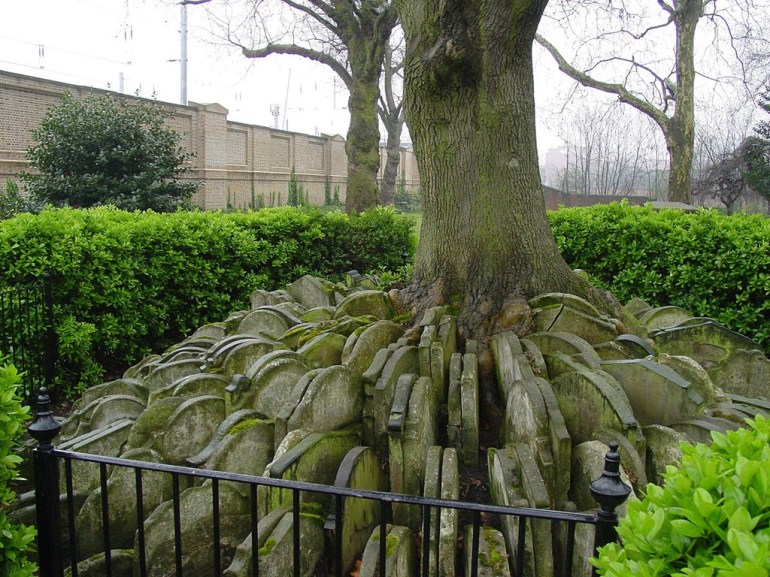
Hardy himself worked out this method of consolidating a graveyard’s worth of tombstones, and it makes a striking illustration for his poem.
.
Hardy, an Englishman born of the middle of the 19th century drops in but one or two anachronistic words in this poem — but while “grandsire” doesn’t sound natural on a 21st century American’s lips, the gist of this metrical and rhymed poem is easily singable in 2023 I thought. Down went Hall’s book and up went the efficient composer! I whipped up the music quickly. Long time listeners here will know that my music is usually not harmonically complex, but my simple cadences often try to confound the usual chords and progression resolutions. I hope I’ve done that with this one. The time to record the piece was scant, so I went with my go-to “I may have to hop a freight train shortly” folk music standby, the acoustic guitar and overdubbed a quick bass guitar part. You can hear it with an audio player below — or if you can’t see that graphical device, with this backup link that will open a new tab with its own audio player.
.
*Few click hyperlinks, so let me put this in a footnote. Wheeler’s book has these additional reasons to read it beside just being good: its story and poetry is contemporary, and as a writer and a woman Wheeler focuses on elements of our lifetime journeys that other poetic memoirs gloss over. Here’s those hyperlinks: Wheeler’s book. Hall’s book.
**Hall’s Harvard classmates circa 1951 included Frank O’Hara, Robert Bly, Adrienne Rich, Kenneth Koch, John Ashbery, and others. Eliot — and to a trivial extent, Frost — were Harvard alums. My personality, alas, is not socially skilled, but even at my most sociable, my circle of working-class Lake Street poets and state college teachers in my 20s is not as name-dropingly famous.
***It’s possible that everyone even vaguely literary in sundry metropolitan areas around this time had drinking with Dylan Thomas stories, even if Hall’s analysis of Thomas’ poetry is individually savvy.
****In his Eliot chapter Hall says that Eliot said more than once to him that no poet knows if their work is any good. When Eliot said this in an interview Hall did with him that was destined for print in a literary magazine, that statement was cut because it seemed too down-beat.
It’s been said of poets that they go out into a perfectly good morning only to think of glum existential thoughts. When I read something like that and look at the pieces this Project does, reflection is called forth. That certainly calls out a lot of subject matter I deal with here.
There’s a rebuttal, songwriter Townes Van Zandt said “There’s only two kinds of music: the blues and zippety doo-dah.” Poetry of course is music’s sister muse, but despite Steve Earle’s cowboy boots,* Van Zandt isn’t likely to be recognized as the world’s best songwriter. A dialectic of “blues and zippety doo-dah” risks falsely reducing Blues to a synonym for “sad songs.” One reason that Van Zandt, who was an excellent songwriter, won’t get the World’s Best award is that his songs vary between sad, sadder, and saddest. Doesn’t make them less perfect for what they are, just makes them suitable for certain moods while other songwriters might portray a range of outlooks and characters. I like Townes Van Zandt, I think “Flyin’ Shoes” is as near a perfect song as ever written, but a playlist of 20 to 30 Van Zandt songs would not carry my attention as well as a similar-length selection of Bob Dylan, B. B. King, Joni Mitchell, or Mose Allison.
An Emily Dickinson playlist would be equally as varied as anyone in that latter quartet. There’s the goth-girl Dickinson, the satirist of religion Dickinson, the legalistic philosopher, the altered-states psychedelic Dickinson, the secret bisexual passion Dickinson, and then there’s the Dickinson I’ll perform today: the botany nerd Dickinson. Part of what makes Dickinson such a fascinating writer is that all those personas talk to each other, seem to know each other.
I’ll not go into thousand-words territory on today’s Dickinson piece — I’ve been too long-winded lately for that. I’m going to treat her poem as a simple delight in the oddities of fungi. I have every reason to estimate that that was Dickinson’s intent, and we can enjoy that intent’s achievement. Here’s a link to the full text of the poem if you’d like to read it. To briefly brag about my restraint, there’s a possible deeper, subconscious, reading of the sporocarp fruiting body — but let’s be done with that. All the other Dickinsons may have been there when this poem was written, but we can simply enjoy one of them today.
Apostate mushroom, pleased grass, surreptitious summer. Emily Dickinson not pictured.
*A famous quote by fellow Texas songwriter Steve Earle was plastered on a Van Zandt album cover: “Townes Van Zandt is the best songwriter in the whole world, and I’ll stand on Bob Dylan’s coffee table in my cowboy boots and say that.” Wikipedia reports Van Zandt had a comeback when asked about that blurb too.
While visiting western North Carolina this month I toured two houses built in the 19th century, each high on hilltops overlooking the mountains surrounding them. My mind likes to link things, I couldn’t help but look at them as a pair.
The first house was named Connemara by an owner that lived there in between the man who had it built and the man whose shade I’d come to visit. The man who had it built was Christopher Memminger who had enslaved workers to build it. Memminger eventually became the Confederacy’s Secretary of the Treasury, so he must have known something about money and the slavery that helped accumulate it.* The later owner was a poet and writer who somehow found his own words remunerative enough to afford it, Carl Sandburg. Sandburg was said to have found the place a bit baronial for a socialist poet, at least on first sight — but his beloved wife wanted temperate pastureland for her dairy goat herd, and this place had that. She’d helped and stood by Carl through his unlikely rise from hoboing between short-lived work, to being an aide to a mayor of Milwaukee, to daily journalism in Chicago, to becoming a prize-winning poet and multi-volume biographer of Lincoln.
The second house is Biltmore, built for George Vanderbilt II. If you know your Gilded Age, the Vanderbilts were likely the first great fortune family of enormous wealth in 19th century America. Brief accounts I’ve read of him don’t make him sound like someone all that interested in business or growing wealth. He was bookish, a bit shy — but also very rich and looking to use that wealth to put his mark on things, to enclose his life in the best as he saw it. If one wonders at the two socialist second-generation immigrants living in the large farmhouse of Connemara, Vanderbilt’s house makes that place look like an outbuilding. Biltmore’s not just bigger, it’s thought to be the biggest residence ever built in the United States, with around 4 acres of floor space beneath huge high-vaulted common rooms. The estate surrounding it was over 100,000 acres, and Vanderbilt had it landscaped by Frederick Law Olmsted, the man who had worked on a much smaller canvas with the 800 acres of New York City’s Central Park.
The mix of manicured and wild seeming landscape is beautiful in the Olmsted manner. We biked along a trail through 8 miles of it, past lagoons and along the banks of the French Broad river —and as we rolled over a wood-rimed rise down past a pasture I was delighted to see three hawks at tree-top level swooping over us, so low that the shadows of one passed over me rolling beneath them.
The two houses have similarities, if not in scale. Both Carl and George were packrats, though at the wealth level of a Vanderbilt, it’s called being an art collector. The Sandburg house was donated to the US government just after Carl’s death. His wife and two live-in adult children packed up as if going on vacation and left the house for residence in Asheville. The Park Service has maintained it ever since in Marie Celeste ghost-ship-shape. One of Carl’s cigar butts sits in an ashtray on the set-for-a-meal dinner table. Piles of books and magazines cover many surfaces as if they were just set down this week. Sandburg has thousands of books in bookcases everywhere around the house, and there are busts of Carl and his long-term subject Lincoln, art photographs by his wife’s brother Edward Steichen, and scattered knickknacks. Vanderbilt had even more thousands of books, all stored in a large floor-to-two-story-high ceiling library room, all arranged with leather and gilt bindings a-plenty. Life-size John Singer Sargent portraits abound and above giant elaborately surrounded fireplaces. Hallways are hung their entire length with framed etchings. Large Flemish tapestries showing Biblical virtues completely cover walls of a big room. Servants kept it all clean and ordered then, and that’s how it’s displayed now.
Vanderbilt Biltmore Library and a Sandburg bookshelf. Some Sandburg clutter.
.
The mood of the two places, as I sensed it, was very different however. Biltmore seemed dark, and though some of that was likely due to preservation of valued pieces from bright lights, both my wife and I had simultaneous Citizen Kane thoughts by the large tables and giant fireplaces. She nudged me and asked if I’d like to put together a jigsaw puzzle. In contrast, the Sandburg house seemed domestic in a familiar way to me. The metal handles on the hand-touch-patinaed Sandburg kitchen cabinets — chrome ones fluted like a Pontiac’s hood — were the same that were in my childhood’s kitchen. The clutter there, like my clutter.
The Sandburg house kitchen
.
In the lengthy tour of the Vanderbilt house, the highlight was when we detoured outside onto a long stone veranda with splendid views of the Blue Ridge Mountains. We sat on deck chairs, as we might sit on our own home’s rickety screen-porch, and gazed not at a multicultural Midwestern neighborhood, but on the far hazy peaks as swallows darted to and fro just over the railing as they likely did when the Cherokee could not dream of steamboat millionaires or multi-volume biographies.
There’s a wicker chair out on a large flat granite rock, yards from the Sandburg house. It too offers a view of the tree-covered mountains, but with no roof over one’s head or seats for others. Carl Sandburg would go to that chair and sit to write first drafts. That unkempt shock of white hair of his would blow like leaves in the breeze, and the sun would remind him how blank the new page was.
Sandburg lived at his hilltop house bought with the proceeds from his own literary labors for two decades. Though George Vanderbilt was rich the day he was born, he had only about the same number of years to enjoy the extraordinary elaborate one he had built to his desires. Some of us still read Sandburg’s work in our homes — only tourists will now see Vanderbilt’s commissioned magnum opus.
I told you I like to connect things — and these two houses around Asheville are a natural pair — but I also look for the more tenuous connections. Last time I said that Sandburg’s most lasting influence, obscured by time and the others influenced by him, was being an original “roots” or “Americana” popularizer, the man with poems, a guitar, and songs from all corners and sub-cultures of America. What is perhaps the greatest lasting fruit of the extended Vanderbilt family tree? Not steamboats. Not gilded age mansions. Not art collections. Maybe not even philanthropic donations to long-lasting institutions. In 1910, Emily Vanderbilt Sloane, descended matrilineally from the Vanderbilts, gave birth to John H. Hammond. There’s no room to tell you all John Hammond gave us, so here his Wikipedia entry is linked. Why would you want to click that link? Here are names you’ll see linked to John Hammond there: Bob Dylan, Bruce Springsteen, Benny Goodman, Robert Johnson, Harry James, Charlie Christian, Billie Holiday, Count Basie, Teddy Wilson, Big Joe Turner, Pete Seeger, Babatunde Olatunji, Aretha Franklin, George Benson, Freddie Green, Leonard Cohen, Arthur Russell, Jim Copp, Asha Puthli, Stevie Ray Vaughan, Mike Bloomfield, and John H. Hammond’s own son John P. Hammond.
Today’s post is dedicated to my life partner of two decades today, Heidi. For a musical piece here’s one of Sandburg’s chief influences whose birthday also happens to fall today, Walt Whitman’s “I Hear America Singing.” In his song Whitman reminds us of our labors, and as the son of a house carpenter, he knew directly who built the houses. Graphical audio player below for some,backup link here if you don’t see it.
..
*Carl Sandburg, Lincoln biographer, was not a Confederate, and was a proud “Civil Rights” supporter. When the tour guide noted the incongruence of this, I put on my village explainer hat and told the tour group that poet Longfellow, he of patriot poems like “The Ride of Paul Revere,”lived in a house built by a Tory who fled the American Revolution.
I’m in Asheville North Carolina this weekend, and I visited the Carl Sandburg home national site not far from here. Longtime readers will know that Sandburg is a touchstone for me and this project, and so I thought it’d be worthwhile to put down a few observations and questions that have arisen from my visit in consideration of Sandburg.
I think Sandburg has suffered from succeeding in doing something we no longer expect poets to do. He achieved a certain level of fame during his lifetime — and that alone is problematic. If poetry has lost sufficient cultural interest, as some critics and some poets believe, then a poet too famous has presented a case that they aren’t really writing true poetry. It doesn’t help that Sandburg wasn’t known as a critic himself, and didn’t present an explicit theory of how poetry works. This led to an assumption that there’s no depth, originality, or vision in his work. From this perceived lack, his fame — and one might assume his influence — died off quickly with the celebrity poet character he became in his long lifetime.
Yet there’s one line of influence that I say is underappreciated, one that flows from his writings and public persona, a path of influence that mixed with others who had complementary urges. That line of influence runs through Sandburg’s work with American folk music. He seems to have been working roughly contemporaneously with John Lomax and Charles Seeger* in popularizing folk music at a time early enough that one couldn’t yet term their actions a revival. And he was mixing these folk tunes collected from various subcultures in America’s regions and mixing them within a project that included outreach of high culture poetry and a lefty political slant from the presenter, as if it was all one thing. There was no natural reason these things were required to be combined, and so a successful poet and author combining them, as Sandburg did, helped set the format for the progress of the folk music revival from the WWI era through to the eventual “folk scare” of the Fifties which launched Bob Dylan and many others who would be called song poets.
Sandburg singing with his grandkids. Note the classical guitar position, a way of holding acoustic guitars I adopted too. Guitar and piano currently in the Sandburg home. I couldn’t get an angle to read the headstock. Anyone got knowledge or a guess what make and model is is?
.
Critical intermediaries in this half-century progression were Pete Seeger and Woody Guthrie, and I’m often struck by how similar their presentations were to Sandburg’s. If you mix Sandburg and Will Rogers** into a cloning machine you wouldn’t get an exact Woody Guthrie, but you’d likely get something like him. Guthrie familiarly called Sandburg’s pioneering 1927 folk song collection The American Songbag “Carl Songbird’s American Sandbag.” And like this project, Guthrie played and composed music to accompany Sandburg poems for public performance. Pete Seeger’s Chautauqua-ish concerts presented to and aligned with a Sandburgian “The People, Yes” outlook. Seeger’s breakout group The Weavers made much of this blurb given them by Sandburg “When I hear America Singing, I hear the Weavers.” Before that, when he was beginning, Pete claimed he got ahold of American Songbag when it came out. Again, like Woody, Pete was Pete. They added themselves.
I admire Langston Hughes, and while not single-handedly, he’s seminal in the development of Afro-American poetry. In reading his early work, some of which remains in the forefront of his legacy, I hear strong echoes of Sandburg’s word-music. Are they both hearing Walt Whitman in their ears? Likely, but the concision of many of Sandburg’s early poems is not Whitmanesque, and Hughes’ poetry likewise could be concise. Langston Hughes was too, himself, but a poet like Sandburg at least ran interference for his work.
Hughes was an early proponent of Jazz Poetry, yet Sandburg’s “Jazz Fantasia” was there to serve as an example when Hughes’ first poems were published. Later on, I was often hearing elements of Langston Hughes in Gil Scott Heron, and if we continue that line, perhaps there are reflected elements of Sandburg is some down-tempo, socially conscious rap.
One of the things a tour of Sandburg’s home offers is the ability to peak at his many bookshelves and scattered magazines. They show a man with wide interests in politics and human rights alongside poetry. Here’s one little something I didn’t expect to find, wedged in between The Roots of American Communism on its left and McCarthy: The Man, The Senator, The Ism on the right: a copy of a science fiction magazine. Did Sandburg read or at least casually follow mid-century SF? Has anyone even asked this question? Is there any way to answer it? Was this one issue or are there many in the house?
The magazine is right next to the McCarthy study. Hard to read the spine, but it may be this issue.
.
Here’s an oddity that I thought of while sitting in Asheville thinking also of the Black Mountain College that existed nearby. From 1945 when Sandburg moved to North Carolina until the college closed in 1957, it existed in the same part of the Blue Ridge mountains with Sandburg. In the 1950s it became the locus of a group of poets*** who eventually were called The Black Mountain Poets after the school. You might wonder (well, I did) did any of them seek out Sandburg, or did Sandburg make any note of them? So far, I can find not a trace of an answer to that question. Was Sandburg either too busy or too retired to mix with them? Was he considered too mainstream and successful to be of interest to insurgent “post modernists?” Many Black Mountain Poets admired and communicated with William Carlos Williams, Sandburg’s contemporary — but Sandburg too had championed a more American and less European-culture-centric style of free verse continued by the Black Mountain Poets. There’s a dog not barking there.
In the end, I suspect Sandburg might be comfortable with his diminished reputation in the 21st century — even if I’m not. Sandburg often spoke of the work of the people as being continuous, of that factor being part of the peoples’ power. In that way he might be satisfied. Things he helped build, put in motion, continue to move forward, change, and develop.
For an audio piece today, here’s a short poem by one of the foundational Black Mountain Poets Charles Olson titled “These Days.” I performed it acapella this morning, recording this very short piece on my phone in a less than quiet room I’m staying at. It speaks of something Olson and Sandburg might have agreed on. You can hear it with the audio player below, or if you don’t see that, with this backup link.
.
.
*Father of Pete, Mike, and Peggy Seeger. Husband of Ruth Crawford Seeger.
**Will Rogers arose in a very similar time-frame to Sandburg. The amateur guitar player/author/speaker Mark Twain had died just a few years previous. The clever yet folksy artist observing the entire range human behavior from a loving/skeptical non-East-coast/high-culture place was a needed character in American life, and while Sandburg isn’t a Twain clone, the role he played was somewhat successive.
***The list of other famous students and teachers of Black Mountain College included Buckminster Fuller, John Cage, Charles Olson, Walter Gropius, Joseph Albers, Robert Motherwell, Robert Rauschenberg, Merce Cunningham, John Cage, Paul Goodman, Franz Kline, Willem de Kooning, Robert Creeley and Robert Duncan.
I’m going to share a musical performance of an Emily Dickinson poem, but before I get to that, I’m going to continue my memoir-of-influences series on things that formed the idea of the Parlando Project earlier in my life. I’m going to try to keep it short, which will force some amputations, but I feel embarrassed spending much time on the small events of my single life. Those in a hurry, or only interested in the new audio piece and what I have to say about that, can skip down to the second section of this post.
At the end of the last post I had moved to Newburgh, a town on the Hudson river about 60 miles north of New York City. I don’t know if the town knew what to do with The Seventies, it seemed between eras; and in some larger sense I might not have known what to do either, but like the town I had a daily job to do, and kept doing it. Can we say that had some value?
I liked many of the people I worked and lived with during my five years there. I still think of some of them from time to time, and they were often kind to me. The folks who worked with me at St. Luke’s Hospital, particularly those in the Emergency Department, worked hard under significant limitations trying to do things that we could only address partway. I could say much of that under-addressed were systematic issues — and I’d be right — and the levers of those systems were outside our direct grasp. Another part of those limitations were closer to us, internal. I said I’d try to be brief. I said there would be amputations. Newburgh had a racism problem. The town, the region, was populated by stratums of immigrants, with the original European WASP colonials to Irish, Italian, and Puerto Rican waves following on. Mixed in there were Afro-Americans who were there, as they were everywhere in the United States. I don’t know the exact demographic details, and I said I’d try to keep this concise, but I’d guess the Black Americans were first in the region from servant and slavery times, and then there was some low-paid and otherwise undesirable work that still may have seemed better than some parts of America for Black folks. Few poor people ever emigrate for marginal gains from acceptable situations.
That work had shriveled over the years, and what jobs there were, those other immigrant waves got some of the employment from the white folks who did the hiring. Again, I’m no expert, I may have some of this wrong, but when I think of the Irish and Italian Americans who can recount the derogatory tropes employed against their ancestors,* I still suspect that even within the cruel othering they received, they sometimes got, in practice, hiring preferences over Afro-Americans.
This led to the town, in the time I was there, with an underclass of underemployed Black folks viewed by too many of the white population as shiftless, ungrateful and unenterprising wards of the state. Think I’m amputating too much to say this was a prominent white attitude? Ten years before I arrived there was a controversy that was called “The Battle of Newburgh.” I didn’t know much of this specific history in 1971, but the attitudes were still easy to hear and feel while I lived there. Here’s a link to a 30 minute podcast on the 1971 controversy. Wonder what happened later? Here’s an article that updates things to 2015.
Back in my Emergency Room, The Seventies, we were the place anyone came when things broke down. Folks needing medical care that couldn’t pay. Victims of violence. Stressed out or addicted people. Worn-out old workers and beneath the working-class people. I worked the 3-11 shift, the busiest one in the ER. We’d typically get 50-70 such situations every shift. What could we do for them, right now, in our imminent place? Patch’em up. Give them a preliminary diagnosis and maybe a shot or some pills. Hand off a referral card to a medical system already fragmenting and requiring insurance levels of payment from various payers. Witness their deaths.
So those folks I worked with, who did this, were they racists? I’m not saying that. I can’t see into the hearts of them — not then, and not with any level of magnification now. I know we were frustrated with the people in and around the treatment beds at times, thinking that what’s close and in front of us was the most significant thing in what was going on. No, no, we’d no doubt say, that thought wasn’t from the color of their skin, that was what they did, or were doing, or weren’t doing. From what some of my coworkers said talking among our tired selves, I could hear racism, hear pat rationalizations. I’d be hearing this from folks on a modest paycheck given the responsibility of a past that isn’t even the past as Faulkner put it. Our actions were mostly care — yes I saw kindness too, even when our philosophies and capacities could not fully appreciate the lives of our patients and their families. Perhaps it was good that we were too busy to think about that incongruity. Would our care have been better if we — speaking now of the whole group of us, including myself — were less ignorant and more broadly empathetic? That’s certain. But such wiser folks weren’t there then, we were. Imperfection trying to heal what could be treated directly.
A couple of years before this, a songwriter was 40 miles to the north of me, goofing off with his Canadian R&B band buddies in a big pink house. Sing heavenly muse, he sang these lines:
Remember when you’re out there
Tryin’ to heal the sick
That you must always
First forgive them.”
To this day, when someone, almost always a white person, concludes some confession to me with a variety of the phrase “You might think I’m a racist because I said that.” I reply “You said it, and you might well be to some degree. So, what are you going to do about that, and about the situation that is before us?” Ignorance and prejudice may not guide us well in trying to solve things, to remedy faulty systems — so what efforts can reduce that so we can see more clearly? But beyond that, even though our thoughts and prejudices can make us work blindly or in the wrong direction, the injured and endangered may be more in need of helpful actions than faultless inner wisdom.
Is writing and performing poetry a helpful action? Well, it’s not clearly so as is binding wounds or performing CPR. Poetry is in the calling-attention business, including part I normally celebrate here as “Other People’s Stories.” With that focus, I feel conflicted in writing so much within this series which touches on individual and sometimes trivial things in my life. What good will calling those things to attention do? Perhaps it helps make you aware of the “unimportant” things in your life, or the dependencies we have in others who have broadened or deadened what we’ve seen and felt. It can be someone else’s story that helps you see the contours of your own story.
And then too, poetry is full of little, trivial things that poets write down to stand for the ineffable larger things. Can our lives stand for the larger things? They do I believe, or they can, in ways we never fully know.
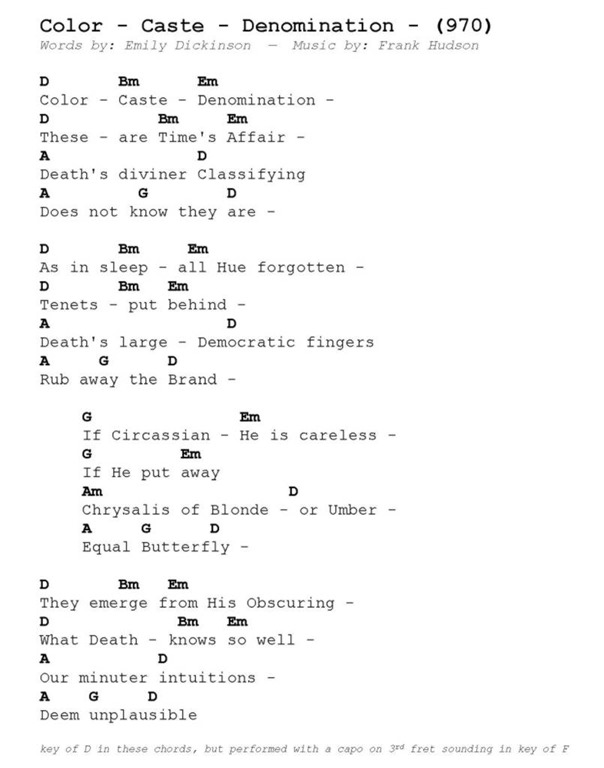
Once more a chord sheet if you’d like to sing this too.
.
The Emily Dickinson Poem
Emily Dickinson has many poems where the small things stand for larger, and then she has others using more philosophical language — yet I was still struck by the first line of today’s Emily Dickinson poem. Poems sometime seek to grab your attention right at the beginning, and this one does that with a trinity: “Color — Caste — Denomination.” These things rule so much of our lives. We may think we don’t let them rule us, but then we see the next person is using them to guide them — or perhaps guide them in how they view us. How can that not affect us. How many next persons can there be without us sometimes being one of those next persons, or yielding to the next person in our lives?
A couple of short notes on things to mention in the poem since we’re running too long. Who’s a “Circassian?” It’s a Middle-Eastern Muslim-believing ethnic group largely exiled from their homeland by the old Russian Empire. “Caste” is a word given by Portuguese colonialists to a hereditary hierarchy they found in South Asia, but it has taken on new usage in modern America to describe the intertwined prejudices and discriminations based on skin color, ethnic background, religion, and economic class. Both terms show a breath in Dickinson’s reading and education. Even though Dickinson’s America was approaching or undergoing a war around race-based chattel slavery when this poem was written, Dickinson seems to give religious prejudice equal or greater weight in the “minuter intuitions” her poem holds that we use to obscure our common humanity. Some scholars have pointed to this poem as a comment on Irish-Catholic immigration in Dickinson’s region at this time which led to a substantial reaction from the existing Protestant settlers.**
My musical setting for it is simple, just guitar and voice, as I’m somewhat rushed for time — and then wanting to use what gifted time I find available when I can record acoustic guitar with open microphones that would otherwise pickup other noise. Though that may have been a practical reason, I think the simplicity works for this hymn from Dickinson’s alternative hymnal. You can hear my performance with the audio player below, or with this alternative, a highlighted link that will open a new tab with an audio player.
.
*Not doubting those stories — see the next note as we see that connect to Emily Dickinson. And I haven’t mentioned anti-Semitism in its Jewish and Muslim varieties. Or the ugly anti-Chinese laws and hate. Oh, and First Nations? I could go on. And that’s just America. I know I have an international readership. Other countries have their own varieties of this, as we’ll see too in Dickinson’s poem. We had all kinds of supposed levels of intelligence and moral fitness that bedeviled us then and now.
**As I mentioned in one of my favorite posts on the roots of Emily Dickinson, her mid-19th century Amherst Massachusetts region had Afro-Americans, mostly in her time in servant class jobs. As she grew into adulthood, the Irish immigrant wave started to displace them, and anti-Irish sentiment ran high. Emily’s brother Austin, who she was close to, at least dabbled with the notorious anti-immigrant Know-Nothings. When young Austin was assigned to teach Irish immigrant kids in Boston, he found the job stressful. There’s a letter from his sister Emily where she jokes that it sounds so bad for him that he ought just as well to go and kill some of them, referencing in the same letter a notorious Boston murder case with anti-Catholic connections. Generously, I sense Emily the satirist there, but this kind of edge-lord humor, then as now, can just be “just joking” license as well. I think: Dickinson, for all her independence of mind, was part of systems, just as you and I are. Even Transcendentalism, the time’s new thought movement that sought to open up cultural enquiry, was not without racism and prejudice. Emerson’s “American Civilization”which I presented part of earlier here, and which is contemporary with this poem, contained portions with racist ethnography.
The most remarkable thing I can think of regarding Emily Dickinson and Irish-Catholic prejudice is that she ended up working elbow to elbow with Irish maids on her rural homestead that retained elements of its former farmhouse work-load carried with other poor first generation Irish immigrants as the hired help. The longest serving maid, Margaret “Maggie” Maher — did she recall Irish poetic bards and song? When Emily’s precious packets of her remarkable poems, overran a portion of a bureau drawer, Maggie offered up her immigrant’s trunk, in which she’d carried her all to America. When the Dickinsons decided they didn’t like the likeness in the oft-seen daguerreotype of Emily we rely on now, they tossed it out, and Maggie rescued it and kept it. Maggie worked beside Emily as she cared for her invalid mother during her prolonged illness, and she then cared for Emily as she lay dying. She was a loyal worker, but it’s said Emily told her to burn the poems. Then, she didn’t obey. When Mabel Loomis Todd was given the task of arranging the poems for posthumous publication, I read that Maggie did housework for Todd to free up her time for the editorial efforts.
And here’s the final thing, as final as death’s equivalence that today’s poem recounts. When Emily Dickinson died, she, this descendant of one of the town old-guard WASP leaders, asked that her coffin be carried by the Irish workers of her homestead. Aren’t you glad you read footnotes, patient reader? You can read a summary account I relied on for much of this in this academic paper available via JSTOR. It’s author Aife Murray expanded her research into this book, which I read a few years back.
There’s a saying, oft shared with a wink among my post-WWII generation, “If you remember The Sixties, you weren’t there.” In many cases I think this misses its mark. The forgotten decade should be The Seventies. And this is not true just of that generation’s personal stories — while objectively the Seventies has just as many years and minutes as the preceding decade, there’s much less romance to it.
Earlier this spring I indulged in writing in a condensed yet round-about way about some influences that led me into creating the Parlando Project. To remind readers, I’d decided as a teenager that there was something attractive, even exalted, about poetry and this was entwined with an eclectic appreciation for music as a listener. Let me also be clear in summary about this: this was instinctive on my part, mysterious in that no one encouraged these interests.
Now more than 50 years later, these things are still somewhat beyond my understanding. I believe I have some ability to create phrases that seem a good shape and use for language, but I did not understand poetry all that well. Nor was I particularly well read. Even now, if one goes beyond poetry to novels, nearly everyone interested in literature has read more than I have. And poetry? My reading of contemporary poets was not extensive. My observation was that this was not so unusual in my generation of young aspirational poets then. Sure, we knew the greatest hits in the anthologies. A City Lights Ferlinghetti or Ginsberg might be on our shelf of books, maybe an e. e. cummings or a selected or collected here and there.* But at least among the non-upper echelon college creative writing students I crossed paths with, there was less reading of our contemporaries than I believe one would find currently.
Yet, on these small bits of evidence, I had decided that I was a poet.
Music? Note that I said “listening” above. Despite that single song I wrote on a borrowed guitar late in The Sixties, as I entered The Seventies I neither owned nor played an instrument. I was a howlingly bad singer, even more problematic than I am now. Therefore, my connection to music was as a listener.
As my story now enters The Seventies, what had changed there? Rock music in the Sixties and The Seventies shared many overlapping musical stars, and for those of my age, a likely compiled survey of greatest records would roughly balance in numbers between the two decades. But, somewhere around 1973 something had changed in the music scene —and it wasn’t merely the “27 Club” deaths. My own summary analysis, informed by reading a great many first-hand accounts written by others, was there was a change in drug usage. Heroin addiction wasn’t even the worst of it. Cocaine seems to have inflated egos and tasked musicians with a need to accumulate working capital to keep being famous and high. **
So much framing to start my Seventies condensed memoir —and yet incidents of my life to extract to explain the eventual Parlando Project from the early Seventies are slim! After the post-Kent State flame-out of my short college career and the associated failed college paper editorship, I ended up moving to New York. I hung out at colleges with my peers sometimes, though college for credit was an Eden I was exiled from. I got married, another story too complex, and too peripheral to the eventual idea of the Parlando Project. Still, I can think of three things in the first half of The Seventies that connect somehow to the Project.
I hung out for a season with a college radio station at Westchester Community College. Though the “radio” part was limited to wired connections to audio speakers on the grounds, the students worked to do their best to portray the newly expanded playlists on FM radio. New promotional records came in constantly, expanding what music I would have been able to afford to hear. One young host I hung out with had an informed interest in and programmed contemporary Jazz records. Other students taught the student DJs how to slip cue vinyl LPs on the turntables, which I found fascinating. The hosts worked their own basic but serviceable board to mix in the records or their mics. I gained appreciation for the perfect segue or flow in a set of cuts. Once in a while since, I’ve thought of an alternative, hip-hop or club DJ infused life I might have developed. Didn’t happen, though I later got to watch radio on another level.
Here’s the second story: when I had enough money free, I enrolled in an American literature class at SUNY New Paltz and lucked into the classroom of H. R. Stoneback. I recall one class were Stoneback asked us what relationship music, and folk poetry and music, might have with literary poetry, the very question I deal with in this Project now. He continued examining some points while playing an acoustic guitar. He was also the person who first informed me that many Emily Dickinson poems could be sung to the tune of “The Yellow Rose of Texas.”
This last one is a more peripheral story, but it connects. At another non-enrolled college situation I was ghostwriting a column and stories in the school newspaper ostensibly under the name of the woman I would marry, who was an enrolled student there. Now I’m not sure if the student newspaper editor was enthralled by the writing or his more carnal desires to sleep with the young woman, which he eventually did. He also edited the school’s student literary annual. I got the wild idea to see how many poems I could publish in it. I grabbed my portfolio of poems I had written at this point, retyped up some of those poems on a variety of typewriters attributing them to various assumed names, and submitted them. As I still do, I wrote in several styles, further establishing the numerous poets as plausibly different people. When the annual came out, I was around a third of the issues’ selected poems, and one was singled out for an award by an English department professor. He couldn’t find the student. “Did anyone know him?” he asked around.
That last story in itself, like many a good poem, has several facets to gleam or blind you. I could explore those — but perhaps I, the author of the scheme and the telling, has a distorted or glare-obscured view. What is it I draw from that tale, that might apply to this Project? I enjoy variety. I enjoy not being myself, and I often am most accepted when I am not myself.
I recall writing this sitting in a old college classroom building, not sure what it was to be about, but knowing the poor condition of the brick tuck pointing. 7 years later in the ‘70s,, I made it into the song the title says it could be.
.
I’ll continue later here with another post on how The Seventies developed for me — but let’s honor this Project with a musical piece. Today is the anniversary of Emily Dickinson’s death, so maybe I should honor her and Professor Stoneback? Shame, not enough time after so much writing about myself. How about an example of one of the kinds of poems I was writing then? I looked through old recordings digitized from cassette tapes, and found this one from the 1990s which is an example of one type of poem I wrote near the end of The Sixties and set to music in the later Seventies. It’s a different gothic sensibility from Dickinson, and I may have been starting to show an interest in French Symbolists, though I don’t recall reading them until later in The Seventies. It’s called “Branched Song.” Graphical player for many below. No player? This is an alternative link to open a tab with a player in it.
.
*Note these poets, while alive during The Sixties, were obviously much older than my cohort, but they were also for the most part post the textbox canon inclusion line. Frost, Eliot, Sandburg, Wallace Stevens made it under the wire for the tail-end of the canon in the Sixties, though all but Stevens were still living in The Sixties. Marianne Moore and William Carlos Williams, were special cases, maybe there or not, though I recall seeing them first in textbooks in that decade. I did read, as did some others of my generation, Richard Brautigan and Leonard Cohen, who like the Beats were not considered canonical then. But both of those “young” poets were born in The Thirties. I also read poets in the New York School, particularly Frank O’Hara (born in The Twenties!). Black Arts and Afro-American poets came into my ken later in The Seventies. Note also, how scarce-to-none were the women. Not even Millay, who my father knew and read.
**”Rock” was a tag that started to be used in later Sixties to separate “serious” popular music from what was felt then to be the merely commercial and only incidentally and accidently artistic “Rock’n’Roll.” This transition is a complex subject, and it can’t be reduced to a footnote. Rock was open to a variety of influences then, but it was also far whiter and therefore less American than Rock’n’Roll.
And here’s a question that could be debated at length. Would the music changes have happened without then-illegal drugs? And even if something like the Rock transition happened, would it have been as wide-ranging and open to altering expectations? But beyond the Sixties’ evidence on those questions, the Seventies says there’s a rat-train of pipers to be paid. Another imaginary question: if everyone magically went into rehab in 1972, how much better would later Seventies music and what followed on have been?
This month, as I wondered what poem to explore through setting it with music, a voice — my voice from a portion of myself — often spoke up. “You still have sheets of poems by Kevin FitzPatrick that you typed-up after he died, ones you thought you might perform.”
This week I finally listened to myself.
In my studio space I have a short stack of those sheets, printed out when I thought I might perform them around a year ago. I picked this one up. I had scribbled some chords on it, and I now tried to recall what melody I’d planned over those chords on a day last spring when Dave Moore and I performed things we recalled of Kevin and Kevin’s poetry. That spring day, I had reordered and reduced that stack as the two of us alternated suggesting musical pieces. This one was shuffled to the bottom then. Had I not felt I had finished the composition? Could be. More likely? From what I could see on the page, it had more chord changes than things which work best when I hand them to Dave and he has to try to follow my eccentric phrasing in real-time.
I picked up a guitar and started running through the chords, trying to discover, or rediscover, a likely tune. In doing so I made a few alterations and after an hour or so of that, I sat at my acoustic guitar recording location in my studio space and performed the guitar and voice tracks of the song you can hear below. As I played, I was thinking of Kevin and some full measure of retirement, that as it turned out, he didn’t get.
But then, none of us know what we’ll get. Part of the reason I have had a rapid release schedule over the years with the Parlando Project — its get-it-down-and-move-on-to-the-next pace — is that factor. Not only do I skip over additional steps toward perfection, the amount of things released probably wears some listeners out. Though somewhat more talented, my fellow studio-rat Prince used to get pushback from his record company that he should trim back his output, that it was too much, bad for his career and their business. Well, should he have waited? Did he get enough time?
More playing with Adobe Firefly, the AI art generator that claims to not use uncompensated artists’ work.
.
Like most of Kevin’s poetry, his poem “Thinning Shade” doesn’t call out for my extemporaneous insights to direct the attention of readers. But while going through the process of composing the music and going over the performance, the poem did get deeper for me as it repeated in my ear. I see myself as his sparrows and that “fattening squirrel,” “pouncing on seeds…in fussy haste.…”
You can hear my performance of Kevin FitzPatrick’s poem as a song with the link below. As the poem reaches it’s volta, I decided to slow down and add a string sextet to my guitar accompaniment. You can hear it with the player gadget below. No player you can see? You haven’t missed your chance at gathering the seeds, there’s this backup link that will open an alternative player in a new tab.
.
Interested in reading more of Kevin FitzPatrick’s poetry? His books are available at this site, KevinFitzPatrickPoetry.com that I’ll link here.
What I’ll write about today’s piece might be needlessly complex. I’ll try not to take too much of your time so you can get to the simple performance of the poem below and you can decide.
The usual job of a critical essay on a poem or other work of art is to explain how something works and doesn’t work, usually making use of, or in the context of, criteria for artistic value. Within these efforts, the spread of essays praising or condemning a poet, poem, or poems is maintained. There’s no contradiction here. How can there be good art if we don’t have bad art? Judgments, pointing out good and bad, are equally creative, just as when we are writing and revising ourselves.
Is this a critical essay? I’m not sure it is. Instead, I think of these pieces of prose as short notes about my experiences with the texts, nearly always literary poems, as I combine them with music and perform them. And in the case of today’s audio piece using Kenneth Patchen’s “Instructions for Angels” my experience so contradicts what criteria I believe I have that it calls into question that I have them or really believe in them.
What do I think are the things I look for in a successful poem? First, I think poetry is musical speech. “Instructions for Angels” is free verse, something formalists take as problematic. I doubt I’m a formalist. I admit the effects of rhyme and meter, but my musical sense admits also that the amount of symmetry and regularity can and should vary. There’s some underlying da DUM da DUM iambic back-beat feel here in Patchen’s poem, that King James version 17th century English thing that can itself now feel overused or overfamiliar. But familiarity is not always bad, no more than regularity in structure. “Instructions for Angels” does clearly use one musical feature: the refrain. Perhaps this is what drew me to it when skimming through a book-length selected poems looking for what would be good to set with music. I’m not alone in choosing this poem. I’ve found several other musical settings online.
Today’s piece is easy enough to play on guitar, so guitarists have at it.
.
I do think we too often confuse imagery with poetry’s essence, praising coded word-play rather than word-music. But imagery is a more abstract version of word music isn’t it? That this-is-like-that, or things arrayed in an as-above-so-below manner is an intellectual harmony. The intervals and combinations are pleasing as audible music is. “Instructions for Angels” is plainsong in this regard. Yes, I suppose angels and God have a certain majesty, but as a recent coronation reminds us, tired pomp can bore quickly. The rest of the poem is full of threadbare, generalized counters isn’t it? “pretty girl,” “red mouth,” “baby,” “beautiful,” “rain,” “snow,” “flowers,” “trees,” “winds,” and “fields.” If one looks for fresh and arresting imagery this poem doesn’t seem to have it. If I was revising this poem or it was being workshopped, it would be easy to imagine changing a few of those general terms to more specific ones. I can see someone asking “But Ken, what flower exactly do you like? Give us the name so we can see it.”
How about a poem’s message? Shouldn’t that count for something? Yes, I think it should, yet over the ages critics can worry that worthy messages are too common, too cheap — or that art for art’s sake has judged any meaning as secondary. Writing in the 1930s Patchen was often reacting to a Modernism that was too inhuman, too concerned with form, and too unconcerned with the fates of its readers. I sense the present pendulum has once more swung and we are now again asking poems to tell us worthy things, and for the poets to be worthy people. I should be happy, yet I’m not always happy with poems on the right side of the issues. I wouldn’t like it if that was all the poetry I read and sing. Am I just cursed with contrariness? Should I note here that Patchen’s pacifism continued throughout WWII? That was a contrary position and not helpful to his poetic career at the time.
If a poem’s message is important, shouldn’t it be as clear as prose about saying it? How obscure can or should poetry be? Again, poems and critics differ on this, but there’s a consensus that a poem shouldn’t be harder to understand than it has to be.
That “has to be” is a broad thing however. Proponents of exciting and fresh images and language will say beauty and skill allows indirection, ambiguity is true to life, a little, even a lot, of mystery can compel, and that irony combats blandness and tiresome cliché. The greatest benefit of workshopping poems, or at least second readers, is for a poet to find out they are sometimes unintentionally obscure.
One could say that “Instructions for Angels” is clear. But on first and later readings, even into my performance, there was one small thing that was less than clear and more at odd. We don’t have to wait long for it: the first sentence says “Take the usual events/For your tall.” “The usual events” is clear, it’s a statement of purpose for the everyday and common that Patchen will praise as the poem continues. But “tall?” It looks like a typo.* I could make more immediate sense if it was “tale,” “tail,” “toll” or “tell.” Is Patchen saying “Angels pass this info up (way up, like to heaven) the chain?” A phrase soon to come, “Blue weather,” is fine, and there is some nice ambiguity there: blues or blue skies? Patchen returns and expands that image with “The weather in the highest soul” indicating he intends that ambiguity.
So where does that leave me, all this applying of what I think and have been taught to understand might constitute a “good poem?” In my present, poems have two states: ones that interest me, often because I can see performing them; and then, the ones I skip over. It may not be the fault of the poet or their poem that I skip them — that poem just doesn’t exist with me in my moment. I’m not totally without criteria, some things I can predict, but this poem is an example of a poem that met me emotionally in my moment, the place where some poems live while others are undressed tombstones. Is Patchen’s poem technically perfect? Unlikely, but there’s a ruined recording take were I just started crying a bit as I tried to sing.
I don’t believe every poem needs to do that. Pleasure in the words, images, and music of some other poems will make them live for me. Amazement at virtuosities can compel at times. If every poem in the world was like “Instructions for Angels,” I’d be a rebel angel, and crawl into a John Ashbery volume and never come out. As it is, I’d instruct the angels to not poop on my head and to pass it up the line that I’m grateful for Kenneth Patchen.
You can hear my performance of “Instructions for Angels” with the graphical player below. No player? This highlighted link will open a new tab with one.
.
*I have a scanned pdf of the published collection presumably OK’d by Patchen, but the typo theory remains possible. Patchen was recorded reading some of his poems, sometimes with music. That would answer this doubt, but as far as search goes I haven’t found him reading this poem.
I asked the teenager if they had any ideas for a poem I could use for May Day, the international workers day. She thought for a minute and then said, “Well there’s one, but it’s from a video game.”
Have I intrigued you? Perhaps only the unusual folks who follow this project might be. May Day. Video game? Poem? Maybe even: teenager? Every one of those things are keywords that might drop readers. Add that your author is an old guy, one not very hip to video games, and I don’t know how many are still reading by this paragraph.
Still here. Good — because the poem is excellent, and we’ll get to it in a moment. First, a short summary of the context it came from. The video game is titled Night in the Woods.It’s now around 5 years old, and it seems to this outsider to have an unusual premise: it revolves around teenagers and their peer relationships in a declining industrial town of Possum Springs. There’s a mystery to be solved, at least after a fashion, but the richness of the characters and their milieu makes it more a novelistic experience than a puzzle escape room or series of mini to macro baddies to battle. Oh, and did I mention that the characters are anthropomorphic animals?
Sound cute? Well, here we go with opposites again. Mental illness and violence are part of the world. Nancy Drew Case-Of… or PBS Kids style animal parables this isn’t. Our main characters are teenagers, and yet the weight of this world is on them — and the world, despite the fantastic elements, is our world, set in the declining rural America inhabited not by animated animal-faced kids but by a gig economy and our new-fangled robber barons.
The poem is spoken in the game by a minor character — in the nomenclature of game mechanics, a non-playable character — a spear-carrier in this small-town opera. I’m told she appears in various episodes as the game proceeds, speaking funny little poems while the foreground, playable characters, deal with weightier things. As she starts to read this, it’s not clear from the opening words that this poem isn’t just another little sideways humorous piece of verse.
It’s not. Yes, the people in it, the working class this May Day is ostensibly for, are counted as small, but the poem builds in its litany of smallness increasing, of inequality compounding. At the end the poet-character finishes stating her dream of justice. In that night dream, she’s alone, and that’s why it’s a dream — and will always be a dream on those terms. A century ago when the Wobbly songwriter Alfred Hayes dreamed he saw the dead Joe Hill, Joe Hill tells him to organize. When Martin Luther King said “I have a dream” he was standing in front of thousands who’d say it with him. That’s why we have a May Day.
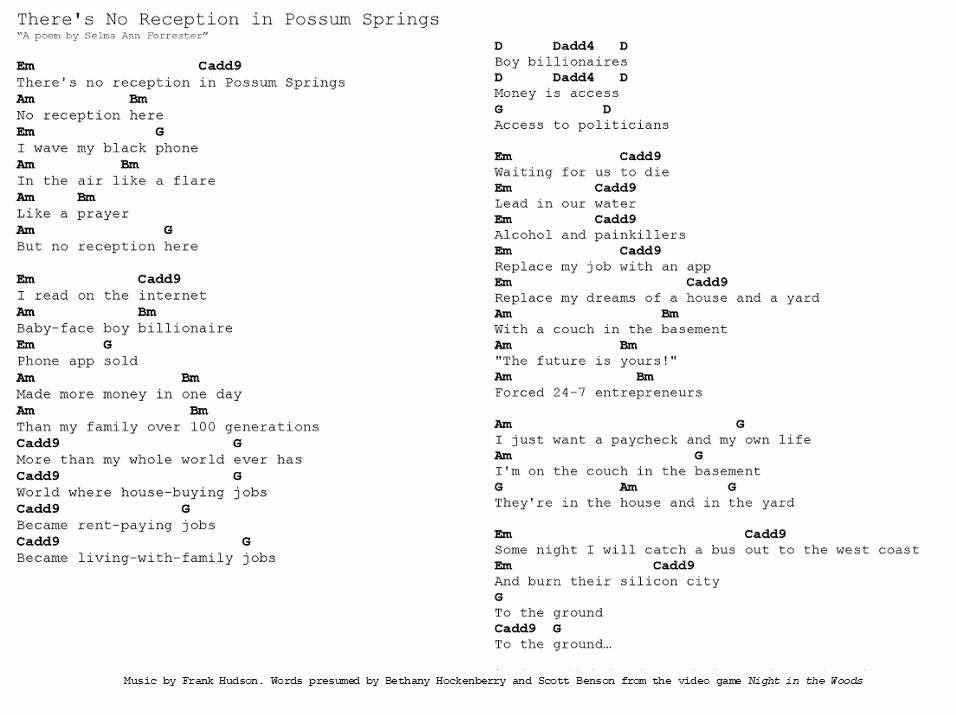
Here’s the poem presented as the chord sheet that I performed it from today, credited to the fictional character in the game. Best as we can figure, the actual authors of the game’s dialog and therefore this poem are Bethany Hockenberry and Scott Benson.* The chords listed show the chords I was fingering on guitar, but I had a capo on the first fret in this recording, so they sound a half-step higher. The main reason I’ve been presenting these chord sheets is that while I do my best in my rapid production schedule on these pieces, I figure others out there might do a better job with this. One person singing a song is a performance. The second is a cover version. More than that, and it might be a folk song!
.
To hear my performance there’s an audio player below. Player not there? Then this highlighted hyperlink will open a new tab with its own audio player.
.
*They have no connection with this performance, other than the eloquence of the words impressing my daughter and then myself. Apologies in that I hurried to do this for May Day and haven’t contacted them.







 Frank Hudson