Anna Akhmatova’s “Love”

It wasn’t a conscious plan, but I’ve been pretty tough on love within recent presentations here. Today’s piece from Russian poet Anna Akhmatova continues that, but it wasn’t something I just started to work on either. My efforts on this 1912 love poem “Liubov”  began when I did a fresh English translation of it last June. Perhaps because of its striking winter imagery, I decided not to publish it until later in the year. I stuck with this decision even though I’d also completed writing the music eventually used for the performance you can hear below.

It was only this week when I decided it was winter enough to complete my work on this, and oh does Akhmatova’s “Love”  fit in with the Australian poet Kenneth Slessor’s “Wild Grapes”  and Margaret Widdemer’s “The Dark Cavalier.”   Her poem wastes no time making its sinister case for distrusting love: it opens with a cold-blooded snake shape-shifting itself into a frosty heart, persistent, and pretending to be as harmless as a dove. It ends with the poet warning others that desire “Knows how to cry so sweetly/with prayers of an aching violin” and its final statement that the hint of interest shown by any man’s smile now sends fears, warning, to the poem’s speaker.

It’s such an arresting statement that it sounds like the judgement of a woman’s hard-won experience. One never knows with poets and their conjured personas, but this is a poem of a young woman, written when Akhmatova was in her early 20s, and the poet herself later rejected her early work off-hand as “naïve poems by a frivolous girl.”*  Yet, even by that age she was already participating in avant-garde circles within an adventurous life of shifting romantic alliances.**

Akhmatova by Modigliani

Portrait of the young Akhmatova reclining on a couch by Modigliani

Anna Akhmatova on couch

Later photo of Akhmatova on a couch. “Is that a smiling winter snake-heart-dove at my frosty window? I’m in no mood to get up to answer.”

.

In my translation (which relied on English literal glosses as I don’t speak Russian) I followed my usual practice: to try to determine what images the poet is presenting, and then to vividly portray them in a way in contemporary English language word-music, even if that’s not closely tied to the original “tune” of the poem’s native language. I thought the solutions I came up with for this poem worked well, and I hoped my instrumental music would add to that. I had recorded the basic tracks of energetically strummed acoustic guitar and my vocal first, and then found it somewhat difficult this month to work out a keyboard part to flesh out some additional melodic interest. I tried to follow myself with the added keyboard arpeggiation, but the eccentricities of the rhythm was challenging. My final judgement was the tension of my attempts might be a feature not a bug, and perhaps you’ll find it so too. You can hear the musical performance of my translation of Anna Akhmatova’s poem “Love”  with the audio player below. If you see no player, this alternate method is offered: you can use this highlighted link which will open a new tab with its own audio player.

*Akmatova’s life was complicated by more than love affairs, as she lived through two world wars, a revolution, and shifting and threatening political currents in the USSR. It’s not impossible for older writers to see their work as a progression and to discount the fondness readers have for their previous work, but living through such history suggests that shifting cultural expectations could have made expressing such doubts an external expectation.

**From choice, chance, and restriction, she lived her life within the bounds of the old USSR. However, before this poem was published, she’d traveled to Paris where she met artists and writers there. If Gertrude Stein had her Picasso portrait to display in her famous French apartment, Akhmatova had a portrait by Modigliani which she carried with her and displayed in her living spaces throughout her life.

The Dark Cavalier

Long time readers here will know I’ve referred several times to an observation by former US Poet Laureate Donald Hall that I’ve called Donald Hall’s Law. Here’s how I’ve recorded what Hall wrote:

The majority of poets who receive prizes, notice and ample publication in their time, will be unread 20 years after their death.

If they are unread at 20 years post-mortem, their fate beyond that rarely changes, save by scattered efforts like this weird Project and its versatile readers and listeners. So, today’s piece is by one such awarded and forgotten poet, Margaret Widdemer. I can’t really claim that Widdemer is a great talent awaiting rediscovery. I fear some antiquated elements in her poetry make reading her in large doses more of an academic exercise. As an indifferent scholar with many other tasks in this project, I can only say I’ve skimmed her work. Yet, per Hall’s Law, she was a prolific oft-published prize winner. Widdemer was first published as a novelist in 1915, and in the silent film era several of her novels were adapted into movies. Her poetry has several modes and subjects, and she wrote selections dealing with social issues, including child labor and women’s suffrage. Perhaps the height of her prize-winning resume came fairly early, when she tied Carl Sandburg in the voting for the 1919 Pulitzer Prize for poetry, becoming the co-winner that year. Anyone who knows me knows I maintain that Sandburg is due for a reappraisal — but if Sandburg’s undervalued, he at least has a current value. If Widdemer was his peer in 1919, her stock has long ago dropped off the literary stock exchange.

Widdemer’s Pulitzer Prize winning poetry collection was The Old Road to Paradise,  and it contained a representative mix of what I’ve seen while skimming her poetry. She writes rhymed verse, and her poems often seem to have music implied in their structure and prosody — you could class many of them as literary ballads or songs. Despite this structure, I’m unaware that she’s been commonly set to music by composers.*

At least to me, the most interesting of Widdemer’s work combines that “just asking for a musical setting” structure with strong fantasy elements.**  Given that fantasy literature retains cultural interest in the present day, these Widdemer poems are the ones that might have revival interest. Today’s selection “The Dark Cavalier,”  included in her Pulitzer book, is one such poem. Furthermore, if it was written more recently and set to music, we’d easily see it genre-wise as Goth. It certainly risks being disturbing, the poem being spoken by a seductive Death who wishes to lure the weary or troubled listener to settle for his stable and grave-set romance. The poem’s outlook is such that one could feel that reprints should have footnotes about the 988 number established for those dealing with suicidal thoughts. Yet it seems to be one of the relatively-known of her nearly-unknown works, and it was selected in 1958 as the title for a late selected poems collection.

Dark Cavalier

I didn’t know Widdemer married a cellist when I composed this, but this setting is acoustic guitar with a simple string quartet accompaniment.

.

In musical performance I tried to undercut the poem’s speaker’s luring spiel, to bring out a little of the subsumed caddishness in a suitor who offers an everlasting relationship, when we know, that even for prize-winning poets, their attention will quickly fade.

You can hear my performance of the musical setting I did for Margaret Widdemer’s “The Dark Cavalier”  with the audio player gadget you may see below. No player to be seen? Some ways of reading this blog will suppress that player, so I offer this highlighted link that will open a new tab with its own audio player.

.

*Widdemer married the year she received the Pulitzer. Her husband was also a prolific author, but it’s also said he was a proficient cellist who wrote book-length biographies of composers.

**One recent reader noted that she wrote a poem about a “Gray Magician” in “Middle Earth” before Tolkien, which indicates that Widdemer may have had some knowledge like JRRT did of Old English. I also suspect that she must have been aware of the revival of interest in older British Isles folk-music by Cecil Sharp, Francis James Child, et al.

The Route of Evanescence

Here’s another little mystery, a riddle inside a riddle, which makes up a new song using the words of Emily Dickinson — but first a little of me sounding like a regular blog that talks about itself.

As assured time to work on this project has largely disappeared, I’ve been turning to simpler compositions and quicker realizations of them to cope with this, but over the past few months a number of pieces have sat in limbo, waiting to be rediscovered, waiting for decisions to be finished or abandoned. In going through some of these this month and I came upon a recording session for “A Route of Evanescence”  from last August.

I recall the session. It was just me and a couple of acoustic guitars, with access to my quiet studio space. I had some advance notice, maybe a day or so, that I’d have that time. On the hurry-up, I prepared a number of compositions to record, and when the day came, I set about laying down tracks singing and playing that pair of acoustic guitars. I’m not an exact or exacting guitar player by temperament, but when I haven’t played as much, my old hands produce more imperfections. None-the-less the limited time meant that I pressed on. I think I may have recorded basic tracks for at least two or three tunes that day. It’s likely that I’ve already presented at least one of the others here, but not this one. Why?

I might have blanched at releasing too many acoustic guitar tunes in a row. Despite my limitations I like what I can do with that instrument, but “like” means that I could fall into doing that over and over, and my temperament also doesn’t like doing that. I might frustrate you a little* by jumping around musical goals and genres, but a bored artist won’t interest an audience either. Or maybe I had some songs more distinctly about summer that I wanted to get out before the end of the season, and so this one was set aside?

Listening again to the raw tracks I thought it sounded pretty good. It’s harmonically different from some ruts I fall into, and the playing and singing is at a level that represents what the composition is. I may have thought I’d record some additional tracks, build out a more elaborate arrangement back then — but it stood by itself when I listened this month. Therefore, I mixed it and made it ready for distribution. **

route of evanescence

Here the chord sheet for today’s Chimera. That 2nd inversion G is a neat sound.

.

And then, as I went to prepare this blog post, there was one additional surprise. I thought it was one Dickinson poem that I performed back in August, the one named in the recording files, but the song was made from two: “A Route of Evanescence”  (F. 1489) and “Ferocious as a Bee without a wing”  (F. 1492).

Why did I combine them? I don’t remember. They sound good as a combined piece, though doing so may confuse Dickinson’s intended mystery, because both appear to be riddle poems. As a poetic or sung genre, the riddle has a long tradition (folk music, going back to the Middle Ages, has a bunch of them). The lyric gives you hints that don’t exactly make sense until you figure out, or are told, what the subject or answer of the riddle is. “A Route of Evanescence’s”  answer/subject is the ruby-throated hummingbird. “Furious as a Bee without a wing’s”  may be a honeypot ant.***  The riddle poem, and Dickinson’s examples of that, are antecedents of the early-20th century Imagist poem, where the moments details are exact, but inference or the title may be necessary to interpret the details meaning. Evanescence, as in the charged moment, is part of that Imagist creed.

Both of these are later Dickinson poems, written in the late 1870s more than a decade after the vast majority of her work written in the 1860s. Dickinson by then may have been like me, writing shorter and shorter — sometimes on scraps of envelopes or the back of food packaging in her case — trying to find autumn creation in the midst of life.

To hear this Chimera song combining a hummingbird and a honey ant, use the audio player gadget you may see below. No player to be found?  This highlighted link will open a new window with an audio player.

.

*Those I frustrate more than a little likely aren’t reading this. I keep thinking there are a goodly number of listeners who’ve heard one to a few of the Parlando Project audio pieces, but finding even a single ill-tasting example, leave off listening here for something elsewhere where they expect consistent rewards.

**I use an audio streaming service that is designed for podcasters, who are typically long-form talkers about their subjects. I could do a talking podcast, more or less replacing these written posts about the exploration that makes up this Project, but I don’t see the demand. So, the Parlando Project podcast is just these musical performances you see at the bottom of the blog posts. You can subscribe to or browse the last 100 or so Parlando audio pieces on most places you can get podcasts — except for Spotify, which for some reason they never shared with me, dropped the Parlando podcast distribution from their podcast section a few years back.

***A fascinating class of creatures that I knew nothing about. I’m not yet even sure if a species of it was found in Dickinson’s 19th century Massachusetts, or if Dickinson knew of this insect. This poem seems to use many similar words to another very short Dickinson poem (F. 1788) that is the penultimate poem in the Franklin listing of the complete Dickinson poems. However mysterious, it’s an image Dickinson returned to.

Van or Twenty Years After

One of the interesting things about 20th century Modernism was that so much of its propagation seems to be based on a handful of pollinators who migrate from one place to another. Some of these pollinators are known but little-read today, others lesser-known, their names themselves faded from cultural memory.

I suspect Gertrude Stein fits into the first group. As a personage, often handily viewed via Picasso’s painted portrait, she remains known. Her main location, early 20th century Paris, remains revered for its scene, and her salon there filled with Modernist paintings can’t be left off the maps as Americans in Paris then gravitated to her. We can add to that notableness, that as the fluent domestic partner in a long-term relationship with another woman, she remains to this day something of a gay icon.

But is she read? I suspect her The Autobiography of Alice B. Toklas  retains interest for its witness to the era. Her novels? Not sure they’re read much beyond scholars — and maybe they’re under-read even there. I gather her poetry remains controversial in this sense of the word: it’s spoken of in passing, its unusualness taken stock of — and after that its import is generally dismissed. When it was new, Stein’s poetry was often treated as a breathalyzer test. If you heard it and took it as meaningful or important you must be an intoxicated acolyte of Modernist excess. I don’t know if we’ve moved on from that stance. We may forget Hemmingway was a Modernist nowadays,* but we can never see Stein as anything more than an Modernist provocateur.

Reading Stein’s prose-poems today we still find them sounding unlike most literary poetry of the present. If we’re reminded of anything, it might be Dr. Seuss books for early readers, full of repetitions rhythmically repeated.**

Sometime in my Twenties I was curious about her work, part of my early interest in Modernism and the movements that emerged from it in the last decade to be called The Twenties. I remember plowing through one or more of her novels*** and reading what of her poetry I could find, out of consideration that as an experimentalist she might have some discoveries I could put to use in my own writing. What do I remember from doing that a half century ago? Not so much passages or particular elements, more an idea which I continue to hold for: that the way we use language to express reality and consciousness has been constrained by expectations and convention.

What remains of that interest in Stein now decades later? I enjoy her in limited doses because it still can break those expectations on the floor, and stomp on the broken fragments in time to a word-music I can enjoy.

Stein-Van Vechten-Dodge-Seuss

Gertrude Stein, Carl Van Vechten, Mabel Dodge, Dr. Seuss. First 3 pictures are photographs by Van Vechten.

.

I don’t know how much of that old interest of mine my friend, poet, and bandmate in The LYL Band, Dave Moore remembers, but when we got together earlier this fall to record some new things, he broke out this Parlando-worthy selection from Stein’s prose-poetry portraits of those she had met and interacted with. I asked him what he’d want readers/listeners here to know about “Van or Twenty Years After,”  and this is what he wrote back:

To avoid Morrison conclusions, I might shift the title to Van & Stein (Iowa boy made weird) — otherwise, references to Mabel Dodge in a history of first American surrealists, found in the library free stack, made me seek out the Gertrude piece about her, which turned out to be in a collection featuring this piece referencing her friendship with Van (sheesh my brain won’t pull up his name, I’m sure it wasn’t Dyke or Heusen), from which I excerpted this section delighted the way it concluded with a joke, then when I presented it to Frank I was incapable of delivering the sound of repetitious notes I had in my head, so anything salvageable here is probably due to Frank’s remixing skills.”

So, who’s the man the Van in Stein’s piece? Carl Van Vechten. Like Stein, Vechten was another of those Modernist pollinators, and he was an early and ardent proponent of Stein’s writing. His name, his own writing? By now he’s largely fallen into the second group, as Dave’s honest stumble testifies. Myself? I knew his name from my interest in Modernism, but nothing of his biography or work until I began to run into him as I read and studied more about the Harlem Renaissance which he was intimately involved in.****   It was only then that I discovered where he was born and grew up: Cedar Rapids, Iowa. And the Mabel Dodge Dave mentions? If you were to cross-reference Gertrude Stein, Carl Van Vechten, and Mabel Dodge’s blue links in their Wikipedia articles, you wouldn’t have to make more than one Kevin-Bacon-jump to encompass the whole Modernist enterprise in Europe and the United States. Pollinators.

After all that history, some of it often forgotten, we’re left with Stein’s words. Here’s a link to the whole prose-poem portrait which Dave took his segment from. You might enjoy them as word-music not having to judge them, or risking them replacing other poetries you enjoy. I did when Dave performed them. You can hear that performance with the graphical audio player below.  See no player? This highlighted link will open a new tab with an audio player.

.

*We’re likely to charge Hemmingway with a lot of other sins — most of which he committed in flagrante — while forgetting his successful revolutions. Hemmingway, the young writer forging his style, was one of those who sought out Stein in Paris.

**Dr. Seuss (Theodore Geisel) likely knew of Gertrude Stein from the circles he ran in. I did a quick web search and found no instant citation of any considerations of a stylistic influence there. I can’t be the only one this has occurred to.

***An admission: I’ve never been much of a novel reader. Most book and literature lovers can embarrass me by exposing my lack of chair time with novels.

****Van Vechten wasn’t just Iowan, he was white. Some early Modernists recognized elements of Black and African culture as aligned with their Modernist project, and some young Afro-American writers and artists felt the same way. Modernism was not immune to racism, but this cross-pollination brought attention and prestige to Afro-American artists and art. This connection had and has its strained and strange elements — no doubt about it — but it’s important.

Another connector here: Van Vechten was bisexual, so were some of the members of the Harlem Renaissance (though some variation of The Closet was usual then).

The Dumb Soldier

I spent Thursday recovering from a brace of winter vaccinations. I was tired and achy enough that I even missed attending my treasured monthly Midstream Poetry reading, but besides whatever mojo the shots might give me from winter respiratory crud, it made me grateful upon waking up Friday with my usual level of old-guy energy. I took a crisp 34 degree F. bike ride for a veggie sandwich and tea at a local bakery, and then spent a good deal of the day finishing some live LYL Band recordings from last September. Only then did I recall that I should do something for Veteran’s Day — or Armistice Day as it used to be called here in the United States. Armistice Day is still the name in much of the rest of the world that experienced WWI, and perhaps because I’ve been thinking a bit more about British poets this week, I quickly settled on two poems by British authors.

The post just before this one, Housman’s “Soldier from the wars returning”  was the first poem I wanted to do, and it’s a straightforward poem of simple gratitude for a veteran’s service. The second one is a little stranger, and I made it stranger yet. Can we be sure Robert Louis Stevenson wished his poem “The Dumb Soldier”  to be read as a whimsical piece about a child’s toy? He published it in A Child’s Garden of Verses  after all.

There were no sensitivity readers for children’s books then,* but the nature of the poem’s story is not benign. It starts right out with the poem’s speaker burying a soldier, which from the text alone we don’t know yet is a toy. When we read “leaden eyes” we might get the hint that it’s a cast metal toy soldier — but if we were to hear this poem as I performed it, without context, sung by an adult, even that detail might not tell us clearly what is going on.

I leaned into that strangeness. I trimmed a couple of stanzas for better performance length and chose to truncate the final one, leaving off the reveal that this is a toy soldier that will return to the child’s shelf. This left this a more ambiguous buried soldier then unable to tell us anything about what they’ve seen.

The Dumb Soldier

Here’s the chord sheet for my version of Stevenson’s poem. To read his original text, here’s a link.

.

Although written decades before the first Armistice Day in 1918, this mode of the silent war dead is clearly apt for that holiday as celebrated outside the U.S.**

It was late Friday night before I was ready to perform these two poems as songs. I had music written, and for practicalities sake, I was able to quickly use my studio space to record the pair of songs with just acoustic guitar for accompaniment. Neither of these are perfected or sophisticated performances, they are more or less what you’d hear if I was to present them off the cuff. You can hear my version of “The Dumb Soldier”  with an audio player below, unless you don’t see any such player. Some ways of reading this blog won’t display that, so I give you this highlighted link that will open a new tab with an audio player in those cases.

.

*”Dumb” used as a term for someone who cannot speak is now a highly impolite term. Given the sacrifice and suffering of war, that term’s objectionableness might be a lesser concern.

**Since the U.S. had an existing holiday, Memorial Day, for remembering those who died in military service, the U. S. Armistice Day became Veteran’s Day to celebrate all who served, particularly the living. Housman’s poem, couched though it may be in the particulars of WWI, speaks to that element of the holiday. As a mid-century child, I can recall Armistice Day was still used occasionally in my youth for November 11th since veterans and others who had experienced that war were numerous.

Soldier from the wars returning

I’m going to present a pair of poems which are more related to Armistice Day, the former name for the holiday now called Veteran’s Day in the U. S. Here’s the first one.

Earlier this month I was confessing to Lesley Wheeler that I haven’t read much of English poet A. E. Housman, a poet who I believe retains more readership in the UK than here in the States. Well, no matter how little I know of him, his poetry has qualities that attracts musical composers like myself.

Soldier from the wars

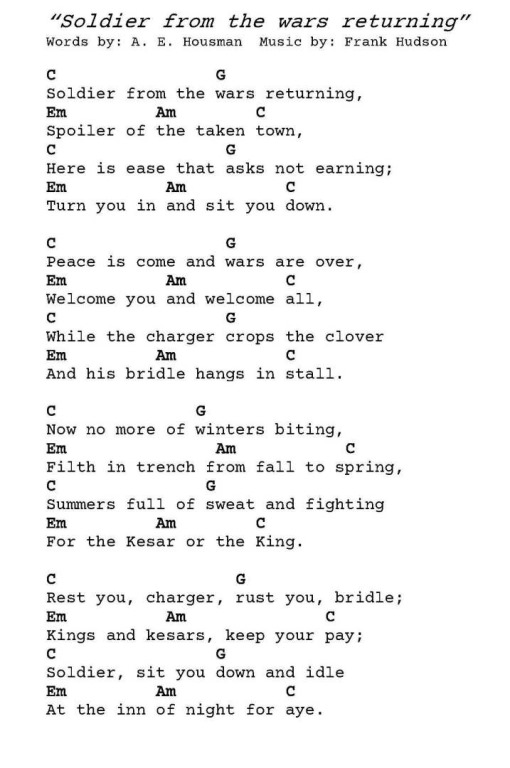
Here’s a chord sheet for today’s song. I recorded this with a capo on the 2nd fret, sounding in the key of D

.

This poem, which may not have had a title as I saw it with just the first line in quotes, is clearly a poem for Armistice Day and its veterans, first published a few years after the end of WWI. I don’t find it a complicated poem, but that doesn’t hurt it when one seeks to be comprehensible in an immediate performance such as I gave it. It’s hope, contemporary with Housman and his listeners when he wrote his words, that “wars are over,” now has sort of cruel quaintness, but it was an earnest statement then. Here’s a link to Housman’s words, and then below this is an audio player gadget to hear my performance of the song I made from them.

No audio player? Clicking on this highlighted link will open a new tab with its own audio player in that case.

.

Free to Fall

Allow me to be more internal than I usually am when presenting these pieces. Today’s piece uses my own words (we do that rarely here) and it’s here today for a peculiar reason — and peculiar is something I enjoy indulging in.

Early this autumn I was looking for a musical piece that represented the season, and I recalled this poem of mine that I had written music for. When? I probably wrote the poem early this century, and from a file I found, I was able to determine I wrote the music in 2007. Sometime after writing the music, I recorded what I recall was a pretty good version of it, likely with Dave Moore playing keys.

“Maybe I made this one of the early Parlando Project pieces” I thought. At the beginning of this Project as I was figuring out how to compose and record our combinations of original music with literary poetry, I had used several recordings of that vintage. Having some already completed pieces gave me time to get a handle on other tasks while getting this thing going.

But, what, I didn’t know? Well, I’ve put up over 700 publicly accessible pieces in this Project’s lifetime since 2016 — and that doesn’t count the ones that just didn’t work or didn’t fit the concept. One might like to think I keep my eye on every sparrow — but with that amount of catalog, it’s not fully accessible in my head. So, I looked. Here. For my own work.

Nope. I hadn’t presented it. It might not have made the cut because I wrote the words, and the Parlando Project is about other people’s words. Where else might it be? I looked in my somewhat disorganized collection of sessions and finished non-public pieces. Nope, not found there either.

My solution then was to re-record it. Recording time has been hard to come by lately, but I remembered this poem-which-became-song as being effective, so I tried to have it ready when I could open my microphone and record.

The piece is called “Free To Fall.”  As I wrote at the start of this inward story, I said I remembered it as being an interesting variation on the poetic perennial of autumn. In the first verse I already hit the falling leaves motif (can that one be escaped?) and I think the “every tree grows tall” was me referencing the British folk song “The Trees They Do Grow High.”   I continued to try to bring some longstanding tropes into this brief song: my own restatement of François Villon’s “Mais où sont les neiges d’antan*” starts off the second verse. I think the lines “Old men carry winters/in which the children play” are my own, but like my memory of where I put this song’s older recording, who knows if I just don’t recall some inspiration or reference.

The third verse’s reversion to summer memories and grief may be influenced by what I consider to be one of the great autumn songs, one found in every fakebook: Joseph Kosma/Jacques Prévert/Johnny Mercer’s “Autumn Leaves.**”  That song too begins with falling leaves, but references a summer lover now gone. Having lost my late wife in August might have made sure I made that step back in memory in the song.

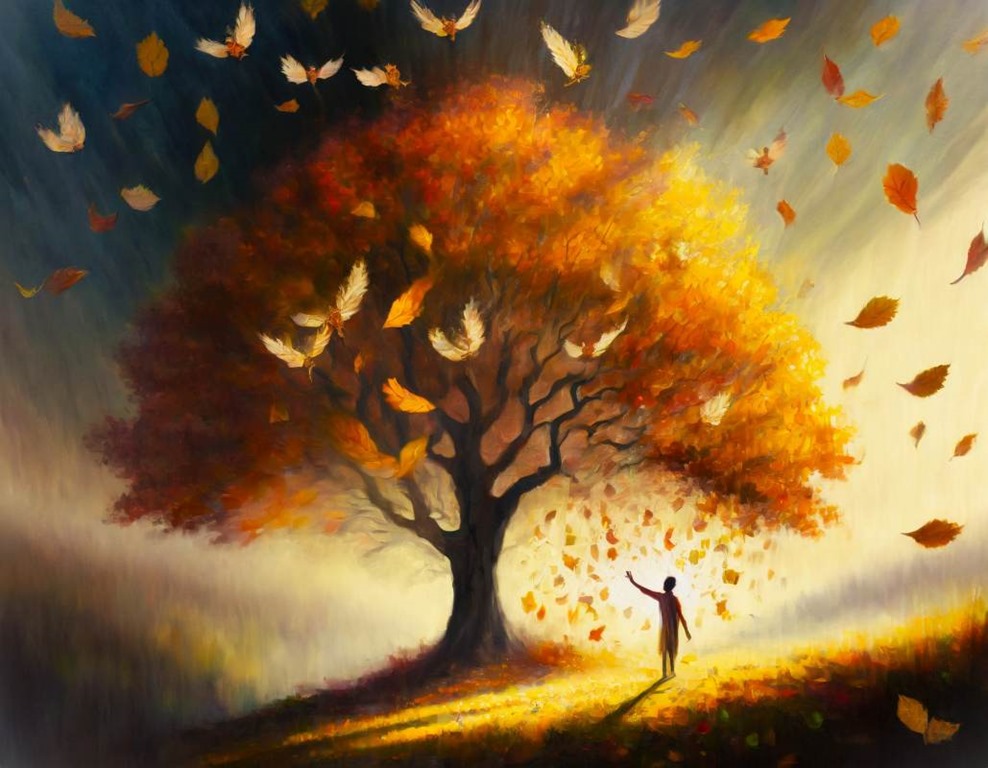
Free to Fall Illustration 800

“Everything is free to fall”

.

The originality of this compressed catalog of autumn thought comes in the refrained pair of lines “I grew up believing/everything was free to fall.” What was my intent there? I’m not sure if I’m articulate enough to do as brief a job as the poet me did in writing the poem. Yes, I knew many readers/listeners would think of things like free will and predestination, shibboleths of theology — but in the lines’ first statement I wanted the connotation that autumn’s falling leaves are freed from their work in photosynthesis and now can flutter and drift. The fourth verse refrain may (or may not) put this in a different context. Is this a compressed statement of “free will,” the doctrine that humankind has the choice of choosing good or evil, which also carries a connected thought that this is what makes good, good, not just an inherent trait? I was likely aware of that when I wrote it, but in performing it this fall I took another plausible memory: that there are those who believe in an afterlife, or a rising or rebirth of the souls of the dead, but that the song’s singer believes that however temporary or final autumn’s dying off is, that there’s a freeing element in it, like that leaf that has been loosed at the start. That’s a bittersweet freedom I wanted to convey.

Free to Fall

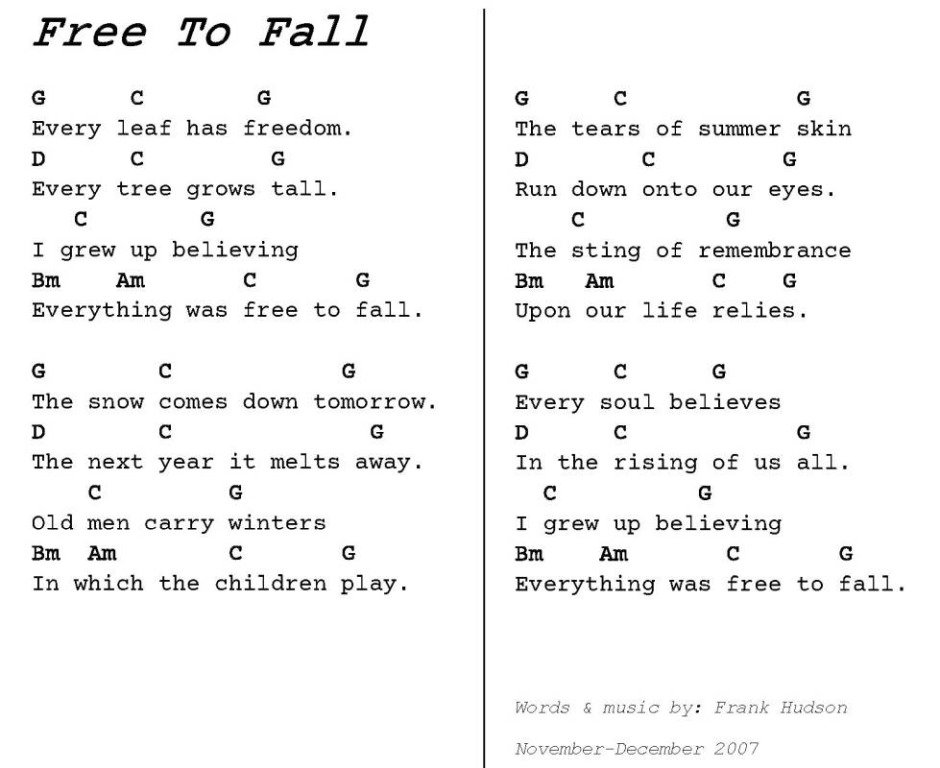
Here’s a chord sheet so that other singers can extend or improve my performance

.

This poem/song works for me. Maybe it has some worth to you. In summary, the way I think it works is from the ability of compressed verse and song to collect things in a small memorable chunk of words, a portable experience. I’m glad I remembered this 16-year-old song and that I was able to record a new version to share with you. You can hear it with the audio player gadget below if you see that. No gadget? Some ways of viewing this blog won’t show them, but this highlighted link will open a new tab with its own audio player.

.

*“Where are the snows of yesteryear” is the concluding line of his “Ballade des dames du temps jadis”  published in 1533. Yup, those snows are definitely gone.

**One of the abandoned Parlando Project songs you won’t hear came from my idea to do a fresh translation of Surrealist-associated poet/lyricist Prévert’s French “Autumn Leaves” lyrics. I got a hold of those lyrics in French, and found that Johnny Mercer’s English lyrics are a freer, looser sort of translation. Prévert’s lyric is longer and more miserable, while Mercer’s cuts right to the nub of the situation without wasted elaboration. I found there was nothing I could do with Prévert’s French that would even approach the recasting that Mercer had already done.

All Souls’ Night, the conclusion of our Halloween Series

You may wonder if our Halloween Series has continued past Halloween — but in pedantic fact,* the calendar date referred to in this poem’s title is November 2nd. Halloween has no particular religious element for most these days in the US, but originally it was All-Saints’ Day Eve (saints=hallowed people), the day before that observation.

That Halloween was for spooky, eerie, and likely non-Christian things was kind of a “get that all out of your system before the day for all saints comes around” proposition. So, if All-Saints’ day is on November 1st, what is this next-up All Souls’ Day? It’s a day for all the dead souls who aren’t  saints — that is to say, for most of us. The ubiquitousness of the total of all those who’ve ever lived, minus those few that were saints, is a likely cause for this holiday to fall into obscurity. It’s the Participation Medal of the holy calendar.

Similarly, the author of today’s text, Hortense Flexner, is not a famous poet, though she spent her entire life working in the field of literature and education. For some reason, probably the effectiveness of the poem and its continued relevance, this single poem out of her life has survived her to be passed around the Internet and in publications as a Halloween poem.**  She subtitled it “1917” on publication, no doubt in reference to the suffering and casualties of WWI — but it’s since needed no dated subtitle. I’m risking little to suggest few read it now as a historical document of situations more than a century old.

All Souls Night

Once more I present a chord sheet so that other singers can spread the singing of this.

.

Today, to anyone her words reach in times of fresh suffering and a glass separation between those comfortable and those afflicted with new death, “All Souls’ Night”  requires no further instructions from me. I’ll just say there’s an audio player gadget to hear it below, and if you don’t see that, I supply this highlighted link that will open a new window with an audio player in it.

.

*I have family members who were Protestant ministers. I’ve had friends who had at least passing familiarity with the Catholic religious calendar — but I’m evidence in that I knew Halloween in its devout practices of costumes and candy, and vaguely its religious connection to All-Saint’s Day, but nothing at all about All Souls Day.

**Although this poem is the last in my Halloween Series this year to get a blog post, a previous post here presenting “All Souls’ Night”  has gotten steady visits throughout the past few weeks.

A Winter’s Tale: A cold mystery for Halloween

Having done over 700 audio pieces in the more than 7 years of the Parlando Project, I take pride in the variety of the original musical settings I’ve supplied for them. Oh, there are more than a few of the performances over the years that embarrass me: stuff were my problematic vocals don’t deserve parole, or arrangements where I can’t now tell how I ever thought they worked, or those where it would have been better if I’d had access to better musicians than my overdubbing, but many of them still sound good to me.

None sounds better than this one as we near the end of my Halloween Series presenting some of the listener favorites from those 700-plus pieces. “A Winter’s Tale”  sets a should-be-better known poem by D. H. Lawrence. For some of you that poem’s climate is going to seem premature — and you may even wonder why it fits a Halloween theme. I assure you in Minnesota, in the northern parts of North America, this poem is not out of season. We’ve had no snow yet, but my morning bike ride was –5 Celsius. And tomorrow? Those thin polyester costumes sold at stores for trick or treating are not right for many a Minnesota Halloween. And any creativity in making one’s own costume is suppressed by the eventual need for an overcoat which will cover it. And what of Lawrence’s poem — here’s a link to the text of the poem — what’s Halloween about it?

Winters Tale 1080

A long way between houses just for some candy.

.

Well, it’s quite mysterious. This is the third time I’ve presented it, and I’m still not sure what the specifics of the described wintery mystery are. At times it seems like a breakup or strained love poem. Other times it seems like a hunting poem, metaphorical or not. It may have some connection I’ve not fathomed to Shakespeare’s play concerned with virulent mistrust. If it’s a hunt, I can’t even say who the speaker/singer and the hunted are. One or the other may even be Winter itself. That mystery and the air of danger are enough to make it a Halloween poem, and after my musical work, a Halloween song.

You can hear it with the audio player gadget you should see below. No player to be seen? This highlighted link is a backup that will open a new window with its own audio player.

.

“Stones,” rolling slowly and backwards

Nine days ago I started this Halloween Series with my sung adaptation of a graveyard poem by Robert Frost. Now we’re nearing the end of the series, and today I’m going to present another graveyard poem that sits with my sense of Halloween, Ethna McKiernan’s “Stones.”

I also promised in the beginning of the series that I would say why I’ve decided to make an extra effort to note Halloween. Decades ago, I met a young man (we were both young then) who had many interests, John Brower. The immediate bond: we both loved unusual music, not just strange or adventurous Rock that one could find in many a large record store back then, but harder to find Modernist orchestral music, and the even harder to find musics from other cultures around the globe. John also had a strong interest, much stronger than mine, in fantasy and horror genre fiction and film. What links those two groupings? For one thing, they were outsider-ish things then. If you want direct evidence of this mysterious connection you only need to investigate the trope of using the musics of the first of John’s interests with the movies and TV shows within his second one. The first signals the second: dread, tension, and the unknown. Scary movie, unknown planet, unsettled minds, eldritch times and places, it was a good chance that the less tonal string sections, the theremins and early electronica, the gongs or tuned percussion, the swooping vibratos and strange timbres of otherwise unheard avant-garde or exotic musics would emerge in the soundtrack. In the obverse, can anyone think of a well-known happy or loving scene similarly soundtracked with odd music? I can’t.*

But that doesn’t explain John. He gathered about him an eclectic mix of folks interested in these things, many of whom would be loners by inclination or classification. And every Halloween he would take them into the dark autumn north woods to his family’s cabin for a celebration of the holiday of the things less -heard than feared, we all in this group lit by the light of frightening movies until deep into the night.**

John grew up, continued to be engaged in many things, keeping those core interests and working to foster them. Then he died suddenly, while still young by the way I’d measure lifetimes from my current age.

There so much more to his story, and I’m sure parts I don’t really know, but within the briefness I prefer for these posts I want to say that I learned things from John and his enthusiasms, and in the scattered pre-Internet age he was a rare ear interested in some of the things that I spent my time thinking about and seeking out. Two decades after his death, I still will hear a piece of music, see a movie referred to, or encounter a piece of dark fantasy, and I’ll think of John, remembering some of what he thought of it, or I’ll be occasioned to consider what he might say about it today,

John had this spirit of Halloween, the old spirit of the things we repress and shush-up the rest of the year. Now, long after his death, and the death of others who so graciously tolerated and helped inform my interests in music and poetry, I have this personal graveyard in my head that I’m tending. As the Blues Poet Bo Diddley sang, I find “I’ve got a tombstone hand and a graveyard mind…”

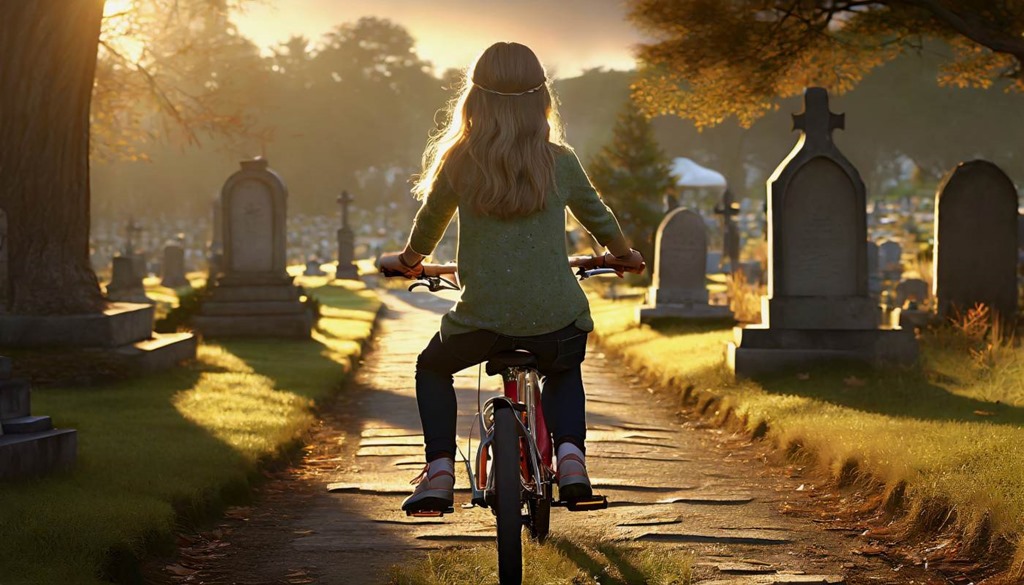
Stones Illustration 800

One of the most striking and effecting poems in my Halloween Series, Ethna McKiernan’s Stones. If you want more, and I’m thinking some of you will, buy her book, linked below.

..

Which brings me to today’s poem I set to music. Regular readers may recall Ethna McKiernan from earlier posts. She was part of a small poet’s group alternate Parlando voice Dave Moore and I were part of — and unlike Dave or I, she published her poetry regularly both locally and via her connection with Ireland.***  She died nearly two years ago now, but in my head she has a mind’s gravestone like my late wife, like John Brower, like Ethna’s friend and poet compatriot Kevin FitzPatrick.

Poets, musicians — we play in our heads all the time. We look back at inscribed dates inside there, and compose in that dark using beats and sounds strung over time. Those beats come to rests, those sounds fade to silence. When I set Ethna’s poem “Stones”  to music I chose to refrain a line from her beautiful poem so that it won’t end before you pay attention to it: “I am watching over all of you.” In Ethna’s poem that line is hauntingly unclear by design. We the living are charged with watching over our personal graveyards. We hope, transparently and by wisps of sight, that their residents are also watching over us.

Happy, yes, Happy Halloween that we knew them. The audio player to hear me trying to do justice to Ethna McKiernan’s poem “Stones”  with my own music and performance is below. No player on your screen? This highlighted link will open a new tab which will supply you with an audio player.

.

*While the avant-garde or the exotic was only used for terror and unrest, for some reason the foundational composer of western classical music, Johan Sebastian Bach was the other go-to music for frightening undercurrents. Why? As young children, did filmmakers sit under towering pipe organ tubes fearing that wolves would appear out of that forest, or that teetering from low notes, that they would fall over and crush them?

**John was one of the first folks I knew with a home VCR, and even as video rental stores started to emerge he proudly purchased movies he admired, just has he collected esoteric avant-garde records, and small-press books. Neither of these things were inexpensive to his income level then, but he considered this his form of patronage of artists and their art.

***As she was dying, Ethna finished her final new and collected book, and it’s very very good. You can order Light Rolling Slowly Backwards  from your local bookstore or from the publisher at this link.