Lambing (Night-Born Lambs)

Over the years I’ve presented a fair number of poems by authors well-known for their prose work — James Joyce, Thomas Hardy, Emily Brontë, D. H. Lawrence, and so on — but as I prepared today’s set of words for performance I thought of something I told its author, poet Kevin FitzPatrick, more than once: “If I came upon the matter of this poem, I’d probably choose to make it into a short story instead of a poem.”

That may sound like a harsh judgement. When I said this once, Kevin’s friend Ethna McKiernan once torted back at me sharply “It’s a narrative poem!”

Yes, I know that form. I may be personally more invested in the lyric poem’s momentary compression, but narrative is a perfectly valid approach. And if you look carefully at how Kevin writes, he subtly weaves into his work touches that are poetic extensions to efficient prose storytelling. I tried to explain to Ethna that I had a second part to my statement about Kevin’s poems like “Lambing,”  “…but you make it work when you make that your choice.”

This poem’s background is implied in small details within it, and Kevin FitzPatrick’s last collection strung together a series of poems portraying this part of his biography: in later middle-age Kevin’s life-partner Tina decided she wanted to run a small but diversified farm, and each weekend, Kevin would leave from his office job in the Twin Cities to this rural farm across the border in Wisconsin. Kevin was thoroughly a city boy, so many of the poems let us use his unaccustomed eyes to pay attention to the rural culture and tasks of this farm. One trait the poems often touch on: the web of interdependence and cooperation between the community of farmers and country dwellers around Tina’s farm. In “Lambing”  we meet Jim and Rose, neighbors and the former owners of Tina’s farm who are called to bring their knowledge to the incidents of the poem.

Kevin worked hard at keeping his narratives tight yet clear. Parlando alternate voice Dave Moore and I would give him notes, which Kevin was always gracious in receiving, and his solutions (not always ours) to problems we might note nearly always improved the poems.*  Unlike more elusive and allusive poetry I won’t have to act the village explainer to assist new readers to understand what’s going on in “Lambing.”

Instead, I’d like to point out that this isn’t just prose with more line-breaks. While not exactly a Robert-Frost-style blank verse poem, the Iambs with the lambs** put subtle music to this story. The sound of lines like “Their lantern lit up the shelter late” would in a lyric poem call attention to their sound, so don’t let the flow of the story overlook them if you want to pay attention to how this poem might work its way. And while not a compressed Imagist poem, the small details speak to that kind of poetic impact: Rose’s green dress shoes, the just-born lamb “like something discarded,” the nursing lambkin’s tail twirling like a gauge’s needle gone wacky.

Lambing illustration

Unintended in FitzPatrick’s spring-set poem, but this time of year I think manger/crèche.

.

Kevin FitzPatrick’s final collection, titled Still Living in Town,  contains more poems about his farm experience, and other things as well. It’s a fine, fine book, and its poems are as carefully straightforward as today’s example. Here’s a link to more information on his poetry and a place to buy this book.

I performed Kevin’s “Lambing”  today with a piano, drums, and keyboard bass musical backing. At the end of the poem performance there’s a short, less than two-minute, purely instrumental piece for synthesizer and arco bass which I call “Night-Born Lambs”  that was inspired by the experience of working on the performance of this poem, and from thoughts of Kevin. You can hear this pairing with the audio player gadget you should see below. What if you don’t see that player?  This highlighted link is a backup, and it will open a new tab with its own audio player.

.

*I forget who said it, but I always remember this rule-of-thumb: when someone points out an issue with a draft you submit for notes: “They are usually correct in seeing something is a problem, but that doesn’t mean that their suggested solutions are also correct.”

**Type-nerd note: depending on what typeface you read this with, that sentence could seem a puzzling typographic tautology.

Beneath the Poplars, César Vallejo’s Easter Locus Solus

As National Poetry Month continues, let me take a brief break from the personal history of Parlando inspirations to again do in the present what this Project does: explore a poem as I combine it with new music. A few weeks ago I found an early poetry collection by the Peruvian poet César Vallejo. Before looking into this collection Vallejo was just a name to me, a poet who is best known as being a favorite of other poets whose work I had read.

If I had time to write more tonight I could go into his troubled life, but I do not. Suffice to say he grew up poor in rural Peru, and by paths he traveled to Lima and studied some in Peruvian universities, but poverty and trouble with the authorities seems to have always followed him. He fled to Europe and had down-and-out adventures there, but eventually died there 85 years ago this April. In a brief interchange with another poet on Twitter this spring we agreed that from what we know Vallejo seemed to always be an expatriate, an exile — and unhappy from that. If so, unhappiness for a man, but poetry deals with diaspora often and well — perhaps because even when we are dealing with our native language, the dialect we spoke from childhood, we are seeking in poetry to find its real home. So often poets stand in the midst of other native speakers of their language and find this so.

My adventure with a poem in a foreign language forces by nature a greater travel. Even if I have another English translation, I try to find it in the original and start again with the awkward literalness of a machine translation of that. Other translators likely have smoothed over the troubles of a literal with their chosen solutions, and out of some pride and a desire to not appropriate the work of other living writers, I then try to make a vivid poem in English out of it. Besides recreating the poem’s images and music of thought* in English, I often drill down into individual words by looking at foreign language dictionaries and examples of usage to see what plausible other English words might convey the author’s intentions. Though I feel conflicted about this, the process of collaborating with a dead author engages me as if I am writing my own poem, and from that arises a danger that I may be tempted to extend the poem or add variations on the original’s theme. In this Vallejo poem, my translation has a couple of gray areas, which I’ll note for accuracy’s sake.

Here’s my translation of “Bajo Los Alamos”  into “Beneath the Poplars:”

Beneath the Poplars

Jose Garrido was another young Peruvian writer that Vallejo knew before exile.

.

A few notes on my translation. In the first line “bardos” might well be translated into poets or bards. I made an eccentric choice, “scriptores,” trying to make the image more clear and mysterious at the same time. I thought of the poplars branches swayed over in the pasture wind would be like monks hunched and copying manuscripts, and that would be consistent with a poem that I feel is about labor and respite. I believe poets labor, but as a word poet doesn’t suggest it directly enough.

The 11th line was difficult for me, and I can’t right now recall all the struggles I went through to arrive at the line in my version. Given that the poem is about an old shepherd falling asleep in autumn, a clear image of the falling leaves being like sheared wool may have attracted me more strongly than a literal line translation.

I think the 12th line describes a sunset — and while Vallejo didn’t say sky, I decided to clarify the sense of “azul” here as the blue sky, as we mean it when we say “out of the blue.”

Lastly, did you notice that this poem mentions Easter, but is set in autumn? Peru is south of the equator and April is autumn there. All those easy connections we northerners feel about Easter and spring as a resurrection metaphor fall apart in the global south.

A gorgeous poem of work and rest, and I hope my rustic music helps set the mood for it. Given Vallejo’s life it seems he’s writing here of his locus solus, his essential place that he’s exiled from. Here’s how you can hear my performance of it: there’s an audio player displayed below for many of you. No player? This highlighted link will open a new tab with an alternate audio player.

.

*I give priority to transmitting what I think are the poet’s images to our eyes through our words. The word-music, such as rhymes and meter where present, I generally take as what is unfortunately lost in translation, though I like the resulting poem to have an attractive sound in English. The “music of thought” is my own term for the order and manner of repetitions in the presentation of the poem’s substance by its images and statements. This has its own musical structure and can more easily be transferred into a different language.

Coyotes

Today let’s examine the place of hands and humor in poetry and music. Let’s start with hands, before we turn to the subject of humor and a poem about farming.*

You just heard alternate Parlando Project voice Dave Moore last time here, but besides letting you get a break from my vocals, Dave has played keyboards with me since the late 1970s as the core of The LYL Band. That’s a long piece of work, particularly in that I’ve needed him more than he’s needed me with this. Here are the basics of that: I’m a poor rhythm guitarist. I like to add color and decoration whether the song is fast and loud or quiet and moody. Groove, beat, a solid march of chords to carry you along? Not in my wheelhouse. The LYL Band has had other guitarists over the years to handle some of that, but most of the time it’s been down to Dave for the chords and groove. Back in the earliest days of recording us, when four tracks were a fresh luxury, I’d put Dave’s keys on the same track as a drum machine, sure that he’d be solid as the machine.

Now we’ve both got some mileage on our hands, and Dave has encountered some issues with both of his arms and hands. He tells me that the fingers just won’t do what he asks them to do some of the time. He’s become more like me now as a musician: able to do some things, some days, within limits. My own hands have had problems too, which currently are no worse, and many days a little better. Oddly, writing and composing can let my hands weaken. To wrangle a guitar as I often like to takes not just flexibility but also finger strength which is best approached by regular use with a gentle uptake, not a two-hour live session where I need them to work right off after weeks of musing on poetry and tapping out a sonnet. I’ve been trying to carve out more time to “just play” in order to keep my digits loose and strong.

So, when Dave and I got together this month to honor our friends who’ve recently died, I assessed that my hands were ready to rumble by current standards; but Dave, while game, wasn’t sure. During the session, he did all right, even if he wasn’t nearly as strong as he was in our little band for years.

Now on to humor. Kevin FitzPatrick was a poet we got together to honor. We both knew him for decades, and Kevin even played a little blues harmonica with us a few times in the early days. One thing that Kevin’s poetry often used was his dry sense of humor. If his poems “had other people in them” the interaction between those characters was often humorous. Humor is like that, isn’t it? With poetry one can easily fill a chapbook with solitary musings, singing philosophies, and hermit’s prayers, but humor generally requires other people, our rubs, our missed and kissed connections.

Kevin’s final collection Still Living in Town  has several characters, but the central ones were his own persona, a city-living office employee and his life partner, Tina, a woman who had decided she wanted the rural life — and not a Walden cabin in the woods, but a farm growing a variety of produce and sheep.**  Kevin was in his 60s, but he was a big fit guy (he boxed and taught martial arts in his youth) and however urban his life had been, his character pitched in with the farm labor.

Kevin’s farm poems are and aren’t like Robert Frost’s to compare them to a famous example. That Kevin could approach a blank verse feel in some poems would connect them — but Frost, urban-born and professionally an itinerant teacher, liked to cast his persona in his farming poems as knowledgeable and in place with farming, while Kevin portrayed himself with beginner’s mind on the farm. Given that fewer living readers have any connection with farm work, Still Living in Town  invites us into that milieu wonderfully.

The poem of Kevin’s I used for today’s piece is looser metrically, but while it’s set in like weather to this current March (wheeling rain and snow and thaw) it most wants us to hear a little story about the two characters, the labor of farming, and yes, the humor in hands and their stubbornness.

Jazzmasters!

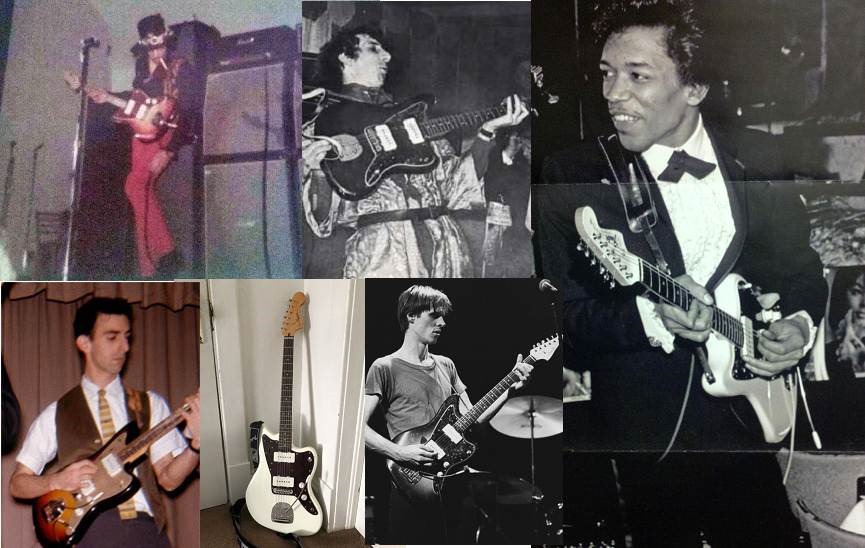
Jazzmasters! From the upper left: Jimi Hendrix without a Strat; Pete Townsend about to decrease the supply of used guitars; some guy named Jimmy James (wonder what became of him?); Frank Zappa, who didn’t say “The Jazzmaster isn’t dead, it just smells funny;” my Jazzmaster painted the homeopathic color Sonic Blue; Tom Verlaine, vanguard of the alternative nation which latched onto the bargain unwanted Jazzmaster in the 1970s.

.

A few notes on the music. I sometimes create the drum tracks for my compositions before the live session begins. And since I’m usually needed in the guitarist role, I sometimes lay down the bass parts with those tracks ahead of time too. That’s how this piece was. On the day of the session, I sang and played the wailing lead guitar*** and recorded the reading of Kevin’s words live with Dave playing a baaing/buzzing synth part live. Dave’s part, subject to his current hands, didn’t fulfill all the groove chop I thought the piece needed. So I added a second guitar part doing my best at rhythm guitar on my Telecaster, but a lot of the final groove you hear is an electric piano part that I laid down trying to imitate my friend and partner Dave’s playing as I recall it from the past.

By now I hope you’re ready to hear the musical story of Kevin FitzPatrick’s farm poem “Coyotes.”   The player gadget is below for many of you. Don’t see that? This highlighted link is provided as an alternative so you can hear it that way too.

.

*I have to repeat this one, which I read in a comment thread this month regarding the upcoming Hollywood Oscar awards event: “The only Oscars I care about are Peterson and Wilde.” In the context of Dave Moore, even the young Dave wasn’t likely to stand toe to toe (finger to finger?) with Oscar Peterson on piano. On the other hand, I’ll hop on top of Oscar Wilde’s tea table in my slush-muddy Minnesota shoes and declare Dave’s poetic wit with Wilde’s.

**Other reoccurring characters weave in and out in the farm poems too — and while four-legged, the couple’s farm dog, the incongruous poodle named Katie, makes a cameo appearance in this one and others.

***The lead guitar part is played on a Jazzmaster, a famous failure in Fender’s otherwise wildly successful line of mid-century electric guitars. A couple of decades into its Edsel-hood of “what were they thinking” failure, unwanted used Jazzmasters became an affordable choice pragmatically chosen by some punk and alternative musicians. Even so, few think of a Jazzmaster for this kind of wailing lead guitar with a bit of funk flavor. As long as one is able to address the Jazzmaster’s bridge design issues, it can  do that sort of thing.