I regularly read and take part in a daily poetry thread on X/Twitter. Its host, Joseph Fasano, posts a theme word and an example poem reflecting a topic most mornings, and other poetry readers respond with poems that relate to that. Early this week the theme was “Longing.”
One of the responding poems was this one:

The X/Twitter poster here happens to be a relative of mine, though I’m not sure which one
.
This is an English translation of a poem by the ancient Greek poet Sappho rendered by famed Canadian poet and translator Anne Carson. If we didn’t know it was a translation, if we thought of it as a poem by a modern poet, here’s one thing we might notice on the photographed page: those short lines, those white spaces, those fenced-off blanks kept apart by square brackets. Looking at the text this way, the poem on the page has a striking effect. Its incompleteness — its, well, longing — is amplified in those spaces.
In Carson’s presentation that’s an inescapable part of Sappho’s work. We have only fragments of Sappho after all, only a handful of her poems are even comprehensively within sight of being complete. Some Sappho fragments are but single words, and many, a phrase or a few lines. And we know so little of the poems’ context. What details recorded about Sappho’s life date at best from centuries after she is thought to have lived, and are inconsistent. That she was a woman in a male dominated world, and lived in an outlying area away from the centers of classical Greek culture that we most know from later surviving works adds to the mystery. That the Greeks of the Athenian Golden Age, or the later Hellenistic Greeks, misread is some way the larger corpus of Sappho still available to them as they supplied us with Sappho quotes, commentary, and biography is plausible.
As readers of modern poetry, we likely assume when reading a Sappho poem that it’s a more-or-less authentic voice of someone describing a moment in her own life. I can’t say that as being a sure thing (any more than it is for, say, Shakespeare’s sonnets). But maybe that makes little difference, especially in the absence of well-attested facts — the words have the effect they have on us, based on our own lives, our own culture, our own time.
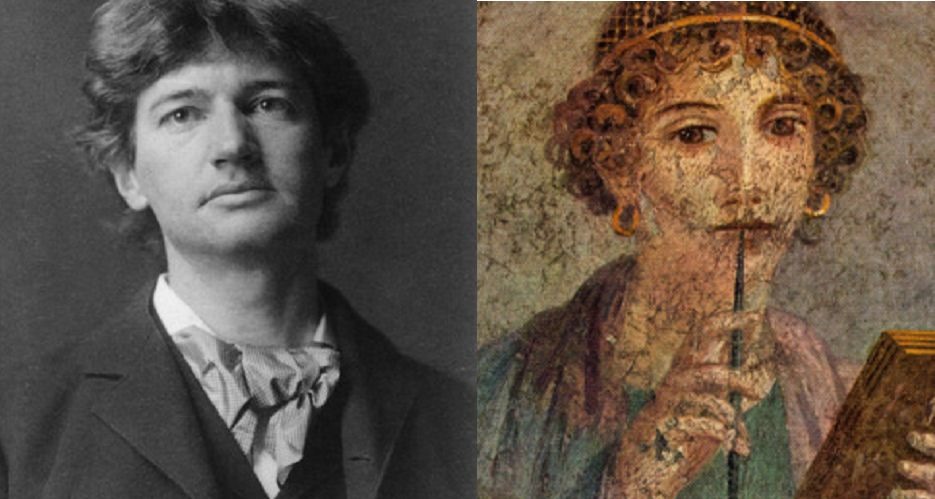
Carson’s translations are well-regarded, but she’s not the first to translate Sappho into English — she’s not even the first Canadian to do so. The first attempts there I know of, likely the first in fact as it’s by such an early Canadian poet, were by Bliss Carman.* In 1904 Carman published Sappho: 100 Lyrics. Unlike Carson, who is a scholar, I don’t know if Carman was all that knowledgeable in ancient Greek, and from what I can find he’s less open in sharing translator’s notes on his methods. The preface to his book, written by a friend, says only he more-or-less imagined the poems as complete and wrote then from that imagination.
From a scholars’ standpoint this is an outrageous act. On the other hand, there’s a current in poetry of writers finding something in assumed characters, some for anonymity, some for fraudulent reasons, some to burlesque writing styles they wish to make fun of. Carman’s life was not straightforward. There were a lot of bumps and setbacks in his career — all as one might imagine at a time where the idea of a Canadian literary poet was yet to be established. So, to take a vacation from all that to the isle of Lesbos and imagine Sappho strumming her lyre within his earshot? Maybe understandable.
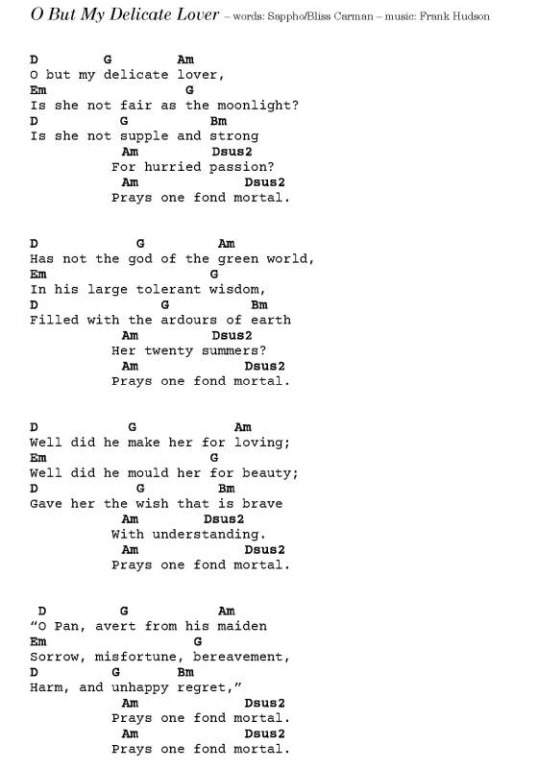
Another green world. Here a chord sheet for today’s musical performance.
.
Published in the era just before the outbreak of English-language Modernism, Carman’s version of Sappho found some readers. Ezra Pound apparently read them, and in his loose Chinese translations and elsewhere he seems to have adopted a no-hurt, no foul practice of translation as a personal recasting of the original work. Carman’s Sappho is sensual without overelaborate decoration or any “I’m so naughty” stance. I can imagine some of those Not-Yet-Modernists who kept a well-thumbed copy of Swinburne in their back pockets circa 1900 appreciating these poems. If the tropes in these love poems are often common ones, he’s portraying Sappho who would have predated those tropes becoming commonplace, and he’s asking us to believe our moments are repetitions with a long heritage.
Many modern readers of Sappho have adapted Sappho as a pioneering Lesbian poet. In the many centuries between Sappho’s 600 B.C. E. and the present there have been a variety of renderings of Sappho’s sexuality. The text, fragmentary as it is, often shows attraction and praise for women and female gods. If we assume Sappho herself is the voice in her poems (and why not, we know so little, and nothing for sure, and Occam’s razor) this would follow. In this poem of Carman’s Sappho, the lover and object of longing is certainly female. Bliss Carman was an apparently hetero male, but his poem’s assigned author is a woman. Parsing….
Those that object to drag-time story hour at the library will have a hard time with all that. If for only that alone, I’m going to give voice to this poem from Carman’s collection of imagined Sappho translations. You can hear my musical performance of “O But My Delicate Lover,” with the audio player below. Has the important fragment that includes an audio player disappeared for you? This highlighted link will open a real, not imaginary, tab with its own audio player.
.
*Carman’s 1904 work may also be the first American translation of Sappho, as it predates the top hit in a web search that shows Mary Barnard’s 1958 volume as the first from the U.S.A. Coincidently, Ezra Pound is attributed as someone who encouraged Barnard to do her book of Sappho translations.
Carman studied in the U.S. and was distantly related to Ralph Waldo Emerson. His ancestors emigrated to Canada as Tories escaping after the U.S. Revolutionary War.



 Frank Hudson