Kevin FitzPatrick’s Farewell

Nearly 50 years ago when I moved to the Twin Cities I fell in with a group of Irish-American writers — only they didn’t call themselves that, they called themselves the Lake Street Writer’s Group, and when my friend Dave Moore wanted to roughly categorize them back in those days he’d say many of them worked as bartenders. And so, at first, their monthly meetings would be at a bar table, I think the first one I attended was at the Artist’s Quarter, a bar and music venue.

Time and writing changes one, and so it changes groups of writers. Over the years some wandered off to other pursuits, or to other cities, and one or two died. In its last decade of existence, the group winnowed down to four people. Dave Moore and myself, and two other poets: Ethna McKiernan and Kevin FitzPatrick.*  None of us remainers were bartenders. Dave worked for a co-op grocery after working in bookstores. I worked for a public radio network. Ethna ran an Irish-Arts store until it needed to close, and then worked as a social worker. Kevin had a job with the state labor department, but he spent every non-workday at his life-partner Tina’s farm across the border in rural Wisconsin.

The poet I perform today and his last book.

.

Kevin was a healthy seeming guy, able to handle the manual small-farm work in contrast to his desk job. During that decade our little quartet of poets would hear Kevin recount his latest news from the farm, and then we’d hear what he’d transformed out of that when he showed us drafts of poems about the odd turn his post middle-aged life had taken. In this series of poems an office-worker who grew up in the Cities was encountering country labors, mores, and situations, being befuddled or making sense of them.

Kevin’s poems were narrative, and he had a real knack for that form, particularly in his talent for drawing characters in a few words and letting you get a sense of them in a stanza or two.**  One of the charming characters we met as the series of poems spun out was the farm dog: an incongruous poodle named Katie — not a Collie or German Shepard, not any other breed you’d naturally think of protecting the flock and farm. The poet didn’t invent that detail of the farmstead’s dog, but the poet knew a symbol when he came upon one.

Farm dogs are pets with job descriptions, but I don’t think Katie was a herding dog in a professional sense, any more than Kevin was a professional farmer. Still, there were in the poems a sense of Katie being an intermediary between the livestock and the bipeds, and she was portrayed as a useful watchdog and companion when Kevin needed to return to his workweek office job.

In Kevin’s poems we learned that Katie had gotten sick; and though it strained budgets, she had gone through some veterinary treatment. Then, at one month’s meeting, we learned that the poodle farm-dog had succumbed to her illness.

The Kevin FitzPatrick poem I perform today came shortly thereafter. For me, this poem works well, even though intellectually it could seem maudlin or sentimental if summarized. We should be wary of such reduction — poems are much more than AI summaries. Kevin undercut the merely weepy here with his dry sense of humor and understated anger — and then too there’s the poem’s sensual detail: a man at work with the remains and memories of a working dog, the corpse as light as a cardboard cutout, the unthawed March cold.

The poem’s ending has extra poignance for me: it was not that long after the poem was written, and the collection that contained it, Still Living in Town,***  was published, that Kevin unexpectedly took sick and died. I think I remember talking with Kevin — before that knowledge on either of our parts — about liking the final part of the poem, how it implies that when the fear and final of death might come to the poem’s speaker, that the dog’s spirit, preceding over the hill, that hearth and home animal in-between livestock and us humans, would be there faithfully there to assuage the fear of what may be nothing in an empty darkness. I call the piece today “Kevin FitzPatrick’s Farewell”   because to me its writer ended up making that statement while writing a poem about a farm dog.

Kevin heard a couple of my performances of his poems, and his feedback was that I overstated them — and my performances were certainly different from his. He had that drier Robert Frost reading tone down whenever I saw him do public readings, mixed with the kind of Irish wit that evidences just a slightest eye twinkle and unvocalized “a-ha!” while it spears some folly with an off-hand brickbat or dagger. So, to honor that contrast between us I had to fire up the electric guitar and make the speaker in his poem a little shoutier than Kevin. You can hear that performance of mine with the audio player below. No audio player to be seen? Listen: Katie is barking that you can use this highlighted link that will open a new tab with its own audio player.

.

*Kevin and Ethna took to hosting a poetry reading every St. Patrick’s Day. The last ones not at some Lake Street dive bar, but at a more tony academic site: The University Club near St. Paul’s Summit Avenue. I’m not Irish, but personally I don’t favor the mandatory cute intoxication elements endemic to that celebration, so I preferred a spotlight on that culture’s poetic side. As the holiday approaches this year, I’m planning to get to Ethna’s poetry too in time for St. Patrick’s Day.

**I admire conciseness. I’ve sometimes compared Kevin’s poems to the narrative poems of Robert Frost. While Frost’s longer blank-verse narrative poems have their power and richness, it’s not the mode that I read for pleasure. Kevin’s rural life poems take more after Frost’s shorter narrations like the “Mending Wall.”  And Kevin’s poems make more use of humor than Frost’s do.

***That book, and others, are available via this web site link.
Ten Cents a Bushel

I seem to have the kind of mind that, unbidden, sees connections. Probably drives some acquaintances around the bend, but regular readers here will have become accustomed to this. After all, this Project is about making a connection — likely unintended connection — between literary, page poetry and musical performance. Still, even though it relates to a mental reflex of mine, there’s “making,” work, involved in that combining.

So it was, that this month I went consciously looking for a connection, one I thought I might find between our American election results and the fear and despair around that event with the early 20th century era which I often look for to find free-to-reuse words to set and sing.

Where and what to look for in the era if trolling for such a connection? I wanted a short poem to leap out at me, one that I’d immediately flash on, in hopes it would attract even the casual listener here with a sense of recognition. I started paging through my Sandburg, who remains one of my personal models, but found no strong candidates I haven’t already performed.*  I next moved on to a 1930’s volume A New Anthology of Modern Poetry  edited by Selden Rodman. Rodman is one of those little-remembered figures I enjoy encountering in the Project, a litterateur and socialist activist who admired American Modernists — so connections right there.

The selections in Rodman’s volume look like an index of this Project’s authors, I counted 37 poets whose texts I’ve used in the nearly 800 published Parlando Project pieces.** His lively introduction promised what I was looking for, connecting the artistic discontent with old literary modes and tactics with social change and discontent.

Eagerly, I read on, looking for that flash of connection with the way folks I know are feeling this month. I read some fine poems, some I might even use someday here, but nothing came out of that quick skim and read that hit me with my sought property: “This sounds like it could have been written today.” Why not? When those poets wrote of their social injustices and feared outcomes the details of their times didn’t match closely enough to the details of our times.***   “It’s just details, what about the essence?” you might think. I thought that too, but I wanted listeners to feel it  from the poem I was looking for. Details usually aren’t ephemeral in poetry, they are often the source of its emotional power.

If I’d left it there you wouldn’t have a musical piece to listen to today. But then I recalled Edwin Ford Piper, a man whose work I discovered earlier this year. Piper’s family settled in frontier Nebraska just after the American Civil War. He grew up there, knowing rural settlers, ranch-hands, and farmers at the turn of the century. To keep this a reasonable length, here’s a link to some of what I wrote about this deserving of more current attention poet earlier this year.

Ten Cents a Bushel

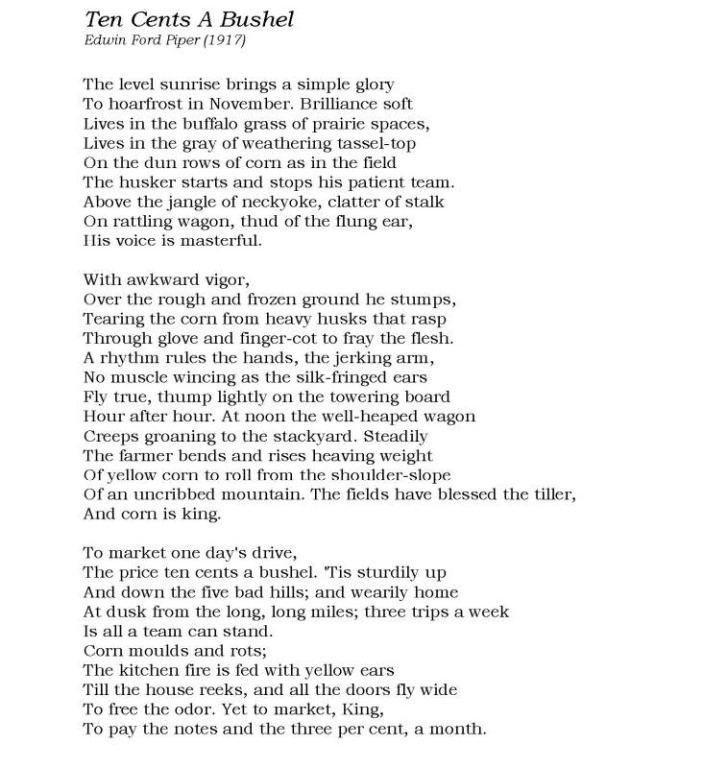
Here’s Piper’s poem I performed today as it was published in his collection Barb Wire

.

Piper’s poem “Ten Cents a Bushel”  is about a small farmer. I doubt I have any readers who commercially harvest corn by hand, though some may have experienced something close enough. There are still agricultural workers, but modern field workers are usually employees, not caught in the exact resident small-farmer serfdom that is the center of Piper’s poem.****  I went with this poem anyway. In doing so, I accepted failure on my goal — at least so far — I didn’t find the brilliant connection between eras I was seeking. But if the poem’s details are off-target to today’s burdens, they are still powerful details. Piper’s poem lets us feel those details in our muscles and smell them with our noses, and the essence of the poem’s world, the repetitive stress of its rural Sisyphus’ burden, is something I expect some tired people can feel this month.

Today’s music? I prefer to call myself a composer, not a musician, even though I operate numerous real and virtual instruments in making these pieces. Modern digital recording allows me to maximize my inconsistent skills and to do with guile and planning what fingers and breath couldn’t accomplish. Be assured: “composer” sounds like a pompous title to me too, while “musician” retains the nobility of the worker. But there’s an element of my personality that sometimes tells the composer-me to back off with the theory and a build-the-musical-piece-with-ideas workflow, and barks “I just want to play!” Weeks like these, or times when I can plug into a loud amp and welcome that power vibrating in a room brings that energy forward. Today’s piece started with two inexpensive electric guitars and a bass playing loud in a room. The lead guitar I played is a Squier Jazzmaster, a model that wasn’t designed for loud, sustained-note playing, but can be forced to do it under volume by an elderly guitarist who can’t rip out rapid flurries of notes. You can hear that performance, my speaking Piper’s account of this November farmer’s harvest while playing more my mood than worked-out musical ideas by using the audio player below. No player? The bank hasn’t foreclosed, some ways of viewing this blog suppress the audio player gadget. This highlighted link is an alternative that will open a new tab with just an audio player of its own.

.

*I’m not disenchanted with Carl Sandburg. My results in this browse through his work may be because he doesn’t really do fear and despair as a predominant emotional frame. This may still be a good attitude to assay in these times, but not what I was specifically seeking. If you want Sandburg for this moment, perhaps this previous Parlando Project performance will serve you well.

**One blind spot: Rodman (who had considerable interest in Black Caribbean culture and history) didn’t include any of the Harlem Renaissance generation of Afro-Americans. I must resort to an academic meta-cultural term of art when I consider that: WTF.

***I did think this week about how to compare the injustice and fears which I naively thought I could measure between the 1930s and our time. I’m certain the levels of injustice were massively greater then. The fears? Even given their Great Depression, fascist governments, genocide factories, and a coming World War — I can’t say our fears are lesser.

****I started to write a conclusion here that would need to spin out more than a thousand words to do it justice. Such an epic would point out that those early 20th century rural farmers caught in an economic squeeze by powerful business forces up the supply chain from their crops, founded radical, effective, and practical political movements: The Farmer Labor Party, the Non-Partisan League. In the same parts of the land that today wave the red flag and the red hat, a very different rural political force was electorally successful. What’s with the same fields bearing different fruits in these two eras? That’s more than a blog post, something for someone with skills beyond mine. One naive half-formed theory: was there something about the largely immigrant-or-child-of-one, practical farmer or small-town-dweller of a century ago that saw through urban sharpies and charlatans, and focused on specific economic remedies?

Storm Fear

Of all the English language poets who have achieved a general readership, it’s likely that Robert Frost is the most misunderstood. I don’t say that to shame that broad audience — after all, in my youth, when asked to read Frost, he seemed too full of tired maxims and quaint commonplace situations. Sure he comforts folks I ignorantly thought, and maybe I undervalued comfort, but that wasn’t what I was looking for.*

I won’t blame that youth I was then too much. I was onto other things — but as far as Frost goes, I was carelessly understanding his best work too quickly. Decades later, partly as a result of this Project, I came to his short lyrical poems, beginning to appreciate their supple word-music — and then once beguiled, I began to see what he’d put in these concise pieces.

“Stopping by the Woods” isn’t about lollygagging when there’s duties to do“The Road Not Taken”  isn’t about the so-consequential road taken. This poem, “Storm Fear”  from Frost’s first collection, A Boy’s Will, isn’t about settling down to a little hygge-time in a winter snowstorm. Here’s a link to that poem’s text if you want to follow along.

Maybe it’s its concision, or the careful way Frost uses incremental details, but this poem was first published in 1915 and yet the horror it contains seems to have passed most readers by. As I read it this month, now more attuned to how Frost can work, my first thought was this is as harrowing as Bob Dylan’s “Hollis Brown”  or as stark as Bruce Springsteen’s Nebraska  album.

My first reminder as you read this poem is that it’s set in a circa 1900 rural America that was more isolated than you might imagine today. Farm families didn’t always have daily connections with others, and those institutions that offered connections: churches, shopping towns, exchanged labor, and rural schools were episodic. Long winter nights and snowstorms restricted what travel there was. Frost himself went through a brief attempt at living that farm life in this era. Perhaps he had a writer’s lighthouse-keeper fantasy of splendid, thoughtful isolation. His poetry testifies that he learned the reality.

Frost’s poem opens with a snowstorm in progress in the nighttime. How many poems, stories, blog posts, other accounts portray such a scene? Frost wants to let us know this isn’t a greeting card picture. The wind is a “beast” and it’s curiously imploring “Come out!” How many readers will miss this odd inclusion and take it as so much filler merely indicating that there’s a wind?**

The poem’s speaker, who we’ll find out is a young husband in the house with a wife and child, responds that it doesn’t take much interior debate to not obey what the beast outside is requesting. He’s thinking: there’s a storm, I’m staying in.

Then we get a different calculation. He tells us about the wife and child. They’re asleep, there’s no awake partner to bounce ideas off of. Suddenly he’s worried about the isolated farmhouse’s sole source of heat, a wooden fire. I think the implication here is that at the very least he thinks he needs to visit an outside woodpile. Or perhaps the winter has been hard enough that he’s short on fuel.

In the poem’s concluding scene, he’s now set on going outside. In the snowhills and blowing snow, even the barn looks “far away.” Is he even considering trying to make it to a neighbors for fuel? Is he making a difficult but sane decision, or is his isolation and “cabin fever” such that he’s thinking of making a risky trip for less than necessity?

Storm Fear 1

I thought too of the deadly rural winter isolation of Susan Glaspell’s “Trifles” reading today’s Frost poem.

.

Let me note one other thing about the poem. For Frost, the famous formalist, this poem’s form is very irregular. Poetic feet, meter, rhyme scheme? It’s all over the place, though periodic iambs are there in the confusion. Formalists who teach Frost would likely skip over this example for lessons. Workshopping this poem with a formalist? I can imagine the markup.

In setting “Storm Fear”  for performance I was able to deal with the irregularities in Frost’s design, but then I’ve worked in this Project with a lot of outright free verse and have found it not as difficult to sing or mesh with music as some might guess. But when you’re performing (rather than writing a page poem) there are a couple of things you might want to add stress to: a sense of repetitive or choral structure and some additional guidance to the listener to intrigue understanding on one listening.

My choice here was to make the poem’s 7th and 8th lines into a refrain that repeats twice more, the last with a variation. The first time we hear “It costs no inward struggle not to go,/Ah no!” we hear it as the easy rejection of the beast-storm’s call. The second time, as the singer thinks of his wife and child, it seems more as a statement of the imperative for him to take action and leave into the storm. And in the final statement at the end of the song, he’s about to enter the storm thinking he must seek aid.

Would Frost have approved of my changes? Who knows. He was a man of strong opinions and an often brusque manner. Many poets or their rights-holders would forbid changing even a word. But this old poem is in the public domain now, I need no permission, and I hope my setting honors the intent of Robert Frost.***

You can hear my musical performance of “Storm Fear”  with the audio player gadget you may see below. Is that player snowed out?  This highlighted link will open a new tab with its own audio player in those cases.

.

*So yes, I was a dolt about Frost, but not singular in that ignorance. Frost’s first two poetry collections were published in England after he left America for there. One reason for that hejira: American publishers were not in the least interested in his poetry. Frost was nearing 40 when A Boy’s Will  was published. So at least in 1915, the experts were also misreading Frost.

**Some Faustian readings of this poem take that beast as The Beast — that the poem’s speaker is a sinner being stalked by his sins’ debt collector. Frost may have been aware of that implication, though it doesn’t strike me as consistent with what I understand of Frost’s own theology. Making the wind “howl” or “growl” is a commonplace, and calling it outright a beast may be stronger — but if enough readers miss the eminent dread in this poem, maybe it wasn’t strong enough.

***Generalizing, poets who feel they’ve worked their words with a fine touch are often resistant to editing by collaborative outsiders. Since Faust has entered the chat, I think of the collaboration between Bob Dylan and Archibald MacLeish who were slated to do an adaptation of Steven Vincent Benét’s “The Devil and Daniel Webster”  for Broadway. MacLeish knew Benét, and likely thought he could do right by his late friend’s work. Dylan has his ways, and MacLeish had his — so the two fell out, and Dylan’s songs in progress for the play were not used. The eventual Broadway production bombed. Dylan used some of the songs later on his own. His “Father of Night”  is often attributed as one of those rejected songs.

The Oxen

As stories go, the Christmas birth story as it has been accumulated through the centuries is quite the thing, isn’t it? Let me be honest with you: the overall theological interjections, who Jesus is, what he means, what is his relationship with what is a godhead are philosophical questions. Perhaps they are of supreme importance (some believe this so), but philosophy makes my head hurt. I may be an indifferent singer, but as a poet or poetry audience it’s the song that attracts me. Music, even small music, is sensory, it resonates. And if one takes all the things that have been added to the Christmas story, it’s the shepherds in the field, not the big angelic hosannas or even salvation — it’s the details that grab me.

One of my favorite Christmas posts by this project was my adaptation of Longfellow’s “Three Kings”  from three years ago. My adaptation focused on a new mother watching the breathing of her infant while the wisemen wizard’s gifts are explained in eschatological terms. What a contrast that is!

This year I decided to set this decidedly rural Thomas Hardy poem “The Oxen.”  which deals with one of the miracles that have been added as details to the Christmas manger scene. Hardy brings a novelist’s gift to his poem. His Christmas birth story is told as a story within a story within a story: countryside English children of Hardy’s youth’s era being told around a fireside that since there were stabled oxen in attendance to the Incarnation on the first Christmas, they and their kin were struck then, and ever after on its anniversary, with the need to kneel and worship the babe.

The speaker in the poem, telling us of being told this story is savvy. He recalls that no child on that hearthside wondered if the elder telling the tale had made it up. Those workaday adults seemed to have no time for authoring fantasy tales — and, in point of fact, they didn’t make it up. Like all great folklore, it’s a miracle of which we don’t know the author of.

So, the poem closes with two Christmas miracles: the cattle bowing in worship every Christmas Eve as midnight comes, and the miracle of plain, ordinary folks telling a joyous tale. Hardy closes by saying he wants the continued promise of those miracles.

Manger 6

The ox may be worshipful, but the donkey may just be asking when baby Jesus can get out of the hay supply

.

As so often with things these days I had to set this poem to music quickly. As quickly as I wrote the music, I then had to wait for a couple of days for when the unscheduled time came that I could record it. I had trouble fretting the guitar that afternoon. I had had to scrub my hands hard to remove grease and dirt from doing some bicycle maintenance earlier that day, and my fingertips were still softened, a bit raw, and not ready for the wires. Still, I managed to get the basic tracks down. I added the rest of the parts you can hear in the performance below with my Little Plastic Keyboard which didn’t challenge the fingers so much. The sound I wanted to add, even in the drum parts, was bell-like — Clarence-angels getting their wings — but listening back to the result I think, unconsciously, I was recreating some of the sound of “Tim Hardin 3 Live in Concert,”  a document of a gig the addicted singer and guitarist performed so high, despite it being a recorded date, that the skilled Jazz musicians playing with him had to dance en-pointe to try to follow him. That tension, that seeking concord, that going to the stable expecting a miracle and dealing with what one finds instead, is to me the very spirit of Christmas.

You can hear my performance of Thomas Hardy’s “The Oxen”  with the audio player gadget below. No player to unwrap? This highlighted link is another way to hear it, as it will open a new tab with its own audio player.

Lambing (Night-Born Lambs)

Over the years I’ve presented a fair number of poems by authors well-known for their prose work — James Joyce, Thomas Hardy, Emily Brontë, D. H. Lawrence, and so on — but as I prepared today’s set of words for performance I thought of something I told its author, poet Kevin FitzPatrick, more than once: “If I came upon the matter of this poem, I’d probably choose to make it into a short story instead of a poem.”

That may sound like a harsh judgement. When I said this once, Kevin’s friend Ethna McKiernan once torted back at me sharply “It’s a narrative poem!”

Yes, I know that form. I may be personally more invested in the lyric poem’s momentary compression, but narrative is a perfectly valid approach. And if you look carefully at how Kevin writes, he subtly weaves into his work touches that are poetic extensions to efficient prose storytelling. I tried to explain to Ethna that I had a second part to my statement about Kevin’s poems like “Lambing,”  “…but you make it work when you make that your choice.”

This poem’s background is implied in small details within it, and Kevin FitzPatrick’s last collection strung together a series of poems portraying this part of his biography: in later middle-age Kevin’s life-partner Tina decided she wanted to run a small but diversified farm, and each weekend, Kevin would leave from his office job in the Twin Cities to this rural farm across the border in Wisconsin. Kevin was thoroughly a city boy, so many of the poems let us use his unaccustomed eyes to pay attention to the rural culture and tasks of this farm. One trait the poems often touch on: the web of interdependence and cooperation between the community of farmers and country dwellers around Tina’s farm. In “Lambing”  we meet Jim and Rose, neighbors and the former owners of Tina’s farm who are called to bring their knowledge to the incidents of the poem.

Kevin worked hard at keeping his narratives tight yet clear. Parlando alternate voice Dave Moore and I would give him notes, which Kevin was always gracious in receiving, and his solutions (not always ours) to problems we might note nearly always improved the poems.*  Unlike more elusive and allusive poetry I won’t have to act the village explainer to assist new readers to understand what’s going on in “Lambing.”

Instead, I’d like to point out that this isn’t just prose with more line-breaks. While not exactly a Robert-Frost-style blank verse poem, the Iambs with the lambs** put subtle music to this story. The sound of lines like “Their lantern lit up the shelter late” would in a lyric poem call attention to their sound, so don’t let the flow of the story overlook them if you want to pay attention to how this poem might work its way. And while not a compressed Imagist poem, the small details speak to that kind of poetic impact: Rose’s green dress shoes, the just-born lamb “like something discarded,” the nursing lambkin’s tail twirling like a gauge’s needle gone wacky.

Lambing illustration

Unintended in FitzPatrick’s spring-set poem, but this time of year I think manger/crèche.

.

Kevin FitzPatrick’s final collection, titled Still Living in Town,  contains more poems about his farm experience, and other things as well. It’s a fine, fine book, and its poems are as carefully straightforward as today’s example. Here’s a link to more information on his poetry and a place to buy this book.

I performed Kevin’s “Lambing”  today with a piano, drums, and keyboard bass musical backing. At the end of the poem performance there’s a short, less than two-minute, purely instrumental piece for synthesizer and arco bass which I call “Night-Born Lambs”  that was inspired by the experience of working on the performance of this poem, and from thoughts of Kevin. You can hear this pairing with the audio player gadget you should see below. What if you don’t see that player?  This highlighted link is a backup, and it will open a new tab with its own audio player.

.

*I forget who said it, but I always remember this rule-of-thumb: when someone points out an issue with a draft you submit for notes: “They are usually correct in seeing something is a problem, but that doesn’t mean that their suggested solutions are also correct.”

**Type-nerd note: depending on what typeface you read this with, that sentence could seem a puzzling typographic tautology.

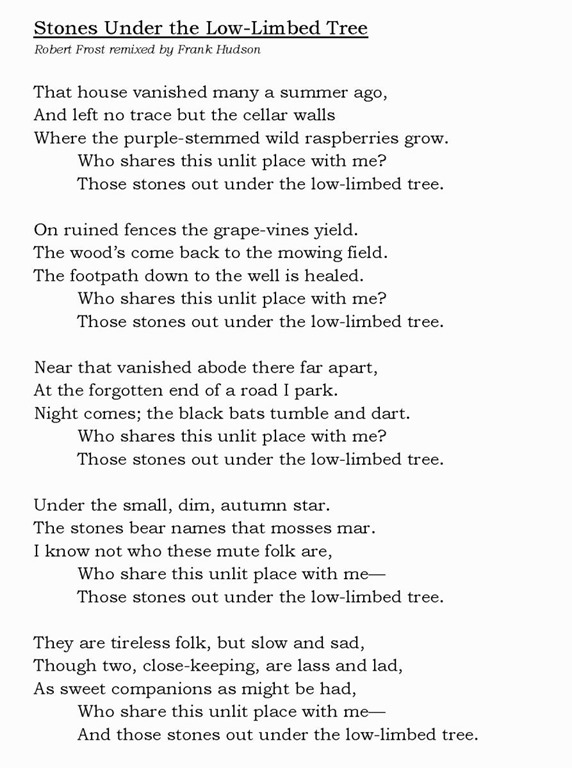
Our Halloween Series begins with “Stones Under the Low-Limbed Tree”

What’s coming up? Halloween! And I’ve decided to dedicate the rest of this month to accelerated posting of some of the Parlando Project’s favorite pieces of fright, fantasy, and the uncanny. There will be ghosts a-plenty, curses, creatures, spells, and graveyards. The Project has done over 700 combinations of various words (mostly literary poetry) and original music over the past 7 years or so. The poetry is of different styles and eras, and the music differs to, at least as much as I can make it do so.

Here to kick things off is a poem by one of America’s favorite poets, Robert Frost, that I adapted and recast in making it into a song. Can Frost do eerie clothed in nature’s homespun? I think so. Frost called his poem Ghost House.”   I revised it enough that I decided to use a different title when I presented it in 2020 as “Stones Under the Low-Limbed Tree.”

If you compare my lyric to the original poem hyperlinked above, you can see I refrained things more than Frost did in his page poem

.

You can hear the resulting song with the audio player below. No player to be seen?  This highlighted link is an alternate way to hear it. It’ll open a new tab with its own audio player.

.

Quiet Sanctuary

I have trouble at poetry readings.  Oh, I enjoy them, but they tend to spark off ideas and associations* in my mind. When I come back from those jumps in my consciousness the poet reading in front of me may have gone off to the next poem — and I feel like I have been delinquent in my duty as an audience.

A couple of months ago at the poetry reading series I try to attend regularly,** a poet was introducing a poem, and somewhere in between that poem’s introductory material and the poem itself this connection, this metaphor, occurred strongly to me. I don’t now recall what it was the poet reading said. Was it something about an acoustic guitar? Possibly. Something about a church? Maybe. That I can’t remember says something about the utter rapidity and completeness of my leaving that room and into the germ of this poem.

Quiet Sanctuary

Here’s the poem presented as a chord-sheet with the guitar chords I used to accompany it.

.

I saw immediately the churches of my parents’ and grandparents’ generation, small Midwestern US churches. Usually wooden and white with a steeple’s neck outside, and inside largely one room, the sanctuary within the single story, filled with dark brown wooden pew benches. A basement below, small children’s bible class spaces and a kitchen that smelled of brewing coffee, the sanctum of wives, mothers, and grandmothers of the congregation after weddings, funerals, baptisms.

South Marion church

The particular church most in my memory is decades gone, but this nearby one will serve as an example.

.

When one thinks of churches, I suppose some think of grand spaces, cathedrals or those more modern large urban churches built to approach that scale and presumption. Weighty stone buildings, as unresonate as tombstones, intricate carvings and décor. Grand halls, chambers, perhaps a pipe organ, for they are the pipe organs of buildings, elaborate and encyclopedic, overwhelming anything human that would manipulate it.

The modesty of those small-town Midwest churches, the woodiness of them, has its own glory. And so it seemed natural to connect them to a instrument that is somewhat of a point of origin to me musically, the acoustic guitar.

I don’t know how well this little poem will communicate that to those who do not share my experiences with those buildings. I accept that a poem can’t be everything. There’s one detail in my poem that might not make sense or image to some readers: the attendance list. In my recall, it was common for these churches to have a board that toted up the attendance for the last service. I’m not sure that sign’s entire purpose. To remind those in the sanctuary that they were part of a continuance? Could be. The small continuances are what these churches contained.

You can hear my musical performance of “Quiet Sanctuary”  with the audio player gadget you might see below. No player to be seen? I offer this highlighted link as fall-back then. The link will open a new tab with its own audio player.

.

*It occurs to me that I rarely have ideas as such so much as I have associations, things that seem to recall other things or suggest other things yet to be connected. It’s possible to write poetry without the poems containing metaphor, that kind of association, but most poets don’t. That trait may be why I’m drawn to poetry.

**That reading series, held the second Thursday of the month in St. Paul Minnesota, is the Midstream Reading Series. I know some of my readers are from the Twin Cities area. I find this event worthwhile, and you might too. Though I’m often inarticulate in person, I would try to say hello if you were to greet me there. Next reading is this coming Thursday, October 12th.

Come August, September

The usual remit of this Project is to take words — somebody else’s words, words that were intended as literary poetry — and to combine them with original music in some way. Every so often, I’ll use my own poetry, but the journey there is similar, not like most songwriting where the songwriter will as likely as not begin with a tune, or a set of words that seem to emerge with a tune.

But I have written that way. No one can spend as much time with music as I do without having the music muse show up dancing with the lyric muse sometimes. Today’s piece is an older composition, one that I considered posting for the Parlando Project since its beginning years ago. You haven’t seen it before today because of that difference, because it always was a song.

I recall distinctly how this song began. I was reading an interview with Brandon Flowers, the lead singer of the modern rock band The Killers. In it he wanted to make plain that for all the traveling showmanship and flash of that part of his life, he was a guy who grew up in a small town where one could see a farm tractor driving down a main street as an unremarkable occurrence.

Bang!

As I read that I thought of the small mid-century Iowa town I grew up in. A tractor on main street? Yes, that had never registered as unusual until this other person made a point to remember that. A version of this song came quickly from that moment of coincident remembrance. Taken back to my mid-century small town in my mind, I could see this teenage schoolkid who had a springtime crush on a fellow classmate, but who couldn’t get up the nerve or words to speak to her of his feelings. And then it would be summer vacation. In my town, my school, in my time, most of the kids lived in the surrounding countryside and disappeared from the town outside of the school-year.

And eventually, as I saw this kid in my mind, this time of year, late August, would arrive. He’d have another chance to speak to her. Would he have the courage? He knows half-way at least that he might not. Does he? We never find out.

Good Tractor 5

Another AI generated image. I couldn’t get the AI genie to generate one of the tall, narrow farm tractors I remembered from my youth, so I had to settle for this.

.

A version of the words came out fairly quickly as I inhabited that kid’s mind and the tune was nearly there simultaneously. The somewhat odd phrase that became the refrain and title was there from the beginning. I don’t know why that phrase came to me. Researching, I see there was a 1961 Rock Hudson movie with the title Come September.   Not a small-town setting, more the Italian Riviera. Our little town did have a movie theater then, or that film might have played on our black & white TV as a “movie of the week.”  Bobby Darin was also in the film and wrote music for it, including a title-tune “Come September.”*  That title laying fallow in my unconscious is plausible — but whatever, I like my variation, as the overlap from late August to September seems a distinct “month” on my calendar, and perhaps yours.

Maybe I should have performed this with a full rock-band setting in honor of The Killers, but my mood and logistics brought this voice and acoustic guitar version out instead. You can hear it with the graphic audio player below if you see that. No player? This highlighted link will open a new tab with its own audio player.

.

*I checked this morning, it was an instrumental.

There’s No Reception in Possum Springs

I asked the teenager if they had any ideas for a poem I could use for May Day, the international workers day. She thought for a minute and then said, “Well there’s one, but it’s from a video game.”

Have I intrigued you? Perhaps only the unusual folks who follow this project might be. May Day. Video game? Poem? Maybe even: teenager? Every one of those things are keywords that might drop readers. Add that your author is an old guy, one not very hip to video games, and I don’t know how many are still reading by this paragraph.

Still here. Good — because the poem is excellent, and we’ll get to it in a moment. First, a short summary of the context it came from. The video game is titled Night in the Woods.  It’s now around 5 years old, and it seems to this outsider to have an unusual premise: it revolves around teenagers and their peer relationships in a declining industrial town of Possum Springs. There’s a mystery to be solved, at least after a fashion, but the richness of the characters and their milieu makes it more a novelistic experience than a puzzle escape room or series of mini to macro baddies to battle. Oh, and did I mention that the characters are anthropomorphic animals?

Sound cute? Well, here we go with opposites again. Mental illness and violence are part of the world. Nancy Drew Case-Of… or PBS Kids style animal parables this isn’t. Our main characters are teenagers, and yet the weight of this world is on them — and the world, despite the fantastic elements, is our world, set in the declining rural America inhabited not by animated animal-faced kids but by a gig economy and our new-fangled robber barons.

The poem is spoken in the game by a minor character — in the nomenclature of game mechanics, a non-playable character — a spear-carrier in this small-town opera. I’m told she appears in various episodes as the game proceeds, speaking funny little poems while the foreground, playable characters, deal with weightier things. As she starts to read this, it’s not clear from the opening words that this poem isn’t just another little sideways humorous piece of verse.

It’s not. Yes, the people in it, the working class this May Day is ostensibly for, are counted as small, but the poem builds in its litany of smallness increasing, of inequality compounding. At the end the poet-character finishes stating her dream of justice. In that night dream, she’s alone, and that’s why it’s a dream — and will always be a dream on those terms. A century ago when the Wobbly songwriter Alfred Hayes dreamed he saw the dead Joe Hill, Joe Hill tells him to organize. When Martin Luther King said “have a dream” he was standing in front of thousands who’d say it with him. That’s why we have a May Day.

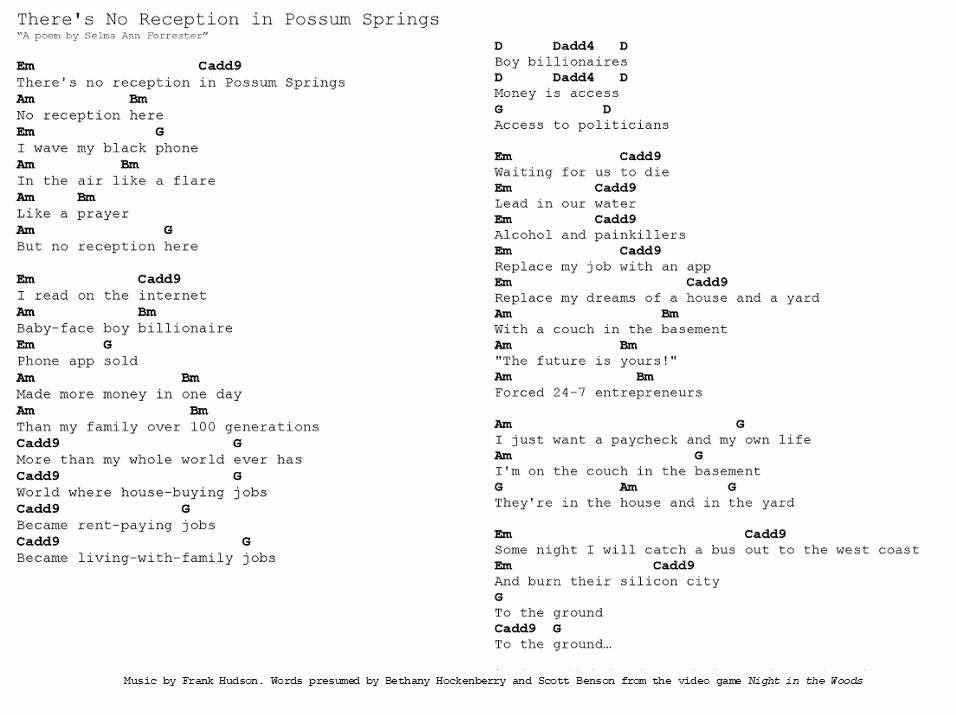
Here’s the poem presented as the chord sheet that I performed it from today, credited to the fictional character in the game. Best as we can figure, the actual authors of the game’s dialog and therefore this poem are Bethany Hockenberry and Scott Benson.*  The chords listed show the chords I was fingering on guitar, but I had a capo on the first fret in this recording, so they sound a half-step higher. The main reason I’ve been presenting these chord sheets is that while I do my best in my rapid production schedule on these pieces, I figure others out there might do a better job with this. One person singing a song is a performance. The second is a cover version. More than that, and it might be a folk song!

There's No Reception in Possum Springs

.

To hear my performance there’s an audio player below. Player not there? Then this highlighted hyperlink will open a new tab with its own audio player.

.

*They have no connection with this performance, other than the eloquence of the words impressing my daughter and then myself. Apologies in that I hurried to do this for May Day and haven’t contacted them.

Completing my National Poetry Month daily posting with two beautiful pieces

It’s been quite the job of work to do daily posts with new lyric videos here this April in celebration of National Poetry Month, and I haven’t taken the time yet to see what impact those extra efforts have had. Though I was re-releasing already recorded audio pieces from the earliest years of this six-year Project this month, even the fairly simple lyric videos took more time than you might think — and then there was the selection of which pieces to present, as well as writing a few hundred words on what I currently thought of each of them.

Well, not only is today the last day of National Poetry Month, it’s International Jazz Day, and I felt I needed to make a nod to that today. So, let’s play two!

The first piece is, I think, one of the prettiest of the more than 600 performances we’ve presented: Carl Sandburg’s “Autumn Movement.”   Sandburg gets tagged as an urban poet, and of course he broke into the scene with Chicago Poems in 1914. But he grew up in a more downstate Illinois town, and traveled around the less urban areas of the country before spending the majority of his “now you’re famous” years on a small goat farm. “Autumn Movement”  is from his 1918 Cornhuskers collection, which as you might expect from its title is not all city living.*

Here’s Sandburg with farmland not skyscrapers

.

While “Autumn Movement”  is short in word-count, I did get to playing a bit as I tried my best to approximate in this piece the stylings of Bill Frisell with my Telecaster and fretless bass. Frisell, who can play more contexts more better than I can properly imagine, is usually labeled a Jazz guitarist. I’m not, labels or otherwise. I just have a lot of guts — but the result is  pretty.

As per our April thing, you have three ways to hear “Autumn Movement.”  You can use the player gadget just below. No gadget?  This highlighted hyperlink will do it too. And the lyric video is above.


.

And the bonus second piece? “Sonny Rollins, The Bridge, 1959”  is not an early performance (I performed and presented it earlier this year) but for International Jazz Day I thought it’d be good to have another piece that not only uses Jazz musical flavorings but actually deals with being a Jazz artist — or by easy extension, an American artist in any medium. If I’m not a proper Jazz composer or musician, I take great strength just from considering their achievements, their dedication, their originality. Given that most of the giants are Afro-Americans who’ve had a whole ‘nother level of obstacles and expectations to get over as serious artists — well, the mind boggles and the heart swells considering them.

And one more chorus: three ways to hear it: the graphical player just below this, the backup highlighted hyperlink, and the lyric video just a bit lower down on the page.

.

I hope this experiment has been enjoyable for the regulars here who may have joined the Parlando Project already in progress and who perhaps haven’t heard the earlier pieces — and it was my hope that it would also bring some new readers and listeners into the fold. If you’re one of those: welcome! I’m not predictable in what kind of poetry or music I’ll use, but I do consistently try to keep it interesting and varied, and I’d sure like to have you come along with me as I do that.

And here’s my ode to the inspiring Sonny Rollins in lyric video form

.

*I’ve always enjoyed the story of Bob Dylan seeking out Sandburg as the younger singer was just starting to reach a level of national fame in 1964. While trying to locate Sandburg, Dylan was unable to get the locals to recognize a “Sandburg the poet” he was seeking, but then they asked back if he was looking instead for “Sandburg the goat farmer.”

Robert Frost wrote a lot of poems about rural life, including many of his best and best remembered, but his contemporary Sandburg, Mr. City of the Big Shoulders, probably spent more time around actual farms and farming.