Carl Sandburg’s Band Concert

A break in the influences as memoir series here, that theme that I’ve fallen into doing for National Poetry Month? Maybe. I’m going to present a new performance of a Carl Sandburg poem — but before that I’m going to talk about another writer, Rod Serling. Serling wrote a variety of things, but he’s best known for creating and hosting, often presenting his own scripts, the mid-century TV show The Twilight Zone.

I’m doubtful young people watch the old gray half-hour Twilight Zone  episodes anymore, though they are still available in various ways — but people younger than me certainly did, and to some degree still do. That generation between today’s youth and my old age has sought to revive it under its original title or in spirit, and they still talk between themselves about the original episodes and their hard to reproduce sensibility. I remember being in a creative writing class back in The Seventies, with folks maybe five years younger than me, and I was surprised at how often they might refer to some TZ episode instead of a Greek myth or some piece of literary poetry. SF/Fantasy fandom has grown a hundredfold since, it’s the backbone of popular narrative culture now. The SF/Fantasy memory-hole village that was Twilight Zone’s  once, has become a crowded inner-ring suburb, neither new-hot nor charmingly old-fashioned.

One episode of that series, one that came early in the show’s 156 episode run from 1959 to 1964, appears on some of the middle-generation’s “best of” lists, though I think there’s a strangeness that it does. Titled “Walking Distance”  it’s tied very clearly to Serling’s own Greatest Generation memories, not as much to my generation who might have watched it on its first run, and I’d expect not-at-all to those younger than me. To summarize the plot without spoilers I’ll say the story is that an overworked and worried 1960 advertising man ends up walking in the countryside and enters his old hometown, the allegorically named “Homewood,” where he grew up before he left for New York City. He finds it not the present town in 1960, but the town of the 1920s.Given the number of time-fantasy stories written since then, not that unique a setup.*

Well, is a poem about a poet hearing a bird sing, or mourning a dead intimate, or finding themselves awash in desire all that unique? “Walking Distance”  works, if it works, on performance and from the strength of the slightly wordy** but emotionally resonant script. A feeling of nostalgia — more than that, the feeling of wanting to be able to walk one’s childhood places in dimensions more palpable than memory is something easy to evoke in us. Serling’s script wants to draw a bit more than just all the feels in this situation — but let’s face it, all the feels, the range of edges soft and sharp of them, is the powerful engine here. That engine is strong and universal enough that I can feel the lost 1920s that Serling evokes, even if I never lived them.

Which brings me to Carl Sandburg and today’s poem for performance, “Band Concert.”   Published in 1918, it presents itself in a poetic collection of contemporary portraits of American places and people that Sandburg has observed in his travels. The night of the band concert in this poem — while in Nebraska instead of upstate New York — is closely contemporary to Serling’s Homewood. Poet Sandburg is roughly 40, so while the scene in his poem is set in the now, the poem views the kids half his age re-enacting things that are already past for our storyteller.

If one knows the history of American music, Sandburg can be decoded as knowing that the Nebraska city is a few decades behind Chicago or New York. The band seems to be playing rags, the craze of the turn of the century, not of 1918. A small-town kid who had long left for the biggest cities in America, Sandburg can compare the giggles of the kids to the “Livery Stable Blues,”  a landmark early Jazz recording where white musicians produced outrageous instrumental sounds imitating farm animals. “Livery Stable Blues”  was released in 1917, and Sandburg was an early Jazz-bug — but he’s not knocking the Nebraskans for their music. He’s celebrating it, and them. And after all, cowboy rags and Negro*** rags, would be in the repertoire of Carl Sandburg the folk musician who would be including a set of guitar-accompanied songs in his poetry readings.

Walking Distance x4

Homewood’s park and our 1960 visitor, dressed much as script writer & host Serling would be. Town square park and bandstand from my grandmother’s town. Bandstands in towns were common enough in my Midwest, so I forgot this elegant one, but I did remember the alligator.

.

In time-space, I’ve never visited Serling’s Homewood, nor the Nebraska place Sandburg is reporting from. Those are my grandparents’ times. In my own midcentury I’ve been to their outskirts close enough to see the band pavilion in the park or square, the full summer dresses, farm boys when that was a common occupation rather than employees of feed lots, and I’ve walked the sidewalks past the lattice shadows decorating porches. I can translate some from their writing. Serling, Sandburg, my grandparents, they know “more of the story.” Which is us — time, space, placental barriers away.

You can hear me perform Carl Sandburg’s “Band Concert”  with a rock quintet which has no tubas nor cornets in this concert. Audio player gadget below, alternative link here for those who don’t see a graphical gadget.

.

*Twilight Zone  itself did another well-loved episode later with a very similar setup: “Next Stop Willoughby.”

**As if poets have standing to complain about the use of words to portray things, rather than filming a chase, fight scenes, or calling in a CGI render farm.

***Those who go to the original text linked here will note that Sandburg uses the n-word in this poem as he does elsewhere in his early poetry. I’ve “translated” it. Sandburg also uses the general range of derogatory ethnic names of an era where “white” by the conventions of today wasn’t then a monolithic block, but instead was segmented into many othered creatures to be devalued with rude names and determinatory stereotypes. I’m not a Sandburg expert, nor am I the one to rule on what’s racist and what’s documentary, but what I’ve read of Sandburg says to me that he was intentionally anti-racist.
Poetry in Gray, Part 1

Continuing our exploration of National Poetry Month, let’s open another door. You unlock this door with the key of imagination. Beyond it is another dimension—a dimension of sound, a dimension of sight, a dimension of mind. You’re moving into a land of both shadow and substance, of things and ideas…

Yes, I’m speaking of mid-20th century TV, and specifically The Twilight Zone.  Once more there is a revival of this series, helmed this time by the talented Jordon Peele. I think there’s something difficult in his task, one that may not matter in terms of audience or financial success, but one that I notice when I look at the old gray-screen stuff from 60 years ago. It’s two of those qualities I look for in poetry: compressed expression and memorability.

If older people remember some of those shows like poems, it’s because they were much more like poetry than prestigious television is today. For one thing the 30 minute drama was a thing. Isn’t this odd? We talk today about ever-shorter attention spans incessantly, as if we ourselves have forgotten that we’ve already talked about that subject—but the predominant television format today is the video equivalent of the serialized novel. Even the basest form of “reality TV’ shows are season-long arcs of hour-long episodes, and most of the prestige shows intelligent critics like to write about unwind over multi-season plots. That’s a valid concept, but it isn’t the only possible one. Those old 30 minute shows had to express the experience and clash of ideas fast, they weren’t about long-form character dynamics, they were about epiphanies.

Do folks feel they remember 21st century television episodes, in a sense they possess them completely as recollections of sensations and apprehensions; in the way that one possesses a poem, even one not completely memorized, where one may hold and carry a key stanza or final couplet in our mind?

There are several Twilight Zone  episodes that seem to have the quality of memorability shared with poetry. For the literary sort, the 1959 first season episode “Time Enough at Last”  starring Burgess Meredith as a man who so loves to read books would be one. The gist of the story is so memorable I’m not going to summarize the plot, because you’ll remember it if you saw it. If you haven’t seen it, it’s worth the 25 minutes of your time, and there will be no spoilers here. Only the final (spoilers!) scene is available on YouTube, so don’t go there, but I expect some streaming services will have it.

Instead I’m here to note two small things you may have forgotten, though I have no idea if Twilight Zone’s  creator, producer, and screenwriter of this episode Rod Serling intended these details.*

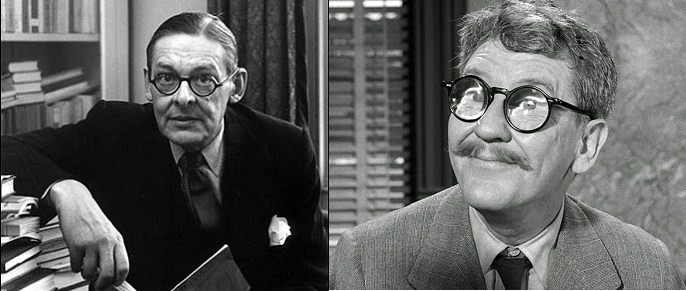
TS Eliot and Harold Bemis

T. S. Eliot and Harold Bemis played by Burgess Meredith. Two bank clerks who’d rather be reading.


First off, Burgess Meredith’s character, Harold Bemis, works in a bank and his marriage is spectacularly dysfunctional. I found it odd that I hadn’t remembered the key scene between the married couple, which is so intentionally cruel and specific as to equal or exceed the empty-hearted offhand cruelty between men and women in “The Waste Land.”  Even if the wife’s character is stereotypically shrewish, the ending of their scene is so heartbreaking that I can’t say why it isn’t more remembered. Of course, the whole sexual politics of this echt-’50s trope of the controlling female denying the freedom of the male should be bothersome, but did the TV show intend to reference the scholarly T. S. Eliot circa the writing of “The Waste Land”  then working in a bank, famously hamstrung by his own dysfunctional marriage?

Probable? I can’t go that far, but it’s more of an outside possibility than you might think. T. S. Eliot was never Tennyson or Longfellow famous, but in the 1950s he was as well-known as a poet could be then**, and poetry was still considered something of a co-equal branch of literature, a substantial part of culture.

And that was the other detail that stood out watching “Time Enough at Last”  again. The couple’s scene revolves around Harold Bemis wanting to sneak a read of a book. A classic novel? A bit of science fiction or fantasy? Hemingway on bullfights and fly fishing? The Second Sex  in French? A hard-boiled detective yarn? Philosophy? History? A collection of “Can This Marriage Be Saved”  columns?

No, it’s A Book of Modern Poetry.  Bemis’ character says of it “This has lovely things in it, really. There’s one or two from T. S Eliot. Edna St. Vincent Millay. Robert Frost. Carl Sandburg.” My ears perked up. That’s the kind of stuff you find here!

Now Harold Bemis is also a stereotype, the nebbish, maybe the idea that the thing his domestic bank clerk life most wants is modern poetry is meant to underline that caricature—that he’s too bookish. It’s not like he wants to anachronistically read The Art of the Deal.  Despite the sadness of the scene, it cheered me, it could also mean to say, even a little, that that is what he needs.  And in any case, Serling at least thought that an audience in 1960 would know these poets in some way, even superficially. If Jordon Peele or someone would rewrite that scene today and his modern Bemis was to speak of Frank Bidart, Tychimba Jess, Peter Balakian, and Gregory Pardlo*** as the lovely things he most wished to read, would the audience read anything in those names?

Well those four poets could well have as much or more to say to us. Why wouldn’t they? On the other hand, I can perform the older poems I use here freely as I encounter them, and it would be a chore to try to get unencumbered use of current poets for my small project. So, here’s my performance of Carl Sandburg’s “At A Window,”  available with the player below, and full text to read along here. All four of the poets he mentions in his scene would have difficult messages that still might console Bemis, all four could write a lovely line, even about harrowing things. But I’d choose this one from Sandburg for him to read aloud.


*Serling’s screenplay was based on a 1953 If magazine short story by Lynn Venable. Venable also has Harold Bemis as henpecked and working in a bank, but her story has Harold’s spouse so dead-set against him reading that it’s said he hasn’t ever been able to finish a book, and the only book author name-checked in the entire story is Spinoza. Her scene between Bemis and his wife is told in a much blander flashback.

**Before there was a national poetry month, on April 30th 1956 T. S. Eliot spoke in the Twin Cities, filling one of the largest capacity basketball arenas in the country (somewhere between 14,000 and 18,000 capacity)—not for a mythic men’s Final Four between Eliot, Robert Frost, Wallace Stevens and Carl Sandburg, but for a solo lecture sure to pack’em in today: “The Frontiers of Criticism.”

***Those are the last four winners of the Pulitzer Prize for poetry. Unfair! Bemis’ book was an anthology of modern poetry, those poets he longs for all had been publishing for 40 years. But just for contrast, here are the poets who won the Pulitzer in the ‘50s, “recent years” to the 1959 TV screenplay: Gwendolyn Brooks, Carl Sandburg, Marianne Moore, Archibald MacLeish, Theodore Roethke, Wallace Stevens, Elizabeth Bishop, Richard Wilbur, Robert Penn Warren, and Stanley Kunitz. Of course, poets in your rear-view mirror may appear larger/greater than they are to contemporaries, and it does look like the Pulitzer committee was more likely to give “lifetime achievement” awards in the ‘50s than they have been in our century.