Two Views of a Lunar Eclipse

We seem to be in a month of sky omens in the Midwest, with the Perseids meteor shower and a solar eclipse following one after the other. Perhaps because solar eclipses are rare, poems about them are rare too. I’m going to cheat then, and present two pieces about lunar  eclipses, a slightly more common event that occurs when the Earth comes between the Moon and the Sun, blocking the moon‘s reflected shine.

I’ll lead off with one written sometime in the 19th Century: Thomas Hardy’s sonnet “At the Lunar Eclipse.”   I remember the moon-trip photos, taken near the middle of the 20th Century, looking back at Earth, where for the first time, we could see our planet whole. Hardy reminds us, a hundred years before that, that we could see our whole Earth in a shadow play during the lunar eclipse.

Whole Earth Catalog

For the first time we could see the big blue marble
…also, composting toilets!

 
Optimists at the end of the 1960s thought these whole Earth pictures would help us understand our solitary yet majestic unity and common cause. Hardy, though he had only the Earth’s shadow during an eclipse to work with, is not so sure.

The LYL Band’s performance of this Hardy poem is a live recording from a few years back and it strains to reach “bootleg tape” recording quality, but still I hope it retains some vitality.  And since this Hardy poem is referenced in the next piece, I’m going to give this rougher recording an airing.
 
Though neither I or the Parlando Project had anything to do with it, if you’d like to hear a restrained and lovely simple solo voice and piano sung setting of the same Hardy poem, you can view it here. To hear the LYL Band performing our louder version of Hardy’s “At the Lunar Eclipse” use the player just below this.

My own lunar eclipse piece is set in our century, and in my Midwestern place. I start off by musing on the same planetary shadow play that Hardy wrote of, but wondering if we were our planet, might we make sport of our standing between the sun and moon, as we did as children when the film strip broke in class, or the slide tray of vacation photos needed to be changed, by making hand shadow puppets in the light. Then, as the blood moon eclipse neared totality, and the dark was dark, save for the streetlight at the end of the block and a houselight here and there left on, every hand up and down the street raised itself to the heavens, holding their lit smartphones, as they took pictures of the moon blocked by ourselves on our planet.

2015 Blood Moon Eclipse

A blood moon eclipse. “Can immense mortality but throw so small a shade?”

Unlike our last pairing, the perennial face off between Marlowe’s Shepherd and Raleigh’s Nymph’s reply, my poem “Lunar Eclipse – The Earth in Transit between the Moon and Sun”  isn’t really an “answer song” or a diss on Hardy. In a lot of ways I wanted more to simply update the scenery of Hardy’s poem. Oh, and that title is awkward, but enough listeners didn’t know the mechanics of a lunar eclipse, that we are in the middle on the earth blocking the Moon from the Sun.

What did I mean by the last line? Well, as I sometimes do, I wanted to mean several things. I wanted to say we thought we could capture this cosmic event that had stopped our routine in with the birthday pictures on our smartphone camera roll. I wanted to say, as Hardy did, that we are seeing the whole of our planet, the lives of all our neighborhoods, yet it is only one disk in the wide sky. I wanted to say that our present, particular lives: all our details, our family, our neighborhoods, our homes—though they are the way we experience living—are but one transit of life. Maybe I wanted to say something else that even I wasn’t sure how to say? If so, I wouldn’t know. Sometimes that happens in poems.

Again, we have the LYL Band performing this piece, but it has better recording quality. To hear it, use this player just below.

Up-Hill

Last post I compared late 19th Century cultural hipsters with early 21st Century urban cultural revivalists.  Did modern natural-fiber clad, skin-inked and perforated young people study up on William Morris’ Arts & Crafts movement and visit museums to absorb the Pre-Raphaelites? Some perhaps, not all. And the same can be said for what is carried onward from punks, hip-hop kids, hippies, beatniks, and so on. I’m too old, and too little a sociologist to answer this definitively.

I can say that when I tried to discover what kind of music I wanted to make in the 1970s I copied imperfectly many musicians from the previous decades as well as my contemporaries working down the river in New York City. And those NYC contemporaries? They too were looking backward to move forward. What had been overlooked? What had gone out of fashion for no good reason? What had been uncompleted? So, in listening to them, I was listening to their understanding and misunderstandings of the past too.
 
One of our principles with the Parlando Project is “Other People’s Stories.” Part of the above is “my story”—but my musical story is really made up of other people’s stories.
 
Tracing the path of influence is often hard to do. Today’s piece Up-Hill  is an example. The words were written by Christina Rossetti, that sister of the Pre-Raphaelite Brotherhood. Obviously, she’s familiar with the Pre-Raphaelites and their circle—but she’s also deeply interested in a Christian religious revival, and that too gets reflected in “Up-Hill.”  Would she have known Anna Coghill’s poem that was set as the hymn Work for the Night is Coming?”  That’s unknown to me, but “Up-Hill”  and “Work for the Night is Coming”  are both poems understood in context as being Christian devotional, while containing not a single specific utterance about a deity, salvation, or an afterlife. With revivals, context changes things.

Christina Rossetti

Christina Rossetti thinking about an up-hill journey?


And here’s another way that influence is hard to trace: it becomes unconscious. As I was writing the music for “Up-Hill”  I was mostly interested in varying my customary harmonic cadences while keeping it to just two or three chords, a short number that often works best for performance with the LYL Band. And “Up-Hill”  is, after all, a work of beautiful simplicity, saying something profound without pretentious elaboration.  I settled on a simple I V IV I progression, and tried it with the band last month, but my vocal wasn’t working. Trying again this month, the unconscious struck.

VU - Shall I Meet Other Wayfarers At Night

“Shall I meet other Wayfarers at night?” The Velvet Underground  certainly think so.


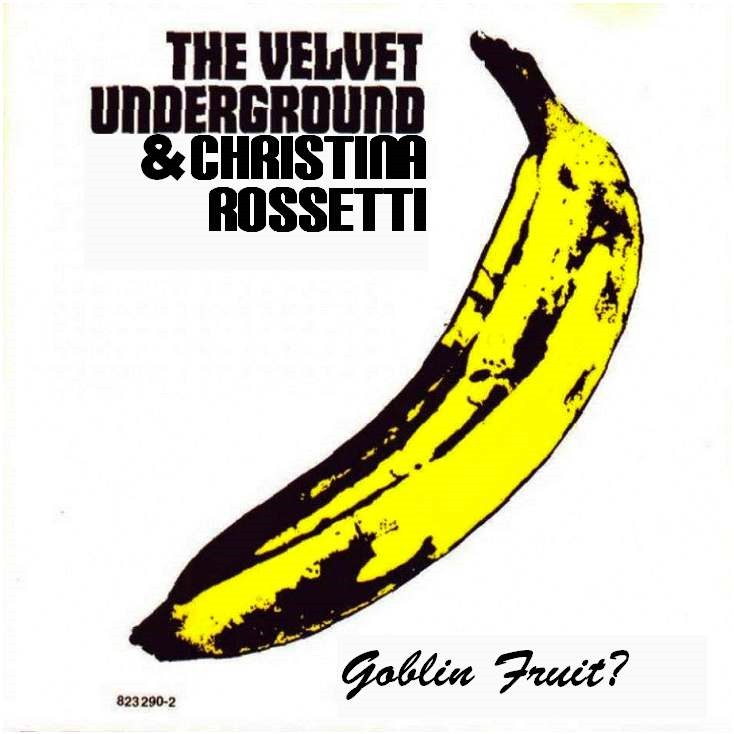
I didn’t realize until I was working out the rhythm track that I was falling into a Velvet Underground groove, like the one they used in I’m Waiting for my Man,”  a tune that is also understood as devotional in context—though to drugs, not a deity. Both songs feature a journey to a destination (up-hill or up-town), both engage in conversation along the way. Was this subconscious choice a sly comment on Christina’s brother Dante Rossetti’s addictions? A comparison of recovery to salvation, or of addiction to salvation?  No, the groove was just working, and it helped me get a better vocal down. If I understood anything about what I was choosing while doing, it was that I was linking sub-cultures and following the near invisible web connecting Other People’s Stories.

Velvet Underground and Christina Rossetti Cover

So what would that sound like? Use the player below to find out.


Same as always, the player should appear below.to hear the performance of “Up-Hill.”  And keep sharing the links, subscribing, and telling folks about the Parlando Project.

Print the Myth

A few posts back I mentioned that the Parlando project keyboardist and alternative reader, Dave Moore had visited Native American mound sites along the Mississippi river this year. He’s working on a series of pieces*  about the largest of the mounds, Cahokia in Illinois. Here’s one of them.

In that August post about William Cullen Bryant’s “The Prairie” I said that when Bryant wrote a poem about Cahokia he borrowed from “from some 19th century mythologies.” For focus and brevity, I left those myths out then, but I wanted to come back to this, because it’s important. In the 19th Century as US exploration and settlement moved westward from the eastern seaboard and these elaborate earthworks were viewed by folks like Bryant, there was a lot of unexplained mystery about them. And explaining mystery is the work of myth. Sometimes poetry joins in that work.

When poetry joins in that, explains mysteries, it faces great dangers. One danger is simple: their explanations can just be wrong. After all that’s another way we use the word “myth,“ to mean something that has been shown to be untrue. Bryant and a host of 19th century explainers of the North American mounds and their builders almost certainly fall into that trap.

You see, when these worthies saw the mounds they thought that they had to have been constructed by some people who were not Native Americans, or at least not the Native Americans who were soon to suffer occupation and displacement from those Eastern settlers. That’s another problem with explained mysteries. Sometimes the explanations are a little too convenient. You don’t have to think much to see the subtext here:

“Why, we don’t have to worry about displacing or even killing the folks who are already here, they did the same to those disappeared builders of these great earthworks.”

Myth gets complicated. We can see the ignorance, prejudices and racism that helped feed these 19th century settlers, but that doesn’t mean we can see our own current ones more clearly than they could see theirs. I often think of the title of the beautiful and wry Leonard Cohen’s first collection of poems “Now Let Us Compare Mythologies,” the title poem of which includes the line “I have learned my elaborate lie.”

One of the virtues of music is that it cannot explain mysteries, though it can sometimes help you experience them.

Now, back to Dave Moore’s piece “Print the Myth.” Dave wrote the words for “Print the Myth,” and he concisely goes into these issues. Dave is also the voice on this one. It was only my job to supply the electric guitar part. This is a live first take, spontaneously exploring how to present Dave’s words about the explanations for the mounds. As such, there are a number musical mistakes. My tastes allow for that. Dave himself thinks his performance wasn’t up to snuff, and I disagree thinking that the energy of the discovery overcomes the rough edges.

So if you want to hear a couple of poets and musicians constructing a way to tell the story of how the mounds were misinterpreted by Bryant and his contemporaries, click  the gadget below to hear “Print the Myth.”


*Dave published these pieces in a chapbook Rhythmic Stories & Prehistoric Mythteries  later in 2016. This book is not generally available alas. I don’t know if Dave still has copies, but if anyone interested could contact him through this blog.