Today’s piece from the two volumes of The Girls and The Boys Book of Verse pair is by a poet I’ve begun to revisit during the past year, Robert Louis Stevenson. Taken just as verse, Stevenson will impress the ears of adults and children alike as charming, but as I revisit his children’s poetry I’m finding additional resonances. So, let’s look very briefly at his “The Wind” today.
A chord sheet so you can sing this one yourself if you’d like. As you look at Stevenson’s poem here you can also participate by guessing if it was placed in the boys or the girls volume of the pair of 1920’s poetry anthologies I’ve been looking at all month. Answer below.
.
The two things the poem wants to establish about its title subject is the wind’s presence and its mysteriousness. It’s felt as a body pushing force, heard as gentle sound of fabric on grass. But its first-mover, its purpose, the meaning we are to derive from it, is expressed as unknown. The wind here is a symbol of motion. Those easily teleological or mythological might reduce this to a matter of God or gods. That might be Stevenson’s intent, and is likely some reader’s experience.
I prefer to find the poem restricted to what I see on the page, and there I find it as a poem of the growth and going of childhood. Stevenson chimes on that elsewhere in his children’s verse.
Do children feel that, that wind of their growth, or is it so merely there as to be unthought of? I, an old man on a bicycle this Spring, certainly think of it, wind in its expression of gusts. I huff and puff in it, mine a much weaker blowing back!
I’ve said this before but let me reiterate in this month when I’m examining a sample of the literature my parents might have experienced in childhood: a lot of good children’s literature speaks to the adult and the child with the same words, the same images — words heard, images seen, from two sides. I think that’s what Stevenson is doing here. The child will find the familiar feeling reflected on the page sensuously. The adult gets the mystery, the passingness.
In the final five days of this National Poetry Month, I’m going to try to move to completion a number of audio pieces I’ve got in various stages. The posts may come — will have to come if I do this — in rapid succession. I’m grateful for your attention, and I apologize if I will press or exceed it. The music for today’s piece is back to electric folk-rock combo mode: Telecaster guitar, drums and electric bass. You can hear my performance of Robert Louis Stevenson’s “The Wind” with the graphical audio player gadget below. Has that gadget blown away? No, you’re just reading this blog in one of the ways that suppresses showing that. This highlighted link will open a new tab with its own audio player so that you can hear my performance. And your answer to which of the two gendered poetry anthologies this poem appeared in: girls.
I spent Thursday recovering from a brace of winter vaccinations. I was tired and achy enough that I even missed attending my treasured monthly Midstream Poetry reading, but besides whatever mojo the shots might give me from winter respiratory crud, it made me grateful upon waking up Friday with my usual level of old-guy energy. I took a crisp 34 degree F. bike ride for a veggie sandwich and tea at a local bakery, and then spent a good deal of the day finishing some live LYL Band recordings from last September. Only then did I recall that I should do something for Veteran’s Day — or Armistice Day as it used to be called here in the United States. Armistice Day is still the name in much of the rest of the world that experienced WWI, and perhaps because I’ve been thinking a bit more about British poets this week, I quickly settled on two poems by British authors.
The post just before this one, Housman’s “Soldier from the wars returning” was the first poem I wanted to do, and it’s a straightforward poem of simple gratitude for a veteran’s service. The second one is a little stranger, and I made it stranger yet. Can we be sure Robert Louis Stevenson wished his poem “The Dumb Soldier” to be read as a whimsical piece about a child’s toy? He published it in A Child’s Garden of Verses after all.
There were no sensitivity readers for children’s books then,* but the nature of the poem’s story is not benign. It starts right out with the poem’s speaker burying a soldier, which from the text alone we don’t know yet is a toy. When we read “leaden eyes” we might get the hint that it’s a cast metal toy soldier — but if we were to hear this poem as I performed it, without context, sung by an adult, even that detail might not tell us clearly what is going on.
I leaned into that strangeness. I trimmed a couple of stanzas for better performance length and chose to truncate the final one, leaving off the reveal that this is a toy soldier that will return to the child’s shelf. This left this a more ambiguous buried soldier then unable to tell us anything about what they’ve seen.
Here’s the chord sheet for my version of Stevenson’s poem. To read his original text, here’s a link.
.
Although written decades before the first Armistice Day in 1918, this mode of the silent war dead is clearly apt for that holiday as celebrated outside the U.S.**
It was late Friday night before I was ready to perform these two poems as songs. I had music written, and for practicalities sake, I was able to quickly use my studio space to record the pair of songs with just acoustic guitar for accompaniment. Neither of these are perfected or sophisticated performances, they are more or less what you’d hear if I was to present them off the cuff. You can hear my version of “The Dumb Soldier” with an audio player below, unless you don’t see any such player. Some ways of reading this blog won’t display that, so I give you this highlighted link that will open a new tab with an audio player in those cases.
.
*”Dumb” used as a term for someone who cannot speak is now a highly impolite term. Given the sacrifice and suffering of war, that term’s objectionableness might be a lesser concern.
**Since the U.S. had an existing holiday, Memorial Day, for remembering those who died in military service, the U. S. Armistice Day became Veteran’s Day to celebrate all who served, particularly the living. Housman’s poem, couched though it may be in the particulars of WWI, speaks to that element of the holiday. As a mid-century child, I can recall Armistice Day was still used occasionally in my youth for November 11th since veterans and others who had experienced that war were numerous.
When I used a Robert Louis Stevenson poem last July I wasn’t expecting to follow it up with another. When introducing his “Bed in Summer” then I mentioned that writing poetry for children, as Stevenson was doing in his A Childs Garden of Verses, seemed to reduce some of the fustian of a lot of Victorian verse.
So, when I happened upon this other example from that collection I was even more struck by the sensibility of this one. Though I had no reason to believe Stevenson was intending visionary poetry, today’s piece could almost fit inside of Blake’s Songs of Innocence — though it was written a half-a-century after Blake’s death.
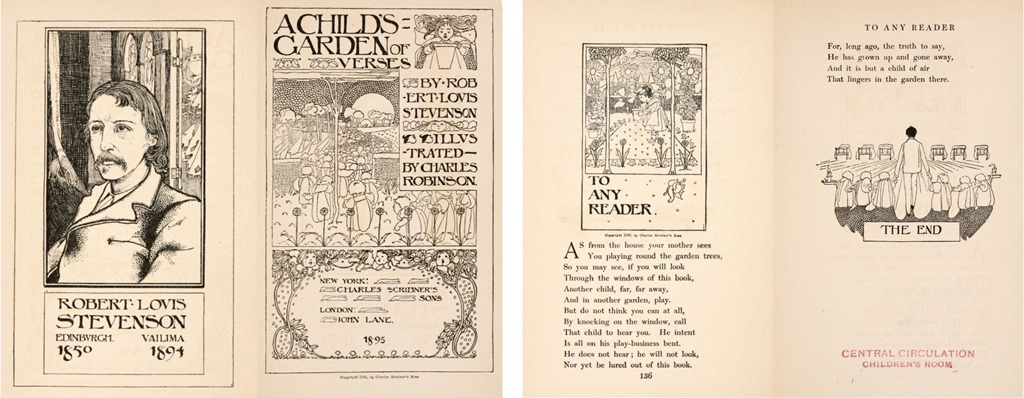
Here’s one illustrated edition of the book and the original text with Stevenson’s title “To Any Reader”
.
What was the author’s intent? I first read it as Stevenson making a pitch that even if the poems in his book might someday seem quaint and old-fashioned, they could still relate to like-experiences of some future another child. Was this canny foresight on Stevenson’s part? Stevenson was only 35 when he published this book, so his own childhood memories should not have been all that outdated as he wrote the material. On the other hand, his childhood nurse (to whom the book is dedicated) raised him on John Bunyan, stories from the Bible, and tales of 17th century Scottish Covenanters. That may have made him aware from a young age that tales from past times could be transmitted to young minds.
I do recall encountering A Child’s Garden of Verses as a young child in the mid-20th century, though I can’t say for sure where. Did someone read it to me in my pre-literate days? Was it a book from my parents’ library, perhaps a keepsake from their childhoods? Did I run into it while exhausting my tiny Iowa town’s small library children’s section?
I would not have minded if it was old-fashioned, for I was from a young age fascinated with the past. It could have seemed juvenile unless I came upon it very early in my reading years, but most editions were illustrated, and illustrations excited the ekphrastic in this young reader. Yet my recall on this is not that specific, I just remember that I had seen it. I have more recall of reading Stevenson’s Treasure Island and enjoying that.
Oddly, when I finally looked this week, this is not the lead-off, introductory poem in the book. Instead, it’s the final poem — not the place to make the case to continue reading “To Any Reader” who just happened onto the book. Instead, in this place, it’s a ghostly envoi, a reminder to the child (or to the adult reading to them) that they, their childhoods, will obsolete themselves.
As I did with Claude McKay a couple of pieces ago, I decided to adapt Stevenson’s words slightly for singing. Some changes were to make it less awkward to separate things into a series of sung verses. A couple of changes just fit better to my non-agile tongue. Most significantly, I devised a repeating coda to drive home a final summary to the listener. One subtle thing I did was a covert attempt to speak to my own child’s specific journey to young adulthood.
Here’s my version. Since I want to emphasize that other child of air, I also retitled the poem.
.
An uncomplicated folk-song style setting seemed appropriate. The chords today are simple for the guitarist, though the alt-tuning I used changes the sound of this simple chord progression slightly. You can hear my performance with the graphical audio player below. If you can’t see any player, I also provide this highlighted link which will open a new tab window with its own audio player.
Today’s text was written as a children’s poem by Robert Louis Stevenson. What it notices about the enticing longer days and late sunsets of summer is not limited to children however. I suspect many adults too find it harder to wind down when it’s still light and pleasant out.
They say I’m supposed to go to bed, but there’s birds out there, and where’s my phone or my Nintendo?
.
Stevenson published this in 1885 when some things of the earlier 19th century were wearing out. The voice of the child in the poem says they were used to arising from bed by candlelight in winter, and now they are going to bed in the still-daylight of a summer evening. How common was candlelight in a child’s room when this poem was first in print? Gas lighting had given its name to that age, and electric light was soon to become common. The adult Stevenson likely knew of such things, as I read his family business was lighthouse engineering. Perhaps Stevenson was recalling his own childhood, when humble candlelight was the norm? The collection that included this poem, A Childs Garden of Verses, was still in circulation in my mid-20th century childhood. I guess we young readers just translated the lighting technology, figuring that poems were from olden days when open flames in kids’ rooms weren’t problematic.
One thing Stevenson’s poem might have gained by being aimed at children is that it’s delightfully spare and unfussy. The adult verse of 1885 was often not so, but here there are no classical allusions, no high-flown metaphors, just that memory of candlelight, an evening’s sunlight, some active birds, and footsteps on the street. The poem is not idealized at all, instead it’s simply present in the child’s conundrum.
I performed it with a 12-string acoustic guitar, an instrument I always want to keep around in addition to the more common 6 string guitar. My music is simple and unfussy today, as is fitting for Stevenson’s poem. You can hear it with the audio player you should see below. No player? Some ways of viewing this won’t show it, but this backup highlighted link will open a new tab with an audio player then.
My Project says it’s about where music and words meet, yet I’m still surprised and gratified when I encounter literary poets whose connection to music is significant. Most poets enjoy music — hell, most people do. And the arts of poetry and music have long been siblings. Who can count how many poems have the word “song” in their titles, or how many poems speak of birds or unfeathered human musicians making music? Yet the number of poets who have publicly taken to composing and performing music is limited.
One might think that songs with words, the music most listeners prefer, would be already halfway accomplished by any good poet. In practice, that’s not always the case. A great deal of literary poetry doesn’t work like a song that captures listeners in real-time once in and through their ears.
What you say: “You do this all the time, you take literary poetry and you combine it with music!” Yes, but I’m choosing what poetry to use, rejecting much more than I even attempt to compose music for. And while I appreciate the audience this project has developed for your open-mindedness and tolerant ears, by Internet standards my Parlando musical pieces have a small audience. Part of that is my voice, which has its limits, and my reach-exceeds-my-grasp musicianship — part of it too may be that I’m no one’s young, good-looking, begging-to-be-discovered talent.
Last time I said I’d leave a fourth example of someone combining poetry with music that I’ve discovered recently for a future post. That one is poet, novelist, teacher and promoter of poetry* Joseph Fasano. In the midst of his very active social media presence this summer, Fasano let it (rather casually) drop that he had publicly released an album of songs, The Wind That Knows the Way.
Fasano is an effective promoter of his own work on Twitter, and he’s amassed (by PoetryTwitter** standards) a sizeable number, thousands, of followers. “Followers” in the social media world is something of a hollow stat. Many in the count are proforma or “polite” followers mutually responding to follows from others, and then there are bots and insubstantial accounts seeking merely to draw attention to their causes & businesses. But when Fasano posts a poem of his or a series of notices about his latest novel, he gets (by literary standards, or mine, whatever I am) lots of eyeballs, re-tweets, and at least a bit of replies and response. By PoetryTwitter standards, people are paying attention to him.
To my knowledge, he’s not followed up to that single notice about his album of songs. For someone showing such effective and continuous effort to promote the other things he’s doing, that’s odd. Even though getting ear-time from me for musical work is tough — composing, recording, mixing the Parlando Project pieces take away from those opportunities — I listened to the album (available on Apple Music, Spotify, and likely some other current music streaming services) within a few days of the announcement.
It’s good, and a particular surprising adds to that goodness. I guess I expected a typical modern musical production — either pop in pretense or a rougher indie one. When someone tells me they have a recording these days, that’s what I’ll most often hear. Instead, the album’s sonic approach is a remarkable duplication of an early 1960s Folkways, Sing Out, folk-venue-appearing guitarist-singer with original songs record. In arrangements and general vibe, it’s like the early records of Gordon Lightfoot, Tim Buckley, Jackson C. Frank, or Eric Anderson. For musical particularists, let me add I’m not talking about post 1965 records. At times Fasano’s voice and musical approach reminds me of a less gruff Tim Hardin, but Hardin’s most popular later ‘60s records used highly skilled bandmates to fill out his sound. The Wind Knows the Way is just Fasano and his acoustic guitar, but like the early ‘60s records I’m referring to, his voice is pleasant and his music appealing, while his lyrics express more emotional complexity and range than the average pop song.
Here’s the title song from Fasano’s album for those that don’t use Apple Music, Spotify, et al.
.
I don’t know who engineered this recording, but the recording is technically well done too. My favorite cuts on the album are “In My Time,” “The Trouble,” and “The Wind and the Rain.” I’m an outsider to Fasano’s creative process, but it appears to me that he already has a “song lyric” mode that both borrows from and differs from his page poetry. These songs don’t come at you with a strange torrent of unusual metaphors with hermetic connections between them. Song lyrics forgive, even arguably benefit, from less originality in tropes, from commonly returned to, simple, elemental words. Many literary poets have trained themselves to avoid those things — and so the Parlando Project sometimes asks the listener to allow more weird words and similes that one hears with most songs. Fasano seems to know that as a songwriter he can write differently for song.
I assume he wrote the music, though the modern streaming services and his sparce posting about the record make this only an assumption. His melodies are fine, not showy, catchy and very singable. Harmonically he shows some variety in this set of songs, but he’s not from the Joni Mitchell or Nick Drake school of advanced guitar composition. This isn’t a pioneering, challenging, or world-changing record, but then too our contemporary world doesn’t have many records like this anymore: a voice, a guitar, and tuneful well-written songs that don’t require anything more than that.
In summary if you are a fan of those early ‘60s records (as I am) or if you would like to hear an intelligent record that usefully uses simplicity and a direct unadorned presentation, there’s a good chance you might like Joseph Fasano’s “The Wind That Knows the Way.”
.
*Fasano’s “promoter of poetry” element appeals to me. I’m forming a number of things I’d like to say about his efforts in that area, and if time and fate allow me, there’s maybe yet one more Joseph Fasano post to come this summer.
**Twitter, its faults and its problematic owner, is a current topic that’s launched a thousand takes, which I won’t add to today. I will say that PoetryTwitter is not overly large, but there are interesting people there. Part of what draws me to poetry is that I’m a naturally long-winded, run-on-story kind of person, and poetry’s compression lets me pare that back. The off-the-cuff, short-answer nature of Twitter lets me exercise the same muscle, and it fits my current fate of having few assured blocks of time to compose more complicated music or thoughts.




 Frank Hudson