Last time in our National Poetry Month series of musical settings of poems and poets included in Louis Untermeyer’s Modern American Poetry we heard from the poems of a leading practitioner of light verse, Ogden Nash. Today’s piece was made using some brief quotes from a much longer poem that fancies itself a step up from light verse.
In 1937 Robert Hillyer was a fresh winner of the Pulitzer Prize for poetry, and he had a professed friendship with the GOAT of all poetry Pulitzer winners, Robert Frost. That year he published a long poem in rhyming couplets, a format that in his day might make a cultured reader think of Alexander Pope – though a 21st century ear might hear in that rhyming form the philippics of Pulitzer winner Kendric Lamar. Couched as a letter to Frost, it’s a wry survey of the between-world-wars state of poetry. As an active professor of literature at Harvard, Hillyer’s in a good position to comment on and even change the nature of The Canon – that agreed upon pantheon of great poets to be taught and kept alive, even if as only as cadavers for academic dissection.
His poem from the start wants to make a point that The Canon is mutable – unlike arguments that it’s revealed truth only disputed by ignorant academic Visigoths with sub-rosa agendas. So, from the start (and the parts I chose to quote for today’s musical piece are all from the beginning of the poem) Hillyer uses himself and Frost (and meta-event! also the very anthology and anthologist that I’m drawing from for this month’s #NPM2026 series) to point out that we can change our mind and experience of poets, even long-dead ones.
His first case in point concerns Emily Dickinson. Let me do a quick attempt to summarize how that great poet – dead 50 years when Hillyer tells his tale – came to be vetted for a position in The Canon. Most of Dickinson’s best-considered work was written in the 1860s, and when she died in 1886 that work was almost entirely unknown, save for those poems she included in letters or otherwise distributed to intimates. None-the-less, in one of the cultural miracles of the ages, a large cache of hand-written fair copies of her poems were located after her death, and her surviving sister Lavinia Dickinson sought to publish them. More coincidence comes into play: Emily had corresponded with Thomas Higginson, a smart and well-connected Boston cultural figure, and two other culturally ambitious local women were willing to assist in editing these manuscripts: Emily’s sister-in-law (and now commonly assumed lover) Susan Gilbert Dickinson, and Mabel Loomis Todd, wife of a local astronomer and mistress of Emily Dickinson’s brother, the husband of Susan. No, this isn’t a season arc of Real Housewives of Amherst, that’s the mishigas/miracle that gives us one of America’s greatest poets.
Susan got first at bat with the surviving poems. She had grand plans for them, perhaps too grand. Lavinia grabbed the rights back and handed them to Mabel. Mabel Loomis Todd and Thomas Higginson were expeditious: they turned in a publishable manuscript quickly, doing what any responsible professional editor would do with this batch of handwritten “amateur” poems: cleaning up punctuation, spelling, grammar, etc., ordering their choice of best poems in a sequence, and adding helpful-to-the-casual-reader poem titles and subject-matter sub-sections.*
Still, the posthumous publication of a dead loved one’s poems generally produces about as much reaction as an engraved epigraph on a cemetery rock: a loving gesture with a small audience. Yet, surprisingly the Poems of Emily Dickinson sold very well, needing additional print runs only weeks after it was released. Two subsequent volumes containing more cleaned up and regularized poems quickly followed. So, at the turn of the 20th century, shortly before Modernism breaks out, this mid-19th century poet arrived.
When Untermeyer presents Emily Dickinson in his Modern American Poetry, it’s only her and Walt Whitman who are from the mid-19th century – the pair considered suitable to be considered “moderns” – but he points out that with the rise of High Modernism in the late 1920s, Dickinson’s poetry had taken a hit in critical assessment: she didn’t seem “serious” enough, and even with the Higginson-Todd edits, her prosody seemed sloppy. Untermeyer notes that the myth and mystery aspect of Dickinson’s biography, as understood then, was in danger of taking over from the verse: why did she withdraw socially, and was that part of some doomed romance?
That was still the Emily Dickinson that I read and heard about in school in the mid-20th century: a curious eccentric with a cozy-gothic-romance backstory to go with those poems of strangely polite funeral carriages. Real poets, like Frost, Stevens, and Eliot had no backstory, just texts that could support impersonal New Criticism exegesis.
But Emily Dickinson’s poetry was still to be written – or rather, printed. It was only in my lifetime that accurate and complete editions of her poetry were released. Shorn of half-measures, her language when faithfully conveyed, unleashed from conventional rules, now seemed less careless and more passionate and incisive. New readers started to see a Shakespearean width to Dickinson’s concerns, partly I suspect because there were smart women now with academic rhetorical skills who didn’t put blinders on when reading Dickinson, poems now sharper with the varnish taken off.
I took you on that little side-trip for two reasons. First, I wanted to be fair to Robert Hillyer as he recounts his and Frost reactions to Dickinson in the between-world-wars era. In the first blush of Modernism before the end of WWI, Dickinson (even if still regularized) seemed contemporary, because those early American Modernists prized concise directness and freedom from tired metaphorical tropes in poetry. Sandburg wrote a poem calling Dickinson an Imagist, the name taken for that early 20th century vanguard. And so it is too, that the young Hillyer recalls his original fondness for Dickinson, but then Hillyer’s journey as a poet and academic** taught him to value exactness in prosody: perfect rhymes, precise metrics, correct grammar arrayed in longer poems with grand themes. And what of his reporting of Frost reply to his youthful Dickinson enthusiasm: “Perhaps a genius, but mad?” Hillyer heard that judgement when Frost was teaching in Dickinson’s home town, people there still lived that knew the living Emily Dickinson, town eccentric.
I think it’s fine to (I quickly did this myself) ascribe the incident I extracted from Hillyer’s much longer poem to so much patriarchal prejudice – but the judgement of The Canon as its caissons go rolling along was for us to forget Hillyer’s verse and study Dickinson’s. The second reason I told Dickinson’s story, the greater point, and the reason I perform these few lines from Hillyer’s poem now, is to show that The Canon isn’t static, that it changes, or rather that we change it by our attention, what we find, what we take into ourselves. Because Hillyer’s long 1937 poem is likely still in copyright, I’m not able to provide a link to the full text on the Internet and I’ve chosen not to print the quotes I excerpted from it for educational purposes this National Poetry Month.
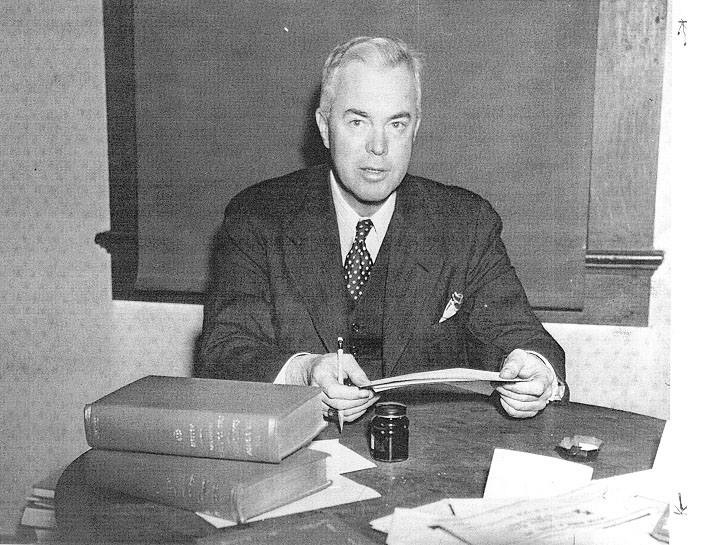
Robert Hillyer. I don’t know if he ever got to revise his learned opinion of Emily Dickinson’s poetry once again.
.
I also present this piece as evidence of the music in differing styles precept of this Project.*** I am a naïve composer with limited musician skills. I suspect nearly all composers compose on an instrument, and that most inform their trial-and-error exploration with more adequate skills on an instrument buttressed with more knowledge of musical theory that I have. My mitigations, which I hope to hide from listeners partway, it to use anything I can do with my instruments and voice in my compositions, and avoid those things I can’t. If I learn some new musical theory or tactic, I’ll turn it into a composition while remaining ignorant of the panorama of musical structural theory – and when I work with orchestral instruments, as I do today, I’m closer to the Lego school of musical construction, using arpeggiators, MIDI editing, and lots of trial and error to make something that may be worthwhile. Today’s piece is therefore limited – from its composition through to its recording you can hear below – by the composer/performer’s limits to realize it. I believe that it will still work for some listeners – perhaps you. The audio player to hear this short piece with quotes from Robert Hillyer’s “A Letter to Robert Frost” is below. No player seen? Some ways of viewing this blog won’t let audio player gadgets into the canon, but I offer this highlighted link that will open a new tab with its own audio player.
.
*Modern critics and scholars generally decry their work. Todd in particular is often taken to task today for suppressing anything in the poems related to Susan Gilbert Dickinson, and both are accused of making the genius of Emily Dickinson all too conventional with their edits. But, if they had not done their work, not gotten Emily published, not done the commercial “clean-up” that made her immediately approachable to general readers in print, we likely wouldn’t have an Emily Dickinson to be concerned with.
**Hillyer seems more remembered today as an important teacher at Harvard than as a poet.
***Beside my own listening to orchestral music and art song (amidst a broad palette of other musical expressions) two pieces by trained composers likely influenced this work. Many years ago I was able to hear a locally-based composer, Dominick Argento’s Letters from Composers performed, and much more recently I was delighted to hear the premier performance of young composer Patricia Wallinga’s The Sisters, a one-act opera featuring singers portraying Sappho, Emily Dickinson, Elizabeth Barrett Browning, and Amy Lowell together on stage singing about their poetic careers. I’d almost consider my little work today to be a modest response to The Sisters from the male side, as three of Wallinga’s quartet of women poets are observed in the Hillyer excerpt I performed. Where’s Amy Lowell? “Our friend at Sevenells” mentioned in Hillyer’s poetic letter to Frost is a reference to Amy Lowell’s home. Wallinga’s less-than-an-hour opera performance is available to be seen and heard at that hyperlink on YouTube.
You might notice that those composer/performer particulars I mention above limit the sophistication of my two-minute piece compared to these of course, my saving grace is the hope that my piece retains some value. I’ve taken to calling my efforts in this vein “punk orchestral” to make my case.
 Frank Hudson