At the Threshold: marvels with French on sky-blue waters

We’re going to travel to one of the best short poems that late 19th century American poet Richard Hovey ever wrote, a strange poem about approaching death, a place far or near, with no trusty mileposts. As I like to do, we’re going in a round-about way. Let’s start with a blue lake.

I can remember what a wonder it was. My father and his youngest brother loved to fish on lakes, and in search of ever more pure sport-fishing beyond the sky-blue waters of northern Minnesota, they took to traveling up further into Ontario Canada. I was maybe 10 or 11, still at an age when I was open to whatever my parents led me toward. We stayed at a family-owned fishing lodge at the end of a gravel road outside of Reddit. A few small, well-kept cabins, a couple of outhouses, and a lake-dock — which was all the two brothers needed, as the day was mostly spent out fishing.

As I said, I was accepting of this. I gamely came along, earnestly operating a rod and reel, waiting, sensing for any piscatorial tugs on the line, listening to the two men occasionally talking about what fishing tactics were most promising. My youngest uncle, maybe 18 or 19, had been about my age when their father died, and my father now served as his younger brother’s father-figure. I was unaware then that more than lures and casting targets was in their talk.

I was never bored. I had a vast imagination when young, and could sit quietly daydreaming stories and ideas in my head for hours. I suspect a good poet would have been more observing of the boundless nature around me; and while I watched and listened to my dad and uncle some, they were too commonplace for me to treasure.

Instead, here is what I recall being fascinated by: I was in another country, Canada, subject to its laws, and a Queen, a governmental oddity that seemed a little out of time to me. A gallon wasn’t even the same gallon there, nor a dollar exactly a dollar! The lodge owning family and everyone we met in Canada spoke English of course, but since my imaginative and book-minded mind lived in words, I was amazed that all the groceries we picked up in Kenora on our way up had bilingual labels including French.

I was as if I had found the Rosetta stone all by myself. As a native Iowan, I already had a passing place-name experience with French from my state’s then 160 year past life as a French possession, but here in Canada a box of Wheaties or a carton of milk could be held inside other words. So, later in high school and in my truncated college studies, I selected French as my foreign language.

I was terrible at it as a school subject. I did OK (not outstanding) in basic vocabulary. I was passable in recalling the tenses and such. I accepted the arbitrary gendering of nouns. But my mouth stumbled entirely in the speaking of French, so obtusely bad at speaking it that I strongly suspect it is something in my neurological wiring. That I persisted with French as I entered college was at least in part because I was learning that French poetry had been so interactive with English language poetry, particularly in the formation of Modernism.*

After my formal education ended, I continued translating French poetry, not by any right of fluency, as I’ve confessed above, but because I wanted to bask in the secret sauce that helped form Modernism.

Richard Hovey seems to have been greatly enamored of what was modern French poetry to him. His published work includes translations of Verlaine, Maeterlinck, and Mallarmé. While going through his published work this summer I came upon this sonnet “Au Seuil,”  in French, dated as having been written in 1898. When I translated it, I found this graceful consideration of dying and some possible judgement and afterlife which I present to you in English today. As an old person, dying no longer requires any heroic situation, acute illness, or grandiose gothic stance to make such consideration apt for me. It’s a matter of petty logistics now.**

At the Threshold as published in French

The poem as published posthumously in a collection by the Vagabondia co-author titled “To the End of the Trail.”

At the Threshold

My translation, presented here as a chord sheet for the musical performance you can hear below. In performance I refrained the final line of the sonnet as shown here.

.

Was today’s poem written by an old man, or a young man staring down a deadly disease? No, Hovey was 34 years old, likely in vigorous health. Still, in less than two years he’d be dead, dying during a routine operation for something as unromantic as a varicocele. One can only wonder how he would have coped with the upcoming English poetic Modernism that would be sparked in part by French writers he admired.

Though subject to my language limitations, today’s poem to song turned out to be a relatively straightforward and faithful translation — with one exception. My usual poetry translation tactic is to primarily find the images in the poem and work at carrying them over vividly to English. I strive to have a non-creaky, natural syntax and word choice in the target language, and to make from that a poem in modern English word-music rather than trying to mimic the prosody of the poem’s native language. What was that one exception? In the poem’s 13th line, “ Qui nous benira de ses grands yeux bleus,” there’s an image I think.***  It could be that Hovey intends a witty little aside about a Nordic male god-in-heaven sitting on a throne of judgement, the cliché being then his point. As I worked on this line I wanted the possibility, however unexpected and wishful, of something universally marvelous. I dropped the andromorphic gendered pronoun as more than unnecessary, and then perhaps unconsciously recalling the poetry of the first-nations name for my current home-state of Minnesota, made the apprehending eyes more than humanly large.****

You can hear my musical performance of what is now an English language poem with the audio player gadget below. No player seen?  This highlighted link is the alternative, and it’ll open a new tab with its own audio player.

*Oddly it wasn’t Spanish poetry. In England we can assign this to not forgiving the Armada and all that — but large portions of the United States had been Spanish possessions after all. And while Canada’s French is spoken regionally, Spanish is the predominate language across our equally large southern border and in the American commonwealth of Puerto Rico.

**For example: when I replaced two bicycles stolen early this summer, ones I’d ridden for 20 and 40 years, I wondered at the return-on-investment of spending like-amounts in current market prices to replace them. My favorite old-person’s joke is that when someone offers me a lifetime guarantee, I ask if there’s a better offer.

***Literal: “Who will bless us with his big blue eyes.”

****Lakota compound word for the place of sky-reflecting-waters. And there I have returned to that boat with my father and his youngest brother, as Hovey wrote in a different language: “we know this hidden way/as one knows the ghost of a dead friend.”

Isabel

I enjoy the part of this Project that gives me cause to examine the lesser-known and forgotten poets and poems. Even the most famous literary poetry principally exists in quiet books, but give me a book now largely unread and my interest is perked.

Today’s poem is by Richard Hovey, one of the co-authors of a remarkable yet forgotten three-book series that began with Songs from Vagabondia  published in 1894. Who was Hovey?

He was the son of a Civil War general* who privately published his first book of poems in 1880 when he was a teenager. He attended Dartmouth College, graduated with honors in 1885, and was highly active in literary activities there, coming to write what remains the official school song. After college he seems to have considered various paths. He studied for a while in New York’s General Theological Seminary, taught briefly at Barnard College and Columbia University. In 1887 he met his Vagabondia  co-author Bliss Carman, and true to their eventual series title, they spent some time tramping around New England. Hovey wrote that he decided to dedicate himself to writing on New Year’s Day of 1889 while viewing a solar eclipse, which seems somewhat magical for an epiphany, but yes, there was an eclipse on that date. In 1891 he began publishing a planned lengthy series of verse plays based on King Arthur’s court, and he seemed to have traveled to Europe around this time where he met writer Maurice Maeterlinck and took on the job of translating Maeterlinck’s work into English. Hovey was also enamored with the French Symbolist poets and did English translations of their work.

Let me set the literary stage for this young poet as he began his career: Verlaine, Rimbaud, and Mallarmé were still alive. So was Walt Whitman. So was Mark Twain. The first and just-posthumous volume of Emily Dickinson’s poetry was still in process. Ezra Pound was a toddler in Idaho. While Hovey was a college student, Oscar Wilde toured America giving lectures on Aestheticism.** Hovey and Carman, with their on-the-road poems of beauty and poetry, of wit over dour seriousness, seemed to have resonated.

Richard Hovey with his mother

Richard Hovey around the time of the Vagabondia books. The woman here is his mother Harriet, not his “older-woman” wife Henrietta. A cousin who knew the young Hovey wrote that he “was so strikingly good-looking that I have seen people turn in the street to look after him.”

.

I learned one other possibly salient fact about the time Hovey and Carman were putting together the first Vagabondia  book. In 1893 there was a sudden economic depression in the United States. Vagabonds were not always free-thinking college boys yet to establish their literary careers. Was there a sub-rosa political/economic point at the start of this series? There’s little I’ve found in the Vagabondia  books that tip me to Hovey’s political stance, if he had formulated one.

I chose Hovey’s poem “Isabel”  from Songs from Vagabondia  partly because it was short and naturally suggested being set to music on first read. Given that I was also trying to get a grasp on Hovey’s life, I wondered who this Isabel might be. I didn’t find out. There’s no Arthurian Isabel, and I haven’t found any prominent Isabel characters in the works of Hovey’s literary heroes. I believe it was a somewhat common name in this era.***

Despite Vagabondia’s  praise for male comradeship, I’m not (as yet) catching any homoerotic overtones there. Where eros does appear, it seems directed at women. The only romantic relationship I know for Hovey was a married woman who he had a child with and later married after her divorce. If you want to wonder at Hovey’s sexuality from afar, clouded in a sexually repressed time and with the small amount of information, I can only offer this tidbit: his lover and eventual wife was said to be “old enough to be his mother.”

Indeed, after all this search for biographic info, today’s poem might seem a tad insignificant. As a short love poem “Isabel”  reminds me of Robert Herrick more than any of Hovey’s contemporaries, and she might be only a device to let Hovey write that sort of poem. In straightlaced society I suppose the poem’s breast-pillow line could have seemed 1894-era hot stuff, but I’m immune to that level of “I’m so naughty” eroticism — likely why Swinburne (also still alive in Hovey’s time) always seems laughable to me.

But Aestheticism holds that a poem doesn’t have to have great wisdom or weight as long as it’s beautiful, so I spent more than my usual amount of time with this 6-line poem’s music to justify asking for your attention to it. “Isabel”  uses some of my favorite odd chords and flavors, and you can hear it with the audio player below. No player?  This highlighted link will open a new tab with its own audio player.

.

*Father Charles Hovey was the President of what is now Illinois State University in its early days, and organized the 33rd Illinois Regiment (known as “the Teacher’s Regiment”) at the outbreak of the American Civil War, serving the Union as a Brigadier General.

**The fact of Oscar Wilde’s tour I first learned about from an episode of the TV Western Have Gun Will Travel Those who knew him remember a young Hovey who seems to have taken Wilde for a model, dressing like him with colorful topcoats, long hair in a center-parted style, and dyed carnation corsages.

***I wondered about writers with that name Hovey could have read. The only hit in that search was the marvelous early 19th century folk poet, folk singer, and tavern keeper Isabel Pagan. Pagan’s poem “Ca’ the Ewes to the Knowes”  was popularly set to music by Robert Burns, a poet who Bliss Carman extolled earlier in this series. I did read that Hovey either knew or took classes with Francis Child, of the famous Child Ballads collection. That the Vagabondia  series calls itself “Songs” is evidence that folk song, at least of the literary variety, is one its elements.

The most famous poetic Isabel remains Ogdon Nash’s from 25 years later.

Down the Songo — Summer: Still Rowing, Still Dreaming

Does the summer feel like it’s gone by like a dream, one of those dreams where the ungainly night-plot finds its own winding path? I started this summer with a May Day suggestion to remember to write of our workday labors, and then too, I presented back then a cover song marking my teenager’s last childhood summer. And now it’s Labor Day weekend, and I’m going to present a poem that is the antithesis of paid labor, another poem from the 1894 Songs of Vagabondia  book by Bliss Carman and Richard Hovey. We’ve already heard from Carman this month, now let’s sample some Hovey.

Richard Hovey is another of those pre-Modernist era poets who wrote in the final years of the 19th century. Because his work falls before the Modernist revolution and the ascension of American poets to a preeminent place in English language literature there’s lesser interest in it, but with a figure like him I think of a bright young man living in an age that felt stirrings of desire to form its own poetic styles.

His Songs of Vagabondia  struck a carefree chord in its time. Tennyson, Longfellow, or Robert Browning would have presented a very serious life that should be attended to. The Vagabondia poems, with intent, fail the Sandburg Test I’ve proposed to assay poetry collections. If my beginning-of-Summer cover song asked the listener to indulge in “That Summer Feeling,”  these poems concur. There’s no Winter and barely an Autumn there. No work or studies either. Instead, we have flirtations and libations, the comradeship of likeminded friends, and here the open road and heart are spent without anything much in one’s purse or paycheck.

For this Hovey poem from Songs From Vagabondia  I chose to create a denser piece of music, a presumptuous rock band ensemble with two drumsets, electric bass, piano, two electric guitars, along with string synth and wind instrument parts. For a Labor Day holiday song about an aimless trip down a Maine river, I spent quite a few hours working to form this into shape. I’m not sure I produced the perfect arrangement after all that, but I enjoyed the process.

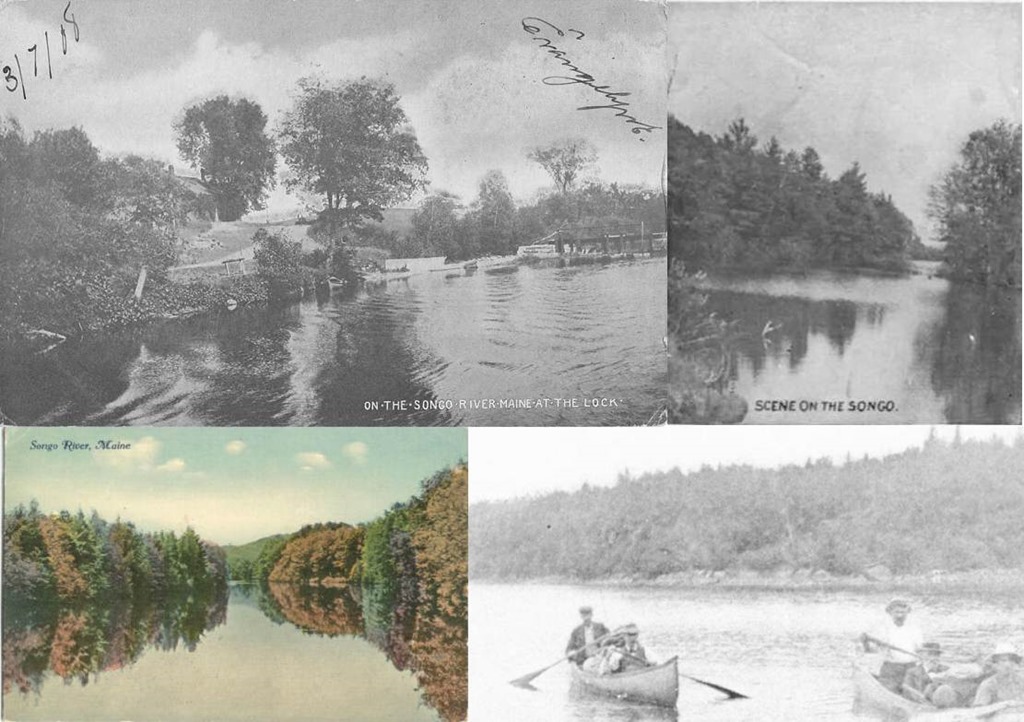
Songo River 4 pictures

These Songo river photos look like they could have been taken within a decade or so of Hovey’s poem. Looks bucolic in these, but others show passenger steamboats (one named for Maine’s poet Longfellow) plied the river too.

.

The Songo in Hovey’s poem is a short river in Maine, but the Songo connects a large lake and some other bodies of water — and though I don’t think the poem mentions it, it had then (and still has!) a hand operated set of locks and a swing-away draw bridge constructed in 1830.*  Hovey’s poem makes this river sound rural and solitary, but having never been to Maine, much less the Maine of the late 19th century, I can’t say how busy it actually would be. The poem’s voice says someone is using oars for propulsion, so even if this is an aimless pleasure trip, there’s work involved just as there was in my recording the song I made of the poem. At the end of the poem there appears to be someone else in the boat, as the poem’s voice cries out “Kiss me” unexpectedly. Who is the other there? Could this be a Hendrixian excused kiss of the sky-blue-water-sky? Maybe, but a lover would be the likely (if unprepared for) guess. The unprepared suddenness of this ask seems dream-plot strange to me.

In my performance I turned the poem’s remarks about the experience being dreamlike into something of a refrain to further emphasize that element for someone who might hear this once as I perform it. I also removed one short stanza from the poem’s original text in the interest of shorter performance length. You can hear the full band performance of “Down the Songo”  with the graphical audio player you should see below. No player?  This highlighted link is an alternative that will open a new tab with its own audio player.

.

*This short modern video shows the continued remarkable operation of the manual lock and drawbridge. Yes, these are hand-cranked mechanisms!  So, Sandburg Test met with this post, there are necessary folks working a job on this river, even if unmentioned in Hovey’s poem.