Late February, repairs, and Claude McKay’s “To Winter”

My winter has been impacted by things a regime of some coarsely-ground humans brewed up, but it’s been good this February to take a quick dive into the poetry of early 20th century Jamaican-American poet Claude McKay. Yesterday I was closing in on completing a new musical piece in my series combining McKay’s poems with original music in differing styles. I’d sung McKay’s “To Winter” accompanied this time by electric guitar instead of acoustic, and I had constructed some nice harmonic support from spare MIDI piano. I wanted a melodic top line though since my rough-hewn singing wasn’t doing enough to carry that role in the song. I decided to use a Mellotron virtual instrument.*  Long-timers here may recall that I love some of the sounds that cranky mechanical 1960s tape-based sampler produces. Back then they were sold because it used actual recordings of real instruments – but the results? They didn’t sound all that convincing – and all that machinery was subject to glitches and breakdowns. However, once one stops aiming for verisimilitude, its sounds have a certain character. It probably doesn’t hurt that their very cheesiness brings back memories of crackling mid-century LPs and hazy concerts.

I was able to record those Mellotron parts, but my city was filling with heavy wet snow while I did that.

Authoritarianism of a meteorological kind as it accumulated, but I had another task for Wednesday. My newly inherited 12-year-old car had a worn drive shaft that needed replacing. I was to drop it off at a mechanic’s shop in a nearby suburb, and my wife had set a time to give me a ride back. She wanted to go right away, as the roads were getting worse from the snow. Long story short, what would have normally been a 45-minute round trip turned into over two hours of slow going.

It was later Wednesday evening when I returned to mix the resulting new and old tracks for the song in my home office, and I couldn’t get my home office Mac to light up my computer screen. First thought: a normal glitch, as the Mac sometimes just forgets that it should see the screen, but a restart or a re-plug did nothing. Connecting the monitor to another computer revealed the sad tale: my 15-year-old LCD screen had chosen that night to die.**

And this was a problem. All my mixing software is installed on the computer connected to that dead screen. So, no mixing Wednesday. It occurred to me: maybe the now dark computer monitor decided to go out because it was Ash Wednesday: remember, from silicon dust you came and to silicon dust you’ll return.

Thursday morning I pulled a smaller, lower resolution monitor from my studio space and hooked it up so I could finish this piece.
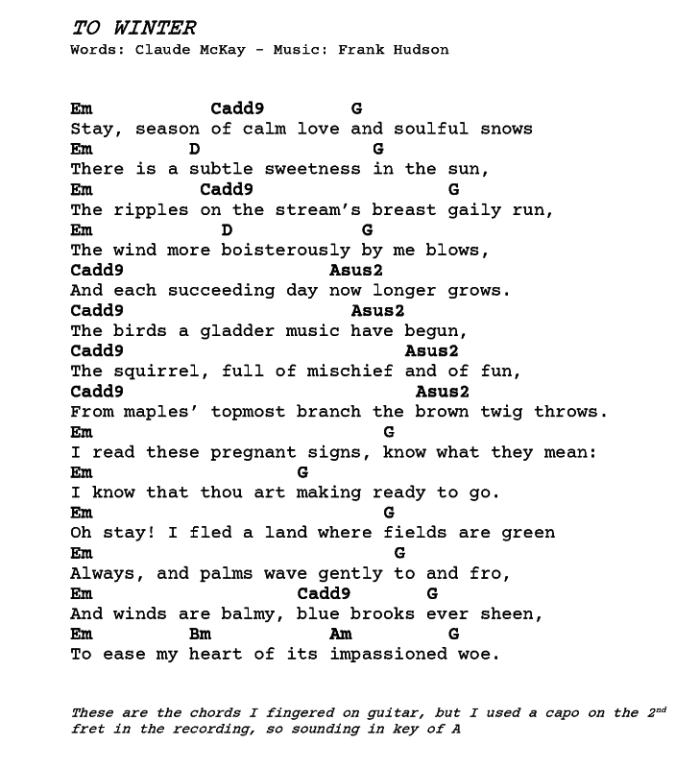
To Winter

Just as I trust the mechanic to fix my drive shaft, I trust that someone out there can probably sing this song better than I can, so here’s a chord sheet.

.

“To Winter”  is Claude McKay considering this very time of the year in the Northern U.S. Days are getting longer, there’s more animal activity, water, once ice, will break and flow. McKay’s poem has a complex reaction to this. He concludes he’s feeling winter inside within the moment of the poem, and finds winter outside permits that mood. Last time, with his Tired Worker”  I found some tension between McKay’s Keats-like language and prosody and the weariness of a 20th century blue-collar laborer. This poem’s my-time-is-like-Keats’-time-may-be-like-some-later-reader’s-21st-century-time choices cause less strain.***

What a wonderous range of coincidences wove into the past few hours. I chose the Mellotron, 19th century orchestral sounds as approximated by mid-20th century technology, mixed on a modern computer whose old LCD monitor left this mortal coil on a snow swirling night at the beginning of the Abrahamic religion’s overlapping spring holy days.

The mechanic has seen to my drive, shaft (“can you dig it”) so that it no longer makes disconsonant noises. I should have a replacement high-resolution computer screen by next week. February snows can be wet and heavy, but to water and mud-luscious they will soon enough go. Crude regimes? I can’t say just myself, but perhaps Carl Sandburg’s “The People, Yes” will increasingly say. So much to repair.

I hope to have a couple more Claude McKay pieces here soon, but to hear this one today, use the audio player below. No audio player to be seen? Mais où sont les neiges d’antan – but I offer this highlighted link as an alternative which will open a new tab with its own audio player.


.


*A virtual instrument contains the modern, much more sophisticated expression of the same idea (the various notes and timbres of a “real” instrument stored as digital recording data instead of one timbre and expression on a strip of magnetic tape for each note pulled along by clockwork springs and levers). My initial attraction to virtual instruments was reading that for only a handful of dollars one could rather precisely “fake the fakery” of the Mellotron without searching out and maintaining a finicky, costly, and increasingly antique instrument.

**The deceased was an HP Compaq LA2405wg model from back when that deleterious merger was fresh. It was a stretch for me to afford then, but in 2010 it was a rare 16:10 1920×1200 display, and I can’t even begin to calculate how many hours I’ve looked at characters and controls on that screen! Everything I’ve ever mixed, every video I’ve ever done, and a lot of writing and research for this Project were done on it.

***McKay’s poem reminds me a little of my favorite John Keats’ poem, “In the Drear-Nighted December.”

Heaven and Hail

I sometimes think I’m working against gathering a larger audience for this.

Twice in the past month or so I’ve had an opportunity to speak in passing with poets about what I do with the Parlando Project. I’ve got my elevator pitch carved out: “I combine poetry, usually literary poetry not intended to be performed, with original music in different styles.” Both poets came back with this replying question: “What kind of music?”

Maybe I should start hitting that word “different” with hard emphasis — but Midwesterners know that kind of spoken underline could be parsed in our regional argot as cloaked disparagement. If I was to say:

“I’ve written a piece for a string quartet in which the instruments are placed on the floor and filled with nuts and seed. A herd of squirrels is then unboxed and will proceed to chew through strings and tonewood for the course of the musical evening.“

The Midwesterner is bound to reply “Oh, that sounds different.”

Squirrel Quartet 3

For Friday the 13th: presenting the unexpected, not gnawful, just “different,”  the Squirrel String Quartet.

.

Now, I believe both of those poets this past month are perceptive, I read it in their admirable poetry. If they miss the word “different” it’s because many people have strong feelings about the music they care about.* Long before reaching the age of those poets most listeners have strong affinities for some music and equally strong dislikes for the sounds that they don’t wish to put in their ears. The idea of combining poetry with music is attractive, but what kind of music is an unavoidable point in describing the Parlando Project, and I can’t encapsulate that. Elevator pitch? If I tried, I’d be out of breath and walking up flights of stairs. To both poets I was reduced to trying to start my response with “That’s my problem: it varies.”

Readership of the blog posts here continues to increase through the years, while listenership to the audio pieces has been for the last half of this Project’s life flat to somewhat lower. This bothers me, and I have theories, but one that seems particularly plausible is that the variety itself turns off listeners. One day acoustic guitar folk-scare strumming, the next day some kind of synthesizer sound, a garage-rock quality electric combo, something like Jazz, small orchestral ensembles, Blues slide-guitar, or alt tunings in a matrix somewhere between John Fahey, Joni Mitchell, and Sonic Youth. And then on the third day, a combination of one or more of the above.**

How well do I (who much of the time needs to play or score all the parts) present that variety? I think my own judgement approximate, but it goes like this: on good days I think I do it well enough, on bad days I feel embarrassed by the faults in execution and conception I hear. So, my limitations are a factor here, but even if I was a master of all these forms, I think the problem would remain. In this theory it takes only one or two “bad fit” musical pieces for a new listener’s taste to judge the work has no value, and no further listening occurs.

What will I do about this? I don’t know. I can’t help the eclecticism — it’s been in me since my youth*** and I don’t think I want to try to scrub it out.

Today’s musical piece comes from that “We’re a garage band, We come from Garageland” mode — looser still in that like most of the LYL Band pieces presented here over the years it’s spontaneous, not the execution of parts each instrument is supposed to play. As keyboardist Dave Moore says at the end, the words are “a personal experience story,” an exception in the Other People’s Stories texts the Parlando Project finds, experiences, and presents. Just over a year ago a storm with 60 mph winds and golf-ball sized hail struck Minneapolis. Overall, it caused 1.1 billion dollars in damages. On my roof, my shingles were totaled (the classic hail-storm result), windows were shattered, and there were plenty of cracks in the siding from the wind-driven hail. As “Heaven and Hail”  tells it, it took months, well into the winter, for overwhelmed builder crews to get all the home damage repairs completed in my neighborhood.

Last year at this time work started on fixing the damage at my place. One experience amid the hammers, ladders, and supply pallets: hearing one of the crew’s boomboxes playing a record of garage rock classics all sung in Spanish. Another Rosetta Stone moment, like reading those cereal boxes in French.

To hear this short account of the storm and aftermath you can use the audio player gadget below. No player? This highlighted link is an alternative that will open a new tab with its own audio player.

.

*Neither asked me —and few people ask me — “What kind of poetry?” With non-poets, I ascribe that to the lesser interest in poetry as an art and therefore a lack of strong likes and dislikes.

**This leaves out the subjective qualities of my voice, something which I recognize is of overwhelming importance to most listeners.

***”Top Forty” rock’n’roll radio was extraordinarily broad in “The Sixties™” and I was listening to the classical music station and a country-western station along with that format. Hootenanny was on TV, folkie music was part of church camp. Other than the occasional cross-over hit I’d hear on the radio, the Jazz waited a bit to creep in late in my youth. Eventually the smart programmers figured out that a pop music station that played a “button pusher” record would cause the listener to switch to a competitor. I’m the odd-duck that when I hear a record I don’t like, right after one I do like, I want to hear the third and maybe fourth or fifth record played, particularly if any of the small sample (liked or not-liked) is something I don’t think I’ve heard before.