Jazz and reading John Darnielle: Part Two, This Year 365 Songs Annotated

Here’s the final piece of this two-parter, and the place where I take off that hair shirt for a while and present a review of John Darnielle’s new book This Year, 365 Songs Annotated.

I largely owe my appreciation of singer-songwriter John Darnielle to my daughter, who found solace in his earlier recordings as she moved through adolescence. One 2005 song, the one that gives its title to a new book by Darnielle, features a 17-year-old speaker refraining: “I am gonna make it through this year if it kills me.” It resonated more than a decade later with another 17-year-old. What a good thing for a song to do.

I knew Darnielle’s work from a couple of songs recorded under his long-running project name “The Mountain Goats,” most notably the mysterious anthem “Jaipur.”   My daughter gifted me his All Hail West Texas  album one Bandcamp Friday a year or so ago. My immediate thoughts on Darnielle were that he was a good song lyricist. Like the late poet-associate of mine Kevin Fitzpatrick, his work is full of “other people,” and those people are often working class or lost-soul types who make themselves known as if in overheard declarations in his songs. Writing in Boomer classic-rock consumer-guide style “he’s like…” comparisons are misleading in Darnielle’s case. Saying he’s lyrically a mix of Randy Newman, Bruce Springsteen, Ray Davies, and John Prine is a bad assay, because he’s like all of them at once or in sequence, and he is his own man too. Still, the range of characters is an important strength. A lot of poetry, and a lot of indie songwriting too, is a singular solipsistic narrative, and Darnielle’s of the songwriting school that avoids this.

This Year cover

More than a collection of song lyrics (though they’re good lyrics)

.

Yet, This Year  is largely the story inside one person, a memoir in a different form: a book of days where he writes somewhat sequentially, but not by strict intent or always, about how 365 songs came about, what he thinks he was trying to express, and what his life was like as he wrote and recorded them. The entries can be quite short, a couple of hundred words typically, though a few extend for a few pages. The lyrics to each day’s song are included with each entry, which is helpful for any reader who’s not familiar with his work. I’m half-way through reading it straight through, but the book can also be read an entry at a time, as sort of daily thought-starter. I’m somewhere between a hardcore fan and someone that doesn’t know any of Darnielle’s work, and I’ve sought out some of the songs after reading of them in the book.

Things I’ve learned? It was not apparent to me beforehand, but he’s a poet who converted to songwriting, and many of his early songs had preexisted as page poems that he wasn’t planning to sing. Reading his lyrics silent on the page in this book demonstrates a literary poet’s craft in his writing, but my finding this out in memoir is a testimony to their lack of crusty poetese. Poets as well as songwriters would benefit from exposing themselves to Darnielle’s lyrical tactics, and he talks effectively about them in this book. I also learned that he spent formative years in his songwriting’s development living in a small town in Iowa, the kind of place I grew up in, in roughly the same part of the state, though I’m more than a generation older than him.

Another part of his story, which unreels through the day entries each devoted to a single song from his now large catalog of original songs, is that he began recording and making these songs public using meager equipment. He so far mentions almost nothing about the particulars of his instruments which are likely unremarkable and inexpensive, and a considerable part of his early career recordings – including the original versions of some of his best-loved songs – were recorded on a boom-box cassette tape machine at home. I resonated with that, having spent around 20 years using such cassette tape along with low-budget equipment. A late 20th century indie-music and fanzine samizdat network allowed Darnielle a slow-burn career doing that, around the time that my own nerve to share my work had faded. He recounts in the book, that royalties from the tapes sometimes paid part of the $170 a month rent,* but he had a day job in a lower-paid nursing field, again something I rhymed with in my cassette years.

The short entries in the book also tell a story of Darnielle’s religious journey, which began as a Catholic youth and has had elements of return, though I’m midjourney on that arc so far in the book.

These similarities paradoxically bring up the personal gap which makes reading his book so meaningful to me now. From what I’ve read so far, Darnielle apparently retained confidence in his own work through these long-beginnings, low-rent, lo-fi years, and even if there are dark nights of the soul in coming parts of his book, he displays that now as he discusses the work in retrospect. I had, and still have, substantial gaps in being able to carry that in public during my cassette years. Having days of private levels of self-confidence in some of my musical work is not an effective dose to properly present it to others, and my doing so “blind” without that confidence led me to some painful comedy of misreadings of likely interest. Those two things (managing self-doubt, being able to present one’s work effectively to others) interact. Darnielle may have been more personally engaging, or just more persistent in his networking. Elements of luck might have been significant (with me, they were in my “day job.”) Thinking of this difference as I read Darnielle’s book, it’s (too) easy for me to think, “Well, it must have been easier for him, his work was so darn good.” He’s a better vocalist and performer than I am (no-biggie, almost everybody is), and though I’m not sure how far apart we are in “on a good day” guitarist skills, his song lyrics are teaching me new tactics even after decades of my doing this on the page and with guitar.

In the first part of this pair of posts I sincerely worried about my work and hubris when I put it up against the skillset and history of Jazz. Despite those differences in how we’ve used our parable of the talents, I find reading Darnielle’s book heartening so far. You don’t have to be a songwriter, if you are any kind of writer – and likely if you are an artist of any kind – spending time with this book may be helpful.

Here’s an early song of mine, recorded on primitive equipment before the nearing 900 songs of the Parlando Project had started counting off, but consistent with its principles, a setting of John Keats’ “In the Drear Nighted December.”   Audio player gadget should be below, but if not, this highlighted link will open a new tab with its own audio player.


.

*For any younger folks reading this, the $170 a month rent (for a house!) must seem a dormouse fantasy. For younger musicians, the idea that royalties from indie recordings might contribute in any substantial way to making rent must seem equally fantastic.

Old Soldier

Today’s piece was created from a poem written by the Irish poet Padraic Colum. Colum was born in the 19th century, then traveled through the world of 20th Century Modernism, and lived on long enough to overlap my lifetime. Looking at the outlines of his life I am pleased to report that Colum connects a favorite of this Project, the undercelebrated Irish poet Joseph Campbell* and the American mythological theorist of the “Heroes’ Journey” also named Joseph Campbell. With the American Campbell, Colum connected because he was a folklorist as well as a poet, and he wrote several young adult and children’s collections of folk tales and retold myths which I’ve not yet read. With the former Campbell, besides being Irish literary revival contemporaries, he collected folk-songs.** Like that Irish Campbell, Colum’s best-known work today is arguably a folk song.

Long-time readers here may recall that the poet Campbell is likely responsible for the song “Reynardine”   being sung in a version featuring a supernatural, shape-shifting lover. At around the same time, and for the same publisher of Irish folk songs, Colum collected/wrote the lyrics to the song “She Moved Through the Fair.”   Why the slash notation on the authorship? There’s some controversy if Colum closely adapted a traditional set of lyrics, or largely wrote original lyrics to an existing tune. Colum claimed he wrote the lyrics, making use of only a few floating lines that are folk song ready-mades. The challenge to Colum’s authorship strikes me as highly suspect: it’s based on another collector writing in 1970 that he came across an old man who told him he’d learned it as a traditional song before Colum’s version was published in 1909.

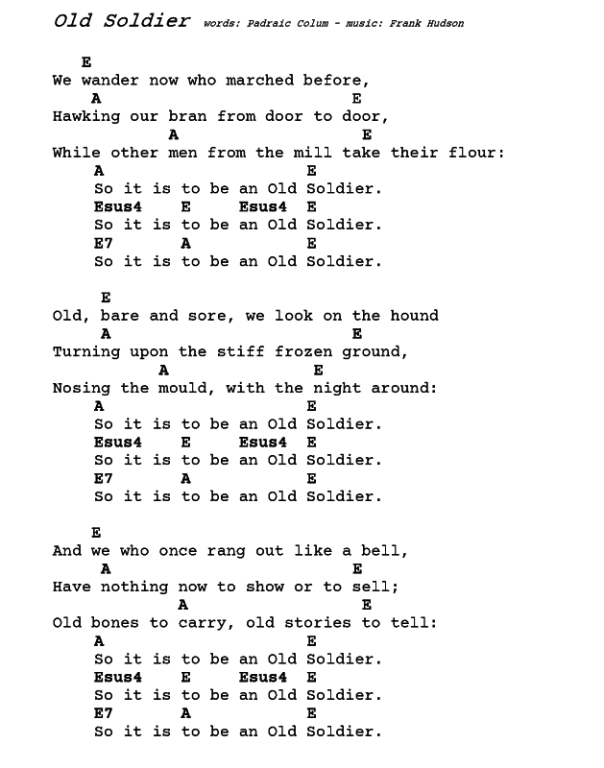
Old Soldier

I suspect there’s someone out there who can do a better job singing this song I created from Colum’s poem.

.

“She Moved Through the Fair”  was included as a poem in Colum’s first poetry collection “The Wild Earth”***  which also includes today’s poem. I note that “Old Soldier”  has some similarities with the lyrical methods of SMTtF:  both use spare details and leave out a great deal. Some of what is implied in the two lyrics may have become more obscure to modern listeners. SMTtF  very early on speaks of the singer’s “lack of kind” which uses a now archaic meaning of “kind,” meaning family. “Old Soldier”  opens with the titular old soldier going door to door. Since “hawking” (a hawker is a street-seller) is used as a verb in the second line I thought at first he was peddling, but from what I can find, no one sold flour that way. I think he’s begging for bran, which was then the discarded part of the milling of flour. That waste part after the wheat was milled or boulted, was thrown out or used as animal feed, though apparently the poor sometimes made use of it for human consumption.**** In the second stanza we meet the old soldier’s only companion, a dog, and the bran the soldier has garnered may have gathered mold.

I don’t know if “Old Soldier”  has been set to music before this, but it seems every bit as singable as “She Moved Through the Fair,”  and as soon as I read it, I wanted to sing it. I decided to use an arrangement soaked in South Asian musical influences, perhaps due to the wonderous extended version of the SMTtF tune played by Davy Graham. That link above includes one of Graham’s recordings of it, as well as Anne Briggs wonderous acapella version. Oh, hell, here’s that link again, click it indeed if you haven’t heard the song Colum made. Last week I recorded the basic tracks singing and playing a tune I created for Colum’s poem using my guitar in an alternate tuning driving a sitar virtual instrument though a MIDI pickup. To this first pass, I added harmonium, tanpura, tabla drums, acoustic guitar, and a final vocal.

Every one of those overdubbed passes felt good as I played them (save for my vocals, I’m never happy with my vocals) but the result was a whole bunch of tracks that would require careful mixing so that the instruments blended well. I set about doing that, working until midnight when I figured I might have a piece to present and saved a complete mix down. Awaking the next morning, I listened again, and the result wasn’t just flawed, it was a mess. A useful question for one mixing a piece of music with various instruments in an ensemble like this is “What track is the focus of the piece?” My putative mix had no good answer for that. The voicings of the chords on the sitar and the guitar didn’t mesh well. The harmonium and the tanpura were fighting over the same part of the sonic spectrum despite my efforts to give them their own sonic space. The tablas didn’t mesh with the acoustic guitar’s rhythm.

The wise solution would be to just re-track the piece. Maybe I should have more particularly considered that Davy Graham had made his impressive version of a Colum poem/song with only a solo acoustic guitar. But I would not have another opportunity to record with a sensitive open mic until this week, too late for Veteran’s Day. So last night I went to work stripping back the crud of my failed mix, leaving mostly the acoustic guitar and the vocal, with the tanpura and then the harmonium coming in for later parts of the song in turn. It’s not an ideal recording, but it’s my hope it lets one consider “Old Soldier”  as song today.

The more palatable version can be heard with the audio player below. The song itself is simple, and the remixed arrangement that builds a bit as the song continues serves it better. You don’t see any audio player gadget? No, I didn’t remove that, it’s a side-effect of some ways of viewing this blog. I have a plan B for that too: this highlighted link that will open a new tab with its own audio player.

.

*Joseph Campbell, who also wrote under the name Seosamh MacCathmhaoil, was acquainted with the original London Imagist circle, and wrote what I think is some excellent short verse in the form. His life and literary career were brought low by siding with the losing side in the Irish Civil War.

**Given that I’ve been doing this project for a decade, the folklorest/singer/collector and poet is a combination near to my heart. Besides Colum and Campbell, two American poets from the same era, Carl Sandburg and Edwin Ford Piper did both things, and I’ve tried to briefly make the case that Sandburg should be more often cited as instrumental in connecting folk song with progressive politics and literary poetry in the United States, which eventually leads to the case of a Nobel laureate in Bob Dylan. Around the same time as all these others, elements of the “Harlem Renaissance” in Afro-American literature were open to melding folk song with high literature too (Fenton Johnson, Langston Hughes, Jean Toomer, Waring Cuney, Zora Neale Hurston).

I’m going to jump far afield before leaving this footnote: I’m writing this on the 50th anniversary of the release of the Patti Smith Group’s glorious debut LP Horses. The Patti Smith Group started because Smith, a poet personally immersed in colloquial music, a paramour of Fugs-adjacent musician/actor/playwright Sam Shepard, joined up with a guitarist/rock critic/crucial anthologist of garage bands Lenny Kaye, wanting to make unexpected poetry combined with electric guitar.

***Just when Colum’s The Wild Earth was published is unclear to me. My copy has a 1927 American printing of a 1922 edition. Wikipedia says “She Moved Through the Fair”  was in a 1916 edition of the book, and then in their entry for Padraic Colum gives a 1907 date for the book.

****What, that’s the healthy part! Whole wheat! At the time the milled pure white flower was prized from making lighter baked goods and for a longer shelf life. The city I live in was growing rapidly at the time of this poem by finely milling the “Best” and the “Gold Medal” flour that had absolutely no bran or wheat germ at all.

Artificial Intelligence in Music: the last wall of the castle

Just a note to readers coming here for the experience of literary poetry combined with the original music stuff we do – I’m still doing some “summer vacation” writing that breaks from that form this month. This post does deal with music – if from another angle – and I expect to fully return to our traditional presentations this Fall.

So, I’m at my frequent breakfast place on a fine August morning that has not yet reached the AQI-alert level of smoke. In an unplanned coincidence, Glenn walks in. We’d talked last week about, of all things, Herb Alpert, and his early 1960’s instrumental hits, particularly “A Taste of Honey”  which was a chart topper in our youth.*

Glenn has some Herb Alpert and the Tijuana Brass CDs, but like many he’s as likely to have a CD player as he is to have a way to play 78 rpm shellac records. He’s been trying to get their music onto his new Mac Mini, but his old USB Apple Super Drive won’t recognize a music disk.**  Somehow (likely my current preoccupation with finally writing about it) we got to talking about AI. I mentioned that I’ve been struggling to use my collection of Virtual Instruments (VIs) to realize recordings with brass instruments that capture the full level of articulation the real thing can produce.

We talked a little bit about the various ways these instruments can be controlled: little plastic keyboards, various guitar pickup schemes, even wind controllers. Glenn has a bit of engineering background – this had (I hoped) some mutual interest.

I have little or no guilt in using VIs here for the Parlando Project. Not only is a VI grand piano highly affordable, it takes up no space, requires no fancy mic’ing, and produces a pleasing sound. Given my musical eclecticism, I think of how much more cluttered my studio space would be if I continued to collect odd instruments that I would experiment with to add unusual colors to pieces. And though I can’t actually play a real cello or violin, I can use a MIDI guitar controller to add those sounds. I’m grateful for those options for realizing my music.

Then I told Glenn about the Mellotron – a pioneering virtual instrument before such a thing had a name and acronym. Rather than hard drive files containing databases of digital recordings of actual instruments playing a range of notes in different articulations like one of my computer VIs, this primitive mid-20th century machine used strips of analog tape recordings of an instrument playing a single note for each tape strip. When professional musicians (among them: The Beatles, the Moody Blues, King Crimson, The Zombies) started to use the Mellotron, some objected: could the Mellotron put real musicians out of work? When the Beatles and their producer George Martin wanted a high trumpet part on “Penny Lane,”  a real musician was contracted for and played that difficult and memorable part. But flip the “Penny Lane” 45 RPM record over and on “Strawberry Fields Forever”  Paul McCartney pressed a Mellotron’s keys to produce an eerie flute sound. Listening closely, it wasn’t quite like a real musician blowing into a real flute. It was maybe 80% there – but if it sounded a little fake to a discerning ear, one might think it was still an interesting sound, whatever its level of verisimilitude. But imagine you’re a flutist in 1967 – the Beatles could certainly afford to pay for your services. Though bands moved on to use more complex synthesizers and other devices, real instruments still retained a level of preference when their fully-authentic sound was called for.

Could I pay or otherwise record real musicians instead of using my computer VIs? It’s hard for me to imagine a cello or violin player that would accept my chaotic and self-imposed quick-turnaround schedule, naïve/inconsistent musicianship, my shifting moods, and my no-revenue-project budget.

In my defense, this human being may well be playing the instruments,  just as I play guitar: this note, here, this loud, this long. Other times I’m scoring the music the VIs play, writing or modifying the MIDI event data rather than on a music-staff leger.

Still, there are some gray (or even darker) areas. For me, that started with using arpeggiators: ways to tell a computer you want it to take a chord and play the notes within it in a rhythmic series. I can tell it what note-length to use, something about the order of the notes, but the precision is then all the computer’s – and arpeggiators will have presets to suggest, and I might agree to one. Numerically quantifying the level of plausibility of my own work is problematic, but VI technology is such that even with my limited musical-instrument-operator skills, I may approach 90% there – but my musicianship, with its intents, and also it’s limits, is still involved. I can’t help but think my brass VIs sound badly because they are so far from the families of instruments I have played in “the real world.”

But a greater temptation arrives: more sophisticated computer “players” that take a chord sequence and duration I supply – from composition or by my playing something – and augment them by playing those cadences musically in a style it supplies and I consent to. These “players” have multiple adjustments, I can (and often do) modify what they supply as defaults, but this further development bothers me. Am I still the composer? In a human-musician world the answer would be clear by well-established tradition: yes, they’d say, I’m still the composer. Professional musicians, working before computer algorithms, have long supplied “feels,” timbres, expression, and entire decorative lines. They might even revoice the chords or play extended harmonies. They will do all that (or more, or better) than my computer does for me. So why do I feel bad when I ask my computer to do this? Well, there’s the impersonality to it. I’ve worked with others who’ve made important musical contributions to work I’ve originated, and that doesn’t feel the same. While I think I would be problematic to impose this on human musicians for the rewards I can offer, there’s more to it than not offering them that opportunity. I can’t help but think I’m cheating, that these realizations are fraudulent.

Yet guilt hasn’t stopped me from using these computer functions, and you’ve heard some of the parts they’ve played sometimes in Parlando Project recordings. The term artificial intelligence is elastic, it’s become a marketing buzz-word, but these enhanced arpeggiators and play-with-this-feel-or-articulation variations could fairly be called AI – even when the same musical piece has my vocals of I-hope-for subjective-quality or my it’s-supposed-to-sound-like-that guitar playing.

That said, over breakfast, I tell Glenn about how far AI music generation has come in the past few months. Just by entering a prompt or making a menu selection, often made up of generalized summary words for genre or playing style, one can create an entire song including vocals and all the musical accompaniment. Earlier in this decade the results would’ve been overly simple or subject to embarrassing defects. Now, the results easily pass the “Turing Test” for casual listeners. If the Mellotron flute is 80% there, and my best VI violin might be 90% there, these entirely machine-generated songs are about 95% there in verisimilitude. Sure, human musicians, real composers, even avid music listeners, are forever aiming for that extra 5% of skill, originality, and listener appeal; but when I listen to these productions which can be produced endlessly in minutes of hands-off computation time, the “tells” are the thoroughly AI songs meh obsequiousness to genre musical tropes and the slight artificiality of the machine-made vocalists. And that’s a problem. Centuries of musical theorists from the days of music theory treatises written with a quill, and onward to the accretion of hardened commercial songwriting craft, have supplied all the steps in ink-stained longhand to create a coherent musical structure with predictable effects. The computer coders only have to apply a light dressing of adaptation to transfer this consensus for robotic mass-duplication. The singers would still have remained a challenge – except by a fateful choice: popular music has increasingly prized machine-aided polishing of human voices to remove the inexactness they are prone too. Ironically, what could have been the last rampart to be surmounted by AI was dismantled by meticulous vocal production and ubiquitous auto-tune before the tech-bro Visigoths arrived.

I said to Glenn over breakfast in the café “Here we are talking about a popular song released 60 years ago, one we both still remember. ‘A Taste of Honey’  didn’t have any vocals, and now AI could easily produce an entire album of other instrumental songs to surround it – and even listening carefully, I’m not sure we could tell AI from human-written and realized musical pieces.”

This is not a theoretical exercise. Streaming platforms and playlists care even less than casual music listeners about AI content standing in for human work. In some genres, the algorithm that supplies your next song playing may already be a robot suggesting robots playing robot-composed imitations of human music. The only thing holding off an overwhelming onslaught of AI slop is that we, the audience, are still invested in the erotic worship of flesh-and-blood young performers and some residual romantic veneration of the human artist. Those things may be illusionary, but even if so, those things may be our defense. Do I have any other hope to offer? Yes, there’s something else, that comes next post.

This is the author of the play “A Taste of Honey” for which
the tune was composed. Her play frankly portrays a whole range of working-class situations in ‘50’s Britain. A teenager when she wrote her play, she was 21-years-old when this cheeky interviewer interrogated her. What admireable self-confidence!

.

*As vividly as I remembered the song, I knew nothing about its origin – and while I could distinctly recall the musical sound of Alpert’s recording in my head (trumpet, trombone, and that beating drum) I also heard in my mind vocals and a crooner singing. I tried to find the version with the sung lyrics I was remembering. I likely had heard the (somewhat unlikely) version of “A Taste of Honey”  done on the Beatles’ earliest LP, but I don’t think it was that one I was hearing in head.

**If you still own that ancient Apple artifact, the external Super Drive CD/DVD drive, you should know that it won’t work unless connected directly to one of your Mac’s USB ports. Even deluxe powered USB hubs or docks won’t work–  the drive will seem completely dead when connected through them.

The Sound of Sense

Today’s piece is kicking off a Summer where I’m going to be doing some different things here than what the Parlando Project usually does. Though the Project’s “usual” varies, the capsule description typically applies: “Combines various words (mostly other people’s literary poetry) with original music in differing styles.” What’s coming this Summer?

I’m not entirely sure yet. There may be more behind-the-scenes stuff, even some “inside baseball” topics about recording, composition, and musical instruments. I think, some personal memoir, a few more peculiar “cover versions” of other folk’s music — we’ll see. I’ve never emphasized those things, so I don’t know how this will work yet. Come September, I intend to return to our regular stuff: writing about my experience of other poets and their poems as the Project moves toward its 10th anniversary. I hope there will still be some things of interest to those who come here for that. For regular readers, particularly those that have followed this Project for a while, I’m hoping you’ll enjoy this Summer’s personal digressions.

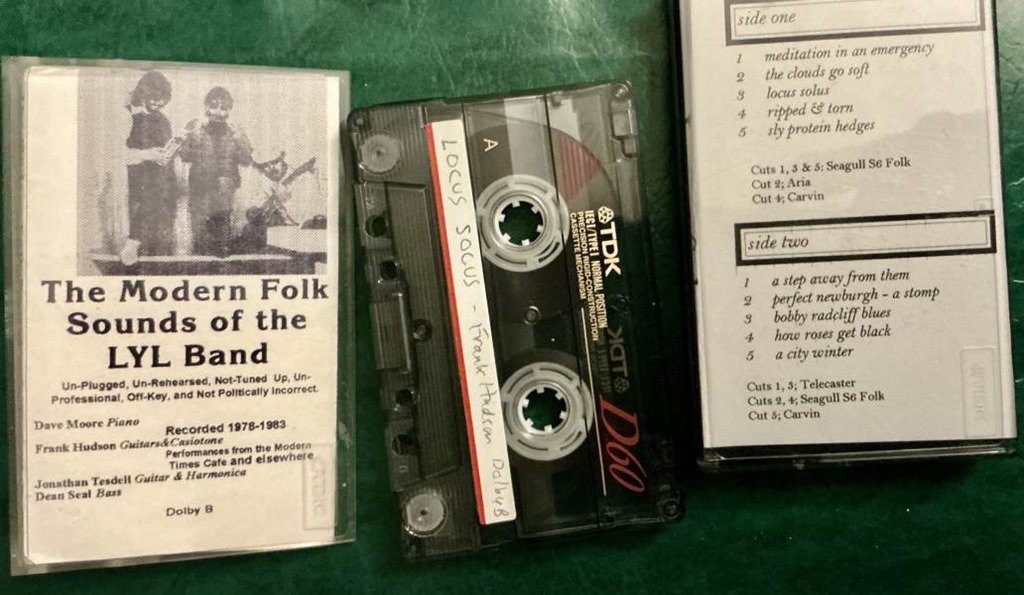
I recorded music with Dave Moore last week. Dave and I have known each other since we were teenagers, and we’ve made music as the LYL Band for 45 years. For much of that time Dave was a driving two-handed keyboard player, pounding first an upright piano, then a Farfisa combo organ and electric piano. The Farfisa had grey keys for the bass register, and Dave was often effectively the bass player in the various LYL lineups. Two-handed keyboard players are a tough thing to integrate into the typical Rock band. That kind of playing can fill a lot of the harmonic space — but in some of Rock’s history, guitar voicings are expected to outline the chords. As it turns out, this was OK for me, as I was never a competent conventional rhythm guitar player. Though LYL had an additional guitar player sometimes, I worked out an unconventional role, most often playing single notes and double stops that decorated the chords that Dave laid down, or adding timbral color with guitar effects.

By the turn of the century, we fell into a regular pattern: around once a month we’d set a date. Just before the appointed time, I’d be ready in my studio space and would start to play a little melodic line or spare pattern. Dave would come by a few minutes later, let himself in, and he’d walk up to the keyboard position in the studio space as I continued to play. I’d lean over and reveal the key I was playing in, and off we’d go. I’d have some words ready, a literary poem for Parlando perhaps. Our familiarity bred musical content: I was accustomed to Dave’s keyboard moves, he likely knew mine after all this time too. We’d extemporize a weaved top line. In 2-6 minutes I’d wind it up. We’d say hi to each other. Dave would next hand me a sheet of lyrics. Sometimes with chords, sometimes just some jottings as to predominant ones or key, sometimes just the words. He’d start to play and sing and I’d find my way to play something that I hoped would fit in. That piece would end, and then I’d hand Dave a chord sheet with lyrics to something I had put together. Though sparse, my sheets would be more organized, allotting info for Dave to drive the basic harmonic content for what I would sing and play along with him.

The alteration proceeded as such from there.* After about an hour we’d take a break, talk a bit, and then we’d pick up the rotation for another hour. There would sometimes be partial takes, even (rarely) a “let’s play through it again” request. There’d be short delays as we shuffled through papers, or switched instruments or keyboard sounds, but there wasn’t much deliberation.

What did the recordings reveal afterward? Some trainwrecks certainly. Some searches for inspiration that snoozed off. Particularly in my case, a lot of poor attempts at singing. None-the-less, there’d also be some stuff I’d think worth working with. You’ve heard some of those spontaneous live-in-the-studio takes here.

As it happens, other than their being two alternating songwriters, this is close to how Bob Dylan worked in the studio throughout much of his career — though he worked with trained studio musicians for the most part — skilled folks who could bring a lot more facility that Dave or I can supply.**

Why’d Dylan do that? Well, I’ll have to ask him, though somehow, I haven’t had the chance. My guess is that when it did work, a real sense of something happening in the room among a group of people was transmitted. An exploration. An edge of the seat, this hasn’t yet been formed, a how will it turn out feeling the listener can share.***

Let me repeat myself for necessary clarity: my skillset as a musical instrument operator is such that I think that it doesn’t fulfill the job description of a musician. I won’t impose a summary on Dave, but I think he’d be unlikely to claim high-level musical skills. I do call myself a composer, and Dave has started to call me a producer. I wish I had more skills, but I work artistically with the ideas and actualities I have.

New Studio Space MIDI keyboard

One thing was different last week. For nearly 20 years Dave usually played an older non-MIDI keyboard at my studio space. I may write more about the context later, but I’m thinking it’s time to move to MIDI. Dave has no experience with MIDI and computer instruments, so this will be a journey. I was able to find a good open-box example of this affordable, semi-weighted MIDI keyboards with aftertouch.

.

So, last week, after decades of this, when Dave and I met, I was in progress, playing a guitar riff, and he, on arrival, began playing electric piano. I had set out a drum loop and had a bass track running that hung around the key center. The piece I read as I played my electric guitar was a sonnet, a recent one in my sonnet-series about Alzheimer’s disease and a care-home for those suffering from it — and how we, outside the disease, interact with those within it. “The Sound of Sense”  doesn’t lie: Robert Frost actually did think there was a basic undercurrent in how poetry works — that it’s like how we hear others speaking just out of earshot.

Dave’s not Bill Evans or McCoy Tyner. I’m not John Coltrane or Mike Bloomfield. Some people say I sing like Bob Dylan, but I think on a good day I might sound something like Bob on a bad day. Here’s something I’ve been thinking lately, as successful music gets more produced and marketed from the moment of conception on: it’s still good to have some notes made that don’t know what the note to follow will be. If that next note is unexpected, even “off,” — well that’s better than always knowing what the next note is. And that latest artistic worry: Artificial Intelligence and LLMs? They’re programmed to work-to-rule, creating statistically what you’d expect next.

Two old guys playing live in the studio together. I perform a sonnet I recently wrote that Dave hasn’t heard. He and I weave together in a loose, homespun warp and woof, and unlike a lot of poets reading to music, I spend a minute playing electric guitar at the end, trying to not play the next note that you’d expect. You can hear that performance with the audio player below. No player? You aren’t out of AI credits or something — this highlighted link will open a new tab with its own audio player.

I hope we’re going to have an interesting summer.

..

*When other musicians played with Dave and I, I tried to continue that strict arbitrary rotation — everyone got to start a piece in turn.

**A few years back a huge box-set including alternate partial and unsuitable takes from Dylan’s classic Sixties period was issued. Fascinating, listening to and hearing the outright failures or “just not it” attempts. Given what I know those musicians involved could  do, knowing those failures keep me from utter despair when I listen to a busted LYL take uttered from my limited skill-set.

***Some classic Jazz recordings of the LP era were done this way, though often with a substantial shared mental “book” of structures and cadences for the skilled musicians to rely on. It may be one of those shared illusions, as there’s no strictly technical reason that Kind of Blue  or A Love Supreme  couldn’t have been recorded as most modern pop music is recorded: many instrumental tracks played separately and laid behind featured top-line tracks constructed of many passes collaged together. Those old Jazz records feel like the musicians are breathing together in the room to me, in my mind’s eye I can see them glance at each other — but we can be fooled.

One need not be a chamber to be haunted. You could be a cassette tape.

However similar if amorphous shapes, everyone’s ghosts are private spirits, and I have a new musical piece with words by Emily Dickinson testifying to that — but let me slide over to a couple of personal things first, as if I was a regular blogger externalizing their internal story.

I’ve had a couple of weeks when I’ve needed to come back to the Parlando Project stuff from other things. I had a colonoscopy with unremarkable results. Huzzah. That’s some prime blogger internal dialog! But before that, I searched around my crowded little bedroom/office to find old cassette tapes. The oldest are from The Sixties when I had one of those small battery powered monaural cassette recorders with a slide-out chrome handle, a single speaker on the top, and a chorded plastic microphone with a start-stop slider button on its side. Others were from the 1970’s-2000 era when I recorded musical things, first on the stereo tape decks of the late 20th century home hi-fi era until I was able to afford one of the legendary Portastudio models designed for musicians, using the same humble cassette tapes, but able to record 4 distinct tracks. My task: to make digital copies that I can store in no appreciable physical space and are independent of an obsolete format.*  More than 30 years of this stuff, much of it of only private interest, though you may hear some of it eventually.

Cassettes 600

Some of the cassette tapes.

.

The ubiquitousness of inexpensive video is fairly recent, but assuming no catastrophic events, many born in the past 15-20 years will likely have color video with sound of their childhoods and young adulthood that could follow them the rest of their lives.**  Is that a good thing, something they welcome? I don’t know. Before this some folks had diaries and journals, or kept letters, so some level of self-documentation is not entirely novel. Still, for me, a person whose Project lives in music and sound, whose favored form of literature began in sound before writing was invented — retaining an element of the sound of the words, and their sequence, and echoes — my particular audio time-capsules have a special tang. And fears.

Most of the tapes are not just me, in a few I’m just the man holding the microphone, though I’m there as the shadow that chose to start the recorder. They hold our imperfections: things before we knew, before we learned — and then too the persistent faux pas that we still commit: there, and committed to a recording. Given that most can record now anytime with the tap of screen, how many will simply erase to save future embarrassment?

So back to Emily Dickinson and this poem about ourselves and what we think we fear — which may not be what we actually fear, or should fear. “One need not be a chamber — to be haunted”  is a poem about that self we either can’t lose or can’t consider. In five stanzas Dickinson lays out some conventional gothic scenery (some of which she herself will erect in other poems) haunted houses, undead ghosts, church graveyards, and finally an assassin laying in wait for us.***  Dickinson points out that the self may be making or amplifying those fears, and perhaps that self, making scary movies in our imaginations, may be doing it to displace us from seeing the real fear source, our mind’s-self. “Ourself — behind Ourself — Concealed — Should startle — most” Dickinson’s poem concludes. You can read the text of Dickinson’s poem at this link. And yes, you might note I sang “alley” by mistake instead of “abbey” messing up Dickinson’s graveyard implication.

So, is that our choice? To ignore ourselves, out of fear of what we’ll find, or to disappear into a copious kingdom of solitary solipsistic self, many of us with the digital equivalent of Krapp’s Last Tape  clanking and dangling from them like Marley’s ghost? Socrates decried the unexamined life. Memoir can be an honorable genre. Despite my taking the time this month with the old tapes, I think of this Scylla and Charybdis, and in the end there’s ultimately no keeping of this life and self, though sometimes there is sharing.

Today’s musical ensemble is a Rock-band of some kind: drums, bass, piano, 12-string acoustic guitar, and two electric guitars, one of which is run through enough effects to mask its guitaristic nature. No need to rewind, you can hear it with the audio player below. No player? No need to untangle that with a pencil in the reel-hole — this highlighted link will open a new tab with its own audio player.

.

*Many years ago, I was on a committee working on the technical design for a radio network’s archives (most of which were still on audio tape then) which involved long-term storage and public accessibility elements. The online “New Media” folks had their ideas about what formats to use for listeners to stream over the Internet, the audio engineers had concerns about what would give the longest life and best fidelity, and the computer IT folks had thoughts about what media would have the capacity to hold something that might climb into the then hard to imagine “terabytes” of digital storage. The three groups weren’t always in agreement, and a grizzled consultant from some outside large, already in existence, archive was brought in to meet with us. Should we use digital tape, hard drives, optical disks? What file-system format on which? What audio file format should be used on that media? Is some of this going to die from “bit rot” on the media in how many years? We had lots of questions and wanted the wizard to arbitrate our concerns. He listened for a while as we cross-talked.

Then he answered. “It doesn’t make much difference what you choose. You’re going to have to convert to other media, file-systems, and audio formats in the future, and every few years going forward. Plan for that.”

**Many of my mid-century generation have photos from their youth. I had a “baby book” that lasts into my grade-school years in black and white. A few families had movie cameras (though no one I knew did) but many of those shot silent film. The cost of film and developing that film constrained the amount of pictures and home movies made. Lots of birthday parties, weddings, holidays. Parts of life yes, but selected shorts.

***I was working on this in the wake of the news of a planned, lay-in-wait killing of an insurance company CEO, which will be followed in the American drama by the killing of a teacher and a teenage student in a school reported by a 2nd grader who called 911. The first was caught on ubiquitous digital video, and the emergency call of the second perhaps made on one of those smaller than a fat postal-letter things we call phones even when we aren’t making phone calls. More than social embarrassment may haunt our digital archives as we live going forward.

I also note that final stanza of this poem’s “revolver” is another example to go with “My life has stood — a loaded gun”  of Dickinson poetry citing a firearm being held as the high card in some kind of deadly personal dispute.

Records In Childhood

As December begins, I’m going to be taking some time to celebrate and elaborate the roots and concepts of this long-running Parlando Project as we reach our 800th-released audio piece milestone.

For those who are new here, let me restate again what we do: we take various words, mostly literary poetry that was never intended by its authors to be performed, and combine them with music in differing styles. Sometimes the page-words are sung, sometimes they’re spoken or chanted. Sometimes the music will patently match the text, sometimes not. The latter class are some of my favorite pieces: Emily Dickinson as blues singer or psychedelic ranger, Robert Frost with EDM, Longfellow at a beatnik coffee-house, Li Bai with western orchestral instruments, Jean Toomer or John Keats as performed by an indie-folk combo. I expect long-term listeners to scratch their heads at times, though I also fear that some will sample a piece that they don’t much care for and leave off from future listening here.

No one idea or artist inspired this all, but today’s piece is about the farthest back I can recall anything that might have inspired the Parlando Project. I think this happened when I was around age 10.

I grew up in a mid-century Iowa town of 700 folks, and it wasn’t a particularly musical place. There was a small high-school marching band, a handful of children probably had piano lessons of some kind, if only in hopes there’d be someone to play piano in the three Protestant churches in town. The two best musicians in my childhood cohort played trumpet and accordion. The former was surprised to admire Louis Armstrong despite having personally absorbed dismissive racial stereotypes, the other might aspire to Myron Floren level of showpieces on the stomach-Steinway. The same little town might have over-achieved in literature though. It was named by its 19th century town-platter “Stratford,” and its streets were named for British poets and Longfellow — main street being Shakespeare Avenue. If you grew up on a street that was merely numbered, or an avenue named for some animal or geographic feature, such things never had a chance of shaping your worldview. I grew up thinking of Milton or Shakespeare as being a local possibility.

My father sang, mostly in church. My mother thought he had a good voice (“better than Perry Como” she once said) and I recall it having a very nice timbre when I was a child, but there was no piano or other instrument in the house, and he didn’t sing a cappella that I recall. We didn’t have a TV until I was 7 or 8 (and even then it was a chancy fringe-reception, rabbit-eared, used set that would send its display to snow or tumbling whenever it felt like it). There was some kind of radio, for which I’d hurry home from school to listen to the Lone Ranger on, though I can’t recall what the radio looked like. And at least some of the time there was a phonograph. I recall it was one of those that looked a bit like a portable typewriter with a luggage-finished case that could be clasped-closed. It may have been one of my parent’s from their college years. It sat in a little side room off the kitchen at home that we called “the breakfast nook.” And with it was a small cache of records. And here it gets odd — specifically odd — but applicable to the Parlando Project.

I clearly recall four 78-rpm disks, an unexpected set for a Fifties, small, rural-town-in-Iowa record collection. Two were commercial spoken word recordings, the sort of thing that was a viable genre then.** Record one: Robert Frost reading his poetry. My recollection that the featured poem was his “Two Tramps in Mud Time,” but so far I’ve found no Frost recording of that poem to refresh my memory or share here.*** The second was Vachel Lindsay reading from his “The Congo,”  which has an insistent, chanting, rhythmic flow. The fact that I can remember them would be clearly meaningful, but to be honest I have to say that I didn’t like either of them. I’m not sure what I expected from poetry that came from poets more recent than those whose names were on my streets, but Lindsay seemed overwrought to me, and even at a young age I might have been put off by the whole white-guy-doing-primitive-African vibe of his poem. And Frost? I’ve often written here that I didn’t care for him until I started to explore things musically that became this Project in the 21st century. Only then did I discover that he was a supple lyric poet — and furthermore, a much more subtle observer of humanity than I had appreciated in my youth.

The fact that I didn’t really dig these two poets didn’t keep me from playing the records. Experiencing them felt exotic then, and I liked that even if I didn’t admire what was engendering that feeling.

The third record didn’t match suit. It was a recording from the 1940s of a song called “Open the Door Richard.”   I didn’t know then, but this was an unusual “Novelty Record” piece, charting in versions by as many as five different musicians within one year, 1947. All those musicians were Black, and before it was one of their recordings it apparently was a Black Vaudeville comic number that the musicians spruced up with swinging jive-cat musical settings and choruses. The musical versions all differ in detail while sharing the chorus. Some of them are largely drunk-act comedy,**** while others are more at down-on-one’s luck frustration and focus on the riffing, musical, chorus-hook. From listens today I suspect the recording I listened to back them could have been the Count Basie Orchestra version or (best guess) this one by the Three Flames. I liked that record, though I thought it a little odd, and I probably didn’t fully understand it. If these first three records have a link, that’s it, isn’t it? I enjoyed the strangeness, the difference.

Open_the_Door_Richard_sheet_music_cover

Tortured Poets Department, but my childhood: disks containing a psalm of comfort, a song of misapprehension,. and two early 20th century Modernist American poets.

.

The final record was the one I listened to the most. It was not a commercial 78, but a recording, perhaps from a record-yourself booth (or offers like that) which provided the earliest Elvis Presley recordings. It was my father reading “Psalm 23,”  the famous psalm of David. The voice was someone in my life, no exotic stranger, but I was totally mesmerized. If no one is more mundane than one’s own parents, this everyday, ordinary person had their voice on a record!   And the text, in familiar English translation, is one of the most comforting pieces of poetry in the canon. When I’ve revisited the Psalms periodically as an adult I’m sometimes shocked at violent and authoritarian themes I find weaving in and out of Psalms’ religious rapture — but if “Psalm 23”  implies frightful things, it does so to say that they pale in comparison to a connection with a godhead.

Parents sometimes comfort their children, do so by saying “it will be all right, we’re here to protect and care for you.” My parents weren’t much like that in expression however, though by action in life they were being that with much effort. This object, this record, did that, using someone else’s words translated from a Bronze-Age king, poet, and musician.

I think I asked about the “Open the Door Richard”  record and the “Psalm 23”  record. I can’t recall what my dad said about the Psalm recording, though I wish I did. I have a vague memory that he said the “Open the Door Richard”  song was something of an in-joke between his brothers. I didn’t get, or can’t remember the full story, but one of my father’s brothers went by the name Richard (one that became a successful Protestant minister). Another brother was named David, though he never talked to Leonard Cohen about secret chords or sling trajectories.

So there you go, in summary: I had formative exposure to poetry on recordings. One case with my own father’s voice offering comfort; and another, an Afro-American tale of misapprehension. It would be years before I had any idea to do likewise, and decades before I could do something from this early experience regularly in ways that you could hear.

Longish post, but here’s a short musical piece called “Records in Childhood”  using a sonnet I wrote this year casting some of that remembering my early experience with recorded words. You can hear it with the audio player below. No player?  This highlighted link will open a new page with its own audio player

.

*There may have been other records, though it was not any kind of large stack. The fact of memory that these four are the ones I recall testifies to their impact.

**Besides poetry recitations, sermons, and even some secular speeches were released on disk — and spoken-word comedy records were often big general-interest sellers. In a previous post I talked about how vividly I experienced Hal Holbrook’s one-man stage show of Mark Twain Tonight on an LP record in a library in Iowa.

***I did find this professional recording of Frost reading some of his “greatest hits,” and was surprised to hear quiet piano backing was used in a way that could be compared with some Parlando pieces.

It’s possible that my home’s Frost recording was a separated part of a set. 78 RPM records were sometime sold in a bookbinder of page-sleeves holding multiple disks, which is the reason we still call a longer form vinyl LP, CD, or issued-together set of digital files “an album”

****Drunk act comedy goes back to at least Shakespeare’s Falstaff, and in an earlier personal history Parlando piece I found out how my teetotal great-grandfather might have perceived the sometimes brutal alcoholic folk-song “Rye Whiskey”  as stoner comedy.

One benefit of having an acquaintance with this largely forgotten song was that when I first heard the Bob Dylan Basement Tapes song “Open the Door, Homer”  I knew the reference.

Sexton!

For a cluster of reasons, it’s been increasingly difficult to create new audio pieces for this Project. For one thing, having done over 750 of these pieces during the past 8 years, a lot of musical ideas, poets, and poems have been explored already. For another, my increasing age and high-mileage body have decreased my stores of reliable energy and dexterity. But one other reason is that I no longer have a predictable and luxurious access to times when I can record something that involves a microphone. Oh, I still get such time — but I don’t always know when it’s coming — and so an opportunity may arise, and I’m committed to something else, or it comes about and I’m weary and spend it napping or resting my aching old frame, or it opens up, and I have nothing prepared to record.

This frustrates me even as I realize that what I do have to bring to the Parlando Project in terms of resources and time is something to be grateful for.

Yesterday I had foreknowledge of one of those recording times coming. I collected two things I wanted to do something with: a well-known poem by Emily Dickinson and another musical piece that I wanted to record just for my own personal enjoyment. As I sat down in my studio space to record my musical performance of the better-known Dickinson poem, I noticed on my music stand a chord sheet for a lesser-known Dickinson poem I had done the music for early this spring: “Sexton! My Master’s sleeping here. ” “Sexton!”  hadn’t been recorded, even though it was ready — I didn’t have the time in early Spring as I rushed to do all the pieces on the children’s verse theme I had chosen for National Poetry Month.

Dickinson’s “Sexton!”  is an early Spring poem, a season that arrives at different times in different climes, but I figured that I needed to record it right away if I was going to keep it at all timely. I grabbed a dreadnaught guitar (a larger, more powerful sounding guitar than my usual instrument) and quickly refreshed myself on how I had intended to perform “Sexton!”

I was so eager to record on this occasion when the restrictions to making a sound had fallen away that I ripped into the piece at a reckless tempo. A choice or a mood? Moot point, I had to get on with it. Thinking about that tempo today I also wondered if my teenager’s hardcore punk listening had seeped into my mental metronome. But then “Sexton!”  does start with an exclamation point, and the whole poem is that: an exclamation of Spring.

Of course this is Goth Emily — so even if her poem and performance are as short as a cut by the so-rapid punk bards of San Pedro The Minutemen, there’s context crammed into 90 seconds. Here’s a link to Dickinson’s poem if you want to follow along. What do we find in those words?

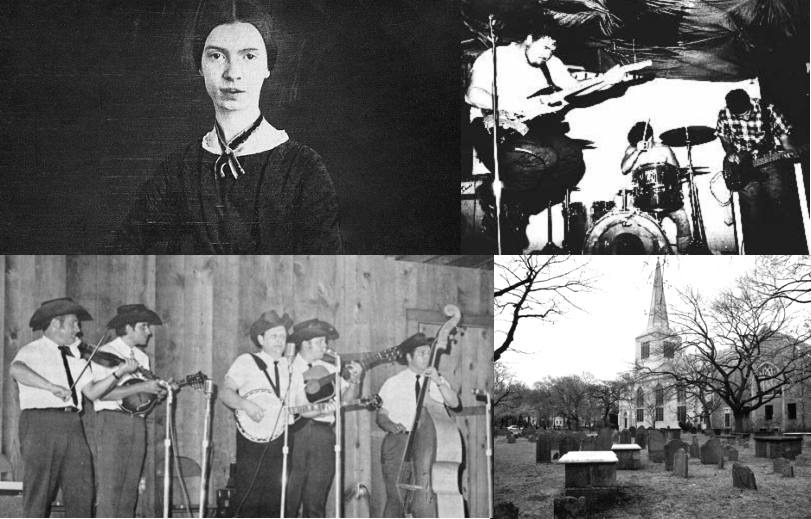
Dickinson-The Minutemen-Ralph Stanley and the Clinch Mountain Boys-graveyard

This is what you come to the Parlando Project for: stuff that’s stuck on each other like cockleburs.

.

A sexton* takes care of church grounds, typically including a graveyard. The sleeping Master’s bed chamber is therefore likely a grave. Spring has come with flowers and birds expecting new life.**

Spring isn’t stopping to reflect on this, like the tempo of the song it’s got work to do. Dickinson is in a churchyard, but it’s full of death departed and life arriving, not dogma. What replaces that dogma, sermon, homily? Bird-troubadours, secular Spring-song: its shortness, its insistence. You can hear my performance of Emily Dickinson’s “Sexton!”  with the graphical audio gadget you should see below. No gadget?  This highlighted link is a backup that will open a new tab with its own audio player.

.

*By anachronistic coincidence, the poem’s sexton made me think of Anne Sexton, a 20th century American poet. Poetry is like a cocklebur: its tropes and metaphors will stick to anything.

**More coincidental connections: in considering Dickinson’s poem in the context of a song I thought of this Earl Sykes song, best-known from a Ralph Stanley bluegrass version, called “A Robin Built a Nest on Daddy’s Grave.”   I wonder if Sykes knew Dickinson’s poem, or if there’s some third source that both the poet and the songwriter tapped for this springtime combination. My Dickinson poem-now-song would make a good medley with Sykes’ song —and good bluegrass high vocals and harmony would certainly spruce up my rough-hewn singing performance.

The Late Singer, a song for Spring

A short post and a short off-the-cuff audio piece today. I keep trying to fit this Project into my life, and this William Carlos Williams’ Spring poem reminds us that it’s never too late to sing.

I had to cancel a more pristine time in my recording space this week. I lost sleep the night before as I prepared fresh material to record, and then woke up early the following morning, anxious to see what I could do performing this new material. Then just as dawn and others woke up, I heard that a mild illness would cancel my plans. Disappointing, but, oh well. If life wasn’t bigger than this Project, what would there be to sing about?

Later that same afternoon I decided that I should do something, anything, with what had been put off. It occurred to me that by the time I’d have an occasion to reschedule I might forget the musical material I had only in my mind, since at this point the songs only existed on simple paper chord sheets, like this one.

The Late Singer

Simple chords for this one, which you can take as an invitation for you to sing this one yourself. The most obscure part of this poem is the “moth-flowers.” I’m not sure what WCW is going for there. Maple trees do have small Spring flowers. I read today that their different flower colors are actually sexually differentiated.  There’s also a moth WCW might have known that is attracted to maple trees.

.

Here’s one catch of my recording space: while ramshackle, and having a remarkable sound capturable in the room, is not acoustically isolated. Since outside sound leaks in, recording quieter acoustic instruments requires planning and scheduling. I decided, no matter if it wasn’t quiet there, I should record short, demo versions of the seven songs I was planning to work up. I figured I could do that in an hour or so, and I could afford that time.

I sat down in the space, background noise accepted, and used my Telecaster electric guitar* instead of an acoustic guitar, and ran through the seven songs one after the other. A couple of takes each, a third only if I had a major stumble. Time was so compressed that the first take was largely my own test of my “so far, only in my head” plans for the song.

During that hour I produced this quick & dirty version of William Carlos Williams’ “The Late Singer”  that you can hear below with the audio player you should see. No player?  This highlighted link then.  It occurs to me that Spring itself has its way of being quick and dirty, and we find charm in that.

.

*Electric guitar masks much of the leaked noise compared to the sensitive microphones used for acoustic guitar. Some of the leakage into the vocal mic I found I could minimize with software that does a good job of “ducking” that noise. Solo electric guitar with a single singer is not a common musical format. Jazz has some examples, ones using more chops than I have. Some early Blues makes it powerful, but that format was soon superseded by full bands. Jeff Buckley’s outrageously good “Live at Sin-é”  makes me want to put my voice inside a box in a closet and hide it. Billy Bragg, a man more of my utilitarian approach, busked and recorded with just his own electric guitar backing.

Have you tried rebooting? And Melanie, in memoriam

There’s new Parlando stuff coming. Indeed, there would already have been a new piece with words by Emily Dickinson this week if it wasn’t for a couple of issues.

Issue #1 was with a new, upgraded Macintosh computer system which handles most of the complicated recording stuff I do for this Project. After working beautifully the night before, the next day it was nearly unusable. I first noticed the mouse wasn’t working well — or a times, at all. I use wired mice, as I’d have no patience with Bluetooth gremlins — but still and all, maybe that mouse had gone bad? I swapped in an old one (I’m a packrat of old computer stuff, so I had a spare handy). Mouse back to working. But then the keyboard was nearly unusable, being extremely balky at registering keypresses. It was so bad that logging in again after rebooting the Mac was a challenge.*  Keyboard dying too? Tried a different keyboard. Same deal. I even tried booting the Mac into MacOS safe mode, which for some reason caused a kernal panic with a crash dump rather than completing a boot into that version of the operating system that’s a fall-back stripped to just the basic stuff. Was my new system demonstrating an internal hardware issue? Besides the nearly unusable keyboard, the whole system was slow, even though the system monitor showed plenty of resources available.

I wondered how much time would be wasted getting warranty service or restoring my complicated music creation environment. And then I noticed that my Time Machine backup drive was no longer mounted — or recognized as a drive in Disk Utility either. Would a warranty replacement Mac be able to transfer my stuff back from that backup? The last Time Machine backup was logged early that morning, then nothing as it had no drive to back up to. Additional worries: that drive might have checked out for good.

There’s a large overlap in musicians with folks involved with computer technology, but since that Venn diagram convergence is much slighter for poetry, I’ll cut to the solution.**  At some point I power-cycled the powered USB hub that holds most all the USB stuff that my kind of music production needs: two software protection dongles, two MIDI interfaces, a little plastic piano keyboard, an audio interface, that Time Machine hard drive, and a charger cable for my MIDI guitar. Mind you, the mouse and keyboard were plugged directly into a USB port on the Mac itself, not into this hub. And —

Everything returned to working normally. How a USB hub plugged into a different USB port from the one used for the mouse and keyboard could all but disable them, as well as causing the other issues, is beyond my knowledge level.

Large, powered USB hubs are not a common in-stock item in local stores, but just in case the issue with mine might return, I ordered a spare. It would be at a will-call desk the next morning. I’d pick it up along with my weekly major grocery run.

Issue #2. A member of the household awoke in clear emotional distress and was unable to talk about it. I thought it best to stay home. I told them I loved them and would be here if they needed me. I spent much of the day worried and concerned, but puttering around in case there were any needs that would emerge. By the middle of the afternoon they were better and talking (though not about the issue that had struck them earlier). They asked for their favorite take-out quesadillas.

I made a quick trip and grabbed the spare hub and that requested late lunch. Issues. Problems. Things don’t always work, sometimes they shut down and don’t tell you why. My late wife worked as a mental health therapist before her mortal illness. I worked decades in hospitals, then another couple of decades in IT. Some people think poetry is difficult, that it taunts you with its obscurity. Maybe so, but life does that too. Spares are difficult for us human beings. We wear and wear-out the ones we have for the most part, learning to use what we have at hand.

I would return to my studio space this morning to continue Parlando Project work. I’d read the night before that the songwriter Melanie had died, I learned of her death in a modern way that somewhat famous strangers have their fortunes told now: by folks speaking their name in past-tense on social media. As I was awaking, with my aim to record at dawn, I read a post by one of those I follow mentioning that they had a favorite Melanie song: “What Have They Done to My Song, Ma.”   Myself? My favorite Melanie is likely her cover of the Rolling Stones “Ruby Tuesday,”  or maybe even her big hit fronting a gospel group, “Candles in the Rain.”   But “What Have They Done to My Song, Ma”  is a fine song, maybe better than you remember it, if you remember it.

I sat at the mics alone, and I decided to sing that song before recording a new Parlando Project piece. In the moment I found it to be about folks attempting to fix you, or make you fit with them and their expectations or needs. That’s not always bad. That’s not always good — which is what this song feels.

This is a video as it’s my understanding that if any appreciable streaming occurs (unlikely with my fame and impeccable musicianship) that the rights owners would be paid by YouTube. Back soon with that Emily Dickinson song-setting.

.

*Yes, I worked in IT. Yes, I’m capable of asking myself “Have you tried rebooting?”

**Early in the days of home computers, SF author Jerry Pournelle had a monthly column in Byte magazine which aimed to cover the emerging field of personal computing, but more often than not, it instead dealt with some problem with a computer system in his household. In the early days of BBSes and dialup online services, there’d be lot of chatter about how this guy who got paid to write about stuff in a glossy magazine didn’t know some detail that was sure to have caused his problem right away. Best as I can figure, something inside the hub itself was “stuck” and no amount of unplugging the USB cable from the Mac, or plugging the devices in an out from the hub, helped until the hub’s own power supply was cycled.

A poet, Joseph Fasano, has a music recording, and he barely let’s you know about it.

My Project says it’s about where music and words meet, yet I’m still surprised and gratified when I encounter literary poets whose connection to music is significant. Most poets enjoy music — hell, most people  do. And the arts of poetry and music have long been siblings. Who can count how many poems have the word “song” in their titles, or how many poems speak of birds or unfeathered human musicians making music? Yet the number of poets who have publicly taken to composing and performing music is limited.

One might think that songs with words, the music most listeners prefer, would be already halfway accomplished by any good poet. In practice, that’s not always the case. A great deal of literary poetry doesn’t work like a song that captures listeners in real-time once in and through their ears.

What you say: “You do this all the time, you take literary poetry and you combine it with music!”  Yes, but I’m choosing what poetry to use, rejecting much more than I even attempt to compose music for. And while I appreciate the audience this project has developed for your open-mindedness and tolerant ears, by Internet standards my Parlando musical pieces have a small audience. Part of that is my voice, which has its limits, and my reach-exceeds-my-grasp musicianship — part of it too may be that I’m no one’s young, good-looking, begging-to-be-discovered talent.

Last time I said I’d leave a fourth example of someone combining poetry with music that I’ve discovered recently for a future post. That one is poet, novelist, teacher and promoter of poetry* Joseph Fasano. In the midst of his very active social media presence this summer, Fasano let it (rather casually) drop that he had publicly released an album of songs, The Wind That Knows the Way.

Fasano is an effective promoter of his own work on Twitter, and he’s amassed (by PoetryTwitter** standards) a sizeable number, thousands, of followers. “Followers” in the social media world is something of a hollow stat. Many in the count are proforma or “polite” followers mutually responding to follows from others, and then there are bots and insubstantial accounts seeking merely to draw attention to their causes & businesses. But when Fasano posts a poem of his or a series of notices about his latest novel, he gets (by literary standards, or mine, whatever I am) lots of eyeballs, re-tweets, and at least a bit of replies and response. By PoetryTwitter standards, people are paying attention to him.

To my knowledge, he’s not followed up to that single notice about his album of songs. For someone showing such effective and continuous effort to promote the other things he’s doing, that’s odd. Even though getting ear-time from me for musical work is tough — composing, recording, mixing the Parlando Project pieces take away from those opportunities — I listened to the album (available on Apple Music, Spotify, and likely some other current music streaming services) within a few days of the announcement.

It’s good, and a particular surprising adds to that goodness. I guess I expected a typical modern musical production — either pop in pretense or a rougher indie one. When someone tells me they have a recording these days, that’s what I’ll most often hear. Instead, the album’s sonic approach is a remarkable duplication of an early 1960s Folkways, Sing Out, folk-venue-appearing guitarist-singer with original songs record. In arrangements and general vibe, it’s like the early records of Gordon Lightfoot, Tim Buckley, Jackson C. Frank, or Eric Anderson.  For musical particularists, let me add I’m not talking about post 1965 records.  At times Fasano’s voice and musical approach reminds me of a less gruff Tim Hardin, but Hardin’s most popular later ‘60s records used highly skilled bandmates to fill out his sound. The Wind Knows the Way is just Fasano and his acoustic guitar, but like the early ‘60s records I’m referring to, his voice is pleasant and his music appealing, while his lyrics express more emotional complexity and range than the average pop song.

Here’s the title song from Fasano’s album for those that don’t use Apple Music, Spotify, et al.

.

I don’t know who engineered this recording, but the recording is technically well done too. My favorite cuts on the album are “In My Time,” “The Trouble,”  and “The Wind and the Rain.”  I’m an outsider to Fasano’s creative process, but it appears to me that he already has a “song lyric” mode that both borrows from and differs from his page poetry. These songs don’t come at you with a strange torrent of unusual metaphors with hermetic connections between them. Song lyrics forgive, even arguably benefit, from less originality in tropes, from commonly returned to, simple, elemental words. Many literary poets have trained themselves to avoid those things — and so the Parlando Project sometimes asks the listener to allow more weird words and similes that one hears with most songs. Fasano seems to know that as a songwriter he can write differently for song.

I assume he wrote the music, though the modern streaming services and his sparce posting about the record make this only an assumption. His melodies are fine, not showy, catchy and very singable. Harmonically he shows some variety in this set of songs, but he’s not from the Joni Mitchell or Nick Drake school of advanced guitar composition. This isn’t a pioneering, challenging, or world-changing record, but then too our contemporary world doesn’t have many records like this anymore: a voice, a guitar, and tuneful well-written songs that don’t require anything more than that.

In summary if you are a fan of those early ‘60s records (as I am) or if you would like to hear an intelligent record that usefully uses simplicity and a direct unadorned presentation, there’s a good chance you might like Joseph Fasano’s “The Wind That Knows the Way.”

.

*Fasano’s “promoter of poetry” element appeals to me. I’m forming a number of things I’d like to say about his efforts in that area, and if time and fate allow me, there’s maybe yet one more Joseph Fasano post to come this summer.

**Twitter, its faults and its problematic owner, is a current topic that’s launched a thousand takes, which I won’t add to today. I will say that PoetryTwitter is not overly large, but there are interesting people there. Part of what draws me to poetry is that I’m a naturally long-winded, run-on-story kind of person, and poetry’s compression lets me pare that back. The off-the-cuff, short-answer nature of Twitter lets me exercise the same muscle, and it fits my current fate of having few assured blocks of time to compose more complicated music or thoughts.