I wanted to get another musical piece up this week as I was somewhat dissatisfied with my performance in my last one here for Armistice Day/Veterans Day. I looked a pieces I had near ready, and selected this one, by Anglo-Welsh poet Edward Thomas. Thomas is lesser-known in the United States, but is more recognized in Britain where he often gets grouped as a “War Poet.” The main reason for that: he volunteered and was killed in WWI, and some of his poetry speaks about his thoughts as he considered volunteering for overseas front-line service.
Sitting in America, which hasn’t regarded Thomas enough, I’d like to expand him a bit from behind that label. First off, like Wilfred Owen (another British poet filed under war poets, and another WWI casualty) Thomas was something of a beginning poet,* but like Owen his poetic voice is so strong it doesn’t need to apologize for being early days. As powerful as Owen’s poems about trench warfare are, I’m just as impressed by his home-front poem “Shadwell Stair.”And Thomas, this other “war poet,” seems not to have finished any poetry about his short front-lines experience before his death in that service. As we celebrate Veterans Day it would be good to remember that each person who served is not just their service.
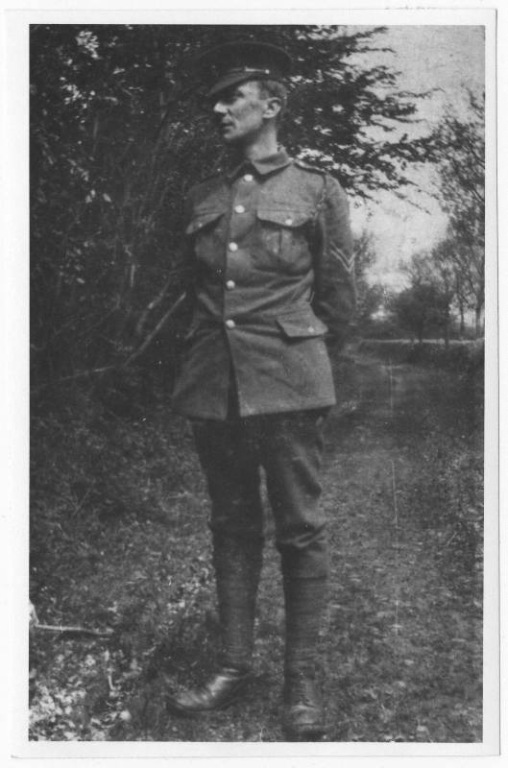
Edward Thomas in his uniform. He was married and past the age of most soldiers, but still volunteered.
.
So, here’s a poem that I think has nothing to do with the war directly – perhaps not indirectly either. “Like the Touch of Rain” seems to me to be a love (or rather a loss of love) poem, though the nature of the relationship is not spelled out.** It uses as its central symbol rainfall, and I suspect it’s speaking of erotic love because of the sensuous opening where the rain, however wild, is caressing the poem’s speaker and he sings and laughs here. The poem ends by telling us he’s now closed in, out of the rain, not by his choice but by some her’s “Go Now.” It’s a turn-about from the typical “Who’ll Stop the Rain” or “Shelter from the Storm” depiction of rain vs. shelter. Here’s a link to the text of the poem that I’ve now turned into a short song.
“Like a Touch of Rain” is not the most complex or virtuosic poem, but it also doesn’t detract from its depiction with any overreaching or stilted poetic diction. There’s a power in that. Reading Thomas’ contemporaries’ poetry in search of material for this Project I’ve read a great deal of published poetry that doesn’t escape those faults. My wife gave me a copy of Thomas’ collected poems a few years back – it’s not a thick volume, and I believe that most of the poems in it were first published in this collection posthumously through efforts of Thomas’ friends.***
After overreaching with my Padraic Colum poem setting earlier this week, and having to settle for an incomplete recording, it may behoove me to leave today’s piece as just voice and acoustic guitar accompaniment – and as rough-hewn as my voice is on this performance, I think it’s better too.
You can hear my performance of Edward Thomas’ “Like a Touch of Rain” with the audio player below. What, has the door to any such player gadget been shut? Well, this highlighted link will open a new tab with its own audio player.
**I have not read a full biography of Thomas, but before the war he seems to have had a complicated set of affections as well as bouts of depression and drug use. Those two things might cause one to suspect a ne’er-do-well life, but through-out that he wrote voluminous freelance reviews and essays to pay the bills for a young family.
I wrote down this poem earlier in the year as a good fit for an April National Poetry Month piece. It’s author, Edna St. Vincent Millay, was from Maine, and I write from another northernmost American state, Minnesota. If a southern-born St. Louis boy like T. S. Eliot who went to live his life in temperate England wants to ironically write about April being the cruelest month, dryly riffing on the Middle English of a Chaucer’s pretty “Aprille with his shoures soote” — well, what with all the flowers and pleasant nourishing rain, that kind of puts a climatic brand on the month poetry-wise.
I rise with Millay to contradict: we have birdsong here, but it’s a more desperate, assertive song, not some celebratory strope — because it rained, sleeted, and concludingly snowed a sloppy wet mix all night and afternoon as I worked on completing today’s musical piece, and this morning everything — tree branches, overhead wires, yard fenceposts, garbage cans — had, to the very limits of toppling, piles of sticky snow as high as any booklover’s stack of unread books.
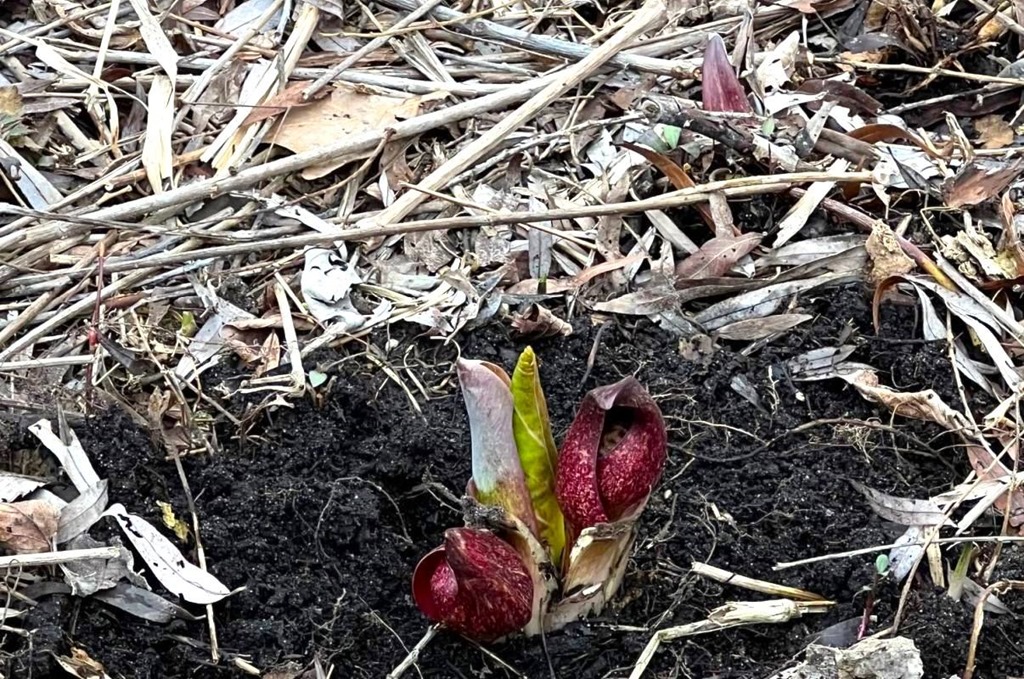
My nature loving wife took a European-born friend on a hike last week and showed the friend skunk-cabbage, a strange red, raw-meat looking early Spring plant that is exothermic — it creates its own heat like some huddled mammal so that it can bake through the snow cover. Nearer to home, indeed right next to the foundation, a small surviving clutch of tulips has sent up green leaves, but no buds yet. Their leaves course with some green antifreeze, as nighttime temps remain consistently below freezing.
“O April, full of blood, full of breath, have pity on us!”
.
My wife and I have varied memories of who planted the tulip bulbs. I remember it was my late father, long ago — while she thinks it was her mother more than a decade ago. There are only a few left. Brazen squirrels dig them up, or perhaps they are only perennial in the same sense that we are, bound to rise in many springs, but not forever.*
So, if the theme of this April’s Poetry Month is The Shared World, I certainly felt I was sharing the world within Millay’s poem “Northern April.” The wind, the resonance of a creek with remaining ice, the just warm enough to be rain/rain. At least for me, in my northern clime, there’s a rich sensuousness in the poem, and enough word-music inherent in it to command me to sing it.
I’ve noticed that I haven’t used my 12-string guitars much this winter. They are a little more stout to play, and I think they show less forgiveness for my less-than-pristine technique, but I tried to plant today’s piece in the furrows dug between my limitations.
My music today makes use of a couple of instruments playing at the edge of their ranges. The bass guitar part is entirely played in the upper octave of the instrument, giving it an unusual sound I found I liked; and for a bit of melodic embellishment, I played an oboe line, again at the upper reaches of the instrument. Why an oboe? I thought of a 20th century band called Oregon who would mix 12-string guitar with reed/woodwind instruments, and I wanted to revisit that set of timbres from the composer/player side instead of from my listener’s memory.
*I took leave from poetry and music to very briefly look at that issue from gardening knowledge. It appears that the bulbs shoot off other child bulbs, a process hidden in the dark underground in the later, non-flowering, part of the year. If so, appropriate for the idea that we think these spring flowers are from our parents.
Someone on social media this week suggested this conversational opener: “Remember when talking about the weather was just small talk?”
I was thinking about this as I worked to finish today’s musical piece that I’d started a week ago. Since then, American news has been filled with accounts of one major hurricane’s aftermath and the approach of another one. The kind of fun I have meshing poetry with a variety of music I compose and realize is hard to set beside disasters of this scope. I think: here I am privileged to explore unusual connections when other citizens are dealing with hardship and immense losses. In the end I saw the Dickinson poem speaking to those differing situations, and I’ll finish by talking about making this musical piece and the style of its playing which also lets two strong differences coexist.
“The Wind Began to Rock” presents as a narrative, with well observed descriptions of the storm’s arrival and then deluge, but Dickinson chooses the odd conclusion. You can read the text of her poem here. We don’t get a tale of devastation. We don’t get the following suffering. We’ve had the fury — and then what? The incongruity of that ending — if it isn’t a mistake, what is it? I think we should be convinced of Dickinson’s genius enough to make our default assumption it’s written with intent. I’m already risking insensitivity, could I add humor to this and say that with the anti-climactic ending of the narrative arc here, I could have appended a subtitle “Started early, took my shaggy dog.”
I’ll just briefly note that Dickinson could be writing from experience. During the 1861 hurricane season, her hometown of Amherst got the inland tail-end of two storms. But I’ll note another metaphoric storm too at the same time: America’s Civil War. That this huge storm occurs, and the Dickinson household damage reported at the end is only “quartering a tree” may be her point. Some are losing more, up to their lives. The question of enslavement’s onerous human property and the continued existence of the nation that her father served in the Congress of are at risk.
Even the seemingly inconsequential summary of “quartering a tree” is an odd choice that bears consideration. Is this a reference to the particularly cruel execution practice of “drawing and quartering?”
The storm has not made her house divided and not standing, but the tree may say her privileged situation has a crucifix of more complete suffering in view. Questions may arise to us, if we are privileged to not be in the direct path of hurricanes or oppression, looking out on our own storm season and the drifting path to an election this Autumn. All those thoughts arose after I’d completed the recording of today’s musical piece. My earlier performance was innocent of them, but let me present the music anyway.
As I mentioned last time, Emily Dickinson’s wide-ranging poetic spirit had possessed me with this charge: “I wanna rock!” I have no idea how rocking Dickinson’s own parlor-piano music-making was, but her poetry often indicates to me a mood of loud slyness that could front a rock band.
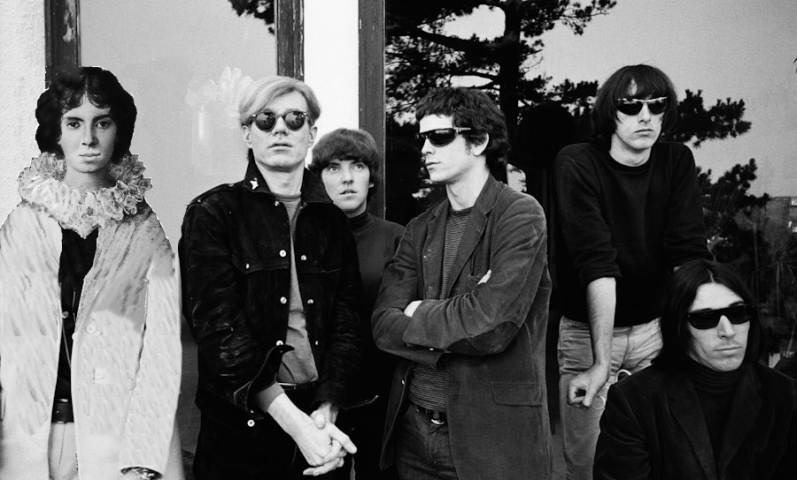
Rock music famously doesn’t require a lot of compositional undergirding, and the harmonic framework of the music here was minimal: two chords (B and A), their roots a full-step apart. Yet, it really doesn’t correspond with typical chordal cadences in Blues or Rock — it’s a tactic I associate with the Velvet Underground, a smart people in a rock band collective whose formative association once traded under the name “The Primitives.”
Today’s musical piece doesn’t sound much like this band, but “All Tomorrow’s Hurricanes” was a cut on the first Velvet Underground and Emily Dickinson album. Andy Warhol’s cover had a picture of a peelable ghost flower.
.
As much as I was working with piano, bowed strings, and acoustic guitar lately, I was itching to get back to loud electric guitar — but my situation in this era of my life makes two poles of music making more difficult to schedule. My quiet stuff has to be recorded when outside noise won’t scrape and bark into sensitive microphones, and the loud Rock that asks for interaction between the electric guitars and amplifiers pushing rude airwaves into a room risks disturbing others. Sometimes the situation, that I can’t whisper in an otherwise silent room, only makes me want to turn up the electric guitars all the more.
As you’ll hear if you venture to the audio player below, I was able to turn the guitar amps up for this, though I had a limited window to shatter.
The kind of guitar playing that steps out to the lead in the ensemble today is a style I worked with quite a bit back at the turn of the century. Like the chord progression, it’s not Rock-band-conventional. The framework is two lead guitars each free to explore melodic lines without strictly alternating (e.g. obligatory “call and response,” “trading fours,” or the like) or playing pre-composed harmonic intervals between their melody notes. It’s still Rock-music-like in that the two lead instruments reference the Rock beat, but this kind of simultaneous, spontaneous lead playing happens only rarely in the Rock genre. You can hear something like it in some folk musics, in early Jazz, and much later in Free Jazz — but for all its “let’s make a racket” ethos, Rock music generally avoids this.
Anyway, if you want to listen to this as it’s intended to be heard, don’t use ear buds or quiet levels. Use a set of stereo speakers and turn up the volume level. You can dance if you want to.
Audio player washed out on your way to reading this? This highlighted link is an alternative that will open a new tab with its own audio player.
A lot of the poetry I combine with music here was published around 100 years ago, making it clearly in the public domain for reuse. Given my age, some of the poetry from the Previous Twenties doesn’t seem all that old — after all, many of the poets’ lives overlapped mine — but some poets and poems look back, as I do now from my 2020s, to older styles of poetic expression, ones from an additional 100 years before the 1920s poet. That may be too much for some younger audiences I think.
Since poetry is at least partly about how something is said, it’s not out of line for style to be substantial when we choose to read or listen to poetry — but, sometimes we might choose to “translate” poetry for performance to make it more immediate.
Here’s an example. I came upon this 1922 poem by Claude McKay while looking for summer poems. I’ve presented McKay a few times already here. A figure stored away in the Tupperware container labeled The Harlem Renaissance, McKay’s poetry is still preserved and sometimes read — often the portion of his poems that speak eloquently about racism and the double alienation of being a Black Caribbean emigrant to the United States. Since these things are still factors in the 2020s, that supplies relevance to continue to consider them. A poem like his 1919 sonnet “If We Must Die,”however formal in prosody, presents clear reasons to our current ears.
But McKay is also a passionate love poet.* Now, to say the least, love is still a contemporary experience, so one might think his love poetry would also get more contemporary exposure. My casual estimate says this hasn’t happened. Yet.
Why not? This poem is significantly old-fashioned, 19th-century-like. Its sentences are poetic in an outdated style, they don’t flow casually in a spoken way. This is a style we might forgive in 19th-century verse if written back then, particularly if the poem is a Hall-of-Fame, “Poetry’s Greatest Hits,” poem — but not so much for a 20th century poet’s less honored selection.
Don’t make the mistake when reading old poetry to think that the poets must be old too. McKay was just 30 when he first published this poem.
.
This poem also makes a mistake writers can fall into. McKay seems to think that leaving a surprise for the ending will strengthen the poem — that when the reader finally sees that surprise they will be happy to have waited for the poem’s context.
There are poems that work that way.** To me, this one doesn’t. Coming upon it, one may not read through the facile but not necessarily compelling nature poem that makes up more than ¾ of the text. Therefore, in my “translation” for today’s performance, I’ve decided to create a refrain out of the poem’s final line, spoiling the surprise but urging the listener to consider the nature and weather report portions of this poem as reports of human desire and inner weather. You’ll hear how it works in the musical performance you can hear below.
Taking liberties like this is one reason I use public domain work: it’s now free for one to do with it what one wants. If you want to read McKay’s work as he intended it, here’s a link to the 1922 version. That link includes its own link to an even earlier published version by McKay, evidence that the poem’s author himself was trying to improve his poem’s impact.
Writers: if you are ever writing a surprise-ending piece, if you ever are withholding something from your reader or listener because you think it’ll be a grand or witty “Aha!” moment at the end, consider the alternative. The alternative here, the bringing out the key context that the poem’s speaker is viewing his summer night and morning “Blind with hunger for your love,” strengthens listener engagement I think, and it lets the listener see that the speaker/singer is just as attracted to the early rain-storm, sleepless-night portion of the weather, as the “miracle” of the subsequent sunny morning which is so incongruent with their present feelings. I’ve doubled down on that revision by making the newly refrained line the title too. ”Summer Morn in New Hampshire,” as McKay titled it, is too specific yet generic in my hindsight judgement.
I did my best with the musical performance of this as a song. I enjoyed playing my big, heavy, 20-plus-year-old 12-string Guild guitar and weaving in the rest of a quartet of ringing and raining instruments. It’s not a humble-brag, but a statement of the song’s potential to say that this piece would benefit from a higher-skilled singer than I am. Perhaps my voice’s approximations can be heard as bringing an imperfect human immediacy to the words? You can hear the performance with a graphic audio player below (if you see that). No player? This is a hyperlink that will open a new tab with its own audio player.
.
*Let me leave this final point to a footnote. Best as can be determined, Claude McKay’s erotic connections seem to have been with men. Given the homophobia of his time — or perhaps from artistic choice — McKay has written this poem, as he has many of his love poems, in an entirely genderless manner.
**This poem isn’t a sonnet, but it is “sonnet-ish,” and the popular English/Shakespearean sonnet conventionally expects a somewhat surprising summation in its final couplet.
Early this week, Poet Jose Hernandez Diaz on Twitter put out a call for people to respond with their go-to poets in our troubled times. I’m always uneasy when being put on the spot for short-lists, because I’m by nature a person of various moods and needs. The poet I need today is not always the one I need tomorrow. And then, it’s the same or even more so with music for me. Perhaps some of that comes through here in this project’s variety?
Two names surprised me* as I tapped in the poet names that came to my mind that day this month: Edward Thomas and Du Fu. We’ve dealt with Thomas here more recently, so today I’ll speak of Du Fu.**
Two things seem to connect me to this master of classical Chinese poetry: Du Fu wrote his best work as an old man (such as I am) — and that productive period coincided with a great governmental rebellion and crisis in China. When Du Fu writes a lovely nature passage, I always read it as the work of someone who is also seeing great destruction and violence in the human part of nature.
Du Fu, not an Asian-American, but his poetry sometimes speaks to my country none-the-less.
.
In this troubled week I went looking for a poem I could get close to and perform, and I found this one of Du Fu’s. For practical reasons, I need to make my own translations of Du Fu from English language glosses (such as the ones found at Chinese-poems.com) and the difficulties of making a graceful poem in English out of an 8th century Chinese poem would seem daunting, but they attract me all the more. Obviously, there are great risks that I will misunderstand what Du Fu is trying to say — but not only do I accept those risks, I’ve been tempted more than once to transform key images from Du Fu’s time and place to contemporary America. For these reasons most of my Du Fu pieces should be understood as adaptations, the kind of thing that I’ve decided are best labeled as “After a poem by….”***
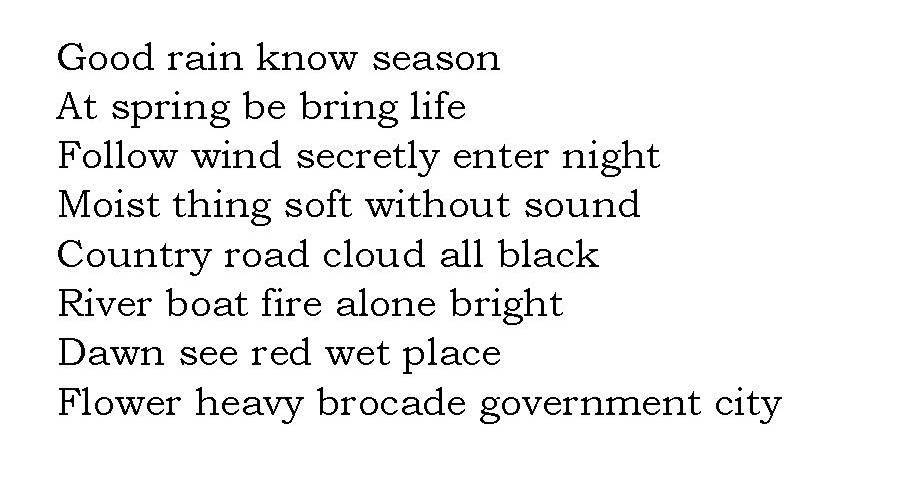
This is the gloss I worked from for today’s piece.
.
And here’s my “Rain on a Spring Night (after Du Fu)” version used for today’s performance:
I usually would work longer on one of these, but it’s been too long since I presented new work here.
I think of my opening section as a good faith attempt at an accurate translation into a working English poem. I used English syntax and conventions, added the poetic device of parallelism to substitute for the word-music losses inherent to translation, and tried, as I always do, to present vivid images.
The last section of Du Fu’s poem is where I likely diverge. I do sense a turn in the poem at this point, I think it’s possible Du Fu’s trying to contrast the peaceful rain following nature’s order in his opening. The (cooking? signal? lantern?) fire on the boat is the only human sign in the poem. Is that only coincidental decoration? The gloss’ final line is most difficult. A single image there comes through to me: that flowers, perhaps even fallen blossoms, are like the patterns on a brocade fabric. “Government city” puzzles. Like brocade on rich courtiers? Or is this spring morning near a capitol city?
So, my choice was to allude, somewhat obliquely as Du Fu seems to have done, and the final scene is designed to depict not peaceful spring and beneficent rain, but the aftermath of violence as we all to well know it now and here: the yellow crime scene tape, the flower memorials left. A rain of bullets is not a good rain.
My music and performance is very sparse for this, but I decided that’s starkness was effective. You can hear the performance with a player some will see below, or with this highlighted link.
.
*I wouldn’t even have known their names, much less their poetry or something of their lives before starting this Project six years ago.
**I have to note his name was often spelled in the western alphabet as Tu Fu. Du Fu is supposed to be the better approximation, even though there are as many or more references to him as Tu Fu online or in books.
Let’s continue our countdown of the pieces you most listened to and liked this past spring. As we move up toward the most popular one, we start today with number 7. If you want to read my first thoughts when the piece was first published, the bold-faced headings are hyperlinks to that. How well will these poems mesh with today’s Father’s Day? Let’s find out.
7 April Rain Song by Langston Hughes. Hughes gets two appearances in this spring’s top ten, and his second one here is yet another song of rainfall that fell in this season’s list. Hughes had a strong element of practicality in his poetry, clear-eyed looks at his times and place, necessary observations — even in this poem written for a short-lived children’s magazine that works as a calming lullaby, something a parent might sing to a child. I said last time in his early poetry I can hear Hughes adopting some of older poet Carl Sandburg’s approaches, and this poem pairs nicely with Sandburg’s “Branches” that came in at number 9 this quarter doesn’t it. But then Hughes in turn helped inspire Gil Scott-Heron, and I can hear how Scott-Heron used and extended what he gathered from Hughes.
6 The World Is a Beautiful Place by Lawrence Ferlinghetti This is a rare piece here that is not AFAIK in the public domain and completely free for reuse, but the death of it’s author this year felt like something that I must respond to, and the way I usually do that here is to perform their words. Listeners last winter and persisting through the spring continued to listen to this performance of one of Ferlinghetti’s poems leading to its second consecutive appearance in a Parlando Top Ten. Copyright aside, if you don’t have one of Ferlinghetti’s books, go ahead and get one. The generosity of his poetry will more than repay your contribution in buying it.
But for many in my generation, Ferlinghetti, and in particular his collection A Coney Island of the Mind, was always there. You’d visit someone’s apartment to talk, to organize, to party, to make out — and there in some improvised bookcase made of boards and bricks or milkcrates there’d be this book-cover wrapping a thin volume: black night and grey illumination that seemed to turn silver from its contrast.
Most of us were in a demographic that said we would likely have had parents then, but in a poem like this one Ferlinghetti was taking, to some suitable degree, the role to be our father. So, for this Father’s Day it is altogether right to listen again to him welcoming us to, and showing us, life. Player gadget below for some to hear the LYL Band’s performance, or this highlighted hyperlink that will open a new tab window to also play it.
.
Influences. Langston Hughes influenced Gil Scott-Heron, Ferlinghetti opened up poetry to many of my generation — and while immortal Dawn’s chasing the young Tithonus still seems a little pervy once we leave the mythological world, Rimbaud might well have been borrowing from that myth.
.
5 Dawn by Arthur Rimbaud Rimbaud on the other hand was never the suitable father figure for anyone. He might have been a teenager when he wrote this poem, but he wasn’t quite acting the child’s role here either, for as I translated this my understanding became that he and that personified borderland time of dawn have run off to the wilderness to swive.
But it just so happened, with a backwards echo, that after I translated this poem and moved on to translate a poem by Sappho, that the two poems were connected. Sappho’s ancient poem ended with the recounting of a Greek myth of Tithonus who, like the singer of Rimbaud’s 19th century poem, was taken off by a love-besotted Dawn. I didn’t know Sappho’s poem or this mythological story when I was translating the Rimbaud, but it now seems possible to probable that Rimbaud knew this myth and was referring to it in his poem. I dealt with this anachronistic learning timeline by replacing Tithonus with Rimbaud and the twist of Rimbaud’s own later life in the ending of my version of Sapho’s poem that you can read about here.
Many a father knows there’s an unintended corollary in Wordsworth’s line “The child is the father of the man.” The teenaged Rimbaud taught the aged me.
It’s time for our every-quarter look back at what pieces you, my valued and appreciated listeners and readers listened to and liked most during the past Spring. This one turned out to be a tight bunch over the past three months, with only a little over a dozen listens and likes between the 1st and 10th position. Given the range of musics I’ll use and the variety of poetry presented, that means that there are a lot of different “yous” out there in this project’s audience, or that some of you don’t mind my jumping around a bit.
We’ll progress in the countdown format, starting with number 10 and over the next few days getting to the most listened to and liked one from this past springtime. If you missed what I wrote about each piece when it was first presented, the bold-faced titles are also hyperlinks to the original post where you can read more about my encounter with it.
10 The Negro Speaks of Rivers by Langston Hughes One of my favorite pieces I’ve done this year. It’s been rare lately that I get to create, record and present an out-and-out electric guitar centered piece like this. This one would place higher except that it was released last winter and its February listens aren’t counted in the Spring Top Ten. As it happens, a great audio piece for Juneteeth though!
9 Branches by Carl Sandburg Sandburg set his poem specifically in April, but as much of the United States has current drought issues it might also serve as an invocation for some summer rain too. Nice to have this one next to the one above — Sandburg was one of Langston Hughes’ models when the younger poet created his own poetic voice.
Limits on recording time this year have led me to present more pieces as simpler and more immediate acoustic guitar and voice arrangements, some of which, like this one, seem to work pretty well.
On electric guitar: Langston Hughes, acoustic guitar: Carl Sandburg, and on whistling bats with baby faces: T. S. Eliot.
.
8 What the Thunder Said Part 3 by T. S. Eliot Each April this project has presented a part of the landmark Modernist poem “The Waste Land.” This April I completed that long task with the final section of the poem “What the Thunder Said.” One of the few pieces this Spring where I got to deploy my orchestral instruments forcefully. Player below, alternatively this highlighted hyperlink.
As we continue our celebration of National Poetry Month, I remind us all that not everything in poetry needs to be heavy business. For example, here’s a poem by American writer Langston Hughes, a man known largely for his poetry that deals frankly with the Afro-American experience, and this poem of his was published in a magazine founded by W. E. B. Du Bois during the famed Harlem Renaissance.
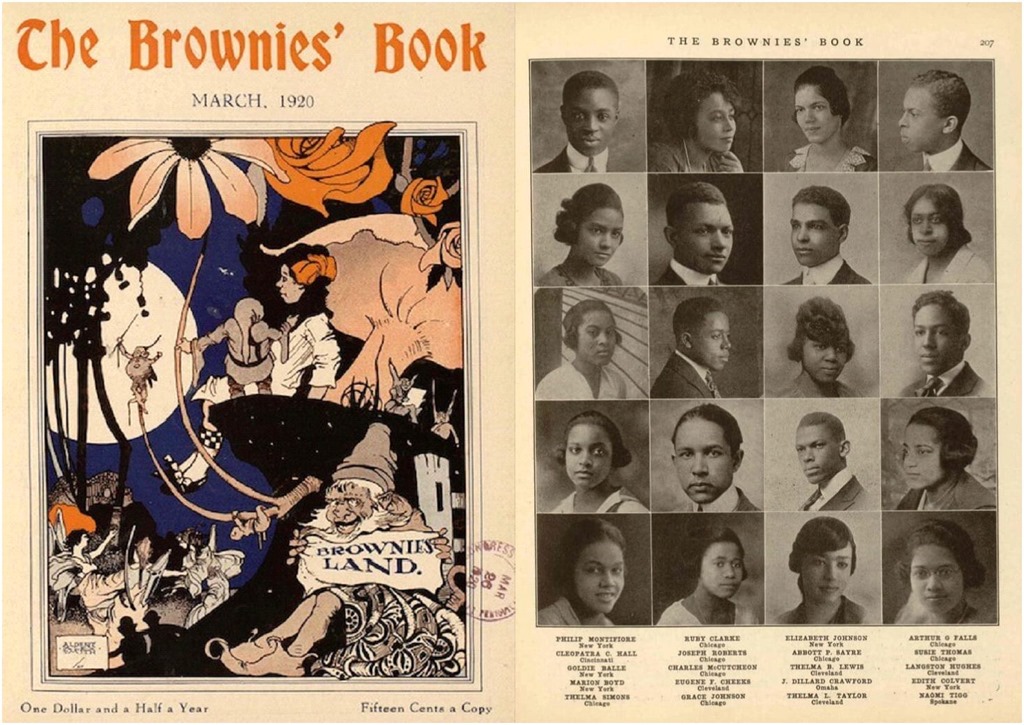
But wait, not only is this a poem about springtime, it’s a children’s poem written for Du Bois’ children’s magazine The Brownies’ Book. I first learned about this pioneering publication for Afro-American children at the My Life 100 Years Ago blog, which among other things often covers what was happening with magazines of that era.
Hughes himself wrote today’s poem when he was a teenager, and The Brownies’ Book was the first publication to publish his poetry. “April Rain Song” is a charming poem, and in rhythm and poetic tactics it reminds me of Carl Sandburg, a fellow Midwesterner whose writing influenced the young Hughes. Here’s a link to the text of Hughes’ poem if you want to follow along.
Check out the high school graduate in far right middle row. Yup, that’s Langston Hughes.
.
It’s been April rainy the past two days in my city, so working on making “April Rain Song” a Parlando Project piece had overcast and setting. Hughes here shows me a mode I sometimes aim for: it’s a nature poem, but specifically set in a city, not in some rural nature. The rain meets sidewalks and street-gutters, not some Eden.
Rain, specifically spring rain, has a strong memory element for me. Perhaps you share this? Outside in rain I’ll often recall other wet spring days, watching from the current distance my child-self walking beside miniature gutter rivers, observing for no particular reason their sweep around last years’ leaves and last winter’s final dusky ice clumps. Or perhaps you recall a particular roof on which fell our general rain? Was Langston Hughes too young yet to have that experience of memory when he wrote this poem? I cannot say, but I have that now, and so I add a bit of wistfulness to his words today.
This project’s subtitle Where Music and Words Meet portrays its interest in the ways words, mostly poetry, might interact with music. How that works varies. I use different kinds of poetry, and different ways to combine those words with the music written for this project.
Song lyric writers, who intend their words to be sung from the git-go usually rhyme their lines, and most song lyrics are at least roughly metrical. That practice has continued even as free-verse without regular rhyme and strict rhythm became a substantial portion of literary poetry written for the page.
None-the-less, I find it’s often easier than you might think to sing free-verse. Here’s the text of today’s piece for our celebration of #NationalPoetryMonth: “Branches,” by one of this project’s favorites, Carl Sandburg:
The long beautiful night of the wind and rain in April,
The long night hanging down from the drooping branches of the top of a birch tree,
Swinging, swaying, to the wind for a partner, to the rain for a partner.
What is the humming, swishing thing they sing in the morning now?
The rain, the wind, the swishing whispers of the long slim curve so little and so dark on the western morning sky … these dancing girls here on an April early morning …
They have had a long cool beautiful night of it with their partners learning this year’s song of April.
One thing I notice right away that lets this take to singing: it’s ecstatic. Some of the sections of what has been our April National Poetry Month staple for the past few years, Eliot’s “The Waste Land,” are hard to cast into singing — even though that poem as a whole is very musical with its repetition and its outright references to musical pieces. Parts of “The Waste Land” use mundane dialog purposefully, and it’s difficult to sing that sort of thing without transforming its nature. “Branches” too uses repetition, along with sound-tricks like words that sound like what they are describing (swishing sounds like the word “swishing” for example). Repetition can stand-in for rhyme to some degree. Free-verse irregularity of lines is less of a problem than it might seem. Music is fully capable of filling in spaces where syllables aren’t, and it can be made comfortable too with melodic lines of various lengths.
Carl Sandburg himself is an interesting combination of words and music. Besides his early and vital contributions to American Modernist poetry, he was also an important collector and popularizer of American folk song both by playing and singing those songs himself, and by the 1927 publication of his significant early anthology of them The American Songbag. I haven’t quite nailed down just how important he was in those matters, but I think it’s possible that without Carl Sandburg there’d be no Woody Guthrie as he was, and going forward from that, no Bob Dylan as he was and is.
When performing them, Sandburg accompanied those folk songs himself with guitar
.
I’m not alone in liking to set Sandburg to music, though I’m not aware that Sandburg himself ever did, oddly enough. I perform his “Branches” today with just acoustic guitar, nothing fancy, just as Sandburg himself could have. The player gadget to hear me perform it is below, or if you don’t see that, this highlighted hyperlink will play it too.
How do we determine what a poem is on about? That this should be a question is a reason many flee poetry. Plainspoken poems still exist, and some poets manage to pull off the technique where there’s an easily accessible layer, and then on further consideration, deeper ones beckoning beneath. But the plainspoken poems are not always honored in the school anthologies that introduce growing minds to the art; and too many when introduced to deeper readings fall away from poetry thinking that either they “just don’t get it” or that those pointing out these subtleties are hallucinating angels and cows in cloud forms.
Even a poet like Robert Frost who was able to pull off that trick of relatable surface and deeper, more complicated undercurrents, must suffer from party boors like myself reminding trapped conversation subjects that “The Road Not Taken” is about the over-consideration of choice not the necessity of stalwart individualism. Damn, the listener thinks, looking for an out, “I thought I had a poem, my poem, and now this fellow is saying one or the other of us is an idiot or a fool.”
There’s another route, another signpost that may help, one couched in the informal phrase “Where are you coming from?” Given that literature in our age has been to a large degree taken over by memoir,* we may employ this tactic as readers or listeners. In this frame, poets are about their lives, and in an even more contained sense, about the important facts of their lives: a trauma, a struggle, a novel life story.
In this view, to consider “The Road Not Taken” in the context of the tragic friendship between Robert Frost and Edward Thomas walking in the wandering lanes and paths of the Cotswolds may help us understand that that poem isn’t just a self-contained piece of art, though it can be that, but also an artifact of something complicated as lives are.
So, I promised I’d get to Rainer Maria Rilke. Last month I started to translate his poem “Before Summer Rain” from the original German. I sometimes do my translations before reading existing English ones. I’m not sure if that is a good idea, but I like the surprise of a poem coming into view for the first time as I work out the language. I finished a draft of it, and then found two or three other English translations in short order.
My “Before Summer Rain” that I could view when this draft was done was a fairly light, fairly clever nature poem about the onset of a thunderstorm. Summer, leaves are all green—then sunlight, perhaps even the chromatic range of the light’s color, takes on a new cast. A bird calls, but we sense it more as a warning omen or a call for others of its species as the storm brews. Inside the house, sunlight no longer illuminates things. Will it storm or will it not quite reach ignition and fade off? A few drops or a deluge? The poem ends.
Right away I doubted my translation in light of the others. I didn’t get the picture entirely wrong, but a couple of significant details diverged, ones that seemed to take the poem elsewhere. Here’s a link to the most common English translation I found. The translation is by Edward Snow, though almost none of the Internet sites that use his work credit him. Snow published his translation in 1991. He’s an award-winning translator who concentrates on Rilke’s poetry—plenty of reasons to respect Snow’s authority on the accuracy of his Rilke. Other than our differing attempts to make compelling English poetry from Rilke’s German, here are the two things that stuck out.
The end of Rilke’s German line “man denkt an einen Hieronymus” (literal: “one thinks of a Hieronymus”) is in Snow’s, and I think every other English translation I found, translated as “St. Jerome.” This indicates strongly that is how the word would be understood in German, and Hieronymus is the Greek version of the name Jerome. This may be problematic for the poem, however. Assuming that the more knowledgeable translators are correct, this leaves many readers in the dark. What the hell does St. Jerome have to do with this reasonably vivid and non-allusive description of an oncoming storm?** In my first complete draft I thought it better to leave it Greek, which would be mysterious in a more mysterious as opposed to a “what the…” way. My second choice, the one I used by the time of my performance, was to use the literal translation of the name from Greek: “sacred name.” This increases an immediate sense of the moment being described by Rilke. The bird’s call is so urgent, so important, that the sacred is invoked.
OK, if I’m going to worry about a single word, what next? The concluding two lines of Rilke’s poem in German are: “das ungewisse Licht von Nachmittagen, / in denen man sich fürchtete als Kind.” (literal: “the uncertain light of afternoons, / in which one was afraid as a child.” Snow renders these as “the chill, uncertain sunlight of those long / childhood hours when you were so afraid.” I had a completely different sense in my draft, that it was still the external object, the changing light of the summer afternoon threatening to storm, that was being depicted. In poetry the observer, the poem’s speaker, and the object may often be merged, but Snow says this is not just an oncoming storm, this is a trigger of something darker than even that. Snow seems to add “chill,” which I can’t find in Rilke’s German, to intensify that sense.
I had read the poems mood as mostly light, mostly clever. Snow had read it, I think, as darker, more chilling. A day or so later I started to think. Did Rilke suffer some kind of childhood abuse?
And so, just in trying to do a translation, trying to figure out what a poem was on about—so that I could bring you an audio performance of a piece that otherwise wouldn’t exist, I found myself thinking I had two roads: throw out my attempt at translation as a misleading embarrassment, or dig more into Rilke’s life.
Turns out I knew even less than I thought. I had this sense of a lean, sickly, aesthete melding art and spirituality, a purist willing to risk lyrical excess. In looking at the highlights of Rilke’s life, it’s stranger than that. I began to think Midwesterner Don Marquis would have made of Rilke something of his poet character Fothergil Finch in his Hermoine and Her Little Group of Serious Thinkers satire. But Rilke’s childhood did have elements that we, and he, might view as abusive.
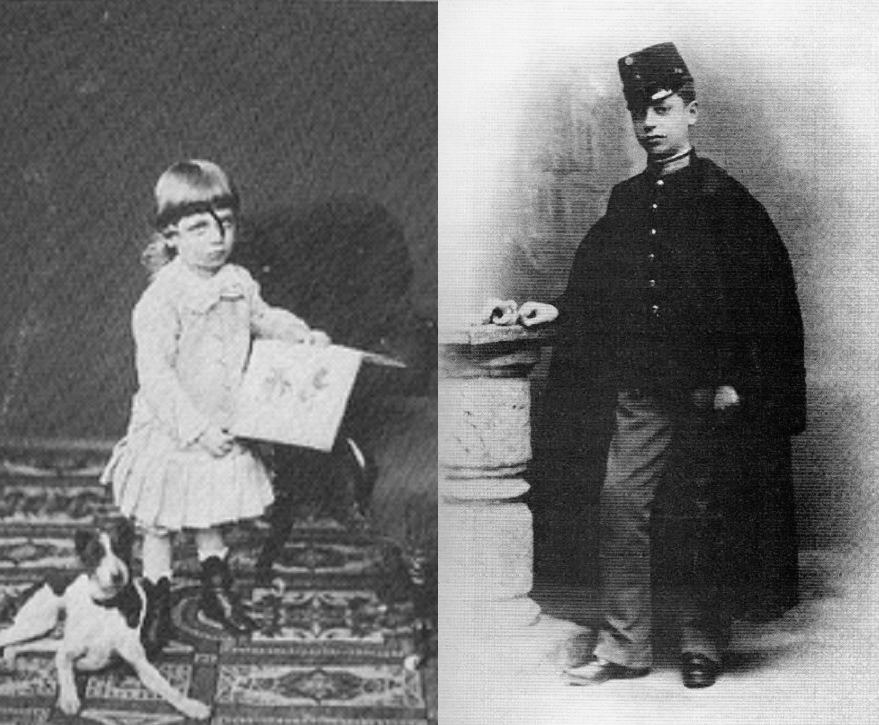
Rilke age 4 dressed by a mom who missed a dead daughter, and Rilke age 11 sent off to military school to butch-up by his dad. Yes, 19th century children’s clothes are a different sensibility, and some kids respond to a disciplined and regimented life. Rilke didn’t seem to, and his teen years in the school were not good, clashing with the other students who were more into it.
And so I concluded, I needed to revise my translation or abandon it.
Then yesterday I had a chance to record with acoustic guitar, and I grabbed a few things that might work presented that way. I thought, “Before Summer Rain” needs revised words, but maybe I can compose the music while I’m at it, and I could record the revised words later.
The tune came fast. The chord progression has similarities to a strain used in Ray Davies Kinks’ song “Rainy Day in June” (another song about sudden summer rain), but given that I had access to a quiet room where I could record acoustically, I decided I’d go all the way and use an even quieter nylon-string guitar available there.
Nylon-string guitar might bring various things to mind: “classical guitar,” Willie Nelson, Latin American music. I’ll often associate it with two things: learning to play guitar on a J C Penny’s nylon string guitar in my youth, and the early albums of Leonard Cohen where Cohen would play his “one lick” effectively on nylon string guitar. Testing the melody against the existing words, I recorded a couple of takes, while trying to reacquaint myself with the different sound of nylon strings.
There, with live mics and the recorder running, I realized I had already written the translation that could bring out the personal darkness, the undercurrents of childhood abuse, with my version of Rilke’s words. It was simply a matter of performance.
You can hear the performance below with the player gadget.
*I don’t object to this except to the degree that as a contrarian by sensibility, I don’t want any mode or approach to become so predominant without at least asking what else could be done. This is part of the reason that this project has been focused on “Other People’s Stories” and isn’t as much about a personal journey (though those elements can’t be avoided).
**Wikipedia’s entry for St. Jerome, who I only knew as the man credited for translating the Bible into Latin (then the common language of educated Europeans) includes an anecdote about the guilt-ridden Jerry after a night of too much party trying to atone by visiting Rome’s dark catacombs to commune with the decaying bodies of apostles and martyrs. Major goth points, and possibly even a reason why he might be mentioned in Rilke’s poem. But how well is this known? I also find it odd that the German to English literal has it “a St. Jerome” if we remove the Greek. Was St. Jerome enough of a big deal meme-wise that you could refer to him as a type, like calling someone “a Judas?”






 Frank Hudson