Here’s another short poem by Sara Teasdale that I’ve done the Parlando Project thing to by making it into a song. As a young woman, Teasdale won the Pulitzer Prize for poetry in 1918, but as the century continued her poetry lost some of its literary/academic esteem for not being written in the manner of High Modernism’s Hermetic allusions.*
Teasdale grew up in the same turn-of-the-century St. Louis Missouri as High Modernism’s Chief Mage T. S. Eliot, though I’ve never been able to establish that they ever met as young people. One plausible reason why not: both were educated in gender-segregated schools for the most part. And Teasdale’s early life was like late-life Emily Dickinson in its isolation, largely confined to a room in her family’s home due to some vaguely defined illness. As a young woman she was able to break away from that confinement, moving to New York City and engaging with other literary figures there during her heyday as a poet. Like her contemporary Edna St. Vincent Millay, she married a non-literary man after romances with other poets, but Teasdale’s marriage was less successful.
Teasdale’s Pulitzer-honored collection was titled Love Songs, and that does describe her most common subject. Today’s poem, at least on face value, is one step removed from a personal experience love poem, posing itself as a poet-supplied maxim applicable to a disappointed-in-love younger woman.** I’d dispute that the poem’s advice is only useful for women — but then the specific in poetry often stands for the general. Here’s a link to the text of this short poem.
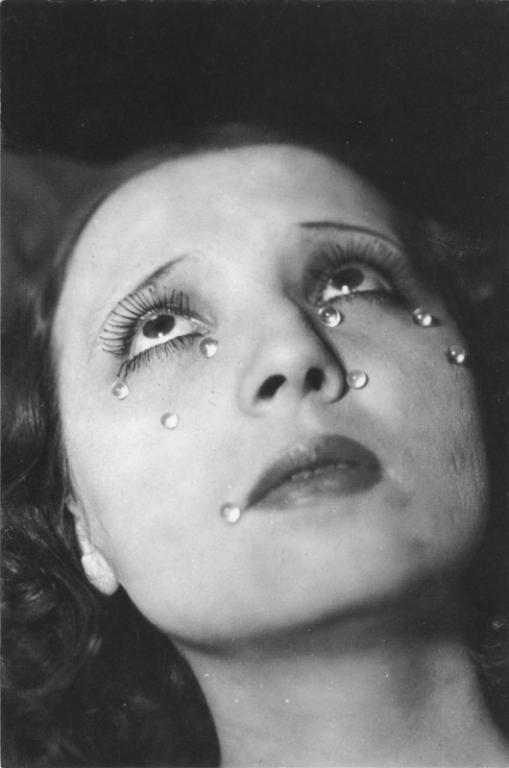
“This truth, this hard and precious stone, lay it on your hot cheek.” Photograph by Man Ray
.
Like many of the poets I feature here, Teasdale’s Wikipedia page is brief and fragmentary — but one thing it does document: her work has been set to music often, and by a wide range of composers. Early in this project I mentioned that singer-songwriter Tom Rapp’s setting of a Teasdale poem was an early inspiration for me. One could make the case that it was us composers, more than literary academics, who maintained Teasdale’s art until it could be re-engaged with.
Part of me wishes I could’ve produced a more polished performance of Teasdale’s “Advice to a Girl,” but my current life often reduces the time I can spend on the musical pieces. I like the harmonic cadence in this song’s music, but I expressed that with just an expeditious strummed guitar part along with some acoustic bass accompaniment. Still, the idea’s there now, and an unexpressed idea easily fades and disappears. You can hear my performance with the audio player below. If you don’t see any audio player, there’s also this highlighted link which will open a new tab with its own audio player.
.
*That I’d write “Hermetic” there indicates that my moods and mind are not opposed to that kind of poetry — but then I’m also not opposed to poetry that speaks of our ordinary and present human relationships, which in their complexities and footnotes exceed any grimoire’s or textbook’s breadth. Just as with music, I’m a poetry eclectic.
**This poem could easily be read as someone talking to and soothing the memory of their own younger self. Our youth may lord over us with its misapprehensions we cannot correct, and that time-separated self often benefits from our wiser selves speaking to them from later up the years.
 Frank Hudson