The month’s name January is derived from Janus, the Roman god of gateways and change, conventionally portrayed as a being with two faces: one looking forward, one backwards. And we have a new year, a place to do that – although this New Year’s Eve, someone revived a quote ascribed to a telegram sent by Dorothy Parker to Robert Benchley on New Year’s Eve 1929: “You come right over here and explain why they are having another year.”
A Roman bust of Janus. You know one of the tough things about having a beard? Trying to trim it symmetrically in a mirror. Now imagine Janus trying to do this.
.
I have a musical piece today, one using words by an unusual Modernist, Vachel Lindsay who published this poem in 1929. Though the poem mentions footprints in the rain, when I read it, I immediately thought of walking or riding my bike in the snows of Minnesota. In the up and back of those trips, often taken in the early morning, I’m conscious of the fresh tracks I’m putting down in the snow – that they are marks of me being there, moving, while I think of this act. On the return leg, I sometimes get the notion to look for my tracks from earlier in the morning. Looking down, I can never find the exact pattern of my treads – more falling snow, or wind, or others tires and feet have obscured them.
“We met ourselves as we came back.” Vachel Lindsay for January
.
What was unusual about Lindsay? This later poem of his wouldn’t look so out-of-place on the page with his contemporaries, but he came to poetry through a long tramp, and several times before WWI he took off as an itinerant on long walking journeys through parts of the United States carrying a sheaf of poems he called “Rhymes To Be Traded For Bread.” To some degree this romantic notion worked, but his breakthrough occurred when he was noted by Poetry, the Chicago-based magazine of the new literary poets. After that, Lindsay became known for public performances of his poems in a boisterous reading style with the energy of waving arms and a booming sing-song vocal cadence that he unapologetically called “Higher Vaudeville.”* Some likened his performances to Jazz, but as I’m made a point of noting in other posts here: in the 1920s that didn’t mean “an art music consumed mostly by connoisseurs,” but a raucous and uninhibited sacrilege. Some recordings of Lindsay exist, but I don’t know how he would have read this particular poem. I decided to do a full Rock quartet setting, and I’m banging a tambourine as I performed his words. You can hear that performance of Lindsay’s “Meeting Ourselves” with the audio player below. No audio player? You don’t need to retrace your tracks, some ways of reading this blog suppress showing the player – but you do want poetry with electric guitar and a guy slapping a tambourine, don’t you? I don’t ask for bread, but you can use this highlighted link which will open a new tab with its own audio player. Want to see the poem on the page or read along? Here’s the link to that.
.
*Lindsay has largely fallen off the literary canon podium, but his hyper-expressive reading style might have traveled via incorporeal and non-literary spirit mode to the more outlandish Slam poets of my lifetime. I’m unaware of any other poets back in the last decade called The Twenties who sought to emulate Lindsay’s controversial style exactly, but live performances of literary poetry, even with music, were not unheard of. Carl Sandburg before he became a published poet, tried to make his living giving lively Chautauqua lectures on the topics of the day, and after his Pulitzer Prize for Chicago Poems, he took to performing folk songs along with his poems at readings. William Butler Yeats, whose poems so sing on the printed page, floated a serious effort to have his poems performed with music, only to receive decidedly mixed reviews for the results. Both of these poets knew Lindsay and had some appreciation for his verse. It might be supposed that by being so outlandish in public, Lindsay allowed them cover for a quieter, but still expressive, poetry performance style.
How about Afro-American poetry performance? In the reverse of his “poems for bread” trade, Lindsay recommended Langston Hughes poetry to others after Hughes, while working as restaurant staff, handed diner Lindsay some of his unpublished verse. Hughes recognized the wider modes of Jazz and Blues ahead of many, and melded it into his poetry. Lindsay’s poetry reading style also referenced extravagant preaching styles, and early Chicago Black Modernist poet Fenton Johnson, a contemporary of Lindsay, put that rhetorical expression into his poetry.
It’s New Year’s Day. Most everyone’s looking forward, but I’m going to double-jump into the past, first to exactly 99 years ago, and then to more than 160 years ago.
I do a lot of stuff from the Modernist era of the first part of the 20th century here at the Parlando Project, but of course not every poet was going all Imagist or Surrealist or whatever new ist was their jam. And one can well note that written poetry in this era still retained a bit of the mass-media or populist strains that are harder to find in our 21st century.* Non-literary-circle people then still might read poetry or write it without taking a stand between Amy Lowell or Ezra Pound.
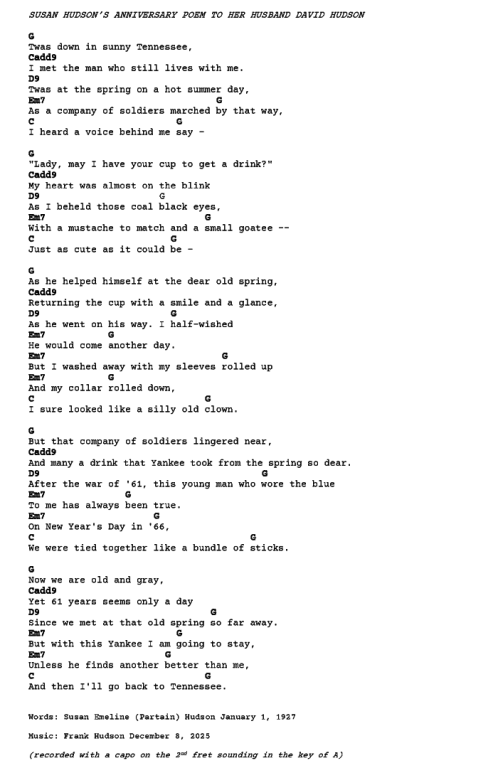
An example: on New Year’s Day in 1927 an 80-year-old woman wrote an anniversary poem to her husband of 61 years. Susan Emeline (Partain) Hudson was my great-great-grandmother, the mother of my great-grandfather for whom I am named. Her New Year’s poem isn’t looking forward much, but then her husband would die later that year, and she would die within two more years. Instead, her poem recounts how the couple met and gives some hints about how they came to settle in Iowa.
Susan Emeline Partain was born in 1847, the daughter of a carpenter who lived in Chattanooga, Tennessee. Tennessee’s stance during the American Civil War over slavery was somewhat unique. It was a slave state, but it joined the Confederacy only after the war broke out – though eventually supplying the second highest number of troops to the retain slavery side.** Yet the state government also officially withdrew from the Confederacy shortly before the end of the war, and this move meant that Tennessee didn’t come under the short-lived era of Reconstruction when the federal government sought to remediate the former slave-holding and secessionist leadership. Tennessee was also the place where the very first WASP-supremacy KKK terrorist group was founded, right at the end of the Civil War.
But I go forth, and here’s the background of the tale Susan Partain Hudson put down. That husband was David Hope Hudson, a young corporal from Ohio who enlisted in the Union Army. His unit was fighting in Tennessee, and involved in some of the bloodiest battles of the war. On and around New Year’s Day 1863 they are engaged in the Battle of Stone’s River. Union forces suffered 32% casualties over 4 days of fighting. For those that aren’t military history nerds, that approaches Charge of the Light Brigade levels of carnage. That summer these Union forces take control of a critical railroad/riverboat center, the town of Chattanooga. Later that year, in the autumn, they are in the battle of Chickamauga as the Northern forces seek to expand their control in that region. Once again, casualties on both sides are terrifying, 28%, and given that 150,000 troops were engaged (counting both sides) it was the second bloodiest battle of the American Civil War to Gettysburg.
Chickamauga was a Union defeat. The forces that included David Hudson had to fall back to Chattanooga. The Confederates, bloodied by the equivalent casualties to the Union at Chickamauga, didn’t press on against the retreating Union army, choosing instead to surround and cutoff the town of Chattanooga. For about a month, the Union army is besieged with no supplies able to get through. Hardtack and salt pork run low, are rationed. And here I need to leave off details, as I haven’t found a detailed account of that month for the Union army troops, or for remaining civilians.***
Susan Partain was a teenager living with her family there, and it’s possible they remained in the town, or at least in the area. Without details, one can only speculate on what things were like for Susan and David during this siege. I’d hold that it’s possible that the cup of water that her poem speaks of was symbolic of more than that, though the poems says the exchange happened in summer and the siege-stage of these battles was in the fall – but clearly this matter is much more risky than a simple flirtation between two young people. Susan’s poem doesn’t give us those details, but her audience – chiefly her husband now near the end of their long-life together – wouldn’t need for that to be said.
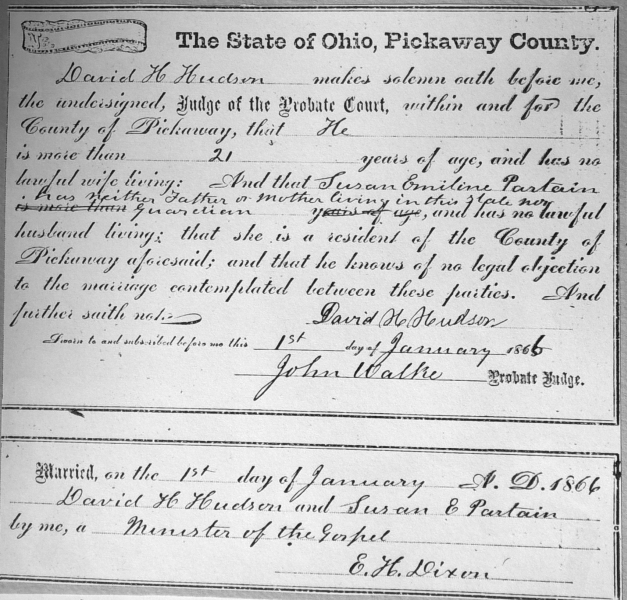
We also don’t know everything Susan’s family felt. Hudson family lore says they might have had Union sympathies, but also that they weren’t supportive of Susan’s romance with the soldier. In the summer of 1865, Susan’s mother died, and that may have broken some constraints for her. David, still stationed in the south, was mustered out in October 1865, and he and Susan eloped off back to Ohio for that New Year’s wedding.
Two things I notice in this marriage certificate: that it may have been necessary to be in another state for Susan to marry without her father’s permission, and that David, or whoever filled out the Jan. 1st date, may have suffered from the still common error of writing 5 first before revising the year with the current 6.
.
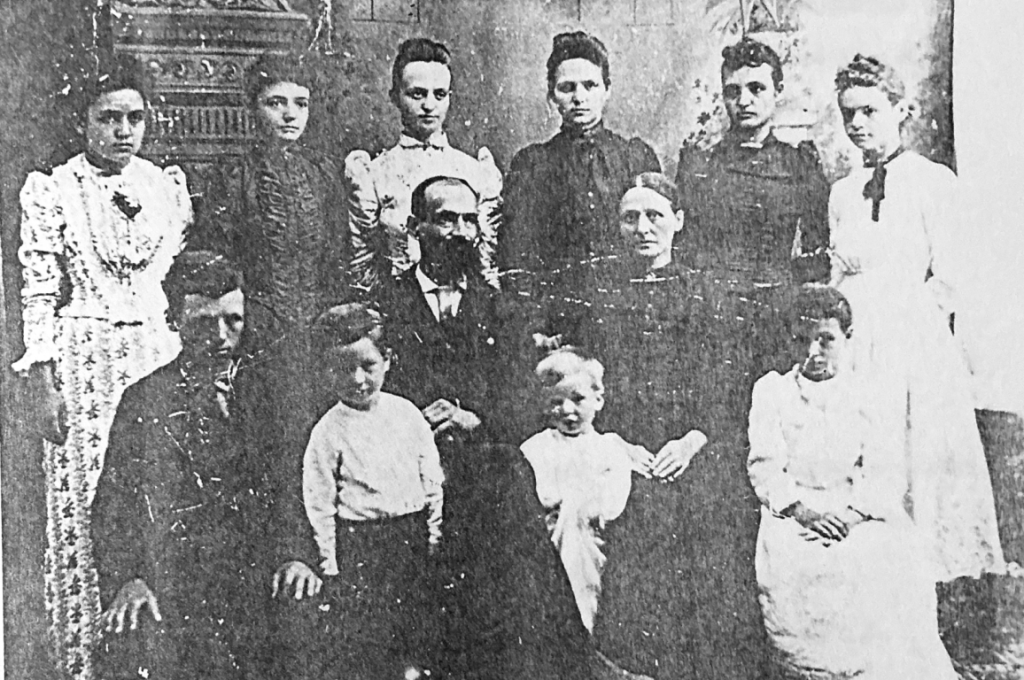
Susan never saw nor stayed in contact with any of her family back in Tennessee until 1905, by when many of her elders were likely dead and she wanted to find out what had happened to her siblings. The newly-married Hudsons also didn’t stay in Ohio – Susan was viewed with suspicion there too. The place they chose to raise a family (eventually, 11 kids!) was Iowa, where David got work in a coal mine.
“From Kisses we make mankind:” Dave and Susan Hudson with 10 of their (take that Nigel Tufnel) 11 kids. The tallest boy on the front left is Frank Hudson, my great-grandfather (who looks a lot in this picture like my dad in his younger years).
.
But it’s still a love song – these are my kin, and as Paul Éluard would have it, their kisses helped make me. They married, looking forward on New Years Day 1866. And Susan made this poem that says they celebrated a long life together in 1927 when looking backwards on another New Year’s. Some other little things before I hand you over to the song made with Susan Partain Hudson’s words. Susan mentions being struck by David’s dark moustache and goatee. A few decades ago, I took to that facial landscaping, proximally because I don’t like the irritation of shaving those areas – but who knows, maybe something whispered the idea from some DNA, and my wife only knows me, from the day we met, with that face. And writing poetry? At least one of Susan’s grandsons did too, as I have seen a poem written by my grandfather to my father on his birthday. And the other half of this Project, music? Susan’s family name, Partain, is common in Tennessee. In days when literacy was far from universal, the exact written spelling of a name was not strictly enforced, and a leading spelling variant of Partain is Parton, also commonly found in Tennessee – in particular, with one Dolly Parton. Family genealogies have found no link whatsoever, but that hasn’t stopped me from stretching beyond fact to joke about “Cousin Dolly.” I should also mention that much of what I know about this story comes from work of a later David Hudson, my uncle, who put together information remembered or gathered by other older relatives.
Susan’s poem in chords-sheet form for those who’d like to sing it themselves.
.
I’ll leave it to you how much Tennessee heritage can be found in the song I made from my great-great-grandmother’s poem, but like Dolly I compose a lot on guitar, and I also plucked a little mandolin to frame today’s musical piece. You can hear it with the audio player gadget below. Has any such player eloped from your view? Well then, I offer this highlighted link that will open a new tab with its own audio player.
.
*Today is also Public Domain Day in the US, works first published in 1930 are now freely available for reuse. Each year a couple of places celebrate with a list of the works now freed-up. In previous years I’d gratefully see a handful of poetry collections or poems in those lists. This year? Nothing highlighted in the summaries. I think this is a double reflection. By 1930 both poetry as a mainstream publishing genre and the Modernist revolution have entered a downward slope, and landmark collections of verse are rarer; and for putative readers in 2026, it’s likely understood that only a handful of readers will be looking for poems to gather.
Populist poetry, everything then from newspaper and radio poets, to greeting cards with short verse, to scrapbook keepers, to folks who simply wrote their own verse for themselves/friends/family without any aim of publication – all these are hard to locate in our current year. “Instagram poets” and others who use social media are perhaps something like this past group. Early in this project I suggested that this kind of poetry, even “bad poetry,” wasn’t harmful to literary poetry, that it wasn’t any different than other “high arts” that tolerated examples that were simply vin ordinaire.
**Wikipedia says Tennessee also supplied a relative high number of Union soldiers for a Confederate state.
***The siege was lifted when a couple of Union Generals named Grant and Sherman sent troops to break the Confederate encirclement, but of course there was more fierce fighting around Chattanooga related to that effort.
I’m starting on one of my New Year’s Resolutions early: to spend more time presenting fresh translations here. I expect a sizeable portion of them will be from French. Today’s piece, from the poet Paul Éluard, will be one example. Since there will be others, I’m going to start today with an aside about the translator’s tasks and my tactics and credentials for doing them, before we get to today’s combination of poetry and music.
I am not a native French speaker, nor do I have great facility with that language. Growing up in a little Iowa town, I had the luck to be able to take French at our small community high school, and later attempted to study it in college. French was Hobson’s choice for any foreign language classes at my small high school, but I welcomed that particular chance. In at least one previous post I’ve mentioned some of my accidental connections to the French language, but let me summarize them for newcomers. I first encountered French during my father and his brother Bill’s fishing trips to Ontario Canada, where I, a grade-school aged kid, was amazed to find the labels on many boxes and cans were bilingual, French and English. Around the same time my beloved Auntie Red, found herself and her young family stationed in France when her military husband was restationed there. Back stateside, she would amaze me by reeling off French phrases still retaining elements of her Southern US accent. That there was such a thing, an entire other language to describe the world, presumably as rich as English, seemed marvelous.
My academic career with French was none-the-less fraught – both in high school and college. Much of the work was based on getting conversational mastery, and I was terrible at it. I have something (I’ve always suspected neurological) that frustrates me with vocal mimesis. It’s likely part of the reason I struggle with singing. Helpful correction of the “no, it’s pronounced like this” kind only made me seem stupid or uncooperative, because my second and further attempts would still be way off in trying to make the right mouth sounds. Though my academic career was eventually stunted anyway, I sometimes wonder what might have happened if I had lucked into a class based on silently reading and appreciating literature in another language.
But that wasn’t on offer, or affordable, to me. So, in my 20s, largely out of school, I started to translate French poetry. This was a laborious process. I would page through a French to English dictionary for all but the most common words. I still retained a smattering of knowledge of French syntactical and grammar practices back then, and putting the two together I was able to produce a handful of translations. One that survived from this work was my translation of Paul Éluard’s “L’Amoureuse” which was presented here some years back.
My activity then, and my activity now, might occasion questions, ones I don’t know that I have a good answer for. Should I be doing this? Wouldn’t it be better if someone fluent in both English and French did any such literary translation? Isn’t the answer the that last question obvious?
My answers (then and now) would be: some of these poems don’t seem to have English translations I have access too, and even if translations exist, isn’t an attempt to do my own translation just another variant of doing one’s own “deep reading” of a poem? If for example, Helen Vendler has written an essay on what she found in a poem, does that mean I shouldn’t look at the poem myself and ask what all is in there – not because I think of myself as more learned or insightful than Vendler, but more at because I’m another human consciousness engaging with the consciousness of the poet.
What gave me such audacity, with so small a mastery of French, to do this? Well, I wanted to – enough for a stubborn young man. Now as an older man, still translating without mastery in the source language, I also tell myself that I did (and do) self-consider myself a poet, a chooser of words, focuser of images, composer of word-music. Part of the task of translation is to do the primary work of literal translation, but to produce the full pleasure to the reader of poetry, the poetic work is at least as important. Decades ago, I read that Ezra Pound used only someone else’s English glosses of Li Bai to create his landmark Cathay collection. Eventually I became aware that Pound’s Chinese translations were not very accurate depictions of Li Bai – and since learning that as a young man I’ve sometimes “checked” translations of poems to see how varied the translator’s version may be from some literal word for word, or from other translators’ versions. I was too uncertain of my own translations to think I was doing better work, but what I read as taking liberties bothered the younger me. Are translators like Pound “cheating” by not serving the original poet faithfully? These resulting English poems (I would say of Pound’s Li Bai) were as much or more the translator’s poem as the source author’s.
But what if I publish my translations? There are what I call “guild concerns” there. In the same way that I worry that my naïve musical compositions and make-do musical skills are, in their small way, part of a flood in the musical culture that reduces the shrinking opportunities for “real musicians” and trained composers, am I doing the same for translators with better knowledge and cultural grounding? Back to Pound: his work out-shadowed other translators who knew Chinese, and I’ve featured here a contemporary of Pound, Shigeyoshi Obata, whose Li Bai translations are largely unknown.
As a guild concern for people who depend, or wish to depend, on income from their art, this can be considered an existential issue, and I wish them no harm. Yet they may think: no matter, you are harming us. And now there’s another monster in the forest that they might view me as riding in on: computer-based artificial intelligence.
Since my early thumb-worn French-English dictionary forays, computer translations have become quite facile. An instant’s click will produce a literal gloss on one’s screen of a poem such as today’s selection. Let me stipulate to all, and to those that fear and dislike AI, these instant computer glosses are not good poetry.* I will click for them, but I will still spend time with dictionaries. What are the various contexts of a word? Which choice in English brings the most to the poem?**
Herein lies one problem. I’m trying to read the source author’s mind, and that will bring in my own mind, experiences, and knowledge to filter that process. This part of translation is unavoidable for causing both errors and accuracy! As I’ve grown older, I now often understand those “cheaters” as other blind ones assessing the elephant of the poem. If, as Frost had it, poetry is what is lost in translation, then a translator’s job is to reclothe the poem’s bones in English poetry, using modern English poetic expression. Doing this has limits, dangers: readers may like their foreign poetry to sound, well, foreign, with an exotic awkwardness – and having ancient poets sound like your contemporaries at a local poetry reading risks unintentional humor.
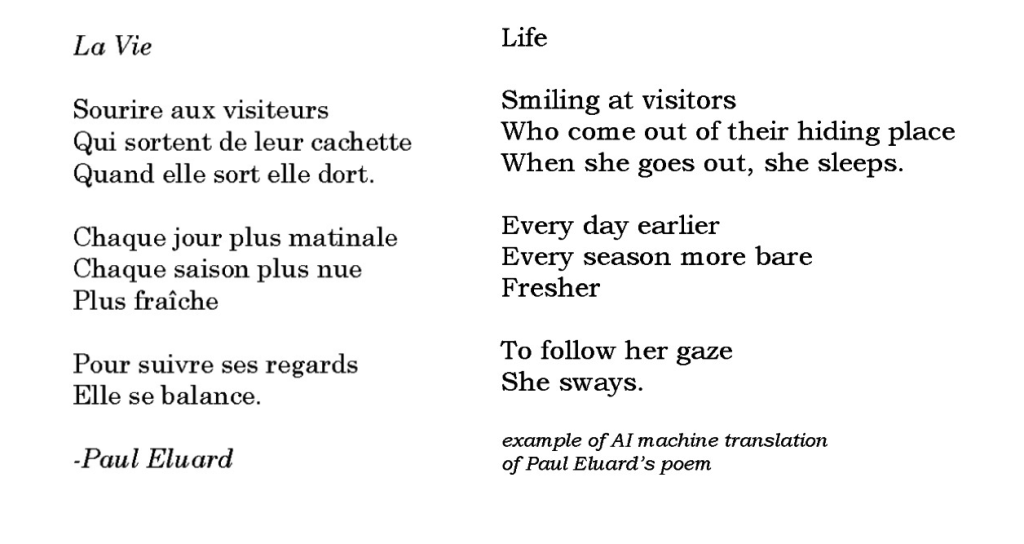
So, here we go: an early poem by French Surrealist Paul Éluard, “La Vie.” I start with a machine translation.
The 1926 poem in its original French, and a computer translation
.
The syntax comes out somewhat scrambled or hard to follow. As a prime Surrealist, one that knew and went through the Dada predecessors to Surrealism, this is likely there in Éluard’s original French I think. My first questions are what are the images: what does the author want me to see, or otherwise sensually appreciate? This can be hard with Surrealist poetry or the like: they often seek strangeness or even nonsense in images. All good imagery works with some degree of mystery or novelty, anything less risks cliché. Even one of those images that you read and think “I’ve never seen it like that before, but once I’ve read this, I’ll always think of this comparison” has to surprise you, cause you to take the leap of likeness. Surrealism says you need to outright react that’s impossible or outrageous to fully free and implement the imagination. So, my primary task is difficult with Surrealist poetry – they may want to be impossible or impenetrable, yet I still try to make the images clear, and this may be subject to mistakes. It’s also possible that in psychoanalyzing the poem that I may be putting things in there that the conscious intent of the original poet didn’t intend. ***
Examining the gloss, I think Éluard is describing a woman whose consciousness is either in a dream state mimicking waking life or living her waking day informed by, or as if, in a dream state. I think the image wants that ambiguity, to have it both ways. Either way, the people and things she meets are like strangers who have been hiding and she has found them for the first time.
My translation, used in today’s short musical performance
.
I take the liberty while translating this image in giving double meanings to some words, using more than one English word to stand for a single French word. I’m doing what “rescaling” a lower resolution digital image does, I intersperse additional pixels/words to bring the image out. “Neu” is rendered “naked” and “new;” “fraiche” becomes both “cool” and “fresh.” This is a judgement call, and my choice may be wrong. In making those word choices, using a French dictionary with multiple meanings and usage examples of the word used in context remains useful. Another thought, that AI will miss, but bears considering: the author may have intended a pun or other wordplay .
The final two lines gave me a word-music chance to put a rhyme in to tie things up, what with “gaze” and “sways.” I was so pleased how that worked out that I overlooked one word, a mere possessive pronoun, “ses.” I’m enough of an idiot regarding French usage that I can’t be sure if it’s a male pronoun such as “his” or a general pronoun, a “he/her/it” equivalent. Who’s gaze is it? The woman in the poem? The poet, the male Éluard? Something else, life or imagination?
In my ignorance, and as an admitted failure of craft, I just put down “her,” because at the time I finalized my translation my focus had moved from the word-for-word elements to what is the vivid image; and I thought, this woman that Éluard is admiring in the poem, living the Surrealist outlook, is confident in her own gaze as she sways in either the intoxication of fresh experience or the artistic refinement of dancing her day forward, and so I wrote in my translation “her.” I thought the poem is about the woman – even should be about the woman in the conclusion if I was writing it – but Éluard might have chosen to end it with his gaze evaluating the woman’s experience: I’m the artist, they’re just “life.”
So unintentionally a feminist recasting of the poem? Surrealism does have a problem there: open to women as muses, yet not as open as it should have been in allowing them to be concrete artists themselves. Shades of Éluard and Breton, may I call my ignorant choice a “Freudian slip?”
Today’s music? This was a little exercise on my part using a depiction of a couple of chord progressions from a Joe Pass performance as the basis for the music. Pass was a great Jazz guitarist – but for external practicalities, once more there’s no guitar in this version at all! Dada composition! You can hear my musical performance of Paul Éluard’s “The Life” with the audio player gadget below. No player visible? Not a mistake or slip, it’s just that some ways of reading this blog won’t translate into showing the player. If so, here’s a highlighted link that will open a new tab with an audio player.
.
*They don’t generate good literary prose either – producing as they do some estimate of the most probable word to be used, not the one chosen by another human’s consciousness that may not be the most common one-for-one. Moreover, with poetry the word-music issue is ignored by the AI translations, and poetry is musical speech. I generally don’t do rhyming accentual-syllabic translations, the cause of many an “inaccurate” translation, but I want the resulting translated poem to sound like poetry in modern English.
**These choices are a reason I highly recommend translation as training for poets. I don’t believe I undervalue topic, message, or prose-level-meaning in poetry, but many poets are stuck in finding the best combination of what they want to say with how it’s said. While I acknowledge the real issues with AI, for a monolingual, working with a literal/prose gloss of another poet lets one develop those selection-skills of the right word, right order, right connection, while one-step-away from their own experience and desired message.
***This may be proper since Andre Breton, another founding Surrealist, thought Sigmund Freud was on to something crucial with his recent theories and psychoanalysis. That Breton may be wrong about Freud or that Freud may be wrong about how the layers of consciousness and personality work only reinforces my stipulation that this outside consideration of the poet’s fellow consciousness is necessary for accuracy and errors.
This is a Christmas poem, a miraculous one – harrowing too – and I’ve made it into a song. I’ll write more about that later, but first let’s engage in imagining something human. Let me intentionally start the story in present tense, as all history, like all miracles, is felt by flesh and blood men and women.
It’s summer, July, 1586. A twenty-something-year-old man landed surreptitiously on the coastline of his own country on a mission he’s spent several years preparing to do. He knows this secret mission risks imprisonment, mistreatment, torture, and death. Perhaps he’s relieved that his landing seems to have kept its secrecy, but his country’s police-state spies had already gotten wind of it, knowing at least in general that he, and others like him, are coming. The kind of things he’s planning to do are illegal.
Let me not leave present tense: I’m writing this story today in a country where the state of having crossed a border without central legal approval is subject of considerable governmental concern. There are secret police, established by the authoritarian head of state, to seek such people, and anyone who shelters them, out.
In 1586, the country is England, the monarch Queen Elizabeth, and the man landing as a huntable alien-in-effect in his own country was Robert Southwell. Southwell took an assumed name and begins to do his work. He’s a priest and a writer, and these things, done by someone like Southwell, were what the secret police are charged to suppress. During the 16th century, England is whipsawed by vicissitudes in the official state religion, from Catholic to Protestant, back and forth – the religious beliefs once seen as proper, even required, could become forbidden. Southwell, this Catholic priest, is now operating in a time his beliefs and practices are outlawed. English laws speak plainly about this: in 1584, it’s declared that any English-born man who entered the Roman Catholic priesthood during her reign had to leave the country within 40 days. Like the laws and practices about borders that change over time, this could seem strange to Southwell, or to us, reading about this now. Southwell would have known people who had lived in England when the Catholic church was the state’s religion. Now it’s a state crime.*
Southwell’s foray as an underground writer and priest, an alien in his own country lasts six years, until someone who knew of his activities and location gives him up under duress in 1592.
Over the next couple of years Southwell is tortured and mistreated, but he did not give up others’ names. I suspect this interval was because he would have had valuable information on others due to his prominence in the underground, and that to break him into a confession or renunciation would have propaganda value, but I haven’t read details on this. This could be long work. One of the torture interrogators writes down that their subjects’ resistance under torture was so steadfast that he had to ascribe such strength to either God or the Devil.
Did that state official wonder too about God or the Devil regarding themselves? I can’t say that was written down.
That next couple of years will be the last years of Southwell’s life. Some of the treatment was so rough that Southwell’s own father petitioned the authorities to get on with executing him rather than to continue the mistreatment. Yet, at other times, though he was locked up in the Tower of London, Southwell was allowed some books and was able to write. Was this a “good cop/bad cop” move by those looking for information from Southwell? Again, I don’t know the details, but then most of these details are sorrowful stuff.
In the new year of 1595, that execution came. Treason is the crime they write down. Our current Mad King throws around this very charge rather casually, but his midnight blathering will sometimes include a reminder that the penalty is death. Southwell’s execution was by being hung, drawn, and quartered. I’ll spare the details once again – look’em up if you want torture porn. It’s an act that is supposed to dehumanize the criminal – what it says about the state and its agents, I’m going to assume goes without me writing more.
This is not the depiction of the Nativity in Southwell’s poem, but I choose it since it included human music in the event.
.
Why have I quartered your attention for this story which I’ve made as brief as I can, and with worries that it’s inappropriate for what is the nation’s leading holiday of gift-giving and children’s joy? It’s all in the hope that you can experience this visionary Christmas poem, apparently written during Southwell’s imprisonment, more completely. Here’s a link to the text of that poem. The Christmas in Southwell’s poem is the ignition, the conflagration, of the moment the Godhead crosses the border to humanity; and so it is that “The Burning Babe” is a vision of the infant Jesus, not sheltered in a stable however far from hearth and home, not asleep in a manger with livestock and farmworkers in attendance, but suffering in flames, his tears accelerants to the flames, not balms to sorrow. Despite being newborn, this vision miraculously speaks not just of the suffering, but that somehow merciful justice exists and may even increase from some refinement of mankind’s souls.
Southwell ends this poem, this vision, somewhat flatly with a statement mundane on the face of it. Perhaps that’s the only way human beings can speak when trying to understand such suffering we as creatures create and practice with earnest effort while congratulating ourselves on serving correction, justice, and the solemn dictates of our tribe, religion, nation, leader, party. The ending? Southwell simply notes, that he’d forgotten it was Christmas Day. That’s my point in taking your time today: so you could hear that statement knowing what I’ve laid out above, about why he’d forgotten this.
To hear my musical performance of Robert Southwell’s “The Burning Babe” you can use the audio player below. No player? Some ways of viewing this blog suppress showing the audio player gadget – I don’t know why, but do you suppose Bari Weiss has something to do with that – so I offer this highlighted link that will open a new tab with its own audio player.
.
*I’ll leave this a footnote, but this battle between Roman Catholics and Protestants – including official state-religion sanctions – lasted a long time, with many deaths and atrocities on both sides. If Queen Elizabeth’s secret police could seem to be concerned about mere heretical spiritual beliefs and practices, they bolstered those practices with the uncovering of murderous plans of resistance among the Catholic underground.
And oh – if you want to hear of gifts – around the time the poet/priest Southwell was arrested and executed, a poet/actor named Shakespeare was starting to make a name for himself in the same Elizabethan London.
Here’s the final piece of this two-parter, and the place where I take off that hair shirt for a while and present a review of John Darnielle’s new book This Year, 365 Songs Annotated.
I largely owe my appreciation of singer-songwriter John Darnielle to my daughter, who found solace in his earlier recordings as she moved through adolescence. One 2005 song, the one that gives its title to a new book by Darnielle, features a 17-year-old speaker refraining: “I am gonna make it through this year if it kills me.” It resonated more than a decade later with another 17-year-old. What a good thing for a song to do.
I knew Darnielle’s work from a couple of songs recorded under his long-running project name “The Mountain Goats,” most notably the mysterious anthem “Jaipur.” My daughter gifted me his All Hail West Texas album one Bandcamp Friday a year or so ago. My immediate thoughts on Darnielle were that he was a good song lyricist. Like the late poet-associate of mine Kevin Fitzpatrick, his work is full of “other people,” and those people are often working class or lost-soul types who make themselves known as if in overheard declarations in his songs. Writing in Boomer classic-rock consumer-guide style “he’s like…” comparisons are misleading in Darnielle’s case. Saying he’s lyrically a mix of Randy Newman, Bruce Springsteen, Ray Davies, and John Prine is a bad assay, because he’s like all of them at once or in sequence, and he is his own man too. Still, the range of characters is an important strength. A lot of poetry, and a lot of indie songwriting too, is a singular solipsistic narrative, and Darnielle’s of the songwriting school that avoids this.
More than a collection of song lyrics (though they’re good lyrics)
.
Yet, This Year is largely the story inside one person, a memoir in a different form: a book of days where he writes somewhat sequentially, but not by strict intent or always, about how 365 songs came about, what he thinks he was trying to express, and what his life was like as he wrote and recorded them. The entries can be quite short, a couple of hundred words typically, though a few extend for a few pages. The lyrics to each day’s song are included with each entry, which is helpful for any reader who’s not familiar with his work. I’m half-way through reading it straight through, but the book can also be read an entry at a time, as sort of daily thought-starter. I’m somewhere between a hardcore fan and someone that doesn’t know any of Darnielle’s work, and I’ve sought out some of the songs after reading of them in the book.
Things I’ve learned? It was not apparent to me beforehand, but he’s a poet who converted to songwriting, and many of his early songs had preexisted as page poems that he wasn’t planning to sing. Reading his lyrics silent on the page in this book demonstrates a literary poet’s craft in his writing, but my finding this out in memoir is a testimony to their lack of crusty poetese. Poets as well as songwriters would benefit from exposing themselves to Darnielle’s lyrical tactics, and he talks effectively about them in this book. I also learned that he spent formative years in his songwriting’s development living in a small town in Iowa, the kind of place I grew up in, in roughly the same part of the state, though I’m more than a generation older than him.
Another part of his story, which unreels through the day entries each devoted to a single song from his now large catalog of original songs, is that he began recording and making these songs public using meager equipment. He so far mentions almost nothing about the particulars of his instruments which are likely unremarkable and inexpensive, and a considerable part of his early career recordings – including the original versions of some of his best-loved songs – were recorded on a boom-box cassette tape machine at home. I resonated with that, having spent around 20 years using such cassette tape along with low-budget equipment. A late 20th century indie-music and fanzine samizdat network allowed Darnielle a slow-burn career doing that, around the time that my own nerve to share my work had faded. He recounts in the book, that royalties from the tapes sometimes paid part of the $170 a month rent,* but he had a day job in a lower-paid nursing field, again something I rhymed with in my cassette years.
The short entries in the book also tell a story of Darnielle’s religious journey, which began as a Catholic youth and has had elements of return, though I’m midjourney on that arc so far in the book.
These similarities paradoxically bring up the personal gap which makes reading his book so meaningful to me now. From what I’ve read so far, Darnielle apparently retained confidence in his own work through these long-beginnings, low-rent, lo-fi years, and even if there are dark nights of the soul in coming parts of his book, he displays that now as he discusses the work in retrospect. I had, and still have, substantial gaps in being able to carry that in public during my cassette years. Having days of private levels of self-confidence in some of my musical work is not an effective dose to properly present it to others, and my doing so “blind” without that confidence led me to some painful comedy of misreadings of likely interest. Those two things (managing self-doubt, being able to present one’s work effectively to others) interact. Darnielle may have been more personally engaging, or just more persistent in his networking. Elements of luck might have been significant (with me, they were in my “day job.”) Thinking of this difference as I read Darnielle’s book, it’s (too) easy for me to think, “Well, it must have been easier for him, his work was so darn good.” He’s a better vocalist and performer than I am (no-biggie, almost everybody is), and though I’m not sure how far apart we are in “on a good day” guitarist skills, his song lyrics are teaching me new tactics even after decades of my doing this on the page and with guitar.
In the first part of this pair of posts I sincerely worried about my work and hubris when I put it up against the skillset and history of Jazz. Despite those differences in how we’ve used our parable of the talents, I find reading Darnielle’s book heartening so far. You don’t have to be a songwriter, if you are any kind of writer – and likely if you are an artist of any kind – spending time with this book may be helpful.
Here’s an early song of mine, recorded on primitive equipment before the nearing 900 songs of the Parlando Project had started counting off, but consistent with its principles, a setting of John Keats’ “In the Drear Nighted December.” Audio player gadget should be below, but if not, this highlighted link will open a new tab with its own audio player.
.
*For any younger folks reading this, the $170 a month rent (for a house!) must seem a dormouse fantasy. For younger musicians, the idea that royalties from indie recordings might contribute in any substantial way to making rent must seem equally fantastic.
Here’s a poem by Emily Dickinson that I made into a little song. There’s an audio player below to hear it.* I intended the music I made for this piece to be jaunty – not only because I worry that too many of the Parlando Project pieces are slow to mid-tempo, but because it fits the language of Dickinson’s poem. Just 8 lines, but its “what’s in the box” description includes: a sunset, a morning, cottages, and a USB C charging cable.
No – error – sorry. No charging cable. I looked at the catalog listing:
OK. I’m funning with you. After living with the poem for awhile as I set it to music and recorded my performance of the result, I instead believe this poem is an example of the genre my wife calls “Cozy Gothic.” How come? I think the poem’s cottages are graves.
Here’s how I understand Dickinson’s poem. There’s a pretty sunset, an eternally repeated and universal, broad-sky-set thing. The sunset must appear where ED’s poem sees it, but after its moment it’ll be “Gone Westerly,” for today. Gone westerly is likely a similar idiom to “gone south,” a euphemism for death. The sun has not fled out of dereliction of duty –“treason” – but because a day, like a human life has its limits. The poem’s second stanza reminds us of the circadian day too: that morning and a sunrise was, and will be, there – but that’s no matter to the dwellers in the cottage/grave “swellings in the ground” who can’t see the “supercilious Sun.”
Here a chords sheet, and what’d be more Cottage-Core than playing this Cozy Gothic song in your own cottage? That G chord form I played is just the B & E strings fretted at the effective 3rd fret along with the open D and G strings.
.
I asked my wife again this morning about “Cozy Gothic” as I prepared to write this. I reminded her that the young Emily Dickinson did not grow up in the grand house that’s now the Emily Dickinson Museum, but in another place where the Dickinson family lived in her youth after her grandfather got the family finances mired in debts until her generation extracted them from that and were able to move back to the grander house we associate with her poetry. The grand Dickinson manse was across the road from a crop field, and had room for gardens of fruit, food, and flowers; and it was beside a main road for travelers in and out of town. The place that her family had to relocate to was smaller, and across the street was a graveyard. Mix those two homes ED knew in her lifetime, and you have some pretty good poetic loam. I asked my wife, a known PK,** “Did you ever live next to a graveyard?”
Yes, when we lived in a parsonage. The town was taken aback when I sunbathed in the graveyard. I didn’t know what the big deal was about that – it just seemed like a nice, peaceful, place.”
That’s my wife. Nature nymph and likely a better writer than I am – and for all the mixture that made up her childhood, she got to live the spirit of this Dickinson poem directly – Cozy Gothic.
Here’s that audio player gadget. What, has any such audio player “Gone Westerly?” You can take hope in the resurrection, but it’s likely because some ways of viewing this blog suppress displaying the audio player gadget, just like they mute the angels that would write better, more concise blog posts. I make do by providing this highlighted link that will open a new tab with its own audio player though. Playing the bass track for this one – without making a point to think of it, but still thinking of it – I was thinking of the great British bassist, Danny Thompson, who died this autumn. Thompson’s playing could be quite free and capable of quick, large, leaps in register, but while doing that he could follow complicated or chaotic other players ad lib and help make musical sense out of them. I loved his playing, and of course mine is more a tribute than the work of a peer in skills or dedication to the instrument.
.
*I find it puzzling as this Project enters its 10th year that the number of people who take the time to listen to the (almost always) short musical pieces here remains essentially flat from 3 years in the Project on forward, while the number of readers of the blog posts continues to grow. Less than 10% of readers click the audio player or link, assuming that the stats I get are accurate.
I have guesses. My rough-hewn voice will never make me America’s sweetheart. My naïve compositional skills may fall between the sawhorses of pop ready-mades and art-song sophistication. The variety of my musical approaches may put a stop to continued listening, as I’m near certain to attempt a style someone doesn’t like (and so my failure or limited success in evoking those styles could be beside the point).
**”PK” = “Preacher’s Kid.” Not just my wife, then Dave Moore, my long-time musical partner sometimes heard here, is a PK too. I’m sort of one, though my father left the Protestant ministry, except for fill-in roles, in my childhood – but that history and those fill-in pulpit appearances likely helped shape me.
The sequela of being a PK vary. Some become rebel angels, some follow into the “family business,” some suffer from having had childhood expectations of goodness and polity, others take the close-hand connections with music, ethics, or philosophy and use that in some other field. For myself, I think the main thing I took from it (and my father deciding not to take to it) is the concept of “a calling.”
I’ve long wanted to do a Parlando Project piece using the words of early 20th century American poet Michael Strange – but there was this one problem: her poetry wasn’t very good. Or perhaps I should restate that: her poetry doesn’t consistently work in the ways that I appreciate poetry. What about her poetry causes problems for me? It’s not just that it risks being ecstatic to a fault, or that it seems grandiose at times. I’ve forgiven other poets those excesses. It’s certainly not her overall poetic approach, as her verse seems to me to be highly influenced by Imagism, that early 20th century poetic movement that continues to inspire me. She also seems fond of Whitman and Nietzsche, but so were other writers of her era that I’ve presented here. So, if not those things, what? If I’d pick one term for what keeps me from enjoying her poetry it would be “over-writing.”
Here’s an example, an ekphrastic poem about an art song by composer Claude Debussy which used a text by François Tristan L’Hermite. I’m not sure if Strange is portraying L’Hermite’s French lyrics (which are quite good and bring in the myth of Narcissus) but she talks of sound and gives the musical composer the sole place in her title:
To Claude Debussy’s La Grotte
Your song
As the hale of mysterious exotic intention
Drifting in palpitating echoes
O’er the pallid oval
Of night-closed flowers -—
Your song
As the increasing shimmer
Of some exquisite nearness —
Clad in those steel-dark foils
Of sinister fancy —
And once more your song
As the moaning hush of a human soul
Receding — from the Divine Moment
.
The images here constantly suffer from the Donald Trump school of interior decorating. They’re not just curlicue ornamented, they’re coated in gold leaf. The “hale of…intention” image is a fine one, but adding both “mysterious” and “exotic” as modifiers cloaks its originality. Are “echoes” so unclear as a sound description that they need “palpitating” to clear up that they repeat at intervals? Why the somewhat archaic “O’er” when the modern “over” will chime nicely with “oval” and “flowers?” And that’s just the first stanza, first 21 words. This over-egging hurts not just the sharpness of the images, it hurts the word music too. As with Trumps White House confessions of gilde, this can be read as a lack of confidence in her own vision and place in poetry. I must include “poetic” words, I must show the specialness of each facet with modifiers and more modifiers, I must show that I’m writing.
Now I’m not writing this to dunk on Strange. I’ve committed every sin above, and more. What I write has enough faults to repel readership. Strange is not a particularly famous or widely-read poet, but more people have likely read her poem, and maybe even more people would like this poem of hers than any I’ve written. Still, I want a better poem than this one printed more than a century ago if I’m going to perform it. Yet what I did is risky ethically – that Strange is dead and her work fully in the public domain doesn’t erase the issues with what I chose to do this week with her poem. I rewrote it.
Your song,
the hale of exotic intention
drifts in echoes
Over the oval night-closed flowers.
Your song,
the shimmer comes nearer,
some steel-dark foils of sinister fancy —
And once more
your song,
the hush of a human soul
receding from the Divine Moment.
.
I tell my self-accusing self that I did this in service to what I think Strange was portraying in her original poem. Indeed, what I did there is similar to what I do when translating a poem from another language: find the images the poet was portraying and convey them in contemporary English with a word music that works in that destination language – though here I’m able to use more of her original words since she wrote in English. I’m opening myself up to a charge of patriarchal overreach, but in my defense, I’ll say I’ve done this to Robert Frost and Rupert Brooke. So, I may just be an asshole when I do this.
Before I move on to a few notes on the musical performance that prompted me to do this rewrite, let me just give the briefest outline of Strange’s fascinating life, a history that gave me such high expectations as I sought out her verse. Strange was born into a socially prominent East-Coast family, and was married (three times) to socially prominent men. Photographs and contemporary testimony portray her as exceptionally beautiful. Despite her background, she was a feminist, a left-wing social activist, and moved in bohemian circles. During the WWI years she published her first poetry collection and used the masculine pen name Michael Strange for this. Wikipedia’s summary says the name was used to shield her family from the poetry, which was claimed to be erotic and scandalous, and it’s also easy to suppose that she may have made (at least in part) a tactical choice to avoid sexist devaluation of the work. Whatever the initial reasons, she soon came to use the name generally, in subsequent writing, when she appeared on stage as an actress, on radio as a host* and, I gather, “in real life.” I’m not an expert on Strange’s life, but it appears she used feminine pronouns.
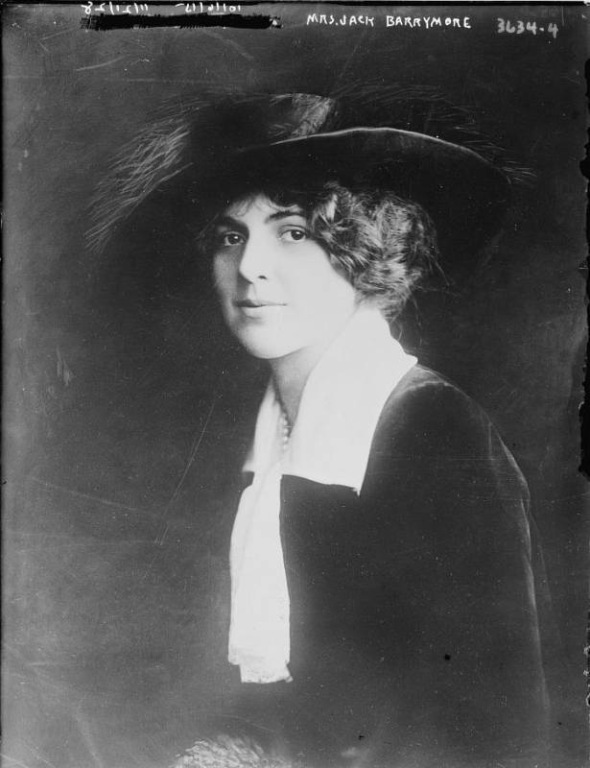
Pleased to meet you. Hope you guess my name. Born Blanche Oelrichs, became Michael Strange, was a member of the Lucy Stone League dedicated to married women keeping their own name – and this photo is labeled “Mrs, Jack Barrymore” (the name of her second husband, the famous actor).
.
It’s possible I would have run into Strange, on her own, at some time in this Project, since I enjoy examining lesser-known poets from her era here. Instead, I first encountered her because of her relationship with another author who produced popular Modernist work, Margaret Wise Brown. What? Yes, Margaret Wise Goodnight Moon Brown. Early this century, in my fatherhood role with a then pre-literate child, I was the bard of such stories as Goodnight Moon or The Color Kittens. And it may not be only because this overlapped my adult reading that I heard them as part of the same world of early Modernism.** For the last decade of her life Strange lived in a committed relationship with Brown, and so it was in reading about Brown that I first read Strange’s name.
All right, on to this short musical piece using adapted words from Michael Strange. I was working on composing with the intent to use minimal motifs, ones that my minimal keyboard skills could play without using an arpeggiator or other automated extensions. I built the music using a variety of alt-techniques and “prepared” piano sounds. In the middle section there’s an organ part that does use an arpeggiator, and a percussion part that had me playing parts on some struck metal objects over a more conventional drum-set pattern. Not exactly Debussy,*** but perhaps evocative of other 20th century avant-garde musics. You can hear it with the audio player below. No audio player? It’s not gender panic, but some ways of viewing this blog suppress it, and so I offer this highlighted link that will also play the musical performance.
.
*Her radio program was titled Music and Poetry. Just as with today’s poem – despite my problems with its prosody – Strange’s bio can’t stop being catnip to me.
**Another “could he really be serious” suggestion: if we might well include Robert Louis Stevenson and Lewis Carroll in studies of Victorian lit, should Brown be read next to H.D. and Pound as Imagist texts?
***Musically, while I’ve listened some to the Impressionist musical school of composers, I came to them largely from instrumental guitarists who were directly influenced by them. So, Dadaistically, today’s piece has no guitar whatsoever.
Long time readers know that the Parlando Project is largely about our encounters with other people’s words – usually their literary poetry. Poetry, even impersonal or hermetic poetry, is a rich way to transfer experience between consciousnesses. Poetry’s strengths in this transference over memoir, blog post, or informal conversation are largely the strengths of focused beauty – that thing that attracts us even before knowledge, expressed as sound or by novel connections.
Still, these beautiful elements of poetry come with costs, which is why many, most of the time, prefer other modes. Yet, I think the shortness and the compressed incidents of lyric poetry offer a possible compromise. We’re asked to share a little burden, a few minutes of reading or listening, subconsciously absorbing the word-music and linkages, which may in leisure or with mood be extended by re-reading and re-thinking such a small number of lines.
One of the things that caused me to begin this Parlando Project was thinking that a short musical accompaniment might add pleasures to possible serial re-encounters with the words. Is this so? I’m not sure, though I persist in doing this.*
That preamble out of the way, I’m going to look like I’m violating the “Other People’s Stories” maxim that is a principle of this Project, because I’m presenting today words I wrote to go with the music I compose and record – but hold on, I’m going to tell you this is still about a poetic transference across a gap.
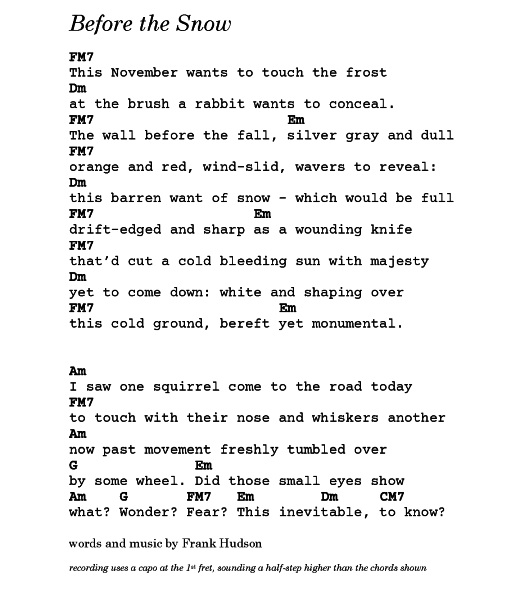
Here’s why: once again I’ve been running into things from decades ago as I do my “death cleaning” reduction in things stored away or unlikely to be of foreseeable use. Just last week I moved aside a drum set that had been played by Dean Seal when he was in the LYL Band,** and found under the bass drum a plastic carryall tub with things hurriedly packed up after some gig: a Radio Shack battery-powered mixer, cables, a guitar strap, a cassette recorder, and a few tambourines we’d hand out for audience participation. And more spiral, college-ruled notebooks have come to light. Glancing through one I found a page with 9, untitled, lines – the start of a poem. From the style of the poetry in the fragment I think it’s from the 1990s, but it might be earlier or later. It caught my attention because it seemed to be talking about November in Minnesota in that interval right before the first snows come.
I remember nothing about writing this poem, or what prompted it, but it had some nice word-music and was roughly pentameter. That pentameter made me think I was writing a sonnet, and for some reason left off at this incomplete draft. That night, before bed, with my aching muscles and joints from twisting, bending, and hauling I decided to complete a full 14-line draft.
More musical perversity: the difficulty in finding times to record acoustic guitar with sensitive mics in the past year or so has increased the number pieces I’ve done with that instrument.
.
For the final 5 lines I used an incident from a recent bike ride. Rolling down to a favorite breakfast destination at the borders of my wooded city I’m usually met with a rewarding bit of wildlife (outside of deep winter): constant squirrels, rabbits, small rodents, birds, including waterfowl by a pond and creek I pass, insistent crows, and so forth. If Keats wrote his “Ode to Autumn” on Hampstead Heath in the Highgate section of the city of London, these near-daily rides of mine with this contrasting nature in the midst of modest single-family houses and parkland is my equivalent. What I saw this day was a little epiphany – a squirrel had been quite recently struck down crossing the road. Not smack dab run over, for it was not squashed, and there was only a little blood – yet it was clearly not moving or breathing, and even from the height of my bicycle its eyes could be seen fixed and dead. And then, as I was approaching, carelessly another squirrel scampered out onto the road and up to the corpse. Though I was riding onward, and only slowed a bit moving to the side, this squirrel bent down right to the head of the dead one, close enough to touch it barely with whiskers, clearly looking closely at it, for a moment regardless of my vehicular approach.
And then, just as I was beside them, it scattered off, missing by accident or close design, my slowed, but rolling, bike wheels. What was that squirrel after, what was it thinking in those few seconds with the dead one? This was the matter to finish the poem that had started years ago with a rabbit finding scarcely-leaved autumn bush and brush to hide in. And I too had had my customary Parlando encounter without firm context, working with the part of the poem written by someone I hadn’t seen for decades: though in this case, it was my younger self. Not really that different from the usual encounters here with Frost, Dickinson, Sandburg, Millay, Stevens, Hardy, et al.
I originally gave the resulting sonnet the title “Before the Rapture of Snow,” because I thought that tied-in the rabbit’s anxious waiting and the dead squirrel. I drew back from that thinking it too grand a reach, and because the theological implications of “rapture” would repel, puzzle, or draw in too-determinant reactions.
I was lucky enough to have a Monday to record this, finishing what felt like a good take of the vocals and acoustic guitar just before I had to leave my studio space. I added piano yesterday and mixed the tracks. As a non-pianist I’ve fallen into using that instrument simplistically as I do here, and I’ve grown fond of how these pounded single notes mesh with the timbre of acoustic guitar. You can hear “Before the Snow” with the audio player below. Has the player been raptured up to heaven? No, it’s just that some ways of reading this blog suppress displaying such a thing, so I provide this highlighted link that will open a new tab with its own audio player.
.
*Besides my lack of talents for promotion, I sometimes feel what I do with this Project presents a number of detriments to gathering an Internet-scale audience. Poetry, as I write above, is not something sought out by modern Americans in great numbers. And then the music I make suffers from these things that reduce audience interest: I’m not a singer with a beautiful voice, nor do I think of myself as a performer with charisma or erotic appeal, and the music I make despite that is both too varied and too limited.
Many potential listeners or readers, presented with an infinite library of options in our modern age, will avoid things that have but one of those strikes against it – and to add another one or two against the Parlando work wouldn’t be rare either.
All this isn’t breast-beating or humble-brag, and I’m even hesitant to waste your time writing this. I am proud of much of the work I’ve done over the last decade here. While my audience is Internet-small, I believe it’s not all that small by poetry standards, and increasingly, not completely outsized by the audience for much non-Pop Indie music. Thanks to my hardy listeners!
**Dean was working elsewhere in comedy, and with at least one other partner in music, when he played in the LYL Band in the 1980s. He was talented and creative, we were looking for a drummer or bass player, and we perversely came upon him as both – unconcerned with the challenges of one person filling both roles! He may have grown to think of us as less professional or ambitious than he was, I don’t know, or events of his life may have intervened, but for reasons unknown to me we just stopped playing together – but this happened without him picking up the small drum set he played with us, and stored at my place. While working on my cleanout this fall I briefly tried to find contact info for Dean to see about the drums, but the trail ran cold after finding articles about him being part of the pastoral lineup at a church that no longer listed him on staff.
Last time I was musically blasting your ears with twin electric guitars, bass, drums, and keyboards as I commemorated the snark of the early Internet’s “flame wars.” Today’s piece combines – just in time for American Thanksgiving – a quiet nylon string “classical” guitar, and a 19th century poetic ode to pumpkin pie.
The words I sang were written by John Greenleaf Whittier, one of a circle of New England worthies who were grouped as the Fireside Poets. Back in my parents or grandparent’s time the Fireside Poets were as celebrated as pumpkin pie. As a group they took on the job of creating an American poetry written by Americans with American subjects.* Alas, that’s a job that once done, doesn’t inherently demand continued interest, particularly in a country like America that has become a cultural superpower. American poems written by Americans about American subjects are a commonplace thing now.
But to do this was a piece of work in the first part of the 19th century – and in furtherance of this Whittier chose an indigenous American plant for his poem. The pumpkin represents American autumn is so many ways, starteing with jack-o-lanterns in October, as a decorative harvest tote, and for its curtain call, the fruit for pumpkin pie at Thanksgiving. Whittier wrote his ode mentioning all these things, and here’s a link to his entire poem. I read Whittier’s tone as “mock heroic” in his poem, but I chose to make a small song using only his ending, the pumpkin pie part, since I was racing to complete it before American Thanksgiving. Friends of our officially young-adult kid are gathering downstairs tonight to do whatever they will, as I hole up under the slanting roof typing this.
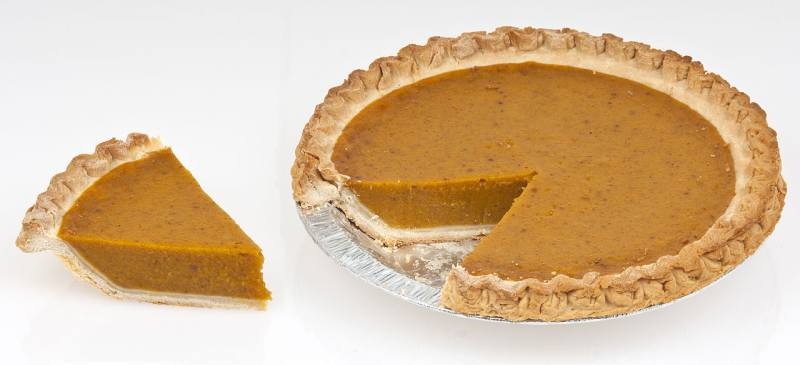
“Fairer hands never wrought at a pastry more fine.” Pumpkin pie picture by Evan-Amos
.
Is it just me, or is there a touch of what my wife calls “comfy gothic” in this passage at the end of Whittier’s poem? The poem starts out addressing the pumpkin plant itself, but as it continues we see it speak to the humans associated with it from childhood to grey-hair-dom. When I have Thanksgiving tomorrow with my little family I’ll have thoughts of everyone distant or dead that made or attended Thanksgiving meals over my life. In the poems final stanza Whittier speaks of, praises, the hands that make the wonderful pumpkin pie, and then as the poem ends, he sings them away with a wish that their final sunset is as orange and lovely as a pumpkin.
There’s an audio player gadget, or should be, below that will let you hear me sing that last stanza of Whittier’s poem. I focused on the simplest and most modest of musical settings for this one, purposeful contrast to the previous musical piece here. If you don’t see the audio player that’s likely because some ways of reading blogs suppress it, so I provide this highlighted link that will open a new tab with its own audio player. Consider that the apple or blueberry pie option to hear this song about pumpkin pie.
.
*Earlier this year when I asked AI to create some protest songs, it defaulted to a musical style stuck somewhere between Bro-Country and Indie Americana. When I needed to make up names for the faux acts I chose Fireside Poets’ names like “Greenleaf Whittier” for them – because though writing for the page, those Fireside poets were the poetic roots of Americana.
Around a decade ago I was looking at how to launch this Project, trying to figure out what service to carry the audio and where to host this blog. I knew I had some things I’d already recorded that fit my design of combining various words (mostly other people’s literary poetry) with original music in differing styles, and so I created a computer folder with those pre-existing Parlando candidates along with a spreadsheet to catalog them. There were 30-50 pieces in there, and if you go back to the first year of the Parlando Project in our archives here, you can hear about half of them. One piece, “Forum,” was in that pre-launch list. “Forum” had been recorded in 2007 live in my studio space by the LYL Band on a 4-track cassette Portastudio.
Why didn’t it make the cut? Two things. First, while I didn’t want the Parlando pieces to always use literary poetry, I planned to focus on that, but the words of “Forum” were a compilation of phrases used on turn-of-the-century interest group forums and Usenet “newsgroups”* when users would get into a dispute loop and a “flame war” would erupt. So, not conventional literary poetry – though I suppose I could have appealed my case citing “found poems” or Catullus’ invective. The other issue: though a step up from my older mono or stereo cassette performances I’ve featured occasionally this year, the recording quality had issues. After that initial year, I stopped considering it for Parlando use.
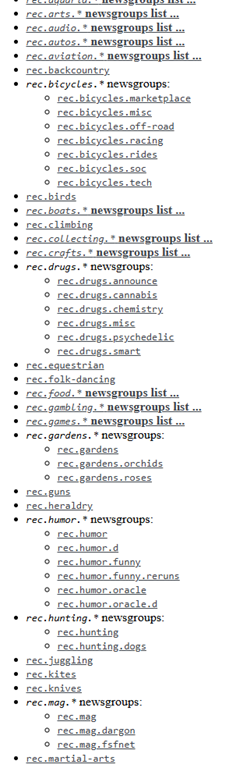
It’s impossible to picture the massive number of interests and sub-interests that Usenet Newsgroup served around the turn of the century. There were hundreds of thousands of separate topics that could be subscribed to and argued about.
.
This month I read someone (online) writing that elements of our current public culture include the historical novelty that nearly everyone can (and many will) try to communicate their opinions and thoughts in writing to a wide range of strangers. Communicating has difficulties. Communicating in writing has further difficulties. Communicating with strangers? More so. Socratic dialog assumes good faith and a certain rigor, and even then it can be exhausting. Now that we have an immense quantity of stranger-to-stranger debate, base human nature is often showing itself bare-assed in the forum.
I thought once again of “Forum” as I read that, this performed snapshot of early Internet culture. The phrases I selected and performed in it were the G-rated ones, skipped the racism and homophobia, and included little to none in the way of political specifics. That curation made the resulting text almost quaint when I relistened to the recording. This 2007 composition was now old enough to vote, and the text seemed like a folk song now, archaic as a sea shanty or hawker’s cries. After 18 years, is it time to share that piece now?
Well, there were still the considerations of its music and its realization on the old recording I had. Should I do a new performance? It might be difficult for me to rise to the level of intensity that version of the LYL Band had back then. The 2007 performance is what the MC5 would have called “High Energy Music,” and if you listen to it – like it or not – that’s how I wanted to present it.
But we had used a drum machine that day, and the energy in the room as we played this in one take/one-pass-through overwhelmed its timid tick toc.
Then I remembered: along with ubiquitous dispute loops, our modern computer age also provides wonderful tools. I can put this old recording digitized from cassette tape into a computer program, and in a few minutes of hard thinking signified by the CPU fan wheezing up, it can remove the drums from the old recording, even though they are buried in a mix full of furious other sounds. I did this, and then spent some time this Sunday putting in a new sequenced drum part with an energy that more appropriately matches the rest of the piece.
You can hear the result with the audio player gadget below. No, this is not like the gentler pieces I’ve been doing lately – that too is part of the design of this Project, and the next one may be gentle acoustic guitar or something – but what, you’re all ready and willing to blow out your speakers with this and you don’t see any audio player? Some ways of viewing this blog won’t include it. No flames, I offer this alternative, a highlighted link that will open a new tab with its own audio player.
*”Newsgroups” makes these sound like it was the AP or something, but Usenet newsgroups were started and were made up of those who’d figured out how to use the Internet in the 20th century, so more male and more STEM/academic/nerdy than the modern Internet. Usenet provided a large hierarchy of interests their own categorized newsgroups on which to share their knowledge – or their opinions about the validity of someone else’s knowledge. I’d suppose Reddit is the most similar common modern equivalent, but that’s more centrally architected and moderated.




 Frank Hudson