I Should Turn to Be – Jimi Hendrix Tribute 2025

Thinking of the late Nineties, I think of the Sixties, 1970, and then the end of the 19th century. When you’re an old man, that’s the kind of swift mobility you retain.

It’s difficult to comprehend how short the careers of some musical figures from The Sixties™ were. This month I watched a documentary on Jeff Buckley, the charismatic late 20th century singer. One of the challenges of his foreshortened life was to deal with the artistic inheritance and distraction of being the son of another singer, one of those Sixties™ artists, Tim Buckley.*

Here’s something I think remarkable, comparing those two. Jeff Buckley was two years older than Tim when he died at age 30. Jeff left one full-length recording, his extraordinary, eclectic debut album Grace.** Tim, beginning in the onrushing Sixties, and continuing through its continuance in the early Seventies when rock performers were increasingly hobbled by drugs of dependence, released nine LPs! Nine,  moving between three  distinct personal stylistic eras in eight years.

Neither Buckley ever made it to the toppermost of the poppermost, but obscured by their creative and commercial hegemony, posthumous fame, and trailing post-group recordings, consider that even the Beatles band was a living presence for only seven years in America.

Back to the Buckleys – there’s a sharp line ending in their careers: Tim died of an overdose of drugs stronger than he expected, Jeff drowned in river currents during an unwise spontaneous swim. We may expect our artists to be audacious – risks come with that.

Which brings me to today’s annual duty, where I mourn the death on September 18th 1970 of my patron saint of The Sixties™ music martyrs, Jimi Hendrix.***  Time and again in these observances here I’ve tried to make the case that Hendrix – the rightfully proclaimed pioneer in expanding the electric guitar’s vocabulary – is underrated as a songwriter, and particularly as a lyricist. I say this, even if I believe such things shouldn’t be reduced to a rating, because his strengths there are just so under-considered. In the pursuance of this goal, I’ve done things like make the lyrics of “Third Stone from the Sun”  audible, and illustrated in a video the scenario of “Up from the Skies,”  but today I’m going to link the lyrics of one of Hendrix’s greatest compositions to a trope not of the 20th century, but more the 19th.

Are you ready for:

Mermaids.

In his song “1983 A Merman I Should Turn to Be”  Hendrix skillfully unravels a Science-Fantasy story without much wasted exposition: in a troubled world beset by wars and violence, a couple of lovers enter the ocean, find they can breathe underwater, and return to the salty brine from which we all have emerged through birth or evolution. Hendrix’s first-order inspiration for this tale is likely mid-century SF writing which he had been reading from childhood – but his imagination made this material his own and he should be remembered as an early Afro-Futurist – but let’s trace those SF stories he read back: the SF pulp writers were still following on from the Verne/Gernsback/H. G. Wells/William Morris late 19th century genesis of their genre.****

This week I went looking for literary mermaid/merman poems, thinking that a possible route into my Hendrix memorial this year. Surprise, there’s a lot of them!   I don’t have a theory as to why this would be, but a great many British Isles poets had a mermaid poem somewhere in their collected works from around the turn of their centuries. In some of the poems the sea maidens are depicted as sirens, luring men to danger or soggy death in their arms, and this kind of naughty sex/death double feature might be a good fit with Victorian decadence. Then there was the highly successful Little Mermaid  story of Hans Christian Anderson, but that’s an opposite plot from most of the poems: Anderson’s heroine wants to flee from the sea to the land, not from the land to the sea, and the mermaid is the story’s protagonist, not the landlubber male poets hearing sea maidens. Baring the example of Hendrix’s song, mermaids in my lifetime more likely follow Anderson fairy tale path onto dry land.

What turned the tide with this poetic trope? It might be T. S. Eliot’s famous use of sea-girl sirens in “The Love Song of J. Alfred Prufrock,”  his first prominent poem. The satiric uncommitted romanticism of the poem’s Prufrock concludes with human voices awakening us from the sea girl romantic/decadent dream. We’ve largely followed suit ever since.

So, for a text for today’s piece I decided to weave together sections of five mermaid poems from that earlier era,***** but I am putting them in the context of a memorial to Hendrix, on the anniversary of Hendrix’s death, which came to him slept-under from unfamiliar pills, drunk on wine – when and where the man who dreamed a tender escape into the sea died on dry land in the middle of London. He was 27, yes too young, only four years in the general public’s eye, yet he had created his revolution for the guitar, and four albums of songs, songs I maintain that are good enough to be remembered alongside the guitar playing. What mighty things to have done in such a short time.

I Should Turn to Be

Selections from mermaid/siren poems by Tennyson, Beckett, De la Mare, Symonds, Eliot, and Yeats were woven together to make the lyrics to today’s musical piece.

.

My song “I Should Turn to Be”  had to be created in a small amount of studio-space time, but I’m reasonably happy how it turned out. I was aiming for some dynamic range in this tale of doomed fantasies underwater, and I was able to get there. I haven’t been able to play electric guitar much for simple enjoyment this month, but even the focused playing to realize this composition felt good, so forgive the indulgence in two guitar solos – The Sixties™ would forgive me. You can hear the performance with the audio player below? Has any such player slipped beneath the waves? It’s just that some ways of reading this blog suppress showing the player gadget, so I provide this highlighted link that will open a new tab with its own audio player.

.

*I recommend that film, It’s Never Over, Jeff Buckley.  For a music documentary about a male artist, it’s remarkable that it relies largely on testimony from women. Yes, like most music documentaries it avoids talking in detail about music – and the musical examples are short clips, which may not convey enough of the man’s art for the uninitiated – but the emotional narrative is richer for this uncommon choice by the makers.

Tim abandoned Jeff’s mother to focus on making his first record and subsequent touring. Jeff broke up with his partner in the midst of trying to launch his own career, though without a child being involved in his case. Questions about his father bedeviled Jeff, understandably – more so in that both père and fils were taken with a strong ethos of living in the moment. Still, it’s hard not to note the similarities in the two singer’s unbounded singing, and the two even sounded a likeness when describing their dedicated artistic drives.

**In Jeff’s defense, his career as a recording artist was only 4 years, having not made his first recordings until his mid-20s. And the range of musical approaches he assayed over fewer recordings is comparable to his father’s.

***The tight cluster of the Jimi, Jim, Janis deaths in 1970 gave rise to that gothic “27 Club” thing. I’d be risking a lot of “who’s that?” shrugs if I’d say that I myself am probably more like Al Wilson, the singer/guitarist/folklorist who died on September 3, 1970, also at age 27. But Hendrix is my choice because he was as much a poet as Jim Morrison, and doubly an artist when he played his guitar.

****Reviving 19th century Victorian fashions and art was a significant part of the English psychedelic era. This undercurrent too might have led Hendrix to compose his merman/mermaid song.

*****One couplet introduces the piece that isn’t from a late 19th-early 20th century poem. Those two lines are from the most-covered Tim Buckley song, lyrics written by his high school friend and collaborator Larry Becket for “Song for a Siren” – another late contribution to the mermaid genre Tim Buckley released in 1970. It’s a haunted song, and it takes only a little dose of gothic romanticism to wonder if Jeff Buckley heard the sirens beckoning from out across that fatal river in Memphis. See, I wasn’t wasting your time with that Buckley stuff at the beginning, it’s a plan.

Bavarian Gentians

One of the things I’ve loved about doing this Project is the varied ways that poems come into consideration for performance within it. I’m not even sure after reaching 850 of them today, that I could catalog all the ways the words have come forward. Here’s an example: last week my wife was visiting a wildflower area — something she does often enough that I kid her that she’s a nature nymph with all the powers and duties thereof. She’d taken some pictures. One she showed me was of gentian flowers.

“Do you know D. H. Lawrence has a poem about blue gentians?” I asked

“The flower or the dye?”

“Mostly the flower as I recall.”

In actuality, I couldn’t recall much about Lawrence’s poem, only that it had once impressed me around the age of 19 or 20 when I had started to read poetry more widely. Now the old man-me did a quick web search before going to sleep that night and found Lawrence’s “Bavarian Gentians,”  likely the Gentian poem I’d barely remembered. I copied it and saved it for further exploration around a Parlando Project performance.

This week I began to work on that. The first thing I noted was the poem’s odd word-music. There is enormous use of repetition: words “blue,” “black”, “dark” and “darkness” reoccur constantly, and the flow of the poem seems less that of normal prose or poetry and more like a stuck-record ostinato.*  In performance I couldn’t see how to treat this as an elegant set of refrains, so I based my eventual performance on my first impression of obsession.

But there are twin narratives inside the poem’s babbling: observation of the gentian flower itself in the Imagist manner, and a retelling of the Persephone in Hades myth. What I feel links them (other than the obsessive refraining about the dark blue color of the flower and the coincident darkness of Hades’ underworld domain) is that flowers are the reproductive organs of plants, and the Hades and Persephone, daughter of Demeter, myth is about a male/female couple in the context of Demeter’s goddess of fertility.

bottle gentians by Heidi Randen

The bottle gentians that led to today’s piece. Like the Bavarian gentians in Lawrence’s poem, dark blue and autumn-blooming. This genus’ flowers stay in this closed budded shape, which hampers pollination, while the Bavarian gentians open into the vase or torch shape described in the poem.

.

And then, as I was fairly far along in my work with the musical performance you can hear below of “Bavarian Gentians,”  I made a discovery. There are two candidates for the official, presumed final text of this poem. It just so happens, the one I found in my quick bedtime search was the lesser-known one. The version that instead will be found in most cites and collections treats the Hades/Persephone/Demeter material at a more abstract level, while the one I’d been working with is much more raw and troubling. Note: I’m not a strict adherent to content warnings, but the account in the version I was performing likely deserves one: it’s an incident of sexual violence. Here are links to the two versions of the poem: the smoother one, and the rawer one I used. Keith Sagar and some other scholars question the predominance given to the smooth version and argue that the more explicit take was Lawrence’s final revision.

I can see how the more often reprinted version of this poem was chosen. It’s more graceful I think, and one could read that kind of change as the path of an author’s revision where later, more-removed, artistic judgement polishes the rough-hewn inspirations — but it could also be the kind of revision made to make something more marketable. Now knowing of the other version, I briefly thought I should redo my performance using it — it might communicate better to a listener who might only hear it once —  and another reason I considered a redo: the sexual violence depicted in the version I had first found presented problems.

I’ll briefly outline that problem. Let me summarize the Hades/Persephone/Demeter myth. Hades, the god of death and the underworld, abducts the young Persephone to be his bride against her will and she is unable to escape from this situation. Her mother, Demeter, a more senior and powerful goddess, intercedes and a compromise is reached. Persephone will be able to rejoin the above-ground world of the living, but she must return every winter back to Hades and his underworld of the dead. The myth here is transparently an explanation of the growing season in non-tropical regions. Told at an abstract PG level, and particularly in the expectations and context of classical non-equalitarian and clearly patriarchal society, it’s a “just-so-story.” We are not to experience horror with it.

But in Lawrence’s lesser-known version, this scene is portrayed: the poet’s speaker, using the gentian flower as if it could be a lamp, follows an abducted Persephone and Demeter, this child’s mother pursuing in rescue. They enter Hades, a place of complete darkness, Persephone and everything else for that matter cannot be seen, but sound remains — and this is heard: Hades (called by his Roman name, Pluto*) is raping Persephone.

Did Laurence mean for this account to make us recoil in horror, as I did when I needed to confront the text for performance? Shouldn’t the text call for that? Or was it intended as just some ancient fantastic myth given a bit of specific detail for which the author had and expected no overwhelming empathetic reaction? There are readings of this poem’ that see a metaphoric synthesis which is only on some surface level horrible, and something else on a metaphysical level.

I don’t know enough to say for sure, if there’s a “sure” in this case. Like the sexual violence and exploitation that was woven into Eliot’s “The Waste Land”  without drawing significant emotional weight from most (and mostly male-oriented) readers for decades, it could go either way in authorial intent — but I’m not the author, I have to perform this, I feel that horror, and I expect some listeners will feel the same. Frankly, this makes me a little dissatisfied with my performance of this piece, though I tried not to shirk its implications, however imperfect the result.

What could have driven Lawrence to use this myth in such a way, and in this version, to keep in the horror? He was working on this poem knowing he was facing a mortal illness. Like poets John Keats and Adelaide Crapsey, he was dying of tuberculosis. I have no knowledge of his experience of sexual violence, but Lawrence was undergoing viscerally an abduction against his will into the underworld of the dead. He might have felt that his poem, starting and ending on the consideration of the (by natural fact) bisexual flower justifies that element of considering Demeter and Persephone, and his anima will be taken away to die along with the rest of him by the disease. Make your own judgements on these issues; they may be wiser than mine.

The final line of this version has a contrasting power to what precedes it. The erect yet open gentian flower — which despite its shape was after all useless as a torch in Hades’ dark —  spreads in dark welcome at the draught of the light of a day.

If you’ve progressed this far past the trigger warning, you can hear my performance of one version of D. H. Lawrence’s “Bavarian Gentians”  with the audio player below. No audio player to be seen? Some ways of viewing this blog suppress showing it, so I offer this highlighted link that will open a new tab with its own audio player for those situations.

.

*I figure much of my audience is old enough to grasp that metaphor, but a footnote for the rest: the vinyl record with a deleterious wound to its groove which won’t let the needle progress beyond one stuttering spiral revolution.

**Lawrence’s use in the poem of the Anglicized Greek names for Persephone and Demeter, but the Roman name for Hades, Pluto, puzzles some readers. I suppose it could just be a Cortez-on-a-peak-in-Darien kind of poetic error, but I wondered if this poem, written in 1929 might have been recently soaked in the Pluto name from the discovery of the then considered 9th planet. Close, but no cigar: Pluto was discovered in February 1930 at an observatory created by the poet-related astronomer Percival Lowell in the American Southwest region that had recently been Lawrence’s home.

My remaining theory on why Pluto? Having the underworld and its god-king both using the same name Hades makes it harder to distinguish between the two.

The Cherry Blossom Wand

Here’s a poem by a poet you may not know of. I certainly didn’t until early this year when I saw a note about the later life of Anna Wickham on Bluesky, read the linked article (which I recommend), and made a note to look into her poetry.

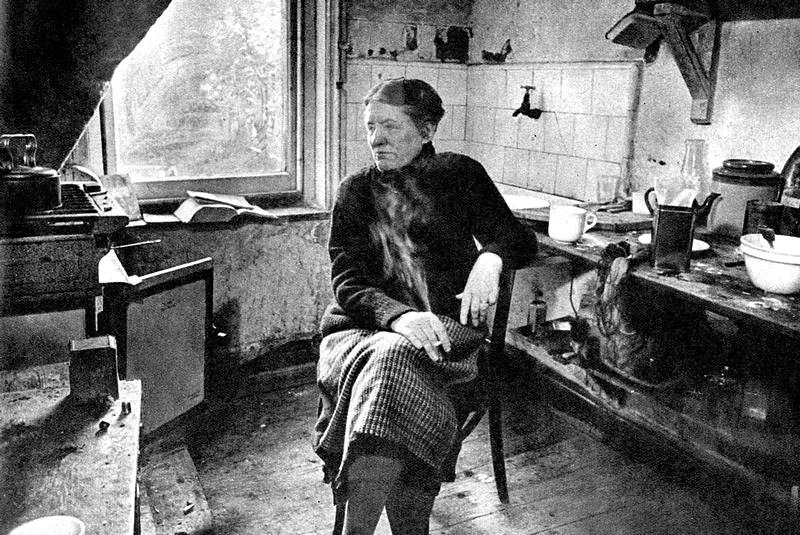
Well, there’s life and my disorderly path – it wasn’t until this month that I did so. As a page poet Wickham may not capture you easily, depending on your expectations. I read a 1921 American collection that combined two books of hers published earlier in England: 1915’s The Contemplative Quarry  and 1916’s The Man with a Hammer.*   She wrote almost entirely in short formats, there are quite a few 8-or-fewer line poems that can remind one of Emily Dickinson poems of similar length. Short formats can be favored by those who dash off poems in an otherwise occupied life, and this may be the case here – but at least on first read through, there’s a different general attitude from the American genius. Dickinson to my reading is often playful in her poem’s argument, and even when writing of subjugation or from inside a gothic fantasia, she generally seems in control – and she was after all a member of a family that had achieved local prominence and financial stability. Wickham’s background seems less secure and more bohemian, and from 1906-1929 she was married to a man who is reported to have viewed her poetry as a sequalae of mental illness.** This horrid situation is reflected in the poetry – there’s ample counter-punching wit and protest deployed against the patriarchy in these two collections – but that also presents a certain closed-in feeling. Some of these poems take on the manner of quickly-whispered-where-he-can’t-overhear asides to friends from a woman in an abusive relationship. From extant drafts we know Dickinson had, and took, time to revise her verse, and she often strikes me as a talented structured improviser. Wickham (so far) seems to me to be more a jotter of quick poems from the first-thought-best-thought practice – biographical scraps I’ve read reinforce that conclusion*** – and some (most?) of her papers that might show more about work in progress do not survive.

older Anna Wickham in her kitchen

Anna Wickham in 1946. She made her living by turning her Hampstead home into a rooming house. Still asserting herself, she famously took umbrage with someone declaring: “You’d better retract, my good man. I may be a minor poet, but I’m a major woman.”

.

There’s a good chance my appreciation of her work will increase, but I also didn’t get a sense of compelling word-music on first reading, and that’s a quality that can attract me to a poem even before I understand it – which makes the first poem of hers that I’ll present today a bit of an anomaly. “The Cherry Blossom Wand” is  musical, and she even put a notation beside its title on the published page “To be sung.” I have no knowledge if she wrote music for it, or sang it,**** but that sort of thing is taunting the Parlando Project!

I see the poem as being a multifaceted account of beauty or love of beauty (and if we extend that, to love itself). The poem starts with its refrain stanza, telling us a branch of cherry blossoms is a “wand” that can do some kind of merciless bewitching magic. I like the refrain’s final line “a beautiful thing that can never grow wise.” Ambiguously: either we never wise up to the thrall of beauty, or that experience, time and wising up removes the beauty.

Blossoms are of course famously temporary, as the first non-refrained verse reminds us. On the page, Wickham only puts the refrain first and last, but since songs favor repetition, I put an extra refrain between the two verses.

The final verse before the ending refrain contrasts the merciless enchantment of the blossom wand with the “kind” removal of the bewitching beauty, and the verse then ends with its own internal refrain saying that the transience of beauty and time is eternal. There’s no change that can change that change, and the mercy is that we are not taunted long with its brevity.

As a whole then: bittersweet.

Cherry Blossom Wand

Chord sheet for the song I took as commanded by Wickham’s note on the page

.

Musically I got to play my nylon string guitar for the first time in a while. Every time I play that variety of guitar, I’m reminded of the cheap J C Penny nylon string guitar that I bought off the after-Christmas sale table in late 1974 to begin to learn how to play. Classical guitar players may be appalled, but I currently play my nylon string with a pick, which is wrong – but it’s how Willie Nelson does it.

You can hear my performance of Anna Wickham’s “The Cherry Blossom Wand”  with the audio player gadget below. Has some merciless hand removed any such player?  This highlighted link will bud a new tab with its own audio player then.

.

*Some accounts say Anna Wickham is more read and studied in the U.S., which would be the reverse of some poets I present here, most notably Welsh poet Edward Thomas who has some best-loved poems in Britain, and is hardly known in America. Influential 20th century American anthologist Louis Untermeyer thought enough of Wickham’s work to praise and include it. The Feminist-Modernist angle probably occasioned some interest too, and you can read her as a predecessor to Sylvia Plath in some of Wickham’s themes. Before she had a career as a best-selling novelist, American poet Erica Jong wrote a couple of poems dedicated in part to Wickham: this one, and this one.

**Wickham was eccentric. The linked article that sparked my interest has accounts that make that eccentricity seem charming, but depression seems to have figured in her life too. The complexities of our mental wiring and biochemicals mixed in with the stress of her life makes remote historical diagnosis chancy of course. The close publication of the two books of poetry that I read as a combined collection coincided with her husband going off to WWI, giving her some increased autonomy. Give a moment to imagine Edwin Starr singing a revised song: “War!! Uhh! What is it good for? Giving Anna Wickham a chance to see her poetry in print. Good God! Say it again!”

***The account of her reading one of her poems in public and presenting it with ““Rubbish, but there it is”” indicates this approach.

****After a childhood family sojourn to Australia, Wickham returned to England to take study in performing arts, particularly a singing career, though that doesn’t mean she composed music. The Cherry Blossom Wand”  has been set to music as Art Song before, at least this once 25 years ago.

She mentioned abandoning any search for musicality in her poetry in one of the poems I recall reading this month. This could be part of Modernist distain for frippery, or a practical act of triage for a poet without enough time. She’s a contrast to her American contemporaries Sara Teasdale, Elinor Wylie and Edna St. Vincent Millay who wrote very musical verse even as they wrote about Modernist concerns.

Sedition. A poem which isn’t, and that’s a point it’s making

Edmund Vance Cooke was a Canadian poet. At least I think he was. There’s not much on his life I can find, and sometimes his last name is rendered as “Cook.” His sparce Wikipedia entry says he was born in what was then known as West Canada in 1866, and back around the beginning of the 20th century he wrote a type of popular published poetry in a style that has largely died out. Wikipedia calls his genre “inspirational verse,” and some of it I’ve found is that: paeans to earnest striving and social virtues that now-a-days would be reduced to short easily-sharable quotes or the captions on “hang in there” motivational/affirmation posters. But there are indications that social criticism was also part of his repertoire, and this poem I perform today has some bite to it. Though written in 1917, I felt I should work up some music and sing it as a freshly-made song in 2025.

One of the things that irks me most this year is the outrageous lying by my country’s mad despot and his fawning courtiers. I can’t say for sure what drives all these fabulations and alibies across his administration. For some personalities a lie is a demented reflex, a neurological tic. Others spout the lies as a cold tactical choice of propaganda, with a sense that it will gain them some rewards. A more generous assumed motivation: that by saying this or that is so, when it’s not, may help manifest the thing not yet in existence – and this is akin to what affirmations invoke for personal improvement. Alas, most of the things not yet in existence that our current regime members are manifesting by statement are ugly, cruel things. We shudder – while considering the exaggerations, we fear they might not stay lies for long.

Today’s Cooke poem “Sedition”  is a statement of the countervailing powers of truth. It reminds me of an anonymous poem about truth that was widely printed in the same era as Cooke was writing, “Truth Never Dies.”   Five years ago in this Project, I presented that poem and wrote about what I found about who had republished it. This link will be of interest if you wonder about that. Though it’s a statement without evidence, it’s not impossible that Cooke was the author of the much reprinted “Truth Never Dies”  poem – but “Truth Never Dies”  is a more religious and spiritual poem than “Sedition.”   I composed music for the former with acoustic guitar and strings presenting it as a firm, but gentle prayer. The latter, Cooke’s poem, is more sardonic, defiant, even militant – and so I decided to crank up some electric guitars for it.

Sedition

Here’s a chord sheet for my version of Cooke’s poem. I won’t take responsibility if you decide to play and sing it yourself, –  that might make you part of a conspiracy.

.

I played three guitars in the recording via multitracking. For the electric guitar nerds, the center channel has a Gretsch hollow-body playing the chords, the right channel’s a Jazzmaster solid-body with a pitch-shimmering wiggle stick, and the left side a Telecaster whose wide vibrato here was created by having enough personal frustration to expiate that my fingers directly wrung the strings sideways to way above their fretted pitch.* I associate this kind of guitar solo with Canadian Neil Young’s credo that sometimes your intent is to not sound like a “professional guitarist,” some master of tasteful licks and precise intonation.

You can hear the performance with the graphical audio player gadget below. No gadget? I’m not lying – some ways of viewing this blog suppress the player, so I offer this highlighted link that’ll open its own tab with an audio player.

.

*”Hey, posh-guy, you’ve got a lot of guitars there.” I accumulated cheap imported versions of these guitars over 30 years, using trades, hunting up second-hand examples, and waiting for sales. Coincidently, the current regime’s tariffs are threatening what has been a golden age of reasonable quality, good sounding instruments for musicians with limited funds.

On the Goodnight Trail, On the Loving Trail

In 1970’s age of the Singer-Songwriter, Poet and folksinger U. Utah Phillips had an anachronistic career. In performance he might sing for only a portion of his time on stage, mixing in story-telling, verse, jokes, and his brand of political advocacy that reflected his even-then old-fashioned connections to Catholic Worker activism and the Industrial Workers of the World.* He would sing his own songs sometimes – and while he apparently didn’t write an awful lot of songs, a couple of them I know are extraordinary. Today’s musical piece, performed for American Labor Day, is one of those.

Here a video of my performance of U. Utah Phillips’ song

.

On the dusty surface of it, “On the Goodnight Loving Trail”  is a cowboy song, one of the real ones that recognize that cowboy is a job title after all, not a romantic name for a gunfighter or wandering charismatic cinematic horseman. That type of cowboy song existed of course – Phillips didn’t have to invent it – but his take on the genre is sui generis. Consider the historical appropriation in the song title and the chorus’ refrain from a historical cattle drive route going from Texas to Wyoming. That trail was named for two cattle-driving ramrods: Charles Goodnight and Oliver Loving. A mere accident of family names, but Phillip’s choice to use them imbues the song from the start with elegiac affection.

Calling the aged cowboy whose cattle drive job fell to being the camp cook “The old woman” is also taken from fact. Is this gendered part of the song’s refrain an inevitable accident, or a choice by Phillips? That the song reinforces the old cook’s abrogation of manhood in a verse’s line about “wearing an apron instead of a name” says that the author wanted to underline that – it’s a choice. If this song isn’t Brokeback Mountain  or the sibling of Paul Westerberg’s and the Replacements’ “Androgynous,”  I’ll take the leap and say it’s maybe a second-cousin. Is it possible that Westerberg knew Phillips’ song? That’s impossible to say – the underground aquifer of the folk process is dark and damp.

UUP Wobbly

U. Utah Phillips: an IWW member in the days of James Taylor and Carole King

.

I chose to present “On the Goodnight Trail”  today because it’s Labor Day weekend here in the U.S. This song about work ends with the ground-truth that the lot of many of us is to use up most of our life in our labors. Years ago, thinking of two specifically American holidays, I wrote this short statement caught commuting itself towards a poem:

The temple of summer is guarded by two pillars:
Memorial Day for those who gave up their lives in war,
and Labor Day for those who gave up their lives in peace.

I’ll flatter myself and say U. Utah Phillips would have liked that one if he had heard it. I did my best to sing his song. Seven years ago I did a musical performance which included these three lines about The Temple of Summer,  and if you haven’t had enough Parlando Project music after the video above, here’s an audio player below to play that performance as we ride up to the gates of autumn this weekend.

.

*corrected thanks to rmichaelroman

.

.

The spider holds a Silver Ball

Welcome back to our regular fare after a spate of summer diversions. And what is it that you’d expect to see here? We take various words, mostly literary poetry, and combine them with original music in differing styles. I’ve done this Project for over nine years, and within the archives here you can wander through nearly 850 of these combinations. Since poetry can be described as words that want to burst into song, such combinations might seem an obvious task – sometimes they are – but I enjoy looking for unusual connections, conversations between tendrils and mycelium deeper in the soil, not just the majestic and visible branches everyone sees.

One frequent supplier of words to be recast in sound here is the seminal American 19th century poet Emily Dickinson. Dickinson’s mind is Shakespearean in its scope, and while her modes of expression vary to meet those needs, much of her poetry sits in a rich intersection between short epigramic verse that superficially seems like it could be stitched as some crewel homily, and unconventional, rebellious, independence of thought.

For example, this lesser-known Dickinson poem: “The spider holds a Silver Ball.”   I’ll link the full text of it here. The opening four lines are praise to a spider’s industriousness, with the arachnid – unusually for this poet – standing in here for the highly common Dickinson totem, the bee. Dickinson, the avid gardener with a science-focused education, knows well the necessity of pollinating and honey-keeping bees. In this rarer appearance in her work, the spider is no such creature, for their work is occult or predatory. She praises its web-work none-the-less, that work’s imperial provisioning for prey goes unmentioned. This praise continues in the next stanza. The web is anchored or arises from “Nought” she says. The spider makes its spider silk from a secreted process, its attachment points may be a dimly lit corner unespied, its constructions do not exist until the spider’s efforts create them. But “Nought to Nought” is an omen too for all this effort as the final stanza will tell. Note too, Dickinson genders the spider: “His.” Spiders of either sex spin webs, but this action is male.

spider and mushroom by Heidi Randen 1080

A mélange of moss and mushroom. Can you spot the spider’s unperceived hands in the picture? (click to enlarge)

.

I’ll make a leap here: Dickinson, the prolific weaver of 1,789 poems, identifies with this spider. One accounting has this as poem 513, so there are hundreds of poems behind her as she makes this one, and more than a thousand yet to go. The bees in Dickinson’s poems are usually cast as joyfully playing, the spider here is more obsessive. Even the dourest Puritan in her era would know the worth of the bee’s work: flowers, food, unspoiled sweetness. In the final stanza, the spider’s work is destroyed by what Dickinson genders as woman’s work, by housework – as endless as this spider’s spinning. Another leap: I wondered if Dickinson might have composed this poem while busy with housework, secretly engaged in the (gendered by her) masculine work of inessential gossamer creation – no matter if “Nought to Nought” is that work’s fate.

As I read this poem I thought of another poet working in this mode, the William Blake of Songs of Innocence and Experience,  who wrote of “The Fly”  and likened his own intellectual and creative drive to the bothersome insect.

I combined Dickinson’s words with music that partakes of the sound of the 1960s psychedelic genre.*  The joy of that kind of expression is the freedom granted to instruments to take novel roles and reconstituted timbres. To a loping 6/8 time, the bass is allowed to rise to sing, the electric piano has been having an episode, the guitars wander onto new paths, an organ breathes, the drums fibrillate. Over this I sing wildly, unconcerned to be overheard. You can hear this performance with the audio player gadget below. What, has that audio player seemingly come to nought? Some ways of viewing this post will suppress the gadget, so I offer this highlighted link which will spin a new tab that has its own audio player so you can listen.

.

*I don’t find this a strained pairing at all. The 19th century American New Thought and Transcendentalist strain was still alive in the Beat and later counter-culture outlooks that arose a century later. Dickinson’s recasting of language and syntax in many of her poems is like to the sonic experiments of psychedelic music, which I’m attracted to for their adventuresomeness rather than their drugs. What is novel about my application of this to Dickinson is that this element of her poetry is under-observed, while it’s more common to view William Blake as “A ‘head’ before his time.”

I ask AI to write a protest song, and…

A funny thing happened on my way to winding-up my Summer diversion series of thoughts on Artificial Intelligence. I’d concluded last time: since current AI was capable of producing musical pieces in popular styles that could pass for human works in casual listening – or plausibly even more exacting listening – those who’d prefer music expressed by humans might need to change the things they look for and value in music. What kind of things? Accept more imperfections in the music, cultivate an appreciation for the humanness inherent in live performance, and increase their consideration of the intent and motivations of the musical organizations they support.

That last point, about more significantly honoring intent, had hardly inscribed itself as a blog post here when a mischievous thought came over me: while AI is created by businesses with commercial intent, human-made music doesn’t have to be. As difficult as it is to refine authentic intent from music made by strangers distributed in a marketplace, could we be fooled about intent by entirely software-generated music? So, what if I asked AI music generating software to produce a protest song? What if I went further and presented it in a misleading context?

Disregarding my environmental footprint for the duration of the experiment, I created a free account on an AI music generating site, and I set about creating a new protest song. Out of the many outrages of 2025 so far, I picked the authoritarian assaults on academic independence which have sought fines/bribes/tribute from some of the U.S.’s most prestigious universities (known in America as “the Ivy League”) while demanding oversight into their operations and academic programs on flimsy pretexts.

Like a lot of AI, the one I used for this works on a “freemium” structure, with limited features for non-paying users. To make a song I only needed to enter in a text prompt (length-limited for free users) describing it. I asked another AI engine to suggest a prompt and asked it to create lyrics for a song (though the song-creating AI site would be glad to generate its own lyrics). The more general AI answer-bot suggested including artists whose style the music generating AI site should seek to emulate. I picked Phil Ochs and the Fugs. I wanted something with real anger and satiric bite.*

I created around six songs. None of them gave me that, even when I tweaked my prompt. What came out was sweet-voiced singers with an attitude of pop-music yearning, or acceptably sorrowful disappointment in their delivery. The AI lyrics did come up with a few phrases that had some charge to them, but the lyrics generally suffered from what I personally call “Horse With No Name” defects.** My prompt specified “gruff,” “angry,” rough” or even “sloppy” to describe the vocal delivery I was looking for, and out came the singers with an air of polished regret, and lyrics that groaned under their attempt at machine-constructed sincerity. The best I could say for the lyrics on the songs? They might pass as modern recording-production-style versions of the parodies created for the Spinal Tap acting company’s folk-music parody It’s a Mighty Wind.***

These results fed into the context I chose to present them in. I wrote a script for a podcast, supposedly devoted to American folk and Americana music. I decided the podcast presenter would be earnest, but a bit removed from the less-commercial segments of American folk music, and so I made her British. She would be portrayed by the machine speech that I use on my writing computer as a proofreading aid.**** As the token human in this enterprise, I’d appear as a hype-man for the Parlando Project.***** Over the next day I wrote the podcast script and recorded it folding in sections of the machine-generated protest songs. I slightly degraded the audio quality for the British host’s dialog, though after I finished I now think I should have done that for my own dialog instead, as I’d be more likely the guest relying on a remote overseas link for the imaginary podcast.

I had fun doing this, trying to gauge how many tells that this wasn’t on the up-and-up I should drop before revealing the near total AI nature of the content in the last minute. For the names of the Americana acts that were purported to be performing the AI songs, I decided to burlesque the names of U.S. 19th century Fireside Poets. I think “Greenleaf-Whittier” is a great name for a band in that genre – failing that, Jeff Tweedy if you’re reading here, you’re welcome to it for the next Wilco album title.

Greenleaf Whittier

Featuring the exciting new song “University Surrender” you heard on the “Kit That Sounds So Real” podcast.

.

The audio player below will let you hear the 18-minute program. The program opens with a snippet of an AI generated folk instrumental whose prompt I supplied was its title: “Obey in Advance.”   Though only a small selection, I think it demonstrates that AI generated music without vocals is particularly “real” sounding. The program continues with parts of three versions of a song called “University Surrender”  where the AI program supplied the words, music, and fully produced recording in three slightly different Americana styles it thought appropriate. The three versions resulted as I tried tweaking my text prompt – and while distinct, on repeated listening they seem somewhat “samey” to me. More smooth than I was asking for, “Ralph Waldo Bryant’s” version rising to falsetto delivery almost works for the material despite the pitch control artifacts I can detect in the computer-generated performance – but remember, as I said earlier in this series, the same artifacts are now common with recorded human vocalists in current pop. “Greenleaf-Whittier’s” cover did add one, nice, out-of-leftfield, touch: the flagrantly computer-voiced autotuned opening refrain of the title before continuing into its bouncy two-step country groove. And then there’s “Oliver and the Rolling Homes’” version of “University Surrender”  whose arrangement serves up a country-music playlist/station format sound. I was laughing hard as I heard the small-town-worshiping-my truck-my girl -I may get a little drunk sometimes-but I’m a hardworkin’ man-like my daddy sonic approach, but this time holding forth on tenure and syllabus issues. And then there’s “Ivy Towers Bow”  that is said to be written and performed by “J. R. Lowell.” The lyrics here were written by an AI chatbot and then those lyrics were given to the AI music generating program to make this song. Musically this one doesn’t give me anything – so generic. I almost didn’t include it, but I decided it was an example that a generate-songs-AI was on par with a text-focused AI when writing lyrics. The final song on the fake podcast might be the one of the group that does the best emulation. If I was listening casually and “E. E. Peterbuilt and the International Harvesters ““The Emperor’s New Chains”  came on, I’d think it better than many songs in its style. Oddly enough, the AI program produced it when I goofed and clicked generate when I’d only partly written the prompt “Folk or Americana protest song, gruff voice…” and by not having to lyrically add the academic details that made Oliver and the Rolling Homes version of “University Surrender”  so unintentionally hilarious, its Horse-with-No-Name lyric faults are not as exposed. If I wanted to pick one AI song from the ones I generated to fool a careful listener, I’d pick this one. You know you’re in the Uncanny Valley when the guitars have faded out and the robot vocalist gives us a little aside into the still open mic. Spooky.

If you don’t see the audio player gadget to play this imaginary podcast, this highlighted link was human supplied to let you hear it, and will open a new tab with its own audio player.

If my courage and energy hold out, I still want to write one more post about what I call “the guild issues” that concern some artists engendered by plausible AI results.

.

*The AI program didn’t object to those two 20th century folk-rock artists of outrage and cutting satire being supplied for models – but it completely ignored trying to emulate them. When I tried “Bob Dylan” – suggested by the separate AI that’d given me a prompt I could use elsewhere – the song AI immediately refused to do so, presumably due to a specific concern about IP.

**”A Horse With No Name” was a 1971 song, recorded in England by a band led by expatriate Americans. The recording, done by humans, not AI, sounded like someone had anachronistically entered our future and asked AI to “Create a song that sounds exactly like a Neil Young record.” The lyrics went forth despite including some awkward lines like “There were plants and birds and rocks and things,” “the heat was hot,” “’Cause there ain’t no one for to give you pain,” and “Under the cities lies a heart made of ground, but the humans will give no love.” To spare us from more lyrical howlers, the song also featured a lot of repeated “la la la’s” in its chorus, well-performed in a CSN&Y style of harmony.

The song was a substantial hit in both the U.S. and Britain, indicating that it worked as a song for its audience none-the-less.

***Hey, I’m a fan of Spinal Tap. Everyone is! And rating art is a fool’s game – but “It’s a Mighty Wind” is every bit as good, maybe better.

****The “read aloud” feature in the current versions of Microsoft Word is a huge aid to my self-proofreading. With my neuro-wiring, it lets me catch a great many errors I’d otherwise miss, and using the female British voice enhances the “hearing this anew, as if I didn’t write it” factor that makes it so effective.

*****The stuff I say in the middle of the satiric podcast concerning the Parlando Project is how I actually feel about the nine-plus years of stuff I’ve put out here.

Wild Peaches, an Eden with undercurrents

There’s an undercurrent of grief beneath life. I don’t say this as a sentimentalist, it’s just there. This doesn’t preclude joy – it may in fact demand it.

I awoke at dawn today, August drizzle falling. I connected briefly with a livestream of the candlelight anniversary memorial service in Hiroshima,* and then shared a few tears with my living wife. Tears from each of us mixed on my face, shed for my late wife now dead for 24 years this morning. After she left for work, I took to my daily joy and hopped on a bike and rode to breakfast under gray skies without remaining rain.

I usually read the news with breakfast, a long habit – and I still do, though there’s little joy and much sense of loss in it these days. I took an old pocket music player with me (which no longer works except for the radio)** so that I could listen on air to the children of a recently assassinated state legislator memorialize her and her husband killed alongside her. They played their parent’s favorite songs mixed with sharing stories of hearing those songs in the back seat of a minivan while all sang along in flagrant voices. See what I mean: grief demands joy.

Perhaps you don’t. I express myself awkwardly, some will wonder what I’m on about. Let me look at it from the perspective of absent connection: the man who has gained some wealth by bamboozling someone or by force of power, often has the briefest of joys. The one who seeks joy in the suppression of others, has a meagre joy constructed out of a comparison to other’s pain inflicted. Grief for them might be a weakness, a sure sign of submission. I, a nobody in this world of power, can laugh at myself writing this and tell myself I should stop trying to be mistaken for Kahlil Gibran.

Today’s musical piece came about when someone shared a poem by Elinor Wylie called “Wild Peaches.”  Wylie, a contemporary of Edna St. Vincent Millay, gained an audience during the last decade to be called The Twenties. She was born into a successful family steeped in political rectitude, but her love life became a national scandal. She eloped with the son of an admiral at age 20, but soon left him for a married, older lawyer by the name of Wylie.***  The abandoned husband committed suicide after she left him, and the lawyer Wylie and Elinor fled to England and lived undercover under an assumed name. Eventually the couple married and were able to return to the U.S. in time to have that relationship too fall apart.

Hanging out with the East Coast Modernists, the now Elinor Wylie launched her poetry career. The scandals likely helped and hurt that career, but Millay and some other women poets were writing with complexity in melodic verse about eros (and what surrounds it) – and for a while they found readers hoping to understand “the New Woman” of the 1920s. As it turned out their careers were helped and hurt by many of them writing rhyming verse in metrical forms. Even before Modernism, rhyming verse was already becoming associated with less serious poetry, and women writing about eros were judged less substantial than men writing about the supposed important things. The oncoming middle of the 20th century was to be very concerned with important things – many deadly through new bombs or other means.

“Wild Peaches”  was published as a series of four sonnets, and I’ll link the full text here. My performance is only of the first one, which I think can stand alone and is representative. Rewardingly musical, the first impression one might have is of a poem that’s kin to the famous Yeats’ poem “The Lake Isle of Innisfree.”  Instead of an Irish bee-loud glade and house of wattles made, the poem’s voice is describing an Eden, a locus solus, a blessed arcadia, in the south-eastern coast of the U.S.**** But wait, there’s an undercurrent.

This is the poem of a woman who had twice eloped – the second time was subject to an international “womanhunt” – and neither partner stuck. The voice of the poem knows full well flee and exile may the entry and exit point of such an Eden. I love the ironic turn the sonnet takes even within its octet when it goes all Frank O’Hara – though written before that poet or Disney’s Davey Crocket had come into existence – with the man taking to wearing a coonskin cap and the fleeing couture-debutante clad in homespun. The exultation of “We’ll swim in milk and honey till we drown” is delicious, moving from Exodus past the parted sea to drowning.

Wylie in elaborate dress

Elinor Wylie, not wearing homespun fabric


The sextet seems to offer more Eden – but wait, the best season is Autumn, the season of The Fall, and we are left with the abrupt movement from wild fruity abundance to a subsistence bringing death, and a hunter whose shot will not miss.

Oh mercy, I’m going to go all Gibran again: death will surely win one battle, though love can win many battles. That’s what I’ve found – and though she died young, Elinor Wylie later seems to have found her most successful marriage the third time around.

After our last piece where I accompanied my speaking ghost with lots of electric guitar, today’s piece is full of bowed strings: cello, violin, and viola da gamba. In secret I’ll tell you I played most of the string parts for my Carolina Eve in Exile with my MIDI guitar. I’ve taken to calling pieces such as this “Punk Orchestral,” in that I’m not getting overly fancy with the rank and order of calling these instruments up. You can hear my song made from the first sonnet in Elinor Wylie’s “Wild Peaches”  with the audio player below. No player? You’ve not been driven out of the garden, it’s just that some ways of viewing this blog will suppress it, and so I’ll supply this highlighted link that will open a new tab with its own audio player.

.

*For several years after my late wife’s death, I didn’t notice that it happened on Hiroshima Day, but I’ve found that linking a single death with the death of thousands underlines my point about humanity’s shared undercurrent of grief and loss.

**I could have Internet-streamed the children’s memorial radio program of course, but I decided to use the old device because it reminded me of the era I shared with my late wife.

***The imp of the perverse in me can’t help but think of the lawyer’s family name with the animated coyote and his well-funded Amazon Prime account who is none-the-less doomed. We find that funny.

****We can locate this poem’s Eden from its fruits. The wild peaches indicate it’s southeastern as that non-native fruit is only cultivated below the Mason-Dixon line. Wild peaches are the remains of abandoned orchards or animal-carried/buried/excreted seed-pit refugees of cultivated fruit. The poem’s other fruit, scuppernong, is a wild white grape native to the Carolinas.

The Unquiet Grave

August brings me this triple obligation: it’s the anniversary of the public launch of the Parlando Project, of my late wife’s death, and of the atomic bombings — three things varying in nearness, scope, and heart-weight. Two of them plainly have to do with grief — and poetry’s connection to matters of death and survival is there to be examined too.

Today’s musical piece isn’t exactly literary poetry, as its survival can largely be laid to singing, not printing and the murmuring eye.*  “The Unquiet Grave”  is one of those works from that prolific author Anonymous. Their publisher? The memories of people who wanted something to sing. The version of “The Unquiet Grave”  that you can hear below was collected by Cecil Sharpe in Great Britain from the singing of a “Mrs. Lucy White at Hambridge, Somerset, 6 August 1904.” This is a portentous coincidence: I just went to the book where I saw that version to gather the note on its collection, and that date of the year is the very day my late wife died; the year of collection, the same that the house my late wife and I bought and I still live in was first occupied; and the place it was sung “Somerset,” says August in its sound.

The Unquiet Grave

With all the words flowing through the Internet, you still might want to pause and listen when the ghost begins to speak.

.

The story in the ballad is compressed, but it opens with a lover’s mourning. The next event, the dead partner becoming present and speaking is not just supernatural, it’s also an empirical report of what many of those in grief experience.

Just last week I was listening to Fresh Air’s Terry Gross interviewing podcaster/comic Marc Maron.  As they talked, ostensibly about Maron’s career, the two bonded over their own recent partner’s deaths — Maron’s a couple of years ago, Gross’ earlier this year. They each shared that their dead spouse’s presence and voice had vividly returned to them, and each averred that this experience was not horror-show scary — rather it was, while remaining strange, comforting. I can remember one of my own experiences around a year after my wife’s death. I was becoming involved with my present wife around this time, and I felt it awkward that here was the presence of my dead wife returning. I don’t know if I spoke to my dead wife’s presence out loud, but then in such a spirit world our conversations likely needed no sound or syntax, only the sense, and that sense was a common realization between us that it was  awkward, but that this new complexity was fine. More than speaking — do ghosts laugh? Do we laugh in their presence? I think we both might have that night.

I’ve always felt that “The Unquiet Grave”  has a practical, darkly humorous, intent. If ghosts have additional knowledge, extra-existential wisdom, what the ghost in the song shares is that one can cherish the dead, even hear them speak, but that they are changed forever — and the living can, should, change too. When the ghost says that you wouldn’t want to kiss the corpse’s lips, the gothic joke on deadly “mourning breath” almost writes itself.

The words in Lucy White’s version, which I remained faithful to, somewhat fumble the lyric’s closing statement. What the final exchange the lovers share means to say is “When the autumn leaves fall from the trees/and (then) spring up green again.” I just sang what was on the page, but that fumble is, I now think, also exemplary of grief, it’s misdirection. Grief’s disruption, like a slight-of-hand magician: something is here (like what you meant to say), and then it’s, poof, gone.

Today’s musical performance of “The Unquiet Grave”  is a tribute to Fairport Convention, the pioneering British folk-rock group — a choice of mine inspired by recently listening to Andrew Hickey’s 500songs.com history on how that group formed its own Cecil Sharpe revival-with-Stratocasters after their own encounter with death and grief. You can hear my performance with the audio player below. Has any such player failed to materialize? If so — mourn but organize — and click this highlighted link which will open a new tab with its own audio player.

.

*It’s hard to date the ur-versions of folk songs, though many were printed in the 18th and 19th centuries, first by commercial broadsheet publishers and then by collectors and song-catchers like Cecil Sharpe and Francis James Child. Child collected “The Unquiet Grave”  in America in the late 19th century and numbered it 78 in his ballad collection. It’s always seemed to me that “The Unquiet Grave”  (also known in versions as “Cold Blows the Wind”)  is an extended variation of one of the oldest fragments of English language poetry “Westron Wynde,” which has been dated to the Middle Ages, plausibly to quite early in that era.

Four Performances-Part Four: We play an Alternative Prom

The experience of the fourth performance in this July series was unlike the previous three. Those reading along may recall that each of the first three I’ve written about this month left me with its own distinct feeling of disconnect, of ways that I had not been able to reach an audience. I could’ve taken the performer’s side in this failure to connect — there is a long and necessary tradition of confounding audience expectations after all — but emotionally I couldn’t live with that unreservedly. Given that the core of the LYL Band was a band of poets not reliable professional musicians, and those poets were reflexive non-conformists singing songs that held up to examination or ridicule civic and cultural matters, I should have expected that outcome.*   Intellectually, I understood this, but emotionally, it bothered me, particularly after the U of M concert I wrote of last time.

Society picks a few non-conformists, perhaps ones bound with redeeming qualities or compelling evolutionary necessities, and is fine dispensing with the rest.**  If it didn’t do this mostly, well, the non-conformists wouldn’t be non-conformists would they? The LYL Band in this metaphor is the platypus.

But as I said, today’s performance is different. Somewhere in the mid-1980s a couple of nurses at the hospital I worked at had an idea: they wanted to put on a Prom to remediate memories of less-than-accepting Proms from their high-school years. What a great idea! They set a date and went about decorating a house’s basement with festooned crepe paper and colored light bulbs, plastic flowers, and some cardboard gilding, just as small school gyms had been transformed in teenage midcentury America. One of the nurses knew I had a band, would we be the rockin’ dance combo for this event?***  Sure, we’d do it — if we could find a drummer.

If nothing else, the perceived (by me) failure of the U of M concert from last time cemented in my mind that playing electric instruments without a backbeat couldn’t sustain the illusion that we were a Rock band. Someone knew a drummer. He agreed. We rehearsed with him a single time, and Dave and I selected from our repertoire songs that might be fit for dancers.

When the night of the Alternative Prom arrived, we set up in the house’s basement. We had no PA as such for vocals at this time, so I used a small Radio Shack mixer connected to my home stereo for the vocals, with no provision for monitors. I even set up one mic for any members of the audience that wanted to sing backing vocals.

The Prom attendees arrived. Some had scrounged old formal wear from second-hand stores, and even accessorized with corsages, while others were in come-as-you-are casual dress. Some came with their we’ve-achieved-adulthood-now partners, others just themselves. Given the nurse-origin of the event, women were in the majority. How many in the audience? Again, memory can’t count, but the basement was soon quite full, just enough room to dance, maybe 30-35 people? I really can’t be sure. I think there was some food and drink, but I don’t recall the particulars as my mind was keyed up for the performance.

Our little trio began to play about 10 p.m., myself with my electric guitar, Dave with his Farfisa combo organ with grey bass-register left-hand keys, and our for-the-night-drummer at his kit.

Dancing broke out, and continued through our roughly 60 minute set which concluded with a cover of Wilson Pickett’s garage-rock classic “In the Midnight Hour.”   I don’t know what experiences any of my readers who play instruments have had, but let me say that if you ever get a chance to play for a dancing audience, I highly recommend it. I believe that music (and to a degree, its sibling art poetry too) are meant to move bodies. While I have never been a very good “rhythm guitarist,” here in a trio I had to fill that space however shambolically I could. It helped that the drummer was good, and fully-invested in “more cowbell,” and Dave’s left hand on the organ grey keys filled in well for no bass player.

I’d considered what should be our encore if the performance worked, and my idea was to lean on my still patent Patti-Smith-inspired vocal improvisation skills. The planned framework would be the ultimate chestnut of its era “Louie Louie,”  a three-chord song that I would connect with whatever songs came into my head by converting them to fit “Louie Louie’s”  three-chord-trick cadence.

Dave started the encore, his voice hoarse from singing without the benefit of vocal monitors that night. “Louie Louie” soon slid into Dave’s song “Sugar Rush.”   As the guitar breaks and audience sing-alongs carried us forward toward midnight, I merged in other songs: “Like a Rolling Stone.” “La Bomba.” “The Star-Spangled Banner.” “Fortunate Son,”  and finally, tiny snippets of the Velvet Underground’s “Pale Blue Eyes”  and “Sweet Jane.”

The performance was over. Art is hard to measure, harder yet when it’s rough-edged, imperfect, and improbable; but it may have been the single best LYL Band performance, despite (or because) of its unconcern for sophistication. The recording is crude too, and the vocals suffer from the lack of monitors and strained voices. The funk of the sweaty basement, the joy of the dancers remediating their teen-age years, the surrounds of dance steps and emotions: none-of-than can make it directly onto audio tape. But Rock’n’Roll isn’t a juried competition. On any one night, with any one audience, it’s a shared mood of ecstatic feelings, and no level of skill and fidelity sans those feelings can’t maintain it.

I can’t find any pictures from the Alternative Prom, but for visuals I put in a bunch of LYL ‘80s posters and pictures from other gigs, including the U of M concert I wrote about last time. One level of our non-conformity:  we tried and succeeded in not dressing for the part of a punk band.

.

*If only in a footnote, I feel a need to note the death of Tom Lehrer this week. He really made an impression on me, and Lehrer’s presentation was, like the early LYL band, centered on the idea of gleefully rubbishing many cultural standards and pieties. I even tried to work in a punked-up version of his “We’ll All Go Together When We Go,”  as our answer to “99 Luftballons.”.

If the Fugs, that other band of poets, were arguably the first punk rock group, I suspect any acerbic singer-songwriter from my generation had listened to Lehrer’s LPs. Here’s one odd thing I noted in the reaction to his death, and the inevitable short pieces on his career: I have yet to see a conservative weigh in with their view. No tut-tutting from the religious cultural nationalists on Lehrer’s satire tearing down the church and militaristic state. No remarks on his musical asides to sexual laissez faire oppressing or not-oppressing in the proper ways. No public-health consequences drawn from his 1953 ode to “The Old Dope Peddler”  recorded when Lou Reed hadn’t turned 12 years old. Somewhere there may have been some “he’d be cancelled today” edge-lord free-to-be-fascist Lehrer elegy, but the respectable conservatives are leaving the field to the crickets. My theory: there’s an audience result that isn’t “enemy list” notoriety, but is more at “never heard of him” where Lehrer resided for 75 years or so.

**Frank Zappa, who understood a scientist’s cool examination of such things, had this quote: “Without deviation from the norm, progress is not possible.”

***Let me do a capsule American Rock history lesson here. During the 1960s and into the early ‘70s the nation was full of small musical combos made up of young semi-professional musicians. They had different models: some wanted to be the Ventures, or Booker T and the MGs, others The Beatles, or Animals, The Young Rascals, The Rolling Stones, Paul Revere and the Raiders, Mitch Ryder and the Detroit Wheels, or the Yardbirds. By later in this era many of these combos took on psychedelic trappings and had converted to ballroom and movie-house stage ambitions, but for a few years before, these “garage rock” band’s gigs would be bars, under-21 not-bars or teen-clubs, and youthful social functions such as high-school dances and proms.