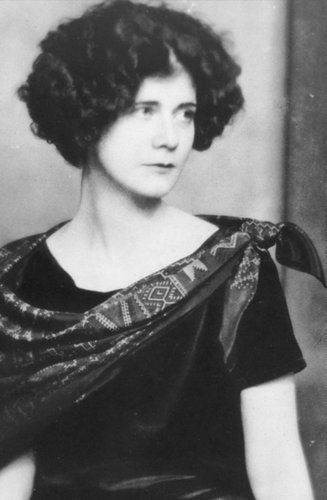
Elinor Wylie once was a reasonably successful poet, back in the last decade that was called The Twenties. I informally group her with some other American women poets of that time: Sara Teasdale, Edna St. Vincent Millay, Dorothy Parker, each of whom wrote often about the complexities of love and relationships. Though none of this group had careers of extended success,* Wylie’s poetry career arc was exceptionally short, contained entirely within the 1920s — though it was preceded by a few years of being a gossip item for a series of romantic elopements and divorces. I wrote a bit about that element of her life a few years back, but it seems that Wylie was playing at the Kardashian-family level of tempestuous celebritydom in her time. Read my link if you want a summary of the tea.
Elinor Wylie. Runaway socialite and 1920s poet.
.
So how good was her poetry? Clearly better than the usual celebrity with a book of poetry. She’s highly musical and concise, an irresistible draw to my Project, and while ranking art is a foolish game, her best work stands up well against the trio I associated her with. Today’s piece uses a poem that was called one of her best works when I first read it as poets.org’s Poem-a-Day a year ago. Here’s a link to the poem’s text if you’d like to read along. I myself wouldn’t rank it that high if I somehow needed to rank her poems, though the musicality alone compelled me to set it with music this week. Why do I prefer, for example, her “Velvet Shoes?” “Let No Charitable Hope” is a bit abstract, despite the eagle and antelope that are cited in passing and the woman trying to get substance from a stone,** while “Velvet Shoes” is as sensuous an experience in imagery as in sound. But as a complaint, “Let No Charitable Hope” probably still connects. Many of us, maybe more for those women reading, are familiar with being misapprehended, of having a hard enough time maintaining one’s own hopes, and to then be asked to try to match the hopes of others. What does Wylie mean by her ending smile in the poem? Is she smiling at how mistaken the apprehension was, or is she allowing herself to smile at her own small lofting of her own hopes?
You can hear my musical performance of Wylie’s poem with the audio player below. I went all-out on the weird chords for this one, so it may not be to all tastes. Is your screen so woozy from fear of odd voicings that it’s obscured any such audio player? No, some ways of reading this blog suppress that player gadget, so I provide this highlighted link that will open a new tab with its own audio player.
.
*Like Wylie, Teasdale died young. Parker and Millay’s political commitment damaged their later careers. The New Morning of the The New Woman of the 1920s had its backlash as well — but this isn’t simple. It’s hard to maintain an artistic career in general, Parker suffered from writerly alcoholism, and some who shared Milay’s politics didn’t think her later work was as good as literature.
**One more concrete image occurs in the poem: masks. The line “Masks outrageous and austere” was sonorous enough for Tennessee Williams to cop it later on. As if sometimes does for me, I thought of masking as in autism, though the syntax of the poem’s last stanza seems to have masking being applied to the years, not the poem’s speaker’s smiling face. Still, I’d expect some ASD readers would see the disconnect of the “charitable hopes” of others viewing them verses their own internal reservoirs of hope and intent.
A post today for a holiday with complications. In the UK, Canada, and the former Commonwealth, today is Remembrance Sunday and tomorrow is Remembrance Day. In my United States tomorrow is Veteran’s Day. Remembrance Sunday/Day is a bigger deal. Here in the U.S., it’s one of two holidays set aside to honor the armed forces,* and the Spring Memorial Day gets more observance. America moves it around as a Monday workday holiday, so it now rarely occurs on November 11th, the day it was originally meant to commemorate, Armistice Day, the day that WWI ended. In the American observance, the day and the moment being observed are no longer there as they happen to be this year.
But then, all the events of WWI have now passed out of the living’s remembrance, and WWII is entering the time of that leaving — while in England the wound and loss are still felt by a generation that themselves only recall the generations that personally experienced it.**
Historically, poets suffer, fight, and die in wars. Presently in the U.S. this may be less true than was traditionally so, our soldiering ranks now coming from a different cohort than those with MFA and workshop attendance. That too is complicated, and I’ll choose to honor your time today by not going into all of that. Yet I’ll maintain that the experiences of service to country, of organized protection and organized death, of comradeship and loneliness — these words of history aren’t so far away if we only open ourselves to listen to them.
Here are five poems for this complicated holiday that this Project has presented over the years. In honor of the UK preservation of the original reason for the holiday, four of them will be British to one American.
Gone, Gone Again (Blenheim Oranges)
British poet Edward Thomas is too little considered in the United States, but in the run-up to WWI this overworked and underpaid freelance writer started to expend his writing efforts to the least commercial of literary forms, poetry of individual honesty — urged in that endeavor by his expatriate American friend, Robert Frost. Frost left England for America as the war began and he asked his friend to follow him and emigrate to the United States.
Thomas didn’t accept his offer. In Britain Thomas is remembered as a War Poet, as one of the casualties of The Great War, but his poetry doesn’t speak of his trenchside times in the conflict — instead it sings with lovely precision and concision of the British countryside as he is making his decision to take the road well-traveled to enlist to the front. “Gone, Gone Again” is one of his masterful poetic verse-essays on this time of decision, as he observes an England depopulated of its workmen. Why did he go to the front? He explained it mostly as being unable to shake his patriotic connection to the very soil and experience of Britain that his poetry sings of, but I said today’s post would be about complications. Thomas was also a troubled soul, looking for meaning in his life not captured by certainty, and some have speculated that a soldier’s pay was a better economic offer for his family than his Grub Street freelancing. He packs every bit of that into this short poem.
.
Shadwell Stair
Wilfred Owen is another Brit who took up poetry in the context of serving in The Great War. He’s known for his scathing anti-war poems, which to Britain’s credit doesn’t keep him from being honored nationally as a War Poet. But here’s a lonely poem written on the banks of the river Thames, likely during the time he was back from the front being treated for what was then called “shell-shock.” Folks today can experience the poem in a context pointed out later, that the Shadwell Stair location was a gay cruising spot at that time. Historically, there’s a blindness in some eyes to see that not just that poets and artists serve, but that they aren’t all straight.
.
On the Troop Ship to Gallipoli
Rupert Brooke was a rising young poet before WWI started, and even at his young age, great things were predicted for him. Unlike Owen, his war poetry is conventionally heroic, conventionally patriotic. Unlike Thomas, he was under no economic pressure when he enlisted. Would that tone have continued, could he have written glorious battlefield odes, or would the war have turned him into a skeptical Modernist? In an irony that only the Fates could have woven, he was detailed to be part of the disastrous attempt to land at Gallipoli. While on the troop ship steaming there, he fell sick from what I’ve read was an infected insect bite, and died before reaching the deadly front.
I took a fragment Brooke composed on that fatal voyage, and audaciously decided to take a Modernist blue pencil to trim and rephrase it the way an Imagist might. That was a complicated act, one that I’m not sure I can justify, other than to say that I wanted Brooke’s moment on that troopship to stand out more vividly, riding roughshod over his verse to honor that.
.
The Cenotaph
I don’t believe there are any women on WWI War Poet plaques in Britain, but of course they were asked to and worked with the war effort, and were there to tend, mend, and mourn the casualties during and afterward. Here’s a complicated poem of mourning, written as the original Cenotaph*** was erected in London. Its author Charlotte Mew is another British poet little-known in America. From what I’ve read she was seen as eccentric by other artists of her time, and her poetry doesn’t fit easily into any movement or style. Every Remembrance observance in Britain to this day has a ceremony at the London Cenotaph where the current government pays solemn homage to the soldiers’ sacrifice. If I read Mew right, she’s the ghost-at-the-feast here, and has some particular wailing to do.
.
.
Grass
Lastly, for Remembrance Day, here’s the American — and non-more American than the child of immigrants Carl Sandburg. I would post his poem “Grass” every Memorial Day, every Veteran’s Day — and yes, even every Remembrance Day. Yet, this is a poem that sings about forgetting. Is forgetting wars, forgetting soldier’s service and sacrifice, a callous thing? Is forgetting the follies and cruelties of war dangerous ignorance? Is it better to forget wars than to suffer them forever in endless horror? Is forgetting just the way things are eventually, an erasing sigh that fades into new present days — as what humans do that humans can never fully comprehend?
Look, I said it was complicated.
.
*In the US, there’s fine print sometimes invoked to separate the two: Memorial Day for those who died in service, and Veteran’s Day to honor all that served. The UK Remembrance Day is more like American Memorial Day focused on wartime losses and sacrifice.
**Proportionate to population, the US casualties in WWI were much lower. And England’s cities suffered under bombs during WWII. I was going to write too about the World Wars and their effect on the British Empire and colonialism, and America sliding in as a replacement, but that subject is too big for any footnote.
***So great were the WWI deaths that logistics couldn’t see to repatriating all the bodies of British war dead back home, and unidentified dead and missing in action mysteries clouded the situation too. Regional cenotaph memorials, including a great one in the national capitol, would serve as a consolidated gravesite to lay flowers and visit in remembrance.
It happens to us alone, but it happens to so many it’s a trope we share. It goes like this: you have one of those bad dreams. Something terrible has gone wrong — and you, inside the dream, feeling it is real, try to fix it — but you can’t because the other people in the dream are oblivious to the terrible and are acting stubbornly in odd, irrational ways. While dreaming you’re trapped in this desperately unsolvable situation only you can clearly see and try to act rationally on, running in place, thinking in circles.
I had one of those dreams this week: felt so real, so heart-wrenching. Then the dawn comes, and you realize that experience was a dream — oh, that’s why you couldn’t fix it, that’s why everyone else in the dream was acting so wrongly!
OK, exiting satire mode, but let’s stay strange.
Early this Fall I was cleaning out something: a box, a drawer, a binder, a little used bag, I can’t remember exactly what. But in it was a clutch of papers. I glanced at the pages and recognized it was a mix of things: some works-in-progress looking for first reads from the old group of poets I used to meet with every month, and some initial drafts of a longer, multipart poem I was writing as my mother was going through her last hospitalization, the one from which she would ask to return to the home I grew up in with my father and sisters in order that she could die there. I set those sheets of paper aside.* I figured I’d look them over later, maybe digitally scan them, or put them in my filing cabinet. At that later I’d also look to see if there were any drafts in the small stack that were unfinished pieces I could revisit.
Now here it is, we’re November and I finally got around to that sort-out. One of the pages was a college-ruled notebook sheet with a complete intermittent draft of an irregular (American) sonnet. What was this? While I remember well working on the longer poem around my mother’s last illness 20-some years ago, I had no memory of working on this sonnet. Complete blank. Moreover, the sonnet seemed to speak of someone’s story that I didn’t recognize as mine — nor anyone else’s I could recall either.** With the time-interval between discovery of the papers and my finally going over them, I can’t even be sure if this sonnet was found among the stuff from the time of my mother’s death or not. Trying to determine why I didn’t remember it, I wondered if it was even older. I recalled that scholars date Emily Dickinson manuscripts by looking at the changes in her handwriting over time, so I tried that assay. Looked to me more like my 20th century handwriting, so the poem could be older. Still, it was my handwriting, testifying I, however unremembering, wrote this poem — and “What was it about?” That intrigued me. The poem asks the reader to work obliquely, details are supplied but not all the details, something that can tantalize.
The gardening stake metaphor used in the final section reminds the 2024-me of Robert Frosts “Pea Brush,” a poem I didn’t know when the me I was back then wrote it
.
Why did the voice in the poem not mail their first letter? What was it about the recipient’s husband that was germane to that decision? Was there an affair or appearance of one? Clearer to me was the latter part, the stuff of the second letter, a recalling of youthful aspirations and a friend who by what they said helped make them more substantial than pretensions. What an interesting yoking, I thought. The imperfect, the not said, or the thing whose saying we keep hidden — combined with the things that were said that help us realize our lives.
As you might tell from the previous paragraph, I was experiencing this poem just as I would the general run of Parlando Project poems, ones written by others in a project which has as one of its mottos “Other People’s Stories.” Its mystery and ambiguity captivated me, and so I set about making it into a Parlando song.
I did a revision of the initial handwritten draft I had found and worked on combining it with the music you’ll hear with it below this week. The music today is played as a conventional LP-era rock ensemble: there’s the usual quartet: bass, drums, chordal and “lead” guitar. Added to that are two keyboards, piano and Hammond organ. You can hear the result with the audio player gadget you should see just below. No gadget? Wake up, this highlighted link opens a new tab with its own audio player.
.
*Two of those poets have since died, I re-handled those pages, ones they’d typed in and handed to me years ago, and thought tenderly of them. My part of the household is due for an austere “death cleaning,” the tossing of those things an old man keeps to extend something of the life of that-and-those who’ve passed on. I have no grave illness, but the keeper now must consider that they will pass on and that there’s no real keeping.
**I did write from personas in my writing life regularly, a bit more so in prose than poetry. I was likely imagining the “short-story” plot that I then went about expressing in the sonnet.
It’s National Election Day in the United States, and it’s seen as an extraordinary consequential election. Amid that great matter, I fielded a clutch of social media queries on poetry and music in the last 24 hours or so. I think I understand this seeming paradox. Though I myself will likely stay up late tonight listening to returns — as it is after voting early in the morning, I’m expecting to have only the maelstrom of worrying and hoping to spend over the rest of this national event tonight.
But since I last left my listeners at the end of October with an atypical audio piece, I thought it’d be a good day to release this performance by the LYL Band of a poem by the American early Modernist poet William Carlos Williams. That’s what we usually do here: take other folk’s literary poetry never meant to be sung and combine it with original music in differing styles.
What’s my personal history with Williams? Oddly,* my introduction to Williams was in the guise of his printed introduction of Allen Ginsburg to me (and many) in the thin City Lights paperback Howl and Other Poems. Williams’ name was printed right on the cover of Howl, and while in a smaller font than Ginsberg’s, it’s not fine print either. They must have thought it would help.
Published November 1st, 1956. Did the choice between Eisenhower and Stevenson seem quite so existential?
.
As a young man I don’t think I absorbed much of what Williams said in his short introduction. I didn’t have the experience of life to fully grasp it, and about all I knew of Williams was that he was an established, a somehow certified, real poet — and the man he was introducing, Ginsberg, was not. At that point, the younger poet had not been elected to such a post by the cultural electoral college, but WCW was vouching for him beyond the matter of a questionable Beatnik fad. As a teenager at the time, what did I know about what made a real poet? I can’t fully remember. I had some romantic ideas about vision, seeing intensely what others couldn’t sense, and some idea that that would likely put the poet in opposition to elements of society. This was not some structured critical philosophy on my part, it was more a gut feeling, a wish for something more. I look back at that kid I was and think: well, maybe I’m still no better a philosopher than he was, though I now know complications — but yeah kid-of-the-past, there’s still something to that.
Williams’ name on the Beat landmark paperback did not lead me to read Williams then. Rereading that introduction today that may have been because while it had words that Ginsberg took as validation, it was somewhat between hands-off and off-hand about Ginsberg’s poetry. He called Ginsberg “disturbed,” recalled that he didn’t think the young man would develop into a poet (or even survive). He characterizes the title poem of the collection, “Howl,” as a howl of defeat. I adamantly heard it as a howl of survival. So, thanks old man. Glad you at least said we should pay attention, be “arrested” Williams wrote, by Ginsberg’s poetry.
It’s only been in this century that I read Williams early 20th century work. I found a lot to like in his clean spare early poems written as Modernism sought to clear out the tired excesses of decoration. Now as I re-read Williams mid-century introduction to Howl I’m arrested by things I, an old man, resonate with. He did see the poem’s survival testimony. He wrote this there about Ginsberg’s poetry:
He proves to us, in spite of the most debasing experiences that life can offer a man,
the spirit of love survives to ennoble our lives if we have the wit and the courage and the faith — and the art! to persist.”
And he continues in the introduction to Howl:
Poets are damned but they are not blind, they see with the eyes of the angels. This poet sees through and all around the horrors he partakes of in the very intimate details of his poem. He avoids nothing but experiences it to the hilt. He contains it. Claims it as his own — and, we believe, laughs at it and has the time and effrontery to love a fellow of his choice and record that love in a well-made poem.”
It seems to me now, from my old age, that to “see with the eyes of angels” may be its own curse, and thus the angels may howl.
Is today’s small William Carlos Williams poem, one turned into a little song sung with the LYL Band, too slight to serve on a night where we look as nations move? I don’t know. I already told you, I’m not much of a philosopher. Williams’ “To Waken an Old Lady” is a poem that yokes old age and the descent into winter. Here’s a link to the text of the poem if you’d like to follow along.
I now can often feel like the small birds he puts in this poem. In the course of life, I’m here past the days of career or work harvest. In the summer, the summer of this political campaign, I felt the cold dark winds plenty of times. The poem doesn’t say, but I suppose the poem knows spring comes. I suppose also the poem knows that death comes and preempts spring too.
“But what?” Williams interjects as the poem turns. Look: there are these broken seed husks, the ones that didn’t bloom. So what if they are not to bloom, they are sustenance for survival.
You can hear the LYL Band performance of “To Waken an Old Lady” with the audio player below. Are the returns of an audio player yet to come in? This highlighted link will open a new tab with its own audio player.
.
*Well maybe not odd for me. If you’ve read many of these posts, you may have recognized that I love the odd connection.
I indicated last time that I had another piece I wanted to present before Halloween by Walter de la Mare, that British master of the subtle supernatural. It took a bunch of concentrated effort to produce something of a realization of it, but it’s as ready as I can make it in time. How’d it come about, and why was I not sure I could promise it?
I use the Internet Archive often as part of this “not just non-profit — it’s non-revenue” Project. One of the things the IA has is a large library of scanned public domain literary works,* which affords me a handy way to look through “many a quaint and curious volume of forgotten lore.” In the run up to Halloween I made a note to see if there was some Walter de la Mare work I could use for my Parlando Project purposes.
This Project lets me not only explore the well-known writer’s and musical composer’s habit of procrastination, but also the reader’s and researcher’s branch of that foible too. I put that book search in my I’ll-do-that-tomorrow bin for about a week. “I’ll get around to it” I told myself.
And then in mid-October some numbskulls hacked the Internet Archive causing it to go largely offline for more than a week. When the scanned book section returned to availability, I was already into making other new work for this year’s Halloween series, but a few days ago I was finally able to access some additional collections of de la Mare’s work from the IA. In looking through those, I found that Walter de la Mare wasn’t only a poet. He also wrote short stories, which like his poetry, exhibit his dry sense of the strange. “The Three Friends” is one of his shortest published stories — short enough to work into one of my short-format audio pieces.
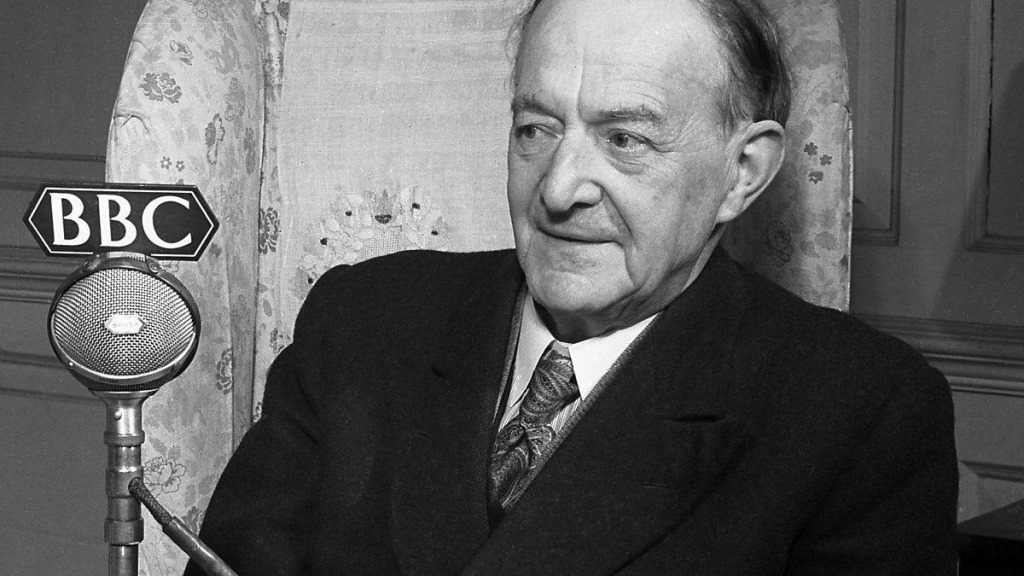
When Walter de la Mare worked the mic, he had a whole radio network to support him.
.
“The Three Friends” is dialog-centric, and in less than a day I was able to jury-rig up a three-person play out of it — but who’d be my voice-acting ensemble? It was less than 72 hours until Halloween. I’d have loved to have used Dave Moore’s voice, but my production schedule is catch-as-catch-can, and I didn’t know if I could corral him in time. My wife agreed to play the part of Lacey, the tavern keeper member of the three friends, assuming she wasn’t completely worn-out from her work and the rest of her life. Last night she stepped up to the mic and recorded that part in a quick pass. I made a logistical compromise and recorded the other two parts with my own voice, also working quickly.** By about 9 PM last night I had the dialog recorded.
Between then and about 3 PM this afternoon I worked on the audio production of the recordings, selecting a bit of instrumental music (from my last-weekend exploration of a new audio software feature) to serve as a plausible theme music for “The Parlando Project Theatre of the Air.” The 19 hours from first opening up the microphones to an audio play ready to upload weren’t all Project work: I did go to sleep after midnight, I got up at dawn and did a bicycle ride to breakfast, and early this afternoon I made another bike trip to the grocery store — but there was a lot of production work trying to meet the needs of this format that isn’t what the Project normally does. “Radio play” music production isn’t the same as recording and mixing a 3-minute song, and I had to learn how to apply my computer audio tools in a slightly different way. If you haven’t done audio production, it’s a heap of tasks even to get a half-way polished result: finding environmental sound effects, balancing levels, fixing the most egregious dialog glitches, deciding if any pauses are too long or too short, and so on. The result of this experiment is good enough to present, though I note things that I would have liked to do better.
So, what’s the story our actors are presenting for your ears today? Two friends are casually talking about a problem bedeviling one of them. That troubled man, Eaves, has been having reoccurring dreams or visions. His friend Sully tries to make light of it, but in the course of their evening they meet up with the third friend who works in a tavern, Miss Lacey. They talk over Eaves’ problem: you see Eaves thinks he has pierced the Samhain veil. Has Eaves seen, will he tell of, “the undiscovered country from whose bourn no traveler returns?”
Well, it’s de la Mare. Most writers would break out the purple pen to write such visions, de la Mare wants to make a more subtle (and human) observation. The orchestra (well, the piano trio) has started to sound. Take your seats and listen to the short, 10-minute world-premiere performance of the audio play “The Three Friends” by using the audio player below. What, has someone tall with a large hat sat in front of your audio player gadget? I provide this alternative, a highlighted link that will open a new tab with its own audio player.
.
*The Internet Archive has also taken an aggressive stance to works that are not clearly in the Public Domain. That activity is controversial and has had some legal judgements handed down for rights-holders. I won’t take your time to go into all that, but its scanned PD literary archive is a treasure for readers and researchers.
**Oh, if only I was one of those skilled voice actors who can call up entirely different vocal timbres to create distinctive sounding character voices! I tried to mitigate the lack of distinction between Eaves’ and Sully’s voices both being portrayed by mine by using stereo separation on today’s audio
Last time in our Halloween series I reported that Edgar Allan Poe had movies made from some of his poems — well, sort of. Today’s poet Walter de la Mare’s poetry, in title and under his name, wouldn’t have served for such, because so much of what de la Mare does is understated and inferred. He’s one of those poets that when read casually seems to not be doing as much as he’s actually doing. There may be no fireworks going off when you read a de la Mare poem of the supernatural— until after reading it once and remembering the poem later, you may sense the flash-bang-backs of what’s there and evoked.
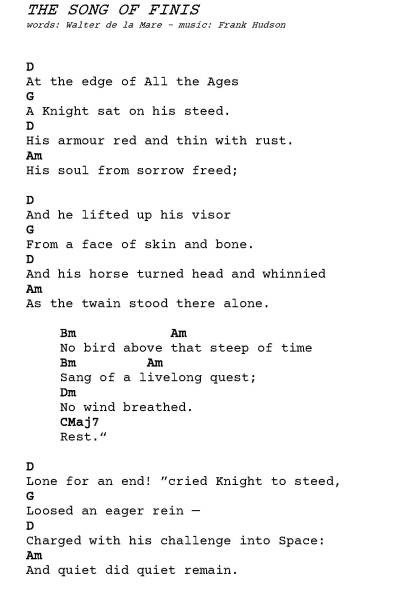
Today’s Walter de la Mare piece “The Song of Finis” is an example. It seems simple enough to be children’s poetry, and indeed his publisher bound selections of de la Mare’s more whimsical short poems to market them as children’s books. “The Song of Finis” presents an eerie short scene and situation, supplying only the barest of details still rich in specificity, and wraps it all in some fine word-music that urged me to make a song of this proclaimed song.
I present these chord sheets so that you can sing these songs yourself.
.
We have a knight, but one out of his time, yet still errant. The once shining armor is rusted.* When he lifts his helmet visor, we see yet “skin and bone,” a choice that lets us imagine a gaunt face suggesting the skull beneath. He’s alone somewhere warm and windless (warm enough to summon the tea-time image of steeping).
There are but two lonely sounds of dialog recorded. His horse whinnies knowing something’s up, and the knight calls out “Lone for an end!” The latter is a bit poetic-dictiony, but I’ll allow it to depict the out-of-time knight, and I suspect de la Mare wants us to hear “lone” as double-sounding for “long.”
What happens in the poem’s conclusion? Does the knight and horse charge off some cliff to end his anachronism? Or is he challenging that empty place he finds himself in with that single cry that has no answer? My thought, it’s sort of both, the song of “Finis” is about endless endings, and the desire for one last adventure.
In de la Mare’s poem there are no angels
.
You can hear my song setting of Walter de la Mare’s “The Song of Finis” with the audio player gadget below. It’s not finis is you can’t see that audio player, as I supply this highlighted link that will open a new tab with its own audio player. Not finis for me either this year, for my plans are to return soon with at least one more de la Mare fantasy piece before this Halloween charges into memory.
*As a fan of the 20th century Rock group Procul Harum, I wondered if the band’s lyricist Keith Reid read de la Mare’s poem once and remembered it in his song “Conquistador.”
Let’s continue our series of fantasy and supernatural poems with a musical performance of a poem by Edgar Allan Poe — a poet that might be expected to appear in any such series. Before we go to that poem and my performance, let me take a quick jaunt back to my mid-century youth.
Poe sat in a unusual place in literature back then (and probably still does now). His writing, including his poetry, remained in circulation. Unlike Longfellow, it wasn’t likely because it was deemed worthy lessons for young people — Poe’s writing kept its place for its gothic sensation into the 20th century. Without Poe or his sensibility, would there have been then a Vampira, EC horror comics, pedantic pulp detectives, Lovecraftian horror, a great deal of Heavy Metal lyrical content, or a post mid-life movie career for Vincent Price? And that’s not even broaching the topic of Poe’s influence on the French Symbolists, who took elements of his strange and abnormal on an emigration journey from the asylum to the academy.
For a year or so around middle school age, I went on a Poe jag, reading a great many of his stories in collections that also included his poetry. It was a short-lived enthusiasm, and I’m not sure what remains of it. Did I start there with my love for an unreliable narrator? Was the on-the-spectrum “Aha” moment attractive to me neurologically anyway before this reading? Since I can’t say, let’s get on with an example of Poe being the inevitable poet that a Halloween series calls forth when the boundary-line between the dead and the living becomes permeable.
The scenery about the ghosts in “The Haunted Palace” is something of a poetic trope. Poetry loves a ruin, and poets being the unacknowledged back-benchers in the world of political power, there’s a draw to poems about the death of kings — and so we have poets writing “Ozymandias” or “Jade Flower Palace.”
Poe though is drawn almost entirely to the sensuousness of the decay here. There’s no lesson about unwise or tyrannical rulers in the poem. There’s no tragedy — if we can even guess the kingdom’s tragic flaw it might be that it was all too beautiful.* On one hand I find the poem a hallow poem of hollowness — but intended by the author or not, that hollowness is a statement about great kingdoms and their lovely riches. And the ending’s invocation of always escaping — and therefore not escaping — unsmiling ghosts of hideous laughter completes the poem with a powerful rhetorical burst.
Take a sideways jump to the genius of SCTV
.
Perhaps because of the simple harmonic structure of my musical setting, I worked some hours unproductively this week on additional musical decoration. I made two attempts at twin bowed-string lead lines for this, and abandoned both those ruins to our mutual benefit. After that wrong turn, I decided that the piece’s feature is more its swaying, understated groove which I left to stand for its value. Mid-century ghosts visiting this music are welcome to do The Frug or The Jerk while listening, but those on any side of the Samhain borders can visit “The Haunted Palace” with the audio player gadget below. Has such a gadget disappeared within a fetid mist? Oh, no matter, you can hear it with this highlighted link then, as that will open a pale-doored new tab with its own audio player.
.
*Poe wrote that the death of beauty was the ultimate poetic theme — the gothic manifesto in short. I’d note in that an undercurrent there that many (most) artists feel: that they create all their beauties, only for them to become abandoned ruins with rare and uncommon audiences. As Frank O’Hara’s fraternal twin brother Count Floyd said: Pretty scary, huh, boys and girls!
As our Halloween series continues, let me advocate today for an element of the fantastical: the goblin. Some fantasy creatures are, by definition, not fully alive: your vampires, zombies, golem, all animated undead meat; your ghosts “spirited” in some way, but incorporeal. The goblin, like all the variations in the fairy realm, seems akin to the human, but not in the beautified, glammed-up way that many fairies are depicted; and also, like the human, goblins seem subject to motivations and whims, not driven by some designed in need.
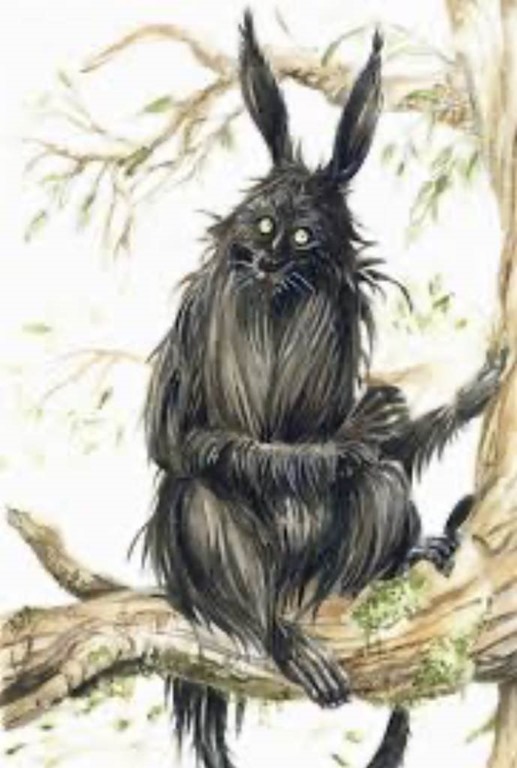
Puca is a goblin name of uncertain etymology, and specifics of their appearance and nature are like the word’s origin, broad-ranging. That non-specific appearance is baked into many accounts: they are shapeshifters. Some accounts link them to taking on animal forms: rabbits, red-eyed horses, and so on.* Today’s puca is related in a poem by Irish poet Joseph Campbell.** While Campbell is attuned to shapeshifters, his puca doesn’t change species or form in his poem: he starts and remains a hairy creature of the forest, human-enough to mirror human behavior, which becomes the signal incident in the poem.
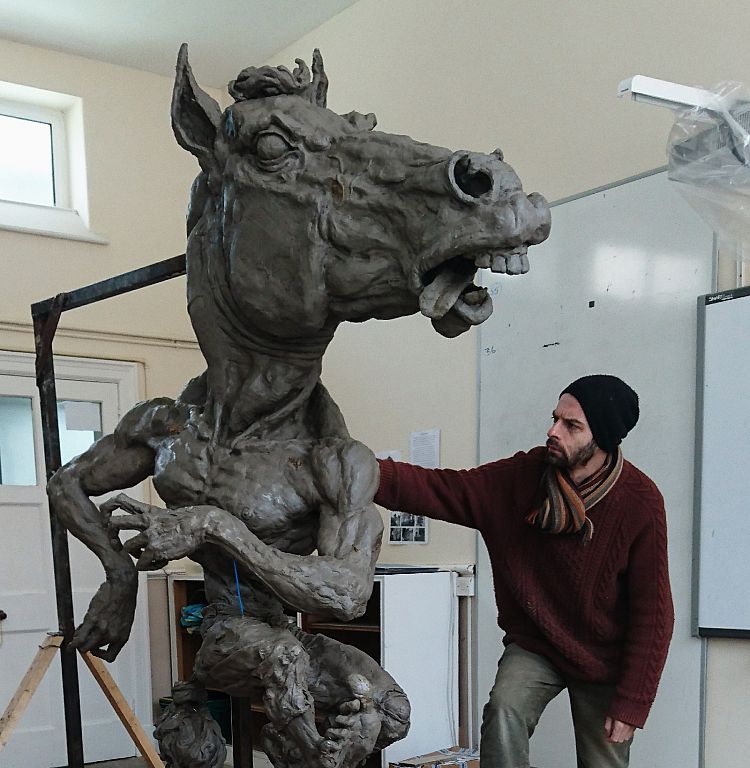
Shapes of pucas. I don’t know the artists for the two on the sides, but the sculptor in the middle is Aidian Harte and his mid-transformation depiction caused a commotion in the Irish town it was to be displayed in.
.
If goblins are unpredictable, portrayed as helpful and troublesome, this puca does in a way transform. In my reading of the poem, I sensed it describes something of a turn-about: rather than a human encountering a magical creature and then by elfin spell or trickery the human is changed, Campbell describes the opposite: a shy creature emerges, is observed laughing, dancing, poetry on his lips. And then a stanza later, his mood is sad, distressed, bitter. What causes this change?
The poem doesn’t say, but another creature, the poem’s voice is observing the puca. Let us assume he’s human, even that he may be the poet himself. The unhappy puca is said to have become “the double of distress.” Does “double” just mean equal to the happiness of the second stanza? Or does it mean the puca has taken on, mirrored, the human who has revealed that he envies the puca’s “sunny mood” in the happy verse before?
The poem ends by telling us this human/goblin encounter has caused the puca to retreat back into its cave, hiding itself. The puca may have been enchanted by the human’s sadness, and thus fled from the human’s thrall.
Unsaid in the poem, but I’ll ask: is the human changed by this encounter? While the puca instinctively flees the dissatisfied human, it’s the poet that’s telling us this story, and I think they’ve concisely explained that their bitterness has an effect, causing the happy fantastic to leave. Did the poet learn something from this?
I’ll add this biographic note on the author: Campbell’s involvement with the Irish Civil War that followed independence broke him. He was imprisoned, faced at least some danger of execution — and once released, he fled the Ireland whose culture had fed his art. His literary efforts tailed off sharply and the “gall and bitterness” that the puca demonstrates was Campbell’s lot in the last part of his life.
But this is a poem of Campbell’s early career, first published in 1913. Mute on the page, it set out a spell for me to set it to music. I think “The Puca” shows one of Campbell’s strengths: concision. A great many literary balladeers want to write epics. While I admire those that can vivify a 10-minute ballad in performance, I also observe that that endurance is beyond me — and Campbell, fresh from rubbing shoulders with the concise Imagists, has packed a charged moment in time into four stanzas — and if my reading is valid, more is evoked in the incident described than might be explicated in extra verses.
I tried for the eerie in the music I composed and recorded here: a certain wildness in the keyboard line’s contour and oddness in their timbre. You can hear my performance with the graphical audio player below. What? Such player has crept away into a cave or twilight glen? This highlighted link is an alternative, as it will open a new tab with its own audio player.
.
*Articles on the puca I read this month relate this creature to the Easter Bunny and the invisible friend in Harvey, generally benign creatures — but then, the red-eyed horse is said to offer rides home to the inebriated, the acceptance of which will lead to a wild, bucking, bramble-scratched ride, ending with the rider being bucked off in a field far from home. Unmentioned in the pieces I read would be the animated cartoon character of Bugs Bunny, the gender-fluid trickster that I’d see as in this tradition too.
**Obligatory footnote every time I bring Joseph Campbell up — no, not the Power of Myth guy. This Campbell is a deserving-of-more-interest writer of the turn of the century Irish cultural revival. Like many others of his generation, he was caught up in the Irish independence struggle, used Celtic folklore material, and dabbled in writing for performance (plays and song-lyrics) — but he was also connected with the Imagists and early English language poetic Modernism that emerged in London before WWI.
Is today’s piece the Parlando Project’s surrender to the Internet’s pervasive cat fancies? No, this is a very serious piece of cultural distribution — and it’s Halloween fans, that grave and gothic lot, that we’re serving with content this month.
I do fresh translations into English as part of this Project semi-regularly. Translations bring benefits, important ones that would fulfill that serious…cultural claim. Since poetry exists in nearly every society* no matter the language spoken, translation allows us to casually absorb more outlooks as readers. And as proud as English speakers can be about the home-team’s innings in verse, a great many poets have taken tactics, forms, and inspiration from writers that wrote in other languages. Adding to the corpus of translations then, is a service to readers and poets.
A couple of the poets I’ve translated here have almost nothing available online in English, a few more, little. Rilke, who wrote today’s piece in German is not such a case. He’s a favorite poet of many English-speaking readers, and has had many well-known translations. But even so, adding another Rilke translation is like adding another human perception of a piece of his writing. All translation comes with a viewpoint and a path taken by the translator to the point of translation. My viewpoint is not particularly learned. I’m not an expert in German literature, and I don’t speak German beyond a few phrases. While I happen to like my approach to writing or performing poetry (most poets get little love for their verse other than self-love, so we’d better have that regard to do the work) that’s about all I bring in qualifications to translating.
My translation approach is primarily image-centered. I want to try to absorb what the poet is seeing, and feeling and transfer that portrayal of sensation into contemporary English. I usually don’t try to convey the parallel sensation of the poems word-music in its original language, but I will give some weight to a sequence of the images as they convey the poem’s argument, the thing I call “the music of thought.” I do like there to be some English word-music in the end result, but as with my original poetry in English the images shouldn’t suffer much just to make some formal lock-step.
Which brings me to the other benefit of translating, the reason I recommend translation to every poet, to every creative-writing class: translating forces you to consider choices made by the original poet intimately, and to make subsequent English-language choices that are not dictated at origin by your desire to tell your life-story or outlook. This separation allows you to practice, in separation, the craft of poetry.**
I took on Rilke’s “Black Cat” because it seems like an apt Halloween poem — after all, it does start out with the cat being described as an apparition of mysterious supernatural powers.*** As I dug into the poem there was one mystery I didn’t solve: how much is Rilke joking with us? Is this cat a dark vision, a domestic cosmic black hole with a gravity that absorbs light? A real Rilke scholar might have a learned opinion on this, but I am not that person. The Rilke poems I know, and famous Letters to a Young Poet essays seem utterly serious — I’d say almost to a fault as weighed by my own tastes. There’s a certain kind of Rilke fan, like a certain kind of Robert Bly fan, that makes me wary of the seriousness with which they take their precepts and scriptures.
The Internet was designed so that scientists, the military, and government could exchange ideas. And cat pictures like this one I found there. Well, the cat pictures came later, but I’m sure it was in the design. Now, who’s my dark little existential vision of non-being that meets my gaze…
.
But as I translate Rilke I occasionally find images that seem to fall into slapstick. Did Rilke intend this, or is that my own path, my outlook, reflecting off the surfaces of poems? Seriousness is indispensable to slapstick after all. My favorite part of this poem is when the frustrated viewer of the black cat resorts to enraged stomping about. Last time we had a poem about the pathos of black & grey ghosts seeming to manifest in a dark house. Is this dark cat a solemn symbol of ever-so-serious human-condition dread — or an excuse to burlesque the frustration of life we cannot fully control, things we cannot perceive clearly, yet are stuck trying to figure out anyway?
This is what I came up with for today’s performance
.
It may not be what we’d wish, but as Rilke gets to his last line, I smile. We try to see in the darkness, we might try to command capricious cats, but in the end we’ll all be extinct as prehistoric insects captured in amber crystals — but at least by translating Rilke (or other poets) we can see our gaze in their gaze.
To hear my spoken word performance of my fresh translation of Rilke’s “Black Cat” you can use the audio player below. What, has a black cat crossed your screen and obscured any such audio player gadget? This highlighted link will open a new tab with its own audio player.
.
*Do historians and anthropologists know of any documented society that didn’t have a form of poetry? I’m neither — but I don’t know of one. If so, this seems a strange fact in the face of poetry’s peripheral place in modern American culture. Is poetry just an archaic skill, like how to make a stone knife or knowing which fungi are safe or sacred to eat?
**Current online language translators (Google’s seems particularly good) are generally adequate at giving you an English-language gloss to start with. For key words conveying images in a poem, online foreign language dictionaries can drill down into further insight. The translator’s job isn’t just turning some decoder ring though: the job is to find effective English language poetry to hold the poem you’re translating.
***Admitting my lack of portfolio to do so, there’s a third reason to do my own translations: I want to avoid — even for my “absolutely-no-profit” Project — taking other writer’s work that isn’t free for reuse. Rilke’s work is in the public domain in the U.S. — but this isn’t true of most English translations of it.
It’s been a busy week at the Parlando Project studio as I record more Halloween-themed songs freshly made by combining other people’s words (usually literary poetry in the public domain) with original music in differing styles. Let us go to the lab and see what’s on the slab.
Last dark-and-stormy-night-time we had a poem that started with someone at a household’s door asking to be let in. Waif or wraith? Therein lies that tale. Today we again have a piece that starts at a doorway — but the tale-teller here lets themselves in. What do they find there? Well, that’s the song.
The words I used today originated with a poem by early 20th century American writer Margaret Widdemer. While Widdemer is little remembered now, she was a successful presence in the literature of her day. And while the Parlando Project does the everlasting Greatest Hits of Poetry sometimes, I also like digging through old poetry collections and anthologies looking for overlooked poems and poets. Such “many a quaint and curious volume of forgotten lore” reading let me find Widdemer, and one thing that drew me to her was that she seemed to have absorbed some stuff from the folk-music collectors of her time — for example, this eerie poem of hers that builds on the “Lyke Wake Dirge”presented here six years ago.
One thing that folk-music tradition teaches us: the singer is free to change and adapt the song that was handed down to them. Entirely new words or new music may be applied. Verse order, much less exact wording is not sacrosanct. Instead, a good fit for the singer and the audience (these being the folk in folk-music) is the guiding force. Most composers who work in the Art-Song form are compelled to keep the text unaltered, and while I’m not of that tradition, I most often present the poet’s words as they published them for the silent page. But, for today’s piece I substantially altered Widdemer’s poem to make what I hope is a more effective song.
I started with a simple change: I created a refrain based on the initial verse of Widdemer’s original text when I found it ineffective for audience grabbing. In other revisions and additions, I sought to sharpen the “build” of the story’s details, and I excised antique words and diction that added no charm.
Musically I recorded a late-night laid-back Rock combo of two electric guitars, electric piano, bass, and drums for my resulting song. Here’s the chord sheet in case you’d like to play your own rendition. That’s also the in the folk-music tradition: the song shouldn’t belong to only one voice.
To hear the way I played and sang it you can use the audio player below. What? Has no audio player gadget materialized on your screen? This highlighted link will open a new tab with its own audio player then.
I plan to be back soon with an entirely different, more orchestral ensemble for the next piece in our 2024 Halloween series. Should I act like a YouTubber or Substack author and urge you to subscribe for this upcoming content?*
No, I’ll leave you as a free agent on that decision. This Project goes beyond non-profit — it is by design no-profit. I just love diverse music and poetry and get a kick out of exploring what’s possible. I have nothing to sell and would avoid anything that is paid by the click, because I have no makeup to be a small-businessman.** But my self-regard (or desire to promote a range of poetry) likes seeing viewers and listeners. Sharing this stuff on social media, or just telling a friend, will help keep this going.
.
*The Parlando Project started as a short-form podcast, one sans the usual blather, paid-for-promotions, and between-host jocularity — presenting instead our typically 2-5 minute musical pieces unadorned. It turns out that podcast audiences prefer one-to-two hours of gab — but if you want a break between the talkers in your podcast app, you can still subscribe to the Parlando Project on Apple Podcasts or most other popular ways to get podcasts.
I don’t believe I misunderstand those who appreciate the typical podcast format. I sometimes listen to podcasts while cleaning or fixing something with my hands. Alas, as a person who spends much of their time reading, composing, playing, recording, and mixing music, my own ears are usually occupied, and so I lack time to partake.
**I admire small-business people in general — and yes, I appreciate how hard it is for musicians, composers, and writers to make even a meagre living these days. While I work at this Project like someone with a small-business enterprise, I’m just not suited to bookkeeping, form-filling, and tax-law lane-keeping.





 Frank Hudson