This Saturday in Minnesota was marvelous. We already go a little crazy when the temps reach 50 degrees Fahrenheit – there are always folks out in shorts and short sleaves as soon at the bulb’s red rise tips over 49 degrees, but Saturday my thermometer read 79 degrees by the afternoon, and everyone that could was outside. Walkers were everywhere, and if they had dogs, they had a shared happiness. The smaller crew of hardy bicyclists I see within Winter were joined by a fresh multitude of carefree riders in summer attire coursing through the city. I myself rode to a place a block or so away from my wife’s apartment when we were courting, and there I had a double scoop of ice cream which I ate sitting on a bench outside soaking up the sun.
I’m feeling my age as more than just an additional year in 2026, but to be old or young or anywhere in-between in such a Minnesota day induces a feeling of specialness. Perhaps for the young the coming spring and summer can have an interval long enough to induce boredom, a sense of regular expectable warmth, and a dispensable ease of adventure – but to be old is to know the shortness of things.
Sunday returned to gray skies and an ordinary chilliness. Saturday seemed like a dream. Spring and Summer are still promises, more sure than many human promises in this corrupted world, but promises still.
All that dilly-dallying with ice cream delayed me completing making a song from this Edna St. Vincent Millay sonnet. Earlier this month I was saying Millay wrote complex love poems. Well, she wrote complex Spring poems too. The sonnet I was working with is one of the Spring ones, but like her apostrophe poem from earlier this month speaking to mankind, this time it’s an apostrophe to the season. It’s an intimate dialog with elements of greetings to Spring, but as that season arrives, the poem tells us it also knows it will depart.
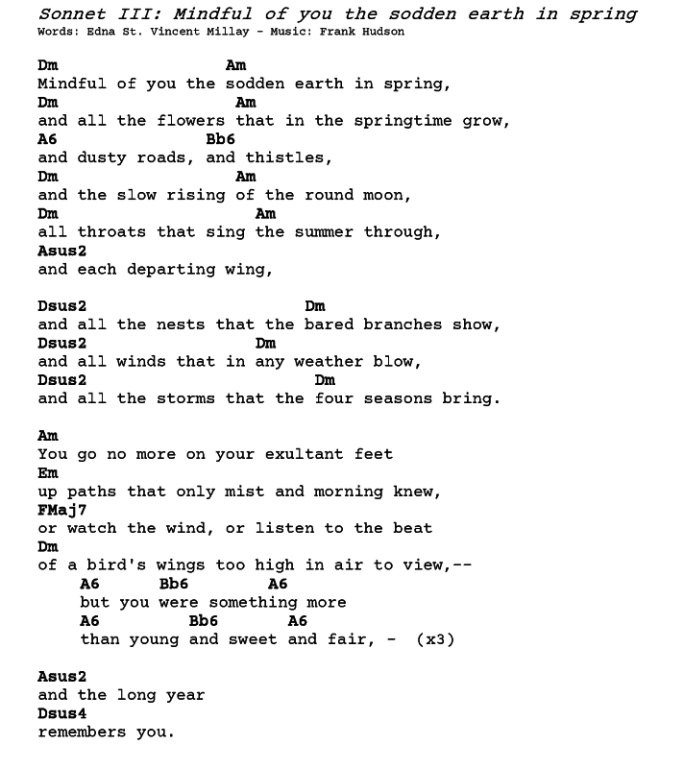
I’ve found that Millay’s poems often improve with performance. While not exactly a slam poet with planned-in applause lines, Millay’s language (even with its touch of archaic poetic diction) has a pleasing sound, and near rhyme and rhyme add a sensuous chime to the lines. It really is one of those poems that ask to be sung. That said, I found myself modifying Millay’s line breaks as I set it to music. The chord sheet version I provide today can be compared to this link of the printed text to see how I adapted it. I also added a refrain again.
Some less common chords in this one, but I offer these chord sheets in hopes that other singers will try these songs out.
.
One last thing developed from the poem as I did this work: the poem, ostensibly addressing Spring, may be speaking also to the passing youth of the poet, and the line I chose to refrain is repeated to bring forward that which I felt on that extraordinary warm Saturday when I performed Millay’s poem, that we can cherish (and be considered) being more than young and sweet and fair. We all live as promises.
To hear that performance of Millay’s sonnet you can use the audio player gadget below. No audio player seen? That throat isn’t gone on departed wing, it’s just some ways of reading this blog suppress showing it, and so I also offerthis highlighted link that will open a new tab with its own audio player.
I’m going to write about 20th century poet Langston Hughes’ pioneering Jazz poetry. I’m hoping to condense a lot, trying to make this short – but we’ll see. Like someone commencing a Jazz improvisation, I’ve got an idea – and maybe have some sight of where that idea goes – but what happens after that? That spirit, going there with maybe a first idea to see what you can develop from it, is what makes Jazz improvisation possible. Some skilled musicians, able to translate written scores into music straight off the page are terrified of that leap. Perhaps it’s because they know how to play those set-down compositions right that they’re frightened – if I must improvise, they may think, how will I know what’s right?
Langston Hughes published the words I’ll be using today in 1926 – but I must be in a hurry telling today’s story, because I’ll start in 1835, or thereabouts. Wikipedia puts “circa” next to that date, so there aren’t any attested records, but one Mary Sampson Patterson was born a free woman of color at about that date in North Carolina.
At around age 20 her Wikipedia entry says she fled for Ohio due to an attempted enslavement.* Records again are sketchy, but in Ohio she in some way studied at Oberlin College – as an Afro-American woman, this a double rarity in the first part of the 19th century. Her education trailed off in 1858 when she married Lewis Leary, a fugitive slave also from North Carolina. Leary was not just a fugitive slave, he became part of the Harper’s Ferry Raid, John Brown’s attempt to start a mass slave rebellion by attacking a military armory in Virginia. Brown attempted this with only 22 men, including Leary. Under the element of surprise, Brown’s men took over the lightly guarded armory, but a little over a day later a full military detachment under the command of Robert E. Lee easily defeated the small band. Nearly half of Brown’s raiders died in the subsequent battle – Leary being one of those – and seven more were executed afterward. Lee didn’t need to be any kind of military genius to win this battle, and whatever Brown’s beliefs, he wasn’t a great tactician either. Were they both improvising? I suppose they were.
The widow Mary married another abolitionist, Charles Langston, and they moved to Lawrence Kansas to raise a family. One of their children was Carolina “Carrie” Langston. That Carrie Langston married a James Hughes. The marriage was short-lived, though it produced a son given the first name from the mother’s family and the last name of the father’s: Langston Hughes. That was 1901 or maybe 1902 – accounts differ. Anyway, we’ve reached the 20th century.
Carrie needed to find work, and so the young Langston Hughes was largely raised by his grandmother Mary. So here you go: a Black woman, born around 1835, in the age of slavery, flees slavery’s grasp, gets at least a smattering of higher education, gives that up for a husband, then in turn gives up that husband in the fight against slavery, and in the end gets a chance to nurture a literary innovator. No one composes such a life and scores it out ahead of time.
I believe this is a photograph of the woman born Mary Sampson Patterson. The place I found it credits Yale’s Beinecke Library. Oddly enough I found two other photos claiming to be the Mary Patterson I write of above. Image search says one is another abolitionist woman from the same era. The other, of an older woman, may be Mary Jane Patterson, who was the first Afro-American woman to get a BA, coincidentally in more than the name, from Oberlin.
.
Hughes started writing poetry as a child. His first publication was as a teenage contributor to W.E.B. DuBois’s short-lived kids magazine. In the 1920’s he’s a young member of what gets called “The Harlem Renaissance.” Like his grandmother, he starts to get some higher education, but that effort is thwarted.** In 1923 he takes a job crewing on an Atlantic ocean merchant steamer.
How far is he planning ahead? Like many an improvisor, Hughes might have an idea in his head, he goes there, and he sees what happens to fit next. In 1924 he jumps ship while it’s in Rotterdam, and makes his way to Paris. One of the things he finds there: other Black folks, some of them playing Jazz, which in Paris has an added layer of exoticism. Here’s a link to a good short account of some of what Langston Hughes found there.
Hughes is an Afro-American. Jazz isn’t exotic to him, but furthermore he’s part of a smaller group (even among Afro-Americans) who are developing a deeper understanding and appreciation of that music.
Given what Jazz is in our current century – a largely select-audience concert art – I feel I have to go on another expository aside now, filled with what I have absorbed from history. In the early 1920s Jazz is viewed as fast-tempo music, suitable for dancing, drinking, and carousing. Intellectually, it’s considered thoughtless, or perhaps comic, a burlesque of real musical structure, timbres, and practice. It’s associated with criminality, intoxication, and sexual promiscuity to the degree that it isn’t just guilty of being an accomplice to vice but the cause of it: just taking in that hopped-up primitive music might drive its listeners to excess and ruin. Believing that I have a wide generational and geographic range within the readers of this Project, rough analogies to the initial cultural assessments of Rock’n’Roll and Hip Hop may be made – but I have no sure metaphor for those of you who grew up in our present century, for whom those later musical movements are history too.
Just like Rock’n’Roll and Hip Hop, Blues and Jazz are Afro-American musical forms, though both soon-enough have non-Black practitioners, and this points out something that the intelligent 1920s Afro-American young man in his 20s, Langston Hughes, is facing when he writes about his experience of Jazz. In a class or vocational level, is he going to be the college-degree middle-class artist or is he going to be a crewman on a steamer or a servant-job worker? Could he be something else beyond that dialectic? Hughes must have thought of all of this even before he took off from that freighter job, and every poem he writes may be notes and directions to himself in these matters.
I don’t know when Hughes first started to write poetry about Blues and Jazz, but some things I’ve read say that his poems about them go back to his high-school poetry – and I also don’t know when he first performed his poetry with Jazz accompaniment, though I think that music is present anyway in the word-music implied in much of his early poetry – but this was unsure ground to stand on in the 1920s.*** The novelty of a genteel high art like literary poetry speaking with appreciation about Jazz had some controversial power, but cultural gatekeepers, including some of the nascent Black critics, considered the music embarrassing and detrimental. Concert music, particularly Afro-American Spirituals, overtly concerned with the Abrahamic Godhead and Biblical stories (even if metaphor for temporal, earthly liberty and respect) were a competing, easily praiseworthy art that elevated the race. Meanwhile, Jazz, including the way it was adopted by some white listeners and practitioners in the 1920s, reeked of black-face minstrel shows, with white folks playing Black folks playing the fool.
So, once more I’ve taken the long way around, but here’s the 22-year-old Langston Hughes, an Afro-American poet and college dropout, so-recently raised by a Black woman who intimately knew the serious costs of seeking freedom and respect, with $9 in capital equity in pocket, who’s jumped ship from his job, and is in Paris, a capital of European Culture – and he finds, of all things, a Jazz band. Here’s a link to the text of his resulting “Jazz Band in a Parisian Cabaret” if you’d like to read along.
There’d be a temptation in this for a long poem of internal monolog, or some mighty external manifesto. A great poem might be written thusly, stuffed with much of what I’ve taken your time to discuss today. Instead, Hughes wrote this sly, shorter poem, one that assumes you know this history, assumes you know it in the same way that some other poet assumes you know Ovid or the Trojan War – and goddammit, if you are an American you should know it! Hughes little poem is made up of contrasting voices, a floating democracy of understandings and misunderstandings, breathing together as Jazz plays. The diverse audience calls out, wants this music. Hughes’ voice inside this colloquy, needs it – not just to remind him of home, but to let he see that home and his culture in perspective – and so he joins the chorus of “Play that thing, Jazz band!” European high culture and wealth enjoys it – and it’s a testimony, not a detriment, to its powers that the demi-monde likes it too. Are the American millionaires (perhaps as culturally stunted as modern techbros) slumming for idle amusement, or covert in foreign secrecy allowing a forbidden release? No matter, schoolteachers, the most modest keepers of culture, find it worthwhile. And oh, this statement, summing up something that Hughes can see in this moment: “You know that tune/That laughs and cries at the same time.” Hughes reports a little babel of European languages is going on around this recognition on his part that the Jazz band knows inherently what he knows. Then Hughes’ voice speaks again in his poem, another remarkable realization about Jazz music, “You’ve got seven languages to speak in/and then some.”
This epiphany then: Afro-American art: Jazz, Blues, Hughes’ own poetry, can go over the heads of the domestic gatekeepers or the reactions of racism.
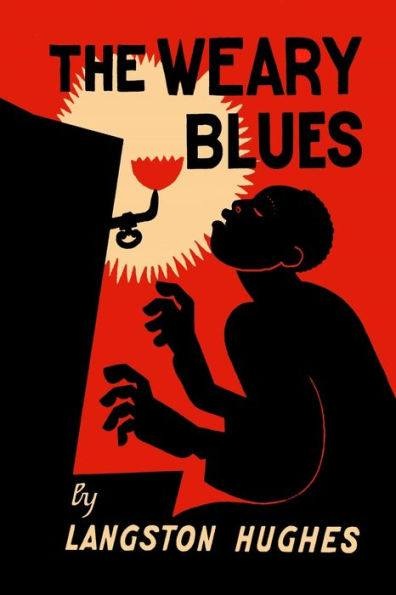
Hughes chooses to close his poem with a three-line final scene, one which a further dramatic program note might illuminate. Someone is picking up someone else for the night. No gender is lined out, and while it could be Hughes, it may also not be, or it may be Hughes constructing a metaphor.**** The person they’re attracted to is said to be from Georgia. I think that’s an important detail, because the poem’s dialog has it “Even if you do come from Georgia.” Hughes, Northern-raised, recipient of a white-privilege-level high school education and some Ivy League University is portraying this amour as an uneducated rural person. Metaphorically then, Hughes’ concludes that Jazz and Blues folk-music ancestry isn’t important compared to what it does – and by writing Jazz poetry, eventually performing Jazz poetry, that’s the choice the young Langston Hughes makes. When this poem appears in his first poetry collection, that book is going to be titled The Weary Blues – right on the cover he’s making a point of his decision on what’s worthwhile art.
.
Now that I’ve written all that, I’m left with handing off to my musical performance of Langston Hughes’ poem. I felt compelled to “make a Jazz noise here,” as one of my models once titled an album. As a composer I don’t have the theoretical training that most modern Jazz composers do, but I put something together using a characteristic Jazz harmonic cadence. Then the composer called on the inconsistent musician me to realize it and improvise the top line melody. I’ve been practicing my poor chord-comping skills a little bit lately, so I was able to portray the set of written chord changes passably. Spontaneously creating while playing the melodic guitar line was easier for me, as I’ve always been open to improvising that sort of thing. When I start something like that, when I don’t know how to play it exactly – I may have an idea, go there, and see what would fit next. You can hear the result with the audio player gadget below. Is there no visible audio player? No, your ship didn’t leave port without you, it’s just that some ways of reading this blog will suppress showing the gadget, so I offer this highlighted link that will open a new tab with its own audio player.
**Hughes and his mother were estranged from his father, who had become a company man with the Pullman Company working out of Mexico City. Langston’s father agreed to support his education as long as it was aimed at practical matters such as engineering, not the arts. Langston Hughes agreed to make a go of that, but found he couldn’t leave his literary interests. The train trip to work out this ultimately-to-fail detente produced one of the greatest poems ever written by a teenager.
***Unintendedly, I seem to have stumbled into a theme this fall: literary poetry which has absorbed folk-music forms. Folk revival acoustic-guitar-based music and electric Rock are in my page poetry just as they are more explicitly in my Parlando Project pieces using other people’s words.
****Hughes sexuality is, best as I can determine, hard to determine. Some say he was gay, others assume bi. Some who knew him well paint a somewhat asexual person, or they just say, as I do, that they don’t know.
This E. E. Cummings poem is often read as delightful. And it is. It’s also a poem some encounter in childhood. At least in my youth, it was an anthology favorite that vied with Carl Sandburg’s “Fog” as an introductory example of free verse. And no verse is ever more free than this: the letters smattered like mudprints all over the page, capital letters not yet grown, stuff smushed together. No colonnaded sonnet, no astringent exhale of meditative breath like a haiku. On your poetic menu, this is a mudpie for Spring.
Is it just this?
I set it to music. That’s what this Project does in Spring, and Fall, and Winter too. Every chord in the music I made today is a minor chord. Is this a sad poem, did I want to force it to be one? Not that simple. Just lowering the 3rd note in a scale a half-step to form a chord from it, is that really determinative? These are just sounds playing together.
But this is a considered song about Spring and the distance in half-steps from childhood, not just some neutral exhalation of it. The poem itself grew up, or blew up, over a few years. It was first submitted for a class assignment by a Harvard college student in 1916, and that version, while free verse, lined up this way.
I found this excerpt of the original version of the poem in a section on Cummings written by Michael Webster included in A Companion to Modernist Poetry published in 2014.
.
That college student would soon go overseas into a world war as an ambulance driver, and Cummings and his cohorts there took exception to simplistic war piety. I’d guess the logistics of suffering didn’t firm up the young man’s patriotism. In something I see echoed in this week’s American news, his talk was deemed an imprisonable thing to say, and Cummings was imprisoned in France. It’s one thing to write free verse, it’s another to convert the currency of one’s free thought into loss of freedom. I wonder if at this point the blood-soaked mud of WWI’s trenches were known to the young man. Anything but mud-luscious.
Cummings had enough luck or privilege to be released. In 1920 The Dial publishes a new version of that college poem. In a few years more this magazine would publish an expatriate American’s poem that indicted Spring, starting “April is the cruelest month…” But this is Cummings’ poem, and this is how it looked on The Dial’s pages.
On first publication it’s largely the poem we now know, but it doesn’t have a title. And curiously, the second instance of balloonman is “balloonMan.” Did a proofreader just get exhausted editing Cumming’s manuscript?
.
In 1923 Cummings published a poetry collection, Tulips and Chimneys. He put the still untitled poem in a section “Chansons Innocentes” (Innocent Songs). By innocent did he mean from childhood’s sensibility, or a plea of not guilty? And this is how that version went.
Nope, the balloonman to balloonMan thing must have been Cumming’s intent.
.
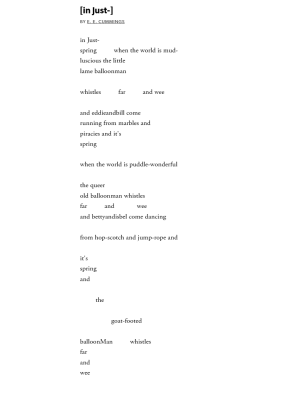
We’re near the final version, but at some later date (I’d assume a selected or collected poems publication) it converted its first line (strictly constructed) into a title with some typographical marks to make it look like Cummings was establishing Bon Iver’s song titling methods a few decades before the bard of Eau Claire. In the end, the poem that a lot of folks informally recall as “In Just Spring” is [in Just-]. I can’t help but read that title as a pun.
Here’s how the poem in it’s final form appears collected on the PoetryFoundation.org web site. “Just” is the only capitalization and man stays lowercase.
.
And now decades have past — and I, an old man, have gone to perform this poem for this year’s Spring, and I pick minor chords. Much has past us, dancing toward or running from: another world war, and current cruel wars happening somewhere further than the far distance whistle of the balloonman. Cummings’ childhood was close enough to me that I can actually recall playing marbles in the dry dirt finger-writ circle of a schoolhouse playground.* I know how a hopscotch chalk field is laid out. Do children still jump rope with rapping rhymes, and if not, what has poetry and hip-hop lost? If there’s a balloonman, his creatures are mylar and determinedly decorated no doubt. All this 20th century stuff is now as archaic as the arcadian goatfoot-god Pan who whistles like escaping air. I, and once-girls with names like Betty and Isbel, know this. Now, as I experience the poem this year there’s more distance there than there was for a twenty-something poet who wrote it. I put a distance far and wee in the music — for Cummings was of an age that he knew he was to be an adult now, while still young enough in years to know within his body’s memory the lost experience of the playing children delighted at the balloons. Balloons that would either fly away or deflate — escape/ascent vs. air loss or a pop as sharp as a bullet.
It’s the first day of spring. My chords have a third a half-step deflated. Disordered self-important dolts are running things, and I think better to have an old halt body with a bouquet of floating hearts. If the world can still seem puddle-wonderful — to be aghast is not to wonder. So, I must recall how to wonder, far and wee.
You can hear my performance of E. E. Cummings “In [Just] spring” with the graphical audio player below. Did someone let go of the string and a player is blown away? Don’t whistle, just use this highlighted link alternative that will open a new tab with its own audio player.
.
*And playing pirates without extra-faceted dice, is a lost quattro too — but I wonder if Cummings was thinking of Barrie’s Peter Pan in choosing that manner of play. I’ve just finished watching an absorbing 2022 TV documentary series called Wonderland on BBC Select that often asks over its episodes how much childhood trauma, WWI, and social injustice informed English children’s literature a hundred years ago.
A lot of the poetry I combine with music here was published around 100 years ago, making it clearly in the public domain for reuse. Given my age, some of the poetry from the Previous Twenties doesn’t seem all that old — after all, many of the poets’ lives overlapped mine — but some poets and poems look back, as I do now from my 2020s, to older styles of poetic expression, ones from an additional 100 years before the 1920s poet. That may be too much for some younger audiences I think.
Since poetry is at least partly about how something is said, it’s not out of line for style to be substantial when we choose to read or listen to poetry — but, sometimes we might choose to “translate” poetry for performance to make it more immediate.
Here’s an example. I came upon this 1922 poem by Claude McKay while looking for summer poems. I’ve presented McKay a few times already here. A figure stored away in the Tupperware container labeled The Harlem Renaissance, McKay’s poetry is still preserved and sometimes read — often the portion of his poems that speak eloquently about racism and the double alienation of being a Black Caribbean emigrant to the United States. Since these things are still factors in the 2020s, that supplies relevance to continue to consider them. A poem like his 1919 sonnet “If We Must Die,”however formal in prosody, presents clear reasons to our current ears.
But McKay is also a passionate love poet.* Now, to say the least, love is still a contemporary experience, so one might think his love poetry would also get more contemporary exposure. My casual estimate says this hasn’t happened. Yet.
Why not? This poem is significantly old-fashioned, 19th-century-like. Its sentences are poetic in an outdated style, they don’t flow casually in a spoken way. This is a style we might forgive in 19th-century verse if written back then, particularly if the poem is a Hall-of-Fame, “Poetry’s Greatest Hits,” poem — but not so much for a 20th century poet’s less honored selection.
Don’t make the mistake when reading old poetry to think that the poets must be old too. McKay was just 30 when he first published this poem.
.
This poem also makes a mistake writers can fall into. McKay seems to think that leaving a surprise for the ending will strengthen the poem — that when the reader finally sees that surprise they will be happy to have waited for the poem’s context.
There are poems that work that way.** To me, this one doesn’t. Coming upon it, one may not read through the facile but not necessarily compelling nature poem that makes up more than ¾ of the text. Therefore, in my “translation” for today’s performance, I’ve decided to create a refrain out of the poem’s final line, spoiling the surprise but urging the listener to consider the nature and weather report portions of this poem as reports of human desire and inner weather. You’ll hear how it works in the musical performance you can hear below.
Taking liberties like this is one reason I use public domain work: it’s now free for one to do with it what one wants. If you want to read McKay’s work as he intended it, here’s a link to the 1922 version. That link includes its own link to an even earlier published version by McKay, evidence that the poem’s author himself was trying to improve his poem’s impact.
Writers: if you are ever writing a surprise-ending piece, if you ever are withholding something from your reader or listener because you think it’ll be a grand or witty “Aha!” moment at the end, consider the alternative. The alternative here, the bringing out the key context that the poem’s speaker is viewing his summer night and morning “Blind with hunger for your love,” strengthens listener engagement I think, and it lets the listener see that the speaker/singer is just as attracted to the early rain-storm, sleepless-night portion of the weather, as the “miracle” of the subsequent sunny morning which is so incongruent with their present feelings. I’ve doubled down on that revision by making the newly refrained line the title too. ”Summer Morn in New Hampshire,” as McKay titled it, is too specific yet generic in my hindsight judgement.
I did my best with the musical performance of this as a song. I enjoyed playing my big, heavy, 20-plus-year-old 12-string Guild guitar and weaving in the rest of a quartet of ringing and raining instruments. It’s not a humble-brag, but a statement of the song’s potential to say that this piece would benefit from a higher-skilled singer than I am. Perhaps my voice’s approximations can be heard as bringing an imperfect human immediacy to the words? You can hear the performance with a graphic audio player below (if you see that). No player? This is a hyperlink that will open a new tab with its own audio player.
.
*Let me leave this final point to a footnote. Best as can be determined, Claude McKay’s erotic connections seem to have been with men. Given the homophobia of his time — or perhaps from artistic choice — McKay has written this poem, as he has many of his love poems, in an entirely genderless manner.
**This poem isn’t a sonnet, but it is “sonnet-ish,” and the popular English/Shakespearean sonnet conventionally expects a somewhat surprising summation in its final couplet.




 Frank Hudson