Paul Éluard’s “The Life” and behind the veil of translation

I’m starting on one of my New Year’s Resolutions early: to spend more time presenting fresh translations here. I expect a sizeable portion of them will be from French. Today’s piece, from the poet Paul Éluard, will be one example. Since there will be others, I’m going to start today with an aside about the translator’s tasks and my tactics and credentials for doing them, before we get to today’s combination of poetry and music.

I am not a native French speaker, nor do I have great facility with that language. Growing up in a little Iowa town, I had the luck to be able to take French at our small community high school, and later attempted to study it in college. French was Hobson’s choice for any foreign language classes at my small high school, but I welcomed that particular chance. In at least one previous post I’ve mentioned some of my accidental connections to the French language, but let me summarize them for newcomers. I first encountered French during my father and his brother Bill’s fishing trips to Ontario Canada, where I, a grade-school aged kid, was amazed to find the labels on many boxes and cans were bilingual, French and English. Around the same time my beloved Auntie Red, found herself and her young family stationed in France when her military husband was restationed there. Back stateside, she would amaze me by reeling off French phrases still retaining elements of her Southern US accent. That there was such a thing, an entire other language to describe the world, presumably as rich as English, seemed marvelous.

My academic career with French was none-the-less fraught – both in high school and college. Much of the work was based on getting conversational mastery, and I was terrible at it. I have something (I’ve always suspected neurological) that frustrates me with vocal mimesis. It’s likely part of the reason I struggle with singing. Helpful correction of the “no, it’s pronounced like this” kind only made me seem stupid or uncooperative, because my second and further attempts would still be way off in trying to make the right mouth sounds. Though my academic career was eventually stunted anyway, I sometimes wonder what might have happened if I had lucked into a class based on silently reading and appreciating literature in another language.

But that wasn’t on offer, or affordable, to me. So, in my 20s, largely out of school, I started to translate French poetry. This was a laborious process. I would page through a French to English dictionary for all but the most common words. I still retained a smattering of knowledge of French syntactical and grammar practices back then, and putting the two together I was able to produce a handful of translations. One that survived from this work was my translation of Paul Éluard’s “L’Amoureuse”  which was presented here some years back.

My activity then, and my activity now, might occasion questions, ones I don’t know that I have a good answer for. Should I be doing this? Wouldn’t it be better if someone fluent in both English and French did any such literary translation? Isn’t the answer the that last question obvious?

My answers (then and now) would be: some of these poems don’t seem to have English translations I have access too, and even if translations exist, isn’t an attempt to do my own translation just another variant of doing one’s own “deep reading” of a poem? If for example, Helen Vendler has written an essay on what she found in a poem, does that mean I shouldn’t look at the poem myself and ask what all is in there – not because I think of myself as more learned or insightful than Vendler, but more at because I’m another human consciousness engaging with the consciousness of the poet.

What gave me such audacity, with so small a mastery of French, to do this? Well, I wanted to – enough for a stubborn young man. Now as an older man, still translating without mastery in the source language, I also tell myself that I did (and do) self-consider myself a poet, a chooser of words, focuser of images, composer of word-music. Part of the task of translation is to do the primary work of literal translation, but to produce the full pleasure to the reader of poetry, the poetic work is at least as important. Decades ago, I read that Ezra Pound used only someone else’s English glosses of Li Bai to create his landmark Cathay  collection. Eventually I became aware that Pound’s Chinese translations were not very accurate depictions of Li Bai – and since learning that as a young man I’ve sometimes “checked” translations of poems to see how varied the translator’s version may be from some literal word for word, or from other translators’ versions. I was too uncertain of my own translations to think I was doing better work, but what I read as taking liberties bothered the younger me. Are translators like Pound “cheating” by not serving the original poet faithfully? These resulting English poems (I would say of Pound’s Li Bai) were as much or more the translator’s poem as the source author’s.

But what if I publish my translations? There are what I call “guild concerns” there. In the same way that I worry that my naïve musical compositions and make-do musical skills are, in their small way, part of a flood in the musical culture that reduces the shrinking opportunities for “real musicians” and trained composers, am I doing the same for translators with better knowledge and cultural grounding? Back to Pound: his work out-shadowed other translators who knew Chinese, and I’ve featured here a contemporary of Pound, Shigeyoshi Obata, whose Li Bai translations are largely unknown.

As a guild concern for people who depend, or wish to depend, on income from their art, this can be considered an existential issue, and I wish them no harm. Yet they may think: no matter, you are  harming us. And now there’s another monster in the forest that they might view me as riding in on: computer-based artificial intelligence.

Since my early thumb-worn French-English dictionary forays, computer translations have become quite facile. An instant’s click will produce a literal gloss on one’s screen of a poem such as today’s selection. Let me stipulate to all, and to those that fear and dislike AI, these instant computer glosses are not good poetry.*   I will click for them, but I will still spend time with dictionaries. What are the various contexts of a word? Which choice in English brings the most to the poem?**

Herein lies one problem. I’m trying to read the source author’s mind, and that will bring in my own mind, experiences, and knowledge to filter that process. This part of translation is unavoidable for causing both errors and accuracy! As I’ve grown older, I now often understand those “cheaters” as other blind ones assessing the elephant of the poem. If, as Frost had it, poetry is what is lost in translation, then a translator’s job is to reclothe the poem’s bones in English poetry, using modern English poetic expression. Doing this has limits, dangers: readers may like their foreign poetry to sound, well, foreign, with an exotic awkwardness – and having ancient poets sound like your contemporaries at a local poetry reading risks unintentional humor.

So, here we go: an early poem by French Surrealist Paul Éluard, “La Vie.”   I start with a machine translation.
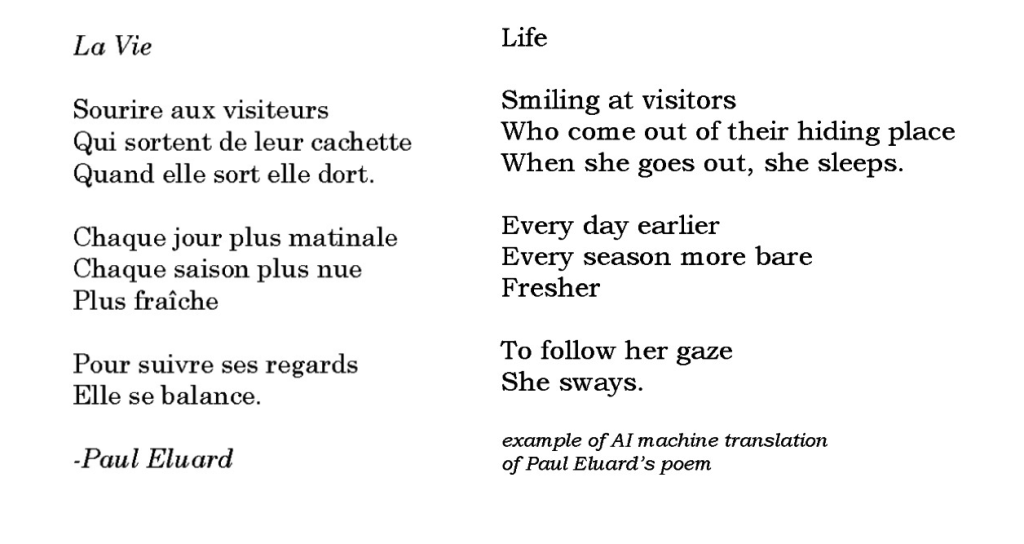
Life x2

The 1926 poem in its original French, and a computer translation

.

The syntax comes out somewhat scrambled or hard to follow. As a prime Surrealist, one that knew and went through the Dada predecessors to Surrealism, this is likely there in Éluard’s original French I think. My first questions are what are the images: what does the author want me to see, or otherwise sensually appreciate? This can be hard with Surrealist poetry or the like: they often seek strangeness or even nonsense in images. All good imagery works with some degree of mystery or novelty, anything less risks cliché. Even one of those images that you read and think “I’ve never seen it like that before, but once I’ve read this, I’ll always think of this comparison” has to surprise you, cause you to take the leap of likeness. Surrealism says you need to outright react that’s impossible or outrageous to fully free and implement the imagination. So, my primary task is difficult with Surrealist poetry – they may want to be impossible or impenetrable, yet I still try to make the images clear, and this may be subject to mistakes. It’s also possible that in psychoanalyzing the poem that I may be putting things in there that the conscious intent of the original poet didn’t intend. ***

Examining the gloss, I think Éluard is describing a woman whose consciousness is either in a dream state mimicking waking life or living her waking day informed by, or as if, in a dream state. I think the image wants that ambiguity, to have it both ways. Either way, the people and things she meets are like strangers who have been hiding and she has found them for the first time.

The Life tranlated by Frank Hudson

My translation, used in today’s short musical performance

.

I take the liberty while translating this image in giving double meanings to some words, using more than one English word to stand for a single French word. I’m doing what “rescaling” a lower resolution digital image does, I intersperse additional pixels/words to bring the image out. “Neu” is rendered “naked” and “new;” “fraiche” becomes both “cool” and “fresh.” This is a judgement call, and my choice may be wrong. In making those word choices, using a French dictionary with multiple meanings and usage examples of the word used in context remains useful. Another thought, that AI will miss, but bears considering: the author may have intended a pun or other wordplay .

The final two lines gave me a word-music chance to put a rhyme in to tie things up, what with “gaze” and “sways.” I was so pleased how that worked out that I overlooked one word, a mere possessive pronoun, “ses.” I’m enough of an idiot regarding French usage that I can’t be sure if it’s a male pronoun such as “his” or a general pronoun, a “he/her/it” equivalent. Who’s gaze is it? The woman in the poem? The poet, the male Éluard? Something else, life or imagination?

In my ignorance, and as an admitted failure of craft, I just put down “her,” because at the time I finalized my translation my focus had moved from the word-for-word elements to what is the vivid image; and I thought, this woman that Éluard is admiring in the poem, living the Surrealist outlook, is confident in her own gaze as she sways in either the intoxication of fresh experience or the artistic refinement of dancing her day forward, and so I wrote in my translation “her.” I thought the poem is about the woman – even should be about the woman in the conclusion if I was writing it – but Éluard might have chosen to end it with his gaze evaluating the woman’s experience: I’m the artist, they’re just “life.”

So unintentionally a feminist recasting of the poem? Surrealism does have a problem there: open to women as muses, yet not as open as it should have been in allowing them to be concrete artists themselves. Shades of Éluard and Breton, may I call my ignorant choice a “Freudian slip?”

Today’s music? This was a little exercise on my part using a depiction of a couple of chord progressions from a Joe Pass performance as the basis for the music. Pass was a great Jazz guitarist – but for external practicalities, once more there’s no guitar in this version at all! Dada composition! You can hear my musical performance of Paul Éluard’s “The Life”  with the audio player gadget below. No player visible? Not a mistake or slip, it’s just that some ways of reading this blog won’t translate into showing the player. If so, here’s a highlighted link that will open a new tab with an audio player.

.

*They don’t generate good literary prose either – producing as they do some estimate of the most probable word to be used, not the one chosen by another human’s consciousness that may not be the most common one-for-one. Moreover, with poetry the word-music issue is ignored by the AI translations, and poetry is musical speech. I generally don’t do rhyming accentual-syllabic translations, the cause of many an “inaccurate” translation, but I want the resulting translated poem to sound like poetry in modern English.

**These choices are a reason I highly recommend translation as training for poets. I don’t believe I undervalue topic, message, or prose-level-meaning in poetry, but many poets are stuck in finding the best combination of what they want to say with how it’s said. While I acknowledge the real issues with AI, for a monolingual, working with a literal/prose gloss of another poet lets one develop those selection-skills of the right word, right order, right connection, while one-step-away from their own experience and desired message.

***This may be proper since Andre Breton, another founding Surrealist, thought Sigmund Freud was on to something crucial with his recent theories and psychoanalysis. That Breton may be wrong about Freud or that Freud may be wrong about how the layers of consciousness and personality work only reinforces my stipulation that this outside consideration of the poet’s fellow consciousness is necessary for accuracy and errors.

Beautiful Justice

This poem by the French Surrealist poet Paul Éluard wandered into my view earlier this month, and it seems like it, and my work translating it into English, slots right in between my late wife’s poem I performed last time and this Saturday’s planned #NoKings protests planned around America.

I’ve mentioned earlier this year that in my youth I became interested in the French Modernists because I had gotten the impression that they were a key force in English-language Modernism. Later, from my work for the Parlando Project, I came to learn that this is only partially so. I wasn’t far into the Project when I realized that there was in London before WWI (at that time still the center of English-language literature) a “reverse British Invasion” going on as crucial as the 1960’s British Invasion that helped revitalized rock’n’roll music. Americans: Pound, Eliot, H.D., Frost, and even the important British Imagist theorist T. E. Hulme who had spent some expanded-sky time in Canada, were all there shaping up a make-it-new freshness. Now it’s also true that Eliot and Pound were fond of some French poets,* but as I later traced those French poets with the greater resources I could obtain this century, I found that some of those French writers were taken with Whitman and Poe.

Still, the French Symbolists, and the more internationally-sourced but eventually Paris-centered Dada and Surrealist poets were  important. Having only High School French it was hard for me to absorb a great deal of French Modernist poetry, but what I was able to find in translation, or painstakingly translate myself in the 1970s was an important influence on me.

It was soon enough that I came upon Paul Éluard then, who as far as the French were concerned, was a big deal, often rated as the greatest Surrealist poet. Well, ratings are silly – ought to remain so – but his poetry had striking imagery and was often concerned with some combination of erotic love and anti-fascist politics. In the 1970s, the first attracted me primarily, while the latter seemed a noble history lesson.

Ha ha! History, it seems, has jumped out of the past, and the anti-fascist Éluard is due for a revival – and so I welcomed seeing his poem “Bonne Justice”  appear on BlueSky in its original French. I could make out enough of it (my French is even more scant than it was in my 20s) to want to do a translation and possible performance.

bonne-justice-paul-eluard-manuscrit

I don’t know why his handwritten manuscript uses a circular format. Éluard may be trying to convey the eternal in natural law. Cynics might read “circling the drain.”  Young moderns seeing this would need to start with the translation task of reading cursive.

.

Translation moved quickly. Vocabulary issues are easily handled by computer these days, and online sources help to drill down on a word’s flavors.**   Éluard’s language here is not fancy, there are no obscure or archaic words, and he seems to me to be speaking to a general audience, not artistic theorists or avant-garde cadres. I proceeded as I normally do when translating from a literal gloss: first finding the images and what word choices will most clearly illuminate them, while giving care in preserving the “music of thought” in how the poem introduces the images and sets them off in the context of each other – though then I will take a hand at using a modern English word order and sentence structure that has some new music of sound in its new language. I rarely try to make rhyming translations. This poem’s word-music retains Éluard’s original repetitions, which I think are sufficient.

Beautiful Justice

A chord sheet presented so that others can sing this fresh song created in English from Éluard’s poem.

.

So, my “Beautiful Justice”  keeps all of Éluard’s parallels, though I made one set of considered changes, both for the benefit of myself as the performer of the result, and from my reading of Éluard’s intent. This poem seems to be speaking of qualities and situations of mankind as a whole, but he uses “hommes” (men) for this, and in another case a masculine noun for brothers (“frères”) which I rendered as “family.” I decided these gendered words were outdated conventions that would benefit from translation. Yes, I was thinking too of my late wife’s poem, “In Another Language,”  performed here last time, who in those same 1970’s was dreaming a genderless language.

It’s just a single acoustic guitar and my rough-hewn voice for this performance. If one wanted to remember this poem, now song, when marching on October 18th, it could be portable that way, though I don’t think my own performance is a stirring march – it’s more a reminiscent prayer. Prayer is focused speech. Song adds intensity of breath and music to speech. Marching and standing together, as simple as that is, adds action from our bodies (even this old man’s body). There may be more going forward that we will be called to do – who can tell with accuracy – but I think it’s not a bad start to be praying in song for those laws old/yet new, those always perfecting laws that protect us, the laws that aren’t capricious decrees to persecute and sever us.

You can hear my song in English made from Paul Éluard’s French poem with the graphical audio player below. No player? This law says you’re permitted to click on the highlighted link and it will open a new tab that will have its own audio player.

.

*Core Imagist F. S. Flint, working-class-born, but a native Londoner, worked hard to promote modern French poetry in this pre-WWI era for one.

**Though an online French dictionary I use for that had a service outage while I was working, and I began to dismay that I’d given away to charity my large old French-English dictionary volume.

Call Any Vegetable

As I promised last month, there’s going to be a few more posts here without new audio pieces, discussing some side issues and ideas I’ve run into during the last year or so of the Parlando Project. Some of these are going to be lengthier, and they may not be as interesting to those who come here just hear surprising combinations of music and words. I’m using the tag “About” on this sort of post, so that you can easily filter the audio containing posts (Podcasts) from these.

Today’s post is about what I found as I looked at Tristan Tzara’s poem “Vegetable Swallow.”

Why was I looking at Tzara poetry? I have a long-standing interest in the Surrealists, a movement that followed Dada, and with whom Tzara sometimes made common cause. And my first translation of Tzara for use in an audio piece, his elegy to proto-Surrealist Apollinaire, was unexpectedly popular here, the third most listened-to piece of last summer. So, time to look into some more Tzara I thought.

I own books that I could have searched, but they are poorly stored and arranged, and so I relied on our modern vade mecum, The Internet, to see what else might be out there to compose music with. A familiar search engine found 122,000 results for Tzara poems, but of course all is relative. One of my favorite French Surrealist poets, Paul Éluard, still obscure to many English speakers, had 222,000 results, and Carl Sandburg turned up 448,000. Emily Dickinson? 23,000,000! So Tzara’s poetry is not as widely available as some. I did not look at all 122,000 results, but of the poems I found translated into English, a handful seemed to repeat, and looking through them, I eventually thought one titled “Vegetable Swallow”  had the most potential for use along with music. Here is how it appeared on several web sites, in an unattributed English translation.

two smiles meet towards

the child-wheel of my zeal

the bloody baggage of creatures

made flesh in physical legends-lives


the nimble stags storms cloud over

rain falls under the scissors of

the dark hairdresser-furiously

swimming under the clashing arpeggios


in the machine’s sap grass

grows around with sharp eyes

here the share of our caresses

dead and departed with the waves


gives itself up to the judgment of time

parted by the meridian of hairs

non strikes in our hands

the spices of human pleasures

Why did I select “Vegetable Swallow?”  It was a good, short length. It seemed to have some musical qualities. I liked how it concluded. Some of it was incomprehensible at first take—but it’s Dada isn’t it.  This is, after all, a poet who taunted the art-world with the idea that randomly arranged words could be compared to the value of recognized literary art.

I found I had preferred my own translation of Tzara’s “The Death of Apollinaire,”  and so I aimed to do my own translation of “Vegetable Swallow”  too.

As I started work on “Vegetable Swallow,”  I first had to find it in the original French. After some searching, I found an edition of Tzara’s “Poésies Complètes”  to work from. Right from the top, at the title, I started to dissent from the English translation used elsewhere. Perhaps you read “Vegetable Swallow”  as Dada: two unrelated words jammed together for the effect of absurdity, but one could also read it in English as a compression of the phrase “Eat your vegetables,” which can be a parent’s command, or a commonplace for feeling obligated to do the unpleasant but necessary thing. But in French, swallow as a verb is not the same word as swallow the bird. Tzara used: “Hirondelle,” and as Minnesota’s own Dada bards The Trashmen once proclaimed: “The Bird is the Word.” I would have chosen “Vegetable Martin” or “Vegetable Bird” as the title, because I clearly think I’m conveying Tzara’s presentation more accurately there—even though, in this case, I’m making the title more hermetic.

The next major puzzle I have is with the second line “l’enfant—une roue de ma ferveur.” In the online text the em dash has changed to a hypen, and we are pressed to visualize a compound noun “child-wheel,” rather than to break the thought after child/l’enfant. I made a more speculative translation of roue/wheel, when I saw that the same French word is used for the gymnastic “cartwheel”. Cartwheel is a very specific, vivid image. It’s also an inside joke relating to the story that Paul Éluard met his wife when she literally cartwheeled down the street. It does the job of making a hyphenated “child-wheel” comprehensible, even if child-wheel’s presence in the Internet version may be a typographical misunderstanding.

In summary, the first stanza is two lovers together, embracing (or at least realizing/admitting) their carnal physicality.

The second stanza to me describes a rain storm above our two lovers. I can’t tell if stags are the storm clouds, or creatures caught in the storm. I chose caught in the storm. Next up I probably make my own mistake, which I’m catching only now. I translated “coiffeur” as simply hair because one of my computer translators had it as hair and I didn’t double-check that, when it now looks like “barber” or “hairdresser,” as in the Internet version, is more likely correct. I love the image of the rain falling down like hair cut by the barber’s scissors. Maybe the image works better if the focus is on the dark hair as heavy rain instead of the immaterial hairdresser, but still, I’m likely wrong on what Tzara wrote.

I make the syntax of the third stanza more English, and I make the most substantial and speculative change in the last line there. I understand “mordues” to not mean dead, as the Internet version has it. It can mean bitten as a verb or a fan/fanatic as a noun from what I find. I chose to go with the fanatic choice. And “parties” can mean part, but it can also be used for a political or other faction. From my choice of “fanatic” I could have then gone with “faction” for the French “parties,” but instead I chose the image of the swirling waves as a convention of fans or fanatics. I liked that image in as a presentation of two ardent lovers sharing caresses within the stanza, but now I’m thinking maybe I should have gone with the ideas of bitten and apart, as it would foreshadow the final stanza to a degree.

In the final stanza, I change around some syntax a bit too, but, in the next to last line, I confront a typo, repeated over and over as the other translation is duplicated on the Internet: “non strikes in our hands.” This is surely Dada! Is this a crossword-puzzle clue for baseball fans with a naughty testicular subtext (but what does Tzara know of baseball?) Or is it a cry against our complicity in the suppression of organized labor’s rights? A clumsy bowler approaching the lane, about to roll another gutter-ball? Such rich poetry!

No. It’s a missing “o.”

Here again, accessing the original French helps, though I should have distrusted one of my machine translators more in other matters after it insisted on translating “midi”, the common French term for noon, as MIDI. Perhaps it knew that I would be using MIDI to play synthesizers from my guitar and little plastic keyboard?

Fixing the typo allows the poem to close strongly. The last stanza’s first line works in either the Internet translations more active voice (though I would have chosen the stronger “surrenders” to “gives up” if I went that way). My choice is more passive: “The hours’ judgement is offered.” I think the third stanza is something of a time-lagged aubade, were the lovers have reached a time (noon instead of the traditional dawn) when they must part. The Internet version of the next-to-last line, with the typo fixed:  “noon strikes in our hands” is fine. My version, “gone noon in our hands” means to clarify what I feel is the image here, the reclining lovers atop each other, hands clasped together above their heads, like the hands of clock at noon, knowing they must part as the day reaches the border of PM (Post-Meridian); but typo fixed, the Internet version may be more accurate to what Tzara wrote. I’m afraid that by this point, I had been letting my poet half overtake my translator half, and I wanted the poem to end as well as it could by my lights, even if I was recasting what Tzara wrote to a sense of what I think he was getting at.

In the end, the Tristan Tzara poem “Vegetable Swallow”  I found on the Internet in English is less of a Dada exercise in scourging language, and more of a sensuous love poem, albeit one with fresh images. And even if you are not an expert in the foreign language being translated, checking English translations against the original is revealing. Furthermore, just as in performing the work does, doing one’s own translations helps one see deeper into the choices the poet made.

So yesterday, proud of my work, I was disparaging the unknown translator of the “Internet Version” of “Vegetable Swallow.”  Reviewing and double-checking my work after the deadlines of performance and recording were finished, his work comes off better upon further review. In the second and fourth stanzas, his work is more accurate than mine, and arguably better than mine (even if I’m doing the scoring). And with the hilarious “non strikes” typo, he’s blameless.

And from further research last night, I think I can identify the translator of the Internet version: it’s Lee Harwood. I was even able to find an audio link on the web where he reads “Vegetable Swallow.”  Even just hearing the modesty in his voice at midnight, him reading “Vegetable Swallow”  across the network as I stayed up too late tracking this down, I wished I could sit down with him and ask him more about his own work and that of Tristan Tzara. Alas, he died two years ago this summer.

Lee Harwood

Several Internet sites use Lee Harwood’s translations of Tzara, yet do not credit him.


For easy reference, here are links to the players of my translations and performances of Tristan Tzara’s “Vegetable Swallow”  and “The Death of Apollinaire.”

“Vegetable Swallow”


and “The Death of Apollinaire”

L’Amoureuse

I promise you, we will end up today very close to the love song of the last episode, though we will travel a ways before we get there.

I’ve not featured any French writers yet with the Parlando Project, but as this summer has used the words of many 20th Century English poets, we may be overdue for that, as the start of that century found some of them looking to the French for some new ways to write.

French poets started to go “modern” before the British poets, around the same time that Emily Dickinson and Walt Whitman were making their own breaks with past practice in America, so they had a head start, and their avant-garde was way past the supply lines of conventional narrative and sentiment by the time the 20th Century really got rolling.  The absurd casualties of WWI, largely fought in France and its neighboring countries, and so deadly to some of the generation of men doomed to fight in it, only accelerated the modernist direction away from the kind of meaning you might find in a political speech or battle plans.

This summer, 50 years ago, the Polish-French writer Guillaume Apollinaire coined a new word to describe a new way to approach the world in words: “Surrealism.” A few years later, his term was taken up by a group of artists who went about trying to practice a new idea, presented in 1924 as if it was a political manifesto, to write and create from:

“…The actual functioning of thought. Dictated by thought, in the absence of any control exercised by reason, exempt from any aesthetic or moral concern.”

  The Surrealists went on from there, going in various directions, becoming less an idea and more of a brand—but stop and think for a moment, that original idea, isn’t it powerful? The idea that there is a reality that we agree not to apprehend, not to speak of, that we constantly reframe our thoughts to, isn’t that idea political as well as aesthetic?
 
You take the idea of Surrealism, add music to it, and later that century you get Bob Dylan. You take the idea of Surrealism, apply it to the current reality, and you are woke, not from the dream, but to the dream that should not be denied.

Today’s piece uses the words of one of the French Surrealists, Paul Éluard. Éluard, like many of the British poets of this era, was another veteran of WWI. One story of his war service was that, since he was a writer, his military superiors assigned him to the office tasked with writing the official letters to the relatives of the casualties, and such was the efficiency of modern war that he sometimes needed to write 150 of them a day. After a year of this, he asked to be sent to the frontline trenches.

Alphaville Capital of Pain book

Jean-Luc Godard’s film “Alphaville.”  “I love you” could be the ending.

 
I have exposed you several times this month to pieces about the horrors of war and slavery, but I also told you we must travel a ways to get to today’s piece. After the war, as a founding Surrealist, Éluard produced verse with strange images and seemingly arbitrary combinations—Surrealist tactics to break the conventions—but his great subject, against the night, pain, and suffering, was love. Perhaps after those 150-letters-a-day forced march, he too wanted to look to war’s opposite.

Paul Eluard and Gala 2

Paul Éluard and the beloved, Gala. Eyelids not visible in this picture.

“L’Amoureuse”  (The  Beloved) is one of Éluard’s most famous early works, and uses my English translation of his words. The LYL Band performance of it was recorded live several years ago. To hear it, use the player below.