That Summer Feeling

I could, maybe should, write about a number of things this weekend. The end of May brings Memorial Day, one of the United States’ two holidays celebrating those who served in the armed forces, the spring version being more focused on those who died in wartime duty. It also brings to mind the anniversary of the drawn-out, agonizing death of George Floyd a few blocks from where I’m writing this. I think of that little group of South Minneapolis people, ordinary citizens of my neighborhood, who witnessed it, who pleaded with the police officers to cease their officiousness. I think of the new policemen in that squad, earnestly following the lead of their trainer who’d arrived, the man with his knee on Floyd’s neck. Duty.

Duty is a small word, but one that we have two holidays to honor. We generally respect it, and in small and large ways we carry duties through our days. My wife does in her workdays what I did for a couple of decades, taking on the duty of helping the sick. In between workdays she takes on the obligations to her mother suffering from increasing Alzheimer’s in a care home.

I’ve written about all those things here. I could write at length about them here tonight. In doing so I could say I am following my obligations to humanity, to those who suffer, to those who’ve lost. We use poetry often to decorate those tasks, more often perhaps than we use the more capricious song to do so. Thus I could write, and you might view it as your duty to read that.

Instead, I’ve been filled this month with the realization that this is my teenager’s last summer as a teenager. They’ve concluded an indifferent year of post-secondary education, and now have taken their first job. As to next Fall plans: they are thinking of stopping with school, saving money from the job, and moving out. Studying seems like a duty — their work-a-day job does too, but maybe it’s a more novel duty, or at least one that has a biweekly award of a paycheck.

Music is a key to memory, particularly emotional memory to me. During these feelings this May, I came upon a performance of a song by Jonathan Richman. Richman has an utterly strange career. He’s one of those you might see called a cult artist, which means those who “get” him sometimes puzzle those who don’t, but also it means that many who read this won’t know his work at all. As a teenager Richman became something of a Velvet Underground* superfan, and his early work shows direct influence of Lou Reed’s songwriting. In the early 70s he and his band The Modern Lovers recorded more than a dozen tunes that prefigured a lot of what was to come in Punk and Indie rock a few years later, but the recordings were not issued when they were made. Then in 1976, when the first stirrings of Punk were drawing attention, they came out along with newer recordings.

Here’s complexity to that odd: the old, early 70s songs and recordings were unvarnished, and they followed Reed’s model of being emotionally honest, but their timbres and approach would be in tune with some of the vanguard of what was called Punk at that time. The newer songs were even more childlike, though no longer being written by a teenager or recent teenage time-emigrant, and the sonics were quieter, even more stripped back. As his career continued, Richman generally proceeded down that path, writing ever more childlike songs focused on everyday wonderment. If his early singing called on some of Lou Reed’s snarl and assertion, the later work took on elements of 50s Do-Wop teenage innocent sweetness.**  Richman in a sense started out before his time, had a recording career launch when his early work seemed of the moment, and then continued until the present day as a singer-songwriter presenting the impression of coming from a place that was younger and younger.

The song I heard while thinking of my teenager at the borderline, “That Summer Feeling,”  was sung by a 40 something Richman a couple of decades into that career. On Richman’s record the Do-Wop influence is apparent, backing harmonies and call and response from additional voices. Compared to the version you can hear below, there are more verses, more detail of youthful specifics. Blind to the career history I’ve summed up above, you might easily think someone about 19 or 20 recorded it, fresh with passing through that borderland.

Here’s the intuitive choice I made when I decided to quickly work up a cover of “That Summer Feeling:”  to record it more in the style of the early 70s The Modern Lovers recordings than the “mature” Jonathan Richman. If I had more time, I would have overdubbed a garage rock guitar solo at the end or maybe some combo rock’n’roll organ as those records sometimes had. Following my taste, I preferred the songs less specific but most summer-set verses.***  This musical change and the way I sang the lyrics also brings out more of the undercurrent in this song, a complexity that a casual listen to a more smoothly produced recording might let one overlook. The singer isn’t just doing a let’s remember our youth story here. He warns in slightly mutating refrains that that youth will haunt you, and then he pleads with the (presumably teenage) listener to not wait until they’re older to, what — it’s not entirely clear — somehow integrate that duty-free time’s outlook fully into oneself or it won’t just haunt you, it’ll taunt  you, and finally it will hurt  you “the rest of your life.”

Would any kid ever listen to that message? Doubtful. My fatherhood duty knows limits, even counterproductive effects, of advice. Still, I wanted to sing it anyway.

After the jumps of this Memorial Day post, I won’t make the proforma Memorial Day holiday wishes. Some will be decorating graves. Some will be thinking of how life was disregarded. Some are caring for the sick and infirm. Some will be having cookouts or taking a little vacation trip away from work. Black joy, worker’s rest, flopping down in the grass without any duty, playing or listening to music. We honor duty. Let us also honor some respite from it.


Here’s my performance of Richman’s song.

.

*As many writers do, I must reiterate the Eno quote about how only a few thousand bought the first Velvet Underground record — but that everyone who did went out and started a band. Historians have determined that the record actually had decent sales, but Richman is one of the early examples of direct VU influence. The early Modern Lovers band included folks who would go on to being in The Talking Heads and The Cars.

**The small vocal ensemble 1950 style of urban teenage music that got called Do-Wop was often written by teenagers or near teenagers — and like the Punk, Rap or Indie music that followed later, it was inexpensive and approachable to create for the kids who made it. Arch cultural critics and satirists-in-song Lou Reed and Frank Zappa both appreciated it, thought it honest in its innocence. Punk founders Patti Smith and Lenny Kaye met because Smith loved an appreciation of Do-Wop that Kaye had published. I on the other hand have vocal limitations that keep me from indulging in the style.

***I am struck by the specific the song takes in one verse where it goes from singing swimming ponds and cool lawns to a traffic stop. I don’t think Richman meant to make that an existential moment, even if our modern gun-soaked life might make it seem so now.

The Wind

Today’s piece from the two volumes of The Girls  and The Boys Book of Verse  pair is by a poet I’ve begun to revisit during the past year, Robert Louis Stevenson. Taken just as verse, Stevenson will impress the ears of adults and children alike as charming, but as I revisit his children’s poetry I’m finding additional resonances. So, let’s look very briefly at his “The Wind”  today.

The Wind

A chord sheet so you can sing this one yourself if you’d like. As you look at Stevenson’s poem here you can also participate by guessing if it was placed in the boys or the girls volume of the pair of 1920’s poetry anthologies I’ve been looking at all month. Answer below.

.

The two things the poem wants to establish about its title subject is the wind’s presence and its mysteriousness. It’s felt as a body pushing force, heard as gentle sound of fabric on grass. But its first-mover, its purpose, the meaning we are to derive from it, is expressed as unknown. The wind here is a symbol of motion. Those easily teleological or mythological might reduce this to a matter of God or gods. That might be Stevenson’s intent, and is likely some reader’s experience.

I prefer to find the poem restricted to what I see on the page, and there I find it as a poem of the growth and going  of childhood. Stevenson chimes on that elsewhere in his children’s verse.

Do children feel that, that wind of their growth, or is it so merely there  as to be unthought of? I, an old man on a bicycle this Spring, certainly think of it, wind in its expression of gusts. I huff and puff in it, mine a much weaker blowing back!

I’ve said this before but let me reiterate in this month when I’m examining a sample of the literature my parents might have experienced in childhood: a lot of good children’s literature speaks to the adult and the child with the same words, the same images — words heard, images seen, from two sides. I think that’s what Stevenson is doing here. The child will find the familiar feeling reflected on the page sensuously. The adult gets the mystery, the passingness.

In the final five days of this National Poetry Month, I’m going to try to move to completion a number of audio pieces I’ve got in various stages. The posts may come — will have to come if I do this — in rapid succession. I’m grateful for your attention, and I apologize if I will press or exceed it. The music for today’s piece is back to electric folk-rock combo mode: Telecaster guitar, drums and electric bass. You can hear my performance of Robert Louis Stevenson’s “The Wind”  with the graphical audio player gadget below. Has that gadget blown away? No, you’re just reading this blog in one of the ways that suppresses showing that. This highlighted link will open a new tab with its own audio player so that you can hear my performance. And your answer to which of the two gendered poetry anthologies this poem appeared in: girls.

.

The World Is Too Much With Us

This sonnet is one of William Wordsworth’s most well-known short poems. As can be the case with commonly known poems, I can’t remember when I first read or heard it, and so it might seem like it’s always existed, that it’s just there, ordinary in its presence. I’ve been thinking today that the poem’s familiarity hides some strangeness. Let’s look at some of that.

For National Poetry Month this year I’ve been examining poems included in a pair of 1920’s anthologies for children: The Girls and The Boys Book of Verse.  Let’s start by examining context for this poem appearing there. This is not a poem of childhood experience.*  “The World Is Too Much With Us” starts off speaking in an adult’s voice of the weariness of “getting and spending.”  I’d say that inside the pair of anthologies I’ve been looking at this month, this is more intended as a poem a parent would read to their child. Other poems in these books live and report from the world of imagination, a splendid world, which though it may also not be physically “with us” as children, exists in the same way as the thoughts and emotions of the actual world do.

The World Is Too Much With Us

Chords in case you’d like to sing this poem yourself. Another form of participation: As the two 1920s poetry anthologies were gendered, I’m asking my audience to guess if each poem I present this month was in the boys or girls volume. Answer below.

.

Do we ever think of Wordsworth’s opening phrase as odd: “The world is too much with us?” Volumes and volumes of poetry are filled with nature poetry telling, seeing, hearing, approaching tasting or smelling, the world. We expect poetry to give us that world-muchness. We’ll get to nature eventually in the second quatrain — though it may not be the nature we’d expect — but this is an example of a leading phrase that should shock or intrigue us: “What do you mean WW? I’m so busy with my adulthood I hardly see the world beyond nearsighted bills and paycheck!” Perhaps familiarity keeps us from feeling any shock at the opening.

There’s an odd idiom to finish off that first line: “late and soon.” Was this a common phrase in Wordsworth’s time, or is it just a make-rhyme? While its variation “sooner or later” is something that everyone still says, in this exact saying it seems to be making the present moment a wider aperture: saying that recently and in my next future this is the way things are — though it’s also expressing the deadlines that press our getting and spending, all that ASAP and overdue.

In reading poetry I’m immediately attracted by the musical impetus prosody brings to the words, but another part of my mind should (eventually, after the word-music has struck me first) trace the actuality of the images. The poem’s second quatrain brings the nature images, one almost conventional, the following one, extraordinary. This poem is so commonplace with us that we think little of this quatrain. “This sea that bares her bosom to the moon” may be an all-to-conventional readymade now, but Wordsworth wants us to see there an offer of vulnerability; and with the other well-worn trope of the moon’s tides, a sense that we will, even if we are “out of tune,” resonate with the pulls of nature. And then the unusual image: this nature is not a slow, predictable rising of a consonant chord. If we think we remember this poem, do we forget the “winds that will be howling at all hours” that are now enclosed inside the petals of “sleeping flowers.” This is Wordsworth’s Blakean heaven in a wildflower. I cannot say what the poem’s composer’s conscious intent was — but as a deep image, the flowers containing the plant’s reproductive features could illuminate that desire and sexuality are a riveting but unreined nature.**

And within the later specific context of this poem appearing in an anthology that might be bought by parents to read to young children, this remarkable — yet little remarked on — image may speak to the howling winds of parenthood.

So, the world of human commerce is too much with us — but nature too may be too much with us — it may rack us beyond our control. Do we overlook that Wordsworth says for everything  we are out of tune, something he writes after a quatrain on the commercial world of work and a quatrain on nature.

The sestet that concludes Wordsworth’s sonnet to my reading is not a grand summation or synthesis, some glorious wish. I read it as saying some rickety, obsolete, altogether false mythology might seem a preferable refuge from this world — its nature and  its business. Proteus and Triton there are not the speaker exalting in neo-paganism. They are “outworn,” and a thing that the poem can only see as plausibly not as bad as the elongated moment the poem has presented. In such a fancy — if bound between covers, the imagination of a childhood book of Greek myths that our anthologists might also offer — we could have powers and a way to shape the world that elude the poem. Over on a bookshelf near me is such a book from my wife’s childhood. In childhood, our imaginations, our fancies, are our superpowers. Us obsolete children, outworn, cannot call on those powers and inveigh them with this world.

I hope I brought out some of those inferences with my musical performance in a poem that is perhaps too well-known to be known today. It was rewarding to take out my nylon-string guitar to record it, the kind of guitar I started on in my 20s. You can hear my performance of “The World Is Too Much With Us”  with the audio player below. No audio player? Is it inside a sleeping flower? No, some ways of reading this blog hide it.  This highlighted link will open a new tab with its own audio player.

.

* One of Wordsworth’s best long poems, Intimations of Immortality from Recollections of Early Childhood,  is the author’s own brief supporting this division.

**Wordsworth’s romantic life and parenthood has complexities that early biographers excised, including a second family in France, a country England was at war with. One can also summarize that women helped make the poetry his name alone is on, including another famous short Wordsworth poem “I Wandered Lonely as a Cloud.”  Here’s one condensed account of Wordsworth and those matters. If you’d like to hear this Project perform his famous April daffodils poem, and read what I wrote about it, that’s linked here.

The answers to your gender quiz game today. “The World Is Too Much With Us”  appears in both the girls and the boys 1920s anthologies. Relax busy adults, no one loses points today. “I Wandered Lonely as a Cloud”  is also in both books.

Danse Russe — While William Carlos Williams dances naked

I’m taking a break today from telling some stories of discovering my own influences, and through them the possibility of this project combining words (mostly poetry) with original music. Instead, let’s return to one of this Project’s themes “Other People’s Stories.”  Today’s piece is by William Carlos Williams, and it tells a story of a morning for a 30-something young father. The mood this poem is coming from is ambiguous on the page: it could be read as joyful, even if gently self-mocking, or it could be seen as an earnest Whitmanesque celebration. Since the poems here are performed — and more so, performed in the emotional environment of music — I had to make a choice of mood. I think it’s wistful, and I took that choice largely from the short song the poem tells us the poem’s speaker sings in the midst of it.

Parenthood, particularly first parenthood, is often a very significant life event. The urge to have a child, to reproduce in the emotionless language of biology, can be partly an expression of the parents seeking to extend and duplicate themselves. The reality of the child and child-rearing, conversely, is to reign in one’s autonomous self. Depending on one’s personality and role in the household, it may mean to act as a caretaker to the helpless and needy infant, or to find much of the home’s attention is now on the newcomer. The romance of the ideal baby can be immanently real some moments, and the endless labor and new roles just as real other times.

If the mood is ambiguous, the story Williams’ “Danse Russe”  tells is told directly. It’s morning, the rest of the household is still asleep. Three others are mentioned as the sleepers: “my” wife, “the” baby, and someone named Kathleen, who has been identified biographically as a nanny the Williams’ family employed. Let’s be honest about the slight tells of the “my” and “the.” My is possessive, the isn’t. Kathleen’s named presence means there’s one other caretaker here. However privileged* we may view what was, in biographic fact, the presence of child-care, I’ll note that the speaker, the father, is plausibly then even more separated from the child. He is obligated and estranged in mixed degrees.

As the poem opens, he’s inside, physically in the household, but not with the others, and the house in his image has a sense of the outside world in morning mists and a cosmic sun. What does he do in this quiet early-morning time?

Danse Russe as AI generated 2

“To dance beneath the diamond sky, with one hand waving free.” Yes Bob ‘n’ Bill, but then the baby wakes up.**

.

He dances and sings, though one hopes it is a large house and he’s sotto voice and light on his feet. We’re told he’s naked and before a mirror. He indulges in a short Whitman’s sampler catalog of his unencumbered body,*** fully himself, able to bask in himself. Is he having a full-on Robert Bly drum circle moment here? Maybe. Let’s give Bly the poet his due here, he was often able to see a layer below the simple image — and Williams has chosen to show us this, even if we don’t know for sure why he makes this choice, and he doesn’t direct us to all his feelings, save for one, the one the dancer sings: loneliness. He concludes from the song that it’s best to be lonely, it’s his fate from birth (for being male?) From Williams’ own life I can assay he was certainly willing to be lonely, proudly stubborn in his self, but his story here, his image, is not without wistfulness mixed with self-justification. He, the poet, can help us see this. Who knows how much he, or we, can do with that knowledge? I tried to emphasize in performance that there’s a small refrained phrase in this short poem. Do you notice it when you read the text, linked here, or listen to the performance below? Three times the poem begins “If I….” What do we know of the I? What shall the I be?

Williams ends with his own “who knows?” Is he self-evidently, or by his own claim, “The happy genius of my household?” “Genius” here I think is meant in the mode of creator and progenitor, not in the IQ test sense.

I choose to think this is not a rhetorical question, that it’s truly at issue. He’s asking to cheer himself on: I’ve made the purchase of this house, I am the father of this child, I’m half the choice of its life — even if I’m also separated from this household and baby, and I feel that separation as loneliness. So many first-time parents feel in thought, bound and estranged, in all their variety of roles, partners, resources, and situations: “Am I happy?” And their best answers are “Halfway.” And then, “Shouldn’t it be all the way?” Who shall say? Well, William Carlos Williams dances and sings, and he says the distance from halfway is loneliness.

Today’s musical portion to go with Williams’ words I jokingly told my wife this morning is “shoegaze,” the genre named not just for the lack of audience eye-contact but for the number of floor-stationed effects pedals to be employed. You can hear that performance of “Danse Russe”  while waving your shirt in the air with the graphical audio player below. What, there’s no player to be seen? Now you’ve got to rebutton that shirt? No, you can use this highlighted alternative link that will open a new tab with an audio player.

.

*Live-in childcare was more common at unexceptional levels of income in the early 20th century. A substantial number of young immigrant women worked in this role.

**I slightly modified this image generated from  a text prompt using the test version of a new Adobe product, Firefly. Adobe promises that it uses only licensed art from it’s stock library to “train” the algorithm. Much controversy these days about AI, but of course poets have been using words to invoke images for some time.

***The contrast here between childbirth and breastfeeding roles and their intimate demonstration of bodily connectiveness strikes me. Did Williams intend this? I don’t know, but it’s there for me to sense. As a family physician, Williams would have certainly known intellectually of those differences.

Bicycle Spring

Let’s celebrate our arrived spring with this LYL Band performance of another Kevin FitzPatrick poem. Here’s a link to the full text of Kevin’s poem that we used — a link which also serves as a reminder that Garrison Keillor’s old Writer’s Almanac program used this poem once too.

Green vs Snow - photo by Heidi Randen

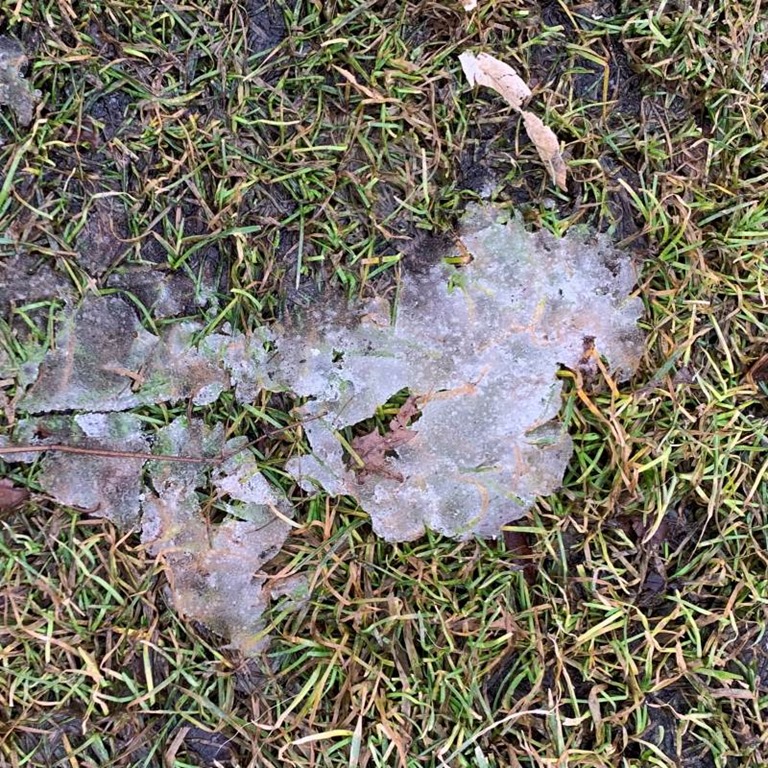
Not a satellite image of Antarctica, but a representation of how ice is fading and green emerging in Minnesota.

.

Like most all of Kevin’s poems this one yields a straightforward meaning to many readers or listeners without need of study or re-reading. As I mentioned last time, that was one of Kevin’s aims. You may also notice the care he takes with the word-music in this piece. In our little poet’s group, Kevin’s suggestions would often be metrical improvements, and isn’t the sound of this poem’s opening line: “Windy, sunny, and Sunday” a fine springboard into this spring poem!

If one expects, requires, or prefers a more allusive and elusive poetry, you could shrug at this poem on the page. The poem’s overall metaphor — that learning to ride a bicycle in childhood is representative of a parent and child’s task of independence and departure — is likely apparent before you complete the poem. Myself? I found the poem charming. I can come to like a poem that doesn’t charm me at first — but how many poems survive to be understood when we initially stand coldly next to them? Oh, some poems taunt you with mystery. Some ask you to be impressed with verbal richness. Some present unknown worlds you may choose to explore. “Bicycle Spring”  seems simple. So, is it less good, or good only for lesser pleasures and less respect?

I’ve been writing, reading, and performing poetry for decades. I suppose I should have a valuable opinion on that matter. Sorry to disappoint, but I do not. Readers often tell me that my own poems and lyrics are too obscure and mannered. I personally prize originality in outlook and images highly, even at the risk of asking my readers/listeners to drop expectations and habitual/familiar ways of understanding a piece. Is that the best way, or do I even execute that way very well?

Way back in the 20th century I was taking a seminar class with poet Michael Dennis Browne, and in talking to the group he suggested that most of us students were writing poems that were more obscure than the ones he was writing. He asked, or at least strongly implied, that we should ask if that obscurity was necessary. I now ask you — as I continue to ask myself — to ask that. One thing should be key to your analysis: obscurity may be a way to cover up bad writing, insufficient intention, and fear — yes fear — of being understood.

Kevin FitzPatrick’s poetry was one poet’s answer to those questions. He truly wanted to speak to a broad audience, and yet at his death had achieved only a small (if appreciative) one. Dave and I are trying to enlarge that audience a little bit with this series,* as well as to memorialize our feelings after the death of our colleague.

Before I leave you with Dave Moore’s performance of Kevin FitzPatrick’s poem “Bicycle Spring,”  let me point out that there are often little figures on the horizon or in the background that can add depth to the first hearing or reading of one of Kevin’s poems. In our first example this month “Blackberries,”  I should have given you a link to the Seamus Heaney poem “Blackberry Picking”  that serves as the distant core of FitzPatrick’s poem.  FitzPatrick’s “Blackberries”  is homey, humorous, even practical. Heaney’s “Blackberry Picking”  is fatalistic, mildly tragic, haunted by waste. Kevin admired one poem, wrote another, and says so in “Blackberries.”   To know the tragic and to choose the comic is a complex choice isn’t it? And in “Bicycle Spring”  the background is there too, those concluding “blocks where he/has forbidden you to walk.” The father’s job is in part to help himself disappear.

The graphical player to hear the LYL Band’s performance of FitzPatrick’s “Bicycle Spring”  is below for many. If you don’t see that, here’s a highlighted hyperlink to hear it too.

.

*Kevin’s poetry collections were published by Midwest Villages & Voices, and are not available through easily linked online booksellers or AFAIK, even directly from the publisher. “Bicycle Spring”  is in his 1987 collection Down on the Corner  which is ISBN 978-0935697025 and this information may help you get a copy via your library or local bookseller.

UPDATE: Kevin’s literary executors have now made his work more easily available for those who need to order it online. See this link to order his books that way.

from Carl Sandburg’s Lincoln: the Prairie Years

I neglected to plan ahead enough for today’s U. S. Presidents’ Day holiday. It’s an odd holiday anyway, of no great interest to the large number of readers/listeners this project has overseas. And for Americans, the title and avowed purpose of the holiday may be especially fraught in our present day.

Back when I was young, it was two holidays, celebrating two specific Presidents: George Washington’s Birthday and Abraham Lincoln’s Birthday. The first President, a leader of the American Revolution, had a cardinal virtue: he could have become the dictator of the newly independent country. That after all, is the result of many revolutions. He was one of the richest and most powerful men in the new country, full-fledged in the 1% for certain. Yes, part of his wealth consisted of enslaved men and women he owned, but these facts strangely testify to this one important fact in his character: he could have been that dictator. He could have run our country as a personal plantation. He would not.

Abraham Lincoln is another case entirely. I’m not au fait with the demographics of the early 19th century United States, but Lincoln’s family was undistinguished in wealth and fame then, and the circumstances of a rural frontier farming family in his time and place would rank his conditions with those of the world’s poorer regions today.

American poet Carl Sandburg was born less than 70 years after Lincoln, the son of a wealth-less immigrant in a rural America that was different from Lincoln’s, but much closer to Lincoln’s country life than we are today. When, in the last previous decade to be called “The Twenties,” Sandburg chose to write a biography of Abraham Lincoln, he could see those differences, smaller though they were to his eyes. And his eyes were an Imagist poet’s eyes.

This led to an unusual book,* one that was once central to Sandburg’s contemporary renown, but now is generally less well-regarded. Sandburg chose to tell the Lincoln story, as he might portray a scene in one of his poems, with a great deal of humble detail that at any moment could slip into a wider context unexpectedly. His palpable reverence for those humble details is unmistakable.

When Lincoln wrote and spoke the great American civic poem called “The Gettysburg Address”  he famously began by noting our “fathers brought forth upon this continent.” Sandburg though, in telling Lincoln’s story was not exclusively beholden to the patriarchy. And so, however late for Presidents’ Day, here’s a piece more directly about the holiday’s forerunner: Lincoln’s Birthday, as portrayed in Sandburg’s book.

I could see Sandburg, being a poet, choosing poetic methods of refrain as he tells the story of Abe’s birth, and then but a few pages later the death of Lincoln’s mother Nancy Hanks Lincoln. Each event is set in humble rural isolation, with a central image of a bed of poles and animal hides, cleated to the wall in the corner of a hand-built, dirt-floor hut. This is where Nancy Hanks first presented us Lincoln’s birth day, and also where she died nine years later.

Abe Lincoln's Birth Day

When Dell books got the paperback rights to Sandburg’s condensed version of his Lincoln book, they also made a 1956 comic book from it. The unknown artist didn’t follow Sandburg’s text accurately for the interior scenes however. The cabin drawing is based on a later reconstruction and the interior panel could be a 20th century home familiar to the 1950s reader.


Can we believe that’s an American story, much less the story of the birth of a President? It seems like a tale from somewhere else, particularly today. Oh, so much, particularly today. Like a grim fairy tale passed down from some old country. That the Lincolns’ nearest neighbors have the name “Sparrow” only adds to this effect. I decided that Sandburg’s Lincoln tale needed an invocation, a striking way to set us in readiness. My choice for that was to begin with a quote from Patti Smith’s “Birdland,”  another place where music met words to tell the tale of a child who had lost a parent. In the little section I chose here Smith—like Sandburg will at times in his tale—steps outward from the particular in her poem to the promise of an ecstatic future.

The player to hear this performance should appear below. Because I was so late in getting this piece together, the main section retains a “scratch” rhythm section track I used while constructing the piece that I’d normally replace, but I doubt it detracts much from Sandburg’s story.


*The first book, published in two volumes,  Abraham Lincoln: the Prairie Years  was followed up several years later with Abraham Lincoln: the War Years  published in four volumes. These books were in their time a success, and helped form the American cultural understanding of Lincoln in the 20th century. After another interval of years Sandburg created his own one volume condensation of these books, greatly shortening the original text. With my short deadline, it was from that later edition, the one I could get quick access to, that today’s text it extracted.