I went to one of the marker events of my year, the May Day Parade in South Minneapolis last Sunday. It’s a wonderful thing to return to, kids and neighbors dressing up and marching from Lake Street to an urban park, some putting on elaborate homemade puppet exoskeletons, others holding signs of local resistance, beating drums, playing instruments, and riding on contraptions ranging from customized bicycles to the mighty fire belching Southside Battletrain hauled upstreet by local Anarchists, a tribe of pierced and tattooed Sisyphus.
But more precious than all this exuberance was that I got to meet up with my old friend, poet, cartoonist, and musician Dave Moore and his partner. We did as we have for many years: we sat on the low concrete curb near the start of the street parade. The little curb, inches high, is a perfect seat for the lower children, the ones that would leap up near us on either side of the march as any promise of tossed candy delighted them. Dave and I are not children, far from it. Oh, very far. Our old bodies creak up and down when we stand to clap, call out, and cheer “Happy May Day!” as the parade passes by. The tumult covers the sound of our joints, our happy shouts outstay our grunts and groans.
And then there is the silent thing Dave does as our neighborhood starts to disperse back to their homes or other activities after the parade passes. Dave carries a bag of milkweed seeds to the parade each year. The bridge whose street side we’ve been sitting on spans the Greenway, a reclaimed railroad right of way that’s now a walking and biking trail. In its older, more overgrown times milkweed lined the tracks, and the hulking trains then whipped up their fluff from the dried pods — little vegetive boxcars unloading the slightest, near weightless freight of their commerce. And so after the parade, Dave takes handfuls of those seeds he’s brought, and tosses them to the present air. They rise like tiny albino angels, swirling into May skies with a job in their seeds: milkweed is the manna of the immigrant monarch butterflies who migrate from Mexico, whose children depend on it when they are infants bundled as caterpillars.
That, kind readers, is a holy moment. The noise, the quiet, the Spring, the joy of workers celebrating their day.
But there’s another chapter in this story. Someone Dave knows sees him and stops to chat. He’s happy enough with the parade of course, but his conversation is troubled. He’s a schoolteacher. Looking nearly as old as Dave and I, he’s still working as such, and he despairs. The children have no attention span, no lessons can adhere, he reports. No one realizes how tough it is now, he says, and I guess I’m an example of that, but I hope he’s partly wrong. I’m one of those dried seed pods now, I don’t know where the escaped fluff I release here lands, and that lofted randomness releases me.
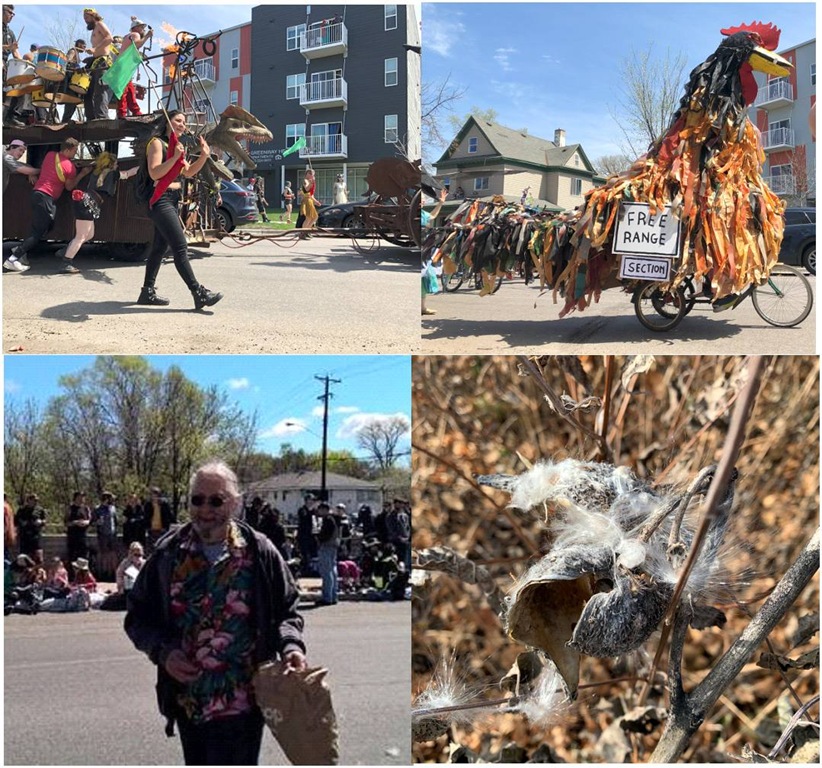
I made a choice to not take pictures this year at the May Day Parade — but here are some older pictures: part of the Southside Battletrain, a bike-powered puppet-float, Dave with his bag of milkweed, and a milkweed pod
.
I thought of this teacher and his tale alongside this poem I perform today written by the young Langston Hughes. Hughes was in his 20s when he published it, so it seems to be another of those poems about old age written surprisingly in youth. Did Hughes have a particular teacher in mind, or was he (even unknowingly) writing about an element of himself as he created this epitaph? In “Teacher” Hughes is engaging the poetic trope of the grave as a place of unending reconsideration, but as a person in their 20s he was a chrysalis where the pulpy worm may turn to wings — not a pulpy corpse under a dissolving summary. Hughes has his teacher in the poem speak as if the unvarnished holding on to virtue pinches the soul – and yet virtues are something that young people are always being told they need to develop. I don’t think such lessons are entirely wrong, but they are not the entire either. I think the star-dust that cannot penetrate the poem’s speaker is the diffuse, the random, the broad-spreading possibility. It’s a signifier of entirely unsure hope, a precious kind. Here’s a link to the text of Hughes’ poem.
You can hear my performance of Langston Hughes’ “Teacher” with the audio player below. Because I wanted a slow, long-hanging-in-the-air, timbre for the guitar here I chose to play electric guitar on this performance— appropriately my Guild Starfire guitar for this representation of star dust or milkweed fluff. No audio player to be seen? Some ways of reading this blog won’t show it, this highlighted link will germinate a new tab with its own audio player so you can hear it.
.

 Frank Hudson