Beneath the Poplars, César Vallejo’s Easter Locus Solus

As National Poetry Month continues, let me take a brief break from the personal history of Parlando inspirations to again do in the present what this Project does: explore a poem as I combine it with new music. A few weeks ago I found an early poetry collection by the Peruvian poet César Vallejo. Before looking into this collection Vallejo was just a name to me, a poet who is best known as being a favorite of other poets whose work I had read.

If I had time to write more tonight I could go into his troubled life, but I do not. Suffice to say he grew up poor in rural Peru, and by paths he traveled to Lima and studied some in Peruvian universities, but poverty and trouble with the authorities seems to have always followed him. He fled to Europe and had down-and-out adventures there, but eventually died there 85 years ago this April. In a brief interchange with another poet on Twitter this spring we agreed that from what we know Vallejo seemed to always be an expatriate, an exile — and unhappy from that. If so, unhappiness for a man, but poetry deals with diaspora often and well — perhaps because even when we are dealing with our native language, the dialect we spoke from childhood, we are seeking in poetry to find its real home. So often poets stand in the midst of other native speakers of their language and find this so.

My adventure with a poem in a foreign language forces by nature a greater travel. Even if I have another English translation, I try to find it in the original and start again with the awkward literalness of a machine translation of that. Other translators likely have smoothed over the troubles of a literal with their chosen solutions, and out of some pride and a desire to not appropriate the work of other living writers, I then try to make a vivid poem in English out of it. Besides recreating the poem’s images and music of thought* in English, I often drill down into individual words by looking at foreign language dictionaries and examples of usage to see what plausible other English words might convey the author’s intentions. Though I feel conflicted about this, the process of collaborating with a dead author engages me as if I am writing my own poem, and from that arises a danger that I may be tempted to extend the poem or add variations on the original’s theme. In this Vallejo poem, my translation has a couple of gray areas, which I’ll note for accuracy’s sake.

Here’s my translation of “Bajo Los Alamos”  into “Beneath the Poplars:”

Beneath the Poplars

Jose Garrido was another young Peruvian writer that Vallejo knew before exile.

.

A few notes on my translation. In the first line “bardos” might well be translated into poets or bards. I made an eccentric choice, “scriptores,” trying to make the image more clear and mysterious at the same time. I thought of the poplars branches swayed over in the pasture wind would be like monks hunched and copying manuscripts, and that would be consistent with a poem that I feel is about labor and respite. I believe poets labor, but as a word poet doesn’t suggest it directly enough.

The 11th line was difficult for me, and I can’t right now recall all the struggles I went through to arrive at the line in my version. Given that the poem is about an old shepherd falling asleep in autumn, a clear image of the falling leaves being like sheared wool may have attracted me more strongly than a literal line translation.

I think the 12th line describes a sunset — and while Vallejo didn’t say sky, I decided to clarify the sense of “azul” here as the blue sky, as we mean it when we say “out of the blue.”

Lastly, did you notice that this poem mentions Easter, but is set in autumn? Peru is south of the equator and April is autumn there. All those easy connections we northerners feel about Easter and spring as a resurrection metaphor fall apart in the global south.

A gorgeous poem of work and rest, and I hope my rustic music helps set the mood for it. Given Vallejo’s life it seems he’s writing here of his locus solus, his essential place that he’s exiled from. Here’s how you can hear my performance of it: there’s an audio player displayed below for many of you. No player? This highlighted link will open a new tab with an alternate audio player.

.

*I give priority to transmitting what I think are the poet’s images to our eyes through our words. The word-music, such as rhymes and meter where present, I generally take as what is unfortunately lost in translation, though I like the resulting poem to have an attractive sound in English. The “music of thought” is my own term for the order and manner of repetitions in the presentation of the poem’s substance by its images and statements. This has its own musical structure and can more easily be transferred into a different language.

Meeting Music and Words, a personal history

While continuing my observance of National Poetry Month, I must apologize for resorting to regular blogging form and writing about myself today. That sort of thing works for many, but I tend to run on a bit when I do it. It must take a long time to bore myself.

Why, when, did I decide to do the Parlando Project, this odd little idea to combine words, mostly literary poetry, with not-exactly commercial music? It wasn’t something I toddled off to grade school knowing I wanted to do. I had no great early childhood connection to poetry. I was exposed to the children’s poetry in my mid-west, mid-century tastes: Longfellow appeared, illustrated. The D. Seuss of my time then was Dr. Seuss, not Diane. My interest in music was greater, despite having no discernible musical talent or outlet. The wife of my little town’s school superintendent taught a music class, which was mostly music appreciation, little samplings from records of the orchestral repertoire. My peers found this impenetrable and boring. Since I was something of an outcast I decided to listen to what was so outré in their just-teenage world. Around the time I myself entered teenagerhood I got a gift of the mid-century handheld device, the transistor radio. I would bike around my town and outskirts with its faux leather case strap wrapped around my bicycle handle-grips, twisting the little plastic radio’s orientation with my fingers so that the stations from far-off towns aligned with its antenna. Was I listening to rock’n’roll, that mid-century strain? No. At first I was listening to an AM station that was one of the pioneers of what later became public radio, and this station programmed classical music.

Rock’n’roll was the music of those that distained that music appreciation teacher and distained me. If many then and now read the sneer or assertion in rock’n’roll as the music of when-in-the-course-of-human-events independence and freedom, I heard it as the music of those that didn’t care much for me. But I eventually relented. I wanted to look at the music the rest of the teenage world was hearing, thinking it might be a window into their interiors. Maybe it was a bit of survivor’s reconnaissance.

I found some of what the Top 40 station played interesting. This was in the era which the American pop music histories sum up as post-Elvis, pre-Beatles, describing it as dire and worthless. Were the teenagers of that Ike to Kennedy time, even if subconsciously, wanting more, wanting better? I dunno. For myself, I didn’t know any better. It was a mix of Brill Building girl groups, Black R&B, folk music/country and western* crossovers, late period crooners, and novelty records that would shame a modern TikTok sensation in their silly sensationalism.**  Unlike my peers who were closed-off to me, there were voices there speaking secrets, their moods and moments.

Want to know why the Parlando Project musical pieces are all over the map in terms of musical flavor? This is the child-is-the-father-of-the-man reason.

Poetry? I admire the knowledge and deep interests of academics, while somehow worrying that poetry is seen as having an academic requirement for reading or writing it. You didn’t need to go to school to listen to the radio. There was no MFA for the Brill Building, Motown, or Slim Harpo, at least not then. Still, I have to be honest, like many who continue to read poetry that they won’t be graded on, it was a teacher again, Terry Brennan, a recent St. John’s of Collegeville grad, who taught an English literature class in my little 100-person high school who introduced me to poetry as possibility. Did I understand poetry? Does one need to understand what one is drawn too? I don’t think so — a little mystery may even help. Much of it was beautifully inarticulate to me, phrases that said with inevitability, descriptions that were exotic, situations that I hadn’t lived, or lived in any understanding whatsoever. I loved Keats and Blake. I found out Blake was the original DIY Indie, who wrote, illustrated, engraved, and published his work, mastering what technical, logistical, and creative work was needed to realize his art. I loved a capsule description of Blake I found in the back of one of my parents’ old textbooks that they had saved. It went something like this: “He wrote early charming lyrics showing real talent, but later descended into incomprehensible writing suggestive of madness.” Writing without limits! I was ready to sign up.

On the day after Christmas, riding in a Dodge station wagon filled with my sisters and parents, rolling between Minnesota and Iowa, I wrote my first poem. I was 16. I thought it rather marvelous that I could write such a magical thing. A year later, the last Christmas I was to spend in my childhood home, I got enough money to buy a cheap record player and three LPs. These inscribed, foot-square, vinyl circles were the adult music, the things that could contain the igneous something that was starting to get called “rock.” Rock as a name seemed solid, monumental, permanent. I suppose in much of my cohort it still is — childhood transition music sticks with you. These are the three LPs I bought with the leftover money: The Doors “The Doors,”  Bob Dylan “John Wesley Harding,”  and The Rolling Stones “Their Satanic Majesties Request.”   In reverse order they imprinted me with love for Mellotron and ramshackle pretension, spare acoustic guitar arrangements and one-room songs without bridges or choruses, and poets who wanted to front a rock band that had listened to some Jazz and Blues records.

Parlando Inspiratins 1

Of those 3 LPs, maybe only the Dylan retains current esteem, yet all were considered significant in their time.  Blake & Keats? Well, it’s poetry, so the answer is complicated, particularly in the United States.

.

Music, various, and words, mostly poetry, exploring other people’s stories — yes, I can still see the damage there. While we’re not to the Parlando Project yet, this is enough for one post. Let me leave you with a Parlando Project audio piece, words from another poet recalling that era, Ethna McKeirnan’s poem of “Stones”  that seemed permanent as she moved through her life.  Player below for most, backup link for the others. McKiernan’s final new & selected collection including this poem is available here.

.

*Little known fact: C&W and folk music were often thought of as the same or aligned genres then. The 21st century Americana thing was how things were considered circa 1960 as well.

**Look up “Ahab the Arab”   for one such example. Can I call it transgressive? Can you call it cultural appropriation? Fatima has less agency in this tale than Clyde (the girl-group Brill Building songwriters might have made her the main character.)  If you’re on the borderline of acceptance, I’ll tell you that Jimmy Saville had the UK cover-version hit with this.

National Poetry Month 2023 and I introduce this Project to newcomers

In the nearing 7 years since the Parlando Project launched we’ve normally celebrated the US National Poetry Month with increased activity. This year that celebration is conflicting with some other factors which are keeping me from a focused plan for NPM. That said, one goal of the #NationalPoetryMonth activity here has been to draw new readers and listeners to what we do. So, it’s probably a good idea to let new eyeballs and ears onto what to expect if they visit our archives of over 650 audio pieces released, pieces featured and expanded on with the nearly 900 posts since we kicked things off in 2016.

You see one motto up in the header of this blog and elsewhere: “The Place Where Music and Words Meet.”   I take words — usually not my words, but words their authors likely intended as literary poetry — and combine them with various original music — music that I generally compose, and increasingly often play myself in one-man-band ways.

2023 NPM poster_800

Sometimes what we mean takes time to discover. How do we relate to something else, the differences, the things similar? That’s a metaphor. Make the metaphor musical, however you do it, and that’s poetry.

.

A few readers may figure — perhaps even a listener of a stray Parlando piece they see linked somewhere — that there’s a convention, a style I follow when I do this. I hope they’re mistaken. I’ve always intended to not do that. The people that have influenced, or unintentionally given me permission to do what I do, made music and word combinations in different ways.*  I try to use all those ways, and hope to stumble on some others. I will sing the words, but just as often chant them, talk-sing them, or resort to a freer, spoken word cadence — thus the origin of my Project’s name.

I try to keep the audio pieces short, almost always less than 5 minutes. I try to keep these blog posts shortish too, less than 1,000 words — and though I sometime fail in keeping those goals, I try to keep my failures in check. And not all the realizations of the words with my music and performance work for everyone, or most, or perhaps anyone. Some of them are even embarrassing to me, but I leave them up in our archives you can see separated into months to the right of this post.

Why do I do this? Manyfold reasons. Some of them? I like the challenge, the variety of verse, the variety of music. I think poetry is musical speech, and making even more of the musical component offers a different way to enter the words for the listener. Consider how you might enter into a song you grow close to, over listens, over time. At first it might be a phrase, riff, or refrain that catches you, or a general tone you feel, but then some new nuance may come to the fore. Or how a song you thought an abstract construction of words can from new experiences, experiences inside or outside of the song, somehow become more realized and concrete.**

This is how poetry lives, it’s the only poetry. Poetry does not live on reputations or silent copies printed, it lives inside you, a single reader or listener, as sound that may eventually saunter up closer in sense. This is what I celebrate all year, and some more so during National Poetry Month.

.

*Perhaps I’ll write more about, and thank more, those possibility creators this month? To name some of the models for Parlando: Beat poets and their immediate predecessors Rexroth and Patchen reading to music, Patti Smith, Bob Dylan, Joni Mitchell, Leonard Cohen, The Fugs, those English lute composers like Campion and Dowland, Tom Rapp, whatever William Butler Yeats planned to do with his bespoke psaltery, Rabindranath Tagore, what alternative hymnal Emily Dickinson was internalizing when she played her Homestead piano, Frank Zappa, Carl Sandburg, Langston Hughes, the American blues poets from Charlie Patton to Gil Scott Heron, Anne Sexton and her rock band, Laurie Anderson and her expansion of Ken Nordine and his “word jazz.” I’m also aware of “art song” — and appreciate both the achievements and the limitations for my purposes of that long established form of combining literary poetry with complex musical settings and melodies using orchestral instruments.

**One of the reasons I trust that you may find these experiences when the poem is carried to you inside a musical environment, and buffered there, is that I very often have had that experience composing and recording the Parlando musical pieces. I start out not sure what a lyric means or thinking I know something of what it means, only to find that there’s an entire other something or somethings there the 5th, 10th, or 20th time through it. The very act of putting the poems words into my mouth illuminates things, the exact question of how to utter them throws light from out of my dark throat.

What the Thunder Said Part 1

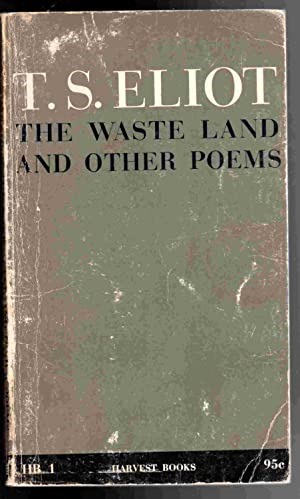
It’s April, time to celebrate U. S. National Poetry Month! We’ve had a tradition here over the past five Aprils of performing “The Waste Land”  in serial-installment fashion, and now this year we’ve come to the landmark Modernist poem’s final section: “What the Thunder Said.”

Since the Parlando Project officially launched in August 2016 it’s been a tremendous effort to lead this exploration of a variety of poetry and ways it can be performed with original music. Last year we crossed the 500th piece threshold — an incredible achievement in creative productivity that I’m often proud of. One could spend hours here just exploring the poets we’ve featured and the ways we’ve performed their work. Though I expect most listeners will enjoy only a portion of what the Parlando Project does, I’d say this month is a good opportunity to wander randomly through our archives or use the search function to see what we’ve explored.

The Waste Land paperback cover

Putting a little worn patina on The New, The Modern…

.

I am a little sad and a fair bit intimidated in reaching this section of “The Waste Land,”  the ending. It has become harder for some uninteresting reasons to keep up this project’s pace, but as I come to this April, I know I’m going to miss my annual return to the sprawling collage that is Eliot’s great poem. Though I’m hugely grateful for the ability to come this far, sadness is all around me, friends and relatives in suffering situations that I’m unable to address or help, and a sad tribunal is taking place a few blocks from where I sit and write.

I’ve always found this section of the poem a confrontation with sadness, and as it largely removes the masks and personas that have peopled the rest of the poem, I think it’s the most difficult to perform, both for audience-effectiveness and because the performer should/must confront that element inside themselves.

I’ve always found this section of the poem a confrontation with sadness, and as it largely removes the masks and personas that have peopled the rest of the poem, I think it’s the most difficult to perform…

As dysfunctional and damaged as they may have been, today’s section of “The Waste Land”  transitions us from the unreal city, its duplicitous characters, and the sweaty faces and the hubbub of “He do the police in different voices” sections, and begins to move us to the titular waste land that will be the stage on which that final confrontation with sadness will occur. Musically, I open this with an urgency as the battle is about to begin. And so, to hear my performance of the first part of “What the Thunder Said”  from “The Waste Land”  you may be able to use a player gadget below. If you don’t see the gadget, this highlighted hyperlink will alternatively play it.

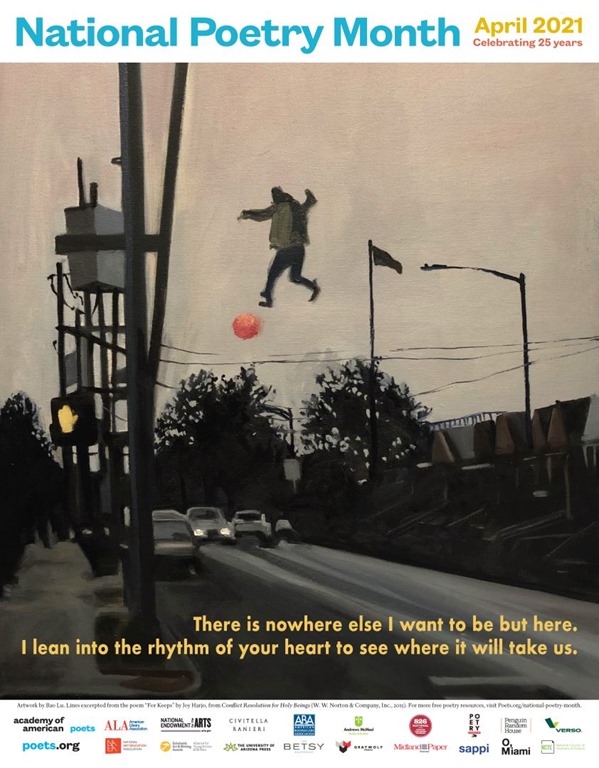
2021 NPM Poster_1080

Thank you for reading and listening. Over the rest of April, I plan on pressing on to the end of the poem, and to present as much other work here regarding the sister arts of poetry and music as I can. Click follow or come back, check out the other things here, and spread the word about this Project. Those of you who’ve done that are what keep this going.

.