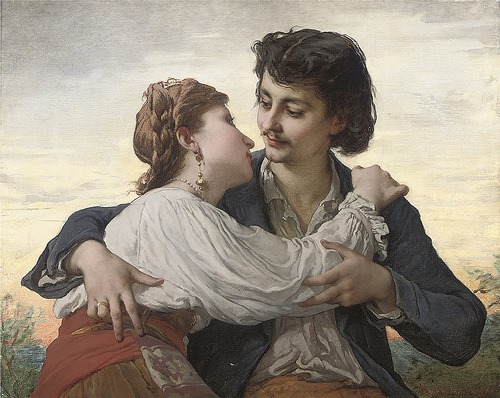
Crepuscule (I Will Wade Out)

Another short break in the Dave Moore series to present an unabashedly ecstatic poem by E. E. Cummings.

The kind of Modernist poetry we often use here rarely presents itself like this, as the early 20th Century pioneers tended to be a downbeat and skeptical lot, even before the great tribulation of the First World War. Cummings isn’t the only exception, but a poem like this is so extraordinary in its exuberance that it will always stand out.

E E Cummings self-portrait

Lipping flowers…the ecstatic poet’s self-portrait in pencil

As a page poem, “Crepuscule”  is laid out on the page in staggered lines sans punctuation, something Cummings may have picked up from Apollinaire, but the syntax isn’t as jumbled as some E. E. Cummings poems. It actually reads fairly easily once I lined-out the dismembered sentences. The images are surreal, though written before official Surrealism, and paradoxical sensations and states come one after another. Can one gather what is happening in the poem beyond the welcoming of sensation and exploration?

Crepuscule as a page poem

Cummings’ “Crepuscule” as a page-poem.

The title is “Crepuscule,”  an antique word for twilight, and so the poem is set in that proverbial border time. The poem goes on to either explore sleeplessly and fearlessly in the unknown darkness, or launch itself into the imagination of dreams, which surreally complete and supersede the “mystery of my flesh”—at night exploration, or dreams, at once, indistinguishable.

I didn’t see this until after I finished performing it, but I suspect the poem may have bookended images near the start and at the end, the twilight beginning with the swallowing of the sun, the ending with the moon setting the teeth (on edge) with the metallic bite-taste of the moon.

As sometimes happens when I compose the music for these pieces I find out or remember that others have done this before me. As soon as I saw the title I thought immediately of Thelonious Monk’s instrumental compositionCrepuscule with Nellie  and the idea was planted to use piano in my music for this. I did end up with some piano, but I reverted to guitar, my home instrument, to express the unrelenting long line of this poem that leaps into the bothness moment of twilight.

Embarrassingly, I had forgotten that Björk had performed all but the last part of Cummings’ poem as Sun in my Mouth  on her album Vespertine.  Björk brings big time sensuality to Cummings’ words, bringing out the eroticism that was always there, not just by her commitment to the performance, but by ending on and repeating the “Will I complete the mystery of my flesh” line, bringing fleshiness to the mystery. But this is a poem of the borderline, and the flesh is also hymned to complete a change to something else.

My fearless borderline tonight is presenting this music which would have difficulty reaching the level of originality of Monk or Björk. To hear my performance of E. E. Cummings’ “Crepuscule,”  leap into the ripe air by clicking on the player below or click this highlighted hyperlink to open a new tab window that’ll play it.

We Grow Accustomed to the Dark

It’s hard to escape the pull of Emily Dickinson here in the Parlando Project, and I keep finding that her poems ask for that unheard music in them to be made audible. So much is remarkable about Dickinson. She’s so original in poetic expression, and yet she’s kept a substantial audience of readers from the time of her first posthumously published collection in the late 19th Century.

Here’s yet another striking fact about her: she wrote over a thousand poems, the majority of her poetic work, roughly around the time of the American Civil War, in a burst of creativity less than a decade long. Can one even imagine what that might have been like? For this means that, on average, over twice a week a new Emily Dickinson poem, a new and unprecedented type of poetry, emerged from her pen.

Emily Dickinson's desk

Where she created a new way to write American poetry over a thousand times


She shared them somewhat, some of them anyway, with family and friends. She informally bound many of them into little booklets. But did she know what she was accomplishing? What faith drove her creativity?

Today’s words are drawn from a Dickinson poem she wrote halfway into that burst. Unlike some Dickinson poems, the “plot” of the poem is easy enough to follow, and it concludes with a moral, like a conventional poem of moral uplift might. However, like a lot of good art, the experience and meaning of it changes as you bring your own time and times to it.

“We Grow Accustomed to the Dark”  starts off in that pre-electric outdoors that we last talked about with Frost’s Stopping by a Wood on a Snowy Evening.”  On a new moon or overcast night, that old dark is darker than any we routinely experience in modern urban America. Yet, then or now, eyes indeed adjust, and make better use of what weak light may be present. Dickinson next changes the scene and speaks of “Evenings of the Brain” where even moon and starlight are extinguished. Other than Dickinson’s near, but not quite, “slant rhymes,” this is a conventional poem up to this point. But wait there’s a small warning that she’s not going to develop this conventionally. Those evenings inside the brain are a larger thing than the whole of the outdoor night.

Her next metaphor is not Victorian sentiment, but outright slapstick farce. Moving forward in the dark earnestly, the nobly brave—smack!  Faceplant themselves into a tree trunk.

This brings ambiguity to her concluding moral. Is becoming accustomed to the dark a good thing? We think we’ve adjusted. We think we’ve steeled ourselves to “Brave”—or maybe we’ve just added that outer darkness to our brain, and we agree to pretend it’s normal. “Life steps almost straight” she concludes. Somehow, at least this week, as I watch our dark world, I don’t think Dickinson intends this as a consolation.

For today’s music I tried to underscore that from the first note. I wrote this orchestral piece based around an F minor to D progression that should leave the listener unsettled from the start. I chose to experiment with this cadence after reading Alex Ross’ short piece about pioneering Afro-American composer Florence Price earlier this month. If you’re new to the Parlando Project, let me remind you that our goal is to present the words with music as varied as I can make it. If you like one kind of music that works one way, we may puzzle you with what we do in any single piece. If so, try another. We are fast approaching 200 audio pieces in our archives, so take a listen around a few of them.

To hear my performance of Dickinson’s “We Grow Accustomed to the Dark”,  use the player below. Please remember that this Project continues because listeners and readers pass the word around about it.  Mentioning us, tweeting about us, linking to us, telling a friend about us, helps grow the audience and encourages our efforts.


Two Views of a Lunar Eclipse

We seem to be in a month of sky omens in the Midwest, with the Perseids meteor shower and a solar eclipse following one after the other. Perhaps because solar eclipses are rare, poems about them are rare too. I’m going to cheat then, and present two pieces about lunar  eclipses, a slightly more common event that occurs when the Earth comes between the Moon and the Sun, blocking the moon‘s reflected shine.

I’ll lead off with one written sometime in the 19th Century: Thomas Hardy’s sonnet “At the Lunar Eclipse.”   I remember the moon-trip photos, taken near the middle of the 20th Century, looking back at Earth, where for the first time, we could see our planet whole. Hardy reminds us, a hundred years before that, that we could see our whole Earth in a shadow play during the lunar eclipse.

Whole Earth Catalog

For the first time we could see the big blue marble
…also, composting toilets!

 
Optimists at the end of the 1960s thought these whole Earth pictures would help us understand our solitary yet majestic unity and common cause. Hardy, though he had only the Earth’s shadow during an eclipse to work with, is not so sure.

The LYL Band’s performance of this Hardy poem is a live recording from a few years back and it strains to reach “bootleg tape” recording quality, but still I hope it retains some vitality.  And since this Hardy poem is referenced in the next piece, I’m going to give this rougher recording an airing.
 
Though neither I or the Parlando Project had anything to do with it, if you’d like to hear a restrained and lovely simple solo voice and piano sung setting of the same Hardy poem, you can view it here. To hear the LYL Band performing our louder version of Hardy’s “At the Lunar Eclipse” use the player just below this.

My own lunar eclipse piece is set in our century, and in my Midwestern place. I start off by musing on the same planetary shadow play that Hardy wrote of, but wondering if we were our planet, might we make sport of our standing between the sun and moon, as we did as children when the film strip broke in class, or the slide tray of vacation photos needed to be changed, by making hand shadow puppets in the light. Then, as the blood moon eclipse neared totality, and the dark was dark, save for the streetlight at the end of the block and a houselight here and there left on, every hand up and down the street raised itself to the heavens, holding their lit smartphones, as they took pictures of the moon blocked by ourselves on our planet.

2015 Blood Moon Eclipse

A blood moon eclipse. “Can immense mortality but throw so small a shade?”

Unlike our last pairing, the perennial face off between Marlowe’s Shepherd and Raleigh’s Nymph’s reply, my poem “Lunar Eclipse – The Earth in Transit between the Moon and Sun”  isn’t really an “answer song” or a diss on Hardy. In a lot of ways I wanted more to simply update the scenery of Hardy’s poem. Oh, and that title is awkward, but enough listeners didn’t know the mechanics of a lunar eclipse, that we are in the middle on the earth blocking the Moon from the Sun.

What did I mean by the last line? Well, as I sometimes do, I wanted to mean several things. I wanted to say we thought we could capture this cosmic event that had stopped our routine in with the birthday pictures on our smartphone camera roll. I wanted to say, as Hardy did, that we are seeing the whole of our planet, the lives of all our neighborhoods, yet it is only one disk in the wide sky. I wanted to say that our present, particular lives: all our details, our family, our neighborhoods, our homes—though they are the way we experience living—are but one transit of life. Maybe I wanted to say something else that even I wasn’t sure how to say? If so, I wouldn’t know. Sometimes that happens in poems.

Again, we have the LYL Band performing this piece, but it has better recording quality. To hear it, use this player just below.

She is Sleeping on the Boundaries of the Night

I said I would change things up last time, and by stepping back a few years, today’s piece does that.

How much different is “She is Sleeping on the Boundaries of the Night”  from the last few posts? First off, we’ve left off from war. This is a love poem. Death appears in it only briefly passing—so fast it passes, as it can in a poem, you might not even notice it. And rather than being a piece by another poet, the words here are mine. We live here at the Parlando Project with the idea of presenting “other people’s stories,” but I also want variety, so I’ll make the exception this time, and present part of my story.
 
One of the modernist/Imagist ideas that Ernest Hemmingway liked to use in his early stories was to leave an essential detail out of story, and then to strive to write it so well that the power of that detail would become present subliminally.

Lovers Tryst

In a classical aubade lovers are always awaking in a field and forgetting to check for contact dermatitis

“She is Sleeping on the Boundaries of the Night”  is an aubade, a traditional form of love poetry. An aubade features lovers awaking at dawn, and the poet lamenting that their night is over, so they must now part for their un-enchanted days. What do I think is different in my aubade?

Sixteen years ago, my wife died after a short and painful illness, not yet 44 years old. I cannot tell you all that means, but one thing I experienced in my grieving process was the question of where one goes from that stopped thing. After all, you are definitively stopped, you have no momentum in any direction, unlike in the normal flow of life. You can stay stopped, or move off in any direction.

I moved, and was moved, in the direction of falling in love again. There are some difficulties in that direction, knowing of love’s inescapable impermanence. Like the lover in an aubade, I knew now, deep in my soul and body, that love means that parting is intensified.

In the end, “She is Sleeping on the Boundaries of the Night”  is a love poem that hardly mentions death. I was trying to do that modernist/Imagist thing. Is death still there?

Alas, the other thing that I left out, is that other person, lying beside the speaker, stuffed with dreams no doubt with all the richness, sadness and choices of their life. My love poem fails, as some do, in that respect. Can it remain unsaid my partner chose to move, and move me, as well?

Today’s piece is musically a bit different as well—there’s an antique 20th Century beat box rhythm used for one thing. To hear the LYL Band perform “She is Sleeping on the Boundaries of the Night”  use the player gadget that should appear below.

A Summers Night

A couple of posts back we had a piece with words by Roy G. Dandridge who got called the “Paul Laurence Dunbar of Cincinnati.” Today’s episode’s words are by the Paul Laurence Dunbar of Paul Laurence Dunbar.

paul-laurence-dunbar

Paul Laurence Dunbar. Young, Gifted, and Black.

Dunbar grew up in Dayton Ohio, the Afro-American son of former slaves. In his town’s high school class of 1890, he was friends with another guy, a white guy, one who had varied enthusiasms. This other guy was a snappy dresser for his time, wearing newfangled wing-tip shoes, bowler hats, and a sporting a dashing waxed handlebar moustache. When the mandolin had a popularity boom, Dunbar’s classmate dude had to learn to play it, and he apparently drove his family around the bend as he practiced. Then later, the dude became interested in printing, and so designed and built his own printing press. He got so attached to printing and publishing that he dropped out of high school to start his own print shop with his brother. Then a couple of years later, the modern bicycle was invented, and his mechanical ability branched out to building, selling, and repairing bikes.

Dayton HS class of 1880 labeled

Dunbar with his high school class. Dunbar is in the upper left, our mystery dude in the shadows in the back.
And what’s with the guy on the left in the front row, shouldn’t he be in a band or something?

But let’s step back to that printing business. Paul Laurence Dunbar was already writing poetry as a high school student. After graduation, his family’s lack of funds and racial discrimination kept him from going to college, but he hungered to get into print. Our dandy, mandolin playing, designed-and-made-his-own-press print shop guy went into business with Dunbar and printed a newspaper that Dunbar edited and wrote for, even while Dunbar was still in high school–and then he used his connections in the business to get his classmate’s poems collected and published two years after Dunbar graduated from high school.

Dunbar’s books gathered attention. James Witcomb Riley, Frederick Douglass and William Dean Howells reviewed him favorably. By the end of the 19th century he had toured England, gotten a job with the Library of Congress, and written the lyrics for a Broadway musical and collaborated on an operetta, becoming the first widely known modern Afro-American poet before he was 30 years old. The 20th Century awaited him.

Then he contracted tuberculosis. His health declined, and though he tried to continue to build on his career, he died in 1906 at the age of 33.

He should have been one the older generation of the Harlem Renaissance of the 1920s. He could have taken his mastery of the lyrical 19th century style, and like Yeats in Ireland, transitioned seamlessly into the forms and topics of modernist poetry.  Alas, none of that was to be.
 

Dunbar’s “A Summer’s Night”  is a lovely, sensuous lyric. If one goes beyond the Victorian-drenched term “maiden” used almost as a refrain in the opening lines, and the slightly precious “perfumed bosom” of the southern breeze that closes the first half of the poem, the flitting last half that closes with carousing fireflies staggering home in the dark is just gorgeous It’s my hope that using our Parlando Project tactic of performing these words with music lets one more easily accept the sentiment of the more archaic words.
 
So, what happened to our mechanical aptitude dude, the guy who’s printing press began printing Paul Laurence Dunbar while they were High School classmates, helping launch the career of America’s first widely known modern black poet?

Wright Bike

This bike looks pretty sweet even today. Dig the mono-tube rear stay, the tri-plane front fork, and the flipped moustache bars.

Turns out bicycles were one of the seed technologies of the 20th century. Our dude knew how fabricate his own stuff, and make it strong and light. The dude was named Orville Wright and he and his brother Wilbur took the modest profits from their printing and bike businesses, and three years before Dunbar died, they designed, built and flew the first airplane. There was a lot of disbelief that a high-school dropout from a hick town could do any such thing. Pioneers like Paul Laurence Dunbar and Orville Wright had to do it,  otherwise no one would believe it.

To hear my performance of Paul Laurence Dunbar’s “A Summer’s Night”  with music, use the player below. And thanks again for liking, following, and sharing.