At the New Year

I’ve long been fond of the poetry of Kenneth Patchen — but even though an old edition of his Collected Poems has followed me about over the years, it was only today that I appreciated this poem of his. He wrote it sometime in the 1930s, but reading it this morning I felt he was speaking my thoughts as I look back from the ending of our year 2024.

Patchen’s poetic sensibility was essentially an exercise in Keats’ Negative Capability. Patchen admired human love and wrote reverently about nature and joy, but he was also disappointed and in opposition to a world manipulated by selfish and thoughtless power. He wrote some poems so sweet you might select them for a child’s bedroom wall, and others bitter in the taste of his analysis — but his life wasn’t a trajectory between those poles. Some of Patchen’s most politically radical and downbeat poems were written in his youth and some of the most hopeful pieces of bonhomie came from late in his life. And this was so despite never achieving crowning literary success, and after suffering chronic and painful health setbacks. He seems to have liked today’s poem, as it stuck with him. Looking briefly at its history tonight I see he had sent it out to be set for a choral musical performance in the 1940s,* and he printed a broadside of a slightly revised version in 1967, shortly before his death. So whatever specifics he was thinking of when he first set it down, the man himself thought it more universal. Here’s a link to the version of “At the New Year”   I found on my bookshelf.
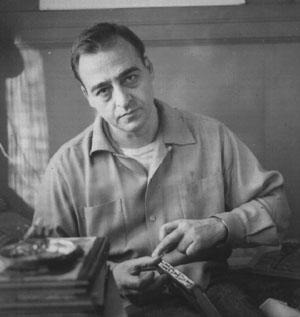
Patchen photo

Kenneth Patchen. He wrote of his times and is timeless.

.

Today I read it as if it was expressing my own thoughts this year, about this  year — not some year in the 30s, 40s, or 60s. Most any decade has wars, but the cruelty of current wars and new refugees cuts freshly. And then, my country’s last national election was heartbreaking for me. I have long held faith with Lincoln’s democratic analysis of how long how many can be fooled, but at my old age I don’t know if I will be there awaiting the arc of the universe when it bends toward justice. As Patchen moves into the second half of his poem he writes of the brave talk and the mean talk, he takes in this world as full of the good and the lovely, but also a measure of the sham and hatred. When he says as the New Year’s bells are to be rung that there are other bells that he, that I, that you and I too perhaps, would ring — well I got a little misty singing those words this afternoon.**

I had to proceed rapidly to create a realized singable version of Patchen’s poem before New Year’s Eve, and so I quickly set up a broadly repeating musical cycle for the accompaniment: VI, V, i changes in musician’s shorthand, but the VI and V sometimes go minor in the quick and dirty rush to make the cycle. Since the passage of years is cyclical and won’t wait, perhaps this accidentally makes for a fitting setting. I was lucky to get accommodation this afternoon so I could open a microphone, and I ripped through the vocal you can hear below while that musical cycle did its thing.

The audio player is below for my performance of Kenneth Patchen’s “At the New Year.”   What, has the ball dropped, the bells have rung, and there’s no player gadget on your screen? No need to stop time, just use this highlighted link.  That’ll open a new tab with its own audio player.

.

*I make a quick search to see if I could find this once-planned 1940s choral setting, but came up empty,

**The bells motif at the end of Patchen’s poem recalls Henry Wadsworth Longfellow’s holiday poem “I Heard the Bells on Christmas Day”  that I wrote about and performed a few years back. Long after Longfellow, and some years after the death of Patchen, Leonard Cohen did his own New Year’s “Anthem”  with bells that contains one of that poet’s more remembered passages: “Ring the bells that still can ring,/forget your perfect offering,/there is a crack in everything/that’s how the light gets in.” Cohen’s poem echoes Patchen’s sentiments, and Cohen’s poem and song may have been in conversation with those earlier poets’ work.

Don’t Have To (Now You’re Done)

Here’s a well-worn trope you’ll see somewhere as the year 2022 ends. Someone will write or say:

“2022 — would it ever end? Glad to see that sorry year done.”

Troubling and bad things happened this past year. I know. I’m a grateful and privileged person, but still this year has had stressful and even frightening things in my family. And if we are to look fully at our nations and the world? Distress might seem a slighting word there.

Here’s another trope, one portrayed in many a cartoon around the New Years, one old enough to be old when I was a child: an aged man with a 2022 sash around his stooped body, and a young smiling toddler just able to stand and show the New Year 2023 banner arrayed across its torso. When I was a child, even a younger adult, I always looked fondly at that baby with the New Year’s sash. What wonders, what new things will the upcoming year bring? What burdens will be set down with the expiration of the old year? Even if I didn’t know how the balance of the forthcoming year would settle with the debts of the passing one, I was looking forward, closer in age to that toddler than to that geriatric December 31st.

Now that I’m an old man, that expiring year is closer to me than that tiny child — and it’s not just years that expire or stoop with age. Since last winter, long time alternative Parlando Project voice and LYL Band-mate Dave Moore and I did our part to say goodbye to some colleagues in poetry, and we both have had some family deaths. No wonder that there’s been a good number of elegies presented by this Project lately.

I’ve had the rough tracks of today’s elegy since last spring, the best of which was a vocal track that Dave laid down as part of a session we did in memory of poet Kevin FitzPatrick. It was only this December as the year was coming to a close that I found an idea of what to do with Dave’s song. His words in “Don’t Have To”  are all about the routine troubles, tasks, and stresses of life mixed with the aspirations we poets dream to grasp. Kevin, who wrote about work and labor, and who labored and worked at his writing, had all of that.

Don't Have Too

This was Dave Moore’s own corrected manuscript I worked from to complete today’s piece.

.

It struck me that this is a great life-lot of things, a glorious jumble — Kevin’s poetry that I was privileged to experience, the care and responsibility that his family, friends, colleagues, and clients were sheltered by. If the First Noble Truth of the Buddha is that life is dukkha sacca,*  then noticing a cessation of dukkha  is apprehending the punching out of the timeclock of a lifetime too. Might it be worthwhile for us on New Year’s Eve to notice, or even thank, the aged 2022 of our families, friends, colleagues, and ourselves for their labors however strained and imperfect they were? When we, like the year 2022, are gone, others will take up that imperfect and sometimes thwarted work.

That thought arose as I took Dave’s vocals from last spring and using the modern tools of audio editing, I sped up their tempo to increase urgency. For music I started with a rollicking piano part which I triggered on my little plastic keyboard but made sound impossibly knuckle-busting by invoking an arpeggiator that kept the sixteenth notes flying. After establishing that tempo, I had to give my fingers a workout on the bass to lay down a bass track, and frankly I was running to catch up the whole length of the song. I added a little vibraphone and guitar to add some visiting outside timbres to the dominant piano and that completed the unusual elegy “Don’t Have To (Now You’re Done)”  you can hear with the player below. Don’t see any player? This highlighted link is an alternative way to hear it.

.

*A complicated term to translate, though the simple translation of “life is suffering” is common. Properly, it includes the sense of stress, unease, and dissatisfaction as well.

The Darkling Thrush

My teenaged son is proud of his mastery of modern youth slang and enjoys the idea that his parents and their generations will have no idea what such terms mean. This is of course part of the utility of language: it not only binds people together, it keeps them apart.*

No matter, new times and new experiences enjoy making fresh and untarnished words to describe them. Words must have their pleasures, even when we don’t quite understand everything someone is saying. Take Thomas Hardy, a man who wrote what may be one of the last poems written in the 19th Century, after he had spent 61 years in it. Published on or around New Year’s Eve in 1900, today’s piece is “The Darkling Thrush.”  In Hardy’s poem, as an old man looks at the changing of a year and century, we have the reverse of my son’s joy: old words from an old man.

Thomas Hardy Moustache wax abuser
Careful with the moustache wax Tom, you’ll put someone’s eye out!


“Darkling”, “coppice”, “spectre”, “bine-stems”, “lyres”, “outleant”, “illimited”—we meet the first one in the title, the second five words in, the third at ten words. Even if I was to quiz educated Americans, I doubt most could define the majority of these words, and I’m unsure how much better modern British residents would do.**

Coppicing is a European method of managing tree growth, in which mature trees are cut off to allow fresh shoots to continually propagate. Spectre is more known now as a trademark applied to laptops and James Bond bad-guys, but is an English word for a spirit or ghost. Bines are not vines to the knowledgeable horticulturist (bines twist their main stem around things to tangle and climb, vines use special parts of branches to hitch themselves up). Lyres are not supporters of disreputable political movements, but a stringed harp. Illimited is just another, rarer, form of the word unlimited, and I think Hardy may have chosen it because it starts with a sick word, ill, but also puns on illuminated. The titled adjective, darkling is a handy way to say it’s occurring in the dark. Although it’s a little-used word, like illimited, the sound of it brings to mind something else, the smallness of the title bird, as in duckling,  and darkling’s sound also lets us see dusk rather than deep night, when we can still see the winter thicket Hardy sets his poem in.

But outleant is the real mystery word. A short web search finds no online dictionary definitions, no examples of its use other than in Hardy’s poem. A simple deconstruction of the word’s parts would make it, inverted, saying “leaning out.” And that’s what it probably means. There’s textural evidence as it ties back to the poem’s second word, “leant upon the gate” to the coppice. Yet, did Hardy intend to infer two other close words in this word’s sound? Out-lent, a sense that the haunted and dreary winter scene of the poem is owned by the old, dying century and is lent out only to the present? Depending on pronunciation of the printed word’s “ea,” it could conceivably be pronounced out-lent (and Hardy does rhyme it with “lament.”) Does he also want us to hear a closeness to outlearnt, and that the old century’s corpus of belief has been superseded (by newer scientific discoveries?) That would be consistent with Hardy’s beliefs.

Perhaps this is my weakness as a reader, translator, performer and poet myself. If I sense an image is possible, I want to see it, hear it, perform it. Bare winter bines twisted around a copse of brush wood as a corpse leaning out of a coffin may be grisly, but it’s not to me a strong image.*** Even if it’s abstract, the second sense, that of this bare and haunted landscape being the cemetery plot owned by the old century of which we are only visiting seems stronger. For others, the sense that new knowledge has killed off the old beliefs (outlearnt) could be a choice. I can’t know that Hardy intended this ambiguity by choosing this unusual word outleant, but I, the reader, put it there.

The title calls attention to the central image, yet another messenger bird in British poetry, to go with the nightingales and skylarks of Keats and Shelley, poets of Hardy’s now dying century. I like that Hardy lets us see the bird, and it’s frail, gaunt, and -ling tiny, and that we can see feathers fluffed to best insulate its frame, which the wind is disputing.

So, there was Hardy, around New Year’s Eve, using his old and odd words at the end of an old century. For us, Hardy’s oncoming one (the 20th century) has now closed itself. Will things get better or worse in our new year? Something in us wants to foretell at every ending—yet even looking backwards, we have trouble making a simple better or worse judgement. Here, the battered bird, the darkling thrush, says better. Hardy says he knows he doesn’t know.

He knows he doesn’t know is the realist’s version of hope.

Anyway, one of the joys of combining poetry with music is that you don’t have to take a test on the words to enjoy the piece. My pompatus of a performance of Thomas Hardy’s “The Darkling Thrush”  is available with the player below.


*Right now he’s very generous in this however. He wants me to know these words so I won’t be left out.

**Before looking them up, I knew spectre and lyres for sure and I was fairly sure about darkling as an adverb, then taken to adjective. I had ideas (some from context) on the others—and in the case of coppice, my ideas were wrong. My son knew spectre and lyres and defined darkling as “a creature of the night” for which I’ll give half-credit. In the case of bines, I told him I learned how bines were different from vines, and he told me “Sure they are! Vines are 7 second videos.” (That last was a joke on his part.) My wife, a fine word-smith, also got 2.5 (“Bines, it that like a wood-bine?” got half-credit as understanding was there, even if a good dictionary definition it wasn’t.)

***Saplings and bines and “sharp landscape” would indicate a skeletal image is intended, but bare bones are not particularly scary or intense compared to rot and decomposition, much less animated brains-hungry undead. Hardy doesn’t mean scary so much as long-dead I guess. Interestingly, Hardy had a direct graveyard experience to draw on here.