Meeting Ourselves

The month’s name January is derived from Janus, the Roman god of gateways and change, conventionally portrayed as a being with two faces: one looking forward, one backwards. And we have a new year, a place to do that – although this New Year’s Eve, someone revived a quote ascribed to a telegram sent by Dorothy Parker to Robert Benchley on New Year’s Eve 1929: “You come right over here and explain why they are having another year.”

A Roman bust of Janus. You know one of the tough things about having a beard? Trying to trim it symmetrically in a mirror. Now imagine Janus trying to do this.

.

I have a musical piece today, one using words by an unusual Modernist, Vachel Lindsay who published this poem in 1929. Though the poem mentions footprints in the rain, when I read it, I immediately thought of walking or riding my bike in the snows of Minnesota. In the up and back of those trips, often taken in the early morning, I’m conscious of the fresh tracks I’m putting down in the snow – that they are marks of me being there, moving, while I think of this act. On the return leg, I sometimes get the notion to look for my tracks from earlier in the morning. Looking down, I can never find the exact pattern of my treads – more falling snow, or wind, or others tires and feet have obscured them.
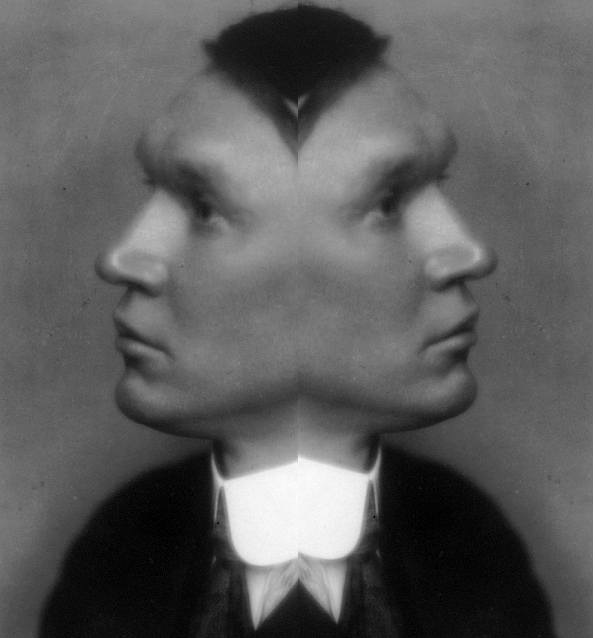
Vachel Lindsay - Janus

“We met ourselves as we came back.” Vachel Lindsay for January

.

What was unusual about Lindsay? This later poem of his wouldn’t look so out-of-place on the page with his contemporaries, but he came to poetry through a long tramp, and several times before WWI he took off as an itinerant on long walking journeys through parts of the United States carrying a sheaf of poems he called “Rhymes To Be Traded For Bread.”   To some degree this romantic notion worked, but his breakthrough occurred when he was noted by Poetry, the Chicago-based magazine of the new literary poets. After that, Lindsay became known for public performances of his poems in a boisterous reading style with the energy of waving arms and a booming sing-song vocal cadence that he unapologetically called “Higher Vaudeville.”*  Some likened his performances to Jazz, but as I’m made a point of noting in other posts here: in the 1920s that didn’t mean “an art music consumed mostly by connoisseurs,” but a raucous and uninhibited sacrilege. Some recordings of Lindsay exist, but I don’t know how he would have read this particular poem. I decided to do a full Rock quartet setting, and I’m banging a tambourine as I performed his words. You can hear that performance of Lindsay’s “Meeting Ourselves”  with the audio player below. No audio player? You don’t need to retrace your tracks, some ways of reading this blog suppress showing the player – but you do want poetry with electric guitar and a guy slapping a tambourine, don’t you? I don’t ask for bread, but you can use this highlighted link which will open a new tab with its own audio player. Want to see the poem on the page or read along? Here’s the link to that.

.

*Lindsay has largely fallen off the literary canon podium, but his hyper-expressive reading style might have traveled via incorporeal and non-literary spirit mode to the more outlandish Slam poets of my lifetime. I’m unaware of any other poets back in the last decade called The Twenties who sought to emulate Lindsay’s controversial style exactly, but live performances of literary poetry, even with music, were not unheard of. Carl Sandburg before he became a published poet, tried to make his living giving lively Chautauqua lectures on the topics of the day, and after his Pulitzer Prize for Chicago Poems, he took to performing folk songs along with his poems at readings. William Butler Yeats, whose poems so sing on the printed page, floated a serious effort to have his poems performed with music, only to receive decidedly mixed reviews for the results. Both of these poets knew Lindsay and had some appreciation for his verse. It might be supposed that by being so outlandish in public, Lindsay allowed them cover for a quieter, but still expressive, poetry performance style.

How about Afro-American poetry performance? In the reverse of his “poems for bread” trade, Lindsay recommended Langston Hughes poetry to others after Hughes, while working as restaurant staff, handed diner Lindsay some of his unpublished verse. Hughes recognized the wider modes of Jazz and Blues ahead of many, and melded it into his poetry. Lindsay’s poetry reading style also referenced extravagant preaching styles, and early Chicago Black Modernist poet Fenton Johnson, a contemporary of Lindsay, put that rhetorical expression into his poetry.

Emerson’s Requiem

In the last hour of 2019 I was sitting on the couch with my son as we exchanged video clips we thought each other should see. I mentioned that Neil Innes had just died, that he was part of the Monty Python circle, and that before Python he had founded a musical group that helped inspire the Pythons called the Bonzo Dog Do-Dah Band.

“I think I’ve heard of the Bonzo Dog Do-Dah Band.”

“Search for ‘Canyons of Your Mind’”  I suggested. Sure enough, the magic of Internet searching brought up a video. “This is the most Sixties song ever” I promised.

Here’s the clip we watched.

Farcical fascicles found  “In the wardrobe of my soul, in the section labeled shirts.”

.

I wasn’t sure if I needed to provide context for it. As the performance shows they’re sending up every bit of performative anguish over absent love as well as the worship of musicians offering it. And the lyrics? They should have mortally wounded a certain kind of Sixties metaphor that was supposed to transcend our mundane world. In the middle of it Neil Innes plays a guitar solo that was likewise a pig cupid’s dart to the heart of every guitar hero moment. Anyone got the tab for that?

Son was not impressed. He had just shown me a Franz Ferdinand video chock-full of early 20th century Dada and Constructivist art moves: Max Ernst, Kurt Schwitters, Alexander Rodchenko visual riffs. In contrast, the Bonzo’s Dada lacked the same danceable drive and sleek black stage dress of the smart and sharp 21st century Glaswegian rock band.

Oh well. I hadn’t seen the Franz Ferdinand videos he showed me and I was glad I saw them. They made me think how we are still working out the Modernist revolution as we enter another decade that will be called “The Twenties.”

Early in the last week, I watched an episode of Apple TV+ Dickinson with my wife. In it Emily was crushing on Benjamin Newton over their mutual admiration for Ralph Waldo Emerson’s poem “Dirge,”  “The one where he’s on a plain with all those ghosts” as TV’s Emily has it.

That made we want to go back and check out Emerson’s “Dirge.”  What might Dickinson have seen in it?

It is 19th century Goth, right full of death and lonely love for the dead. Emerson had suffered at least as much as his early 19th century peers in terms of early deaths in his circle, and his poem is quite similar to a poem Abraham Lincoln wrote around the same time that we’ve featured here. One of Emerson’s charms as an essayist was that his mind might take him anywhere while writing one, and the reader is afterward taken along for the ride. This one-thing-after-another move can also work in poetry, but when Emerson the poet does it, it generally doesn’t work for me. “Dirge”  suffers for that.

Here’s the text of “Dirge”  as Emerson published it. The TV show’s Dickinson latched right onto that arresting image, a rural plain full of ghosts, but Emerson buries the lede, putting another stanza before it. That stanza isn’t entirely bad, indeed its abandoned field with scanty corn could have conceivably informed Dickinson’s “Summer’s empty room” in her later poem we featured this December. I tried performing the poem in its entirety, but it was running nearly 8 minutes (longer than I like to use here) and so I then decided to cut to length by removing those stanzas that were Emersonian digressions. I’m not sure that’s the right way to go, though I think the listener might prefer my more single-threaded version. In some of the excised stanzas, Emerson made the poem’s setting distinctly his Concord hometown; and the mourned, missing folks: his siblings who died young. Specificity also works in poetry, but I’m not sure it strengthens this  poem.

One more thing before I offer you a chance to hear my resulting performance. An 1850s Emily Dickinson would have been reading this kind of gothic romanticism in its moment. The element, performative or not, of contemporary personal emotion in poems was part of the change of 19th century Romanticism. Her models: Emerson, Emily Bronte, Elizabeth Barrett Browning, and others used that mode. Even Whitman made common use of it. Here’s something I find striking: Dickinson generally didn’t. Her poems make little use of sentimentality. She will use emotional words in her poems rather than images meant to invoke feelings in the 20th century Imagist manner, but those emotional terms often seem examined, observed, set to the side.

I asked my son if what put him off the Bonzos was that they were desecrating his musical religion. *

“No, you could have just picked a better one.”

Acoustic guitar and a mix of synthesizer sounds for today’s musical performance of Emerson’s “Dirge.”  The player gadget to hear it is below. Don’t see it? Then this highlighted hyperlink will also play it.

.

*Pedantically one could draw a fairly direct line from the Bonzos to early Roxy Music to “Anarchy in the UK.”  But no more footnotes today! If I’m going to excise Emerson’s digressions, why should I give myself license?

There is Always Time

It’s a new year, and here’s a piece that is not representative of most of what we do here. First off, it’s a piece where I wrote the words, when one of the Parlando Project principles is “Other People’s Stories.” So, the words we use here are normally from others, often originally written as page poems by their authors. The Parlando Project adapts, recasts, and performs these pieces with various combinations of original music. Today’s audio, “There is Always Time”  was conceived as a song to be sung from the start.

It’s been a busy last couple of weeks for me, so my ability to work on new pieces has been slightly curtailed. I’ve had this one done for a month, saved for just such an occasion when I’ve fallen behind in the work that goes into this project—and well, it does seem like a good piece for the day of New Year’s Resolutions.

Woody Guthrie's 1942 NY Resolutions

Woody Guthrie’s 1942 NY Resolutions. He didn’t keep all of them—still glad we had a Woody Guthrie.


“There is Always Time”  is a “carpe diem” song about dreams and desires deferred, so it’s perhaps the precursor to those lists of “shoulds” for the coming year.

Goals and focus are good things. Approximately three years ago I set out on just such a goal, to create and present 100 or so audio pieces combining various words and various music. I needed to learn a bit about how to syndicate these pieces via podcasting as well as how to stream them from a blog. Once I started this, I soon found there was even more to learn, more things that will ask to be needed by the work. Since the Parlando Project was launched in August 2016, we’ve exceeded the original goal, and we now near 170 audio pieces published.

Goals, focus, drive, desire to learn, audacity mixed with humility—all were necessary. However, I think today, as I present this piece, of Karen Horney, the innovative early psychoanalyst, who developed a concept as she looked at personalities and the goals they set. She called it “The Tyranny of the Shoulds.”

Karen Horney

Karen Horney. Beavis and Butthead’s favorite Adlerian psychoanalyst?


Who was the tyrant, the oppressor, who is in this phrase? Parents? Society? Government? Natural Law? Racism, sexism, ageism, gender roles? Well, they all could contribute to the tyrant’s powers, but in her formulation the mad dictator is specifically “The Ideal Self.”

Wait—what? The Ideal Self is what is going to get me out of those old-year patterns, get me doing those things that I need to do. The Ideal Self will make sure I commit to my art. The Ideal Self will fix those things about myself that keep failing. The Ideal Self will make me a better person, a better co-worker, a better partner, a better parent, a better son or daughter, and so on.

What’s wrong with that? Look again at Horney’s formulation: “The Tyranny of the Shoulds.” What if that Ideal Self behaves as a tyrant does? What if instead of being the loving, supportive partner, parent, boss, or teacher that we may or may not have had, the Ideal Self acts as a dictator would: the executions, the inquisitions, the scape-goating, the banishments, the wars of aggression, all waged by the Ideal Self against the poor Real Self, who beaten-down will eventually fail the tyrant or overthrow it.

So yes, seize the day, seize the year. Do more and better art this year. Love your partners and your families and your friends while they are here. Repair the world, slowly and little-by-little if you can be patient and brave. Clean out the closet. Ride your bike more. Learn a new instrument. Read more. But be the loving partner to that struggling Real Self. It knows it’s limitations, it’s failures, it’s shames, but it is only your Real Self that can do these things.

To hear “There is Always Time,”  use the player below. If you like it, go ahead and click the like button, and it’s very helpful if you share the audio pieces or this blog on your own site, or on social media. We’ll be back with more pieces using words by other authors soon.

Ring Out Wild Bells

This guy was once famous. Not just writer-famous, but Beyoncé or Beatles famous. In England, and to a large degree in America, he was the face of, and the center of, Victorian poetry. And poetry in Victorian times, the written-down and printed in books kind, was still a force in mass culture.

tennyson

Once an empire’s most famous poet, now reduced to modeling a Slanket.

The town I grew up in was platted and settled around 1880, its success achieved by the industrious Swedish-American farmers around it and the railroad that went through it. The town was named Stratford, after Shakespeare’s birthplace, and so it was that the town’s main street, with it’s block of stores, was named Shakespeare Avenue. Shakespeare Avenue was met just north of the shops by the town’s central cross street, Tennyson Avenue.

That’s a remarkable piece of trivia isn’t it? Think of how many suburbs and housing developments were similarly planned and platted in the centuries since in the United States. How many of them had main streets named for contemporary poets? Milton and Byron had their streets along with Shakespeare in Strafford, but even Byron was 50 years dead; but here was Tennyson, a man still in his career across half a continent and one ocean away, and here this proud avenue in a farming town was written down to bear his name.

The problem with being a big-thing Victorian, as Tennyson was, is that our Modernists came after them. Came after them in time and eventually, opposition. Even though you can see the influences of the Victorians on the early work of some Modernists, you can also see the things they came to reject in search of an art for their own time. In those scattered small settlements where page poetry is still read or studied, we are now more likely to be reading Hopkins or Hardy for the English, or Dickinson or Whitman for Americans, or hinge figures like Yeats who spanned the eras, than Alfred Lord Tennyson, the once leading poet of his age.

Besides the street in my tiny town, Tennyson lives on in a handful of phrases from his poems that have become commonplace mottos such as “It’s better to have loved and lost, than never to have loved at all”words well-enough known even as their author’s fame and esteem has faded, that many people think they must be Shakespeare’s.

Today’s words come from another section in the same long poem or collection that premiered the “loved and lost” phrase, Tennyson’s broad meditation on loss and perseverance “In Memoriam A.H.H.”  If we’ve forgotten Tennyson, this makes it possible for him to be new again, and this is a piece, as I recast it, that seems very appropriate for our age—even for this year. The New Year’s bells ring in a new year, but they also chase away the devils of the old one.

So, enjoy the music I wrote and recorded for “Ring Out Wild Bells”,  but you may be surprised at how well Tennyson’s sentiments fit as you sing along with them while 2017 ends. The player for the audio piece is right below this for many of you. Don’t see a player? This highlighted hyper link will also play my performance of a new setting for Tennyson’s words.

.