Thoreau’s June

We’ve already heard from Claude McKay and Thomas Wentworth Higginson on the month of June, and now it’s time to turn to one of the foremost spirits of the mid-19th century American Transcendentalist movement, Henry David Thoreau.

Thoreau is well-known for being in the activist, live-the-ideals, wing of Transcendentalism, though readers here have been introduced to Thoreau’s contemporary Thomas Wentworth Higginson—more than a footnote in the Emily Dickinson story—who also spent considerable time living those ideals.
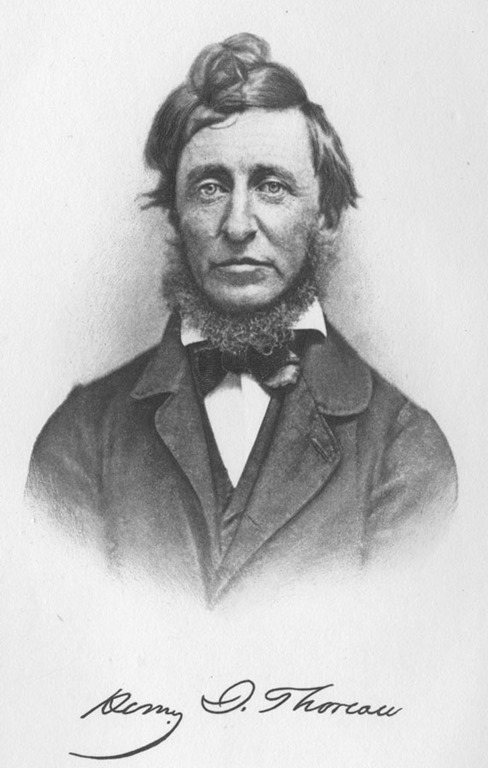
Henry David Thoreau

Collect the series: Unfortunate Hair Stylings of Important Personages


Thoreau and Transcendentalism’s major domo Ralph Waldo Emerson lived in the same town in Massachusetts, and one of the most striking things for me when I first visited that town, Concord, was to think that in a matter of a few blocks there lived Emerson, Thoreau, Hawthorne, Bronson and Louisa May Alcott—all in this place not that much larger than the small farming community I grew up in. What a town that must have been in those years!

Transcendentalism is a little hard to put a finger on exactly as a movement because it was interested in and had change-convictions about so many things. Higginson in his 1899 collection of memoir pieces Cheerful Yesterdays  calls it “The Period of the Newness” and speaks of “The Sisterhood of Reforms.”

My current working-definition of Transcendentalism is it is the belief that there is a primary knowledge to be obtained from the deep study and meditation on the structures and methods of nature, as opposed to the accumulation of received and conventional truths about it. Thoreau the Transcendental activist helped to pioneer this, often writing about his direct experience of nature. His thought process also caused him to develop political ideals, including Civil Disobedience to unjust and violent government actions, famously inspiring Gandhi and Martin Luther King.

Thoreau didn’t just inspire Gandhi and King with his writing. The first story I ever heard of Thoreau recounted the tale of Ralph Waldo Emerson visiting Thoreau who had been jailed for refusing to pay taxes as a protest against the Mexican-American war and its support of slavery.

Henry, what are you doing in there?” Emerson asked across the jail door bars.

“Waldo, the question is, what are you doing out there?” Thoreau replied.

But here’s one lesser known thing about Thoreau, the deep naturalist, writer and political activist: he was also something of an engineer. Between writing and other activities, he was active in his father’s business, a small factory that made pencils. A chief problem at the time was the formulation of the graphite used in the “lead” for these indispensable writing instruments. Thoreau’s father’s pencils, like other American pencils at the time, used a too soft binder that led to a crumbling point and blurry line. Through study of European pencils (and one suspects a little lab time on his part) Henry David Thoreau, Transcendentalist writer, philosopher, and activist figured out a clay formulation to mix with the powdery graphite to produce a much better American pencil. Profits from the sale of these pencils and the underlying technology* were largely what supported Thoreau’s writing career.

Not to make too fine a point of it—and King and Gandhi might have found other inspiration, and Thoreau other funding—but the 20th century Afro-American civil rights movement and the independence of the Indian sub-continent owe something to a thing as prosaic as a better pencil design—monumental things that literally come from a feet of clay.

Today’s piece is a short meditation taken from an entry in Thoreau’s Journals for June 6th 1857. Adding to the above connection, when Thoreau was writing his nature observations in the field, he most likely was doing so using a pencil of his own design. Note too that at one point engineer-Thoreau talks of the revolution of thought connected to the revolution of the natural cycle of seasons as if they are the meshing of a gear train.

Thoreau June 6 1857

Handwriting as bad as mine! The page from Thoreau’s journal containing today’s text.


Written as prose, it has a flow that I could find to recite and accompany it with music. The piece’s chordal part I played on an electric 12-string guitar recorded in the manner Roger McGuinn and the engineers on The Byrds recordings devised in the Sixties. Instead of the John Coltrane-inspired lead 12-string melodic line of something like “Eight Miles High”  I played an acoustic guitar with an E-Bow, a magnetic invention that drives a guitar string to vibrate and produce a flute-like sound. As I read a little about Thoreau this week, I came upon the information that he was also an avid flute player, so it seems appropriate.

The player gadget is below. My apologies for being away from this blog and blog activities so far in June—you know, life and things.


*Here’s more about Thoreau and his pencils. I first heard the story on the radio series “Engines of our Ingenuity”.

Hitch Your Wagon to a Star

As we continue to celebrate National Poetry Month here, I ask your indulgence—today’s piece isn’t based on a poem. Earlier this week I did use a Ralph Waldo Emerson poem, mentioning then that his poetry often fails. Well, there are compensations—as an essayist, Emerson often expresses himself poetically.

Today’s piece is part of an Emerson essay published in The Atlantic in April 1862 called “American Civilization.”  In it Emerson ranges quite a bit, including some racial and regional stereotyping that may shock some modern readers with its ignorance and prejudice. But rather than concentrate on what Emerson got wrong—after all, I don’t need to go to 150-year-old writing to find that sort of thing, our own age will supply all we’ll ever need—I want to present to you some things that Emerson might have gotten right.

I’ve selected a handful of sections from Emerson’s essay for today, the parts of the essay that strike me as if they were a poem. I call my extracted text “Emerson’s Wagon,”  in that one of the phrases it popularized became a pervasive folk-motto: “Hitch your wagon to a star.”

What do you think that means when you hear it today? Most likely you think it means have high ambitions, aim for success not mediocrity, that if you only make it half-way you’ll still get farther than if you’d set your sites lower.*

If so, you may be surprised to hear how Emerson meant that phrase. Indeed, the whole argument Emerson makes in today’s piece is a subtle and surprisingly contemporary one.

Ralph Waldo Emerson at desk

Emerson wondering if his essay will go viral—wait—can something go viral on the telegraph?


“Emerson’s Wagon”  starts by telling a technology story. While he’s speaking about the telegraph, a recent marvel of his time, the metaphor here could just as easily be applied to the Internet on which you are reading this.**  In this metaphor we meet the essay’s first wagon, and it’s, well, stuck and broken down. He points out technology has found a way to get around that.

OK, nice story. Interesting contemporary parallel.

Then mid-19th century Emerson starts considering renewable energy. A couple years back I was talking to someone about that very subject and he mentioned Massachusetts had fewer resources than some other parts of the U.S. for that, which I found ironic, because Emerson’s 19th century Massachusetts was leading the country in exploiting water and tidal energy for industrial power.

Here is Emerson’s second wagon, the first one he hitches to a star. He’s not talking about personal advancement particularly, he’s talking about harnessing nature’s renewable power, and working with it to improve our civilization.

Now his technological story is getting more interesting. How many times have you heard of nature and technology portrayed as opposites? Enough that you may think that technology inevitably destroys nature, or that technology is replacing nature, and so on?

Emerson’s asking you to think of technology (and also nature, as we’ll soon see) differently. Technology comes from close observation of and analysis of the powers of nature. And in concert, the book of nature can tell us something about how to use and deploy technology, and how we should share the bounty of that.

Finally, Emerson goes somewhere you probably won’t expect. His third wagon*** says that moral principles are natural principles (and vice versa). We moderns may have some doubts about this, but it was part of the Transcendentalist ideals that Emerson and his fellows believed. From that equivalence, he says that for American civilization to succeed, for us to fix those broken and stuck in the mud situations like that first wagon, we must align ourselves (if we wish to make change) with the moral principles of a nature that spreads over all and gives benevolently. To do so makes us more powerful agents of change that cannot be defeated in the long run.

An interesting thought for a time of lies and behavior that isn’t pulled forward by the tides of heroic stars, that instead aims at the lower level of personal enrichment defended with the muddy shield of not-quite-legally-indictable.

To hear me perform Emerson’s story of three wagons, use the player below, and electricity will transfer it to you in its invisible pockets. To read all of Emerson’s essay, you can find it here.


*It was a phrase my mother would use, and in this sense too. She raised her large and different family whose members did different things, so maybe it has some value used in this way as well.

**The “invisible pockets” he has the telegraph carrying data in so easily become the “packets” that have flown through TCP/IP routers to bring this post or the accompanying audio file to you. Did you know that some of the savviest conceptual thinking about how the Internet works can be expressed via carrier pigeons?

***As he once more returns to the line “hitch your wagon to a star” Emerson eventually reels off a list of constellations named after heroes. You might be thrown by the first one on his list “Charles’ Wain.” I’d never heard of it. Turns out it’s another name for the Big Dipper. Wain is a Middle English word for, yes, wagon and together Charles’ Wain sort of morphs into the name of legendary king Charlemagne.

There Will Come Soft Rains

A single work of art can inspire and be reformed by others as it lives—or rather, if it lives, as there is no choice in the matter. No work of art once it has escaped its creator lives for one moment more except by this process.

There’s a fair chance that someone coming upon this post via search for its title will believe it’ll be about Ray Bradbury’s work of the same name, and I will touch on that story, but short as Bradbury’s 1950 story is, this project is about the compression, sound, and stepping-order of words, as in poetry; and Bradbury’s story is also not clearly free for us to reuse. But Sara Teasdale’s poem, “There Will Come Soft Rains”  meets all our requirements.

There Will Come Soft Rains - Wood

Ray Bradbury’s story that used Teasdale’s title was adapted by Wally Wood for a Weird Tales comic book. Read the whole thing here.

.

I’ve presented Teasdale’s words here several times, and it’s possible that I could have discovered her work (as I have many others) because of the Parlando Project. But it just so happens, I discovered Teasdale on a Tom Rapp record, long before this project began. Rapp sang Teasdale’s “I Shall Not Care”  in company with a passage of Shakespeare. Yes, as a short-lyric poet, Teasdale can stand up in that kind of company.

I probably need to turn in my SciFi credibility badge, but I don’t recall reading Bradbury’s famous story before today, so I now know Bradbury’s story because of Teasdale’s poem.*  I’m sure this is in reverse of many.

I suspect Bradbury is also the vector by which Teasdale’s poem was included in the Fallout  video-game universe. As with Bradbury’s “Soft Rains,”  Fallout  is set in a midcentury-modern sense of the future, and it’s not hard to fit Teasdale’s 1918 poem into that. Indeed, many read Teasdale’s poem and assume that it’s explicitly post-apocalyptic. However, Teasdale wrote and published this poem near the end of World War I, and the poem’s final sentence conditions itself with a “would,” however definite it is about that natural world’s indifference to mankind’s existence and its wars. She could  only be speaking of the landscapes of the WWI battlefields—settings that still bear the scars of the trenches, tanks, bombs, and burial grounds of that war still a century later. WWI’s depersonalized industrial warfare, aerial bombardment, and chemical weapons did open up some thoughts of wider casualties from modern war, even in a pre-atomic age.

Teasdale’s WWI poem is now read as something of a pioneer in presenting that idea of an apocalyptic post-war future. Several years later, but still pre-World War II, came H. G. Wells Things to Come  a novel and then movie, and Stephen Vincent Benét’s story “By the Waters of Babylon,”  and that later could have been part of the inspirational universe Bradbury drew from for his own story that adds another I to the post World War series.

All these: Teasdale’s poem, and Bradbury’s, Benét’s, and Wells’ prose, explicitly use war’s casualties as the measurement of mankind and his civilization’s impermanent nature. Today we might add our insults on nature itself as another potential cause for self-destruction.

So today, let’s revisit Teasdale’s spring poem of indifferent beauty. It’s short, as is my musical presentation of it. The player to hear it is below. After you click on it, can I remind you, just as briefly, that this project would appreciate more readers and listeners. I’ve focused my energies on researching, creating, and writing about these pieces—and so a great deal of the audience growth over the past few years has come from folks like you passing on the word about this.

*One thing that puzzles me is the explicit days that Bradbury sets his story in, their calendar-ness framing his narrative: August 4th and 5th. Bradbury’s story (set in the year 2026) seems very much based on the particulars of the 1945 atomic bombings of August 6th and 9th that ended WWII, and I see that the dates were subject to some rethought on his part (the original publication had the story begin on April 28th.) Teasdale only set her poem in spring, but in his specificity did Bradbury want to imply some the-last-days-another-choice-could-be-made point in choosing August 4 and 5?

An August Midnight

Today’s episode is something of a companion to our last one, what with moths appearing in each. Emily Dickinson’s sister-in-law Susan Gilbert Dickinson let the Book of Job fly in with her moth, and today Thomas Hardy’s open summer window lets in four bugs.

Our scene: a summer night, window open, a 19th Century lamp letting Hardy literally and literarily burn the midnight oil. The breeze and light brings on the bugs, and beside the moth we get a daddy-longlegs spider, a fly, and a dumbledore. Besides it making his rhyme, I think Hardy must have liked that charming name for his fourth bug, which is either a bumble bee or a beetle, though either will disappoint Harry Potter fans brought here by a search term.

Dumbledore Beetle and DOD Carcosa fuzz pedal

A dumbledore beetle and a DOD Carcosa fuzz pedal. They could be filed under “things you step on.”

What was Hardy writing when the bugs arrived? He doesn’t say, though of course to be meta, it should be this poem now shouldn’t it—but even if it was some other piece, the bugs interrupt it, marching over his just-penned wet ink and drawing his attention away to their antics. Susan Gilbert Dickinson called her moth “silly” and Hardy has his insects more or less performing a Three Stooges skit bumping into the glass of his artificial light.

Susan Gilbert Dickinson wanted to remind us of that harrowing Old Testament lesson that God can crush a human as easily as a bug. She wrote “Irony” and underlined it over the top of her poem’s manuscript. Hardy writes a slightly different conclusion. After watching his fab four beetles make a farce out of replacing the poet on top of his manuscript paper, he ends by declaring that those insects know more about nature than he does. I think that little insect play on his desk reminds him that he, like other poets, struggle to understand and portray nature.

Just as the last time I worked with Thomas Hardy poetry, the melody just flowed out effortlessly when I went to set his words. I quickly had the basic vocal and guitar track, and then added a couple of cello parts and an additional guitar melody that followed what I had so easily fallen into as I sang Hardy’s words.

That electric guitar melody line uses a DOD Carcosa fuzz pedal which I’ve been using a fair amount here lately. It’s a very flexible effects pedal, but I won’t interrupt this with any more guitar nerd material than that tonight. To hear my performance of Thomas Hardy’s “An August Midnight,”  use the player below. Don’t see a player? This highlighted hyperlink another way to play it.

Students Making Audio with the Wordsworths

I do make something of an effort to look for other folks doing something interesting with poetry and music online, and to check out the blogs of folks who’ve commented or otherwise contributed here. I really should be more consistent in doing this, but particularly this month as I’ve attempted to ramp up production of Parlando Project pieces as part of the National Poetry Month celebration, I’ve fallen behind. Come May I’ll have a lot of blog reading to catch up on!

But this one caught my ear just after posting my own attempt at presenting a Wordsworth nature poem. A group of Keswick School students working with Durham University in England have posted a couple of audio pieces connected with William Wordsworth and his sister and collaborator Dorothy Wordsworth’s Lake District observation of nature and the resulting landmark poems. This one has the students speaking about the book of nature and some of Dorothy’s journal entries on the siblings walks. There some nice, spare music added to this one as well.

A second one has an audio piece using spoken word alone to convey William Wordsworth poetry combined with Dorothy’s prose. The blog talks about how the students have noticed new, modern diversions from the contemplation of nature:

As we read over the poems composed by the students, it was fascinating to see how many of them – the majority of the group, in fact – had fixated on the idea of more modern distractions from nature, and in particular, the role of smartphones in quite literally ‘filtering’ nature for us. While William’s poem admonishes its addressee to abandon books and ‘hear the woodland linnet’, the year ten pupils from Keswick School used their poems as a chance to reflect on the need to abandon their phones and enjoy nature in its own right.

I keep asking my middle-school aged son what his generation has decided the rapidly aging Millennials don’t understand and that his generation will have to fix. He looked at me funny when I asked him again this week

. “Is that some kind of Dad joke?”

Perhaps he just doesn’t want to divulge yet his generations secret plans to fix the worst mistakes of those who came before, or maybe he’s still formulating the answer. But one of the time-tested ways to look for answers or better questions is to skip back a few generations and see what someone observed and thought before those now running things made their decisions.

I Wandered Lonely as a Cloud (Daffodils)

It may be U. S. National Poetry Month, but one can’t deny the impact that English poets have had on poetry, particularly before the Modernists launched with significant American participation.

Modernism, as practiced by those early 20th Century Imagists sought to cleanse poetry of the rust and rot of “poetic language” and rote abstract metaphors. Strong, exact words, no more complex or numerous than necessary were to describe things that were actual things, not merely decorative analogies to describe something else. By the 1920s, that American import, T. S. Eliot, became the standard of one large stream of Modernism. Although inspired by this fresh use of language, the Eliot wing of Modernism sought to rid poetry of “romanticism,” defined as a relentlessly subjective expression of personal experience unshaped by a greater historical and cultural understanding. Poetic language might be refreshed, but the cult of the great poem returned, and said that poetry is best to be in service of great themes and elaborate—rather than elegant—structures of thought.

Early Imagist/Modernist poems were about moments. The High Modernism of Eliot allowed it to be about eras. Imagists prized images of things formerly ignored or costumed only in the rhetorical finery in 19th Century poetry. High Modernism still allowed the mundane to stand for sublime thoughts, but it often sought to display a level of knowledge and literary scholarship along with the everyday in its choice of images.

This is why it’s important to look at the early part of artistic movements. Often their best ideas become mutated as the movements develop. Their revolutions become the new orthodoxy.

Today’s piece, “I Wandered Lonely as a Cloud (Daffodils)”  is by English poet William Wordsworth, one of the founders of Romanticism. It’s a poem that can be attached to an exact (April, Poetry Month) date: April 15th, 1802, and to a walk that Wordsworth and his sister took in rural England. But that’s not how the poem was written. Wordsworth wrote it a couple of years later. He referred to his sister’s detailed journal entry about the April walk to refresh his particulars. His wife supplied two critical lines for the final stanza. This was not a spontaneous outburst of subjective personal feeling at all.

Daffodils at Kew Gardens

I couldn’t make it to the Lake District, but even a month ago, daffodils were blooming during an English Spring in Kew Gardens
In a few weeks my lawn will look like this in Minnesota—only dandelions, not daffodils.


When I performed the version you’ll hear below, I made one significant change and one minor one. The minor change? I dropped the adjective golden from his line “A host, of golden daffodils.” I suspect I did this by accident as I performed it. Not to dis Wordsworth (and by the way, Billy, what’s with that obvious pen name “Words-worth” for your poetry gig?) but I think I improved the line when I sung it as “A host, a host of daffodils.” First off, daffodils are a common flower, and they are in the wild always yellow. Strict Imagists would say the golden adjective is therefore unnecessary—and it is, well, a gilding of the lily. I can’t recall my reason for the major change, dropping the next to last stanza—I may have desired to shorten the piece for performance—but it is the weakest stanza in the poem.

The resulting “Daffodils”  I perform wouldn’t have been far from what F. S. Flint or Richard Aldington would have written a century or more later as pioneering Modernists. After all, Wordsworth said that he was trying to cleanse English poetry from special, high-flown, poetic diction too, to return it to “as far as is possible, a selection of the language really spoken by men.”

I do retain something else Wordsworth does here, something I don’t recall the Imagists doing much. “Daffodils”  is presented in a framing device, while the Imagists were all about the presentation of immediacy. Wordsworth doesn’t say merely that looking at all these wildflowers, the temporary exultation of spring, was transfixing—and he says that less with that next-to-last stanza removed. This is not a poem only about letting us see them in their wild, external multitude through his eye on an April walk in nature.

No, the poem starts, deliberately, in past tense. “I wandered lonely as a cloud.” And the poem closes even more removed. The speaker of the poem is not the energetic nature-walker strolling in Spring. In the actual, unknown, later time of the poem, he’s lying on a daybed, vacant or pensive. These daffodils are now only obtainable by the “inward eye” of recollection.

Setting something in the past can be seen as a tactic of sentimentality, something the Modernists distained, but what we have here is worth that risk. How so?

I thought it a delightful little nature poem when I read it as a teenager. Then I read it decades later, as my Eagle Scout father, the angler long accustomed to waiting perpendicular on the flat surface of lakes, the man who had bicycled across his rural state many times—while then, as I re-read, he was further and further confined to lying flat in rooms with the erasing of days. In that later time, noting the wild daffodils bliss is told to us in memory, I reversed Wordsworth’s famous dictum on the origin of poetry. In my reading, in that time, it became a poem, a song, of tranquility recollected in emotion.

Here’s my performance of “Daffodils”  as I sang and accompanied it on acoustic guitar.

Thaw

I like to mix up our musical encounters with poetry here, using both well-known and lesser-known poems. Here’s one you probably haven’t heard before, written by a poet who is less-known in the U.S. than in his native Britain, Edward Thomas.

In 1913, Thomas was 36 years old and was scratching out a living for his family as a freelance writer on whatever topics could generate a check, but his real passion seemed to be as an enthusiastic naturalist. He liked nothing better than to walk about the countryside reading the book of nature, jotting down notes about what he’d seen. Then he met a similar no longer young writer, a 40-year-old American who wanted a career as a poet.

The American had not found his own country in agreement with his vocational desire, and so he had flipped a coin to strike out somewhere else: Canada or England? He knew no one in either place, it was just a hunch that someplace different might change his lot. The coin came up England. He took a cottage in the Cotswolds, near to where Thomas was living. The 40-year-old American poet? Robert Frost.

Over the next couple of years, the two men developed what would be the most significant friendship in their lives. Now Thomas had a companion besides his notebook on those nature walks. Although Frost had published only a handful of poems in periodicals at this point, Thomas saw his talent, a man who could write metrical verse so supple that it didn’t seem like poetic diction. In turn, Frost saw another poet in this self-described “hack writer” with his avocational notebook.

Thomas and Frost

Nearing 40 years old and yet thinking about poetry. Edward Thomas and Robert Frost.


Frost published his first two books of poetry in England, “A Boy’s Will”  and “North of Boston,”  and Thomas reviewed them enthusiastically, helping launch Frost’s literary career. And with Frost’s encouragement, Thomas’ notebook jottings became poems.

In 1915 Frost moved back to the U. S. where publishers would now publish American editions of his poetry. Edward Thomas, and his family, were to follow. The two poets were to live near each other in America and continue their fruitful friendship.

These two men, these two friends, who each could write tremendously concise poems in which a natural drama could play out in but a few lines, had one constitutional difference. Frost was reconciled to chance and fate. He would jump oceans with a coin flip. If lost on a road by a snowy woods on the darkest night of the year—well keep on driving that buggy onward in the dark. Thomas, on the other hand, believed that introspection and judgement, an ever-closer reading of the book of nature could discern the right choice. If two roads diverge (as they would when he and Frost walked the Cotswolds) your honor derives from making the correct choice from the inconsistent evidence.

Back in the USA, Frost wrote his famous, misunderstood, poem about those two paths and sent it to his friend, still tarrying in England, and Thomas became the first person to misunderstand The Road Not Taken.”  No matter how much we honor the author’s intent, the poem exists after it’s creator. Thomas’ outlook saw the undercurrent in the poem, that choice could be important. Thomas thought: if Frost was making gentle fun of that, no matter, that was the point.

Here’s a small, four-line poem that Thomas wrote about spring, “Thaw.” As often with Thomas’ poems “Thaw”  is set on a nature’s large stage, but it’s a very short drama. Winter’s snow, as it is here in Minnesota today, is half-melted. Crows are cawing in tree tops, as the crows I saw today on my morning bike ride to breakfast were too, speaking the inscrutable language of crows. I saw one swoop down and frighten a foraging squirrel on a lawn, the black bird somewhat larger than the squirrel—and then, larger yet to it when the rook spread its wings and hammered out its hard-consonant caw.

The squirrel hopped like something had exploded underneath it and disappeared. These natural decisions could be read if one picks up the book of nature.

In Thomas’ “Thaw,”  the poet has come to understand that the crows know spring is coming, they are nesting already, and their treetop kingdom, unlike the ground beneath the poet’s feet, is snow free. They have read the book of nature more perceptively.

In Frost’s “The Road not Taken”  the comic narrator will sigh “ages and ages hence” about not having read nature right, of having lost the experience the road not taken would have given him. Edward Thomas decided not to move to New England to live next to Frost. Edward Thomas decided, though he was nearing 40 years old, and with a family to leave behind, that honor and his sense of correct decision required that he enlist in World War I, then half-way over. Within a few weeks of arriving at the front, a German artillery shell, following the arc of nature’s laws for men’s unnatural needs, killed him outright.

Thomas had continued writing his nature poems through his boot-camp training, and presumably at the front. He was still seeking to find what it knows that he doesn’t.

You can hear my performance of “Thaw”  using the player below. In the middle section I tried to give the impression with electric guitar of the sounds of a flock of crows.

If you like what we do here, particularly as we celebrate National Poetry Month (#npm2018), you may want to let others know about The Parlando Project on social media or elsewhere.


Wild Swans

Let’s return again to Edna St. Vincent Millay as I start a short series of pieces using words by more well-known poets, each of whom considers the book of nature as played out by birds.

Millay’s “Wild Swans”  may be somewhat overshadowed in the Cygnet Committee by William Butler Yeats’ “The Wild Swans at Coole,”  published only a few years earlier than Millay’s poem. The birds of these poems’ central image, the largest waterfowl, are known for white and graceful beauty while at rest or swimming on the water, which contrasts with their somewhat overburdened flight and strangled hinge-in-need-of-oil song.

Other than their pure color and size, it may be the swan in flight that makes them something of the ornithological model for angels, as for such a large bird to have enough strength and wingspan to fly is practically miraculous.

an_angel_playing_a_flageolet-Burne-Jones

No matter how hard you blow on that horn, not enough wingspread to get airborne


In “Wild Swans”  Millay presents that miracle in flight, but by misdirection or misapprehension. The swans are flying as the poem opens, but Millay is instead looking inward—and furthermore, the poet thinks this introspection is bringing no insight.

Swan taking off

Headlong effort transcends grace


But in this short poem’s second part, the images and insights come anyway. In an apostrophe to her heart, Millay addresses it as a “house without air”—an acute metaphor there for despair—and she now asks for the swans to fly over us again, trailing their ungainly legs, crying unselfconsciously their sad and awkward calls.

Wildness, movement, flight beyond bounds, the miraculous after grace, the next day flying over the weeks, then the months and the years.

This is a surprising poem, it’s titular image, those wild swans, are missing, until they are called for in the last five words; not to be beautiful, but straining to be possible.

To hear my performance of Edna St. Vincent Millay’s “Wild Swans”,  use the player below. And remember I rely greatly on readers/listeners helping spread the word about the combination of various words and music here. Tweeting, linking, including in Facebook posts and on other social media, helps this project reach it’s audience. If you don’t do social media, that’s fine too, the amount of work it takes to do this makes that a practical impossibility for me; but if you like this, hitting the Like button for this post helps keep me going.


A Dust of Snow

Here’s another winter poem by Robert Frost to put to our uses. Writing about my last piece here, Frost’s “Stopping by Woods on a Snowy Evening,”  I wondered about the actualities of the scene the poet was describing: a New England winter road in a dark snowy evening before the coming of rural electrification. Frost would know, of course, that it would be quite dark in those conditions. But did he use that knowledge when he wrote the poem? Did he, the author—like I did as a reader once (despite knowing too the darkness of rural night)—visualize a well-lit snowfall on trees, an alluring and beautiful sight that might tempt him to stay and watch for a while?

I can’t say for sure.

Frost’s “A Dust of Snow” is even shorter, and the accepted meaning of its images has been a settled thing for some time. Last time I wondered if “Stopping by Woods”  was more a poem about a man who was lost in the dark in both levels of meaning rather than a man who was tempted by bright beauty. I could have been wrong, but I think it’s worth considering. With “A Dust of Snow”  certain images have been determined by most academic readers to be, well, symbolic. What if we consider them as real, natural objects and not as handy metaphors?

Robert Frost with axe

Let’s cut down on our use of overdetermined symbols with Robert Frost

We start right off with a crow. “A symbol of death” it is said. Perhaps it doesn’t hurt the poem to think that. I think it’s a crow. A dark bird, darker yet against the snow, and no crow would let the poet that near without a racket of loud caws. The poet doesn’t let us hear the caws though. Instead, like the uncanny sound of sifting snow in “Stopping by Woods,”  Frost wants us to feel just a dusting of snow falling from the branch as the bird flaps off. He wants the main action in the poem to be almost microscopic. He could have written that the bird’s takeoff “dumped a pound of cold slush down my collar”—but that wouldn’t be the poem he wrote. Is the dust a symbol of death too? Or is it an image of a tiny action of little weight? I hold to the later.

Oh, and symbol alert! The tree the bird left is a hemlock tree. Or as the movieReal Genius  reminds us in “the immortal words of Socrates, who said: ‘I drank what?”

How aware was Frost that the American Hemlock is a pine tree and the European poison is a completely different, smaller plant? If this were written by the avid amateur botanist Emily Dickinson, we’d know the poet would know this. Even William Carlos Williams M. D. might have need to know about the derivations of poison. Like the crow being “death” or a bird, “hemlock” could be a reference to death or suicide—but the evergreen is also a symbol of life in winter too, if it must be a symbol. Frankly I think either taken in a one-to-one direct simile way may overdetermine the poem. In the book of nature, having a black bird against white snow causing the small, light amount of snow to fall from an evergreen tree is sufficient.

And this snow falls on the narrator of the poem, and the small sprinkling of snow lifts the rueful mood. I think that’s the essence of the poem: the smallest action of nature, a flighting crystalline snow sprinkle that may not have weighed an ounce, can lift a human out of their dense internal fixations. I think that’s a more graceful poem than the leaden march of death-crows, grave-dust snow and poison trees. I could be wrong, but I like that poem better.

Musically, a much simpler arrangement than last time, just a bass and 12-string guitar. I’m trying to carve out time to prepare for some more recording with the LYL Band tomorrow. Even if we are successful, you won’t hear those pieces for some time, so use the player below to hear “A Dust of Snow.”

Thanks again for the likes, comments, and the sharing of these pieces on your blogs or on social media.

It Is a Small Plant

September 17th is the birthday of the American Modernist poet and physician William Carlos Williams, and today’s piece uses the words from one of his poems “It Is a Small Plant,”  the best known selection from a sequence of poems Williams called “The Flowers of August.”

William_Carlos_Williams_passport_photograph_1921

Just because you have have a passport doesn’t mean you have to move overseas.


Unlike some other American Modernists—including two poets he met and befriended while a student at the University of Pennsylvania, H.D. and Ezra Pound—Williams spent most of his formative writing years in the United States, much of it in his native state of New Jersey where he practiced as a pediatrician. Like his fellow stay-at-home Modernist Carl Sandburg, Williams wrote poems the followed the new Imagist rules, at least at the start, finding them useful in breaking away from the old poetic styles.

One of those Imagist rules, the first one in fact, was “direct treatment of the ‘thing.” That doesn’t mean that you just directly state the message from your heart. Rather, it means that you honor and hone the image(s) that represent your meaning as palpable thing, not as mere poetic decoration for your words. “It Is a Small Plant” demonstrates that by spending nearly the entire poem presenting a description of a flowering plant.

In the series “The Flowers of August,”  each of Williams’ other poems are titled with the name of a particular meadow or pasture flower, but not this one. So, I suspect this is meaningful. The description of the flower here sounds a bit to me like the common bluebell, but it’s possible that he diverged from botany in service of one of the poem’s images, or that the omission of the flower name in the title for this poem made a point for him.

The other, more important, mystery is who the “her” that is inspecting the flower with the poet is, the her who regards the subject flower as “a little plant without leaves.” At first. I wondered if it was perhaps a young girl looking at the flowers, but I now believe that it’s the “her” featured at the poem’s close: summer. If that’s so, that is the reason the flower has no name, as the human name doesn’t exist for nature and for nature’s incarnation as summer. And in the course of the poem, summer then too cannot care about the anthropomorphic desires presented in Williams’ presentation of the image of the flower.

Violet

Unlike William Blake, William Carlos Williams didn’t see Heaven in a wildflower,
but he did see nature observing himself observing the flower.

I’m not a quick understander of poetry. In working on this piece, I read Williams’ poem, enjoying some lines in themselves. The ostensible subject seemed to fit with the season and coincidentally with some other pieces I’m working on—but I wasn’t sure what it meant. In the course of fitting it with music, recording the vocal, and then tweaking and mixing the music, I lived with this poem for a good part of the last couple of days, reading or hearing the words over and over.

If I had been too concerned with its meaning, I might have stuck with my initial supposition, that it was child apprehending the flower. I was pre-disposed to that on first reading, having briefly re-meeting Margot Kreil earlier this week, a poet who wrote an excellent poem called “Weeds”  which featured just such an image. But I was more concerned with getting the drums right, playing the bass, setting up delay divisions for the guitar lines, and marshalling my limited keyboard skills for the soft keyboard parts, and then making that all fit together.

Through you don’t have to go through those composition and production steps, this points out again one of the things that music can do to change the context for words when it’s combined with them. While music can emphasize some mood or presentation of the words, in the same way that suspense music makes a film clip of a character walking down an unremarkable hallway scary, it can also offer its art as a distraction from worrying about meaning too soon with a poem.

To hear my performance of William Carlos Williams’ “It Is a Small Plant,”  use the player below.