We’re coming to the end of my month-long look at a pair of poetry anthologies for children: 1922’s The Girls Book of Verse and the follow-up 1923 Boys Book of Verse. I’ve had a little fun with the decision to make two volumes, asking you to guess which poems the editors chose for each gender. So, before we get to a poem from them and its corresponding musical piece, let me do a quick final summary of how they divvied poetry up by gender audience.
The boys book has four sections: Outdoor Poems, Poems of Peace and War, Story Poems, Songs of Life. The first three are self-explanatory, the fourth consists of poems meant to teach stalwart virtues and honorable life. I’d hoped to include at least one poem from this section to demonstrate that flavor — a leading candidate was William Henley’s “Invictus” — but I maxed out my capacity to produce increased posts this National Poetry Month and it didn’t make the cut.
The girls book has four sections too: Melody, The Pipes of Pan, Enchantment, and Stories. Melody is more-or-less a poetic catchall, with a slight preference for poems explicitly invoking song or music. The Pipes of Pan is the girls version of the boys Outdoor Poems. Stories obviously corresponds to the narrative Story Poems in the other volume. Enchantment? It’s fairy poetry.
So, here’s our divergence: boys get war and stern life-coaching. Girls get fairies.* Most of these are fairy whimsey, only a few touch on anything truly mysterious or an outland** where humans have no dominion.
Today’s piece is made from one of the whimsical fairy poems, written by Rose Fyleman. Fyleman was making book on fairies in the run up to these American children’s verse anthologies. During WWI she submitted a fairy poem to England’s Punch magazine and it was so well liked that a number of books of fairy poems for children authored by Fyleman followed. I know no further details, but two things stand out from this career story: Fyleman was 40, a somewhat late start for a writer, and she was the daughter of an immigrant from Germany, a nation that England was at war with as she was submitting her poetry of the “Oh, nothing — just fairies pretending not to be imaginary” kind. Given the war losses in Britain then, the market for light fantasy might have been a desirable diversion.
A frontpiece from the book-length collection that included today’s poem, Fairies and Chimneys. The illustration is for another poem in Fyleman’s book that starts “The child next door has a wreath on her hat./Her afternoon frock sticks out like that,/ All soft and frilly;/She doesn’t believe in fairies at all /(She told me over the garden wall)—/She thinks they’re silly.”
.
“The Fairies Have Never a Penny to Spend” isn’t “La Belle Dame Sans Merci” or “Tam Lin,” but it is fun, and after the sober Arnold, a darkly satiric Browning, and a month of much work to bring these pieces to you, we can enjoy a little of that. The music is a rock’n’roll trio, so go to the graphical audio player below and bop to the fairy beat. What? The fairies have stolen your graphical audio player? This highlighted link is a backup that will open a new tab with its own player.
.
*Consider this gendered choice in the context of later years when Tolkien and all the extensions of his imagined worlds and demi-humans became a considerable sub-culture among boys and young men. While Fyleman was writing her fairy poetry, Tolkien was stuck in the battle of the Somme.
**There is another Walter De La Mare fairy poem that I planned to perform — and it might still sneak in some following day because it’s too good not to present. And this girls book section included Yeats’ “Faries Song,” a similar case to “Pippa Passes” from a couple of days ago. Both seem innocuous as stand-alone poems, but each was part of a play which provides dread context. You can read about Yeats’ play and hear my performance of the song from it here.
This April I’ve been looking at a pair of volumes of poetry for children published in 1922/23 The Girls and The Boys Book of Verse. One of the things I think about as I read the poems and consider the editor’s selections is what’s ahead for the kids that will read these books. Depending on your age, this is your parents generation, or your grandparents, or even in some cases great-grandparents. Those then-children are highly likely to now be dead, but their grownup results may be in the boundaries of our memory.
Here in a children’s book for them is this dead solemn poem. Its mood, however earnest and perceptive is downbeat. That it was written on the occasion of Matthew Arnold’s honeymoon* makes the poem’s downcast directed look at the sea as the emblem of erosive time and wear even more outlandish. Arnold wrote this in 1851, and I’d assay that the futures for a middle-class English cultural critics and civil servants like Arnold were not extraordinarily dire.
Honeymoon material? Want to discuss Sophocles in the original Greek? Do you think the editors put this poem in the girls or the boys volume of their gendered pair of anthologies? Answer below.
.
What would we say for our Greatest Generation’s future, the kids for whom this poem was selected by the editors? Let me narrow that audience in a bit — acknowledging that there will be dear exceptions — a white middle-class or better audience of American tweens to younger teens would be these books most likely readers. Most of their families will have the means to not make the Great Depression a test of survival. WWII will deeply change four years of their lives, ending some, swerving others. The Cold War years afterward are held in memory as a complex mix of unconnected simplicities — particularly the first two post war decades. When the rich landlord’s son talks about the Great America to be Againing, there’s where he thinks we want to live.
I’m not a young man on a honeymoon, the sea is calm tonight, and I live in this moment in gratitude to be able to exercise my “art or sullen craft.” My mind has learned to question any unalloyed mood, but I’ve written here a few years back that the current young generation may need to be a greater Greatest Generation to face the challenges I read out my window.
Will Arnold’s poem help them. Is that likely for any poetry? I doubt I’m wise enough to say. I will say this, the music in this poem of dread carries it through, a strange energy of words forming into antiphons. Its concluding naming the fears, singing the fears, in the poem’s powerful ending: that world not committed to joy, love, light, certitude, peace, a solace for pain placed amidst a personal choice to closely realize those things.** Is that enough? I don’t know, but I can put it to music.
You can hear my musical performance of Matthew Arnold’s “Dover Beach” with the audio player below. What — has such a player retreated like the Sea of Faith? Draw back and fling your click to this highlighted link which will open a new tab with an audio player for my tremulous cadences.
**Just this month I’ve been reminded again of The Fugs, an anarchic and utterly sex-positive band of poets that should be considered as pioneers alongside The Mothers of Invention and The Velvet Underground instead of being memory-holed by musos for being musically shambolic. The Fugs performed “Dover Beach” by only refraining the final section, and I’d suppose in the depth of The Sixties, just as today, we are ready to sing where ignorant armies are clashing by night. Gender fun-quiz answer: Arnold’s mansplaining honeymoon ode was published in The Girls Book of Verse.
One never knows where strangeness will arise in this Project. Take today’s piece, which I thought was the most routine little poem in a pair of 1920s anthologies of children’s verse I’ve been exploring this National Poetry Month. I wrote down Robert Browning’s “Song from Pippa Passes” as a candidate early in this process. It’s short. It claims in its title to be singable. It contains a well-known line that’s so often repeated we may have forgotten it came from a poem. Those are all good things for a Parlando Project piece. In the context of my planned series, I figured this innocuous poem could stand for the elements of the innocence of childhood portrayed in The Girls andThe Boys Book of Verse.
Here’s the childhood context known and unknown for the editors of these books in 1922. There was much change afoot:
The United States had emerged from a pair of overseas wars — the second, WWI, broader and more deadly.
World maps had been redrawn. Kings deposed and monarchies ended.
American women had just gained the right to vote.
In the arts Modernism was breaking through, music and poetry took on forms that seemed formless.
Children are born into a world they know is new only by definition, but their parents, the ones who’d purchase such books must have sensed these changes. Is this poem a way to rest from all that change?
And then there’s what we know, but the editors would need to be prophets to foretell to those children starting to read or be read to:
The world would soon be plunged into a widespread economic depression.
Totalitarian dictators as cruel as any evil historical monarch would arise with popular backing.
A greater and more widespread world war was to come as these children reached young adulthood.
That great war would end with a fearsome weapon’s deployment and a cold war standoff between two global alliances.
Could they repeat this poem later in a breadline, bomb shelter, or landing craft?
So far this month we’ve learned that the editors would include poems of blood, murder, war, and strife. These weren’t considered off-limits for children. They would almost completely ignore Modernist poetry however (save for our special child prodigy exception). There would be some poems of adventure in the girls volume, but more poems in the realm of imagination, and no notice of women at work (though there’s little about men at work in the boys volume either). The boys volume would have sections of poems on war and battles, and another section devoted to “words to live by” poems of virtue. The girls were not given a similar section of poetic instruction. *
A thorough introduction? It does show that the editors had knowledge there was a context to this short poem. Now read the rest of this post.
.
And Browning’s little poem? Well at least I won’t have to do any research for it. It’s just a poem of Springtime childhood safety and innocence. I think I ran into the poem in schoolbooks in my youth, and it was never explained as anything other than that. Well, I have to write something about it now. Let me check.
OMG, in heaven or otherwise.
Turns out the verse drama the song comes from is a nasty little piece of work. Smutty adultery, political assassination, trickery, dirty deeds done with wills and waifs. I read the first act, the part that includes this well-known poem. It portrays a scene between two adulterous lovers fondling each other and panting about their ardor. We learn this bodice-ripping ceremony celebrates that they’ve just killed off the third-wheel husband. The Pippa in “Pippa Passes” wanders by singing our 8-line ditty, and without an ounce of explanation on the part of Browning, the adulterous man kills the new widow and himself out of guilt for — well, it’s complicated — guilt for being seduced by the hot wife, not thanking the dead husband enough, and maybe a little for the murdering part, though obviously the song has occasioned him being up for some more murdering.
TL:DNR summary: more “Double Indemnity” than “Mr. Rogers.”
My reading? Browning’s intent, however ham-handed, was to draw bitter contrast between humankind’s fallen state and Pippa — a poor, innocent, factory girl, who’s passing by these scenes of mayhem on the only day-off she gets in a year. To give Browning the best I can give him: the total incongruity of this tiny song that ends “God’s in his heaven — all’s right with the world” moving the plot to some new if not exactly benign resolution is Brechtian a century before Brecht.
Now here’s what’s strangest. How the hell did this become a popular short poem all on its own as just a piece about Springtime happiness? What’s the path here? Was there a shortage of happy short spring poems? Did someone misunderstand it and promote it as such? My musical performance is left with just trying to make this set of happiness words seem vaguely strange. I’m writing this in a world with manifest suffering and dutiful cruelty explained by “You don’t understand, we have reasons and rules that prescribe that suffering.” We are slow as snails on that thorn. So, I had help.
The audio player to play my performance of Robert Browning’s “Song from Pippa Passes” is below. No player? This highlighted link will open a tab with its own audio player.
.
*My wife galsplained this: “Girls were supposed to be just naturally good and virtuous.” If you’re wondering why I didn’t prompt you to guess if the poem was from the girls or the boys volume of these poetry anthologies today, this is another one that was in both books.
Today’s piece from the two volumes of The Girls and The Boys Book of Verse pair is by a poet I’ve begun to revisit during the past year, Robert Louis Stevenson. Taken just as verse, Stevenson will impress the ears of adults and children alike as charming, but as I revisit his children’s poetry I’m finding additional resonances. So, let’s look very briefly at his “The Wind” today.
A chord sheet so you can sing this one yourself if you’d like. As you look at Stevenson’s poem here you can also participate by guessing if it was placed in the boys or the girls volume of the pair of 1920’s poetry anthologies I’ve been looking at all month. Answer below.
.
The two things the poem wants to establish about its title subject is the wind’s presence and its mysteriousness. It’s felt as a body pushing force, heard as gentle sound of fabric on grass. But its first-mover, its purpose, the meaning we are to derive from it, is expressed as unknown. The wind here is a symbol of motion. Those easily teleological or mythological might reduce this to a matter of God or gods. That might be Stevenson’s intent, and is likely some reader’s experience.
I prefer to find the poem restricted to what I see on the page, and there I find it as a poem of the growth and going of childhood. Stevenson chimes on that elsewhere in his children’s verse.
Do children feel that, that wind of their growth, or is it so merely there as to be unthought of? I, an old man on a bicycle this Spring, certainly think of it, wind in its expression of gusts. I huff and puff in it, mine a much weaker blowing back!
I’ve said this before but let me reiterate in this month when I’m examining a sample of the literature my parents might have experienced in childhood: a lot of good children’s literature speaks to the adult and the child with the same words, the same images — words heard, images seen, from two sides. I think that’s what Stevenson is doing here. The child will find the familiar feeling reflected on the page sensuously. The adult gets the mystery, the passingness.
In the final five days of this National Poetry Month, I’m going to try to move to completion a number of audio pieces I’ve got in various stages. The posts may come — will have to come if I do this — in rapid succession. I’m grateful for your attention, and I apologize if I will press or exceed it. The music for today’s piece is back to electric folk-rock combo mode: Telecaster guitar, drums and electric bass. You can hear my performance of Robert Louis Stevenson’s “The Wind” with the graphical audio player gadget below. Has that gadget blown away? No, you’re just reading this blog in one of the ways that suppresses showing that. This highlighted link will open a new tab with its own audio player so that you can hear my performance. And your answer to which of the two gendered poetry anthologies this poem appeared in: girls.
I’m continuing with my examination of a pair of 1920s poetry anthologies aimed at children: 1922’s The Girls Book of Verse and the following 1923 The Boys Book of Verse. Since you’re getting so much of me this month, you may welcome a short break from my singing voice today. In its place, you’ll get the voice and guitar of a singer-songwriter from The Sixties: Phil Ochs.
Despite its 18th century setting, Alfred Noyes’ “The Highwayman” wasn’t all that old a poem when the anthologist chose it for one of our pair of books. It was first published in 1906. As I write a bit more about the poem, and give you this link to the full text of it, you may choose to play along with the little game I’ve been suggesting as we look at this set of gendered poetry books: was this poem in the girls or the boys volume? The answer is below.
The poem is a highly romantic though tragic tale of a mysterious but altogether gentlemanly armed robber and his devoted landlord’s-daughter sweetheart. I’m unread in modern romance fiction for young adults, but the general characterization there strikes me as surviving into the present day in such genre novels. I’ll also say that I don’t know how many current young adult novels deal in deaths of the main characters, particularly violent deaths with a strong overtone of chosen death. I knew this poem as a mid-century child, and loved its rush of alliterative language, but I’d suspect that modern American sensibilities might find it’s death-wish problematic for younger readers. “The Highwayman” seems to have retained some general esteem in Great Britain at least through the end of the 20th century when it placed 15th in a 1995 survey of that nation’s favorite poems. One other late 20th century piece of evidence: a favorite singer-songwriter of mine, Richard Thompson, wrote a somewhat analogous death-of-a-romantic-robber narrative into one of his best-loved songs: “1952 Vincent Black Lightning” which was released in 1991 and is an obligatory part of his performances to this day.*
Speaking of death wishes, guitarists who hear Thompson play may be tempted to self-harm.
.
Roughly midway between our anthology of children’s verse and Thompson’s song, American Phil Ochs set Noyes’ poem as a song he’d accompany with only his acoustic guitar. Ochs had made his way to the East Coast scene during the Cold War “Folk Scare” where he made his specialty the topical song. As one of the “sons of Pete Seeger” then, Ochs’ songs often commented on social issues and expressed left-wing viewpoints, and a good case can be made that Ochs was the purest expression of that. Yet, it was just such a summary that eventually would stunt his continuing reputation. His compatriot Bob Dylan could write songs like “Oxford Town” or “Let Me Die in My Footsteps” that overlap with the kind of songs that Ochs was writing at the same time — but alongside his advantages of untouchable charisma, Dylan had a knack for writing more abstract songs with a longer shelf-life, even early on.
Ochs did work on developing other modes of his songwriting. Near the end of his active recording career he demonstrated some achievements there — but The Seventies, that decade that took Americans from Nixon to Reagan, troubled Ochs greatly and made is New Frontier persona seem yesterday’s papers. The endgame of Phil Ochs is as tragic a story as “The Highwayman,” but the details aren’t ballad material, and they are everything but romantic.
But if I step back to 1964, I’d guess that Ochs recording Noyes poem was a way for him to buffer his branding as just a topical lefty songwriter. The rest of the LP it appeared on, “I Ain’t Marching Any More,” otherwise showcases those strengths that would be seen as limitations later.** I remember hearing that record in The Sixties, and I’m sure I filed the tactic it demonstrated — that you could set literary poems to music with only an acoustic guitar — away to later become an influence on this Project.
.
OK, you’ve either heard Ochs sing Noyes or read the poem — maybe both, and it’s time to finalize your guesses: girls or boys book? Today’s answer: boys. I think this shows one marked difference between Noyes’ 1906, the anthologists’ 1923, and even Ochs’ 1964, Are young American boys or teens connected with anything like this level of romantic outlook today? That’s a honest question — I can’t say I’d know — but I suspect the answer is almost never. I can’t assay what’s good or bad about that change, it that’s so, without adding a thousand words to this post. Consider it amongst yourselves.
.
*This is of course a side-point regarding a cracking good song, but has Thompson ever said (or has anyone ever asked) about Noyes’ poem (or Ochs setting of Noyes’ poem) as an inspiration for this song? As a mid-century-born British songwriter, Noyes might have been known to Thompson — and his original UK band’s USP was (at first) performing works by the North American singer-songwriters of Ochs generation.
**Other reasons Ochs might have chosen Noyes’ poem? Noyes was a life-long antiwar man, and in 1940 he even wrote a science fiction book with a prescient trope of a weapon that could — and did in the story — wipe out nearly all humankind, leaving only a handful who were under the surface to survive.
It’s 1914. A single mother is listening to her 4-year-old talk to her imaginary playmate. Has this always happened? Did children in pharaonic Egypt or ancient Ur exercise their fresh language skills and nascent social skills with such fancies while being buckled into their camel child-seats? There was no Mesopotamian Facebook — the only way we’d know this would be if someone wrote it down. No such accounts survive.
This mother was a professor of English at Smith College, associated with artists: visual artists, writers, musicians. She wrote poetry, and I’ve read she knew Robert Frost and Walter De La Mare. She chose, as an artist might do, as a mother might do, to write down some of the things that her child was saying.
At some later point, the daughter was asked if she knew what her mother was doing. “No, she was always scribbling” the daughter replied, she made nothing of it. Eventually, her mother revealed that she was writing down what the child was saying as poetry. What the child invented and spoke — at first to her imaginary friend, and now to her mother — was transcribed by the mother into lines and stanzas. The mother’s name was Grace Conkling, her child/poet was Hilda Conkling.
Short, compressed, Modernist free-verse was becoming a thing in America. Ezra Pound’s first Imagist anthology and Carl Sandburg’s Chicago Poems were published in 1914. Edgar Lee Masters’ The Spoon River Anthology was released on New Years Day in 1915. The child’s mother was savvy enough to know that a few lines with fresh, direct imagery could be a poem even without strict meter or rhyme.
Over the next few years the mother and child produced poetry this way: the child speaking it, the mother writing it down. Some of the poems were sent to magazines by the mother, and they were published.* In 1920, a book-length volume of the poetry, Poems of a Little Girl, was published. It was successful enough that two other Hilda Conkling collections soon followed. Amy Lowell wrote a preface to the first Conkling book. I read this week that Louis Untermeyer called Hilda “the most gifted of all” child geniuses. Rimbaud, dead for 30 years, couldn’t complain. When the editors of our pair of 1922/1923 poetry anthologies for kids made their choices, they included four of Hilda Conkling’s poems, an unusually high number. Only Wordsworth and De La Mare had five selections in the volume that included Conkling — Shakespeare or Robert Louis Stevenson only warranted 3 each.
As I revealed earlier this month, Conkling’s poems are the only Modernist poetry in the Girls and Boys Book of Verse.** That may somewhat account for that level of representation. The first two sentences in that book’s foreword say:
“Because real lovers of poetry know that time and place are of little importance, the poems in this book are brought together with no sense of the period in which they were written. From “The Song of Solomon” to Hilda Conkling’s “Spring Song” they are here because they are beautiful, with a beauty that neither years nor events can change.”
So, Conkling is there to represent the here and now, a representative not only for being the most recently published, but because she still hadn’t reached the age of 12 when those words were written — she wasn’t just content for an audience of boys or girls, she was still a young girl, plausibly a future as much as a present.
Verse for children? I’m children, and a Modernist too!
.
Those who’ve been reading along this month know that since our anthologists decided to produce a gendered pair of books, The Girls Book of Verse and The Boys Book of Verse, I’m asking readers here this National Poetry Month to guess which book included the poem of this little girl. Answer below.
Hilda Conkling is now largely forgotten. When one looks at the published poems today, they still have their charms. When I’ve tired of reading so much derivative and rote late 19th century poetry and those 20th century poets who didn’t even try to “make it new” Conkling’s poems can be refreshingly free of the dead hand of influence or fears of being scored on exacting verse-craft. There are still effective lines in many of them. Unpretentious but striking images pop out. Professor/mother Grace Conkling was adamant that she didn’t edit the poems, that as their process developed she would read the transcribed poems to Hilda and that she would always obey Hilda’s corrections of anything she got wrong. What’s unsaid is how much selection or excision Grace did, what poems never were transcribed as unremarkable or if any lines were never transferred from scribbled notes to manuscript. Young Hilda Conkling wouldn’t be the first artist whose work was magnified by a sharp blue pencil and a shortening scissor wielded by a skilled editor.
As far as anyone knows, Hilda stopped creating poems just as she became a teenager. If there were any later-life discarded drafts from adult revisiting of her childhood inspirations, they are unknown. She lived with her mother Grace until Grace died, and made her living working in bookstores in Boston, two things indicating that Hilda could have continued to connect with literary culture if she’d wanted to. Hilda’s story, her poetry, once held as so remarkable, became a literary curiosity that only attracts folks like me who want to think about art and Modernism thoroughly.****
.
I haven’t read anyone claiming that Hilda wrote her poems because she remembered past lives, because she was an “old soul” — but then or now, that sort of woo thing might have come up. Today, as I was finishing this post, days after completing the musical arrangement I used for her poem “Hills” that you can hear below, I wondered how to explain the musical choices I made for that original music. The music is sorta-kinda South Asian, based slightly on my appreciation for those World Pacific Ravi Shankar LPs that entranced me as a young man and the Indian physicians I worked with in New York in the 70s. Specifically though, it’s more at the cod-raga experiments that many Western folk/rock musicians took to in the 60s. I always liked that stuff, and it’s more approachable with my musicianship than the real thing. Was something asking me to musically express a reincarnation theory?
To hear my musical performance of the 8-year-old Hilda Conkling’s poem “Hills” use the graphical audio player below. No player manifesting? The skepticism of your way of reading this post may be blocking the ectoplasm! Knocking on this highlighted spirit-table link will open a new tab with its own audio player.
.
*Poetry Magazine published Conkling’s poems alongside a great many of the formative Modernist poets. But she also appeared in Good Housekeeping.
**As a fan of early Modernist poetry, I tell myself that I could have easily found a dozen or more suitable Modernist poems published before 1922 to include in their books.
****I think of the work of New York School poet Kenneth Koch, who in the 1970’s started teaching poetry and creative writing to grade school children by reading them Modernist poetry (including poems that our 1920s anthologist overlooked) and then prompting them to create their own poems. A short web search revealed nothing so far, but the brief phenomenon of Hilda Conkling might easily have come up alongside Koch’s teaching ideas.
I have some hopes of finding the energy and audacity to write about a new attempt this year by a contemporary poet to inspire children to write poetry, but only time will tell on that one. Girls or boys book of verse for this poem of genderless camel-hills bearing the world on their backs? Girls.
It’s Poem in Your Pocket Day in the midst of U. S. National Poetry Month. This lily gilding observance aims to integrate poetry more completely with ordinary life. A great way to do that would be to bring poetry and our workdays together, something we rarely do.
For National Poetry Month I have been selecting and performing poems from a pair of poetry anthologies published in the 1920s for children: The Boys and The Girls Book of Verse. There’s little in the two books about ordinary work life. You might explain that as “Well, those books were for kids after all” — but the same could be said about many a poetry collection or anthology, then or now.
Our last piece, a famous poem by Wordsworth, touches on the weariness of work, speaking of the getting and spending part of life. Other than military service, there is little else in these children’s books about working for a living, so today’s piece stands out. “The Coromandel Fishers” sounds, even on the page, like a folk song, a work song, something that might be sung in the tedium and effort of daily labor. It’s author, Sarojini Naidu, published it in a section of her poetry that she called “Folk Songs,” so it really does ask to be sung, which you’ll see below I’ve done.
A reminder of the casual game I’m playing here with this pair of gendered anthologies: was this in the girls or boys book of verse? Answer below.
.
Naidu is little known in America but led a fascinating and significant life. She was born in an India ruled by Great Britain as a colonial possession, was educated in England, and during that education touched bases with literary figures there. William Butler Yeats’ father, an artist, sketched her as a young student, and while a young poet she was called “The Yeats of India.” Despite that start, she more-or-less left poetry for a life of political activism. Upon her return to India she became a key lieutenant of Gandhi, marched and strategized with him, was imprisoned twice by the British for her activism, and after Indian independence served in the new Indian government.
The young Naidu while studying in England as sketched by W. B. Yeats’ father, and during the famous Salt March with Gandhi. Gandhi thought the Salt March would be to arduous for women, Naidu thought otherwise.
.
I happen to have had a few more hours to work on music this past week as my teenager has started their first job. I, an old man, think often about my decades of paid labor. I recall the dailiness — yes, sometimes the weariness — of that. But here’s what I think of more often: the coworkers — A fair feld, ful of folk, fond I there bytwene, of alle manere of men, the mene and the pore, worchyng and wandryng as this world asketh.* I recall the thereness of these, my colleagues for the majority of my life’s waking hours, working in common cause. I’d often have a poem in my pocket in those years, a draft of my own, or a song of another on those days after days. Another thought: not often enough was the poem in my pocket about them, about the world of work we shared. Wordsworth said in his poem I sang last time that “The world is too much with us” — and we poets too often, too completely, stop at that phrase. I tried to outline in response: Wordsworth’s poem is more complex than we think it is, that his poem says everything is out of tune. Naidu’s fishermen, like the political activism she joined after writing this poem, says that we may sing to align us with the world.
Here’s an anecdote I read about Naidu. At the end of her life, she was weary from the wear-and-tear of political administration. Doctors said she must stop at whatever place she found herself, but she was restless, she could not rest. Finally, she asked a nurse to sing to her, and she fell asleep. In that night she died.
A couple unrelated last notes, and then you’ll have the opportunity to hear my performance of the song I made from Sarojini Naidu’s poem. She seems to have been the only person of color to have a poem in the two 1920s children’s anthologies,** and just as Wordsworth’s from last time, her poem of a world that’s with us, late and soon, ends up invoking the god of the sea. The audio player to hear me sing Naidu is below. No player? It’s not washed overboard, some ways of reading this blog hide it, so you can use this link as an alternative.
.
*Autocorrect didn’t have a stroke — can’t you read English? It’s a passage from the medieval poem Piers Plowman:
A fair field full of folk · found I in between,
Of all manner of men · the rich and the poor,
Working and wandering · as the world asketh.
**A fault I wouldn’t expect in any modern anthology for children, there are just too many good choices that are well-known and published now. It wouldn’t have hurt them to include a poem by American Paul Laurence Dunbar, or one of the translations from Chinese or Japanese by Arthur Walley — though the latter were new on the bookshelves at the time. I’ll allow them an excuse on a case near enough to the one for these 1922-1923 anthologies’ almost complete exclusion of Modernist poetry.
Are you taking part in this month’s quiz on which gendered book of verse Naidu’s poem appeared in. It was in The Boys Book of Verse.
This sonnet is one of William Wordsworth’s most well-known short poems. As can be the case with commonly known poems, I can’t remember when I first read or heard it, and so it might seem like it’s always existed, that it’s just there, ordinary in its presence. I’ve been thinking today that the poem’s familiarity hides some strangeness. Let’s look at some of that.
For National Poetry Month this year I’ve been examining poems included in a pair of 1920’s anthologies for children: The Girls and The Boys Book of Verse. Let’s start by examining context for this poem appearing there. This is not a poem of childhood experience.* “The World Is Too Much With Us” starts off speaking in an adult’s voice of the weariness of “getting and spending.” I’d say that inside the pair of anthologies I’ve been looking at this month, this is more intended as a poem a parent would read to their child. Other poems in these books live and report from the world of imagination, a splendid world, which though it may also not be physically “with us” as children, exists in the same way as the thoughts and emotions of the actual world do.
Chords in case you’d like to sing this poem yourself. Another form of participation: As the two 1920s poetry anthologies were gendered, I’m asking my audience to guess if each poem I present this month was in the boys or girls volume. Answer below.
.
Do we ever think of Wordsworth’s opening phrase as odd: “The world is too much with us?” Volumes and volumes of poetry are filled with nature poetry telling, seeing, hearing, approaching tasting or smelling, the world. We expect poetry to give us that world-muchness. We’ll get to nature eventually in the second quatrain — though it may not be the nature we’d expect — but this is an example of a leading phrase that should shock or intrigue us: “What do you mean WW? I’m so busy with my adulthood I hardly see the world beyond nearsighted bills and paycheck!” Perhaps familiarity keeps us from feeling any shock at the opening.
There’s an odd idiom to finish off that first line: “late and soon.” Was this a common phrase in Wordsworth’s time, or is it just a make-rhyme? While its variation “sooner or later” is something that everyone still says, in this exact saying it seems to be making the present moment a wider aperture: saying that recently and in my next future this is the way things are — though it’s also expressing the deadlines that press our getting and spending, all that ASAP and overdue.
In reading poetry I’m immediately attracted by the musical impetus prosody brings to the words, but another part of my mind should (eventually, after the word-music has struck me first) trace the actuality of the images. The poem’s second quatrain brings the nature images, one almost conventional, the following one, extraordinary. This poem is so commonplace with us that we think little of this quatrain. “This sea that bares her bosom to the moon” may be an all-to-conventional readymade now, but Wordsworth wants us to see there an offer of vulnerability; and with the other well-worn trope of the moon’s tides, a sense that we will, even if we are “out of tune,” resonate with the pulls of nature. And then the unusual image: this nature is not a slow, predictable rising of a consonant chord. If we think we remember this poem, do we forget the “winds that will be howling at all hours” that are now enclosed inside the petals of “sleeping flowers.” This is Wordsworth’s Blakean heaven in a wildflower. I cannot say what the poem’s composer’s conscious intent was — but as a deep image, the flowers containing the plant’s reproductive features could illuminate that desire and sexuality are a riveting but unreined nature.**
And within the later specific context of this poem appearing in an anthology that might be bought by parents to read to young children, this remarkable — yet little remarked on — image may speak to the howling winds of parenthood.
So, the world of human commerce is too much with us — but nature too may be too much with us — it may rack us beyond our control. Do we overlook that Wordsworth says for everything we are out of tune, something he writes after a quatrain on the commercial world of work and a quatrain on nature.
The sestet that concludes Wordsworth’s sonnet to my reading is not a grand summation or synthesis, some glorious wish. I read it as saying some rickety, obsolete, altogether false mythology might seem a preferable refuge from this world — its nature and its business. Proteus and Triton there are not the speaker exalting in neo-paganism. They are “outworn,” and a thing that the poem can only see as plausibly not as bad as the elongated moment the poem has presented. In such a fancy — if bound between covers, the imagination of a childhood book of Greek myths that our anthologists might also offer — we could have powers and a way to shape the world that elude the poem. Over on a bookshelf near me is such a book from my wife’s childhood. In childhood, our imaginations, our fancies, are our superpowers. Us obsolete children, outworn, cannot call on those powers and inveigh them with this world.
I hope I brought out some of those inferences with my musical performance in a poem that is perhaps too well-known to be known today. It was rewarding to take out my nylon-string guitar to record it, the kind of guitar I started on in my 20s. You can hear my performance of “The World Is Too Much With Us” with the audio player below. No audio player? Is it inside a sleeping flower? No, some ways of reading this blog hide it. This highlighted link will open a new tab with its own audio player.
The answers to your gender quiz game today. “The World Is Too Much With Us” appears in both the girls and the boys 1920s anthologies. Relax busy adults, no one loses points today. “I Wandered Lonely as a Cloud” is also in both books.
I keep meaning to write some things in general about the two anthologies aimed at children I’m featuring during this U.S. National Poetry Month: “A Girls Book of Verse” (1922) and “A Boys Book of Verse” (1923). NPM implies an American focus in its name — and these 1920s anthologies were published by an American publisher (Frederick A Stokes) with American editors (Mary Gould Davis & Helen Dean Fish) and they remained in print until at least the WWII years.
Long-time readers here will know that I have an affinity for the first quarter of the 20th century as a literary era. It’s the time of Modernism’s emergence and triumph in the arts, and English language literary poetry was transformed largely by a group of Americans: Ezra Pound, Carl Sandburg, Langston Hughes, T. S. Eliot, Robert Frost, H. D., William Carlos Williams, Amy Lowell et al.
How much of this is reflected in our two 1920’s anthologies?
Close to zero, zilch, nada, nothing,
There’s a single poem by Amy Lowell, “A Little Garden,” a metered and rhymed poem that barely reflects her influence on a branch of Imagism, that indispensable early Modernist poetic movement. There is one Modernist with several poems included in the two anthologies — an American not in the above list, one that I’ll reveal later this month — but most of you won’t know that poet’s name.
This is not because the anthologists wanted to include only older poems from before America was in the game. Most of those published postdate America’s Whitman/Dickinson/Longfellow and the “Fireside poets” poetic emergence. Many of the poems are from the young 20th century or the final years of the old century. OK, let’s quantify how many poems by U. S. poets are in this set of English language poetry from just about a century ago.*
I did a quick and dirty count of American’s poems in these two anthologies’ tables of contents. Remember, Americans are making these two books, and while they might have been sold overseas, I suspect American parents, libraries, and children were the intended audience. Are they going to be flying the red, white and blue from the library ramparts? Cheering the home team?
Apologies for the cursory numbers to follow. Even if I’m reasonably knowledgeable about poets of this era, there are a lot of unknown authors in these two books 237 poems. Stopping to search Pamela Tennant, Jean Ingelow, Cecil Roberts, Alice Meynell, and Young E. Allison, and the like would have delayed this post.**
Here’s the rough count: 42 poems with known U.S. authors. 150 written by known non-U. S. authors (almost all British Isles residents). The poems by unknowns (which still included those in the footnote below when I did the tally) counted as 42. Given the over 3-1 breakdown in the knowns, and the revealed makeup of the short sample of the unknowns, I expect the unknowns would break similar to the knowns.
So, there you have it: about a hundred years ago — within our parents’ and grandparents’ childhoods for many readers of this post — they easily could have gotten the idea that poetry was still largely a British thing. I was surprised at this lopsidedness. I’d also say that before reading through the anthologies this year I expected at least a smattering of the Modernists, though I’m not surprised by the overwhelming rhymed/syllabic metric poetry .
And then I remembered how poetry was taught to me as an American student. Modernism was acknowledged, though things seemed to stop at Frost and Yeats. The art started with Chaucer and Beowulf, quickly moved to the Tudor poets, and spend a fair amount of time on the 19th century worthies that were included in these 1920s books.
However de-emphasized poetry may be in today’s America, I doubt we’d see such a disproportionate mix now. But before I end off today, I’ll reiterate what I wrote last time: I’m not that much of a literary nationalist, and so I’ll leave you with two non-American authors from this gendered pair of books of verse for children, two poems that speak of longing for their home nations. Both were written when the poets were no longer living in their birth countries, intensifying their poetic expressions. As I’m doing throughout this series, I’m asking you to guess if the poems appeared in the girls or boys book of verse.
The first is one of the most famous and best-loved poems to appear in the pair of books: William Butler Yeats “The Lake Isle of Innisfree.” I was at a poetry reading here in America this past Thursday night, and not just one, but two of the reading poets said that one of their own poems was inspired by this poem of Yeats. It’s such an Irish poem that it’s printed on the Irish passport. Yet the poem was written in London, by a man whose father had moved his family to England when the poet was only two. I performed this as part of this Project in 2019, and you can hear it here with this audio player — or if you don’t see the player, with this link.
Can you guess if it’s in the girls or boys book?
The second one, is by Robert Browning, who’d eloped off to Italy with his poetic life-partner Elizabeth Barrett Browning. He called his poem “Home Thoughts from Abroad” and I recast it for singing and call my version “In England Now.” My aim in my recasting was to make the dislocation from an ideal England seem less a matter of geography and more a matter of time and change. You can hear that version with the next audio player gadget, or with this link.
Was this floral longing poem in the girls or boys book?***
.
Here at NPM2024 Field the British side has shown up to face the Modernist American 9. The Brits advantages: fine woolens, bats that could also be used in a pizza oven. Americans? Plenty of sharp Latin-American players, closer, more aerodynamic beard trims. Read the post for the score.
.
*In case you’re wondering, I think the only translations from a non-English poet are a pair of William Cullen Bryant translations of Homer, and a KJV Song of Songs excerpt.
**Anyone who knows me, knows that just typing this excuse makes me want to indeed do a web search for at least this quintet. I did. Results: only Allison is an American.
***Yeats’ poem of his bee-loud Mojo Dojo Casa Dream House was the leadoff poem in the “Girls Book of Verse.” Browning’s poem of an April unaware for those who simply live in it was in both the boys and the girls volumes. So, if you’re keeping score, you guessed this second one correctly.
Social media likes controversy, so it’s no surprise that two things have recently mingled there in provocative assertion: poet Mary Oliver and the dread “middlebrow” epithet.* It’s not a long bridge between the two: Oliver’s poems are put forward as all too middlebrow in this charge, and middlebrow is a sign of significant lack of ambition or achievement. I’m not a fan of the term “middlebrow,” for a hierarchy is implied and I don’t care for hierarchies much — but to speak of this I should define middlebrow poetry. A definition that works for me is: poems that remind us of something we already sorta-kinda know, but maybe couldn’t quite put into words. These poems are usually immediately understandable on first reading by a significantly literate reader.
Why’s this bad or lacking? If this is a singular mode it rules out poems that tell us multivalent things, or mysterious things that require more thought to comprehend, thought perhaps taken in stages. It rules out shocking, utterly surprising poems. And such poetry doesn’t feed our playful desire to puzzle-solve with clues we are proud to have acquired.**
My view? I think various modes of poetry (even differing modes of reading the same poem) have diverse values, and I’m more than OK with that. Poetry’s eye should be the insect’s compound eye, containing a hundred, a thousand, ommatidia. And so, if it was up to me, the best cultures wouldn’t be restricted to, or rewarding of, one poetic mode. This may be a visceral thing with me: I get bored with all one type of thing quickly. Building towers of hierarchies might be fun, and illustrative of what one can stably hold long enough to build such a tower, but in the end, the domain one will look out on will have a lot of scenery that isn’t in your tower. In the right mood, I can get pleasure out of looking at the commonplace apprehension poem and a “difficult” avant-garde one — and in the wrong mood on my part, or insufficient achievement in the poet, not a touch of pleasure in either mode. And beyond all this meaning and metaphor, there’s the oldest part of poetry, the part even young children understand, that poetry also has abstract pleasures like music has — poetry is the instrument on which the meaning plays.
A great many of the poems in our pair of 1920s children’s poetry anthologies are as middlebrow as any Mary Oliver poem brought up on charges in this controversy. This shouldn’t surprise us. A modern children’s anthologist looking to duplicate the task of those in the previous decade called The Twenties would, I think, do likewise. Some of those pressures would be commercial: what will sell to parents, libraries, teachers. Some would be practical: these children aren’t yet bored with the lessons of the world — those lessons are new and useful building-blocks for their youthful towers — and maybe a lesson of my old age (and a lesson of Mary Oliver) is that I shouldn’t have been bored with the lessons of the world either.
I think too of what happened as the first childhood readers of these poems in the 1920s progressed into the economic distress of the Great Depression, the rise of nationalist dictators, the Second World War, and the Damoclean Cold War. All through the middle of their lives how much time would they have for poetry that offered them the highbrow pleasure of gnostic meaning, of shocking new combinations and collisions?
The answer is: some would find the time, some went on and made their own verses in those modes — and many others would not. Some kept food on the table, kept bolts tightened on airplanes, tended the sick, kept fuel in NATO tanks facing east. Some had their yet young lives ended sans poetic envoi. Others desired, birthed, and raised my generation.
Highbrow, middlebrow, it is neither sophistication nor no-nonsense populism to forget either part of that cohort.
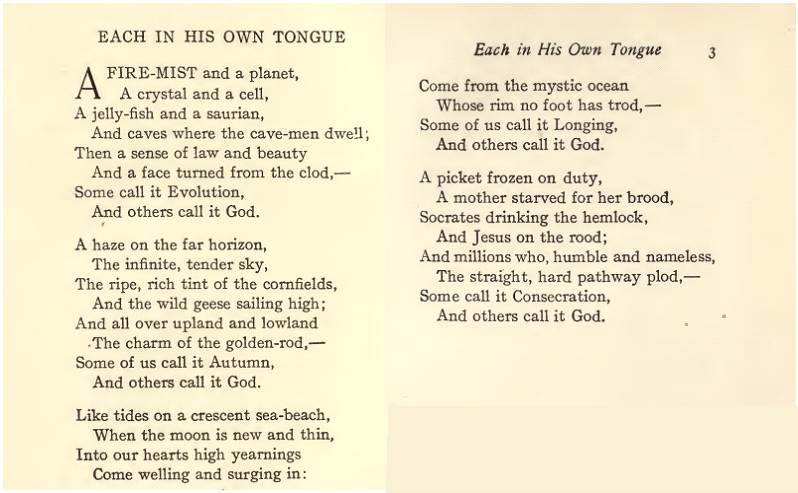
On to today’s poem, an example of a poem that earnestly intends to be a lesson: “Each in His Own Tongue” by William Herbert Carruth. Look! Mary-Oliver-approved wild geese make their appearance in it, decades too early! I also offer this month’s puzzle challenge: the pair of 1920’s anthologies I’m drawing from were gendered: one for boys, one for girls. So as with each post this month, you’re asked to guess in which volume did the poem appear. Answer lower down.
Here’s today’s poem as it appeared as the title poem in a book-length poetry collection by Carruth.. Marginalia picked up in the scan of a copy of that poetry collection. Wonder who Ina Coolbrith is? Here’s a link.
.
The brief Wikipedia stub for Carruth tells me he was “president of the Pacific Coast Conference of the Unitarian Church.” One of my preacher relatives once said of an Unitarian school he’d attended “The only time anyone would speak of ‘God’ is when someone stubbed their toe.” I read this morning a brief poetic knot of a summary of Oliver’s earnest lessons delivered by A. M. Juster who wrote that he’s “Not a big fan or a big detractor of Mary Oliver” but then sums up his impressions of her work by saying “I also think her spirit wanted to write religious poetry, but her mind wouldn’t let her.” Each in their own tongue I’d say, ungendering Carruth. Carruth wrote “His,” and his poem appeared in the Boys Book of Verse. You can hear my musical performance with the audio player gadget below. No gadget to be seen? This highlighted link is a backup which will open a new tab with an audio player.
*This last factor is less-often laid out as I just did, perhaps because it doesn’t seem serious when complex poetry is discussed. But let’s admit it: great portions of humanity loves puzzles and challenges in which they feel rewarded if they can progress farther than some other human.






 Frank Hudson